Persecution Complex

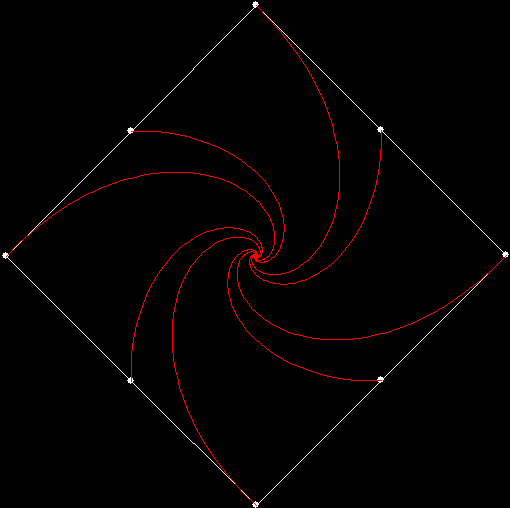
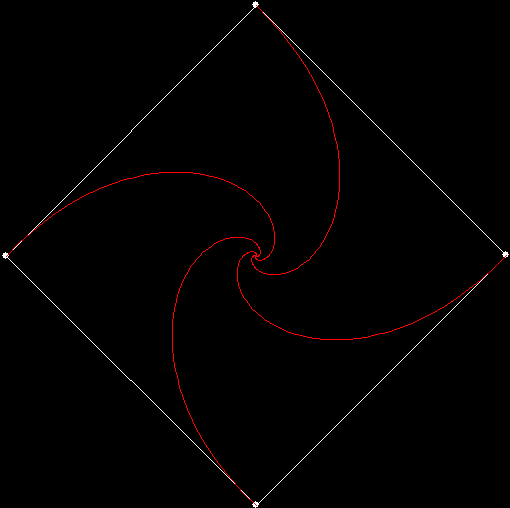
Imagine four mice sitting on the corners of a square. Each mouse begins to run towards its clockwise neighbour. What happens? This:

Four mice chasing each other

Four mice chasing each other


The mice spiral to the centre and meet, creating what are called pursuit curves. Now imagine eight mice on a square, four sitting on the corners, four sitting on the midpoints of the sides. Each mouse begins to run towards its clockwise neighbour. Now what happens? This:

Eight mice chasing each other

Eight mice chasing each other


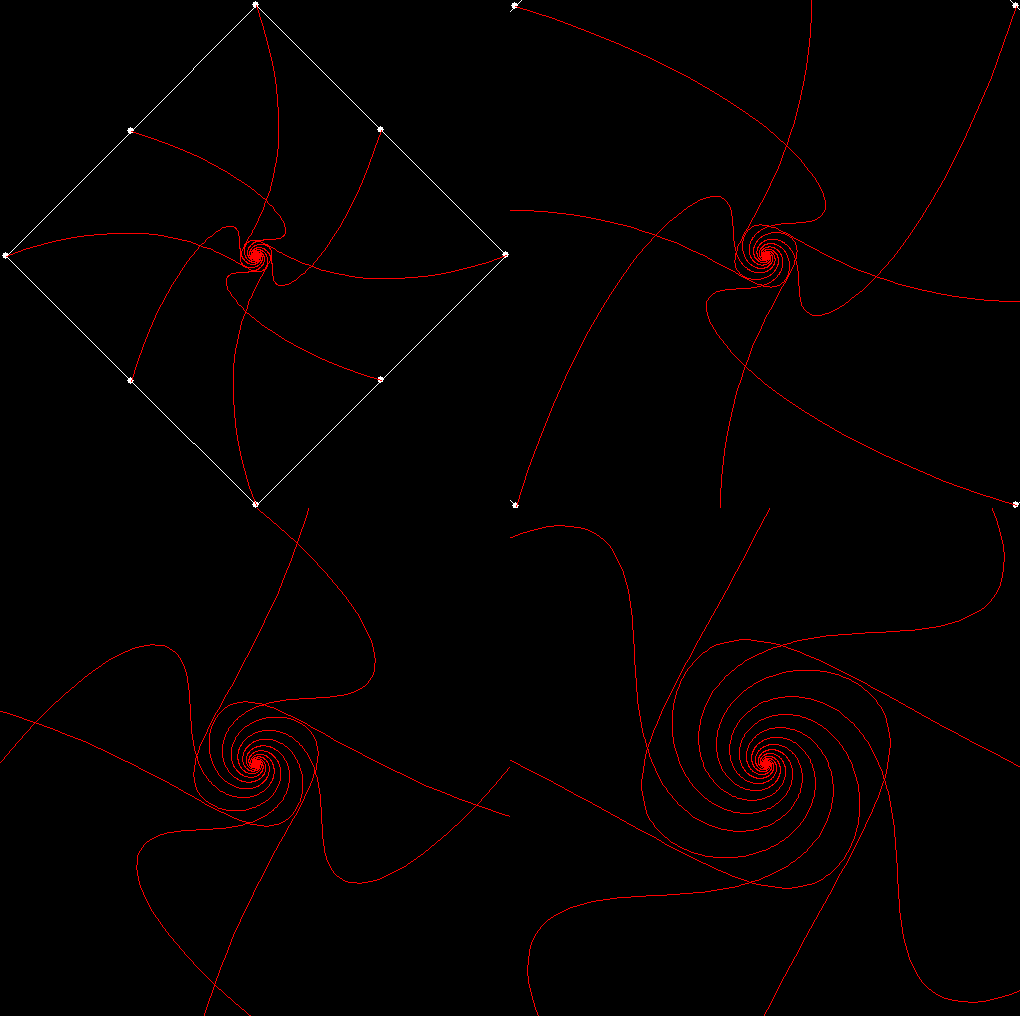
But what happens if each of the eight mice begins to run towards its neighbour-but-one? Or its neighbour-but-two? And so on. The curves begin to get more complex:

square+midpoint+2


(Please open the following image in a new window if it fails to animate.)

square+midpoint+3


You can also make the mice run at different speeds or towards neighbours displaced by different amounts. As these variables change, so do the patterns traced by the mice:

• Continue reading Persecution Complexified

Poulet’s Propeller

The Penguin Dictionary of Curious and Interesting Numbers (1986) is one of my favourite books. It’s a fascinating mixture of math, mathecdote and math-joke:

2·618 0333…

The square of φ, the golden ratio, and the only positive number such that √n = n-1. (pg. 45)


6

Kepler discussed the 6-fold symmetry of snowflakes, and attempted to explain it by considering the close packing of spheres in a hexagonal array. (pg. 69)


39

This appears to be the first uninteresting number, which of course makes it an especially interesting number, because it is the smallest number to have the property of being uninteresting.

It is therefore also the first number to be simultaneously interesting and uninteresting. (pg. 120)

David Wells, who wrote the Dictionary, “had the rare distinction of being a Cambridge scholar in mathematics and failing his degree”. He must be the mathematical equivalent of the astronomer Patrick Moore: a popularizer responsible for opening many minds and inspiring many careers. He’s also written books on geometry and mathematical puzzles. But not everyone appreciates his efforts. This is a sideswipe in a review of William Hartston’s The Book of Numbers:

Thankfully, this book is more concerned with facts than mathematics. Anyone wanting to learn more about [π] or the Fibonacci sequence should turn to the Penguin Dictionary of Curious and Interesting Numbers, a volume which none but propeller-heads will find either curious or interesting. (Review in The Independent, 18th December 1997)


Continue reading: Poulet’s Propeller

Narcissarithmetic #2

It’s easy to find patterns like these in base ten:

81 = (8 + 1)^2 = 9^2 = 81

512 = (5 + 1 + 2)^3 = 8^3 = 512
4913 = (4 + 9 + 1 + 3)^3 = 17^3 = 4913
5832 = (5 + 8 + 3 + 2)^3 = 18^3 = 5832
17576 = (1 + 7 + 5 + 7 + 6)^3 = 26^3 = 17576
19683 = (1 + 9 + 6 + 8 + 3)^3 = 27^3 = 19683

2401 = (2 + 4 + 0 + 1)^4 = 7^4 = 2401
234256 = (2 + 3 + 4 + 2 + 5 + 6)^4 = 22^4 = 234256
390625 = (3 + 9 + 0 + 6 + 2 + 5)^4 = 25^4 = 390625
614656 = (6 + 1 + 4 + 6 + 5 + 6)^4 = 28^4 = 614656
1679616 = (1 + 6 + 7 + 9 + 6 + 1 + 6)^4 = 36^4 = 1679616

17210368 = (1 + 7 + 2 + 1 + 0 + 3 + 6 + 8)^5 = 28^5 = 17210368
52521875 = (5 + 2 + 5 + 2 + 1 + 8 + 7 + 5)^5 = 35^5 = 52521875
60466176 = (6 + 0 + 4 + 6 + 6 + 1 + 7 + 6)^5 = 36^5 = 60466176
205962976 = (2 + 0 + 5 + 9 + 6 + 2 + 9 + 7 + 6)^5 = 46^5 = 205962976

1215766545905692880100000000000000000000 = (1 + 2 + 1 + 5 + 7 + 6 + 6 + 5 + 4 + 5 + 9 + 0 + 5 + 6 + 9 + 2 + 8 + 8 + 0 + 1 + 0 + 0 + 0 + 0 + 0 + 0 + 0 + 0 + 0 + 0 + 0 + 0 + 0 + 0 + 0 + 0 + 0 + 0 + 0 + 0)^20 = 90^20 = 1215766545905692880100000000000000000000

Patterns like this are much rarer:

914457600 = (9 x 1 x 4 x 4 x 5 x 7 x 6)^2 = 30240^2 = 914457600

3657830400 = (3 x 6 x 5 x 7 x 8 x 3 x 4)^2 = 60480^2 = 3657830400

I haven’t found a cube like that in base ten, but base six supplies them:

2212 = (2 x 2 x 1 x 2)^3 = 12^3 = 2212 (b=6) = 8^3 = 512 (b=10)
325000 = (3 x 2 x 5)^3 = 50^3 = 325000 (b=6) = 30^3 = 27000 (b=10)
411412 = (4 x 1 x 1 x 4 x 1 x 2)^3 = 52^3 = 411412 (b=6) = 32^3 = 32768 (b=10)

And base nine supplies a fourth and fifth power:

31400 = (3 x 1 x 4)^4 = 13^4 = 31400 (b=9) = 12^4 = 20736 (b=10)
11600 = (1 x 1 x 6)^5 = 6^5 = 11600 (b=9) = 6^5 = 7776 (b=10)

Then base ten is rich in patterns like these:

81 = (8^1 + 1^1) x (8 + 1) = 9 x 9 = 81

133 = (1^2 + 3^2 + 3^2) x (1 + 3 + 3) = 19 x 7 = 133
315 = (3^2 + 1^2 + 5^2) x (3 + 1 + 5) = 35 x 9 = 315
803 = (8^2 + 0^2 + 3^2) x (8 + 0 + 3) = 73 x 11 = 803
1148 = (1^2 + 1^2 + 4^2 + 8^2) x (1 + 1 + 4 + 8) = 82 x 14 = 1148
1547 = (1^2 + 5^2 + 4^2 + 7^2) x (1 + 5 + 4 + 7) = 91 x 17 = 1547
2196 = (2^2 + 1^2 + 9^2 + 6^2) x (2 + 1 + 9 + 6) = 122 x 18 = 2196

1215 = (1^3 + 2^3 + 1^3 + 5^3) x (1 + 2 + 1 + 5) = 135 x 9 = 1215
3700 = (3^3 + 7^3 + 0^3 + 0^3) x (3 + 7 + 0 + 0) = 370 x 10 = 3700
11680 = (1^3 + 1^3 + 6^3 + 8^3 + 0^3) x (1 + 1 + 6 + 8 + 0) = 730 x 16 = 11680
13608 = (1^3 + 3^3 + 6^3 + 0^3 + 8^3) x (1 + 3 + 6 + 0 + 8) = 756 x 18 = 13608
87949 = (8^3 + 7^3 + 9^3 + 4^3 + 9^3) x (8 + 7 + 9 + 4 + 9) = 2377 x 37 = 87949

182380 = (1^4 + 8^4 + 2^4 + 3^4 + 8^4 + 0^4) x (1 + 8 + 2 + 3 + 8 + 0) = 8290 x 22 = 182380
444992 = (4^4 + 4^4 + 4^4 + 9^4 + 9^4 + 2^4) x (4 + 4 + 4 + 9 + 9 + 2) = 13906 x 32 = 444992

41500 = (4^5 + 1^5 + 5^5 + 0^5 + 0^5) x (4 + 1 + 5 + 0 + 0) = 4150 x 10 = 41500
3508936 = (3^5 + 5^5 + 0^5 + 8^5 + 9^5 + 3^5 + 6^5) x (3 + 5 + 0 + 8 + 9 + 3 + 6) = 103204 x 34 = 3508936
3828816 = (3^5 + 8^5 + 2^5 + 8^5 + 8^5 + 1^5 + 6^5) x (3 + 8 + 2 + 8 + 8 + 1 + 6) = 106356 x 36 = 3828816
4801896 = (4^5 + 8^5 + 0^5 + 1^5 + 8^5 + 9^5 + 6^5) x (4 + 8 + 0 + 1 + 8 + 9 + 6) = 133386 x 36 = 4801896
5659875 = (5^5 + 6^5 + 5^5 + 9^5 + 8^5 + 7^5 + 5^5) x (5 + 6 + 5 + 9 + 8 + 7 + 5) = 125775 x 45 = 5659875


Previously pre-posted (please peruse):

Narcissarithmetic

Narcissarithmetic

Why is 438,579,088 a beautiful number? Simple: it may seem entirely arbitrary, but it’s actually self-empowered:

438,579,088 = 4^4 + 3^3 + 8^8 + 5^5 + 7^7 + 9^9 + 0^0 + 8^8 + 8^8 = 256 + 27 + 16777216 + 3125 + 823543 + 387420489 + 0 + 16777216 + 16777216 (usually 0^0 = 1, but the rule is slightly varied here)

438,579,088 is so beautiful, in fact, that it’s in love with itself as a narcissistic number, or number that can be generated by manipulation of its own digits. 89 = 8^1 + 9^2 = 8 + 81 and 135 = 1^1 + 3^2 + 5^3 = 1 + 9 + 125 are different kinds of narcissistic number. 3435 is self-empowered again:

3435 = 3^3 + 4^4 + 3^3 + 5^5 = 27 + 256 + 27 + 3125

But that’s your lot: there are no more numbers in base-10 that are equal to the sum of their self-empowered digits (apart from the trivial 0 and 1). To prove this, start by considering that there is a limit to the size of a self-empowered number. 9^9 is 387,420,489, which is nine digits long. The function autopower(999,999,999) = 387,420,489 x 9 = 3,486,784,401, which is ten digits long. But autopower(999,999,999,999) = 387,420,489 x 12 = 4,649,045,868, also ten digits long.

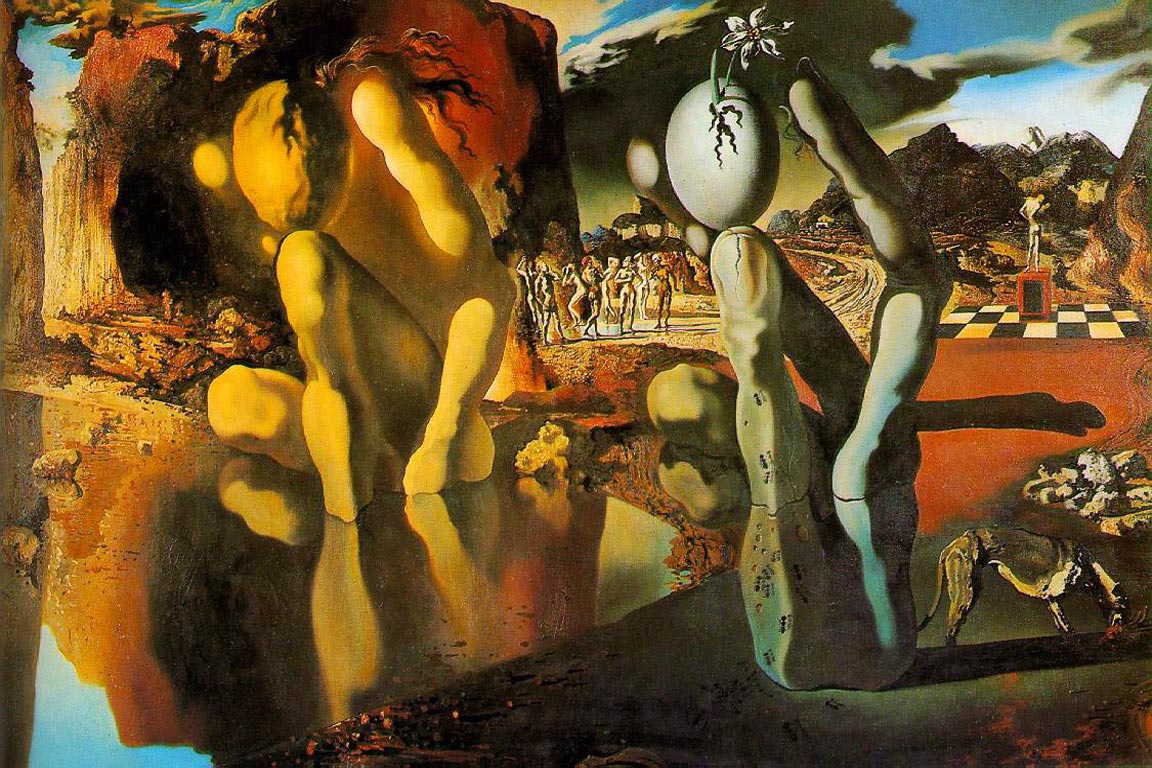
The Metamorphosis of Narcissus by Salvador Dalí

Salvador Dalí, La Metamorfosis de Narciso (1937)

So you don’t need to check numbers above a certain size. There still seem a lot of numbers to check: 438,579,088 is a long way above 3435. However, the search is easy to shorten if you consider that checking 3-3-4-5 is equivalent to checking 3-4-3-5, just as checking 034,578,889 is equivalent to checking 438,579,088. If you self-empower a number and the result has the same digits as the original number, you’ve found what you’re looking for. The order of digits in the original number doesn’t matter, because the result has automatically sorted them for you. The function autopower(3345) produces 3435, therefore 3435 must be self-empowered.

So the rule is simple: Check only the numbers in which any digit is greater than or equal to all digits to its left. In other words, you check 12 and skip 21, check 34 and skip 43, check 567 and skip 576, 657, 675, 756 and 765. That reduces the search-time considerably: discarding numbers is computationally simpler than self-empowering them. It’s also computationally simple to vary the base in which you’re searching. Base-10 produces only two self-empowered numbers, but its neighbours base-9 and base-11 are much more fertile:

30 = 3^3 + 0^0 = 30 + 0 (b=9)
27 = 27 + 0 (b=10)

31 = 3^3 + 1^1 = 30 + 1 (b=9)
28 = 27 + 1 (b=10)

156262 = 1^1 + 5^5 + 6^6 + 2^2 + 6^6 + 2^2 = 1 + 4252 + 71000 + 4 + 71000 + 4 (b=9)
96446 = 1 + 3125 + 46656 + 4 + 46656 + 4 (b=10)

1647063 = 1^1 + 6^6 + 4^4 + 7^7 + 0^0 + 6^6 + 3^3 = 1 + 71000 + 314 + 1484617 + 0 + 71000 + 30 (b=9)
917139 = 1 + 46656 + 256 + 823543 + 0 + 46656 + 27 (b=10)

1656547 = 1^1 + 6^6 + 5^5 + 6^6 + 5^5 + 4^4 + 7^7 = 1 + 71000 + 4252 + 71000 + 4252 + 314 + 1484617 (b=9)
923362 = 1 + 46656 + 3125 + 46656 + 3125 + 256 + 823543 (b=10)

34664084 = 3^3 + 4^4 + 6^6 + 6^6 + 4^4 + 0^0 + 8^8 + 4^4 = 30 + 314 + 71000 + 71000 + 314 + 0 + 34511011 + 314 (b=9)
16871323 = 27 + 256 + 46656 + 46656 + 256 + 0 + 16777216 + 256 (b=10)

66500 = 6^6 + 6^6 + 5^5 + 0^0 + 0^0 = 32065 + 32065 + 2391 + 0 + 0 (b=11)
96437 = 46656 + 46656 + 3125 + 0 + 0 (b=10)

66501 = 6^6 + 6^6 + 5^5 + 0^0 + 1^1 = 32065 + 32065 + 2391 + 0 + 1 (b=11)
96438 = 46656 + 46656 + 3125 + 0 + 1 (b=10)

517503 = 5^5 + 1^1 + 7^7 + 5^5 + 0^0 + 3^3 = 2391 + 1 + 512816 + 2391 + 0 + 25 (b=11)
829821 = 3125 + 1 + 823543 + 3125 + 0 + 27 (b=10)

18453278 = 1^1 + 8^8 + 4^4 + 5^5 + 3^3 + 2^2 + 7^7 + 8^8 = 1 + 9519A75 + 213 + 2391 + 25 + 4 + 512816 + 9519A75 (b=11)
34381388 = 1 + 16777216 + 256 + 3125 + 27 + 4 + 823543 + 16777216 (b=10)

18453487 = 1^1 + 8^8 + 4^4 + 5^5 + 3^3 + 4^4 + 8^8 + 7^7 = 1 + 9519A75 + 213 + 2391 + 25 + 213 + 9519A75 + 512816 (b=11)
34381640 = 1 + 16777216 + 256 + 3125 + 27 + 256 + 16777216 + 823543 (b=10)

It’s easy to extend the concept of self-empowered narcisso-numbers. The prime 71 = 131 in base-7 and the prime 83 = 146 in base-7. If 131[b=7] is empowered to the digits of 146[b=7], you get 146[b=7]; and if 146[b=7] is empowered to the digits of 131[b=7], you get 131[b=7], like this:

71 = 131[b=7] → 1^1 + 3^4 + 1^6 = 1 + 81 + 1 = 83 = 146[b=7]

83 = 146[b=7] → 1^1 + 4^3 + 6^1 = 1 + 64 + 6 = 71 = 131[b=7]

But it’s not easy to find more examples. Are there other-empowering pairs like that in base-10? I don’t know.

In Perms Of

13 is a prime number, divisible only by itself and 1. Perm 13 and you get 31, which is also a prime number. The same is true of 17, 37 and 79. There are only two possible permutations – 2 x 1 – of a two-digit number, so base-10 is terminally permal for two-digit primes:

13, 31
17, 71
37, 73
79, 97

What about three-digit primes? Now there are six possible permutations: 3 x 2 x 1. But base-10 is not terminally permal for three-digit primes. This is the best it does:

149, 419, 491, 941
179, 197, 719, 971
379, 397, 739, 937

Fortunately, we aren’t restricted to base-10. Take a step up and you’ll find that base-11 is terminally permal for three-digit primes (139 in base-11 = 1 x 11^2 + 3 x 11 + 9 = 163 in base-10):

139, 193, 319, 391, 913, 931 (6 primes) (base=11)

163, 223, 383, 463, 1103, 1123 (base=10)

Four-digit primes have twenty-four possible permutations – 4 x 3 x 2 x 1 – and base-10 again falls short:

1237, 1327, 1723, 2137, 2371, 
2713, 2731, 3217, 3271, 7213,
7321 (11 primes)

1279, 1297, 2179, 2719, 2791,
2917, 2971, 7129, 7219, 9127,
9721

For four-digit primes, the most permal base I’ve discovered so far is base-13 (where B represents [11]):

134B, 13B4, 14B3, 1B34, 1B43,
314B, 31B4, 34B1, 3B14, 413B,
41B3, 431B, 43B1, 4B13, 4B31,
B134, B143, B314, B413 (19 primes) (base=13)

2767, 2851, 3019, 4099, 4111,
6823, 6907, 7411, 8467, 9007,
9103, 9319, 9439, 10663, 10687,
24379, 24391, 24691, 24859 (base=10)

Is there a base in which all permutations of some four-digit number are prime? I think so, but I haven’t found it yet. Is there always some base, b, in which all permutations of some d-digit number are prime? Is there an infinity of bases in which all permutations of some d-digit number are prime? Easy to ask, difficult to answer. For me, anyway.

Factory Records

The factors of n are those numbers that divide n without remainder. So the factors of 6 are 1, 2, 3 and 6. If the function s(n) is defined as “the sum of the factors of n, excluding n, then s(6) = 1 + 2 + 3 = 6. This makes 6 a perfect number: its factors re-create it. 28 is another perfect number. The factors of 28 are 1, 2, 4, 7, 14 and 28, so s(28) = 1 + 2 + 4 + 7 + 14 = 28. Other perfect numbers are 496 and 8128. And they’re perfect in any base.

Amicable numbers are amicable in any base too. The factors of an amicable number sum to a second number whose factors sum to the first number. So s(220) = 284, s(284) = 220. That pair may have been known to Pythagoras (c.570-c.495 BC), but s(1184) = 1210, s(1210) = 1184 was discovered by an Italian schoolboy called Nicolò Paganini in 1866. There are also sociable chains, in which s(n), s(s(n)), s(s(s(n))) create a chain of numbers that leads back to n, like this:

12496 → 14288 → 15472 → 14536 → 14264 → 12496 (c=5)

Or this:

14316 → 19116 → 31704 → 47616 → 83328 → 177792 → 295488 → 629072 → 589786 → 294896 → 358336 → 418904 → 366556 → 274924 → 275444 → 243760 → 376736 → 381028 → 285778 → 152990 → 122410 → 97946 → 48976 → 45946 → 22976 → 22744 → 19916 → 17716 → 14316 (c=28)

Those sociable chains were discovered (and christened) in 1918 by the Belgian mathematician Paul Poulet (1887-1946). Other factor-sum patterns are dependant on the base they’re expressed in. For example, s(333) = 161. So both n and s(n) are palindromes in base-10. Here are more examples — the numbers in brackets are the prime factors of n and s(n):

333 (3^2, 37) → 161 (7, 23)
646 (2, 17, 19) → 434 (2, 7, 31)
656 (2^4, 41) → 646 (2, 17, 19)
979 (11, 89) → 101 (prime)
1001 (7, 11, 13) → 343 (7^3)
3553 (11, 17, 19) → 767 (13, 59)
10801 (7, 1543) → 1551 (3, 11, 47)
11111 (41, 271) → 313 (prime)
18581 (17, 1093) → 1111 (11, 101)
31713 (3, 11, 31^2) → 15951 (3, 13, 409)
34943 (83, 421) → 505 (5, 101)
48484 (2^2, 17, 23, 31) → 48284 (2^2, 12071)
57375 (3^3, 5^3, 17) → 54945 (3^3, 5, 11, 37)
95259 (3, 113, 281) → 33333 (3, 41, 271)
99099 (3^2, 7, 11^2, 13) → 94549 (7, 13, 1039)
158851 (7, 11, 2063) → 39293 (prime)
262262 (2, 7, 11, 13, 131) → 269962 (2, 7, 11, 1753)
569965 (5, 11, 43, 241) → 196691 (11, 17881)
1173711 (3, 7, 11, 5081) → 777777 (3, 7^2, 11, 13, 37)

Note how s(656) = 646 and s(646) = 434. There’s an even longer sequence in base-495:

33 → 55 → 77 → 99 → [17][17] → [19][19] → [21][21] → [43][43] → [45][45] → [111][111] → [193][193] → [195][195] → [477][477] (b=495) (c=13)
1488 (2^4, 3, 31) → 2480 (2^4, 5, 31) → 3472 (2^4, 7, 31) → 4464 (2^4, 3^2, 31) → 8432 (2^4, 17, 31) → 9424 (2^4, 19, 31) → 10416 (2^4, 3, 7, 31) → 21328 (2^4, 31, 43) → 22320 (2^4, 3^2, 5, 31) → 55056 (2^4, 3, 31, 37) → 95728 (2^4, 31, 193) → 96720 (2^4, 3, 5, 13, 31) → 236592 (2^4, 3^2, 31, 53)

I also tried looking for n whose s(n) mirrors n. But they’re hard to find in base-10. The first example is this:

498906 (2, 3^3, 9239) → 609894 (2, 3^2, 31, 1093)

498906 mirrors 609894, because the digits of each run in reverse to the digits of the other. Base-9 does better for mirror-sums, clocking up four in the same range of integers:

42 → 24 (base=9)
38 (2, 19) → 22 (2, 11)
402 → 204 (base=9)
326 (2, 163) → 166 (2, 83)
4002 → 2004 (base=9)
2918 (2, 1459) → 1462 (2, 17, 43)
5544 → 4455 (base=9)
4090 (2, 5, 409) → 3290 (2, 5, 7, 47)

Base-11 does better still, clocking up eight in the same range:

42 → 24 (base=11)
46 (2, 23) → 26 (2, 13)
2927 → 7292 (base=11)
3780 (2^2, 3^3, 5, 7) → 9660 (2^2, 3, 5, 7, 23)
4002 → 2004 (base=11)
5326 (2, 2663) → 2666 (2, 31, 43)
13772 → 27731 (base=11)
19560 (2^3, 3, 5, 163) → 39480 (2^3, 3, 5, 7, 47)
4[10]7[10]9 → 9[10]7[10]4 (base=11)
72840 (2^3, 3, 5, 607) → 146040 (2^3, 3, 5, 1217)
6929[10] → [10]9296 (base=11)
100176 (2^4, 3, 2087) → 158736 (2^4, 3, 3307)
171623 → 326171 (base=11)
265620 (2^2, 3, 5, 19, 233) → 520620 (2^2, 3, 5, 8677)
263702 → 207362 (base=11)
414790 (2, 5, 41479) → 331850 (2, 5^2, 6637)

Note that 42 mirrors its factor-sum in both base-9 and base-11. But s(42) = 24 in infinitely many bases, because when 42 = 2 x prime, s(42) = 1 + 2 + prime. So (prime-1) / 2 will give the base in which 24 = s(42). For example, 2 x 11 = 22 and 22 = 42 in base (11-1) / 2 or base-5. So s(42) = 1 + 2 + 11 = 14 = 2 x 5 + 4 = 24[b=5]. There are infinitely many primes, so infinitely many bases in which s(42) = 24.

Base-10 does better for mirror-sums when s(n) is re-defined to include n itself. So s(69) = 1 + 3 + 23 + 69 = 96. Here are the first examples of all-factor mirror-sums in base-10:

69 (3, 23) → 96 (2^5, 3)
276 (2^2, 3, 23) → 672 (2^5, 3, 7)
639 (3^2, 71) → 936 (2^3, 3^2, 13)
2556 (2^2, 3^2, 71) → 6552 (2^3, 3^2, 7, 13)

In the same range, base-9 now produces one mirror-sum, 13 → 31 = 12 (2^2, 3) → 28 (2^2, 7). Base-11 produces no mirror-sums in the same range. Base behaviour is eccentric, but that’s what makes it interesting.

More Multi-Magic

The answer, I’m glad to say, is yes. The question is: Can a prime magic-square nest inside a second prime magic-square that nests inside a third prime magic-square? I asked this in Multi-Magic, where I described how a magic square is a square of numbers where all rows, all columns and both diagonals add to the same number, or magic total. This magic square consists entirely of prime numbers, or numbers divisible only by themselves and 1:

43 | 01 | 67
61 | 37 | 13
07 | 73 | 31

Base = 10, magic total = 111

It nests inside this prime magic-square, whose digit-sums in base-97 re-create it:

0619  =  [06][37] | 0097  =  [01][00] | 1123  =  [11][56]
1117  =  [11][50] | 0613  =  [06][31] | 0109  =  [01][12]
0103  =  [01][06] | 1129  =  [11][62] | 0607  =  [06][25]

Base = 97, magic total = 1839

And that prime magic-square nests inside this one:

2803  =  [1][0618] | 2281  =  [1][0096] | 3307  =  [1][1122]
3301  =  [1][1116] | 2797  =  [1][0612] | 2293  =  [1][0108]
2287  =  [1][0102] | 3313  =  [1][1128] | 2791  =  [1][0606]

Base = 2185, magic total = 8391

I don’t know whether that prime magic-square nests inside a fourth square, but a 3-nest is good for 3×3 magic squares. On the other hand, this famous 3×3 magic square is easy to nest inside an infinite series of other magic squares:

6 | 1 | 8
7 | 5 | 3
2 | 9 | 4

Base = 10, magic total = 15

It’s created by the digit-sums of this square in base-9 (“14 = 15” means that the number 14 is represented as “15” in base-9):

14 = 15 → 6 | 09 = 10 → 1 | 16 = 17 → 8
15 = 16 → 7 | 13 = 14 → 5 | 11 = 12 → 3
10 = 11 → 2 | 17 = 18 → 9 | 12 = 13 → 4

Base = 9, magic total = 39


And that square in base-9 is created by the digit-sums of this square in base-17:

30 = 1[13] → 14 | 25 = 00018 → 09 | 32 = 1[15] → 16
31 = 1[14] → 15 | 29 = 1[12] → 13 | 27 = 1[10] → 11
26 = 00019 → 10 | 33 = 1[16] → 17 | 28 = 1[11] → 12

Base = 17, magic total = 87

And so on:

62 = 1[29] → 30 | 57 = 1[24] → 25 | 64 = 1[31] → 32
63 = 1[30] → 31 | 61 = 1[28] → 29 | 59 = 1[26] → 27
58 = 1[25] → 26 | 65 = 1[32] → 33 | 60 = 1[27] → 28

Base = 33, magic total = 183

126 = 1[61] → 62 | 121 = 1[56] → 57 | 128 = 1[63] → 64
127 = 1[62] → 63 | 125 = 1[60] → 61 | 123 = 1[58] → 59
122 = 1[57] → 58 | 129 = 1[64] → 65 | 124 = 1[59] → 60

Base = 65, magic total = 375

Previously Pre-Posted (please peruse):

Multi-Magic

The Whisper from the Sea

─But what is that whisper?

─Ah. Then ye hear it?

─Aye. ’Tis thin and eerie, mingling with the waves, and seemeth to come from great distance. I know not the language thereof, but I hear great rage therein.

─As well ye might. We stand near the spot at which the wizard Zigan-Uvalen bested a demon sent against him by an enemy. ’Tis the demon’s whisper ye hear.

─Tell me the tale.

─It is after this wise…

Zigan-Uvalen woke to a stench of brimstone, a crackle of flame, and found himself staring up at a fearsome ebon face, lapped in blood-red fire, horned with curling jet, fanged in razor-sharp obsidian.

“Wake, Wizard!” the apparition boomed. “And make thy peace with thy gods, for I am come to devour thee!”

Zigan-Uvalen sat up and pinched himself thrice.

“Without introduction?” he asked, having verified that he was truly awake.

“Introduction?”

“Well, ’tis customary, in the better magickal circles.”

“Aye? Then know this: I am the Demon Ormaguz, summoned from the hottest corner of the deepest pit of Hell by your most puissant and malicious enemy, the wizard Muran-Egah. I have been dispatched by him over many leagues of plain and ocean to wreak his long-meditated, slow-readied, at-last-matured vengeance on thee.”

“Very well. And what are your qualifications?”

“Qualifications?”

“Aye. Are ye worthy of him who sent you, O Demon Ormaguz?”

“Aye, that I am! And will now dev–”

“Nay, nay!” The wizard raised a supplicatory hand. “Take not offence, O Ormaguz. I ask merely out of form. ’Tis customary, in the better magickal circles.”

“Truly?”

“Truly.”

“Then know this… Well, of formal qualifications, diplomas, and the like, I have none, ’tis true. But I am a demon, thou puny mortal. I have supernatural powers of body and mind, far beyond thy ken.”

“I doubt them not. At least, I doubt not your powers of body, in that ye have travelled so very far and very fast this very night. Or so ye say. But powers of mind? Of what do they consist?”

“Of aught thou carest to name, O Wizard.”

“Then ye have, for instance, much mathematical skill?”

“Far beyond thy ken.”

“How far?”

“Infinitely far, wizard!”

“Infinitely? Then could ye, for instance, choose a number at hazard from the whole and endless series of the integers?”

“Aye, that I could!”

“Entirely at hazard, as though ye rolled a die of infinite sides?”

“Aye! In less than the blink of an eye!”

“Well, so ye say.”

“So I say? Aye, so I say, and say sooth!”

“Take not offence, O Demon, but appearances are against you.”

“Against me?”

“Ye are a demon, after all, unbound by man’s pusillanimous morality.”

“I speak sooth, I tell thee! I could, in an instant, choose a number, entirely at hazard, from the whole and endless series of the integers.”

“And speak it to me?”

“Ha! So that is thy game, wizard! Thou seekest to occupy me with some prodigious number whilst thou makest thy escape.”

“Nay, nay, ye misjudge me, O Demon. Let me suggest this. If ye can, as ye say, choose such a number, then do so and recite its digits to me after the following wise: in the first second, name a single digit – nay, nay, O Demon, hear me out, I pray! Aye, in the first second, name a single digit thereof; in the second second, name four digits, which is to say, two raised to the second power; in the third second, name a number of digits I, as a mere mortal, cannot describe to you, for ’tis equal to three raised to the third power of three.”

“That would be 7,625,597,484,987 digits named in the third second, O Wizard.”

“Ah, most impressive! And your tongue would not falter to enunciate them?”

“Nay, not at all! Did I not tell thee my powers are supernatural?”

“That ye did, O Demon. And in the fourth second, of course, ye would name a number of digits equal to four raised to four to the fourth power of four. And so proceed till the number is exhausted. Does this seem well to you?”

“Aye, very well. Thou wilt have the satisfaction of knowing that ’tis an honest demon who devoureth thee.”

“That I will. Then, O Ormaguz, prove your honesty. Choose your number and recite it to me, after the wise I described to you. Then devour me at your leisure.”

─Then the Demon chose a number at hazard from the whole and endless series of the integers and began to recite it after the wise Zigan-Uvalen had described. That was eighteen centuries ago. The demon reciteth the number yet. That is the whisper ye hear from the sea, which rose long ago above the tomb of Zigan-Uvalen.

Multi-Magic

A magic square is a square of numbers in which all rows, all columns and both diagonals add to the same number, or magic total. The simplest magic square using distinct numbers is this:

6 1 8
7 5 3
2 9 4

It’s easy to prove that the magic total of a 3×3 magic square must be three times the central number. Accordingly, if the central number is 37, the magic total must be 111. There are lots of ways to create a magic square with 37 at its heart, but this is my favourite:

43 | 01 | 67
61 | 37 | 13
07 | 73 | 31

The square is special because all the numbers are prime, or divisible by only themselves and 1 (though 1 itself is not usually defined as prime in modern mathematics). I like the 37-square even more now that I’ve discovered it can be found inside another all-prime magic square:

0619 = 0006[37] | 0097 = 00000010 | 1123 = [11][56]
1117 = [11][50] | 0613 = 0006[31] | 0109 = 0001[12]
0103 = 00000016 | 1129 = [11][62] | 0607 = 0006[25]

Magic total = 1839

The square is shown in both base-10 and base-97. If the digit-sums of the base-97 square are calculated, this is the result (e.g., the digit-sum of 6[37][b=97] = 6 + 37 = 43):

43 | 01 | 67
61 | 37 | 13
07 | 73 | 31

This makes me wonder whether the 613-square might nest in another all-prime square, and so on, perhaps ad infinitum [Update: yes, the 613-square is a nestling]. There are certainly many nested all-prime squares. Here is square-631 in base-187:

661 = 003[100] | 379 = 00000025 | 853 = 004[105]
823 = 004[075] | 631 = 003[070] | 439 = 002[065]
409 = 002[035] | 883 = 004[135] | 601 = 003[040]

Magic total = 1893

Digit-sums:

103 | 007 | 109
079 | 073 | 067
037 | 139 | 043

Magic total = 219

There are also all-prime magic squares that have two kinds of nestlings inside them: digit-sum magic squares and digit-product magic squares. The digit-product of a number is calculated by multiplying its digits (except 0): digit-product(37) = 3 x 7 = 21, digit-product(103) = 1 x 3 = 3, and so on. In base-331, this all-prime magic square yields both a digit-sum square and a digit-product square:

503 = 1[172] | 359 = 1[028] | 521 = 1[190]
479 = 1[148] | 461 = 1[130] | 443 = 1[112]
401 = 1[070] | 563 = 1[232] | 419 = 1[088]

Magic total = 1383

Digit-sums:

173 | 029 | 191
149 | 131 | 113
071 | 233 | 089

Magic total = 393

Digit-products:

172 | 028 | 190
148 | 130 | 112
070 | 232 | 088

Magic total = 390

Here are two more twin-bearing all-prime magic squares:

Square-719 in base-451:

761 = 1[310] | 557 = 1[106] | 839 = 1[388]
797 = 1[346] | 719 = 1[268] | 641 = 1[190]
599 = 1[148] | 881 = 1[430] | 677 = 1[226]

Magic total = 2157

Digit-sums:

311 | 107 | 389
347 | 269 | 191
149 | 431 | 227

Magic total = 807

Digit-products:

310 | 106 | 388
346 | 268 | 190
148 | 430 | 226

Magic total = 804

Square-853 in base-344:

883 = 2[195] | 709 = 2[021] | 967 = 2[279]
937 = 2[249] | 853 = 2[165] | 769 = 2[081]
739 = 2[051] | 997 = 2[309] | 823 = 2[135]

Magic total = 2559

Digit-sums:

197 | 023 | 281
251 | 167 | 083
053 | 311 | 137

Magic total = 501

Digit-products:

390 | 042 | 558
498 | 330 | 162
102 | 618 | 270

Magic total = 990

Proviously Post-Posted (please peruse):

More Multi-Magic