Numbered Days

Numbered Days: Literature, Mathematics and the Deus Ex Machina

Think French. Think genius. Think rebellious, tormented, iconoclastic. Finally, think dead tragically young in the nineteenth century… And if you’re thinking of anyone at all, I think you’ll be thinking of Rimbaud.

And you’d be right to do so. But only half-right. Because there were in fact two rebellious, tormented, iconoclastic French geniuses who died tragically young in the nineteenth century. One was called Arthur Rimbaud (1854-91) and the other Évariste Galois (1811-32). Rimbaud is still famous, Galois never has been. At least not to the general educated public, though on all objective criteria – but one – you might expect his fame to be greater. In every way – but one – Galois has the more powerful appeal.

Continue reading Numbered Days

Pest Test

Health warning: I am not a mathematician. That said, here is a mathematical question:

Suppose there is a 99% accurate test for a medical condition – say a symptomless infection. You take the test and get a positive result. What are your chances of having the infection?

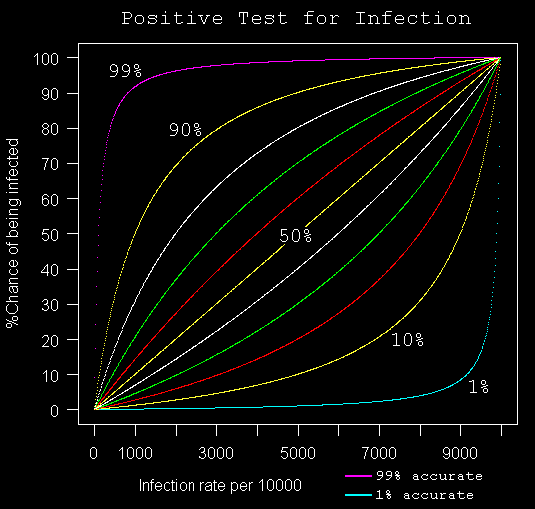
That obvious answer might seem to be 99%. But the obvious answer is wrong. The accuracy of the test is only half the information you need to answer the question. You also need to know how common the infection is. Say it occurs once in every hundred people. On average, then, if you test a hundred people, one of whom has the infection, you will get two positive results: one that is accurate and one that is inaccurate, i.e., a false positive. Under those circumstances, a positive result means that you have a ½, or 50%, chance of having the infection (see appendix for further discussion). Under some other circumstances, a positive result on an 80% or 90% accurate test would mean that you have a higher chance of having the infection. Here’s a graphic to illustrate this apparent paradox:

Graph illustrating confidence rates for medical tests of various accuracy

The x-axis represents infection rate per 10,000 of the population, the y-axis represents one’s chance of being infected, from 0%, for no chance, to 100%, for complete certainty. The coloured curves represent tests of different accuracy: 1% accurate, for the bottom curve, and 99% accurate, for the uppermost curve. The curves between the two represent tests of 10% to 90% accuracy. Note how the curves mirror each other: the 99% accurate test rises towards certainty very quickly, but takes a long time to finally get there. The 1% accurate test stays near complete uncertainty for a long time, then finally rises rapidly towards certainty. In other words, a positive result on a 99% accurate test is equivalent to a negative result on a 1% accurate test, and vice versa. Ditto for the 90% and 10% accurate tests, and so on. But a positive (or negative) result on a 50% accurate test is useless, because it never tells you anything new: your chance of being infected, given a positive result, is the same as the rate of infection in the population. And when exactly half the population is infected, your chance of being infected, given a positive result, is the same as the accuracy of the test, whether it’s 1%, 50%, or 99%.

Here is a table illustrating the same points:

Accuracy of test →


Infection rate ↓

1% 10% 20% 30% 40% 50% 60% 70% 80% 90% 99%
1/100 <1% 0.1% 0.3% 0.4% 0.7% 1% 1.5% 2.3% 3.9% 8.3% 50%
10/100 0.1% 1.2% 2.7% 4.5% 6.9% 10% 14.3% 20.6% 30.8% 50% 91.7%
20/100 0.3% 2.7% 5.9% 9.7% 14.3% 20% 27.3% 36.8% 50% 69.2% 96.1%
30/100 0.4% 4.5% 9.7% 15.5% 22.2% 30% 39.1% 50% 63.2% 79.4% 97.7%
40/100 0.7% 6.9% 14.3% 22.2% 30.8% 40% 50% 60.9% 72.7% 85.7% 98.5%
50/100 1% 10% 20% 30% 40% 50% 60% 70% 80% 90% 99%
60/100 1.5% 14.3% 27.3% 39.1% 50% 60% 69.2% 77.8% 85.7% 93.1% 99.3%
70/100 2.3% 20.6% 36.8% 50% 60.9% 70% 77.8% 84.5% 90.3% 95.5% 99.6%
80/100 3.9% 30.8% 50% 63.2% 72.7% 80% 85.7% 90.3% 94.1% 97.3% 99.7%
90/100 8.3% 50% 69.2% 79.4% 85.7% 90% 93.1% 95.5% 97.3% 98.8% 99.9%
99/100 50% 91.7% 96.1% 97.7% 98.5% 99% 99.3% 99.6% 99.7% 99.9% >99.9%
100/100 100% 100% 100% 100% 100% 100% 100% 100% 100% 100% 100%

Appendix

We’ve seen that we have to take false positives into account, but what about false negatives? Suppose that the rate of infection is 1 in 100 and the accuracy of the test is 99%. If the population is 10,000, then 100 people will have the disease and 9,900 will not. If the population is tested, on average 100 x 99% = 99 of the infected people will get an accurate positive result and 100 x 1% = 1 will get an inaccurate negative result, i.e., a false negative. Similarly, 9,900 x 1% = 99 of the non-infected people will get a false positive. So there will be 99 + 99 = 198 positive results, of which 99 are accurate. 99/198 = 1/2 = 50%.

Yew and Me

The Pocket Guide to The Trees of Britain and Northern Europe, Alan Mitchell, illustrated by David More (1990)

Leafing through this book after I first bought it, I suddenly grabbed at it, because I thought one of the illustrations was real and that a leaf was about to slide off the page and drop to the floor. It was an easy mistake to make, because David More is a good artist. That isn’t surprising: good artists are often attracted to trees. I think it’s a mathemattraction. Trees are one of the clearest and commonest examples of natural fractals, or shapes that mirror themselves on smaller and smaller scales. In trees, trunks divide into branches into branchlets into twigs into twiglets, where the leaves, well distributed in space, wait to eat the sun.

When deciduous, or leaf-dropping, trees go hungry during the winter, this fractal structure is laid bare. And when you look at a bare tree, you’re looking at yourself, because humans are fractals too. Our torsos sprout arms sprout hands sprout fingers. Our veins become veinlets become capillaries. Ditto our lungs and nervous systems. We start big and get small, mirroring ourselves on smaller and smaller scales. Fractals make maximum and most efficient use of space and what’s found in me or thee is also found in a tree, both above and below ground. The roots of a tree are also fractals. But one big difference between trees and people is that trees are much freer to vary their general shape. Trees aren’t mirror-symmetrical like animals and that’s another thing that attracts human eyes and human artists. Each tree is unique, shaped by the chance of its seeding and setting, though each species has its characteristic silhouette. David More occasionally shows that bare winter silhouette, but usually draws the trees in full leaf, disposed to eat the sun. Trees can also be identified by their leaves alone and leaves too are fractals. The veins of a leaf divide and sub-divide, carrying the raw materials and the finished products of photosynthesis to and from the trunk and roots. Trees are giants that work on a microscopic scale, manufacturing themselves from photons and molecules of water and carbon dioxide.

We eat or sculpt what they manufacture, as Alan Mitchell describes in the text of this book:

The name “Walnut” comes from the Anglo-Saxon for “foreign nut” and was in use before the Norman Conquest, probably dating from Roman times. It may refer to the fruit rather than the tree but the Common Walnut, Juglans regia, has been grown in Britain for a very long time. The Romans associated their god Jupiter (Jove) with this tree, hence the Latin name juglans, “Jove’s acorn (glans) or nut”… The wood [of Black Walnut, Juglans nigra] is like that of Common Walnut and both are unsurpassed for use as gunstocks because, once seasoned and worked, neither moves at all and they withstand shock particularly well. They are also valued in furniture for their good colour and their ability to take a high polish. (entry for “Walnuts”, pg. 18)

That’s from the first and longer section, devoted to “Broadleaved Trees and Palms”; in the second section, “Conifers”, devoted to pines and their relatives, maths appears in a new form. Pine-cones embody the Fibonacci sequence, one of the most famous of all number sequences or series. Start with 1 and 1, then add the pair and go on adding pairs: 1, 1, 2, 3, 5, 8, 13, 21, 34, 55, 89, 144… That’s the Fibonacci sequence, named after the Italian mathematician Leonardo Fibonacci (c.1170-c.1245). And if you examine the two spirals created by the scales of a pine-cone, clockwise and counter-clockwise, you’ll find that there are, say, five spirals in one direction and eight in another, or eight and thirteen. The scales of a pineapple and petals of many flowers behave in a similar way. These patterns aren’t fractals like branches and leaves, but they’re also about distributing living matter efficiently through space. Mitchell doesn’t discuss any of this mathematics, but it’s there implicitly in the illustrations and underlies his text. Even the toxicity of the yew is ultimately mathematical, because the effect of toxins is determined by their chemical shape and its interaction with the chemicals in our bodies. Micro-geometry can be noxious. Or nourishing:

The Yews are a group of conifers, much more primitive than those which bear cones. Each berry-like fruit has a single large seed, partially enclosed in a succulent red aril which grows up around it. The seed is, like the foliage, very poisonous to people and many animals, but deer and rabbits eat the leaves without harm. Yew has extremely strong and durable wood [and the] Common Yew, Taxus baccata, is nearly immortal, resistant to almost every pest and disease of importance, and immune to stress from exposure, drought and cold. It is by a long way the longest-living tree we have and many in country churchyards are certainly much older than the churches, often thousands of years old. Since the yews pre-date the churches, the sites may have been holy sites and the yews sacred trees, possibly symbols of immortality, under which the Elders met. (entry for “Yews”, pg. 92)

This isn’t a big book, but there’s a lot to look at and read. I’d like a doubtful etymology to be true: some say “book” is related to “beech”, because beech-bark or beech-leaves were used for writing on. Bark is another way of identifying a tree and another aspect of their dendro-mathematics, in its texture, colours and patterns. But trees can please the ear as well as the eye: the dendrophile A.E. Housman (1859-1936) recorded how “…overhead the aspen heaves / Its rainy-sounding silver leaves” (A Shropshire Lad, XXVI). There’s maths there too. An Aspen sounds like rain in part because its many leaves, which tremble even in the lightest breeze, are acting like many rain-drops. That trembling is reflected in the tree’s scientific name: Populus tremula, “trembling poplar”. Housman, a Latin professor as well as an English poet, could have explained how tree-nouns in Latin are masculine in form: Alnus, Pinus, Ulmus; but feminine in gender: A. glutinosa, P. contorta, U. glabra (Common Alder, Lodgepole Pine, Wych-Elm). He also sums up why trees please in these simple and ancient words of English:

Give me a land of boughs in leaf,
A land of trees that stand;
Where trees are fallen, there is grief;
I love no leafless land.

More Poems, VIII.

Angst, Anguish, Abjection

It’s half tradition, half tic. At every Ruin-Dredger gig, the lead-singer Jerome Daziel asks the same simple question. Sometimes he shouts it and demands a reaction from the audience. Sometimes he whispers it and ignores what the audience does. Depending on the country, he’s asked it in French, Italian, Greek, Russian, Georgian, Mandarin, Thai, Samoan and Quechua. He’s also asked it in complete silence, having written it across his chest and on the palms of his hands in phosph-ink, invisible when the lights are on, glowing ghoulishly when they’re turned off. Occasionally he’s asked it backwards. In English, the question runs like this: “And What Doth It Mean To Be Flesh?”

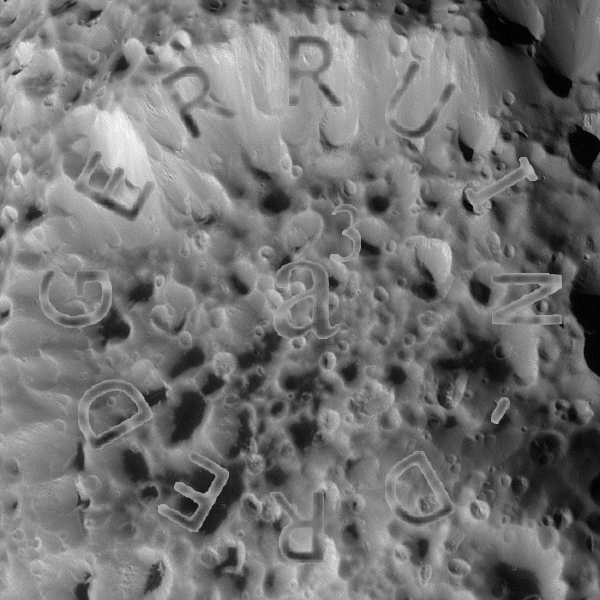
Cover of Triple-A by Ruin-Dredger (2000)

But you could see the whole of a Ruin-Dredger gig as asking the same searching thing. The band specialize in unusual frequencies that hunt out – and hum out – the resonances of the human body: the lungs, the bones, the blood. And their music sets up strange resonances in the mind. It’s both mindless and masterful, at once tearful and tyrannous. Sometimes it sounds like mathematics trying to come to life, and sometimes like mathematics trying to commit suicide. There’s a lot of science in their music, and a lot of silence too. “Star-clusters having tantrums,” is how one early review ran. “With occasional episodes of narcolepsy.” That mixture of sound and silence is mutually reinforcing: the sounds are sterner, the silence is sharper. They began their career with the albums Xoli-Hein (1992) and Pyramidion (1996), where they forged a series of griffs, or “gruff riffs”, that were often Ohrwürmer, or “ear-worms”, as German calls tunes that stick in your head. Even if you don’t want them to. But I’m not sure “tune” has ever been the right word for the music Ruin-Dredger create. It’s part industrial noise, part wolf-howl, part bat-twitter, but mostly “folded, fused, fissured, fractured, fidgety phonaesthesia.” And if you want to sample it, this album from the turn of the century is a good place to start.

What to call the album is one of the first puzzles it will set you. The band’s website usually calls it “a3” or “a3”; in interviews, the band themselves refer to it as “Triple-A” or “that A-fucker”. The second name comes from a plagiarism suit by the astro-music veterans Kargokkult that put Ruin-Dredger’s career on hold for nearly a year, 2002-3, and allegedly threatened to bankrupt their record-company. In the end the case was thrown out of court and even today some conspiracy-minded Dredge-heads claim it was cooked up for publicity between the ’Dredgers and the Kargonauts. The case might never have got as far as it did without that lunar cover for Triple-A, where the corroded letters of the band’s name and the album’s name hang above a lifeless moon-scape. Only it isn’t our moon. And it isn’t necessarily lifeless. Ruin-Dredger have a bee in their bonnet about the pre-biotic – the conditions necessary for the appearance of life. That’s what the first track on Triple-A, “Invention of the Cross”, is about: the chemicals that gave rise to life. And it literally has bees on it: the band sampled bees and bumblebees in flight and gathering nectar. They then altered the pitch and speed of the buzzing and made it sound both unearthly and unsettling. I’ve known people demand the track be turned off or skipped when it’s played to them.

But skipping track one of Triple-A is a bit like jumping from the frying-pan into the fire, because track two, “Seventh Sword”, is even more unearthly and even more unsettling. Bat-twitters hurtle through the speakers, falling from the ultra-sonic to the infra-sonic, rising in reverse, twisting, turning inside-out, mating, mutating and miscegenating. Then, as though the band have taken mercy on your ears and your mind, everything slows and soothes for track three, “Titanomachia”, which is often preceded in concert by the aforementioned carnal question: “And what doth it mean to be flesh?” This track is one of the last outings for the griffs of their early career: a slow, synth-based triple chord underlain by a sample of waves washing on an unknown shore. Track four, “Breathing Vacuum”, has also been known to provoke a “Turn it off!”, because the mumbling beneath the music is both sinister and sorrowful. You feel as though you should understand the words or, worse, that you will in your dreams. The chimes in the track are sinister too: they sound like a deep-sea, or deep-space, monster tapping on its fangs before putting them to famished use.

Which sets things up nicely, or nastily, for track five, “Scylla / Charybdis”. This is named after a pair of sea-monsters faced by Odysseus on his journey home from Troy and has been described by the ’Dredgers as a “battle-song”. The waves on “Titanomachia” are back, but bigger, badder and in a mood to fight. Daziel’s electronically treated voice wolf-howls a series of unintelligible questions, answered by patches of silence and gong-like drum-rolls. Track six, “Nyctogigas”, starts softly, builds back to the volume and violence of “Scyl/Char”, then breaks apart to allow the bats and bees of “Whilom” to steer your imagination out and up into the freezing star-light on the outer fringes of the solar system, where comets, shorn by the cold and dark, wait to swing sun-ward and regain their blazing locks. I like to listen to “Whilom” in the dark, wearing a blindfold, but then that’s the best way to listen to all of Ruin-Dredger’s music. Listening like that conjures visions and commands the viscera. Not an easy album, nor an unrewarding one, Triple-A isn’t their finest hour, if fan-polls and sales are any guide, but it’s an excellent guide to where they had come from and where they were about to go. If it’s the alpha-and-omega of their career, perhaps that explains the title: the “a” is the alpha (α) and the “3” an omega (ω) tipped on its side. I see it, or hear it, as a bridge between the ’nineties and the ’noughties: they’d give up the griffs and big up the bats, from then on, but they’ve never stopped asking that simple, sinister/sorrowful question of themselves and their listeners: “And What Doth It Mean To Be Flesh?”


a3 / a3 / Triple-A (S.R.K., 2000)

1. Invention of the Cross (5:26)
2. Seventh Sword (3:33)
3. Titanomachia (7:18)
4. Breathing Vacuum (9:03)
5. Scylla / Charybdis (6:11)
6. Nyctogigas (4:20)
7. Whilom (13:37)

Three Is The Key

If The Roses of Heliogabalus (1888) is any guide, Sir Lawrence Alma-Tadema (1836-1912) thought that 222 is a special number. But his painting doesn’t exhaust its secrets. To get to another curiosity of 222, start with 142857. As David Wells puts it in his Penguin Dictionary of Curious and Interesting Numbers (1986), 142857 is a “number beloved of all recreational mathematicians”. He then describes some of its properties, including this:

142857 x 1 = 142857
142857 x 2 = 285714
142857 x 3 = 428571
142857 x 4 = 571428
142857 x 5 = 714285
142857 x 6 = 857142

The multiples are cyclic permutations: the order of the six numbers doesn’t change, only their starting point. Because each row contains the same numbers, it sums to the same total: 1 + 4 + 2 + 8 + 5 + 7 = 27. And because each row begins with a different number, each column contains the same six numbers and also sums to 27, like this:

1 4 2 8 5 7
+ + + + + +
2 8 5 7 1 4
+ + + + + +
4 2 8 5 7 1
+ + + + + +
5 7 1 4 2 8
+ + + + + +
7 1 4 2 8 5
+ + + + + +
8 5 7 1 4 2

= = = = = =

2 2 2 2 2 2
7 7 7 7 7 7

If the diagonals of the square also summed to the same total, the multiples of 142857 would create a full magic square. But the diagonals don’t have the same total: the left-right diagonal sums to 31 and the right-left to 23 (note that 31 + 23 = 54 = 27 x 2).

But where does 142857 come from? It’s actually the first six digits of the reciprocal of 7, i.e. 1/7 = 0·142857… Those six numbers repeat for ever, because 1/7 is a prime reciprocal with maximum period: when you calculate 1/7, all integers below 7 are represented in the remainders. The square of multiples above is simply another way of representing this:

1/7 = 0·142857…
2/7 = 0·285714…
3/7 = 0·428571…
4/7 = 0·571428…
5/7 = 0·714285…
6/7 = 0·857142…
7/7 = 0·999999…

The prime reciprocals 1/17 and 1/19 also have maximum period, so the squares created by their multiples have the same property: each row and each column sums to the same total, 72 and 81, respectively. But the 1/19 square has an additional property: both diagonals sum to 81, so it is fully magic:

01/19 = 0·0 5 2 6 3 1 5 7 8 9 4 7 3 6 8 4 2 1
02/19 = 0·1 0 5 2 6 3 1 5 7 8 9 4 7 3 6 8 4 2…
03/19 = 0·1 5 7 8 9 4 7 3 6 8 4 2 1 0 5 2 6 3…
04/19 = 0·2 1 0 5 2 6 3 1 5 7 8 9 4 7 3 6 8 4…
05/19 = 0·2 6 3 1 5 7 8 9 4 7 3 6 8 4 2 1 0 5…
06/19 = 0·3 1 5 7 8 9 4 7 3 6 8 4 2 1 0 5 2 6…
07/19 = 0·3 6 8 4 2 1 0 5 2 6 3 1 5 7 8 9 4 7…
08/19 = 0·4 2 1 0 5 2 6 3 1 5 7 8 9 4 7 3 6 8…
09/19 = 0·4 7 3 6 8 4 2 1 0 5 2 6 3 1 5 7 8 9…
10/19 = 0·5 2 6 3 1 5 7 8 9 4 7 3 6 8 4 2 1 0…
11/19 = 0·5 7 8 9 4 7 3 6 8 4 2 1 0 5 2 6 3 1…
12/19 = 0·6 3 1 5 7 8 9 4 7 3 6 8 4 2 1 0 5 2…
13/19 = 0·6 8 4 2 1 0 5 2 6 3 1 5 7 8 9 4 7 3…
14/19 = 0·7 3 6 8 4 2 1 0 5 2 6 3 1 5 7 8 9 4…
15/19 = 0·7 8 9 4 7 3 6 8 4 2 1 0 5 2 6 3 1 5…
16/19 = 0·8 4 2 1 0 5 2 6 3 1 5 7 8 9 4 7 3 6…
17/19 = 0·8 9 4 7 3 6 8 4 2 1 0 5 2 6 3 1 5 7…
18/19 = 0·9 4 7 3 6 8 4 2 1 0 5 2 6 3 1 5 7 8

First line = 0 + 5 + 2 + 6 + 3 + 1 + 5 + 7 + 8 + 9 + 4 + 7 + 3 + 6 + 8 + 4 + 2 + 1 = 81

Left-right diagonal = 0 + 0 + 7 + 5 + 5 + 9 + 0 + 3 + 0 + 4 + 2 + 8 + 7 + 5 + 6 + 7 + 5 + 8 = 81

Right-left diagonal = 9 + 9 + 2 + 4 + 4 + 0 + 9 + 6 + 9 + 5 + 7 + 1 + 2 + 4 + 3 + 2 + 4 + 1 = 81

In base 10, this doesn’t happen again until the 1/383 square, whose magic total is 1719 (= 383-1 x 10⁻¹ / 2). But recreational maths isn’t restricted to base 10 and lots more magic squares are created by lots more primes in lots more bases. The prime 223 in base 3 is one of them. Here the first line is

1/223 = 1/220213 = 0·

0000100210210102121211101202221112202
2110211112001012200122102202002122220
2110110201020210001211000222011010010
2222122012012120101011121020001110020
0112011110221210022100120020220100002
0112112021202012221011222000211212212…

The digits sum to 222, so 222 is the magic total for all rows and columns of the 1/223 square. It is also the total for both diagonals, so the square is fully magic. I doubt that Alma-Tadema knew this, because he lived before computers made calculations like that fast and easy. But he was probably a Freemason and, if so, would have been pleased to learn that 222 had a link with squares.

Roses Are Golden

Sir Lawrence Alma-Tadema’s painting The Roses of Heliogabalus (1888) is based on an apocryphal episode in the sybaritic life of the Roman Emperor Elagabalus (204-222 A.D.), who is said to have suffocated guests with flowers at one of his feasts. The painting is in a private collection, but I saw it for real in an Alma-Tadema exhibition at the Walker Art Gallery in Liverpool sometime during the late 1990s. I wasn’t disappointed: it was a memorable meeting with a painting I’d been interested in for years. Roses is impressively large and impressively skilful. Close-up, the brush-strokes are obvious, obtrusive and hard to interpret as people and objects. It isn’t till you step back, far beyond the distance at which Alma-Tadema was painting, that the almost photographic realism becomes apparent. But you get more of the many details at close range, like the Latin inscription on a bowl below and slightly to the right of that scowling water-mask. Alas, I forgot to take a note of what the inscription was, though perhaps the memory is still locked away somewhere in my subconscious.

The Roses of Heliogabalus (1888)

The Roses of Heliogabalus (1888)

Whatever it is, I feel sure it is significant, because Roses is rich with meaning. That’s a large part of why I’m interested in it. Yes, I like it a lot as art, but the women would have to be more attractive for it to be higher in the list of my favourite paintings. As it is, I think there are only four reasonably good-looking people in it: the man with the beard on the right; the flautist striding past the marble pillar on the left; the red-headed girl with a crown of white flowers; and Heliogabalus himself, crowned in roses and clutching a handful of grapes beside the overweight man who’s wearing a wreath and sardonically saluting one of the rose-pelted guests in the foreground. When I first wrote about Roses in a pub-zine whose name escapes me, I misidentified the overweight man as Heliogabalus himself, even though I noted that he seemed many years old than Heliogabalus, toppled as a teen tyrant, should have been. It was a bad mistake, but one that, with less knowledge and more excuse, many people must make when they look at Roses, because the overweight man and his sardonic salute are a natural focus for the eye. Once your eye has settled on and noted him, you naturally follow the direction of his gaze down to the man in the foreground, who’s gazing right back.

A comparison between Alma-Tadema's portrayal of Heliogabalus and a bust of Heliogabalus from the Musei Capitolini in Rome

Something Like the Sun

And by following that gaze, you’ve performed a little ratio-ritual, just as Alma-Tadema intended you to do. Yes, Roses is full of meaning and much of that meaning is mathematical. I think the angle of the gaze is one of many references in Roses to the golden ratio, or φ (phi), a number that is supposed to have special aesthetic importance and has certainly been used by many artists and musicians to guide their work. A rectangle with sides in the proportions 8:13, for example, approximates the golden ratio pretty closely, but φ itself is impossible to represent physically, because it’s an irrational number with infinitely many decimal digits, like π or √2, the square root of two. π represents the ratio of a circle’s circumference to its diameter and √2 the ratio of a square’s diagonal to its side, but no earthly circle and no earthly square can ever capture these numbers with infinite precision. Similarly, no earthly rectangle can capture φ, but the rectangle of Roses is a good attempt, because it measures 52″ x 84 1/8". That extra eighth of an inch was my first clue to the painting’s mathematical meaningfulness. And sure enough, 52/84·125 = 416/673 = 0·61812…, which is a good approximation to φ’s never-ending 0·6180339887498948482045868343656…*
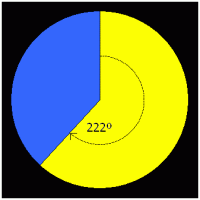
A circle with radii at 0 and 222 degrees
That deliberate choice of dimensions for the canvas led me to look for more instances of φ in the painting, though one of the most important and obvious might be called a meta-presence. The Roses of Heliogabalus is dated 1888, or 1666 years after the death of Heliogabalus in 222 AD. A radius at 222º divides a circle in the golden ratio, because 222/360 = 0·616… It’s very hard to believe Alma-Tadema didn’t intend this reference and I also think there’s something significant in 1888 itself, which equals 2 x 2 x 2 x 2 x 2 x 59 = 25 x 59. Recall that 416 is the expanded short side of Roses. This equals 25 x 13, while 673, the expanded long side, is the first prime number after 666. As one of the most technically skilled painters who ever lived, Alma-Tadema was certainly an exceptional implicit mathematician. But he clearly had explicit mathematical knowledge too and this painting is a phi-pie cooked by a master matho-chef. In short, when Roses is read, Roses turns out to be golden.


*φ is more usually represented as 1·6180339887498948482045868343656…, but it has the pecularity that 1/φ = φ-1, so the decimal digits don’t change and 0·6180339887498948482045868343656… is also legitimate.

Appendix I

I’ve looked at more of Alma-Tadema’s paintings to see if their dimensions approximate φ, √2, √3 or π, or their reciprocals. These were the results (ε = error, i.e. the difference between the constant and the ratio of the dimensions).

The Roman Wine Tasters (1861), 50" x 69 2/3": 150/209 = 0·717… ≈ 1/√2 (ε=0·02)
A Roman Scribe (1865), 21 1/2" x 15 1/2": 43/31 = 1·387… ≈ √2 (ε=0·027)
A Picture Gallery (1866), 16 1/8" x 23": 129/184 = 0·701… ≈ 1/√2 (ε=0·012)
A Roman Dance (1866), 16 1/8" x 22 1/8": 43/59 = 0·728… ≈ 1/√2 (ε=0·042)
In the Peristyle (1866), 23" x 16": 23/16 = 1·437… ≈ √2 (ε=0·023)
Proclaiming Emperor Claudius (1867), 18 1/2" x 26 1/3": 111/158 = 0·702… ≈ 1/√2 (ε=0·009)
Phidias and the Frieze of the Parthenon Athens (1868), 29 2/3" x 42 1/3": 89/127 = 0·7… ≈ 1/√2 (ε=0·012)
The Education of Children of Clovis (1868), 50" x 69 2/3": 150/209 = 0·717… ≈ 1/√2 (ε=0·02)
An Egyptian Juggler (1870), 31" x 19 1/4": 124/77 = 1·61… ≈ φ (ε=0·007)
A Roman Art Lover (1870), 29" x 40": 29/40 = 0·725… ≈ 1/√2 (ε=0·034)
Good Friends (1873), 4 1/2" x 7 1/4": 18/29 = 0·62… ≈ φ (ε=0·006)
Pleading (1876), 8 1/2" x 12 3/8": 68/99 = 0·686… ≈ 1/√2 (ε=0·041)
An Oleander (1882), 36 1/2" x 25 1/2": 73/51 = 1·431… ≈ √2 (ε=0·017)
Dolce Far Niente (1882), 9 1/4" x 6 1/2": 37/26 = 1·423… ≈ √2 (ε=0·008)
Anthony and Cleopatra (1884), 25 3/4" x 36 1/3": 309/436 = 0·708… ≈ 1/√2 (ε=0·003)
Rose of All Roses (1885), 15 1/4" x 9 1/4": 61/37 = 1·648… ≈ φ (ε=0·03)
The Roses of Heliogabalus (1888), 52" x 84 1/8": 416/673 = 0·618… ≈ φ (ε<0.001)
The Kiss (1891), 18" x 24 3/4": 8/11 = 0·727… ≈ 1/√2 (ε=0·039)
Unconscious Rivals (1893), 17 3/4" x 24 3/4": 71/99 = 0·717… ≈ 1/√2 (ε=0·019)
A Coign of Vantage (1895), 25 1/4" x 17 1/2": 101/70 = 1·442… ≈ √2 (ε=0·028)
A Difference of Opinion (1896), 15" x 9": 5/3 = 1·666… ≈ φ (ε=0·048)
Whispering Noon (1896), 22" x 15 1/2": 44/31 = 1·419… ≈ √2 (ε=0·005)
Her Eyes Are With Her Thoughts And Her Thoughts Are Far Away (1897), 9" x 15": 3/5 = 0·6… ≈ φ (ε=0·048)
The Baths of Caracalla (1899), 60" x 37 1/2": 8/5 = 1·6… ≈ φ (ε=0·018)
The Year’s at the Spring, All’s Right with the World (1902), 13 1/2" x 9 1/2": 27/19 = 1·421… ≈ √2 (ε=0·006)
Ask Me No More (1906), 31 1/2" x 45 1/2": 9/13 = 0·692… ≈ 1/√2 (ε=0·03)

Appendix II

The Roses of Heliogabalus is based on this section from Aelius Lampridius’ pseudonymous and largely apocryphal Vita Heliogabali, or Life of Heliogabalus, in the Historia Augusta (late fourth century):

XXI. 1 Canes iecineribus anserum pavit. Habuit leones et leopardos exarmatos in deliciis, quos edoctos per mansuetarios subito ad secundam et tertiam mensam iubebat accumbere ignorantibus cunctis, quod exarmati essent, ad pavorem ridiculum excitandum. 2 Misit et uvas Apamenas in praesepia equis suis et psittacis atque fasianis leones pavit et alia animalia. 3 Exhibuit et sumina apruna per dies decem tricena cottidie cum suis vulvis, pisum cum aureis, lentem cum cerauniis, fabam cum electris, orizam cum albis exhibens. 4 Albas praeterea in vicem piperis piscibus et tuberibus conspersit. 5 Oppressit in tricliniis versatilibus parasitos suos violis et floribus, sic ut animam aliqui efflaverint, cum erepere ad summum non possent. 6 Condito piscinas et solia temperavit et rosato atque absentato…

Historia Augusta: Vita Heliogabali

XXI. 1 He fed his dogs on goose-livers. He had pet lions and leopards, which had been rendered harmless and trained by tamers, and these he would suddenly order during the dessert and the after-dessert to get on the couches, thereby causing laughter and panic, for none knew that they were harmless. 2 He sent grapes from Apamea to his stables for the horses, and he fed parrots and pheasants to his lions and other beasts. 3 For ten days in a row, moreover, he served wild sows’ udders with the matrices, at a rate of thirty a day, serving, besides, peas with gold-pieces, lentils with onyx, beans with amber, and rice with pearls; 4 and he also sprinkled pearls on fish and used truffles instead of pepper. 5 In a banqueting-room with a reversible ceiling he once buried his parasites in violets and other flowers, so that some were actually smothered to death, being unable to crawl out to the top. 6 He flavoured his swimming-pools and bath-tubs with essence of spices or of roses or wormwood…

Augustan History: Life of Heliogabalus

Summer-Climb Views

Simple things can sometimes baffle advanced minds. If you take a number, reverse its digits, add the result to the original number, then repeat all that, will you eventually get a palindrome? (I.e., a number, like 343 or 27172, that reads the same in both directions.) Many numbers do seem to produce palindromes sooner or later. Here are 195 and 197:

195 + 591 = 786 + 687 = 1473 + 3741 = 5214 + 4125 = 9339 (4 steps)

197 + 791 = 988 + 889 = 1877 + 7781 = 9658 + 8569 = 18227 + 72281 = 90508 + 80509 = 171017 + 710171 = 881188 (7 steps)

But what about 196? Well, it starts like this:

196 + 691 = 887 + 788 = 1675 + 5761 = 7436 + 6347 = 13783 + 38731 = 52514 + 41525 = 94039 + 93049 = 187088 + 880781 = 1067869 + 9687601 = 10755470 + 7455701 = 18211171 + 17111281 = 35322452 + 25422353 = 60744805 + 50844706 = 111589511 + 115985111 = 227574622 + 226475722 = 454050344 + 443050454 = 897100798 + 897001798 = 1794102596 + 6952014971 = 8746117567 + 7657116478 = 16403234045 + 54043230461 = 70446464506 + 60546464407 = 130992928913 + 319829299031 = 450822227944 + 449722228054 = 900544455998…

And so far, after literally years of computing by mathematicians, it hasn’t produced a palindrome. It seems very unlikely it ever will, but no-one can prove this and say that 196 is, in base 10, a Lychrel number, or a number that never produces a palindrome. In other words, a simple thing has baffled advanced minds.

I don’t know whether it can baffle advanced minds, but here’s another simple mathematical technique: sum all the digits of a number, then add the result to the original number and repeat. How long before a palindrome appears in this case? Sum it and see:

10 + 1 = 11

12 + 3 = 15 + 6 = 21 + 3 = 24 + 6 = 30 + 3 = 33 (5 steps)

13 + 4 = 17 + 8 = 25 + 7 = 32 + 5 = 37 + 10 = 47 + 11 = 58 + 13 = 71 + 8 = 79 + 16 = 95 + 14 = 109 + 10 = 119 + 11 = 130 + 4 = 134 + 8 = 142 + 7 = 149 + 14 = 163 + 10 = 173 + 11 = 184 + 13 = 197 + 17 = 214 + 7 = 221 + 5 = 226 + 10 = 236 + 11 = 247 + 13 = 260 + 8 = 268 + 16 = 284 + 14 = 298 + 19 = 317 + 11 = 328 + 13 = 341 + 8 = 349 + 16 = 365 + 14 = 379 + 19 = 398 + 20 = 418 + 13 = 431 + 8 = 439 + 16 = 455 + 14 = 469 + 19 = 488 + 20 = 508 + 13 = 521 + 8 = 529 + 16 = 545 (45 steps)

14 + 5 = 19 + 10 = 29 + 11 = 40 + 4 = 44 (4 steps)

15 + 6 = 21 + 3 = 24 + 6 = 30 + 3 = 33 (4 steps)

16 + 7 = 23 + 5 = 28 + 10 = 38 + 11 = 49 + 13 = 62 + 8 = 70 + 7 = 77 (7 steps)

17 + 8 = 25 + 7 = 32 + 5 = 37 + 10 = 47 + 11 = 58 + 13 = 71 + 8 = 79 + 16 = 95 + 14 = 109 + 10 = 119 + 11 = 130 + 4 = 134 + 8 = 142 + 7 = 149 + 14 = 163 + 10 = 173 + 11 = 184 + 13 = 197 + 17 = 214 + 7 = 221 + 5 = 226 + 10 = 236 + 11 = 247 + 13 = 260 + 8 = 268 + 16 = 284 + 14 = 298 + 19 = 317 + 11 = 328 + 13 = 341 + 8 = 349 + 16 = 365 + 14 = 379 + 19 = 398 + 20 = 418 + 13 = 431 + 8 = 439 + 16 = 455 + 14 = 469 + 19 = 488 + 20 = 508 + 13 = 521 + 8 = 529 + 16 = 545 (44 steps)

18 + 9 = 27 + 9 = 36 + 9 = 45 + 9 = 54 + 9 = 63 + 9 = 72 + 9 = 81 + 9 = 90 + 9 = 99 (9 steps)

19 + 10 = 29 + 11 = 40 + 4 = 44 (3 steps)

20 + 2 = 22

I haven’t looked very thoroughly at this technique, so I don’t know whether it throws up a seemingly unpalindromizable number. If it does, I don’t have an advanced mind, so I won’t be able to prove that it is unpalindromizable. But an adaptation of the technique produces something interesting when it is represented on a graph. This time, if s > 9, where s = digit-sum(n), let s = digit-sum(s) until s <= 9 (i.e, s < 10, the base). I call this the condensed digit-sum:

140 + 5 = 145 + 1 = 146 + 2 = 148 + 4 = 152 + 8 = 160 + 7 = 167 + 5 = 172 + 1 = 173 + 2 = 175 + 4 = 179 + 8 = 187 + 7 = 194 + 5 = 199 + 1 = 200 + 2 = 202 (15 steps)

Here, for comparison, is the sequence for 140 using uncondensed digit-sums:

140 + 5 = 145 + 10 = 155 + 11 = 166 + 13 = 179 + 17 = 196 + 16 = 212 (6 steps)

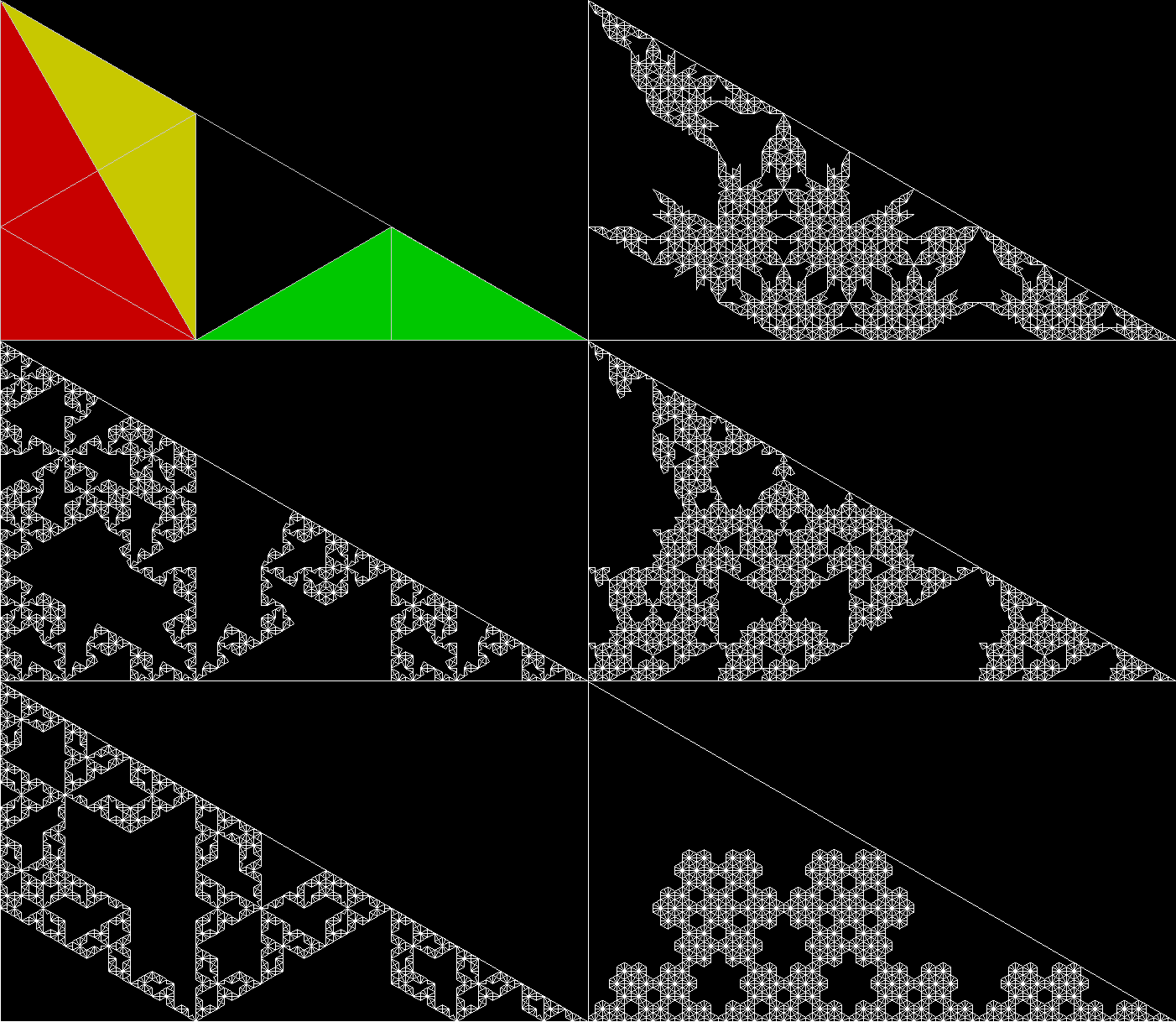
When all the numbers (including palindromes) created using condensed digit-sums are shown on a graph, they create an interesting pattern in base 10 (the x-axis represents n, the y-axis represents n, n1 = n + digit-sum(n), n2 = n1 + digit-sum(n1), etc):

(Please open images in a new window if they fail to animate.)

digitsum_b10

condensed_b3_to_b20_etc

And here, for comparison, are the patterns created by uncondensed digit-sums in base 2 to 10:

uncondensed_b2_to_b10

Light at Night

The Sky at Night: Answers to Questions from Across the Universe, Patrick Moore and Chris North (BBC Books, 2012)

Astronomy, one of the most successful and far-reaching of all sciences, has been largely based on almost nothing. Human beings have pushed their knowledge of the physical universe out over huge stretches of space and time without using anything physical, in the everyday sense of the word. This is because astronomy is largely based on the collection and analysis of tiny, weightless particles known as photons, which can’t be touched, tasted, smelt, or heard, only seen. And sometimes not seen either: visible light is only a small part of the electro-magnetic spectrum occupied by photons at different wavelengths and energies. Move a little in one direction and you meet invisible ultra-violet; move a little in the other direction and you meet invisible infra-red. Move further and you’ll meet radio-waves and gamma-rays. To make all those visible, we need technology, but we also need technology to collect the visible light of dim or distant celestial objects.

That technology is called the telescope and without it modern astronomy wouldn’t exist. The telescope opened a door in the attic of the universe just as the microscope opened a door in the cellar. But astronomy was an advanced subject well before the telescope was invented, in part because it is an essentially simple subject. Unlike human beings and animals, planets and stars behave in relatively stereotyped, predictable ways. That’s why their behaviour is so easily expressed and analysed using mathematics. Thousands of years ago, men could create mathematical models of the universe and accurately predict celestial behaviour in detail. But they couldn’t create mathematical models of animal or human behaviour and make accurate predictions. We still can’t do that, but we’ve getting better and better at applying mathematics to the photons we collect from the sky. Patrick Moore (1923-2012) was the eccentric BBC presenter of a series called The Sky at Night and devoted his life to those photons, particularly the ones that bounced off the surface of the moon. He wasn’t a professional astronomer or an advanced mathematician, but he could recognize the importance of mathematics and the devices that run on it:

What single technological advance over the past 53 years has facilitated the greatest increase in our knowledge and understanding of the cosmos?

Tony Davies (Shoreham-by-Sea, West Sussex)

I think we’ve got to say here the development of electronics in astronomy. Old-fashioned photography has gone out, and electronic devices have taken over. They have led to amazing advances, in all branches of science, not just astronomy. Coupled with the advances in electronic computing, they have allowed discoveries astronomers could only dream of even as recently as a decade ago. So I must say the advent of the Electronic Age. (“Patrick Moore and the Sky at Night”, pg. 424)

I can almost hear Patrick Moore’s slightly clipped, almost stuttering tones as I read that answer. He was an odd character, but I think he led a worthwhile life and odd characters are attracted to subjects like astronomy. It’s on the philatelic side of science and this description by George Orwell of his job in a bookshop might also apply to astronomy:

Like most second-hand bookshops we had various sidelines. We sold second-hand typewriters, for instance, and also stamps — used stamps, I mean. Stamp-collectors are a strange, silent, fish-like breed, of all ages, but only of the male sex; women, apparently, fail to see the peculiar charm of gumming bits of coloured paper into albums. (“Bookshop Memories”, 1936)

Women also mostly fail to see the peculiar charm of astronomy. One of the reasons I like it is that it contains a lot of big ideas and tantalizing possibilities, from the lingering birth-bawl in the Cosmic Microwave Background to the prospect of life beneath the ice-cap of Jupiter’s moon Europa, by way of T.L.P., or Transient Lunar Phenomena, the mysterious fleeting changes that occasionally occur on the moon. This book covers all of those and much more. Another reason I like astronomy is that, so far, it hasn’t often involved killing things and cutting them up. Or worse, not killing them and still cutting them up. H.G. Wells couldn’t have written The Island of Dr Moreau (1896) about an astronomer and part of H.P. Lovecraft’s genius was to combine the grandeurs and glories of astronomy with the intimacy and viscerality of biology. Lovecraft would certainly have liked this book. This sounds like a giant cosmic conspiracy right out of a story like “Dreams in the Witch House” (1932):

…our Galaxy is moving relative… to the Universe… at a speed of around 600 km/s… The cause of the motion, enigmatically known as the “Great Attractor”, was a mystery for several decades, partly because whatever is causing it is hidden behind the material in the disc of our Galaxy. The source of the motion is now thought to be a massive cluster of galaxies in the constellation of Norma, which is attracting not just our Galaxy and its immediate neighbours, but also the much larger Virgo cluster. (“Cosmology: The Expansion of the Universe”, pg. 208)

It’s a large and complicated universe out there and it’s amazing that we’ve managed to learn so much about it from our own tiny corner, using mostly nothing but light and working mostly nowhere but the earth itself. But that is the power of mathematics: Archimedes said of levers that, given a place to stand, he could move the world. Using the lever of mathematics, men can move the universe standing only in their own heads. The co-author of this book, Dr Chris North of the School of Physics and Astronomy at Cardiff University, is one of those men. He does the heavy intellectual lifting here, answering the most advanced questions, but I’m sure that he would acknowledge that Patrick Moore was one of the world’s greatest popularizers of astronomy. The questions themselves range from the naïve to the nuanced, the elementary to the exoplanetary. But I was surprised, given that this is a book issued by the Bolshevik Broadcasting Corporation, that almost all of them seemed to be asked by white males, sometimes from hideously unvibrant parts of Britain like County Durham. Was there no edict to invent some astrophile Ayeshas and Iqbals from Bradford and some budding Afro-physicists from Brixton?

Perhaps there was, but Moore ignored it. He was an old-fashioned character with old-fashioned views, after all, and he says here that he was introduced to astronomy by a book, G.F. Chambers’ The Story of the Solar System, that was published in 1898 (pg. 409). So his astronomy touched three centuries. He also met three very important men: Orville Wright, the first man to fly properly; Yuri Gagarin, the first man into space; and Neil Armstrong, the first man on the moon. Those were three steps towards our permanent occupation of space. To understand what attracts men there and the questions they hope to answer, this book is a good place to start.

Watch this Sbase

In standard notation, there are two ways to represent 2: 10, in base 2, and 2 in every other base. Accordingly, there are three ways to represent 3: 11 in base 2, 10 in base 3, and 3 in every other base. There are four ways to represent 4, five ways to represent 5, and so on. Now, suppose you sum all the digits of all the representations of n in the bases 2 to n, like this:

Σ(2) = 1+02 = 1
Σ(3) = 1+12 + 1+03 = 3 (+2)
Σ(4) = 1+0+02 + 1+13 + 1+04 = 4 (+1)
Σ(5) = 1+0+12 + 1+23 + 1+14 + 1+05 = 8 (+4)
Σ(6) = 1+1+02 + 2+03 + 1+24 + 1+15 + 1+06 = 10 (+2)
Σ(7) = 1+1+12 + 2+13 + 1+34 + 1+25 + 1+16 + 1+07 = 16 (+6)
Σ(8) = 1+0+0+02 + 2+23 + 2+04 + 1+35 + 1+26 + 1+17 + 1+08 = 17 (+1)
Σ(9) = 1+0+0+12 + 1+0+03 + 2+14 + 1+45 + 1+36 + 1+27 + 1+18 + 1+09 = 21 (+4)
Σ(10) = 1+0+1+02 + 1+0+13 + 2+24 + 2+05 + 1+46 + 1+37 + 1+28 + 1+19 + 1+010 = 25 (+4)

It seems reasonable to suppose that as n increases, so the all-digit-sum of n increases. But that isn’t always the case: occasionally it decreases. Here are the sums for n=11..100 (with prime factors when the sum is composite):

Σ(11) = 35 = 5·7 (+10)
Σ(12) = 34 = 2·17 (-1)
Σ(13) = 46 = 2·23 (+12)
Σ(14) = 52 = 22·13 (+6)
Σ(15) = 60 = 22·3·5 (+8)
Σ(16) = 58 = 2·29 (-2)
Σ(17) = 74 = 2·37 (+16)
Σ(18) = 73 (-1)
Σ(19) = 91 = 7·13 (+18)
Σ(20) = 92 = 22·23 (+1)
Σ(21) = 104 = 23·13 (+12)
Σ(22) = 114 = 2·3·19 (+10)
Σ(23) = 136 = 23·17 (+22)
Σ(24) = 128 = 27 (-8)
Σ(25) = 144 = 24·32 (+16)
Σ(26) = 156 = 22·3·13 (+12)
Σ(27) = 168 = 23·3·7 (+12)
Σ(28) = 171 = 32·19 (+3)
Σ(29) = 199 (+28)
Σ(30) = 193 (-6)
Σ(31) = 223 (+30)
Σ(32) = 221 = 13·17 (-2)
Σ(33) = 241 (+20)
Σ(34) = 257 (+16)
Σ(35) = 281 (+24)
Σ(36) = 261 = 32·29 (-20)
Σ(37) = 297 = 33·11 (+36)
Σ(38) = 315 = 32·5·7 (+18)
Σ(39) = 339 = 3·113 (+24)
Σ(40) = 333 = 32·37 (-6)
Σ(41) = 373 (+40)
Σ(42) = 367 (-6)
Σ(43) = 409 (+42)
Σ(44) = 416 = 25·13 (+7)
Σ(45) = 430 = 2·5·43 (+14)
Σ(46) = 452 = 22·113 (+22)
Σ(47) = 498 = 2·3·83 (+46)
Σ(48) = 472 = 23·59 (-26)
Σ(49) = 508 = 22·127 (+36)
Σ(50) = 515 = 5·103 (+7)
Σ(51) = 547 (+32)
Σ(52) = 556 = 22·139 (+9)
Σ(53) = 608 = 25·19 (+52)
Σ(54) = 598 = 2·13·23 (-10)
Σ(55) = 638 = 2·11·29 (+40)
Σ(56) = 634 = 2·317 (-4)
Σ(57) = 670 = 2·5·67 (+36)
Σ(58) = 698 = 2·349 (+28)
Σ(59) = 756 = 22·33·7 (+58)
Σ(60) = 717 = 3·239 (-39)
Σ(61) = 777 = 3·7·37 (+60)
Σ(62) = 807 = 3·269 (+30)
Σ(63) = 831 = 3·277 (+24)
Σ(64) = 819 = 32·7·13 (-12)
Σ(65) = 867 = 3·172 (+48)
Σ(66) = 861 = 3·7·41 (-6)
Σ(67) = 927 = 32·103 (+66)
Σ(68) = 940 = 22·5·47 (+13)
Σ(69) = 984 = 23·3·41 (+44)
Σ(70) = 986 = 2·17·29 (+2)
Σ(71) = 1056 = 25·3·11 (+70)
Σ(72) = 1006 = 2·503 (-50)
Σ(73) = 1078 = 2·72·11 (+72)
Σ(74) = 1114 = 2·557 (+36)
Σ(75) = 1140 = 22·3·5·19 (+26)
Σ(76) = 1155 = 3·5·7·11 (+15)
Σ(77) = 1215 = 35·5 (+60)
Σ(78) = 1209 = 3·13·31 (-6)
Σ(79) = 1287 = 32·11·13 (+78)
Σ(80) = 1263 = 3·421 (-24)
Σ(81) = 1293 = 3·431 (+30)
Σ(82) = 1333 = 31·43 (+40)
Σ(83) = 1415 = 5·283 (+82)
Σ(84) = 1368 = 23·32·19 (-47)
Σ(85) = 1432 = 23·179 (+64)
Σ(86) = 1474 = 2·11·67 (+42)
Σ(87) = 1530 = 2·32·5·17 (+56)
Σ(88) = 1530 = 2·32·5·17 (=)
Σ(89) = 1618 = 2·809 (+88)
Σ(90) = 1572 = 22·3·131 (-46)
Σ(91) = 1644 = 22·3·137 (+72)
Σ(92) = 1663 (+19)
Σ(93) = 1723 (+60)
Σ(94) = 1769 = 29·61 (+46)
Σ(95) = 1841 = 7·263 (+72)
Σ(96) = 1784 = 23·223 (-57)
Σ(97) = 1880 = 23·5·47 (+96)
Σ(98) = 1903 = 11·173 (+23)
Σ(99) = 1947 = 3·11·59 (+44)
Σ(100) = 1923 = 3·641 (-24)

The sum usually increases, occasionally decreases. In one case, when 87 = n = 88, it stays the same. This also happens when 463 = n = 464, where Σ(463) = Σ(464) = 39,375. Does it happen again? I don’t know. The ratio of sum-ups to sum-downs seems to tend towards 3:1. Is that the exact ratio at infinity? I don’t know. Watch this sbase.