Pestilent, Pustulent and Pox-Pocked

I’m sorry, but let’s face facts: you cannot consider yourself a keyly committed core component of the counter-cultural community unless you own at least three copies — a reading copy, a prominent-shelf-of-the-bookcase copy and a wrap-carefully-in-brown-paper-put-away-in-a-cupboard-and-never-touch-or-look-at-again copy — of each of these toxic’n’tenebrose titles:

Can the Cannibal? Aspects of Angst, Abjection and Anthropophagy in the Music of Suzi Quatro, 1974-1986 (University of Nebraska Press 2004)

Doubled Slaughter: Barbarism, Brutalism and Bestial Bloodlust in the Music of Simon and Garfunkel, 1965-2010 (Serpent’s Tail 2007)

Re-Light My Führer: Nausea, Noxiousness and Neo-Nazism in the Music of Take That, 1988-2007 (U.N.P. 2013)

Base Citizens Raping: Revulsion, Repulsion and Rabidity in the Music of the Bay City Rollers, 1972-2002 (U.N.P. 2014)

Underground, Jehovahground: Ferality, Fetidity and Fundamentalist Phantasmality in the Music of the Wombles, August 1974-January 1975 (forthcoming)

Jane in Blood: Castration, Clitoridolatry and Communal Cannibalism in the Novels of Jane Austen (U.N.P. 2018)

All are by Dr Miriam B. Stimbers, of course. And what can I say about them? Simply this: these books hold an uncompromising mirror up before the pestilent, pustulent and pox-pocked features of so-called Western so-called society and say: “Look. That’s you, that is.” Dr Stimbers’ ruthlessly radical research and sizzlingly psychoanalytic scholarship will overturn your preconceptions so hard that, in some cases, they won’t appear to change at all.

Performativizing Papyrocentricity #13

Papyrocentric Performativity Presents:

Brown StudyWilliam in Trouble, Richmal Crompton (1927)

Bleeding BlackWatch You Bleed: The Saga of Guns n’ Roses, Stephen Davis (Michael Joseph 2008)

Toxic TailsIn the Seventies: Adventures in the Counterculture, Barry Miles (Serpent’s Tail 2011)

Leaf BriefWhat a Plant Knows: A Field Guide to the Senses of Your Garden — and Beyond, Daniel Chamovitz (Oneworld 2012) (posted @ Overlord of the Über-Feral)

Electrify Your EyesThe Spark of Life: Electricity in the Human Body, Frances Ashcroft (Penguin 2013) (@ O.o.t.Ü.-F.)


Or Read a Review at Random: RaRaR

Neuclid on the Block

How many blows does it take to demolish a wall with a hammer? It depends on the wall and the hammer, of course. If the wall is reality and the hammer is mathematics, you can do it in three blows, like this:

α’. Σημεῖόν ἐστιν, οὗ μέρος οὐθέν.
β’. Γραμμὴ δὲ μῆκος ἀπλατές.
γ’. Γραμμῆς δὲ πέρατα σημεῖα.

1. A point is that of which there is no part.
2. A line is a length without breadth.
3. The extremities of a line are points.

That is the astonishing, world-shattering opening in one of the strangest – and sanest – books ever written. It’s twenty-three centuries old, was written by an Alexandrian mathematician called Euclid (fl. 300 B.C.), and has been pored over by everyone from Abraham Lincoln to Bertrand Russell by way of Edna St. Vincent Millay. Its title is highly appropriate: Στοιχεῖα, or Elements. Physical reality is composed of chemical elements; mathematical reality is composed of logical elements. The second reality is much bigger – infinitely bigger, in fact. In his Elements, Euclid slipped the bonds of time, space and matter by demolishing the walls of reality with a mathematical hammer and escaping into a world of pure abstraction.

• Continue reading Neuclid on the Block

O Apollo

One of Swinburne’s most powerful, but least-known, poems is “The Last Oracle”, from Poems and Ballads, Second Series (1878). A song in honour of the god Apollo, it begins in lamentation:

Years have risen and fallen in darkness or in twilight,
   Ages waxed and waned that knew not thee nor thine,
While the world sought light by night and sought not thy light,
   Since the sad last pilgrim left thy dark mid shrine.
Dark the shrine and dumb the fount of song thence welling,
   Save for words more sad than tears of blood, that said:
Tell the king, on earth has fallen the glorious dwelling,
   And the watersprings that spake are quenched and dead.
Not a cell is left the God, no roof, no cover
   In his hand the prophet laurel flowers no more.

And ends in exultation:

         For thy kingdom is past not away,
            Nor thy power from the place thereof hurled;
         Out of heaven they shall cast not the day,
            They shall cast not out song from the world.
         By the song and the light they give
         We know thy works that they live;
         With the gift thou hast given us of speech
         We praise, we adore, we beseech,
         We arise at thy bidding and follow,
            We cry to thee, answer, appear,
   O father of all of us, Paian, Apollo,
            Destroyer and healer, hear! (“The Last Oracle”)

The power, grandeur and beauty of this poem remind me of the music of Beethoven. Swinburne is also, on a smaller scale and in a different medium, one of the geniuses of European art. He and Beethoven were both touched by Apollo, but Apollo was more than the god of music and poetry: he also presided mathematics. But then mathematics is much more visible, or audible, in music and poetry than it is in other arts. Rhythm, harmony, scansion, melody and rhyme are mathematical concepts. Music is built of notes, poetry of stresses and rhymes, and the rules governing them are easier to formalize than those governing, say, sculpture or prose.  Nor do poetry and music have to make sense or convey explicit meaning like other arts. That’s why I think a shape like this is closer to poetry or music than it is to painting:

Apollonian gasket (Wikipedia)

(Image from Wikipedia.)

This shape has formal structure and beauty, but it has no explicit meaning. Its name has a divine echo: the Apollonian gasket or net, named after the Greek mathematician Apollonius of Perga (c.262 BC–c.190 BC), who was named after Apollo, god of music, poetry and mathematics. The Apollonian gasket is a fractal, but the version above is not as fractal as it could be. I wondered what it would look like if, like fleas preying on fleas, circles appeared inside circles, gaskets within gaskets. I haven’t managed to program the shape properly yet, but here is my first effort at an Intra-Apollonian gasket:

Apollonian gasket

(If the image does not animate or looks distorted, please try opening it in a new window)

When the circles are solid, they remind me of ice-floes inside ice-floes:

Apollonian gasket (solid)

Simpler gaskets can be interesting too:

five-circle gasket


five+four-circle gasket


nine-circle gasket

Mental Marine Music

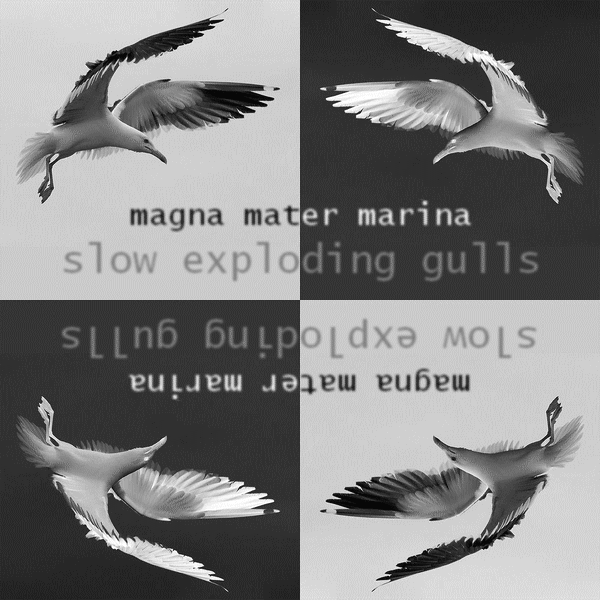
Cover of Magna Mater Marina by Slow Exploding Gulls (CD re-issue)

“Thalassa! Thalassa!” The chant that began the first song on the first side of the first S.E.G. album is still inspiring the group twenty-six years and eighteen albums later. Few fans will need reminding that it is ancient Greek for “The Sea! The Sea!”, as shouted in ecstasy by a mercenary army after a long and dangerous retreat across Asia Minor in 401 BC. Ecstasy is not so much an inspiration to the group as an aspiration. They try to use melody, rhythm and “drowned sound” to take their listeners out of the everyday and into the otherwhere, to sink them “full fathom five” in music as rich and mysterious as the sea. The S.E.G. story begins in 1987, when Joseph Corvin, the ever-present Kapitän und Kappellmeister, as he jokingly calls himself, was living in an old house in the ancient Celto-Roman town of Exeter on the southern English coast. When the sea-wind blew, his living quarters became lowing quarters: “an eerie wailing used to sound from the roof and there were all sorts of weird sound effects in the bathroom, because of air moving in the overflow pipe and the walls. I liked what I heard and I thought I could do something with it, musically speaking.”

Corvin recorded some of the wind-sounds, mixed them with gull-cries and underwater engine-noise, added vocals and electronically treated flute and drums, and put out the results on a cassette-only album called Magna Mater Marina (Latin for Great Marine Mother), under the odd but memorable moniker of Slow Exploding Gulls. The name was inspired by Corvin’s love of the surrealists Salvador Dalí and Max Ernst, but it would dog him and his cohorts for years to come, partly because it pigeon-holed the group as “Kraut-rock” and partly because it suggested cruelty to animals, which was not appreciated by some of his potential audience. Both assumptions were completely wrong: Corvin says, first, that, as a fan, he was then much more into The Cure, The Smiths and Siouxsie and the Banshees than anything electronic or experimental, and, second, that far from advocating cruelty to gulls, he was celebrating them:

Not for one moment was I suggesting any harm to anything with wings or feathers. Gulls are my favourite birds, highly potent symbols of freedom, grace and the life-force. The title was meant to be metaphorical, not literal, and it was partly a reference to the explosion of joy that sudden sight of a flying gull can waken in your heart. There’s something very Nietzschean about them and yeah, I will admit to a Friedrich-fixation in the 1980s, though the Kraut-rock label was an albatross around our necks, no pun intended, for most of the ’90s. It came mainly from a review in the N.M.E. [New Musical Express, one of Britain’s big “pop-papers”] claiming to detect similarities between us and Einstürzende Neubaten, which means “Collapsing New Buildings”. Well, I can’t say there wasn’t a subliminal influence, name-wise, but I’d heard very little by any of the German groups at the time and when I did hear more, I didn’t detect many similarities between their music and ours. We were and always will be inspired by sea-sounds, everything you can hear under and over the water of the British coast. The next label they tried to stick on us was “goth”, on the ground that we made gloomy music and always dressed in black. We didn’t: it was dark blue, it wasn’t all the time and there’s nothing gloomy about our music, if it’s listened to right. (Interview on the fan-site GullSegg, November, 2003)

Corvin’s protests were to no avail: S.E.G.’s next album, A Grey Mist (1989), was reviewed under titles like “Submarine Electro-Goths” and “Solipsistic Entrail-Gazing”. Again he says the press had got hold of the wrong end of the stick: “The title of the album comes from ‘Sea-Fever’, a very beautiful poem by John Masefield, and far from attempting to be gloomy or depressing, it was all about the joy of the sea, the cold in the early morning and the bite of the wind, ‘the white clouds flying’ and mist as a symbol of mystery and possibility, not as anything glum and gothic.” Happily, S.E.G. would outlive that early hostility and journalists’ insistence on labelling, rather than listening to, the music they created, but a lasting effect of both has been the playful name-switching they’ve indulged in since their early days. They’ve released albums under at least eight different names and performed gigs under all those and more, but every name has been based on the acronym S.E.G. and had a maritime theme. 1994’s Mew Upsilon Sigma, for example, came out under the name Swim with Elegant Gods, and 2003’s re-mixed Yr Wylan Ddu (Welsh for The Black Gull) under the name Seaside Excursion Guide. They’ve also recorded songs with titles like “Sunken Etruscan Gold”, “Sailing to Ecstatic Gnosis”, “Submersed in the Eternal Gulf” and “She’s an Exeter Girl” (a reference to Cathleen Orne, Joseph’s then girlfriend, now wife, who is indeed an Exeter girl).

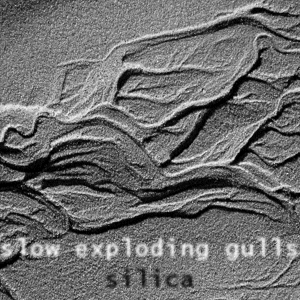
Cover of Silica by Slow Exploding Gulls

This S.E.G. motif means that hardcore fans, of whom they’ve garnered and retained a flighty fair few down the decades, are generally referred to as SEGheads, while their biggest – and best – fan-site is GullSegg, where you can find the earliest and most accurate news on the group’s activities, plus detailed and reasonably objective reviews of every piece of music they’ve ever recorded. So can S.E.G. be described as Shadowy Exeter Goths? No, Soaring Elemental Gods is much closer the mark and I join many mental-marine-music fans in wishing them well in their ambition of recording music in every major sea-side town of the British Isles. Wexford on the eastern coast of Ireland is next, according to GullSegg, and Wassernyxe, album #19 (and German/Greek for “Mermaid-Night”), should be released before the end of the year. It’s unlikely it will sail new seas, or sound new depths, but after twenty-six years of mer-music-making who could expect it to? Yes, never mind the rowlocks! S.E.G.’s Saline Esoterica Gangs on – and gongs on – every time someone plays a classic album like Mew or Thalas/Socratic, their 1996 split-EP with their own whale-song side-project Schatten über Exeter Gruppe (German for “Shadow over Exeter Group”).


Elsewhere other-posted:

• More Musings on Music

Previously pre-posted (please peruse):

Stoch’! (In the Name of Dove)

Proviously post-posted (please peruse):

The Sound of Silex

Guitardämmerung

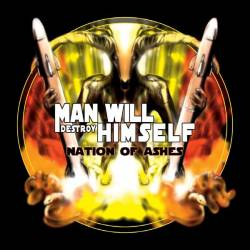
Cover of Nation of Ashes by Man Will Destroy HimselfMan Will Destroy Himself, Nation of Ashes (2007)

I’ve enjoyed this album a lot. It’s short, sharp and psycho-sonically stimulating. It could be called sonic-ironic too. Hardcore, in the guitar sense, is an accelerated and intensified form of punk that first appeared in the late 1980s. It was then an extreme, bleeding-edge – and bleeding-ear – form of music. But now it has three decades of tradition behind it. One of the men who first championed it, the BBC D.J. John Peel (1939-2004), would be seventy-four if he were still alive today. This is from Peel’s auto/biography, Margrave of the Marshes (2004), which was begun by him but completed by his wife Sheila after he died of a heart-attack in Peru:

William [one of Peel’s sons] and I [his wife writes] went regularly with John to gigs that Extreme Noise Terror and Napalm Death played together at the Caribbean Centre in Ipswich. They were grimy, chaotic affairs attended largely by crusties wearing layers of shredded denim and dreadlocks thick as rope. The moshpit was like an initiation ritual – if you could make it out of there in one piece, you knew you could survive anything life had to throw at you. People would stagger out with nosebleeds, clutching their heads, complaining of double vision, drenched in sweat. And yet a good-natured atmosphere prevailed somehow. William, who was around thirteen at the time, took one look at these crusties, who mostly shunned bathing or showering, and decided that this was the musical sub-genre to which he wanted to pledge undying allegiance. His karate teacher attended the reggae nights upstairs at the Caribbean Centre, and would say to William on the way out, “What are you doing listening to that?” (Op. cit., pg. 387-8)

That extract sums up the music well: hardcore is adolescent and part of its early appeal was its ability to shock your parents and conventional society. Okay, the adolescent William Peel was attending Extreme Noise Terror gigs actually with his parents, but then John Peel was a permanent adolescent and the music didn’t appeal to the karate teacher. Before long, William Peel probably did something his father never did, namely begin to grow up. He would then have lost interest in hardcore. Or grindcore, as Sheila Peel calls it. I don’t think E.N.T. were grindcore (and neither do they, apparently) and I don’t think Napalm Death belong with E.N.T. or with Man Will Destroy Himself. For one thing, Napalm Death are crap. For another, they are, or became, much more metal and lost the grimy authenticity of E.N.T. and M.W.D.H.

Grime is authentic, after all: you’re closer to reality when you’re dirty and smelly and living in a squat, far from the nine-to-five conformity of deluded mainstream society. Or are you? In fact, the crusties – named from the crustiness of their unwashed skin and hair – could not have existed without the generous benefit-systems of Western Europe. Crusties sneered at straights – and lived off the taxes of straights. They bemoaned the brutal military-industrial complex – and were kept safe by it from a communist system that would not have tolerated their rebellion for a second. And, of course, they were using electricity to create and record their music. Not to mention benefitting from the transport network for food, the sewage network for hygiene, and the generally law-abiding, relatively uncorrupt societies that surrounded them and without which their “lifestyle” would have been impossible or unsustainable. If crusty political ideas had been realized – or are realized, because they’re alive and well in the Occupy movement – even crusties might begin to see that Western society was rather more complex and benign than they recognized.

But recognizing the complexity and benignity would get in the way of the self-righteousness that is another and essential part of hardcore’s adolescent appeal. You have to strip down your music to get the exciting speed and you have to strip down your ideas to get the exciting sneer. The first track on this album, “Subdivide”, begins with a sample from the end of the film Planet of the Apes (1968), when Charlton Heston learns, in a particularly dramatic and memorable way, where he has been all the time and what man has done with his super-sized brain. “Goddamn you all to Hell!” he cries – and the music swells up and screams off in that exciting, but by now very familiar, hardcore way. It’s an effective opening, but it reminds me of the term used of art by Aldous Huxley in Brave New World (1931): “emotional engineering”. The sample relies for its power on listeners’ previous knowledge of the film. Man has indeed destroyed himself – but in a science-fiction universe. The sample is effective, but insincere. Heston is acting and so, I feel, are M.W.D.H. The theme of nuclear armageddon was very well-trodden well before the ’noughties, when this album was released: Planet of the Apes appeared in 1968 and is based on a book published in 1963. Extreme Noise Terror were railing against the arms-trade from the beginning and E.N.T. have been assaulting ears, offending noses, and straining their throats for a long time now. Which is sonic-ironic: M.W.D.H. could never shock E.N.T. with their music, even though E.N.T. are probably old enough to be their dads.

Global warming, the apocalyptic theme now occupying the progressive community, isn’t so much fun to scream about: it’s slower and less obviously an act of malevolent free-will. But what about the much bigger threats posed not by man but by Mother Nature, with things like asteroid-strikes and mega-volcanoes? Well, hardcore bands have never worked themselves into self-righteous frenzies about those. How can you be self-righteous about billions of people dying if no human agency is involved? If we’re wiped out by an asteroid or a mega-volcano, it will be, at worst, a sin of omission. We could have spent more money researching the threat and inventing ways to prevent or avoid it. We’ve not been wiped out like that yet, but the threats remain and I think we should spend more money watching the skies, for example. But it’s difficult to get emotional about it: there are no self-righteous thrills to be found in nearby asteroids. Nuclear arsenals are different: men made those and men may use them. So you can get emotional about the threat. The strong sensations of hardcore aren’t supplied by just the speed and volume: the self-righteousness and sanctimony are important too. That’s why M.W.D.H. use that sample from Planet of the Apes and put nuclear missiles on the front cover of this album.

I don’t know whether they scream about global warming too, because I can’t understand the lyrics and haven’t found them on the web yet. The final track, “M.O.A.B.”, is presumably about the mega-munition called the “Mother Of All Bombs” by the U.S. military. Whether or not that bomb is the subject, it’s surprising how quickly you reach “M.O.A.B.”: this album whirls by and can seem even shorter than its actual running-time of twenty minutes. Hardcore is headlong, like sheets and shards of metal being blown along by a hurricane. And metal is a word that comes to mind a lot as you listen to this album. The sounds are metallic in an almost literal sense: strong but flexible, meaty but malleable. Nation of Ashes sounds like a sonic factory taking the raw ore of volume and hammering, twisting, and rolling it into shape. That’s appropriate for a form of music that depends on an advanced technological civilization, though it’s sonic-ironic because the music is being used to criticize that civilization. But Nation of Ashes also sounds metallic in a more strictly musical sense. As I’ve said, M.W.D.H. and E.N.T. aren’t metal bands like Napalm Death, but heavy metal does influence the sound of hardcore. There are throbbing, thundering passages between the headlong charges on this album, but that variety increases the power of the music. And has been doing so on hundreds of albums for thousands of days. So, as M.W.D.H.’s music pounds, listeners can ponder things like authenticity and originality.

I’ve certainly pondered my own originality while writing this review. I’m pleased with the title of the review – “Guitardämmerung” – but I’ve found from a web-search that it’s been used before. Other minds have worked like mine, noting the similarity between “guitar” and Götter. The point of a pun is to distort language and create a new sensation from something familiar. That’s also what punk did to rock music, and what hardcore did to punk: they were distortions for new sensations. Sometimes musical distortion is inadvertent: new forms of music, like new forms of life, can arise when there’s a mistake in copying. Or when the technology of the art does undesigned and originally unwanted things, like causing feedback. An accidental thing like that can then become something pursued and valued in its own right. Hardcore is about distortion in lots of ways: it uses distorted guitars and voices to protest about the distortion of society and justice. But this album isn’t distorted in one way: it adheres faithfully to the hardcore recipe first laid down in the late 1980s. So that’s sonic-ironic again.

“Guitardämmerung” also blends ideas in the way that hardcore blends punk and heavy metal. Götterdämmerung means “Twilight of the Gods” and refers to the cataclysmic end of the world in Norse mythology. Man Will Destroy Himself use electric guitars to create music about cataclysm and apocalypse, but are we now in the final stages of guitar-based music? Will hardcore, heavy metal, and other forms of rock exist much longer? I don’t think they will. There are cataclysms of various kinds ahead: political, social, scientific, and technological. The political and social cataclysms probably won’t be those foreseen by the self-righteous and sanctimonious crusty community (crummunity?). And that community may realize that it’s been working for political and social cataclysm in a lot of ways, rather than against it. The scientific and technological cataclysms will be more powerful and long-lasting in their effects – assuming science and technology survive what is ahead in politics and sociology. I don’t think the Deus Ex Machina, the electronically enhanced superhuman now in preparation, will be interested in loud guitars. But I’m not superhuman, or properly grown-up, and I am still interested in loud guitars. Although the music is quite different, this album makes me nostalgic – or prostalgic – in a similar way to the mediaeval ballads on Music of the Crusades. That music was traditional, and so, sonic-ironically, is hardcore, three decades after it first appeared. Hardcore expresses ugly emotions in an ugly way, but it’s still human. And Man is indeed about to be Destroyed.

Nation of Ashes is available for free at Last.fm


Elsewhere other-engageable:

Musings on Music