Green Grass Growing

green (adj.)

Old English grene, Northumbrian groene “green, of the color of living plants,” in reference to plants, “growing, living, vigorous,” also figurative, of a plant, “freshly cut,” of wood, “unseasoned” earlier groeni, from Proto-Germanic *grōni- (source also of Old Saxon grani, Old Frisian grene, Old Norse grænn, Danish grøn, Dutch groen, Old High German gruoni, German grün), from PIE root *ghre- “grow” (see grass), through sense of “color of growing plants.”


grass (n.)

Old English græs, gærs “herb, plant, grass,” from Proto-Germanic *grasan, which, according to Watkins, is from PIE *ghros- “young shoot, sprout,” from root *ghre- “to grow, become green,” thus related to grow and green, but not to Latin grāmen “grass, plant, herb.”


grow (v.)

Middle English grouen, from Old English growan (of plants) “to flourish, increase, develop, get bigger” (class VII strong verb; past tense greow, past participle growen), from Proto-Germanic *gro-, from PIE root *ghre- “to grow, become green” (see grass).


EtymOnline

Future Floral Font

Odoric (also known as Odoryc, Odorous, Dendric, Dryadic, Floric, and Floral) will be a language of odors used by many races of intelligent tree and a few races of intelligent flower for an indefinite period between 15,000,000 and 20,000,000 years in the future. In its standard form among trees it will be based on odors released from special odorifera (scent-organs) on leaves or branches and wafted from tree to tree by the wind or air-diffusion. Because of the chemical nature of Odoric, a simple exchange of greetings will take several hours in favorable weather, a brief conversation several days, and the recitation of an average tree-saga a year or more.

Odoric will have innumerable and often mutually unintelligible dialects falling into three main families: Coniferous Odoric, as used by conifers; Deciduous Odoric, as used by non-coniferous deciduous trees; and Floral Odoric, as used by flowers. Its native written form will evolve late and be based on chemical markers laid down within leaves and roots as a mnemonic for individual trees. In this form, it cannot be represented directly by a script suitable for human eyes, but Odoric will also be written by a non-plant species: an advanced race of intelligent squirrel that will discover and transcribe the language about 28,000,000 years in the future. This Sciurine (Squirrel) Odoric is presented here in one of its several forms.

As can be seen, the letters, or osmemes, of the script fall into six eight-letter scent-series named after the closest equivalent scent in the present-day plant kingdom. The letters of each series will be distinguished in their wafted (that is, “spoken”) form by subtle chemical variations, although some may be created artificially to complete an incomplete series – eight will apparently have mystical significance for squirrels, perhaps under the influence of a mathematic mysticism among trees. For example, seems to be a homosme of , or to become so in some dialects of Odoric. Each letter is transcribed into Roman using the initial of the scent in the series to which it will belong, plus a subscripted digit indicating its place in the series: the second letter of the Jasmine series, , is therefore J2 and the fifth letter of the Honeysuckle series, , is H5.

There will be only two punctuation marks in this form of Sciurine Odoric: <  >, used like a comma, semi-colon, or colon, and <  >, used like a full stop. It is believed that these marks will have no wafted form and will be used purely for the convenience of the squirrels transcribing a passage of Odoric.

Sample text

Transliteration
L3H1C5L6C6 J6H4J8C2C5S1 L2H7L7C6V8V5 L7C2S6C4L2H7 C6H8J5H3C6J6H4 L7C2S6C4L2H7L7C6 L3H1C5L6C6V2, H3C6J6H4J8C2 H4J8C2C5S1J1V5J4 L2H7L7C6V8V5 L7C2S6C4L2H7 L7C2S6C4L2H7L7C6 L2H7L7C6V8V5 C2L3H1C5L6C6V2V7 L7C2S6C4L2H7L7C6 L3H1C5L6C6V2, H7L7C6V8V5C5 L7C2S6C4L2H7 L7C2S6C4L2H7L7C6 L2L7C2H8C6V7S6 L2L7C2H8C6 L7C2S6C4L2H7L7C6 L3H1C5L6C6V2, S1J1V5J4L7C2 L7C2S6C4L2H7 L7C2S6C4L2H7L7C6 C6V8V5C5C2L3H1C5 L3L2L7C2H8 C2S6C4L2H7 L7C2H8C6 L7C2S6C4L2H7L7C6 L3H1C5L6C6V2 C5C2L3H1C5L6 L7C2S6C4L2H7 C2L3H1C5L6C6V2 J4L7C2S6C4L2H7L7. C5S1J1V5J4 L3H1C5L6C6 L7C2S6C4L2H7 C2C5S1J1V5J4L7C2 L3H1C5L6C6V2, J6H4J8C2C5S1 L7C2S6C4L2H7 C2C5S1J1V5J4L7 L3H1C5L6C6V2, L2H7L7C6V8V5 H3C6J6H4J8C2 L7C2S6C4L2H7 L7C2S6C4L2H7L7C6 J1V5J4L7C2S6 L3H1C5L6C6V2, L2L7C2H8C6V7S6 H7L7C6V8V5C5 L7C2S6C4L2H7 L7C2S6C4L2H7L7C6 J8C2C5S1J1V5J4 L3H1C5L6C6V2, C5C2L3H1C5L6 L7C2S6C4L2H7L7C6 S1J1V5J4L7C2 L7C2S6C4L2H7 L7C2S6C4L2H7L7C6 L2L7C2H8C6V7 L2L7C2H8C6 L7C2S6C4L2H7L7C6 L3H1C5L6C6V2 L7C2H8C6V7S6L6 L7C2S6C4L2H7 C2L3H1C5L6C6V2 J4L7C2S6C4L2H7L7.

Literal translation
sun rain with thou bless plural subj, leaf branch with thou plural wind stifle plural subj, root thou plural earth eat plural subj, seed thou plural number adj not be plural subj true thou stand future. but sun thou scorch subj, rain thou drown subj, wind leaf thou plural tear subj, earth root thou plural crush subj, worm plural seed thou plural each eat plural subj false thou stand future.

Idiomatic translation

“May the sun and rain bless thee, thy leaves and branches stifle the wind, thy roots swallow the (whole) earth, thy seeds be innumerable if thou art true. But may the sun scorch thee, the rain drown thee, the wind tear thy leaves, the earth crush thy roots, worms eat all thy seeds if thou art false.” – Traditional Odoric formula used to seal vows and treaties.

© 2005 Simon Whitechapel

Vers d’un Veuf

El Desdichado

Je suis le Ténébreux, – le Veuf, – l’Inconsolé,
Le prince d’Aquitaine à la tour abolie :
Ma seule étoile est morte, – et mon luth constellé
Porte le Soleil noir de la Mélancolie.

Dans la nuit du tombeau, toi qui m’as consolé,
Rends-moi le Pausilippe et la mer d’Italie,
La fleur qui plaisait tant à mon cœur désolé,
Et la treille où le pampre à la rose s’allie.

Suis-je Amour ou Phébus ?… Lusignan ou Biron ?
Mon front est rouge encor du baiser de la reine ;
J’ai rêvé dans la grotte où nage la syrène…

Et j’ai deux fois vainqueur traversé l’Achéron :
Modulant tour à tour sur la lyre d’Orphée
Les soupirs de la sainte et les cris de la fée.

Gérard de Nerval, Les Chimères (1856)


The Misfortunate One

I am the Dark One, – the Widower, – the Inconsolable,
The Prince of Aquitaine in the ruined tower:
My only star is dead, – and my star-studded lute
Bears the black Sun of Melancholy.

In the night of the tomb, thou who consoledst me,
Give me back Posillipo and the Italian sea,
The flower that so pleased my desolate heart,
And the vine where the tendril entwines with the rose.

Am I Love or Phoebus?… Lusignan or Biron?
My brow is still red from the queen’s kiss;

I dreamed in the grotto where the siren swims…

And twice victorious I crossed the Acheron:
Fingering in turn from Orpheus’s lyre
The sighs of the saint and the cries of the fairy.

The Wyrm Ferns

A fern is a fractal, a shape that contains copies of itself at smaller and smaller scales. That is, part of a fern looks like the fern as a whole:

Fern as fractal (source)


Millions of years after Mother Nature, man got in on the fract, as it were:

The Sierpiński triangle, a 2d fractal


The Sierpiński triangle is a fractal created in two dimensions by a point jumping halfway towards one or another of the three vertices of a triangle. And here is a fractal created in one dimension by a point jumping halfway towards one or another of the two ends of a line:

A 1d fractal


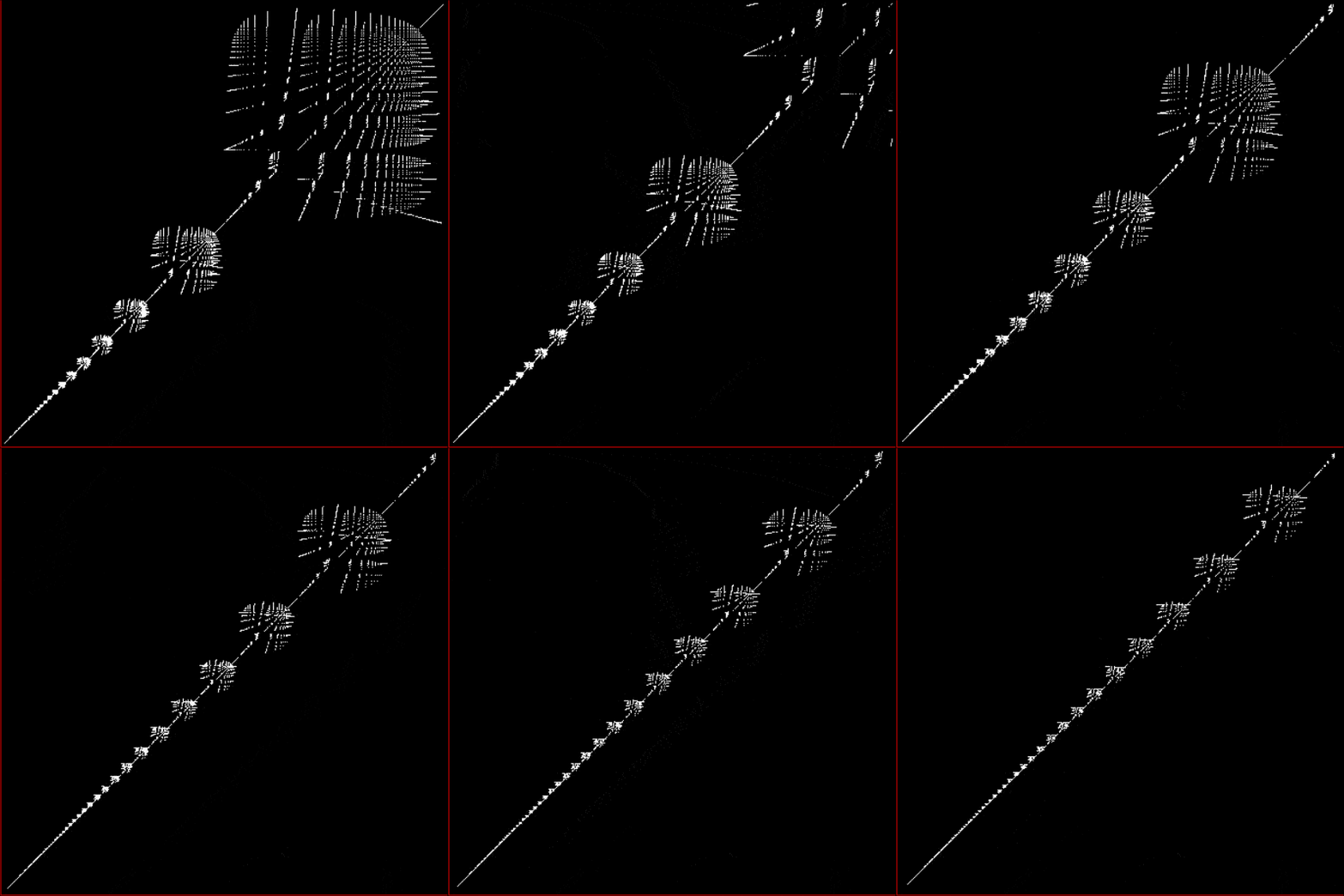
In one dimension, the fractality of the fractal isn’t obvious. But you can try draggin’ out (or dragon out) the fractality of the fractal by ferning the wyrm, as it were. Suppose that after the point jumps halfway towards one or another of the two points, it’s rotated by some angle around the midpoint of the two original points. When you do that, the fractal becomes more and more obvious. In fact, it becomes what’s called a dragon curve (in Old English, “dragon” was wyrm or worm):

Fractal with angle = 5°


Fractal 10°


Fractal 15°


Fractal 20°


Fractal 25°


Fractal 30°


Fractal 35°


Fractal 40°


Fractal 45°


Fractal 50°


Fractal 55°


Fractal 60°


Fractal 0° to 60° (animated at ezGif)


But as the angle gets bigger, an interesting aesthetic question arises. When is the ferned wyrm, the dragon curve, at its most attractive? I’d say it’s when angle ≈ 55°:

Fractal 50°


Fractal 51°


Fractal 52°


Fractal 53°


Fractal 54°


Fractal 55°


Fractal 56°


Fractal 57°


Fractal 58°


Fractal 59°


Fractal 60°


Fractal 50° to 60° (animated)


At angle >= 57°, I think the dragon curve starts to look like some species of bristleworm, which are interesting but unattractive marine worms:

A bristleworm, Nereis virens (see polychaete at Wikipedia)


Finally, here’s what the ferned wyrm looks like in black-and-white and when it’s rotating:

Fractal 0° to 60° (b&w, animated)


Fractal 56° (rotating)


Fractal 56° (b&w, rotating)


Double fractal 56° (b&w, rotating)


Previously Pre-Posted (Please Peruse)…

Curvous Energy — a first look at dragon curves
Back to Drac’ — another look at dragon curves

Toxic Turntable #30

Currently listening…

• Vrocsec, Rosa sub Luna (1981)
• Usward Quenched, Trust the Dust (2006)
• Under the Willows, Of Mouse and Man (1999)
• Doom Quota, A Gloomier Land Never Was (2009)
• Jay Victor Caldwell, Symphony in V Minor (1926)
• Elementic TS, Eight’s Too Late (2022)
• Gauntlet Fox, Evensongs of Eleven Counties (1971)
• Les Xenonymphes, Acétone (1995)
• Gnosthrill, God Gnose (1998)
• Malodious, Τῶν Βδελυγμάτων τῆς Γῆς (2007)
• Yickthraite, Om Gom Nom (1997)
• Koukog, Gluehouse (1997)
• Harold Meistmeyer, Best Of (1986)
• Uzuzuzu, We Want Wonders (1992)
• Kotzu, Zone of Clones (1985)
• Liam Tolloway, Ragtime Rex (1913)
• Ptosis, 1991 (1992)
• Nsurosus, Eight Cold Moons (1975)
• Rita Haunts Rita, Ghost to Ghost (2017)


Previously pre-posted:

Toxic Turntable #1#2#3#4#5#6#7#8#9#10#11#12#13#14#15#16#17#18#19#20#21#22#23#24#25#26#27#28#29

Graph durch Euler

This is the famous Ulam spiral, in which prime numbers are represented on filled squares on a square spiral:

The Ulam spiral


I like the way the spiral sits between chaos and calm. It’s not wholly random and it’s not wholly regular — it’s betwixt and between. You get a similar chaos-and-calm vibe from a graph for a function called Euler phi. And primes are at work there too. Here’s the graph from Wikipedia:

Graph of eulerphi(n) = φ(n) (see Euler’s totient function)


But what is the Euler phi function? For any integer n, eulerphi(n) gives you the count of numbers < n that are relatively prime to n. That is, the count of numbers < n that have no common factors with n other than one. You can see how eulerphi(n) works by considering whether you can simplify the fraction a/b, where a = 1..n-1 and b = n:

φ(6) = 2
1/6 (1)
2/6 → 1/3
3/6 → 1/2
4/6 → 2/3
5/6, ∴ φ(6) = 2


φ(7) = 6
1/7 (1)
2/7 (2)
3/7 (3)
4/7 (4)
5/7 (5)
6/7, ∴ φ(7) = 6


φ(12) = 4
1/12 (1)
2/12 → 1/6
3/12 → 1/4
4/12 → 1/3
5/12 (2)
6/12 → 1/2
7/12 (3)
8/12 → 2/3
9/12 → 3/4
10/12 → 5/6
11/12, ∴ φ(12) = 4


φ(13) = 12
1/13 (1)
2/13 (2)
3/13 (3)
4/13 (4)
5/13 (5)
6/13 (6)
7/13 (7)
8/13 (8)
9/13 (9)
10/13 (10)
11/13 (11)
12/13, ∴ φ(13) = 12


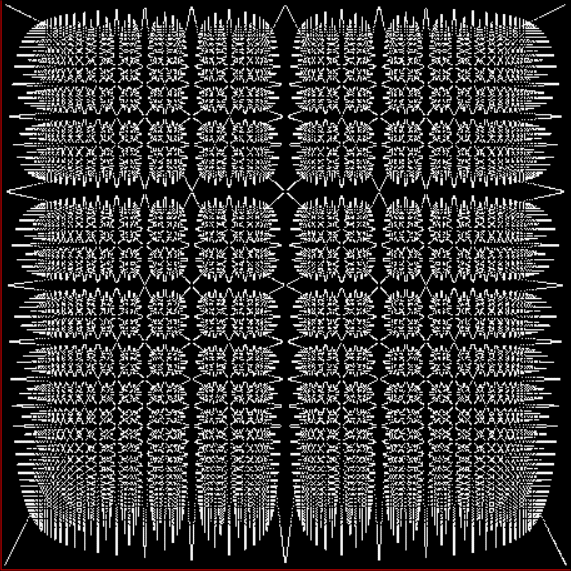
As you can see, eulerphi(n) = n-1 for primes. Now you know what the top line of the Eulerphi graph is. It’s the primes. Here’s a bigger version of the graph:

Graph of eulerphi(n) = φ(n)


Unlike the Ulam spiral, however, the Eulerphi graph is cramped. But it’s easy to stretch it. You can represent φ(n) as a fraction between 0 and 1 like this: phifrac(n) = φ(n) / (n-1). Using phifrac(n), you can create Eulerphi bands, like this:

Eulerphi band, n <= 1781


Eulerphi band, n <= 3561


Eulerphi band, n <= 7121


Eulerphi band, n <= 14241


Or you can create Eulerphi discs, like this:

Eulerphi disc, n <= 1601


Eulerphi disc, n <= 3201


Eulerphi disc, n <= 6401


Eulerphi disc, n <= 12802


Eulerphi disc, n <= 25602


But what is the bottom line of the Eulerphi bands and inner ring of the Eulerphi discs, where φ(n) is smallest relative to n? Well, the top line or outer ring is the primes and the bottom line or inner ring is the primorials (and their multiples). The function primorial(n) is the multiple of the first n primes:

primorial(1) = 2
primorial(2) = 2*3 = 6
primorial(3) = 2*3*5 = 30
primorial(4) = 2*3*5*7 = 210
primorial(5) = 2*3*5*7*11 = 2310
primorial(6) = 2*3*5*7*11*13 = 30030
primorial(7) = 2*3*5*7*11*13*17 = 510510
primorial(8) = 2*3*5*7*11*13*17*19 = 9699690
primorial(9) = 2*3*5*7*11*13*17*19*23 = 223092870
primorial(10) = 2*3*5*7*11*13*17*19*23*29 = 6469693230


Here are the numbers returning record lows for φfrac(n) = φ(n) / (n-1):

φ(4) = 2 (2/3 = 0.666…)
4 = 2^2
φ(6) = 2 (2/5 = 0.4)
6 = 2.3
φ(12) = 4 (4/11 = 0.363636…)
12 = 2^2.3
[…]
φ(30) = 8 (8/29 = 0.275862…)
30 = 2.3.5
φ(60) = 16 (16/59 = 0.27118…)
60 = 2^2.3.5
[…]
φ(210) = 48 (48/209 = 0.229665…)
210 = 2.3.5.7
φ(420) = 96 (96/419 = 0.2291169…)
420 = 2^2.3.5.7
φ(630) = 144 (144/629 = 0.228934…)
630 = 2.3^2.5.7
[…]
φ(2310) = 480 (480/2309 = 0.2078822…)
2310 = 2.3.5.7.11
φ(4620) = 960 (960/4619 = 0.20783719…)
4620 = 2^2.3.5.7.11
[…]
30030 = 2.3.5.7.11.13
φ(60060) = 11520 (11520/60059 = 0.191811385…)
60060 = 2^2.3.5.7.11.13
φ(90090) = 17280 (17280/90089 = 0.1918103209…)
90090 = 2.3^2.5.7.11.13
[…]
φ(510510) = 92160 (92160/510509 = 0.18052571061…)
510510 = 2.3.5.7.11.13.17
φ(1021020) = 184320 (184320/1021019 = 0.18052553…)
1021020 = 2^2.3.5.7.11.13.17
φ(1531530) = 276480 (276480/1531529 = 0.180525474868579…)
1531530 = 2.3^2.5.7.11.13.17
φ(2042040) = 368640 (368640/2042039 = 0.18052544540040616…)
2042040 = 2^3.3.5.7.11.13.17

Maven of Mixcegenation

The obfuscating and intentional doublespeak swirling around the emotive cauldron ingredients of “immigration”, “illegal immigration” and “small boats” has been intentionally leveraged into mainstream political and media jargon by Reform UK, big tech algorithms, and thence into the baying mob. […] We are daily enriched by, and should feel deeply indebted to, the many people of colour in this and other sectors of our society. — “This capitulation to racist rhetoric will not end well for Labour or Britain”, letter by Quentin Cowen of Laxfield, Suffolk in The Guardian, 18xi25


Post-Performative Post-Scriptum

“The obfuscating and intentional doublespeak swirling around the emotive cauldron of…” woulda bin even betterer. If the ingredients aren’t bubbling away in the emotive cauldron, why would doublespeak bother to swirl around them? It certainly wouldn’t swirl around them as much, one would’ve thought. And does “emotive cauldron ingredients” mean “emotive-cauldron ingredients” or “emotive cauldron-ingredients”? Maybe it’s both. I’m also struck by the implications of “intentionally leveraged”. Is it possible to “unintentionally leverage” something? Not in this context, one would have thought. And if doublespeak is swirling, that is, if it’s fluid, it’s hard to see how one could exert leverage on it.

Etc, etc. Like all the best Guardianese, this passage is passionately pregnant with interrogation-inducing imagery in a way that is very difficult to achieve by conscious effort. Perhaps Quentin has been smoking some wacky baccy or other psychoactive stimulant supplied by one of the many Persons of Colour enriching his life and fighting da power in da extensive hoodz of Laxfield, Suffolk.

Talking Stalking…

“Most of the trouble in the world has been caused by ten to twenty percent of folks who can’t mind their own business, because they have no business of their own to mind, any more than a smallpox virus.” — Bill Burroughs

“I could a tale unfold whose lightest word
Would harrow up thy soul, freeze thy young blood,
Make thy two eyes like stars start from their spheres,
Thy knotted and combined locks to part,
And each particular hair to stand on end
Like quills upon the fretful porpentine.
But this eternal blazon must not be
To ears of flesh and blood.
List, list, O list!” — Bill Shakespeare

Aldapuerta’s Acute Angst… A Toxic True Tale of Traumatic Teratotropism…

Hue Views

The fact is, we none of us enough appreciate the nobleness and sacredness of color. Nothing is more common than to hear it spoken of as a subordinate beauty, — nay, even as the mere source of a sensual pleasure; and we might almost believe that we were daily among men who

“Could strip, for aught the prospect yields
To them, their verdure from the fields;
And take the radiance from the clouds
With which the sun his setting shrouds.”

But it is not so. Such expressions are used for the most part in thoughtlessness; and if the speakers would only take the pains to imagine what the world and their own existence would become, if the blue were taken from the sky, and the gold from the sunshine, and the verdure from the leaves, and the crimson from the blood which is the life of man, the flush from the cheek, the darkness from the eye, the radiance from the hair, — if they could but see for an instant, white human creatures living in a white world, — they would soon feel what they owe to color. The fact is, that, of all God’s gifts to the sight of man, color is the holiest, the most divine, the most solemn. We speak rashly of gay color, and sad color, for color cannot at once be good and gay. All good color is in some degree pensive, the loveliest is melancholy, and the purest and most thoughtful minds are those which love color the most.

• John Ruskin, The Stones of Venice, Vol II, Chapter 5, xxx