World Wide Watchmen

I prefer to self-issue books in a library. It’s quicker and more convenient. And you feel okay about borrowing books suggestive of sordid and socially unacceptable tastes. For example, who would want to hand a copy of Watch You Bleed to a live librarian?

Well, I wouldn’t mind. I find it amusing to be mistaken for a Guns’n’Roses fan, just as I find it amusing to be mistaken for a Guardian-reader. But there are limits, so I’m grateful for self-issue when I borrow, say, a biography of Martin Amis or that book about The Simpsons. The trouble is, nowadays we have to be more dubious about self-issue than we used to be. It’s all on computer and it isn’t just librarians who might be scanning the record of books you borrow. No, you also have to ask yourself: What will the NSA, GCHQ and MOSSAD think?

With this in mind, I’d like to put it clearly on record: I got that book out last year for research purposes only. Nothing more. I am not – repeat not – a fan of Iron Maiden. The same applies to that other book this year. I got it out for research purposes only, I swear. Inter alia, I had a hypothesis to confirm. I am not – repeat not – a fan of his.

Front cover of Iron Maiden: On Board Flight 666

And was the hypothesis confirmed? Yes, thanks for asking, it was.


As for Big Numbers, Moore asserted: “It is the most advanced comic work I’ve ever done in terms of the storytelling.” — Magic Words: The Extraordinary Life of Alan Moore, Lance Parkin, pg. 266 (Aurum 2013)


Elsewhere other-posted:

Ex-term-in-ate!

He Say, He Sigh, He Sow #23

“Brion knew it wasn’t William’s fault. But in terms of the general popular culture not recognizing the importance of his contribution, there was a little bitterness.” — phantasmagoric freethinker Genesis P-Orridge interrogates issues around Brion Gysin and William S. Burroughs.


Elsewhere other-posted:

Ex-term-in-ate!

Septics vs Dirties

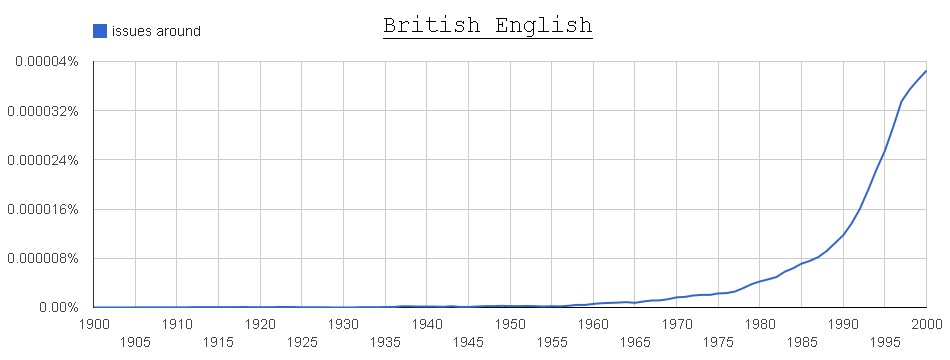
Some interesting patterns at Google’s Ngram Viewer (please follow the links to see the original images with further statistics):

in terms of (American + British English)

in terms of (American + British English)


in terms of (American English)

in terms of (American English)


in terms of (British English)

in terms of (British English)


issues around (American + British English)

issues around (American + British English)


issues around (American English)

issues around (American English)


issues around (British English)

issues around (British English)


Previously pre-posted (please peruse):

Titus Graun
Ex-term-in-ate!
Reds under the Thread

The Term Turns dot dot dot

In Titus Graun, I interrogated issues around the Grauniness, or Guardianisticity, of two keyly committed core components of the counter-cultural community: the semiotician Stewart Home and the æsthetician John Coulthart. Seeking to utilizate their usage-metrics for the core/epicentral Guardianista phrase “in terms of” (i.t.o.), I interrogated their personal websites like this in terms of January 2013:

site:http://www.johncoulthart.com “in terms of”
About 2,180 results

site:http://www.johncoulthart.com “the”
About 8,860 results

site:http://www.johncoulthart.com “and”
About 8,150 results


site:http://www.stewarthomesociety.org “in terms of”
About 123 results

site:http://www.stewarthomesociety.org “the”
About 602 results

site:http://www.stewarthomesociety.org “and”
About 599 results

Noting that Coulthart’s site used “the/and” approximately 14 times more often than Home’s, I adjusted Home’s raw i.t.o.-score accordingly: 123 x 14 = 1722. I concluded that Coulthart, with an i.t.o.-score of 2180, was approximately 26·59% Graunier than Home – exactly as one might have hoped, given that Coulthart is not merely a Guardianista (good), but a gay Guardianista (doubleplusgood). But that was in terms of January. When I re-interrogated their websites in terms of June 2013, I discovered that the semiotic situation had transitioned in a most disturbing and disquieting way:

site:http://www.johncoulthart.com “in terms of”
About 1,080 results

site:http://www.johncoulthart.com “the”
About 8,680 results

site:http://www.johncoulthart.com “and”
About 8,010 results


site:http://www.stewarthomesociety.org “in terms of”
About 119 results

site:http://www.stewarthomesociety.org “the”
About 541 results

site:http://www.stewarthomesociety.org “and”
About 536 results

I was aghast (literally) to see that Coulthart’s i.t.o.-metrics have spiked (in reverse). Other lexicostatistical metrics have transitioned relatively little: his site now seems to use “the/and” approximately 15·5 times more often than Home’s. Home’s raw i.t.o.-score is 119 and 119 x 15·5 = 1844·5. So it is now Home who is approximately 70·78% Graunier than Coulthart.

This can only be described as highly suspicious. What has Coulthart been up to? Has he been spraying his site with verbicide? Has he donned a black Savoy nihilinja-suit™, crept out under cover of darkness and clubbed innocent i.t.o.’s as they lay basking in the feral radiance of Manchester’s Most Maverick Messiahs? If so, this is “‘Pushing the Transgressive Envelope Too Far’ Too Far” too far. Even M.M.M.M. must look askance at behaviour like that. Surely.


Previously pre-posted (please peruse):

Titus Graun
Ex-term-in-ate!
Reds under the Thread

Fifty Sense

I can recommend George Orwell’s essay “Politics and the English Language” (1946) to anyone who wants to write better English. Or better French, Georgian, Arabic, Mandarin or Tagalog, because some of Orwell’s advice is universal. But perhaps the essay is partly a joke: Orwell may deliberately have committed some of the literary sins he criticizes. Or not deliberately. Orwell wasn’t infallible, despite his modern cult. He wasn’t a perfect observer either, but I don’t think his failure to criticize “in terms of” in the essay is a bad oversight. The phrase wasn’t the blight in his day that it is today. All the same, you can see its spores beginning to drift through the flower-beds of English literature in the 1930s and ’40s. Orwell himself uses it nineteen times in the Fifty Orwell Essays available at the Australian Gutenberg site. But that’s roughly one I.T.O. for every 12,000 words or 2·63 essays, which I think is a healthy ratio. No I.T.O.’s at all would have been even healthier, though some are defensible and may be the best way of expressing Orwell’s thought. Others, however, seem to me to be tending towards Guardianese. I’ve collected them all here and suggested alternatives. Sometimes it might be better to re-write more fully, but only two alternatives are longer than the I.T.O. they replace (orthographically, at least).

From Charles Dickens:

More completely than most writers, perhaps, Dickens can be explained in terms of his social origin, though actually his family history was not quite what one would infer from his novels. → More completely than most writers, perhaps, Dickens can be explained by / through his social origin, though actually his family history was not quite what one would infer from his novels.

What now strikes us as remarkable about the new moneyed class of the nineteenth century is their complete irresponsibility; they see everything in terms of individual success, with hardly any consciousness that the community exists. → What now strikes us as remarkable about the new moneyed class of the nineteenth century is their complete irresponsibility; they see everything by / through individual success, with hardly any consciousness that the community exists.

When he speaks of human progress it is usually in terms of moral progress – men growing better; probably he would never admit that men are only as good as their technical development allows them to be. → When he speaks of human progress it is usually as moral progress – men growing better; probably he would never admit that men are only as good as their technical development allows them to be.

I have been discussing Dickens simply in terms of his “message”, and almost ignoring his literary qualities. → I have been discussing Dickens simply by / through his “message”, and almost ignoring his literary qualities.

The truth is that it is absurd to make such comparisons in terms of “better” and “worse”. → The truth is that it is absurd to make such comparisons with / by “better” and “worse”.

Charles Dickens (1940)


From Inside the Whale:

Alliances, changes of front etc., which only make sense as part of the game of power politics have to be explained and justified in terms of international socialism. → Alliances, changes of front etc., which only make sense as part of the game of power politics have to be explained and justified by / through international socialism.

Miller replied in terms of extreme pacifism, an individual refusal to fight, with no apparent wish to convert others to the same opinion – practically, in fact, a declaration of irresponsibility. → Miller replied as an extreme pacifist, as an individual refusing to fight, with no apparent wish to convert others to the same opinion – practically, in fact, a declaration of irresponsibility.

Inside the Whale (1940)


From The Lion and the Unicorn:

At the same time the Labour Party was a Socialist party, using Socialist phraseology, thinking in terms of an old-fashioned anti-imperialism and more or less pledged to make restitution to the coloured races. → At the same time the Labour Party was a Socialist party, using Socialist phraseology, thinking of / by an old-fashioned anti-imperialism and more or less pledged to make restitution to the coloured races.

Because the time has come when one can predict the future in terms of an “either–or”. → Because the time has come when one can predict the future with / by an “either–or”.

The Lion and the Unicorn: Socialism and the English Genius (1941)


From Looking Back on the Spanish War:

I saw, in fact, history being written not in terms of what happened but of what ought to have happened according to various “party lines”. → I saw, in fact, history being written not by what happened but by what ought to have happened according to various “party lines”.

Looking Back on the Spanish War (1942)


From Antisemitism in Britain:

There is more antisemitism in England than we care to admit, and the war has accentuated it, but it is not certain that it is on the increase if one thinks in terms of decades rather than years. → There is more antisemitism in England than we care to admit, and the war has accentuated it, but it is not certain that it is on the increase if one thinks in decades rather than years.

Antisemitism in Britain (1945)


From In Defence of P. G. Wodehouse:

He had missed the turning-point of the war, and in 1941 he was still reacting in terms of 1939. → He had missed the turning-point of the war, and in 1941 he was still reacting as though it were 1939.

In Defence of P. G. Wodehouse (1945)


From Notes on Nationalism:

A nationalist is one who thinks solely, or mainly, in terms of competitive prestige. → A nationalist is one who thinks solely, or mainly, of / by competitive prestige.

In practice, however, the necessary calculations cannot be made, because anyone likely to bother his head about such a question would inevitably see it in terms of competitive prestige. → In practice, however, the necessary calculations cannot be made, because anyone likely to bother his head about such a question would inevitably see it through / by competitive prestige.

But Chesterton was not content to think of this superiority as merely intellectual or spiritual: it had to be translated into terms of national prestige and military power, which entailed an ignorant idealisation of the Latin countries, especially France. → But Chesterton was not content to think of this superiority as merely intellectual or spiritual: it had to be translated into national prestige and military power, which entailed an ignorant idealisation of the Latin countries, especially France.

History is thought of largely in nationalist terms, and such things as the Inquisition, the tortures of the Star Chamber, the exploits of the English buccaneers (Sir Francis Drake, for instance, who was given to sinking Spanish prisoners alive), the Reign of Terror, the heroes of the Mutiny blowing hundreds of Indians from the guns, or Cromwell’s soldiers slashing Irishwomen’s faces with razors, become morally neutral or even meritorious when it is felt that they were done in the ‘right’ cause. → History is thought of largely through nationalism, and such things as the Inquisition, the tortures of the Star Chamber, the exploits of the English buccaneers (Sir Francis Drake, for instance, who was given to sinking Spanish prisoners alive), the Reign of Terror, the heroes of the Mutiny blowing hundreds of Indians from the guns, or Cromwell’s soldiers slashing Irishwomen’s faces with razors, become morally neutral or even meritorious when it is felt that they were done in the ‘right’ cause.

Notes on Nationalism (1945)


From The Sporting Spirit:

It is the most violently combative sports, football and boxing, that have spread the widest. There cannot be much doubt that the whole thing is bound up with the rise of nationalism – that is, with the lunatic modern habit of identifying oneself with large power units and seeing everything in terms of competitive prestige. → There cannot be much doubt that the whole thing is bound up with the rise of nationalism – that is, with the lunatic modern habit of identifying oneself with large power units and seeing everything by competitive prestige.

The Sporting Spirit (1945)


From Books vs. Cigarettes:

Exactly what reading costs, reckoned in terms of pence per hour, is difficult to estimate, but I have made a start by inventorying my own books and adding up their total price. → Exactly what reading costs, reckoned in pence per hour, is difficult to estimate, but I have made a start by inventorying my own books and adding up their total price.

There are books that one reads over and over again, books that become part of the furniture of one’s mind and alter one’s whole attitude to life, books that one dips into but never reads through, books that one reads at a single sitting and forgets a week later: and the cost, in terms of money, may be the same in each case. → There are books that one reads over and over again, books that become part of the furniture of one’s mind and alter one’s whole attitude to life, books that one dips into but never reads through, books that one reads at a single sitting and forgets a week later: and the cost, in money, may be the same in each case.

Books vs. Cigarettes (1946)


From Writers and Leviathan:

Quite largely, indeed, the workers were won over to Socialism by being told that they were exploited, whereas the brute truth was that, in world terms, they were exploiters. → Quite largely, indeed, the workers were won over to Socialism by being told that they were exploited, whereas the brute truth was that, viewed from overseas, they were exploiters.

Writers and Leviathan (1948)


From Reflections on Gandhi:

Even when he was fighting what was in effect a color war, he did not think of people in terms of race or status. → Even when he was fighting what was in effect a color war, he did not think of people by race or status.

At the same time there is reason to think that Gandhi, who after all was born in 1869, did not understand the nature of totalitarianism and saw everything in terms of his own struggle against the British government. → At the same time there is reason to think that Gandhi, who after all was born in 1869, did not understand the nature of totalitarianism and saw everything through his own struggle against the British government.

Reflections on Gandhi (1949)


Previously pre-posted (please peruse):

Ex-term-in-ate!

Titus Graun

Reds Under the Thread

Homotextuality

In terms of the highest levels of the United Kingdom’s counter-cultural community, it seems to be compulsory for non-conformists, mavericks, free-thinkers et al to be committed readers of The Guardian (which was nicknamed The Grauniad by Private Eye in honour of the misspellings once common there). Naturally enough, committed Guardian-readers use the special dialect of English known as Guardianese (which is also found in The Times Literary Supplement, The London Review of Books, etc). And there are a lot of such Guardianistas in the counter-cultural community, trust me. So the obvious question arises:

Myriads, myriads, off the wall,
Who is the Grauniest of them all?

Continue reading Homotextuality

’Ville to Power

The SWP's red fist (lefthanded)

As a life-long socialist, it’s impossible to deny that, yes, there are a few self-righteous windbags on the left. And in terms of issues around self-important halfwits, again, yes, as a life-long socialist, it’s far from not unimpossible to disrefute the notion that, yes, they aren’t unknown on the left either. But they are, I must insist, the exceptions that prove the rule. And to me, personally, the rule, i.e. the non-exceptions, is/are best represented by the award-winning author’n’academic China Miéville (b. 1972), who has done for science fiction and fantasy what Karl Marx (b. 1818) did for politics and economics. Okay, I have heard it suggested that Miéville’s writing is as exciting and unpredictable as his hair. In reply to that, all I’d have say is this: “Read one of his award-winning books, monkey-funker!” I’ve also witnessed it adumbrated that he has a torturer’s face. In reply to that, I would simply say this:

1) No he hasn’t.
2) And even if he has it’s woefully misleading because
3) He is (at the time of writing) a member of the Socialist Workers Party.

And can you imagine a potential torturer belonging to a Trotskyist party like the S.W.P.? Well, there you go, then. Anyway, as a keyly committed comrade in the Mythopoetic Miéville Massiv, it’s been very difficult to process my emotion at an angst-y article recently written by my heresiarchic hero about his beloved revolutionary corps d’élite (i.g., the S.W.P.). Yes, super-intellect China Miéville, award-winning author’n’academic, has discovered that a Trotskyist party – a Trotskyist party – can be not just a wee bit authoritarian, but also a wee bit dishonest, too. And also a wee bit anti-democratic, in addition! And is he pleased? You’re monkey-funkin’ right he isn’t! You may, like me, find it difficult to credit what you’re reading when you engage issues around his curt’n’concise cri du cœur. Yes, check out his non-self-righteous non-windbaggery for yourselves, comrade-skis: The Stakes.

The S.W.P. Central Committee? “Catastrophic errors of principle and process”? “Belief-beggaringly inadequate and arrogant”? By the Goat with a Thousand Young, whatever next?!? Speaking personally, for myself, I’ve not been so gobsmacked since I heard that Andy Coulson, former Downing Street Press Secretary, had been involved in something a teensy bit dodgy while editing The News of the World (prop. R. Murdoch).

P.S. Don’t neglect to engage the other engagements around the topic of Trotsko-toxicity in terms of that shining ornament of the Far Left, the ever-readable Lenin’s Tomb (prop. R. Seymour). Here are some tantalizing titbits:

I first became aware of the very serious nature of the allegations against Comrade Delta in late Autumn 2012 (not long after they had been made); as a result of a number of comrades, most of whom I have known for several years, contacting me to express their understandable grave concern. It immediately became clear to me that the information comrades had been given at the 2011 SWP Conference – that Comrade Delta had had an affair which had ended but that he had continued to hassle the woman (now referred to as Comrade W) afterwards – was quite seriously inaccurate. It adds insult to injury to recall that the session in which we were given this misleading information at the 2011 conference was turned into a kind of Delta love-in, culminating in a standing ovation for him (even at this stage it was effectively a standing ovation for having an affair) – but this demonstrates the effect that stage-managing a conference can have. Some party members resigned in protest at this time.

SWP in Crisis: What Do Socialists Say?


I recently started a degree, and was stunned to discover a whole new world of intersectionality, gender politics, and critical studies of which I had been unaware. I felt unequipped by what I had learnt so far during 8 years of membership to meet these new analyses head on. Now I feel like I exist in two discourses; a classical Marxist tradition – and the language and ideas I have had to develop to be able to continue to apply Marxist ideas in my studies, in talking and activity with other students, and in making sense of new understandings of oppression. I do not believe the latter conflicts with the former, but there is no space to discover how they interrelate within the party at the moment.

SWP and women’s liberation


We do reject the bourgeois system of justice but in this case aspects of the bourgeois process were used, and having read the available documents relating to this case it is not convincing that there was a there a clear analysis and understanding of what aspects of an investigatory and quasi-judicial process were accepted and which were rejected. Clear decisions around process needed to be made and then fully explained to the complainant so that she was aware of what exactly she was getting into, its limitations and how effective it could possibly be in terms of her need for a resolution and could make her own choice on that basis.

Letter to the Central Committee


Previously pre-posted (please peruse):

Reds under the Thread

Ex-term-in-ate!

He Say, He Sigh, He Sow

“It’s only really in the last decade or so that I’ve started to engage seriously with what I think the implications of modernism are in terms of the novel…” – Will Self, The Observer, Sunday, 5th August, 2012.


Pre-Previously Posted (Please Peruse)

Ex-Term-In-Ate!

Ex-term-in-ate!

In terms of keyly core components of Guardianese, the dialect of those who read and write for The Guardian, Britain’s premier papyrocentric purveyor of progressive performativity, there can be little or no doubt that at the key core is the phrase I began this sentence with: “in terms of”. Arguably it is the keyliest corest component of all. It’s a bad sign if you use it even a little; if you use it a lot, it’s time to mend your ways. Siriusly. But whatever your own issues in terms of usage metrics for I.T.O., you’ll certainly hear this phrase a lot throughout the English-speaking world. In terms of communities / demographics like politics, academia and the media, it’s a kind of linguistic bindweed: a tough, fast-growing weed smothering everything in sight.

Unlike bindweed, however, it doesn’t produce beautiful flowers or grow in interesting ways. What’s wrong with “in terms of” was summed up very well by the Australian comedian and satirist Barry Humphries, the creator of Dame Edna Everage and Sir Les Patterson. He re-wrote the title of a famous film as One Flew Over In Terms of the Cuckoo’s Nest. “In terms of” is beloved of those who want long ways to say short things. Its use is usually unnecessary, never essential. As a keyly committed component of the core I.T.O.phobic community, I never use it except to take the piss of the Guardianista demographic. The mission statement of the Guardian might be “Purveying pretentious prose to pretentious people since 1959.” “In terms of” is corely key to this mission. The lexicographer Robert Burchfield discussed its origins in The New Fowler’s Modern English Usage (1996):

How did this complex preposition come into being? The OED [Oxford English Dictionary] reveals that it has been in use since the mid-18c. as a mathematical expression “said of a series… stated in terms involving some particular (my emphasis) quantity”, and illustrates this technical usage by citing examples from the work of Herbert Spencer (1862), J. F. W. Herschel (1866), and other writers. From this technical use came at first a trickle and, after the 1940s, a flood of imitative uses by non-mathematicians. (Op. cit., entry for “in terms of”).

I suggest that the flood of imitative uses was flattery. Mathematicians are highly intelligent and intellectually rigorous people. Non-mathematicans wanted to pretend to themselves that they were highly intelligent and intellectually rigorous too. “In terms of” lends a judicious, thoughtful air to one’s prose or speech. It’s a good way of disguising the absence of judgment or thought. This is one reason it’s so popular among politicians, who need ways to sound impressive and say little. Burchfield condemns its use as a “vague all-purpose connective” in politics and broadcasting, but concludes, after listing examples of I.T.O. in action, that it may be a “useful particularizing device” in general prose. He’s wrong. All his examples can be re-written to be better English:

The impact of Ibsen… did much to revitalize the degenerate English theatre and force it to think in terms of living ideas and contemporary realities. J. Mulgan and D. M. Davin, 1947. (My suggestion: …force it to use living ideas…)

Dataquest pegs ESRI as the leading GIS company—in terms of both revenue and reputation. Computer Graphics World, 1988. (Dataquest lists ESRI as… in both revenue and reputation)

He deals with the converso judaizing world in terms of its social and religious rituals, births, marriages, deaths, leading to the establishment of the Inquisition. The Bulletin of Hispanic Studies, 1990. (…through its social and religious rituals…)

Rameau… conceived his music precisely in terms of timbres, types of attack, degree of sostenuto. Country Life, 1990. (…in timbre, type of attack…)

Justifying space in terms of material wealth is as ridiculous as saying that man went to the Moon merely to be able to return with velcro zips and non-stick frying pans. New Scientist, 1991. (…space [exploration] by its material benefits…)

The dating of his novels in terms of when they were written rather than when they were published is often uncertain, since in the upheavals of exile some were not published chronologically. New York Review of Books, 1991. (…his novels by when they were written…)

The re-writing makes them better English, but not necessarily good English. Writers who use “in terms of” are generally bad writers. That’s why I’m unsurprised to see The New York Review of Books in the list. Like its twin on this side of the Atlantic, The London Review of Books, its mission statement might be “Purveying Pathological Prose to Pathological People.” A core component of this pathology is “in terms of”. My reaction to I.T.O. is I.T.T.O.! In other words: It’s Time To Obliterate In Terms Of. This lexical bindweed doesn’t flower: pluck it out wherever you find it in your linguistic garden. I’ve allowed other weeds to spring up here and there in terms of issues around the prose of this polemic, but I do my best to keep my bad English deliberate.

Guardianistas and their equivalents overseas produce bad English the way cows produce methane: copiously and unconsciously. And the internet has allowed their bad English to billow forth as never before. Wikipedia, for example, is like an experimental farm on which they can fart all day and every day, polluting the English language in vibrant new ways. “In terms of” is keyly core to their methanogenic mission. I groan when I see it in Wikipedia articles about people like, say, Saki or Clark Ashton Smith. I grin when I see it in articles about people like, say, William S. Burroughs or Alan T. Moore. Some people deserve bad prose. Some people don’t. I hope you and your favourite writers are among the latter. Siriusly. “In terms of” sucks! “Sucks” sucks too! Just say no to I.T.O.!


Proviously post-posted (please peruse):