Performativizing Papyrocentricity #20

Papyrocentric Performativity Presents:

Clive AliveC.S. Lewis: A Life, Alister McGrath (Hodder & Staughton 2013)

Ink TuneNick Drake: Dreaming England, Nathan Wiseman-Trowse (Reaktion Books 2013)

Stan’s FansAwaydays, Kevin Sampson (Vintage 1998)

Words at WarPoetry of the First World War: An Anthology, ed. Tim Kendall (Oxford University Press 2013) (posted @ Overlord of the Über-Feral)


Or Read a Review at Random: RaRaR

Performativizing Papyrocentricity #18

Papyrocentric Performativity Presents:

Der ÜbergmenschDougal Haston: The Philosophy of Risk, Jeff Connors (Canongate Books 2002)

Book with Bite Steve Backshall’s Most Poisonous Creatures, Steve Backshall (New Holland 2013)

The Politics of PretenceMo Mowlam: The Biography, Julia Langdon (Little, Brown 2000)

Guns’n’GladioliA Light That Never Goes Out: The Enduring Saga of the Smiths, Tony Fletcher (Windmill Books 2013) (posted @ Overlord of the Über-Feral)

Think Ink50 Quantum Physics Ideas You Really Need to Know, Joanne Baker (Quercus 2013) (posted @ O.o.t.Ü.-F.)


Or Read a Review at Random: RaRaR

Guns’n’Gladioli

Front cover of A Light That Never Goes Out by Tony FletcherA Light That Never Goes Out: The Enduring Saga of the Smiths, Tony Fletcher (Windmill Books 2013)

Coke, booze, earsplitting volume. Not a combination you associate with the Smiths. But it was there, as you’ll learn from this book. Towards the end, they were almost turning into Guns’n’Gladioli. Morrissey, of course, was the odd one out: he wasn’t battering his brain-cells with drink and drugs on their final American tour. But back home his Lichtmusik was also lout-music: the Smiths didn’t just appeal to bedsit miserabilists in rain-hammered humdrum towns. No, they appealed to some football hooligans too, including a Chelsea fan who didn’t mind being asked, “You still wanking off over that miserable northern poof?” as he travelled north by train to do battle with Manchester United and Manchester City, who also supplied hoolifans to the Smiths (pp. 509-10). So did football clubs in Glasgow and Edinburgh. The Smiths are easy to caricature, but the caricatures don’t capture their complexity.

Tony Fletcher does capture it: the band, their music, their fans, friends, producers, studio-engineers and record-labels. He’s definitely a Guardianista, but his prose is plodding rather than painful and he does a good job of putting the poof and his partners into context. The 1980s is one important part of that context. So are Irish Catholicism and Manchester. When you look at pictures of the Smiths, you can see two clear divisions. One of them separates the singer, guitarist and drummer from the bassist: the dark-haired, bushy-browed, strong-faced Morrissey, Johnny Marr and Andy Rourke clearly belong to one race and the light-haired, lesser-browed, milder-faced Mike Joyce to another. They’re Irish and he’s English: the British Isles are rich in language and rich in biology too. But Morrissey’s height and handsomeness also separate him from Marr, Rourke and Joyce, like his polysyllabic name. Both must be related to his intelligence, his creativity and his ability to turn himself into the Pope of Mope and become much more famous than any of the other three. Fletcher doesn’t talk about this biology – as I said, he’s a Guardianista – but it’s implicit in his descriptions of Irish settlement in Manchester and of Morrissey’s genius.

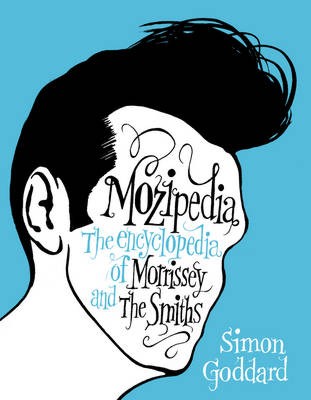
Is that too strong a word? Maybe. Morrissey is certainly the interesting and original one in this book and it ends with his story only just beginning. You can feel the tug of his later career throughout the book: it’s not discussed, but you know it’s there. But Fletcher isn’t concentrating on Morrissey and doesn’t seem very interested in Carry On and Brit-film in the 1960s, so he’s less good on what might be called the Smythos: the world created by Morrissey in his lyrics and interviews. Morrissey’s influences are better explained in Simon Goddard’s Mozipedia (2009), which isn’t just about the New York Dolls, the Cockney Rejects and vegetarianism. It has also entries for everyone from Hawtrey and Housman to Williams and Wilde by way of Sandy Shaw, Shelagh Delaney and Jobriath. No-one will ever devote an encyclopaedia to Marr like that: music doesn’t have as much meaning and metaphor in it. It has emotion and beauty instead and Fletcher is good at describing how Marr created a lot of both on albums like Meat Is Murder and Strangeways Here We Come.

Front cover of Mozipedia by Simon Goddard

Front cover of Mozipedia by Simon Goddard

I’ve never liked him much, though. I like what he did with the guitar and in the studio, but I don’t like what he did to his body and mind. Or what he put on his body: he didn’t have Mozza’s way with weeds either. In the photos, you can clearly see Morrissey’s narcissism and Marr’s weediness. It’s no surprise that Marr smoked a lot of marijuana, preferred working at night and didn’t eat properly. But he’s weedy in more ways than the physical: there’s also a photo of him with Billy Bragg, the committed socialist behind Red Wedge. This was a collective of musicians and bands who wanted to make the world a better place by fighting Fatcher, fascism and free speech with their fantastic music. Morrissey had his lefty opinions too, but he didn’t like collectives and he didn’t scorn just Margaret Thatcher and the Queen: Bob Geldof and Live Aid got the sharp side of his tongue too. Which is good. Mozza is worshipped by Guardianistas, but he’s not a Guardianista himself.

Or not wholly. The hive-mind hasn’t been able to hum him fully into line, unlike Marr and Bragg. As for Rourke and Joyce: their politics don’t matter and the most interesting thing one of them does in this book is get stung by a sting-ray (pp. 539-40). They were competent musicians, but they weren’t essential to the Smiths. Joyce is most important for causing trouble, not for strumming his bass: first there was the heroin addiction, then the 21st-century court-case in which he sued for more money and earnt Morrissey’s undying enmity. Fletcher barely mentions the court-case and ends the book in the 1980s, with the Smiths exhausted, antagonistic and unfulfilled. They never achieved their full potential and though few bands do, few bands have had more to offer than the Smiths. The Beatles were one and managed to offer it from the nearby northern city of Liverpool. They were Irish Catholic too. But, like the Smiths, they achieved success in England, not Ireland. That’s important and the younger band captured it in their name. “Smiths” is an Anglo-Saxon word with ancient roots and difficult phonetics. It seems simple, but it isn’t. Rather like light.

More Musings on Music

Black Mother Nirvana — from the potency of Purushmedh to the blast-beat barrage of Bodhisattva

Groaning and Grieving — the ashen passion of Slough of Despond

Pummelling Putridity — probing the purulence and putrefaction of Paraphistomiasis


Elsewhere other-posted:

• More Musings on Music

Performativizing Papyrocentricity #15

Papyrocentric Performativity Presents:

Brought to BookA Book of English Essays, selected by W.E. Williams (Pelican 1942)

GlamourdämmerungTreasures of Nirvana, Gillian G. Gaar (Carlton 2011)

Highway to Hell – The Road, Cormac McCarthy (2006)

Solids and ShadowsAn Adventure in Multidimensional Space: The Art and Geometry of Polygons, Polyhedra, and Polytopes, Koji Miyazaki (Wiley-Interscience 1987) (posted @ Overlord of the Über-Feral)

Magna Mater MarinaThe Illustrated World Encyclopedia of Marine Fish and Sea Creatures, Amy-Jane Beer and Derek Hall (Lorenz Books 2007) (@ O.o.t.Ü.-F.)


Or Read a Review at Random: RaRaR

Court in the Act

Cover of Bombshell by The PrimitivesBombshell: The Hits and More, The Primitives (1994)

In all walks of life, from pop music to drug-dealing, some people achieve far more success than their talents deserve and some people achieve far less. Paul Court, the song-writer for the late-’eighties-and-a-bit-of-the-’nineties indie group The Primitives, is one of the second group. And perhaps drug-dealing describes his largely unrewarded talents too. Like a drug, music is designed to alter your consciousness and some of the songs on this compilation album are perfect little pills of pop, filling your brain with a two- or three-minute rush of jingly-jangly melodic pleasure. And maybe jungly pleasure too: The Primitives were a primitive band in the garage-and-bubblegum-pop tradition, particularly when they played live. Female vox, occasional male backing vocals, guitar, bass and drums, and that was it. There was no pretension about them, but they achieved the kind of a-lot-in-a-little simplicity that only an intelligent and skilful songwriter can give a band.

“Crash”, their most famous song, both opens and closes the album (apart from the doubly unexpected hidden track). It appears first as the album track, then as a demo, and some of the other songs come in a second version, whether demo or acoustic. I enjoy the chance to hear the different interpretations, but this padding does reflect the brevity of their career, which stretched from about 1987 to about 1992. Unfortunately, a twice-misspelt “Way Behing Me” and the appearance of “Secrets (Demo)” as the already-heard album track rather than the demo also reflect the sloppiness of the German company that put the compilation out. Court deserved better. There’s further proof of that in the single cover version, “As Tears Go By” by the Rolling Stones. It’s given the light treatment of the early Primitives and isn’t anywhere near as good as Court’s own compositions, I’d say.

Bombshell by The Primitives (CD)

Perhaps that’s why he chose it, and perhaps the darker songs on their final album, “Glamour”, reflect his frustration at not achieving the success that seemed to await him in the beginning. But there was a big obstacle ahead of him: although bands with attractive female singers can get attention more easily, they find it harder to get taken seriously. The Primitives never did drop any bombshells in the end and I suspect that the title of this compilation is a self-ironizing acknowledgment of that, as well as a reference to Tracy’s gleaming blonde locks.

Voc and Rôle

Medieval music by Vox Vulgaris and Trouvère

At one time, people could never hear their own voices the way others heard them, because our own voices come to us partly through the flesh and bone of our skulls. Then phonographs and tape-recorders were invented and nowadays we all know what we really sound like. But what does the medieval music of groups like Vox Vulgaris and Trouvere really sound like? It comes to us through the flesh and bone of history and we listen to it with uninnocent ears, soaked in a hundred different genres. Medieval music doesn’t stand alone any more, it stands in contrast: acoustic, not amplified; simple, not complex; authentic, not artificial.

Or is it authentic? No, because it’s not the music that comes most readily to hand or to ear any more. Playing it and listening to it are roles you choose, not roles you’re born into, because it’s part of a cultic fringe nowadays. Ferns once ruled the forests; now they’re pushed to the damp or rocky margins by more advanced plants. So this is ferny music: fresh, green and simple, with a glamour of exile and overthrow. You can hear that glamour more strongly in Trouvere, who play slow, sad and sometimes stately music that seems both to celebrate and to lament the Middle Ages. Vox Vulgaris, which literally means “Popular Voice”, celebrate and don’t lament: they’re raucous and almost rocking and sound like a group for inns and peasants’ weddings, not for courts and cathedrals. They’re fun, not bittersweet like Trouvere, who remind me of the Early Music Consort of London. But, like Vox Vulgaris, Trouvere play instrumentals and don’t add lost languages to their lost music.

The music is enough, but they’re surely playing it with a modern accent that would raise smiles or laughter in a real medieval audience. We can’t go back and that is part of why their music is so attractive. It lilts, it longs and it laments, searching for something it will never find. And that is another way Trouvere evoke the Middle Ages:

La royne Blanche comme ung lys,
Qui chantoit à voix de sereine;
Berthe au grand pied, Bietris, Allys;
Harembourges, qui tint le Mayne,
Et Jehanne, la bonne Lorraine,
Qu’Anglois bruslèrent à Rouen;
Où sont-ilz, Vierge souveraine?…
Mais où sont les neiges d’antan!

“Ballade des dames du temps jadis”, François Villon (1431-c.1485)

White Queen Blanche, like a queen of lilies,
With a voice like any mermaiden,—
Bertha Broadfoot, Beatrice, Alice,
And Ermengarde the lady of Maine,—
And that good Joan whom Englishmen
At Rouen doomed and burned her there,—
Mother of God, where are they then?…
But where are the snows of yester−year.

Translation by Rossetti.

A Diet of Quiet

The astonishment one feels on learning of the success of the movement takes second place only to the astonishment that this success has been achieved almost without notice from the mainstream and the underground press alike. Nation-wide weeklies like the NME [New Musical Express] haven’t condescended as yet to feature a single band even vaguely affiliated to the movement, and the fanzines that spring up like mushrooms around any spasmodic “new genre” emptying of popular music’s overclogged bowels have found little nourishment in the only truly fresh development in the field since the earliest days of rap. So far only one or two of the bands on the very fringes of the movement have received any serious attention. Yet Dwaal, who by their own admission are one of the “baby” acts in Quiet, have sold nearly 20,000 of their debut album Slow Hearts in the eight months since its release; the really big boys like Morpheus and Dark could expect to shift this amount in the first week of release of their next albums. Tickets for tours by either of the last mentioned have been known to sell out within an hour of going on sale, and rumours of an imminent ocean-hop by Murmur, the Chicago band seen by many as the kings of Quiet, had the telephones at the offices of London’s GigWise booking agency tied up solid for nearly two days.

So, how has Quiet not merely got off the ground but got well on the way to the outer reaches of the Solar System without collecting a write-up or a review worthy of the name? Why do the names of the most important bands in the movement still mean nothing to the majority of music fans? Well, for a start, Quiet — in every sense — lives up to the name bestowed on by Hank O’Dowell, Murmur’s lead guitarist. To see how this is so, it’s necessary to take a look at its history.


• Continue reading A Diet of Quiet

Tattoo Your Ears

“The most merciful thing in the world,” said H.P. Lovecraft, “is the inability of the human mind to correlate all its contents.” Nowadays we can’t correlate all the contents of our hard-drives either. But occasionally bits come together. I’ve had two MP3s sitting on my hard-drive for months: “Drink or Die” by Erotic Support and “Hunter Gatherer” by Swords of Mars. I liked them both a lot, but until recently I didn’t realize that they were by two incarnations of the same Finnish band.
Cover of "Die by the..." Swords of Mars
They don’t sound very much alike, after all. But now that I’ve correlated them, they’ve inspired some thoughts on music and mutilation. “Drink or Die” is a dense, fuzzy, leather-lunged rumble-rocker that, like a good Mötley Crüe song, your ears can snort like cocaine. But, unlike Mötley Crüe, the auditory rush lasts the whole song, not just the first half. “Hunter Gatherer” is much more sombre. Erotic Support were “Helsinki beercore”; Swords of Mars are darker, doomier and dirgier. They’ve also got a better name – “Erotic Support” seems to have lost something in translation. Finnish is a long way from English: it’s in a different and unrelated language family, the Finno-Ugric, not the Indo-European. So it lines up with Hungarian and Estonian, not English, German and French. But Erotic Support’s lyrics are good English and “Drink or Die” is a clever title. They’d have been a more interesting band if they’d sung entirely in Finnish, but also less successful, because less accessible to the rest of the world.

Es war einmal eine Königstochter, die ging hinaus in den Wald und setzte sich an einen kühlen Brunnen. Sie hatte eine goldene Kugel, die war ihr liebstes Spielwerk, die warf sie in die Höhe und fing sie wieder in der Luft und hatte ihre Lust daran. Einmal war die Kugel gar hoch geflogen, sie hatte die Hand schon ausgestreckt und die Finger gekrümmt, um sie wieder zufangen, da schlug sie neben vorbei auf die Erde, rollte und rollte und geradezu in das Wasser hinein.

Some Indo-European


Mieleni minun tekevi, aivoni ajattelevi
lähteäni laulamahan, saa’ani sanelemahan,
sukuvirttä suoltamahan, lajivirttä laulamahan.
Sanat suussani sulavat, puhe’et putoelevat,
kielelleni kerkiävät, hampahilleni hajoovat.

Veli kulta, veikkoseni, kaunis kasvinkumppalini!
Lähe nyt kanssa laulamahan, saa kera sanelemahan
yhtehen yhyttyämme, kahta’alta käytyämme!
Harvoin yhtehen yhymme, saamme toinen toisihimme
näillä raukoilla rajoilla, poloisilla Pohjan mailla.

Some Finno-Ugric


All the same, being inaccessible sometimes helps a band’s appeal to the rest of the world: the mystique of black metal is much stronger in bands that use only Norwegian or one of the other Scandinavian languages. Erotic Support haven’t joined that rebellion against Coca-Colonization and tried to create an indigenous genre. They’re happy to reproduce more or less American music using the more or less American invention known as the electric guitar. But amplified music would have appeared in Europe even if North America had been colonized by the Chinese, so I wonder what rock would sound like if it had evolved in Europe instead. It wouldn’t be called rock, of course, but what other differences would it have? Would it be more sophisticated, for example? I think it would. The success of American exports depends in part on their strong and simple flavours. “Drink or Die” has those flavours: it’s about volume, rhythm and power. It’s full of a certain “drug-addled, crab-infested, tinnitus-nagged spirit” — the “urge to submerge in the raw bedrock viscerality of rock”, as some metaphor-mixing, über-emphasizing idiot once put it (I think it was me).
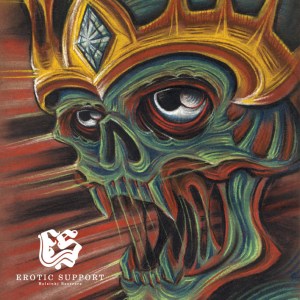
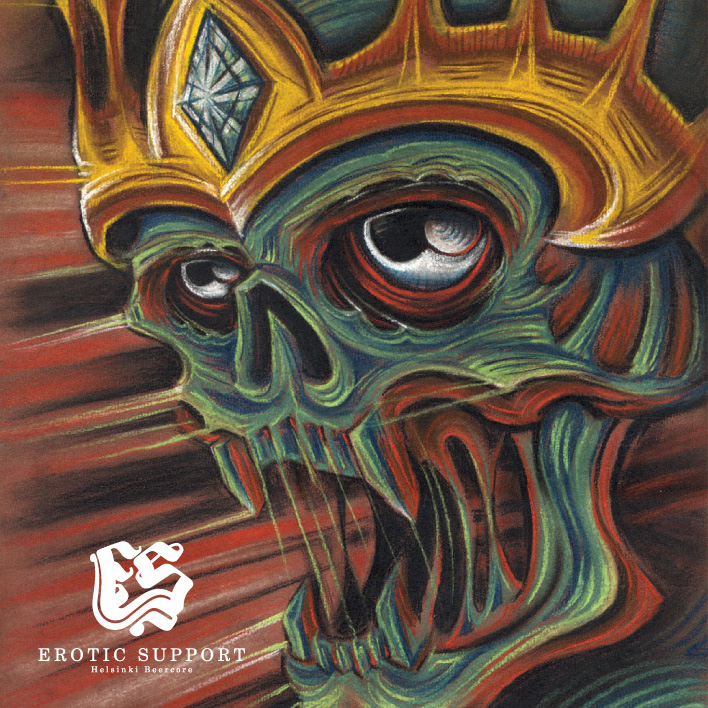
Cover of "II" by Erotic Support

Erotic Support are “beercore”, remember. Beer marks the brain with hangovers, just as tattoos mark the skin with ink. And just as loud music marks the ears with tinnitus. There are various kinds of self-mutilation in rock and that self-mutilation can have unhealthy motives. It can be an expression of boredom, angst, anomie and self-hatred. Unsurprisingly, Finland has the nineteenth highest suicide rate in the world. Beer, tattoos and tinnitus are part of the louder, dirtier and loutier end of rock: unlike Radiohead or Coldplay, Erotic Support sound like a band with tattoos who are used to hangovers. “Drink or Die” is a joke about exactly that. But what if rock had evolved in a wine-drinking culture? Would it be less of a sado-masochistic ritual, more a refined rite? Maybe not: the god of wine is Dionysos and he was Ho Bromios, the Thunderer. His brother Pan induces panic with loud noises. But black metal looks towards northern paganism: it’s music for pine forests, cold seas and beer-drinkers, not olive groves, warm seas and oenopotes.

Erotic Support don’t create soundscapes for Finland the way black metal creates soundscapes for Norway, but they do create beer-drinkers’ music, so they do express Finnishness to that extent. Swords of Mars, being darker, doomier and dirgier, are moving nearer an indigenous Finnish rock, or an indigenous Scandinavian rock, at least. This may be related to the fact that genes express themselves more strongly as an individual ages: for example, the correlation between the intelligence of parents and their children is strongest when the children are adults. Erotic Support create faster, more aggressive music than Swords of Mars, so it isn’t surprising that they’re the younger version of the same band. In biology, the genotype creates the phenotype: DNA codes for bodies and behaviour. Music is part of what Richard Dawkins calls the “extended phenotype”, like the nest of a bird or the termite-fishing-rods of a chimpanzee. A bird’s wings are created directly by its genes; a bird’s nest is created indirectly by its genes, viâ the brain. So a bird’s wings are part of the phenotype and a bird’s nest part of the extended phenotype.

Both are under the influence of the genes and both are expressions of biology. Music (like bird-song) is an expression of biology too, as is the difference between the music of Erotic Support and Swords of Mars. As brains age, the behaviour they create changes. Swords of Mars are older and not attracted to reckless self-mutilation as Erotic Support were: it’s not music to precede hangovers and induce tinnitus any more. Sword of Mars aren’t trying to tattoo your ears but to educate your mind.