
Chimerical colors (from Wikipedia)
(click for larger)

Chimerical colors (from Wikipedia)
(click for larger)

Abyss-illusion rug in blue and yellow (image from Temu)
Incunabula Media have re-published Tales of Silence and Sortilege with a beautiful new cover:
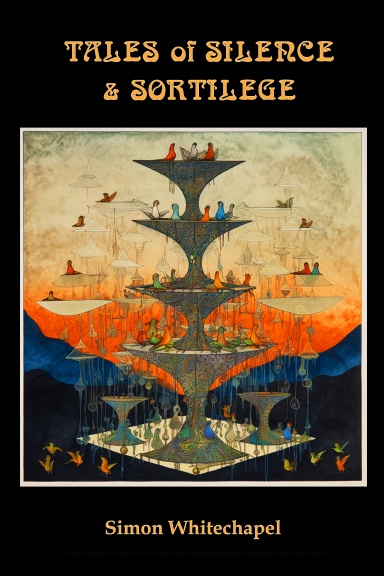
Tales of Silence & Sortilege — Incunabula’s new edition
A review from Lulu of the first edition:
Tales of Silence & Sortilege, Simon Whitechapel (Ideophasis Books 2011)
If you love weird fantasy, if you love the English language, even if you don’t love Clark Ashton Smith, you should read this book. The back cover describes it as “the darkest and most disturbing fantasy” of this millennium, but that’s either sarcastic or tragically optimistic, because what these stories really are is beautiful. The breath of snow-wolves is described as “harsh-spiced.” A mysterious gargoyle leaning from the heights of a great cathedral has “wings still glistening with the rime of interplanetary flight.” Hummingbirds are “gem-feathered… their glittering breasts dusted with the gold of a hundred pollens.” If you cannot appreciate such imagery, then perhaps you are dead to beauty, or simply dead. These tales are very short, but some of them have stayed with me for years, such as “The Treasure of the Temple,” in which a thief seems to lose the greatest fortune he could ever have found by stealing a king’s ransom in actual treasure. Most of the stories are brilliant, one or two is only good, but the masterpieces are “Master of the Pyramid” and “The Return of the Cryomancer.” The sense of loss and mystery evoked by these two companion stories is almost physically painful, it is so haunting. There is nothing like these stories being published today. Reading them, I feel the excitement and wonder that fans of Weird Tales magazine must have known long ago when new stories would appear by H.P. Lovecraft, Clark Ashton Smith, and Robert E. Howard. Simon Whitechapel doesn’t imitate these authors so much as apply their greatest lessons to new forms of fantasy. This is one of the cheapest books I own, but I accord it one of my most valuable. It is easily the best work of art you will find in any form on Lulu. I cannot recommend it highly enough.
Elsewhere Other-Accessible…
• Tales of Silence & Sortilege (Incunabula 2023)
• Gweel & Other Alterities (Incunabula 2023)
[In the plane] We hurried past the great bay at the northern end of Santo, down the eastern side of the island, well clear of its gaunt, still unexplored mountains. The morning sun was low when we passed the central part of Santo, and I can still recall the eerie effect of horizontal shadows upon the thickest jungle in the South Pacific. A hard, forbidding green mat hid every feature of the island, but from time to time solitary trees, burdened with parasites, thrust their tops high above the mat. It was these trees, catching the early sunlight, that made the island grotesque, crawling, and infinitely lonely. Planes had crashed into this green sea of Espiritu and had never been seen again. Ten minutes after the smoke cleared, a burnt plane was invisible. — James A. Michener evokes H.P. Lovecraft in the short-story “Wine for the Mess at Segi” from Tales of the South Pacific (1947)
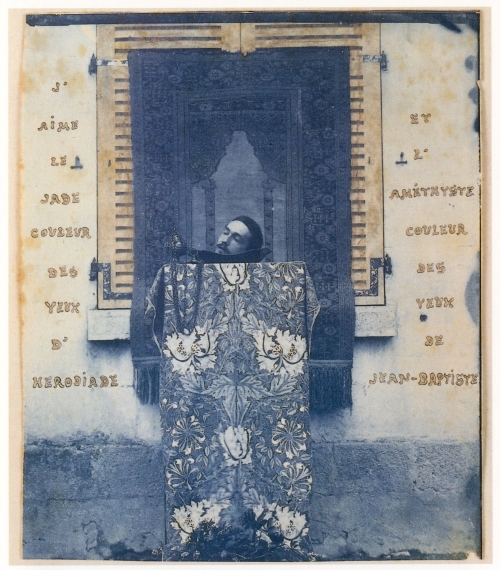
Above you can see the Peacock on a Platter, or Robert de Montesquiou posing as the severed head of John the Baptist and flanked by relevant lines of his own poetry. But there’s a better version of the poetry, as you can see by comparing the photo with this:
J’aime le jade,
Couleur des yeux
D’HérodiadeEt l’améthyste,
Couleur du sang
De Jean-Baptiste. — from “Robert de Montesquiou: The Magnificent Dandy” (1962) by Cornelia Otis Skinner
I love jade,
Color of the eyes
Of HerodiasAnd amethyst,
Color of the blood
Of John the Baptist.
Elsewhere Other-Accessible…
• Portrait of a Peacock — Cornelia Otis Skinner’s excellent essay on Montesquiou
• Le Paon dans les Pyrénées — review of Julian Barnes’ not-so-good book partly about Montesquiou
• Le record de froid peut atteindre -77°C, alors que l’été le thermomètre peut monter jusqu’à 30°C. Les températures hivernales causent des phénomènes étonnants. Par exemple, ce que les Yakoutes appellent « le chuchotement des étoiles » : lorsqu’il gèle, l’homme entend en permanence le doux bruissement de sa respiration qui gèle dès qu’il expire.
• At its worst the cold can reach -77°C, while in summer the thermometer can climb to 30°C. Winter temperatures cause some astonishing phenomena. For example, there is what the Yakuts call “the whisper of the stars”: when it’s freezing, you constantly hear the soft rustle of your own breath, which is turning into ice-crystals even as you exhale.
Elsewhere other-engageable
• Cry’ Me A Shiver — an interview with French avant-gardistes Cryogénie, les Rois du Froid and Kings of Cold…
From Intellectual Impostures (1998) by Alan Sokal and Jean Bricmont:
To conclude, let us quote a brief excerpt from the book Chaosmosis, written by Guattari alone. This passage contains the most brilliant melange of scientific, pseudo-scientific, and philosophical jargon that we have ever encountered; only a genius could have written it.
We can clearly see that there is no bi-univocal correspondence between linear signifying links or archi-writing, depending on the author, and this multireferential, multidimensional machinic catalysis. The symmetry of scale, the transversality, the pathic non-discursive character of their expansion: all these dimensions remove us from the logic of the excluded middle and reinforce us in our dismissal of the ontological binarism we criticised previously. A machinic assemblage, through its diverse components, extracts its consistency by crossing ontological thresholds, non-linear thresholds of irreversibility, ontological and phylogenetic thresholds, creative thresholds of heterogenesis and autopoiesis. The notion of scale needs to be expanded to consider fractal symmetries in ontological terms.
What fractal machines traverse are substantial scales. They traverse them in engendering them. But, and this should be noted, the existential ordinates that they “invent” were always already there. How can this paradox be sustained? It’s because everything becomes possible (including the recessive smoothing of time, evoked by Rene Thom) the moment one allows the assemblage to escape from energetico-spatiotemporal coordinates. And, here again, we need to rediscover a manner of being of Being — before, after, here and everywhere else — without being, however, identical to itself; a processual, polyphonic Being singularisable by infinitely complexifiable textures, according to the infinite speeds which animate its virtual compositions.
The ontological relativity advocated here is inseparable from an enunciative relativity. Knowledge of a Universe (in an astrophysical or axiological sense) is only possible through the mediation of autopoietic machines. A zone of self-belonging needs to exist somewhere for the coming into cognitive existence of any being or any modality of being. Outside of this machine/Universe coupling, beings only have the pure status of a virtual entity. And it is the same for their enunciative coordinates. The biosphere and mecanosphere, coupled on this planet, focus a point of view of space, time and energy. They trace an angle of the constitution of our galaxy. Outside of this particularised point of view, the rest of the Universe exists (in the sense that we understand existence here-below) only through the virtual existence of other autopoietic machines at the heart of other bio-mecanospheres scattered throughout the cosmos. The relativity of points of view of space, time and energy do not, for all that, absorb the real into the dream. The category of Time dissolves into cosmological reflections on the Big Bang even as the category of irreversibility is affirmed. Residual objectivity is what resists scanning by the infinite variation of points of view constitutable upon it. Imagine an autopoietic entity whose particles are constructed from galaxies. Or, conversely, a cognitivity constituted on the scale of quarks. A different panorama, another ontological consistency. The mecanosphere draws out and actualises configurations which exist amongst an infinity of others in fields of virtuality. Existential machines are at the same level as being in its intrinsic multiplicity. They are not mediated by transcendent signifiers and subsumed by a univocal ontological foundation. They are to themselves their own material of semiotic expression. Existence, as a process of deterritorialisation, is a specific inter-machinic operation which superimposes itself on the promotion of singularised existential intensities. And, I repeat, there is no generalised syntax for these deterritorialisations. Existence is not dialectical, not representable. It is hardly livable! (Félix Guattari 1995, pp. 50-52)
In a prev-previous post, I looked at this interesting fractal image on the front cover of a Ray Bradbury book:
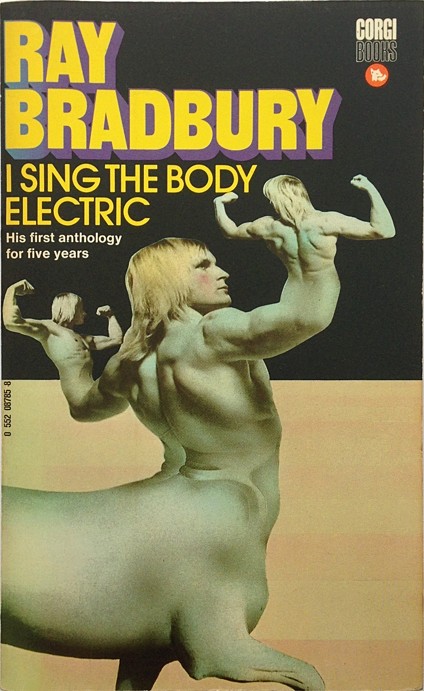
It seems obvious that the image is created from photographs: only the body of the centaur is drawn by hand. And here’s my attempt at extending the fractality of the image:
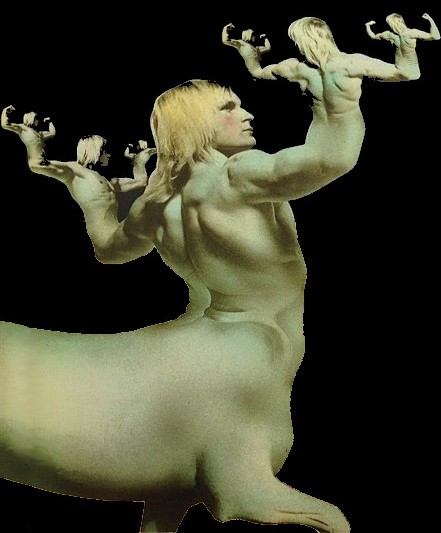
• Mythical Mathical — Man-Horse! — the pre-previous post about the fractal centaur
• εἰ πάντα τὰ ὄντα καπνὸς γένοιτο, ῥῖνες ἂν διαγνοῖεν. — Ἡράκλειτος ὁ Ἐφέσιος
• • Si toutes choses devenaient fumée, on connaîtrait par les narines. — Héraclite d’Ephèse
• • • If all things were turned to smoke, the nostrils would tell them apart. — Heraclitus of Ephesos, quoted in Aristotle’s De sensu, 5, 443a 23

Post-Performative Post-Scriptum
“Jonglietzsche” is a portmanteau of German Jongleur / jonglieren, “juggler, juggling”, and the surname of core counter-cultural philosopher Friedrich Nietzsche (1844-1900). Jongleur is pronounced something like “zhawngloer”, as in French.
 Overlord In Terms of Core Issues Around Maximal Engagement with Key Notions of the Über-Feral