He Say, He Sigh, He Sow #7

“I had, also, during many years followed a golden rule, namely, that whenever a published fact, a new observation or thought came across me, which was opposed to my general results, to make a memorandum of it without fail and at once; for I had found by experience that such facts and thoughts were far more apt to escape from the memory than favourable ones.” — The Autobiography of Charles Darwin (1958).

Rep-Tile Reflections

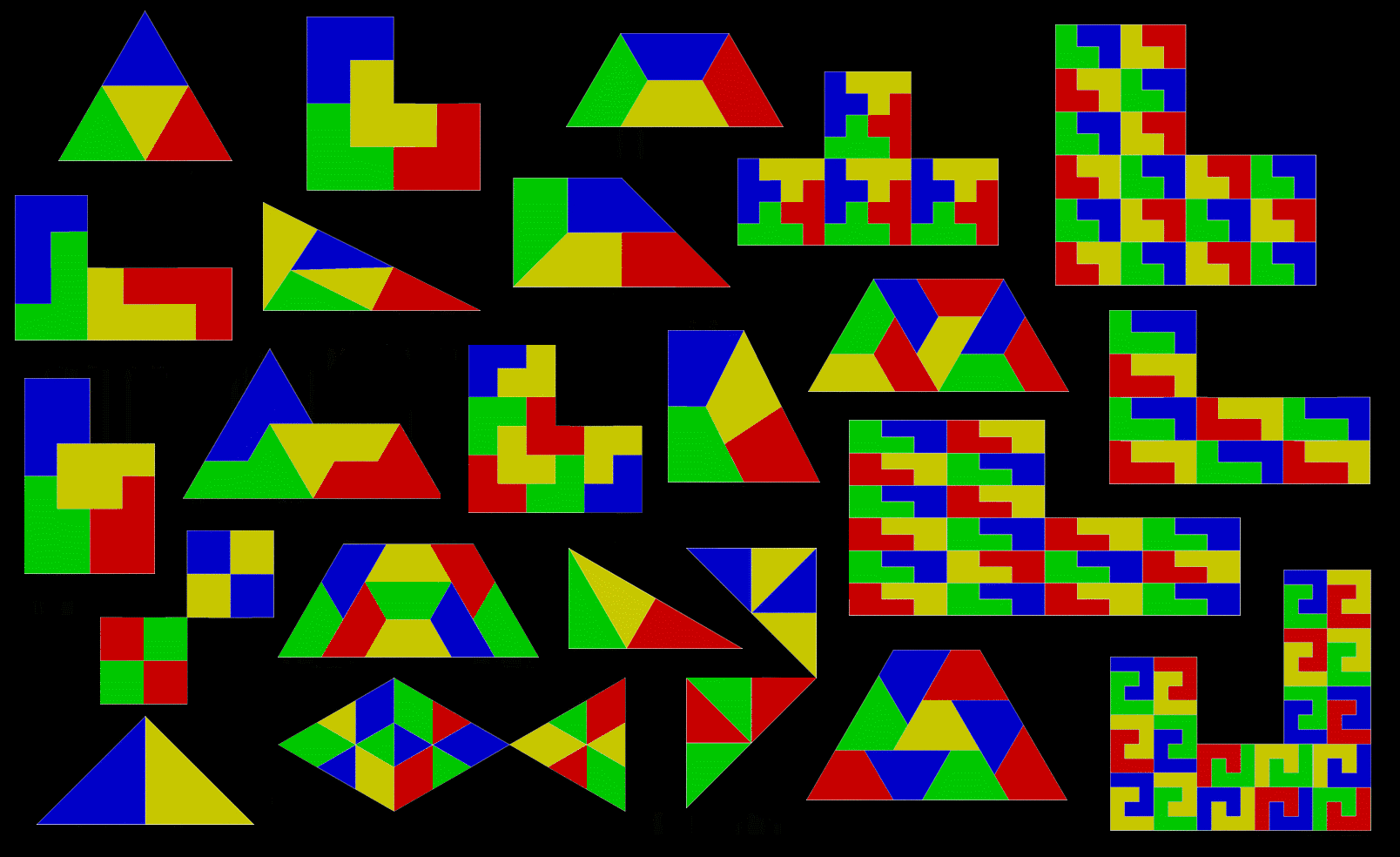
A rep-tile, or repeat-tile, is a two-dimensional shape that can be divided completely into copies of itself. A square, for example, can be divided into smaller squares: four or nine or sixteen, and so on. Rectangles are the same. Triangles can be divided into two copies or three or more, depending on their precise shape. Here are some rep-tiles, including various rep-triangles:

Various rep-tiles

Various rep-tiles — click for larger image

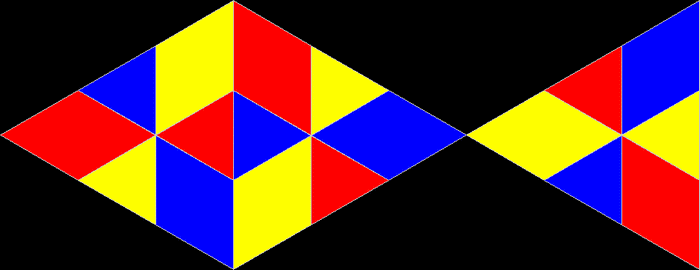
Some are simple, some are complex. Some have special names: the sphinx and the fish are easy to spot. I like both of those, particularly the fish. It would make a good symbol for a religion: richly evocative of life, eternally sub-divisible of self: 1, 9, 81, 729, 6561, 59049, 531441… I also like the double-square, the double-triangle and the T-tile in the top row. But perhaps the most potent, to my mind, is the half-square in the bottom left-hand corner. A single stroke sub-divides it, yet its hypotenuse, or longer side, represents the mysterious and mind-expanding √2, a number that exists nowhere in the physical universe. But the half-square itself is mind-expanding. All rep-tiles are. If intelligent life exists elsewhere in the universe, perhaps other minds are contemplating the fish or the sphinx or the half-square and musing thus: “If intelligent life exists elsewhere in the universe, perhaps…”

Mathematics unites human minds across barriers of language, culture and politics. But perhaps it unites minds across barriers of biology too. Imagine a form of life based on silicon or gas, on unguessable combinations of matter and energy in unreachable, unobservable parts of the universe. If it’s intelligent life and has discovered mathematics, it may also have discovered rep-tiles. And it may be contemplating the possibility of other minds doing the same. And why confine these speculations to this universe and this reality? In parallel universes, in alternative realities, minds may be contemplating rep-tiles and speculating in the same way. If our universe ends in a Big Crunch and then explodes again in a Big Bang, intelligent life may rise again and discover rep-tiles again and speculate again on their implications. The wildest speculation of all would be to hypothesize a psycho-math-space, a mental realm beyond time and matter where, in mathemystic communion, suitably attuned and aware minds can sense each other’s presence and even communicate.

The rep-tile known as the fish

Credo in Piscem…

So meditate on the fish or the sphinx or the half-square. Do you feel the tendrils of an alien mind brush your own? Are you in communion with a stone-being from the far past, a fire-being from the far future, a hive-being from a parallel universe? Well, probably not. And even if you do feel those mental tendrils, how would you know they’re really there? No, I doubt that the psycho-math-space exists. But it might and science might prove its existence one day. Another possibility is that there is no other intelligent life, never has been, and never will be. We may be the only ones who will ever muse on rep-tiles and other aspects of mathematics. Somehow, though, rep-tiles themselves seem to say that this isn’t so. Particularly the fish. It mimics life and can spawn itself eternally. As I said, it would make a good symbol for a religion: a mathemysticism of trans-biological communion. Credo in Piscem, Unum et Infinitum et Æternum. “I believe in the Fish, One, Unending, Everlasting.” That might be the motto of the religion. If you want to join it, simply wish upon the fish and muse on other minds, around other stars, who may be doing the same.

Guise and Molls

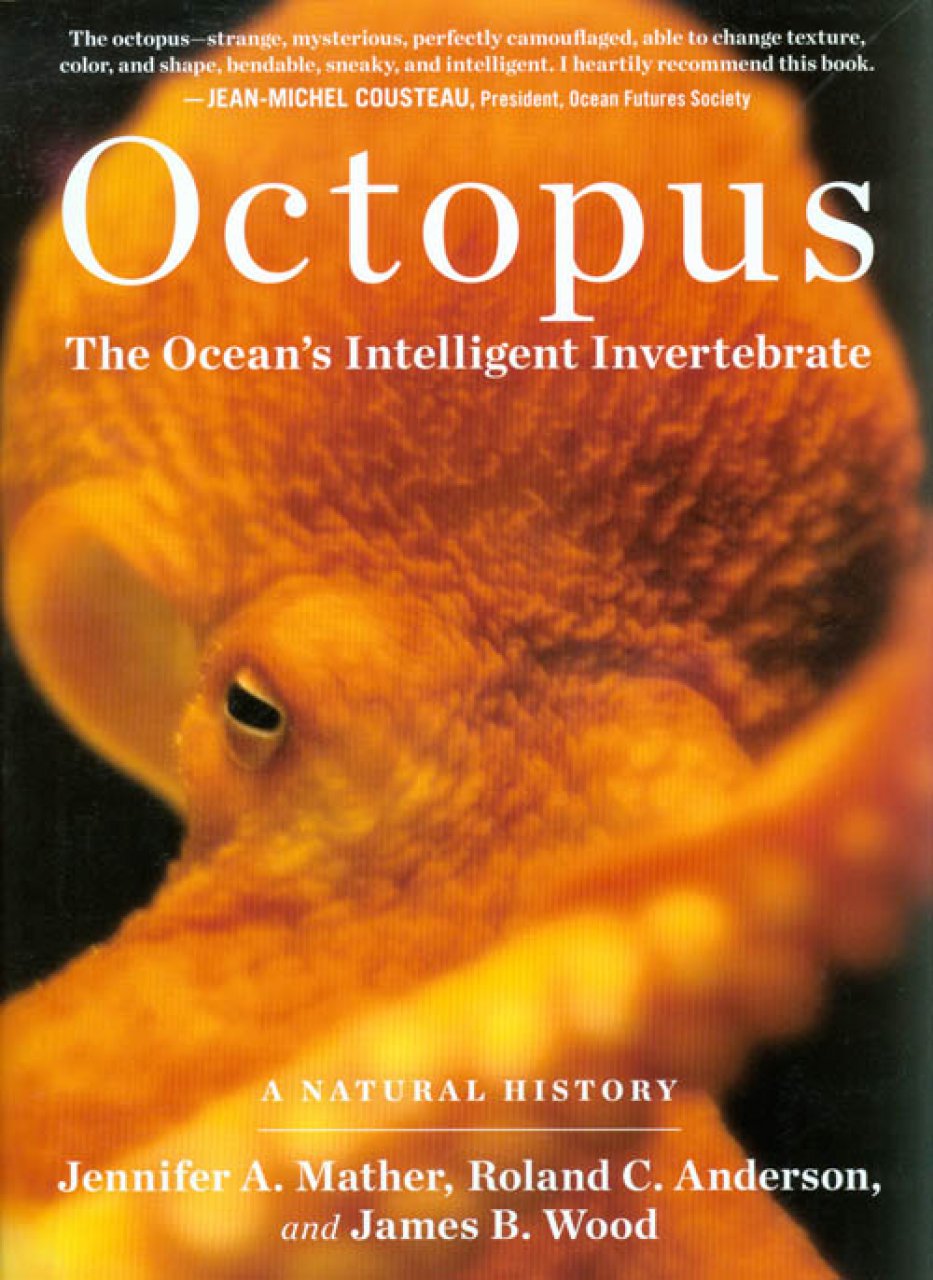
Front cover of Octopus: The Ocean’s Intelligent Invertebrate: A Natural History, by Jennifer A. Mather et al
Octopus: The Ocean’s Intelligent Invertebrate: A Natural History, Jennifer A. Mather, Roland C. Anderson and James B. Wood (Timber Press, 2010)

Who knows humanity who only human knows? We understand ourselves better by looking at other animals, but most other animals are not as remarkable as the octopus. These eight-armed invertebrates are much more closely related to oysters, limpets and ship-worms than they are to fish, let alone to mammals, but they lead fully active lives and seem fully conscious creatures of strong and even unsettling intelligence. Octopuses are molluscs, or “soft ones” (the same Latin root is found in “mollify”), with no internal skeleton and no rigid structure. Unlike some of their relatives, however, they do have brains. And more than one brain apiece, in a sense, because their arms are semi-autonomous. They don’t really have bodies, though, which is why they belong to the class known as Cephalopoda, or “head-foots”. Squid and cuttlefish, which are also covered in this book, are in the same class but do have more definite bodies, because they swim in open water rather than, like octopuses, living on the sea-floor. Another difference between the groups is that octopuses don’t have tentacles. Their limbs are too adaptable for that:

Because the arms are lined with suckers along the underside, octopuses can grasp anything. And since the animal has no skeleton, it can flex its arms and move them in any direction. The arms aren’t tentacles: tentacles are used for prey capture in squid, and these arms, with their flexibility, are used for many different actions. (“Introduction: Meet the Octopus”, pg. 15)

Octopuses would be interesting even if we humans knew ourselves perfectly. But one of the interesting things is whether they could be us, given time and opportunity. That is, could they become a tool-making, culture-forming, language-using species like us? After all, unlike most animals, they don’t use their limbs simply for locomotion or aggression: octopuses can manipulate objects with reasonably good precision. I used to think that one obstacle to their use of tools was their inability to make fine discriminations between shapes, because I remembered reading in the Oxford Book of the Mind (2004) that they couldn’t tell cubes from spheres. The explanation there was that their arms are too flexible and can’t, like rigid human arms and fingers, be used as fixed references to judge a manipulated object against. But this book says otherwise:

[The British researcher J.M.] Wells found that common octopuses can learn by touch and can tell a smooth cylinder from a grooved one or a cube from a sphere. They had much more trouble, though, telling a cube with smoothed-off corners from a sphere… They couldn’t learn to distinguish a heavy cylinder from a lighter one with the same surface texture. (ch. 9, “Intelligence”, pg. 130)

The problem isn’t simply that their arms are too flexible: their arms are also too independent:

Maybe the common octopus could not use information about the amount of sucker bending to send to the brain and calculate what an object’s shape would be, or calculate how much the arm bent to figure out weight. Octopuses have a lot of local control of arm movement: there are chains of ganglia [nerve-centres] down the arm and even sucker ganglia to control their individual actions. If local information is processed as reflexes in these ganglia, most touch and position information might not go to the brain and then couldn’t used in associative learning. (Ibid., pg. 130-1)

Or in manipulating an object with high precision and accuracy. An octopus can use rocks to make the entrance to its den narrower and less accessible to predators, but that’s a long way from being able to build a den. It is a start, however, and if man and other apes left the scene, octopuses would be a candidate to occupy his vacant throne one day. But I would give better odds to squirrels and to corvids (crow-like birds) than to cephalopods. Living in the sea may be a big obstacle to developing full, language-using, world-manipulating intelligence. The brevity of that life in the sea is definitely an obstacle: one deep-sea species of octopus may live over ten years, which would be “the longest for any octopus” (ch. 1, “In the Egg”). In shallower, warmer water, the Giant Pacific Octopus, Enteroctopus dofleini, is senescent at three or four years; some other species are senescent at a year or less. Males die after fertilizing the females, females die after guarding their eggs to hatching. In such an active, enquiring animal, senescence is an odd and unsettling process. A male octopus will stop eating, lose weight and start behaving in unnatural ways:

Senescent male giant Pacific octopuses and red octopuses are found crawling out of the water onto the beach [which is] likely to lead to attacks by gulls, crows, foxes, river otters or other animals… Senescent males have even been found in river mouths, going upstream to their eventual death from the low salinity of the fresh water. (ch. 10, “Sex at Last”, pg. 148)

Female octopuses stop eating and lose weight, but can’t behave unnaturally like that, because they have eggs to guard. Evolution keeps them on duty, because females that abandoned their eggs would leave fewer offspring. Meanwhile, males can become what might be called demob-demented: once they’ve mated, their behaviour doesn’t affect their offspring. In the deep sea, longer-lived species follow the same pattern of maturing, mating and senescing, but aren’t so much living longer as living slower. These short, or slow, lives wouldn’t allow octopuses to learn in the way human beings do. The most important part of human learning is, of course, central to this book and this review: language. Cephalopods don’t have good hearing, but they do have excellent sight and the ability to change the colour and patterning of their skin. So Arthur C. Clarke (1917-2008) suggested in his short-story “The Shining Ones” (1962) that they could become autodermatographers, or “self-skin-writers”, speaking with their skin. The fine control necessary for language is already there:

Within the outer layers of octopus skin are many chromatophores – sacs that contain yellow, red or brown pigment within an elastic container. When a set of muscles pulls a chromatophore sac out to make it bigger, its color is allowed to show. When the muscles relax, the elastic cover shrinks the sac and the color seems to vanish. A nerve connects to each set of chromatophore muscles, so that nervous signals from the brain can cause an overall change in color in less than 100 milliseconds at any point in the body… When chromatophores are contracted, there is another color-producing layer beneath them. A layer of reflecting cells, white leucophores or green iridophores depending on the area of the body, produces color in a different way: Like a hummingbird’s feathers, which only reflect color at a specific angle, these cells have no pigment themselves but reflect all or some of the colors in the environment back to the observer… (ch. 6, “Appearances”, pg. 89)

“Observer” is the operative word: changes in skin-colour, -texture and -shape are a way to fool the eyes and brains of predators. The molluscan octopus can adopt many guises: it can look like rocks, sand or seaweed. But the champion changer is Thaumoctopus mimicus, which lives in shallow waters off Indonesia. Its generic name means “marvel-octopus” and its specific name means “mimicking”. And its modes of mimicry are indeed marvellous:

This octopus can flatten its body and move across the sand, using its jet for propulsion and trailing its arms, with the same undulating motion as a flounder or sole. It can swim above the mud with its striped arms outspread, looking like a venomous lionfish or jellyfish. It can narrow the width of its combined slender body and arms to look like a striped sea-snake. And it may be able to carry out other mimicries we have yet to see. Particularly impressive about the mimic octopus is that not only can it take on the appearance of another animal but it can also assume the behaviour of that animal. (ch. 7, “Not Getting Eaten”, pg. 109)

But octopuses also change their skin to fool the eyes and brains of prey. The “Passing Cloud” may sound like a martial arts technique, but it’s actually a molluscan hunting technique. And it’s produced entirely within the skin, as the authors of this book observed after videotaping octopuses “in an outdoor saltwater pond on Coconut Island”, Hawaii:

Back in the lab and replaying the video frame by frame, we found how complex the Passing Cloud display is. The Passing Cloud formed on the posterior mantle, flowed forward past the head and became more of a bar in shape, then condensed into a small blob below the head. The shape then enlarged and moved out onto the outstretched mantle, flowing off the anterior mantle and disappearing. (ch. 6, “Appearances”, pg. 93)

It’s apparently used to startle crabs that have frozen and are hard to see. When the crab moves in response to the Passing Cloud, the octopus can grab it and bite it to death with its “parrotlike beak”. They “also use venom from the posterior salivary gland that can paralyze prey and start digestion” (ch. 3, “Making a Living”, pg. 62). But a bite from an octopus can kill much bigger things than crabs:

Blue-ringed octopuses, the four species that are members of the genus Hapalochlaena, display stunning coloration. Like other spectacular forms of marine and terrestrial life, they have vivid color patterns as a warning signal. These small octopuses pose a serious threat to humans. They pack a potent venomous bite that makes them among the most dangerous creatures on Earth. Their venom, the neurotoxin tetrodotoxin (TTX) described by Scheumack et al in 1978, is among the few cephalopod venoms that can affect humans. A variety of marine and terrestrial animals produce TTX [including] poisonous arrow frogs [untrue, according to Wikipedia, which refers to “toads of the genus Atelopus” instead], newts, and salamanders… but the classic example, and what the compound is named after, is the tetraodon puffer fish. The puffers are what the Japanese delicacy fufu is made from. If the fish is prepared correctly, extremely small amounts of TTX cause only a tingling or numbing sensation. But if it is prepared incorrectly, the substance kills by blocking sodium channels on the surface of nerve membranes. A single milligram, 1/2500 of the weight of a penny, will kill an adult human… Even in the minuscule doses delivered by a blue-ringed octopus’s nearly unnoticeable bite, TTX can shut down the nervous system of a large person in just minutes; the risk of death is very high. (“Postscript: Keeping a Captive Octopus”, pg. 170)

It’s interesting to see how often toxicity has evolved among animals. Puffer-fish and blue-ringed octopuses may get their toxin from bacteria or algae, while poison-arrow frogs get the even more potent batrachotoxin from eating beetles, as do certain species of bird on New Guinea. Accordingly, toxicity is found in animals with no legs, two legs, four legs, six legs, eight legs and ten legs (if squid have a poisonous bite too). Evolution has found similar solutions to similar problems in unrelated groups, because evolution is a way of exploring space: that of possibility. And it is all, in one way or another, chemical possibility. Blue-ringed octopuses have found a chemical solution to hunting and evading predators. Other cephalopods have found a chemical solution to staying afloat:

Another substance used to keep plankton buoyant is ammonia, again lighter than water. Ammonia is primarily used by the large squid species, including the giant squid (Architeuthis dux), in their tissues, although the glass squid (Cranchia scabra) concentrates ammonia inside a special organ. The ammonia in the tissues of these squid makes the living or dead animal smell pungent. Dead or dying squid on the ocean’s surface smell particularly foul. The ammonia in these giant squid also makes them inedible – there will be no giant squid calamari. (ch. 2, “Drifting and Settling”)

Other deep-sea solutions from chemical possibility-space include bioluminescence. This is used by a cephalopod that was little-known until it was used as a metaphor for the greedy behaviour of Goldman-Sachs and other bankers:

…although they do not have an ink-sac, vampire squid have a bioluminescent mucus that they can jet out, presumably at the approach of a potential predator, likely distracting it in the same way as a black ink jet for a shallow-water octopus or squid. Second, they have a pair of light organs at the base of the fins with a moveable flap that can be used as a shutter. These could act as a searchlight, turning a beam of light onto a potential prey species that tactile sensing from the [tentacle-like] filaments has picked up. And third, they have a huge number of tiny photophores all over the body and arms. These could work two ways: they might give a general dim lighting as a visual counter-shading. With even a little light from above, a dark animal would stand out in silhouette from below. With low-level light giving just enough illumination, it could blend in. And the second function of these lights has been seen by ROV [remotely operated underwater vehicle] viewers: a disturbed vampire squid threw its arms back over its body and flashed the lights on the arms, which should startle any creature. (ch. 11, “The Rest of the Group”, pg. 161)

I was surprised to learn that vampire squid can be prey, but in fact their scientific name – Vampyroteuthis infernalis – is almost as big as they are: “for those imagining that vampire squid are monsters of the deep, they are tiny – only up to 5 in. (13 cm) long” (ibid., pg. 162). Even less-studied, even deeper-living, and even longer-named is Vulcanoctopus hydrothermalis, the “specialized deep-sea vent octopus”, which is “found, as its name suggests, near deep-sea hydrothermal vents way down at 6000 ft. (2000 m)” (“Introduction: Meet the Octopus”, pg. 15). Life around hydrothermal vents, or mini-volcanoes on the ocean floor, is actually independent of the sun, because the food-pyramid there is based on bacteria that live on the enriched water flowing from the vents. So an asteroid strike or mega-volcano that clouded the skies and stopped photosynthesis wouldn’t directly affect that underwater economy. But vents sometimes go extinct and Vulcanoctopus hydrothermalis must lead a precarious existence.

I’d like to know more about the species, but it’s one interesting octopus among many. This book is an excellent introduction to this eight-limbed group and cousins like the ten-limbed squid and the sometimes ninety-limbed nautiluses. It will guide you through all aspects of their lives and behaviour, from chromatophores, detachable arms and jet propulsion to siphuncles, glue-glands and the hectocotylus, the “modified mating arm” of male cephalopods that was once thought to be a parasitic worm. That mystery has been solved, but lots more remain. Octopus: The Ocean’s Intelligent Invertebrate should appeal to any thalassophile who shares the enthusiasm of H.P. Lovecraft or Arthur C. Clarke for a group that has evolved high intelligence without ever leaving the ocean.

Yew and Me

The Pocket Guide to The Trees of Britain and Northern Europe, Alan Mitchell, illustrated by David More (1990)

Leafing through this book after I first bought it, I suddenly grabbed at it, because I thought one of the illustrations was real and that a leaf was about to slide off the page and drop to the floor. It was an easy mistake to make, because David More is a good artist. That isn’t surprising: good artists are often attracted to trees. I think it’s a mathemattraction. Trees are one of the clearest and commonest examples of natural fractals, or shapes that mirror themselves on smaller and smaller scales. In trees, trunks divide into branches into branchlets into twigs into twiglets, where the leaves, well distributed in space, wait to eat the sun.

When deciduous, or leaf-dropping, trees go hungry during the winter, this fractal structure is laid bare. And when you look at a bare tree, you’re looking at yourself, because humans are fractals too. Our torsos sprout arms sprout hands sprout fingers. Our veins become veinlets become capillaries. Ditto our lungs and nervous systems. We start big and get small, mirroring ourselves on smaller and smaller scales. Fractals make maximum and most efficient use of space and what’s found in me or thee is also found in a tree, both above and below ground. The roots of a tree are also fractals. But one big difference between trees and people is that trees are much freer to vary their general shape. Trees aren’t mirror-symmetrical like animals and that’s another thing that attracts human eyes and human artists. Each tree is unique, shaped by the chance of its seeding and setting, though each species has its characteristic silhouette. David More occasionally shows that bare winter silhouette, but usually draws the trees in full leaf, disposed to eat the sun. Trees can also be identified by their leaves alone and leaves too are fractals. The veins of a leaf divide and sub-divide, carrying the raw materials and the finished products of photosynthesis to and from the trunk and roots. Trees are giants that work on a microscopic scale, manufacturing themselves from photons and molecules of water and carbon dioxide.

We eat or sculpt what they manufacture, as Alan Mitchell describes in the text of this book:

The name “Walnut” comes from the Anglo-Saxon for “foreign nut” and was in use before the Norman Conquest, probably dating from Roman times. It may refer to the fruit rather than the tree but the Common Walnut, Juglans regia, has been grown in Britain for a very long time. The Romans associated their god Jupiter (Jove) with this tree, hence the Latin name juglans, “Jove’s acorn (glans) or nut”… The wood [of Black Walnut, Juglans nigra] is like that of Common Walnut and both are unsurpassed for use as gunstocks because, once seasoned and worked, neither moves at all and they withstand shock particularly well. They are also valued in furniture for their good colour and their ability to take a high polish. (entry for “Walnuts”, pg. 18)

That’s from the first and longer section, devoted to “Broadleaved Trees and Palms”; in the second section, “Conifers”, devoted to pines and their relatives, maths appears in a new form. Pine-cones embody the Fibonacci sequence, one of the most famous of all number sequences or series. Start with 1 and 1, then add the pair and go on adding pairs: 1, 1, 2, 3, 5, 8, 13, 21, 34, 55, 89, 144… That’s the Fibonacci sequence, named after the Italian mathematician Leonardo Fibonacci (c.1170-c.1245). And if you examine the two spirals created by the scales of a pine-cone, clockwise and counter-clockwise, you’ll find that there are, say, five spirals in one direction and eight in another, or eight and thirteen. The scales of a pineapple and petals of many flowers behave in a similar way. These patterns aren’t fractals like branches and leaves, but they’re also about distributing living matter efficiently through space. Mitchell doesn’t discuss any of this mathematics, but it’s there implicitly in the illustrations and underlies his text. Even the toxicity of the yew is ultimately mathematical, because the effect of toxins is determined by their chemical shape and its interaction with the chemicals in our bodies. Micro-geometry can be noxious. Or nourishing:

The Yews are a group of conifers, much more primitive than those which bear cones. Each berry-like fruit has a single large seed, partially enclosed in a succulent red aril which grows up around it. The seed is, like the foliage, very poisonous to people and many animals, but deer and rabbits eat the leaves without harm. Yew has extremely strong and durable wood [and the] Common Yew, Taxus baccata, is nearly immortal, resistant to almost every pest and disease of importance, and immune to stress from exposure, drought and cold. It is by a long way the longest-living tree we have and many in country churchyards are certainly much older than the churches, often thousands of years old. Since the yews pre-date the churches, the sites may have been holy sites and the yews sacred trees, possibly symbols of immortality, under which the Elders met. (entry for “Yews”, pg. 92)

This isn’t a big book, but there’s a lot to look at and read. I’d like a doubtful etymology to be true: some say “book” is related to “beech”, because beech-bark or beech-leaves were used for writing on. Bark is another way of identifying a tree and another aspect of their dendro-mathematics, in its texture, colours and patterns. But trees can please the ear as well as the eye: the dendrophile A.E. Housman (1859-1936) recorded how “…overhead the aspen heaves / Its rainy-sounding silver leaves” (A Shropshire Lad, XXVI). There’s maths there too. An Aspen sounds like rain in part because its many leaves, which tremble even in the lightest breeze, are acting like many rain-drops. That trembling is reflected in the tree’s scientific name: Populus tremula, “trembling poplar”. Housman, a Latin professor as well as an English poet, could have explained how tree-nouns in Latin are masculine in form: Alnus, Pinus, Ulmus; but feminine in gender: A. glutinosa, P. contorta, U. glabra (Common Alder, Lodgepole Pine, Wych-Elm). He also sums up why trees please in these simple and ancient words of English:

Give me a land of boughs in leaf,
A land of trees that stand;
Where trees are fallen, there is grief;
I love no leafless land.

More Poems, VIII.

Angst, Anguish, Abjection

It’s half tradition, half tic. At every Ruin-Dredger gig, the lead-singer Jerome Daziel asks the same simple question. Sometimes he shouts it and demands a reaction from the audience. Sometimes he whispers it and ignores what the audience does. Depending on the country, he’s asked it in French, Italian, Greek, Russian, Georgian, Mandarin, Thai, Samoan and Quechua. He’s also asked it in complete silence, having written it across his chest and on the palms of his hands in phosph-ink, invisible when the lights are on, glowing ghoulishly when they’re turned off. Occasionally he’s asked it backwards. In English, the question runs like this: “And What Doth It Mean To Be Flesh?”

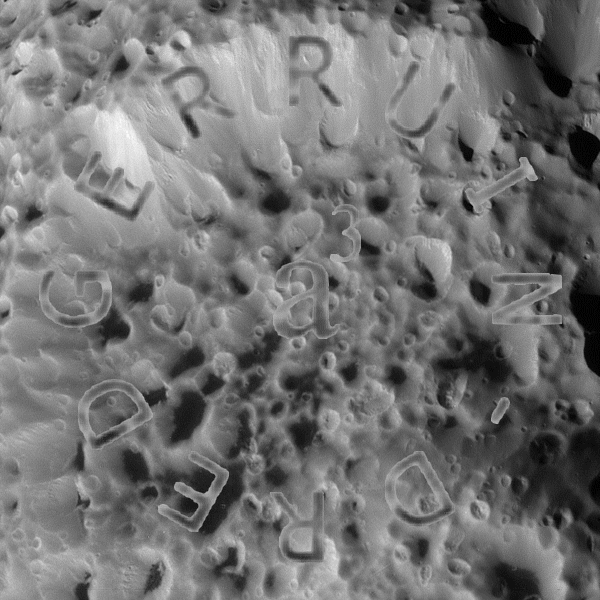
Cover of Triple-A by Ruin-Dredger (2000)

But you could see the whole of a Ruin-Dredger gig as asking the same searching thing. The band specialize in unusual frequencies that hunt out – and hum out – the resonances of the human body: the lungs, the bones, the blood. And their music sets up strange resonances in the mind. It’s both mindless and masterful, at once tearful and tyrannous. Sometimes it sounds like mathematics trying to come to life, and sometimes like mathematics trying to commit suicide. There’s a lot of science in their music, and a lot of silence too. “Star-clusters having tantrums,” is how one early review ran. “With occasional episodes of narcolepsy.” That mixture of sound and silence is mutually reinforcing: the sounds are sterner, the silence is sharper. They began their career with the albums Xoli-Hein (1992) and Pyramidion (1996), where they forged a series of griffs, or “gruff riffs”, that were often Ohrwürmer, or “ear-worms”, as German calls tunes that stick in your head. Even if you don’t want them to. But I’m not sure “tune” has ever been the right word for the music Ruin-Dredger create. It’s part industrial noise, part wolf-howl, part bat-twitter, but mostly “folded, fused, fissured, fractured, fidgety phonaesthesia.” And if you want to sample it, this album from the turn of the century is a good place to start.

What to call the album is one of the first puzzles it will set you. The band’s website usually calls it “a3” or “a3”; in interviews, the band themselves refer to it as “Triple-A” or “that A-fucker”. The second name comes from a plagiarism suit by the astro-music veterans Kargokkult that put Ruin-Dredger’s career on hold for nearly a year, 2002-3, and allegedly threatened to bankrupt their record-company. In the end the case was thrown out of court and even today some conspiracy-minded Dredge-heads claim it was cooked up for publicity between the ’Dredgers and the Kargonauts. The case might never have got as far as it did without that lunar cover for Triple-A, where the corroded letters of the band’s name and the album’s name hang above a lifeless moon-scape. Only it isn’t our moon. And it isn’t necessarily lifeless. Ruin-Dredger have a bee in their bonnet about the pre-biotic – the conditions necessary for the appearance of life. That’s what the first track on Triple-A, “Invention of the Cross”, is about: the chemicals that gave rise to life. And it literally has bees on it: the band sampled bees and bumblebees in flight and gathering nectar. They then altered the pitch and speed of the buzzing and made it sound both unearthly and unsettling. I’ve known people demand the track be turned off or skipped when it’s played to them.

But skipping track one of Triple-A is a bit like jumping from the frying-pan into the fire, because track two, “Seventh Sword”, is even more unearthly and even more unsettling. Bat-twitters hurtle through the speakers, falling from the ultra-sonic to the infra-sonic, rising in reverse, twisting, turning inside-out, mating, mutating and miscegenating. Then, as though the band have taken mercy on your ears and your mind, everything slows and soothes for track three, “Titanomachia”, which is often preceded in concert by the aforementioned carnal question: “And what doth it mean to be flesh?” This track is one of the last outings for the griffs of their early career: a slow, synth-based triple chord underlain by a sample of waves washing on an unknown shore. Track four, “Breathing Vacuum”, has also been known to provoke a “Turn it off!”, because the mumbling beneath the music is both sinister and sorrowful. You feel as though you should understand the words or, worse, that you will in your dreams. The chimes in the track are sinister too: they sound like a deep-sea, or deep-space, monster tapping on its fangs before putting them to famished use.

Which sets things up nicely, or nastily, for track five, “Scylla / Charybdis”. This is named after a pair of sea-monsters faced by Odysseus on his journey home from Troy and has been described by the ’Dredgers as a “battle-song”. The waves on “Titanomachia” are back, but bigger, badder and in a mood to fight. Daziel’s electronically treated voice wolf-howls a series of unintelligible questions, answered by patches of silence and gong-like drum-rolls. Track six, “Nyctogigas”, starts softly, builds back to the volume and violence of “Scyl/Char”, then breaks apart to allow the bats and bees of “Whilom” to steer your imagination out and up into the freezing star-light on the outer fringes of the solar system, where comets, shorn by the cold and dark, wait to swing sun-ward and regain their blazing locks. I like to listen to “Whilom” in the dark, wearing a blindfold, but then that’s the best way to listen to all of Ruin-Dredger’s music. Listening like that conjures visions and commands the viscera. Not an easy album, nor an unrewarding one, Triple-A isn’t their finest hour, if fan-polls and sales are any guide, but it’s an excellent guide to where they had come from and where they were about to go. If it’s the alpha-and-omega of their career, perhaps that explains the title: the “a” is the alpha (α) and the “3” an omega (ω) tipped on its side. I see it, or hear it, as a bridge between the ’nineties and the ’noughties: they’d give up the griffs and big up the bats, from then on, but they’ve never stopped asking that simple, sinister/sorrowful question of themselves and their listeners: “And What Doth It Mean To Be Flesh?”


a3 / a3 / Triple-A (S.R.K., 2000)

1. Invention of the Cross (5:26)
2. Seventh Sword (3:33)
3. Titanomachia (7:18)
4. Breathing Vacuum (9:03)
5. Scylla / Charybdis (6:11)
6. Nyctogigas (4:20)
7. Whilom (13:37)

Chicks, Dicks and H.B.D.

Britain has recently been entertained by a cat-fight conducted at Twitter, The Observer and other loci of liberalism. Or perhaps “cat-and-castrated-tom-fight” is a better way of putting it. In the cat corner: a pair of self-righteous feminist egomaniacs called Julie Burchill and Suzanne Moore. In the castrato corner: lots of self-righteous transsexual egomaniacs and their supporters. It’s been one of those fights you wish both sides could lose, but it’s also been interesting from a hateful, bestial and demonic point of view. That is, from an HBD POV. HBD stands for human bio-diversity and is about looking at how human biology influences social, cultural and political patterns. Transsexuality is obviously a biological phenomenon, but I think feminism and female writers are too. Read on, if you’re man enough, and I’ll explain how.

The fight started when Suzanne Moore wrote an essay about “female anger” for an anthology published by the booksellers Waterstones. I don’t know or care what the anthology was about, but Moore’s essay included these lines:

The cliché is that female anger is always turned inwards rather than outwards into despair. We are angry with ourselves for not being happier, not being loved properly and not having the ideal body shape – that of a Brazilian transsexual. (Moore article)

Moore was then politely challenged on Twitter by a transphilic woman who detected a hint of transphobia in her remark. Moore refused to retract it and was even sarcastic about the notion of “intersectionality”, i.e., the multiple oppressions suffered by, say, black homosexuals with bad legs, who will suffer not just from racism, homophobia or disabledism, but from all three. Finally, pushed too far, Moore announced that:

People can just fuck off really. Cut their dicks off and be more feminist than me. Good for them. (Transphobic tweeting)

Moore then left Twitter because of the “bullying” she was experiencing. Her friend Julie Burchill came to her defence in The Observer (i.e. The Guardian-on-Sunday) in an article that began like this:

Hey trannies, cut it out

Where do dicks in terrible wigs get off lecturing us natural-born women about not being quite feministic enough? (Burchill article)

Burchill went on to excoriate “dicks in chick’s clothing” and “bed-wetters in bad wigs” who have had their “nuts taken off”. Further uproar ensued, the “transsexual community” complained long and loudly, and The Observer withdrew the article and apologized for the offence it had caused. All this has been entertaining but also, I think, an example of the poisoning of politics described by Britain’s Chief Rabbi, Jonathan Sacks:

Sacks: Multiculturalism threatens democracy

Multiculturalism promotes segregation, stifles free speech and threatens liberal democracy, Britain’s top Jewish official warned in extracts from his book The Home We Build Together: Recreating Society… [Jonathan] Sacks said Britain’s politics had been poisoned by the rise of identity politics, as minorities and aggrieved groups jockeyed first for rights, then for special treatment. The process, he said, began with Jews, before being taken up by blacks, women and gays. He said the effect had been “inexorably divisive. A culture of victimhood sets group against group, each claiming that its pain, injury, oppression, humiliation is greater than that of others.” (Multiculturalism threatens democracy, The Jerusalem Post)

By claiming “pain, injury, oppression” and so on, transsexuals want to make themselves immune from criticism. Saints could be trusted to behave well when immune from criticism, but saints wouldn’t demand to be so. Transsexuals are, I think it’s safe to say, no more saintly than Jews, blacks, women or gays. All the same, I also think Moore and Burchill have shown bigotry – in the proper, rather than politically correct, sense – towards transsexuals. This transphobic twosome obviously don’t like their feminist franchise being challenged by transsexuals, i.e., people who were born in men’s bodies, but think they’re really women and have had surgery to prove it. From my own bigoted, biocentric point of view, I am happy to accept that bodies do not always match brains and that someone with a female mind can be born in a male body. Or vice versa. It’s an interesting phenomenon, scientifically speaking, but it must also sometimes be a distressing phenomenon, psycho-socially speaking. Burchill’s sneers about “phantom limbs” and “bed-wetters in bad wigs” don’t show much female solidarity, let alone imaginative sympathy. But then she doesn’t seem to accept that a real woman can be born in a male body:

Shims, shemales, whatever you’re calling yourselves these days – don’t threaten or bully we [sic] lowly natural-born women, I warn you. We may not have as many lovely big swinging PhDs as you, but we’ve experienced a lifetime of PMT and sexual harassment, and many of us are now staring HRT and the menopause straight in the face – and still not flinching. Trust me, you ain’t seen nothing yet. You really won’t like us when we’re angry.

That is echt essentialism – indeed, physio-fascism. Burchill seems to believe that you can’t be a real woman unless you’re born in a female body. The bit about “lovely big swinging PhDs” is a sneer too, but a funny one: Burchill is an entertaining writer who combines masculine vigour with feminine illogic. Look at her reasoning here, for example:

…their lot [i.e., transsexuals] describe born women as “cis” – sounds like syph, cyst, cistern; all nasty stuff…

If “cis” is nasty because it sounds a bit like “cistern”, presumably “sister” would be even worse. Like Burchill, Suzanne Moore has no time for the nasty male invention of logic; unlike Burchill, she isn’t an entertaining or amusing writer. I’d never read anything by her before this cat-fight and I don’t intend to read anything again. The fight itself seems a good example of narcisso-sisters playing tyranny-trumps and poisoning politics, as the Chief Rabbi warned. Burchill and Moore themselves seem good examples of testotero-sisters: they’re masculinized in both psychology and physiognomy. It’s not just their aggression and coarseness: take a look at their faces:

Suzanne Moore and Julie Burchill

Suzanne Moore and Julie Burchill

I suggest that Moore and Burchill, despite their female bodies, are less psychologically female than some transsexuals who were born in male bodies. Both of them are left-wing and opponents of biological determinism, but they are cruder in their bio-determinism than the supposedly right-wing psychologist Hans Eysenck (1916–97), who was writing about HBD before HBD existed under its present name. In his book Sex, Violence and the Media (1978), Eysenck discussed that idea that “there is a strong biological determinant which predisposes individuals in the direction of greater or lesser ‘maleness’”:

Some of the strongest evidence for this point of view comes from the work of Dr Wilhart Schlegel, a Hamburg physician who made an exhaustive study of the shape of the pelvis in men and women. In men, typically, the pelvis is shaped like a funnel, tapering down to a narrow outlet; in women, the pelvis is shaped more like a tube, with a broad outlet. There is much variety within each sex; thus there are men with tube-shaped pelvis outlet structures, and women with funnel-shaped ones. What made Schlegel interested in the pelvic outlet is that its shape is apparently determined at the foetal stage by precisely the kind of hormonal burst [determining masculinity or femininity] already described; if such androgenic material is supplied, the pelvic shape will be masculine; if not, feminine. This led Schlegel to study in detail the social and sexual behaviour of men and women having typical and atypical pelvic shapes, using over a thousand men and women in his researches. (Op. cit., H.J. Eysenck and D.K.B. Nias, Maurice Temple Smith, London, 1978, pg. 230-1)

Schlegel discovered a strong correlation between pelvic shape and behaviour:

A masculine-type pelvis correlated with leadership, an active sexual role, dominance and a preference for a younger sexual partner, in men and women alike. A feminine-type pelvis correlated with empathy, suggestibility, and compliance. In other words, behaviour in both sexes seemed to be determined by the same hormonal factors which originally produced skeletal features of the pelvis, namely androgen secretion at the foetal stage.

Faces, like pelvises, are shaped by hormonal factors and I suggest that Moore and Burchill have masculinized faces. I also suggest that, as female writers, they are not unique in this. Another example of a masculinized female writer seems to be Hilary Mantel, winner of last year’s Man-Booker Prize for her novel Bring Out the Bodies. Mantel has been placed under scientific analysis by Eysenck’s protegé Chris Brand at his g-Factor blog:

Hilary Mantel

Hilary Mantel

Incomprehensible bug-eyed leftist old bag authoress Hilary Mantel was welcomed by the London Review of Books to put in her two pennorth slagging off the gracious, cheerful and pregnant Duchess of Cornwall… Broad-beamed Mantelpiece was a leftie born and bred – a matter which her publishers had contrived to conceal for several years. Of Irish parentage, she was raised a Catholic by parents who separated (she never saw her father after age eleven). She gave up Christianity at twelve and progressed to full-blown socialism, as was readily compatible with her studies at the London School of Economics and the University of Sheffield. Her own lack of husband and family was perhaps traceable to gynaecological problems so serious that she had been treated by doctors for psychosis during her twenties. (IQ & PC – By Chris Brand, Monday, February 25, 2013)

Mantel’s unusually broad features seem to occur elsewhere among female writers:

L-R: Jane Austen, Harriet Beecher Stowe, Pearl S. Buck, Iris Murdoch

L-R: Jane Austen, Harriet Beecher Stowe, Pearl S. Buck, Iris Murdoch

L-R: Joyce Carol Oates, Maya Angelou, Alice Walker, Arundhati Roy

L-R: Joyce Carol Oates, Maya Angelou, Alice Walker, Arundhati Roy

I suggest that the particular genre in which a writer works would also be reflected in her – or his – biology, but female writers are a small, self-selected group and don’t seem typical of women in general. This also appears to be true of female politicians. I first began to notice their unusual features in the 1990s among women like Hillary Clinton and Madeleine Albright:

Hillary Clinton and Madelaine Albright

Hillary Clinton and Madelaine Albright

Like Moore and Burchill, Clinton and Albright are left-wing and opponents of biological determinism. But the reality may be that a rejection of biological determinism is itself, in part, biologically determined. The subjective self-confidence and aggression of a masculinized woman may lead her to deny any influence of biology on politics, even though there is more and more evidence that such influence exists:

The GOP has a feminine face, UCLA study finds

At least when it comes to female politicians, perhaps you can judge a book by its cover, suggest two UCLA researchers who looked at facial features and political stances in the U.S. House of Representatives. “Female politicians with stereotypically feminine facial features are more likely to be Republican than Democrat, and the correlation increases the more conservative the lawmaker’s voting record,” said lead author Colleen M. Carpinella, a UCLA graduate student in psychology.

The researchers also found the opposite to be true: Female politicians with less stereotypically feminine facial features were more likely to be Democrats, and the more liberal their voting record, the greater the distance the politician’s appearance strayed from stereotypical gender norms. In fact, the relationship is so strong that politically uninformed undergraduates were able to determine the political affiliation of the representatives with an overall accuracy rate that exceeded chance, and the accuracy of those predications increased in direct relation to the lawmaker’s proximity to feminine norms. (“The GOP has a feminine face, UCLA study finds”, Meg Sullivan, September 27, 2012)

Faces and pelvises are indirect guides to brains and it would be very interesting to have more direct data about the brains of female politicians, whether left- or right-wing. It would also be interesting to know how many children they have and the sex-ratio of those children, because that is also influenced by hormonal factors. Like Burchill and Moore, Hilary Mantel and Hillary Clinton would no doubt dismiss HBD as hateful, but all of them are biological entities and none of them can escape HBD. Neither can I or you or any other human being, but the more we know about ourselves the better we may be able to understand politics and culture. And the more we know about human biology, the more we may also understand that some forms of politics are far less caring and compassionate than they claim to be.

Vigor Mortis

Front cover of The Best of Black Sabbath
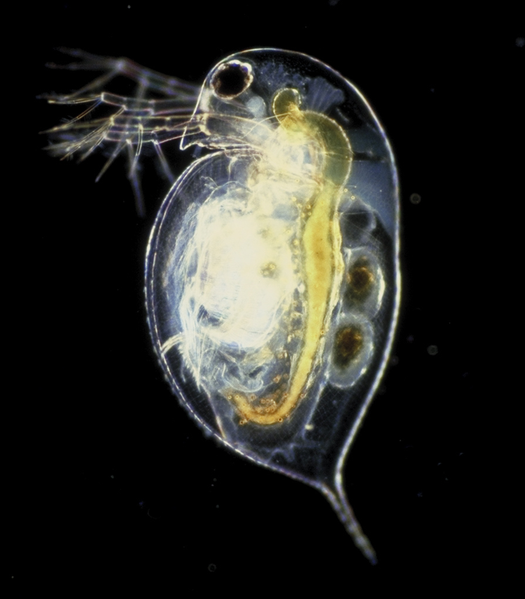
In the Christian religion, the resurrection follows the virgin birth. In the rock-graves at Heysham, the virgin birth follows the resurrection. Or rather: the virgin-births follow the resurrections. There are many of both. The rock-graves at Heysham* are carved in solid rock near the remains of St Patrick’s chapel, an ancient ruin overlooking Morecambe Bay on the coast of Lancashire in England. You may have seen them before, because they appear on the cover of a compilation album by the heavy-metal band Black Sabbath, where they’re filled with ice and look suitably dark and sinister. But the graves are sometimes full of life and activity. In spring, as the rainwater filling them begins to warm, there are resurrections – dozens of them. Tiny crustaceans (a group of animals that includes crabs, shrimps and woodlice) hatch from eggs that have over-wintered in the sediment on the floors of the graves. Some of the crustaceans are called water-fleas, others are called seed-shrimps. Water-fleas, whose scientific name is Daphnia, hop through the water with jerks of their antennae, sieving it for fresh-water plankton. Seed-shrimps, or ostracods, are enclosed in tiny double-sided shells through which their legs protrude. They trundle over the stone sides of the graves, scraping off algae and catching even smaller and simpler animals like rotifers and protozoa.

The rock graves at Heysham (c. 11th century A.D.)

Rock graves at Heysham, Lancs. (c. 1000s)

Water-fleas are famous for parthenogenesis, or their ability to produce offspring without sex. Those that hatch first in spring are female and give birth without mating with any males. A single water-flea in a jar of stagnant water soon becomes a swarm. It’s only later in the year that males are born and the water-fleas mate to produce winter eggs, which sink to the floor of the graves and lie there through the cold weather. The eggs of water-fleas and ostracods can also survive desiccation, or drying-up, and can be blown on the wind to new sites. That is probably how these crustaceans arrived in the rock-graves, which they must have occupied for centuries, through the coldest winters and the hottest summers, dying and being reborn again and again. When a human being or large animal dies, chemical changes in the body make the muscles rigid and wood-like. The scientific term for this is rigor mortis, or the “stiffness of death”. Rigor mortis wears off in time and the body begins to rot. The rock-graves at Heysham are an example of vigor mortis, or the “vigour of death”. Medieval human beings created the graves to bury their dead, but the bodies that were once there have been lost to history. The water-fleas and the seed-shrimps remain, tiny, overlooked and fascinating.

A seed-shrimp or ostracod

A seed-shrimp

A water-flea, Daphnia pulex

A water-flea


*Heysham is pronounced HEE-shum and is an old coastal village near the city of Lancaster, after which Lancashire is named.

Standing on the Sky

Field Guide to Meteors and Meteorites
Field Guide to Meteors and Meteorites, O. Richard Norton and Lawrence A. Chitwood (2008)

If you want to touch something from outer space, simply form one of your hands into a fist. You will then be touching star-stuff, because every atom in every human was once heavenly. We eat star-cinders, breathe star-fumes and stand on the sky, because all terrestrial matter was once extra-terrestrial. This is because the fusional furnace of a star, unlike an ordinary furnace, creates complexity out of simplicity. Simple atoms like hydrogen and helium go in, complex atoms like oxygen and iron come out. I think that’s one of the important messages to take from this book: Up There is down here and always has been. O. Richard Norton is writing about stones that are special because they fall from the sky, but sometimes those stones are very hard to tell from ordinary stones, as the section called “Meteorwrongs” explains next to a photo of two very similar rocks:

One of these rocks is a meteorite. Note the rounded knobbly shapes in both that look like clusters of grapes. Mundrabilla (right) is an Australian iron meteorite. The knuckle-like knobs are large, randomly orientated iron-nickel crystals of taenite that stand out due to weathering. A pair of Moqui marbles (left) are concretions weathered out of Navajo Sandstone in the southwestern United States. The sand is glued together by the iron oxides, hematite and goethite. They are a terrestrial analogue to the hematite-cemented Martian blueberries seen from the Martian rover Opportunity in 2004. (“A Gallery of Meteorwrongs”, pg. 178)

Unless you’re an expert, distinguishing special sky-stones from ordinary earth-stones can be difficult. But are any stones really ordinary? I don’t think so. They all come ultimately from the belly of a star and they all raise this fascinating question: what is matter? The ultimate answer to that may be: Matter is mathematics. But maths is always present when you study matter and its behaviour, so there is a lot of maths in this book. In fact, the whole book is mathematical, because it’s all about chemistry, geology, petrography and various forms of physics: orbital mechanics, thermodynamics, optics and even acoustics:

The sound of a fireball is an altogether different experience. It is an eerie experience when a fireball begins its rapid journey across the sky. Trees and tall buildings cast long moving shadows… Seconds go by and not a sound is heard. Suddenly, without warning, the fireball explodes, scattering myriads of fragments that briefly maintain their courses among the stars. All of this happens in absolute silence. Seconds and minutes go by. The fireball vanishes. Still, silence. Then, when you least expect it, a tremendous series of explosions rock the silence. The fireball’s shock wave has finally arrived, announcing its presence by a series of ground-shaking sonic booms. These sounds are caused by pressure waves generated in the atmosphere by the hypersonic flight of the fireball. (chapter 3, “Meteoroids to Meteors: Lessons in Survival”, pg. 45)

Fireballs are rare, but meteors fall constantly and many people watch for them and photograph them, so this book is also about sky-stones you can see falling, not just about sky-stones you can pick up or stand on. After all, some never reach the ground. Huge numbers of meteors fall individually and unpredictably, but there are also periodic meteor-showers named after the constellations they seem to fall from, like the Aquarids, Leonids and Taurids, and associated with the debris-trail of comets. These can also be tracked using radar:

In the 1940s military radar operators noticed that meteors caused interruptions in high-frequency broadcasting reception, taking the form of whistles that rapidly dropped in pitch. Most individual meteoroids are too small to reflect radar waves back to the ground. Instead, radar waves sent from the ground were detected as they reflected off much larger targets, in this case, columns of ionized gas left in the wake of a meteor, formed when the particles evaporated passing through the Earth’s upper atmosphere. (ch. 1, “Interplanetary Dust and Meteors”, pg. 19)

In a way, radar was detecting the death-cries of the “Ancient Fragments of the Solar System” described in part one of this book: the asteroidal and cometary grit in the cosmic clockwork of the sun and planets. Bits of that grit have been falling to earth throughout man’s existence, but some sceptics, inspired by Newton’s apparent conquest of the heavens, decided it wasn’t there after all. When two scientists from Connecticut reported a meteorite fall in 1807, Thomas Jefferson famously said: “I would sooner believe that two Yankee professors would lie than that stones would fall from heaven.” He wasn’t just wrong, he was unimaginative too. Two hundred years later, we know better, but some knew better more than two millennia ago:

Diogenites are named for the fifth century B.C. Greek philosopher, Diogenes of Apollonia, considered to be the first person to suggest that meteorites actually came from beyond the Earth. They are called Plutonic since their origin appears to be plutonic rocks deep below the eucrite crust of the asteroid 4 Vesta. (ch. 5, “Primitive and Differentiated Meteorites: Asteroidal Achondrites”, pg. 122)

So fragments of asteroid existed on the earth before astronomers discovered the existence of asteroids. Fragments of Mars and the moon have been found on earth too, as Norton describes: big meteoric impacts there have blasted Mars- and moon-stuff free and some of it has fallen here. But Diogenes’ ancient insight about the origin of sky-stones didn’t influence their name: meteors are so-called because they were thought to be atmospheric phenomena. That is, a shooting star, or meteor, was seen as part of meteorology, not astronomy. When science learnt better, it created two more terms: meteoroid, meaning the physical object in space, and meteorite, meaning the physical object once it’s landed on the earth. You may have meteorites on your windowsills, because some of them are very small: IDPs, or Interplanetary/Interstellar Dust Particles, like the ones that stream from the tail of a comet as it approaches the sun. These drift to earth rather than drop, but they’re hard to tell from terrestrial dust. To study them more easily, scientists had to get away from the surface of the earth and Richard Norton describes how the “University of Washington’s Interplanetary Dust Laboratory” began to use “high flying aircraft” in the 1970s to collect this cometary dandruff (ch. 1, “Interplanetary Dust and Meteors”, pg. 9). Since then, the Stardust probe has actually collected samples from “the periodic Comet Wild 2 (pronounced ‘Vilt’)” and returned them to earth.

This is one part of astronomy that isn’t reliant on the ephemerality of photons, but photons can still tell us a lot about the chemistry of comets and asteroids, because light is influenced by the nature of the matter it bounces off or shines from:

In 1970, T.B. McCord and his coworkers at the Institute of Geophysics and Planetology, University of Hawaii, made astronomical history when they were the first to recognize similar characteristics between the spectra of 4 Vesta and a specific meteorite type. They compared the reflection spectra of the Nuevo Laredo achondrite with the reflection spectra of 4 Vesta. (ch. 2, “Meteorites: Fragments of Asteroids”, pg. 33)

Photons are important in other ways, as you’ll find in chapter 11, “From Hand Lens to Microscope”. Here astronomy meets petrography, or the study of patterns and colours in slices of rock under high magnification. The photographs in this chapter are some of the strangest and most beautiful in the book: “A calcium-rich clinopyroxene glows with bright second order interference colors” (pg. 218). But meteorites can be beautiful to the naked eye too, though sometimes they have to be cut open to become so. There’s gold and silver on page 171, for example, where you’ll see photographs of meteorites like:

Esquel, a main group pallasite. It was found in Argentina 1951 by a farmer while digging for a water tank. The meteorite shows beautiful yellowish green olivine (peridot) crystals… The Glorieta Mountain meteorite. When cut into a thin slab, polished and lighted from behind, this becomes one of the world’s most beautiful pallasites. (ch. 8, “Differentiated Meteorites: Stony-Irons”)

Pallasites aren’t named after the asteroid Pallas, but after the “German naturalist and explorer, Peter Simon Pallas”, who collected samples of a “1,600 lb meteorite found in 1749 near Krasnojarsk, Siberia” (pg. 168). Nearly two hundred years later, the Sikhote-Alin mountains in Siberia experienced a much bigger meteorite, seen as an “enormous fire-ball” on February 12, 1947, then collected as “thousands of beautifully sculpted iron meteorites… Today, Sikhote-Alin meteorites are highly prized in public and private collections throughout the world” (pg. 47). They’re black, not colourful, but the “flow-patterns” and regmaglypts – depressions like thumb-prints – caused by heat make them like attractive modernist sculpture. That Siberian fireball is described in in chapter 3, “Meteoroids to Meteors: Lessons in Survival”, which is about what happens to meteoroids as they plunge through the atmosphere. They heat up and sometimes break up, but they aren’t always sizzling when they hit the ground:

The temperature at 50,000-ft [15-km] altitude is about -50°F [-45°C]. This low temperature aids in rapidly chilling the falling rock. Long before hitting the ground the meteorite’s surface temperature has been reduced to between lukewarm and stone cold. The meteorite may even be coated with a thin layer of ice. In fact, some meteorites have been found minutes after landing, resting on top of a snow bank – without melting the snow. (pg. 45)

But sometimes meteorites are found millennia after landing, so the effects of water and weather are an important topic for meteorite-hunters. So are the effects of magnetism: you can use metal-detectors to hunt for meteorites, as Norton describes in chapter 10, “In the Field”. This is a field-guide, after all, but “field” can mean African desert, Swedish pine-forest and Arctic or Antarctic ice-sheet:

In the continental United States, the best hunting ground is in the southwestern part of the Mojave desert of southern California, where vegetation is relatively sparse and the climate is dry. Look for an old surface, one that has been exposed for a long time. Old dry lakes can be a good place to search. Many meteorites have been found in Rosamond, Muroc, and Lucerne dry lakes. (pg. 183)

The American meteorite-hunter Steve Arnold found his record-breaking “1,400 lb Brenham orientated pallasite” another way: “he dug it up from a depth of seven-and-a-half feet, locating it with the help of a high-tech metal detector” in 2005 (pg. 187). “Brenham orientated” is a reference to the way the meteorite was shaped by “ablation”, or the “removal and loss of… material by heating and vaporization” during its fall to earth (“Glossary”, pg. 267). But meteoroids aren’t just shaped by their encounter with the earth: they can also shape the earth, both geologically and biologically. The earth bears the scars of many past impacts, some of them cataclysmic in scale and epoch-making in their effects. Would man the mammal now rule the earth and watch the sky if it hadn’t been for the asteroid that wiped out the dinosaurs 65 million years ago? Or would an advanced, intelligent species of reptile be collecting and analysing meteorites now?

Questions like that aren’t just of historic interest: stones that fall from the sky are of huge practical importance, because big ones can wipe out not just cities and civilizations, but entire species, including Homo sapiens. The sky gave birth to all life on earth, because without the chemicals created there, life wouldn’t exist here. Life may even have begun there, but the sky has regularly committed infanticide too and man’s name is definitely on the hit-list. Sooner or later another giant sky-stone will hit the earth and cause megadeaths or worse, unless we spot it en route and stop it. That’s another message to take from this book: some meteoroids are beauties and some are beasts. All of them are interesting. This book explains how, what, where, and why, all the way from aphelia and bolides to xenoliths and the Zodiacal light.

Hateful, Bestial, Demonic

Who is the world’s saintliest womun? I would say Hillary Clinton, but she’s white, alas, so I’ll go for Aung San Suu Kyi and/or Winnie Mundela instead. But who is the world’s evillest woman? (sic) I don’t know, but I do know someone who is trying damn hard for the title: the keyly committed hate-blogger called HBD-Chick, who engages issues around an über-misanthropic unter-movement called H.B.D. This stands for Human Bio-Diversity, i.e., the hateful, bestial and demonic notion that biological “differences” between groups of humun being can help explain social, cultural and political patterns. HBD-Chick, for example, tries to explain levels of “corruption” and democracy in “different” countries by looking at how “in-bred” their populations are.

’Cuse me while I throw up. Yes, HBD is not just evil, it’s so pseudo-scientific that it makes tea-leaf reading look like gamma-ray astronomy. As proper scientists like Stephen Jay Gould, Jared Diamond, Steven Rose, Richard Lewontin and Karl Marx have taught us, humun beings floated free of biology during the Pleistocene and are best regarded as disembodied social units that just happen (for the time being) to have a corporeal component. It follows from this proper science that all social, cultural and political dysfunction can be explained by racism, sexism, homophobia and other forms of hate-think invented by white male Europeans of Christian heritage. And, like cornered rats baring their yellowed fangs and squealing their defiance, this despicable demographic has created HBD in an attempt to over-turn the hard-won scientific insights of Gould et al. If you’re a good persun, you won’t be taken in by the HBDers’ lies, deceit and pseudo-science. HBD-Chick is plainly a bad person (sic), because she has been taken in. But, as a womun, she isn’t really to blame – here are some of the real vectors of this diseased and depraved ideology:

Steve Surfer – KKKalifornian krank who invented and popularized the term HBD

West Hunter – run by pseudo-scientists Greg Cochran and Henry Harpending, the former of who/whom is responsible for an unspeakably hateful theory about the origins of homosexuality

JayMan – mendaciously claims to have Community-of-Color heritage and has added more hate-think to Cochran’s hate-theory

Evo and Proud – White, Male and Evil, more like

Dienekes – so pseudo-scientific it makes aromatherapy look like quantum physics

Light at Night

The Sky at Night: Answers to Questions from Across the Universe, Patrick Moore and Chris North (BBC Books, 2012)

Astronomy, one of the most successful and far-reaching of all sciences, has been largely based on almost nothing. Human beings have pushed their knowledge of the physical universe out over huge stretches of space and time without using anything physical, in the everyday sense of the word. This is because astronomy is largely based on the collection and analysis of tiny, weightless particles known as photons, which can’t be touched, tasted, smelt, or heard, only seen. And sometimes not seen either: visible light is only a small part of the electro-magnetic spectrum occupied by photons at different wavelengths and energies. Move a little in one direction and you meet invisible ultra-violet; move a little in the other direction and you meet invisible infra-red. Move further and you’ll meet radio-waves and gamma-rays. To make all those visible, we need technology, but we also need technology to collect the visible light of dim or distant celestial objects.

That technology is called the telescope and without it modern astronomy wouldn’t exist. The telescope opened a door in the attic of the universe just as the microscope opened a door in the cellar. But astronomy was an advanced subject well before the telescope was invented, in part because it is an essentially simple subject. Unlike human beings and animals, planets and stars behave in relatively stereotyped, predictable ways. That’s why their behaviour is so easily expressed and analysed using mathematics. Thousands of years ago, men could create mathematical models of the universe and accurately predict celestial behaviour in detail. But they couldn’t create mathematical models of animal or human behaviour and make accurate predictions. We still can’t do that, but we’ve getting better and better at applying mathematics to the photons we collect from the sky. Patrick Moore (1923-2012) was the eccentric BBC presenter of a series called The Sky at Night and devoted his life to those photons, particularly the ones that bounced off the surface of the moon. He wasn’t a professional astronomer or an advanced mathematician, but he could recognize the importance of mathematics and the devices that run on it:

What single technological advance over the past 53 years has facilitated the greatest increase in our knowledge and understanding of the cosmos?

Tony Davies (Shoreham-by-Sea, West Sussex)

I think we’ve got to say here the development of electronics in astronomy. Old-fashioned photography has gone out, and electronic devices have taken over. They have led to amazing advances, in all branches of science, not just astronomy. Coupled with the advances in electronic computing, they have allowed discoveries astronomers could only dream of even as recently as a decade ago. So I must say the advent of the Electronic Age. (“Patrick Moore and the Sky at Night”, pg. 424)

I can almost hear Patrick Moore’s slightly clipped, almost stuttering tones as I read that answer. He was an odd character, but I think he led a worthwhile life and odd characters are attracted to subjects like astronomy. It’s on the philatelic side of science and this description by George Orwell of his job in a bookshop might also apply to astronomy:

Like most second-hand bookshops we had various sidelines. We sold second-hand typewriters, for instance, and also stamps — used stamps, I mean. Stamp-collectors are a strange, silent, fish-like breed, of all ages, but only of the male sex; women, apparently, fail to see the peculiar charm of gumming bits of coloured paper into albums. (“Bookshop Memories”, 1936)

Women also mostly fail to see the peculiar charm of astronomy. One of the reasons I like it is that it contains a lot of big ideas and tantalizing possibilities, from the lingering birth-bawl in the Cosmic Microwave Background to the prospect of life beneath the ice-cap of Jupiter’s moon Europa, by way of T.L.P., or Transient Lunar Phenomena, the mysterious fleeting changes that occasionally occur on the moon. This book covers all of those and much more. Another reason I like astronomy is that, so far, it hasn’t often involved killing things and cutting them up. Or worse, not killing them and still cutting them up. H.G. Wells couldn’t have written The Island of Dr Moreau (1896) about an astronomer and part of H.P. Lovecraft’s genius was to combine the grandeurs and glories of astronomy with the intimacy and viscerality of biology. Lovecraft would certainly have liked this book. This sounds like a giant cosmic conspiracy right out of a story like “Dreams in the Witch House” (1932):

…our Galaxy is moving relative… to the Universe… at a speed of around 600 km/s… The cause of the motion, enigmatically known as the “Great Attractor”, was a mystery for several decades, partly because whatever is causing it is hidden behind the material in the disc of our Galaxy. The source of the motion is now thought to be a massive cluster of galaxies in the constellation of Norma, which is attracting not just our Galaxy and its immediate neighbours, but also the much larger Virgo cluster. (“Cosmology: The Expansion of the Universe”, pg. 208)

It’s a large and complicated universe out there and it’s amazing that we’ve managed to learn so much about it from our own tiny corner, using mostly nothing but light and working mostly nowhere but the earth itself. But that is the power of mathematics: Archimedes said of levers that, given a place to stand, he could move the world. Using the lever of mathematics, men can move the universe standing only in their own heads. The co-author of this book, Dr Chris North of the School of Physics and Astronomy at Cardiff University, is one of those men. He does the heavy intellectual lifting here, answering the most advanced questions, but I’m sure that he would acknowledge that Patrick Moore was one of the world’s greatest popularizers of astronomy. The questions themselves range from the naïve to the nuanced, the elementary to the exoplanetary. But I was surprised, given that this is a book issued by the Bolshevik Broadcasting Corporation, that almost all of them seemed to be asked by white males, sometimes from hideously unvibrant parts of Britain like County Durham. Was there no edict to invent some astrophile Ayeshas and Iqbals from Bradford and some budding Afro-physicists from Brixton?

Perhaps there was, but Moore ignored it. He was an old-fashioned character with old-fashioned views, after all, and he says here that he was introduced to astronomy by a book, G.F. Chambers’ The Story of the Solar System, that was published in 1898 (pg. 409). So his astronomy touched three centuries. He also met three very important men: Orville Wright, the first man to fly properly; Yuri Gagarin, the first man into space; and Neil Armstrong, the first man on the moon. Those were three steps towards our permanent occupation of space. To understand what attracts men there and the questions they hope to answer, this book is a good place to start.