Flesh and Fear

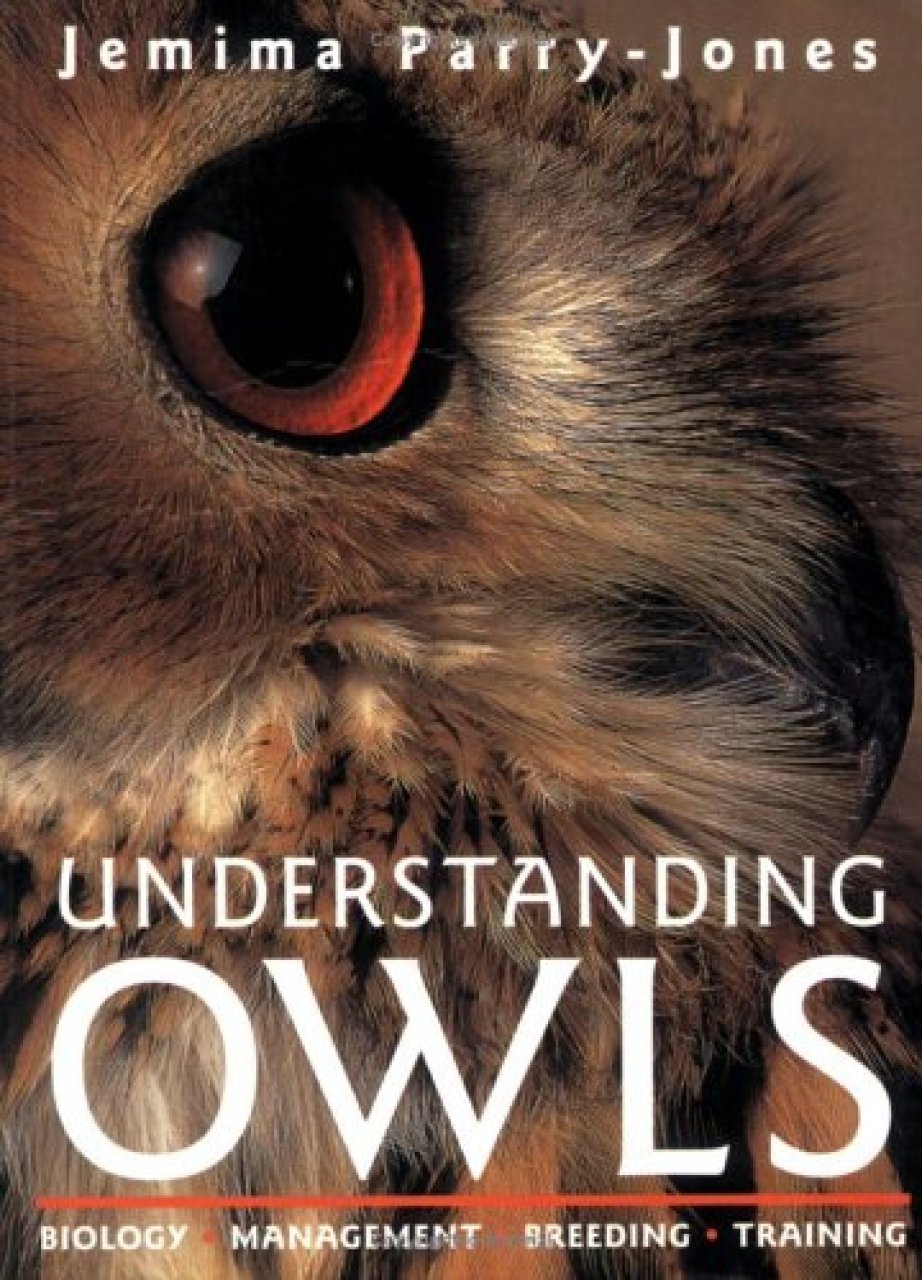
Understanding Owls by Jemima Parry-JonesUnderstanding Owls: Biology, Management, Breeding, Training, Jemima Parry-Jones (David & Charles, 1998)

We come into the world ready for the world. And in more ways than one. We aren’t just born with sense-organs and a brain designed to use them: we’re born with instinctive likes and dislikes. That’s where phobias come from. The common ones, about heights or contamination or potentially dangerous animals, are based on things that we’ve been facing and surviving for millions of years. Or failing to survive, because we didn’t pay them sufficient attention or respect. Those who did pay sufficient attention and respect were those who had more offspring and passed down the relevant, phobogenic genes.

How precisely those genes encode fear is an interesting question. Are spiders and snakes written into our brains in some sense? Monkeys are instinctively afraid of snakes, for example, and though that fear has to be triggered by example, it is obviously there to be triggered. A mother-monkey apparently reacting with fear to a flower will not induce a fear of flowers in her offspring. But if she reacts with fear to a snake, she will induce a fear of snakes. Monkeys also have special warning-calls for birds of prey. Human beings have been too big for too long to be easily afraid of birds, but we were small enough once to be their prey and genetic memories may linger. That might help explain our fascination with birds of prey. But I don’t think owls are written into our brains the way spiders and snakes probably are.

They do trigger other instincts, however: their uncanny stare, their nocturnal lives, their loud calls and the silence of their flight all help explain why they’re psychologically special to human beings and part of myth and legend around the world. This book is a practical introduction to keeping owls as pets, not general guide, but it has lots of owls in it, so it has lots of uncanny and unblinking eyes too. And a lot of beauty: owls don’t often have elegant shapes, but they often have beautiful feathers. They’re also intelligent birds and can be trained to the hand rather like eagles and falcons. Unlike eagles and falcons, however, they generally hunt small ground-animals and at night, so “Hunting with Owls” is unrewarding and Jemima Parry-Jones gives it only two pages, one of which is mostly taken up by a photo of an eagle owl (Bubo sp.). But it’s an interesting addition to a short but interesting book, with lots of attractive pictures and practical advice.

He Say, He Sigh, He Sow #13

“In the early thirties Trotsky also spoke of ‘Bonapartism’ in the Stalinist regime. In 1935, however, he observed that in the French Revolution Thermidor had come first and Napoleon afterwards; the order should be the same in Russia, and, as there was already a Bonaparte, Thermidor must have come and gone.” — Leszek Kołakowski in Main Currents of Marxism: Vol. III, The Breakdown (1978).

Hit and Smith

Front cover of Songs that Saved Your Life by Simon GoddardSongs that Saved Your Life: The Art of The Smiths 1982-87, Simon Goddard (Titan Books 2013)

I enjoyed Simon Goddard’s Mozipedia – The Encyclopedia of Morrissey and The Smiths a lot. And learnt a lot from it too. But I haven’t bothered finishing Simon Goddard’s Songs that Saved Your Life: The Art of The Smiths 1982-87 (an updated edition of The Smiths: Songs That Saved Your Life, 2002). There’s too much rock-writer rhetoric, too many mixed metaphors, too few pictures. None, in fact, apart from the band-photo on the front cover and the tickets on the back. Part of the problem is that The Smiths were only Act One in Mozza’s career. Johnny Marr played guitar well and wrote some beautiful tunes. But Morrissey was the interesting, eclectic and original one in The Smiths: the Mogpie didn’t need Marr a quarter as much as Marr needed the Mogpie. That’s part of why Mozipedia is better. Use this book as a supplement, because it’s got a lot of disc-o-detail and the appendices are good, covering The Smiths on record, in concert and on TV and radio. Goddard doesn’t have room to get rock-o-rhetorical there.

Performativizing Papyrocentricity #10

Papyrocentric Performativity Presents:

Sea HereSea Charts of the British Isles: A Voyage of Discovery around Britain & Ireland’s Coastline, John Blake (Conway Maritime Press, 2005)

Art-BanditOutsider II: Always Almost, Never Quite, Brian Sewell (Quartet Books, 2012)

Clarke’s ArksImperial Earth (1976) and Rendezvous with Rama (1972), Arthur C. Clarke

The Joy of ’LeksThe Dalek Handbook, Steve Tribe and James Goss (BBC Books, 2011)


Or Read a Review at Random: RaRaR

Lit Is It

You know, I’m getting worried at my inability to have unmediated experiences. Everything reminds me of something in literature. It reminds me of this passage in Brideshead Revisited (1945):

“Oh, don’t talk in that damned bounderish way. Why must you see everything second-hand? Why must this be a play? Why must my conscience be a Pre-Raphaelite picture?”

“It’s a way I have.”

“I hate it.” (Op. cit.)

He Say, He Sigh, He Sow #12

“There were no bears, but at one point I disturbed an eagle on a ledge — and perhaps have seen nothing more beautiful than the one lazy flap of its wings that set it on a seemingly effortless vertical flight up the sun-warmed cliff behind it.” — the art-critic Brian Sewell describing a Turkish journey in Outsider II: Always Almost, Never Quite (2012).

Neuclid on the Block

How many blows does it take to demolish a wall with a hammer? It depends on the wall and the hammer, of course. If the wall is reality and the hammer is mathematics, you can do it in three blows, like this:

α’. Σημεῖόν ἐστιν, οὗ μέρος οὐθέν.
β’. Γραμμὴ δὲ μῆκος ἀπλατές.
γ’. Γραμμῆς δὲ πέρατα σημεῖα.

1. A point is that of which there is no part.
2. A line is a length without breadth.
3. The extremities of a line are points.

That is the astonishing, world-shattering opening in one of the strangest – and sanest – books ever written. It’s twenty-three centuries old, was written by an Alexandrian mathematician called Euclid (fl. 300 B.C.), and has been pored over by everyone from Abraham Lincoln to Bertrand Russell by way of Edna St. Vincent Millay. Its title is highly appropriate: Στοιχεῖα, or Elements. Physical reality is composed of chemical elements; mathematical reality is composed of logical elements. The second reality is much bigger – infinitely bigger, in fact. In his Elements, Euclid slipped the bonds of time, space and matter by demolishing the walls of reality with a mathematical hammer and escaping into a world of pure abstraction.

• Continue reading Neuclid on the Block

O Apollo

One of Swinburne’s most powerful, but least-known, poems is “The Last Oracle”, from Poems and Ballads, Second Series (1878). A song in honour of the god Apollo, it begins in lamentation:

Years have risen and fallen in darkness or in twilight,
   Ages waxed and waned that knew not thee nor thine,
While the world sought light by night and sought not thy light,
   Since the sad last pilgrim left thy dark mid shrine.
Dark the shrine and dumb the fount of song thence welling,
   Save for words more sad than tears of blood, that said:
Tell the king, on earth has fallen the glorious dwelling,
   And the watersprings that spake are quenched and dead.
Not a cell is left the God, no roof, no cover
   In his hand the prophet laurel flowers no more.

And ends in exultation:

         For thy kingdom is past not away,
            Nor thy power from the place thereof hurled;
         Out of heaven they shall cast not the day,
            They shall cast not out song from the world.
         By the song and the light they give
         We know thy works that they live;
         With the gift thou hast given us of speech
         We praise, we adore, we beseech,
         We arise at thy bidding and follow,
            We cry to thee, answer, appear,
   O father of all of us, Paian, Apollo,
            Destroyer and healer, hear! (“The Last Oracle”)

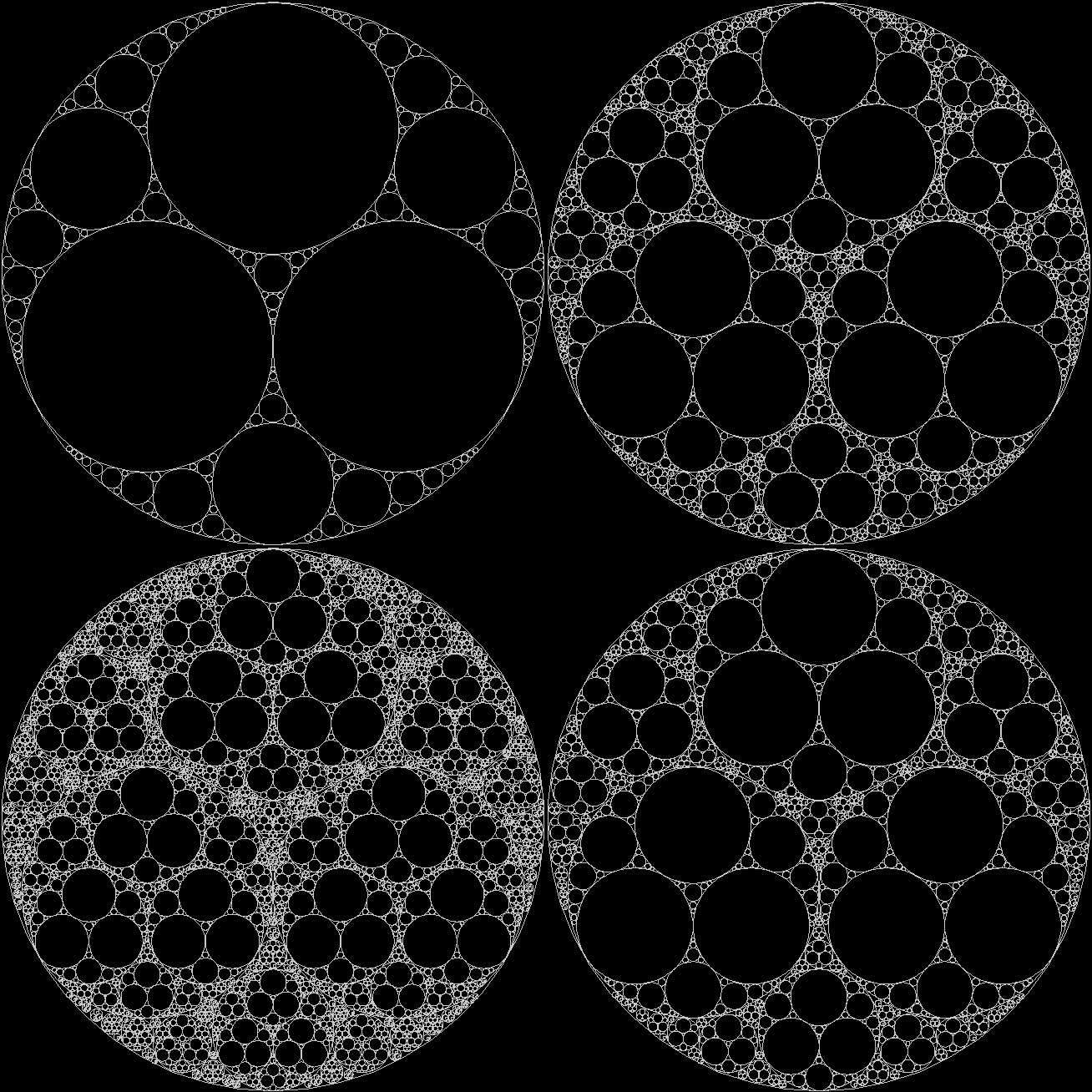
The power, grandeur and beauty of this poem remind me of the music of Beethoven. Swinburne is also, on a smaller scale and in a different medium, one of the geniuses of European art. He and Beethoven were both touched by Apollo, but Apollo was more than the god of music and poetry: he also presided mathematics. But then mathematics is much more visible, or audible, in music and poetry than it is in other arts. Rhythm, harmony, scansion, melody and rhyme are mathematical concepts. Music is built of notes, poetry of stresses and rhymes, and the rules governing them are easier to formalize than those governing, say, sculpture or prose.  Nor do poetry and music have to make sense or convey explicit meaning like other arts. That’s why I think a shape like this is closer to poetry or music than it is to painting:

Apollonian gasket (Wikipedia)

(Image from Wikipedia.)

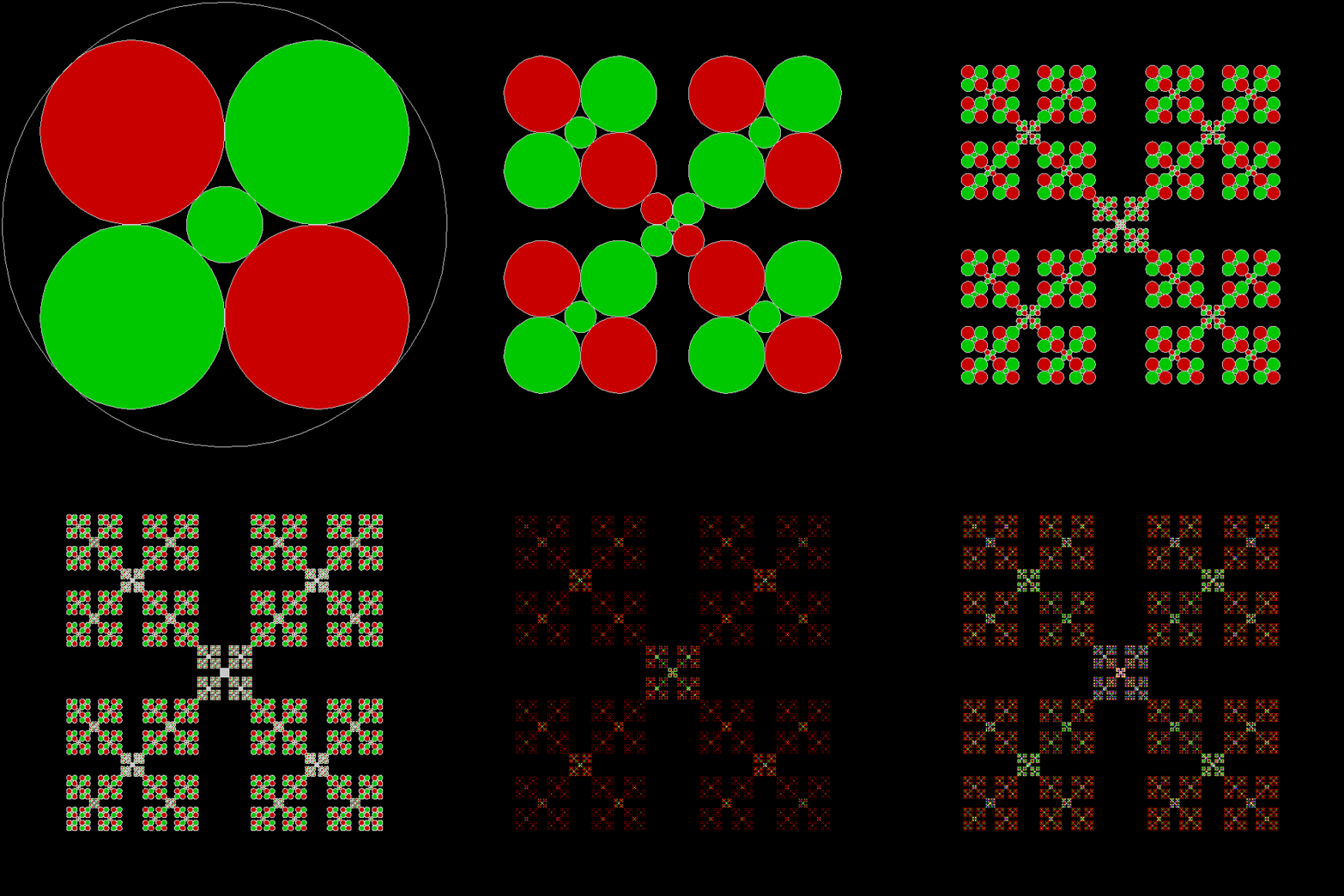
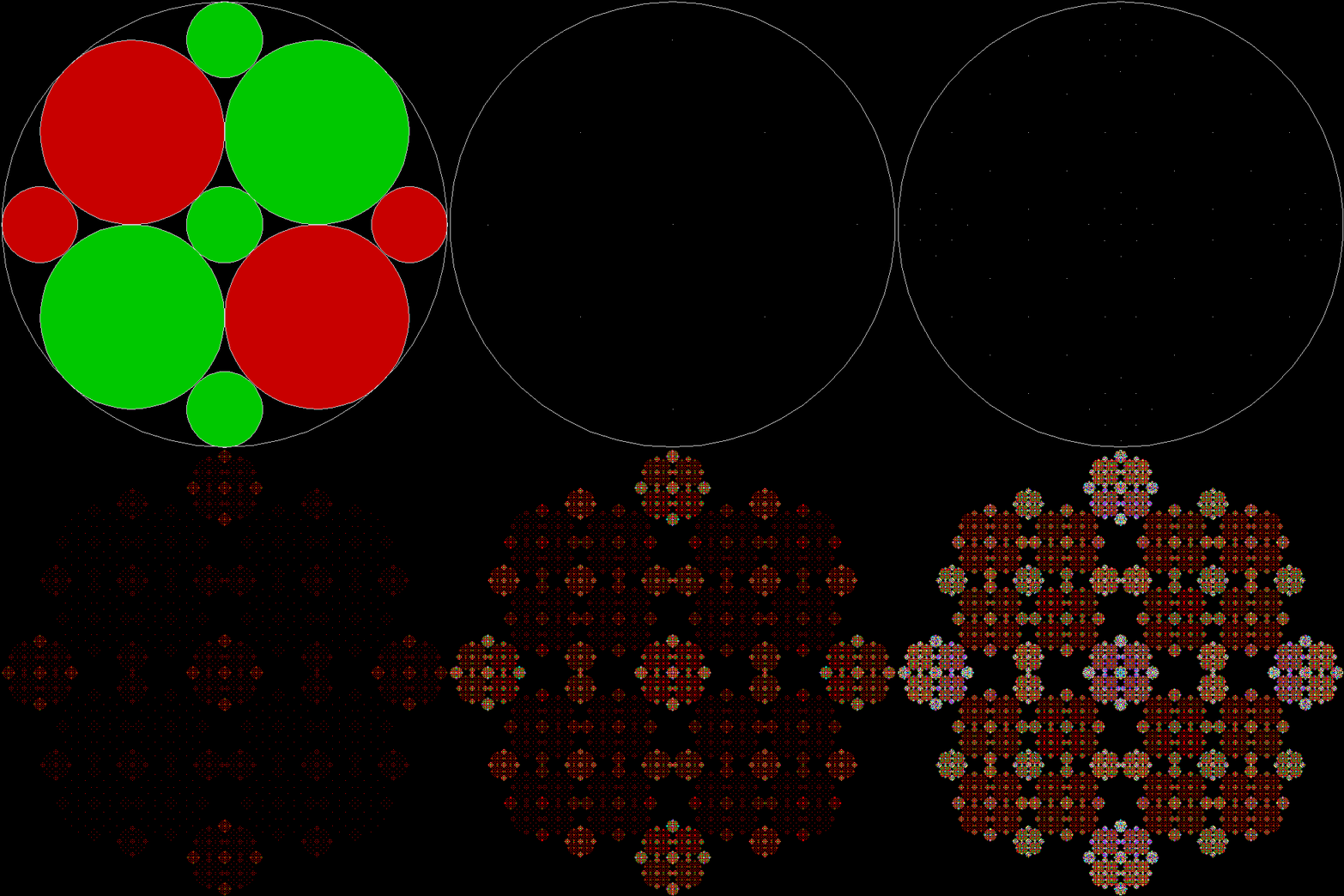
This shape has formal structure and beauty, but it has no explicit meaning. Its name has a divine echo: the Apollonian gasket or net, named after the Greek mathematician Apollonius of Perga (c.262 BC–c.190 BC), who was named after Apollo, god of music, poetry and mathematics. The Apollonian gasket is a fractal, but the version above is not as fractal as it could be. I wondered what it would look like if, like fleas preying on fleas, circles appeared inside circles, gaskets within gaskets. I haven’t managed to program the shape properly yet, but here is my first effort at an Intra-Apollonian gasket:

Apollonian gasket

(If the image does not animate or looks distorted, please try opening it in a new window)

When the circles are solid, they remind me of ice-floes inside ice-floes:

Apollonian gasket (solid)

Simpler gaskets can be interesting too:

five-circle gasket


five+four-circle gasket


nine-circle gasket