“Egypt’s election hands liberals a pivotal voice” — headline in The National, 27/v/12 (English-language Arab newspaper)
Previously pre-posted (please peruse):

“Egypt’s election hands liberals a pivotal voice” — headline in The National, 27/v/12 (English-language Arab newspaper)
Previously pre-posted (please peruse):
The astonishment one feels on learning of the success of the movement takes second place only to the astonishment that this success has been achieved almost without notice from the mainstream and the underground press alike. Nation-wide weeklies like the NME [New Musical Express] haven’t condescended as yet to feature a single band even vaguely affiliated to the movement, and the fanzines that spring up like mushrooms around any spasmodic “new genre” emptying of popular music’s overclogged bowels have found little nourishment in the only truly fresh development in the field since the earliest days of rap. So far only one or two of the bands on the very fringes of the movement have received any serious attention. Yet Dwaal, who by their own admission are one of the “baby” acts in Quiet, have sold nearly 20,000 of their debut album Slow Hearts in the eight months since its release; the really big boys like Morpheus and Dark could expect to shift this amount in the first week of release of their next albums. Tickets for tours by either of the last mentioned have been known to sell out within an hour of going on sale, and rumours of an imminent ocean-hop by Murmur, the Chicago band seen by many as the kings of Quiet, had the telephones at the offices of London’s GigWise booking agency tied up solid for nearly two days.
So, how has Quiet not merely got off the ground but got well on the way to the outer reaches of the Solar System without collecting a write-up or a review worthy of the name? Why do the names of the most important bands in the movement still mean nothing to the majority of music fans? Well, for a start, Quiet — in every sense — lives up to the name bestowed on by Hank O’Dowell, Murmur’s lead guitarist. To see how this is so, it’s necessary to take a look at its history.
• Continue reading A Diet of Quiet…
A little-known Housman poem that should be better-known:
Breathe, my lute, beneath my fingers
One regretful breath,
One lament for life that lingers
Round the doors of death.
For the frost has killed the rose,
And our summer dies in snows,
And our morning once for all
Gathers to the evenfall.
Hush, my lute, return to sleeping,
Sing no songs again.
For the reaper stays his reaping
On the darkened plain;
And the day has drained its cup,
And the twilight cometh up;
Song and sorrow all that are
Slumber at the even-star.
A.E. Housman (1859-1936) — see also Breathe, my lute at Wikilivres.
Papyrocentric Performativity Presents:
Scheming Demon – The Screwtape Letters, C.S. Lewis (1942)
Ai Wei to Hell – How to Read Contemporary Art, Michael Wilson (Thames & Hudson, 2013)
Toxic Twosome – Doll, Peter Sotos and James Havoc (TransVisceral Books, 2013)
Know Your Limaçons – The Penguin Dictionary of Curious and Interesting Geometry, David Wells (1991) (posted @ Overlord of the Über-Feral)
Pestilent, Pustulent and Pox-Pocked – various books by Dr Miriam B. Stimbers (@ O.o.t.Ü.-F.)
Or Read a Review at Random: RaRaR
You can stop reading now, if you want. Or can you? Are your decisions really your own, or are you and all other human beings merely spectators in the mind-arena, observing but neither influencing nor initiating what goes on there? Are all your apparent choices in your brain, but out of your hands, made by mechanisms beyond, or below, your conscious control?
In short, do you have free will? This is a big topic – one of the biggest. For me, the three most interesting things in the world are the Problem of Consciousness, the Problem of Existence and the Question of Free Will. I call consciousness and existence problems because I think they’re real. They’re actually there to be investigated and explained. I call free will a question because I don’t think it’s real. I don’t believe that human beings can choose freely or that any possible being, natural or supernatural, can do so. And I don’t believe we truly want free will: it’s an excuse for other things and something we gladly reject in certain circumstances.
Continue reading The Brain in Pain…
89 is special because it’s a prime number, divisible by only itself and 1. It’s also a sum of powers in a special way: 89 = 8^1 + 9^2. In base ten, no other two-digit number is equal to its own ascending power-sum like that. But the same pattern appears in these three-digit numbers, as the powers climb with the digits:
135 = 1^1 + 3^2 + 5^3 = 1 + 9 + 125 = 135
175 = 1^1 + 7^2 + 5^3 = 1 + 49 + 125 = 175
518 = 5^1 + 1^2 + 8^3 = 5 + 1 + 512 = 518
598 = 5^1 + 9^2 + 8^3 = 5 + 81 + 512 = 598
And in these four-digit numbers:
1306 = 1^1 + 3^2 + 0^3 + 6^4 = 1 + 9 + 0 + 1296 = 1306
1676 = 1^1 + 6^2 + 7^3 + 6^4 = 1 + 36 + 343 + 1296 = 1676
2427 = 2^1 + 4^2 + 2^3 + 7^4 = 2 + 16 + 8 + 2401 = 2427
The pattern doesn’t apply to any five-digit number in base-10 and six-digit numbers supply only this near miss:
263248 + 1 = 2^1 + 6^2 + 3^3 + 2^4 + 4^5 + 8^6 = 2 + 36 + 27 + 16 + 1024 + 262144 = 263249
But the pattern re-appears among seven-digit numbers:
2646798 = 2^1 + 6^2 + 4^3 + 6^4 + 7^5 + 9^6 + 8^7 = 2 + 36 + 64 + 1296 + 16807 + 531441 + 2097152 = 2646798
Now try some base behaviour. Some power-sums in base-10 are power-sums in another base:
175 = 1^1 + 7^2 + 5^3 = 1 + 49 + 125 = 175
175 = 6D[b=27] = 6^1 + 13^2 = 6 + 169 = 175
1306 = 1^1 + 3^2 + 0^3 + 6^4 = 1 + 9 + 0 + 1296 = 1306
1306 = A[36][b=127] = 10^1 + 36^2 = 10 + 1296 = 1306
Here is an incomplete list of double-base power-sums:
83 = 1103[b=4] = 1^1 + 1^2 + 0^3 + 3^4 = 1 + 1 + 0 + 81 = 83
83 = 29[b=37] = 2^1 + 9^2 = 2 + 81 = 83
126 = 105[b=11] = 1^1 + 0^2 + 5^3 = 1 + 0 + 125 = 126
126 = 5B[b=23] = 5^1 + 11^2 = 5 + 121 = 126
175 = 1^1 + 7^2 + 5^3 = 1 + 49 + 125 = 175
175 = 6D[b=27] = 6^1 + 13^2 = 6 + 169 = 175
259 = 2014[b=5] = 2^1 + 0^2 + 1^3 + 4^4 = 2 + 0 + 1 + 256 = 259
259 = 3G[b=81] = 3^1 + 16^2 = 3 + 256 = 259
266 = 176[b=13] = 1^1 + 7^2 + 6^3 = 1 + 49 + 216 = 266
266 = AG[b=25] = 10^1 + 16^2 = 10 + 256 = 266
578 = 288[b=15] = 2^1 + 8^2 + 8^3 = 2 + 64 + 512 = 578
578 = 2[24][b=277] = 2^1 + 24^2 = 2 + 576 = 578
580 = 488[b=11] = 4^1 + 8^2 + 8^3 = 4 + 64 + 512 = 580
580 = 4[24][b=139] = 4^1 + 24^2 = 4 + 576 = 580
731 = 209[b=19] = 2^1 + 0^2 + 9^3 = 2 + 0 + 729 = 731
731 = 2[27][b=352] = 2^1 + 27^2 = 2 + 729 = 731
735 = 609[b=11] = 6^1 + 0^2 + 9^3 = 6 + 0 + 729 = 735
735 = 6[27][b=118] = 6^1 + 27^2 = 6 + 729 = 735
1306 = 1^1 + 3^2 + 0^3 + 6^4 = 1 + 9 + 0 + 1296 = 1306
1306 = A[36][b=127] = 10^1 + 36^2 = 10 + 1296 = 1306
1852 = 3BC[b=23] = 3^1 + 11^2 + 12^3 = 3 + 121 + 1728 = 1852
1852 = 3[43][b=603] = 3^1 + 43^2 = 3 + 1849 = 1852
2943 = 3EE[b=29] = 3^1 + 14^2 + 14^3 = 3 + 196 + 2744 = 2943
2943 = [27][54][b=107] = 27^1 + 54^2 = 27 + 2916 = 2943
Previously pre-posted (please peruse):
“The most merciful thing in the world,” said H.P. Lovecraft, “is the inability of the human mind to correlate all its contents.” Nowadays we can’t correlate all the contents of our hard-drives either. But occasionally bits come together. I’ve had two MP3s sitting on my hard-drive for months: “Drink or Die” by Erotic Support and “Hunter Gatherer” by Swords of Mars. I liked them both a lot, but until recently I didn’t realize that they were by two incarnations of the same Finnish band.
They don’t sound very much alike, after all. But now that I’ve correlated them, they’ve inspired some thoughts on music and mutilation. “Drink or Die” is a dense, fuzzy, leather-lunged rumble-rocker that, like a good Mötley Crüe song, your ears can snort like cocaine. But, unlike Mötley Crüe, the auditory rush lasts the whole song, not just the first half. “Hunter Gatherer” is much more sombre. Erotic Support were “Helsinki beercore”; Swords of Mars are darker, doomier and dirgier. They’ve also got a better name – “Erotic Support” seems to have lost something in translation. Finnish is a long way from English: it’s in a different and unrelated language family, the Finno-Ugric, not the Indo-European. So it lines up with Hungarian and Estonian, not English, German and French. But Erotic Support’s lyrics are good English and “Drink or Die” is a clever title. They’d have been a more interesting band if they’d sung entirely in Finnish, but also less successful, because less accessible to the rest of the world.
Es war einmal eine Königstochter, die ging hinaus in den Wald und setzte sich an einen kühlen Brunnen. Sie hatte eine goldene Kugel, die war ihr liebstes Spielwerk, die warf sie in die Höhe und fing sie wieder in der Luft und hatte ihre Lust daran. Einmal war die Kugel gar hoch geflogen, sie hatte die Hand schon ausgestreckt und die Finger gekrümmt, um sie wieder zufangen, da schlug sie neben vorbei auf die Erde, rollte und rollte und geradezu in das Wasser hinein.
Mieleni minun tekevi, aivoni ajattelevi
lähteäni laulamahan, saa’ani sanelemahan,
sukuvirttä suoltamahan, lajivirttä laulamahan.
Sanat suussani sulavat, puhe’et putoelevat,
kielelleni kerkiävät, hampahilleni hajoovat.Veli kulta, veikkoseni, kaunis kasvinkumppalini!
Lähe nyt kanssa laulamahan, saa kera sanelemahan
yhtehen yhyttyämme, kahta’alta käytyämme!
Harvoin yhtehen yhymme, saamme toinen toisihimme
näillä raukoilla rajoilla, poloisilla Pohjan mailla.
All the same, being inaccessible sometimes helps a band’s appeal to the rest of the world: the mystique of black metal is much stronger in bands that use only Norwegian or one of the other Scandinavian languages. Erotic Support haven’t joined that rebellion against Coca-Colonization and tried to create an indigenous genre. They’re happy to reproduce more or less American music using the more or less American invention known as the electric guitar. But amplified music would have appeared in Europe even if North America had been colonized by the Chinese, so I wonder what rock would sound like if it had evolved in Europe instead. It wouldn’t be called rock, of course, but what other differences would it have? Would it be more sophisticated, for example? I think it would. The success of American exports depends in part on their strong and simple flavours. “Drink or Die” has those flavours: it’s about volume, rhythm and power. It’s full of a certain “drug-addled, crab-infested, tinnitus-nagged spirit” — the “urge to submerge in the raw bedrock viscerality of rock”, as some metaphor-mixing, über-emphasizing idiot once put it (I think it was me).
Erotic Support are “beercore”, remember. Beer marks the brain with hangovers, just as tattoos mark the skin with ink. And just as loud music marks the ears with tinnitus. There are various kinds of self-mutilation in rock and that self-mutilation can have unhealthy motives. It can be an expression of boredom, angst, anomie and self-hatred. Unsurprisingly, Finland has the nineteenth highest suicide rate in the world. Beer, tattoos and tinnitus are part of the louder, dirtier and loutier end of rock: unlike Radiohead or Coldplay, Erotic Support sound like a band with tattoos who are used to hangovers. “Drink or Die” is a joke about exactly that. But what if rock had evolved in a wine-drinking culture? Would it be less of a sado-masochistic ritual, more a refined rite? Maybe not: the god of wine is Dionysos and he was Ho Bromios, the Thunderer. His brother Pan induces panic with loud noises. But black metal looks towards northern paganism: it’s music for pine forests, cold seas and beer-drinkers, not olive groves, warm seas and oenopotes.
Erotic Support don’t create soundscapes for Finland the way black metal creates soundscapes for Norway, but they do create beer-drinkers’ music, so they do express Finnishness to that extent. Swords of Mars, being darker, doomier and dirgier, are moving nearer an indigenous Finnish rock, or an indigenous Scandinavian rock, at least. This may be related to the fact that genes express themselves more strongly as an individual ages: for example, the correlation between the intelligence of parents and their children is strongest when the children are adults. Erotic Support create faster, more aggressive music than Swords of Mars, so it isn’t surprising that they’re the younger version of the same band. In biology, the genotype creates the phenotype: DNA codes for bodies and behaviour. Music is part of what Richard Dawkins calls the “extended phenotype”, like the nest of a bird or the termite-fishing-rods of a chimpanzee. A bird’s wings are created directly by its genes; a bird’s nest is created indirectly by its genes, viâ the brain. So a bird’s wings are part of the phenotype and a bird’s nest part of the extended phenotype.
Both are under the influence of the genes and both are expressions of biology. Music (like bird-song) is an expression of biology too, as is the difference between the music of Erotic Support and Swords of Mars. As brains age, the behaviour they create changes. Swords of Mars are older and not attracted to reckless self-mutilation as Erotic Support were: it’s not music to precede hangovers and induce tinnitus any more. Sword of Mars aren’t trying to tattoo your ears but to educate your mind.
 The Penguin Dictionary of Curious and Interesting Geometry, David Wells (1991)
Mathematics is an ocean in which a child can paddle and an elephant can swim. Or a whale, indeed. This book, a sequel to Wells’ excellent Penguin Dictionary of Curious and Interesting Mathematics, is suitable for both paddlers and plungers. Plumbers, even, because you can dive into some very deep mathematics here.
Far too deep for me, I have to admit, but I can wade a little way into the shallows and enjoy looking further out at what I don’t understand, because the advantage of geometry over number theory is that it can appeal to the eye even when it baffles the brain. If this book is more expensive than its prequel, that’s because it needs to be. It’s a paperback, but a large one, to accommodate the illustrations.
Fortunately, plenty of them appeal to the eye without baffling the brain, like the absurdly simple yet mindstretching Koch snowflake. Take a triangle and divide each side into thirds. Erect another triangle on each middle third. Take each new line of the shape and do the same: divide into thirds, erect another triangle on the middle third. Then repeat. And repeat. For ever.
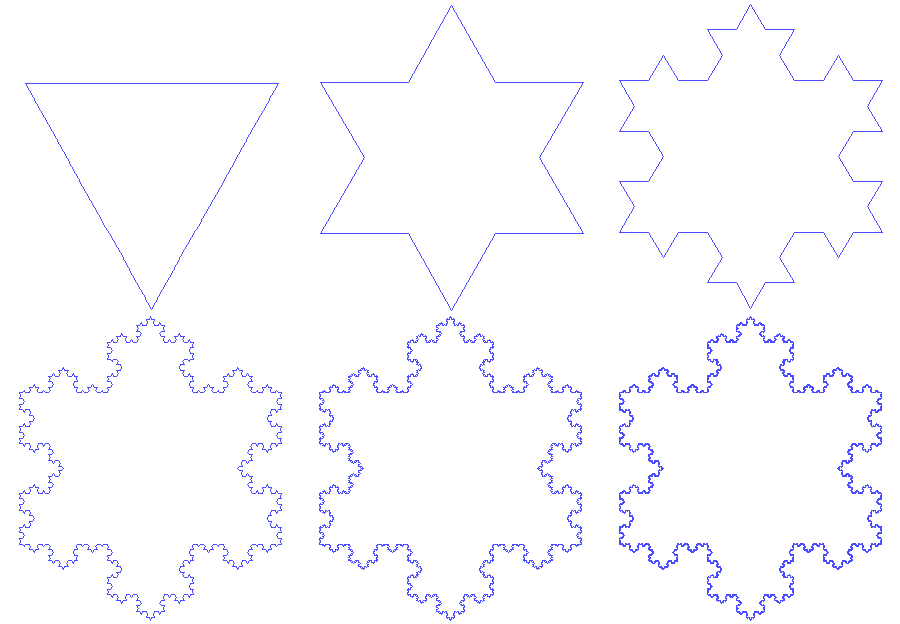
A Koch snowflake (from Wikipedia)
The result is a shape with a finite area enclosed by an infinite perimeter, and it is in fact a very early example of a fractal. Early in this case means it was invented in 1907, but many of the other beautiful shapes and theorems in this book stretch back much further: through Étienne Pascal and his oddly organic limaçon (which looks like a kidney) to the ancient Greeks and beyond. Some, on the other hand, are very modern, and this book was out-of-date on the day it was printed. Despite the thousands of years devoted by mathematicians to shapes and the relationship between them, new discoveries are being made all the time. Knots have probably been tied by human beings for as long as human beings have existed, but we’ve only now started to classify them properly and even find new uses for them in biology and physics.
Which is not to say knots are not included here, because they are. But even the older geometry Wells looks at would be enough to keep amateur and recreational mathematicians happy for years, proving, re-creating, and generalizing as they work their way through variations on all manner of trigonomic, topological, and tessellatory themes.
Previously pre-posted (please peruse):
• Poulet’s Propeller — discussion of Wells’ Penguin Dictionary of Curious and Interesting Numbers (1986)
Imagine four mice sitting on the corners of a square. Each mouse begins to run towards its clockwise neighbour. What happens? This:
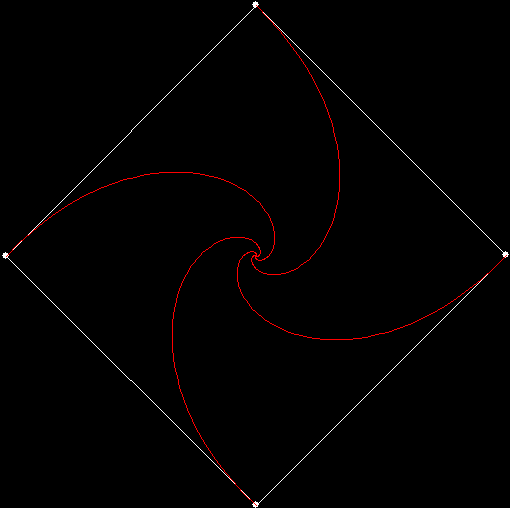
Four mice chasing each other
The mice spiral to the centre and meet, creating what are called pursuit curves. Now imagine eight mice on a square, four sitting on the corners, four sitting on the midpoints of the sides. Each mouse begins to run towards its clockwise neighbour. Now what happens? This:

Eight mice chasing each other
But what happens if each of the eight mice begins to run towards its neighbour-but-one? Or its neighbour-but-two? And so on. The curves begin to get more complex:
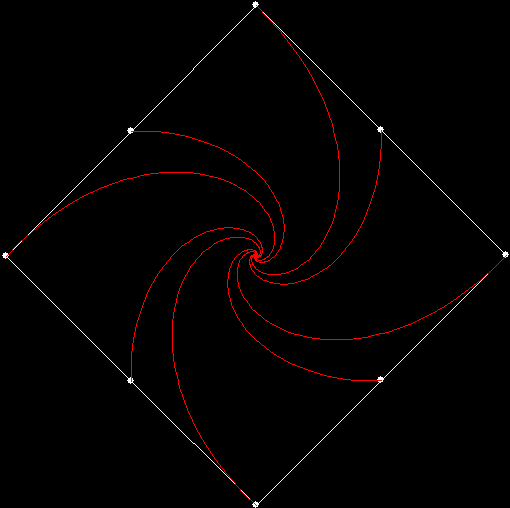
(Please open the following image in a new window if it fails to animate.)
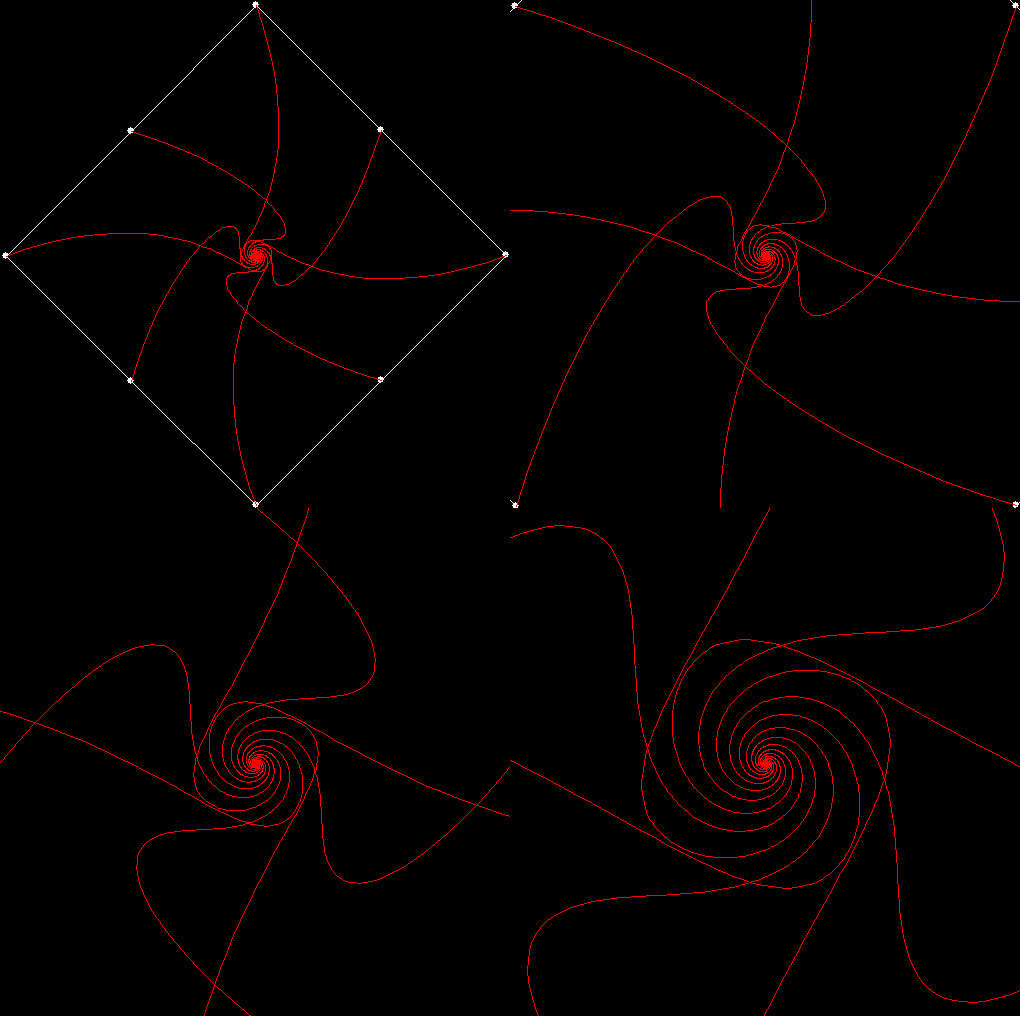
You can also make the mice run at different speeds or towards neighbours displaced by different amounts. As these variables change, so do the patterns traced by the mice:
• Continue reading Persecution Complexified

