Angst, Anguish, Abjection

It’s half tradition, half tic. At every Ruin-Dredger gig, the lead-singer Jerome Daziel asks the same simple question. Sometimes he shouts it and demands a reaction from the audience. Sometimes he whispers it and ignores what the audience does. Depending on the country, he’s asked it in French, Italian, Greek, Russian, Georgian, Mandarin, Thai, Samoan and Quechua. He’s also asked it in complete silence, having written it across his chest and on the palms of his hands in phosph-ink, invisible when the lights are on, glowing ghoulishly when they’re turned off. Occasionally he’s asked it backwards. In English, the question runs like this: “And What Doth It Mean To Be Flesh?”
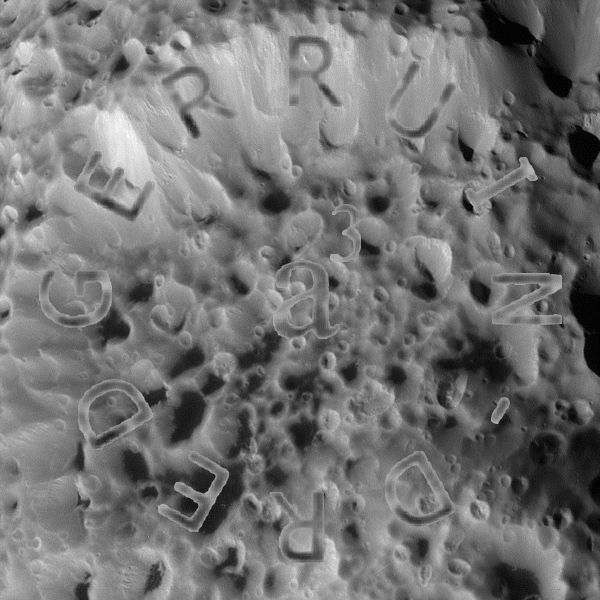
Cover of Triple-A by Ruin-Dredger (2000)

But you could see the whole of a Ruin-Dredger gig as asking the same searching thing. The band specialize in unusual frequencies that hunt out – and hum out – the resonances of the human body: the lungs, the bones, the blood. And their music sets up strange resonances in the mind. It’s both mindless and masterful, at once tearful and tyrannous. Sometimes it sounds like mathematics trying to come to life, and sometimes like mathematics trying to commit suicide. There’s a lot of science in their music, and a lot of silence too. “Star-clusters having tantrums,” is how one early review ran. “With occasional episodes of narcolepsy.” That mixture of sound and silence is mutually reinforcing: the sounds are sterner, the silence is sharper. They began their career with the albums Xoli-Hein (1992) and Pyramidion (1996), where they forged a series of griffs, or “gruff riffs”, that were often Ohrwürmer, or “ear-worms”, as German calls tunes that stick in your head. Even if you don’t want them to. But I’m not sure “tune” has ever been the right word for the music Ruin-Dredger create. It’s part industrial noise, part wolf-howl, part bat-twitter, but mostly “folded, fused, fissured, fractured, fidgety phonaesthesia.” And if you want to sample it, this album from the turn of the century is a good place to start.

What to call the album is one of the first puzzles it will set you. The band’s website usually calls it “a3” or “a3”; in interviews, the band themselves refer to it as “Triple-A” or “that A-fucker”. The second name comes from a plagiarism suit by the astro-music veterans Kargokkult that put Ruin-Dredger’s career on hold for nearly a year, 2002-3, and allegedly threatened to bankrupt their record-company. In the end the case was thrown out of court and even today some conspiracy-minded Dredge-heads claim it was cooked up for publicity between the ’Dredgers and the Kargonauts. The case might never have got as far as it did without that lunar cover for Triple-A, where the corroded letters of the band’s name and the album’s name hang above a lifeless moon-scape. Only it isn’t our moon. And it isn’t necessarily lifeless. Ruin-Dredger have a bee in their bonnet about the pre-biotic – the conditions necessary for the appearance of life. That’s what the first track on Triple-A, “Invention of the Cross”, is about: the chemicals that gave rise to life. And it literally has bees on it: the band sampled bees and bumblebees in flight and gathering nectar. They then altered the pitch and speed of the buzzing and made it sound both unearthly and unsettling. I’ve known people demand the track be turned off or skipped when it’s played to them.

But skipping track one of Triple-A is a bit like jumping from the frying-pan into the fire, because track two, “Seventh Sword”, is even more unearthly and even more unsettling. Bat-twitters hurtle through the speakers, falling from the ultra-sonic to the infra-sonic, rising in reverse, twisting, turning inside-out, mating, mutating and miscegenating. Then, as though the band have taken mercy on your ears and your mind, everything slows and soothes for track three, “Titanomachia”, which is often preceded in concert by the aforementioned carnal question: “And what doth it mean to be flesh?” This track is one of the last outings for the griffs of their early career: a slow, synth-based triple chord underlain by a sample of waves washing on an unknown shore. Track four, “Breathing Vacuum”, has also been known to provoke a “Turn it off!”, because the mumbling beneath the music is both sinister and sorrowful. You feel as though you should understand the words or, worse, that you will in your dreams. The chimes in the track are sinister too: they sound like a deep-sea, or deep-space, monster tapping on its fangs before putting them to famished use.

Which sets things up nicely, or nastily, for track five, “Scylla / Charybdis”. This is named after a pair of sea-monsters faced by Odysseus on his journey home from Troy and has been described by the ’Dredgers as a “battle-song”. The waves on “Titanomachia” are back, but bigger, badder and in a mood to fight. Daziel’s electronically treated voice wolf-howls a series of unintelligible questions, answered by patches of silence and gong-like drum-rolls. Track six, “Nyctogigas”, starts softly, builds back to the volume and violence of “Scyl/Char”, then breaks apart to allow the bats and bees of “Whilom” to steer your imagination out and up into the freezing star-light on the outer fringes of the solar system, where comets, shorn by the cold and dark, wait to swing sun-ward and regain their blazing locks. I like to listen to “Whilom” in the dark, wearing a blindfold, but then that’s the best way to listen to all of Ruin-Dredger’s music. Listening like that conjures visions and commands the viscera. Not an easy album, nor an unrewarding one, Triple-A isn’t their finest hour, if fan-polls and sales are any guide, but it’s an excellent guide to where they had come from and where they were about to go. If it’s the alpha-and-omega of their career, perhaps that explains the title: the “a” is the alpha (α) and the “3” an omega (ω) tipped on its side. I see it, or hear it, as a bridge between the ’nineties and the ’noughties: they’d give up the griffs and big up the bats, from then on, but they’ve never stopped asking that simple, sinister/sorrowful question of themselves and their listeners: “And What Doth It Mean To Be Flesh?”


a3 / a3 / Triple-A (S.R.K., 2000)

1. Invention of the Cross (5:26)
2. Seventh Sword (3:33)
3. Titanomachia (7:18)
4. Breathing Vacuum (9:03)
5. Scylla / Charybdis (6:11)
6. Nyctogigas (4:20)
7. Whilom (13:37)

Performativizing Papyrocentricity #7

Papyrocentric Performativity Presents:

Gábor, Gábor, Hej!Paradoxes in Probability Theory and Mathematical Statistics, Gábor J. Székely (1986)

Hit and MistThe Lost World and Other Stories, Arthur Conan Doyle (various dates)

Pride and PrecipiceThe Monk, Matthew Lewis (1796)

Mocking ManningEminent Victorians, Lytton Strachey (1918)

Mind the GapLytton Strachey: A Biography, Michael Holroyd (1967)

H8-FactoryRe-Light My Führer: Nausea, Noxiousness and Neo-Nazism in the Music(k) of Take That, 1988-2007, Dr Miriam B. Stimbers (2013)


Or Read a Review at Random: RaRaR

Chicks, Dicks and H.B.D.

Britain has recently been entertained by a cat-fight conducted at Twitter, The Observer and other loci of liberalism. Or perhaps “cat-and-castrated-tom-fight” is a better way of putting it. In the cat corner: a pair of self-righteous feminist egomaniacs called Julie Burchill and Suzanne Moore. In the castrato corner: lots of self-righteous transsexual egomaniacs and their supporters. It’s been one of those fights you wish both sides could lose, but it’s also been interesting from a hateful, bestial and demonic point of view. That is, from an HBD POV. HBD stands for human bio-diversity and is about looking at how human biology influences social, cultural and political patterns. Transsexuality is obviously a biological phenomenon, but I think feminism and female writers are too. Read on, if you’re man enough, and I’ll explain how.

The fight started when Suzanne Moore wrote an essay about “female anger” for an anthology published by the booksellers Waterstones. I don’t know or care what the anthology was about, but Moore’s essay included these lines:

The cliché is that female anger is always turned inwards rather than outwards into despair. We are angry with ourselves for not being happier, not being loved properly and not having the ideal body shape – that of a Brazilian transsexual. (Moore article)

Moore was then politely challenged on Twitter by a transphilic woman who detected a hint of transphobia in her remark. Moore refused to retract it and was even sarcastic about the notion of “intersectionality”, i.e., the multiple oppressions suffered by, say, black homosexuals with bad legs, who will suffer not just from racism, homophobia or disabledism, but from all three. Finally, pushed too far, Moore announced that:

People can just fuck off really. Cut their dicks off and be more feminist than me. Good for them. (Transphobic tweeting)

Moore then left Twitter because of the “bullying” she was experiencing. Her friend Julie Burchill came to her defence in The Observer (i.e. The Guardian-on-Sunday) in an article that began like this:

Hey trannies, cut it out

Where do dicks in terrible wigs get off lecturing us natural-born women about not being quite feministic enough? (Burchill article)

Burchill went on to excoriate “dicks in chick’s clothing” and “bed-wetters in bad wigs” who have had their “nuts taken off”. Further uproar ensued, the “transsexual community” complained long and loudly, and The Observer withdrew the article and apologized for the offence it had caused. All this has been entertaining but also, I think, an example of the poisoning of politics described by Britain’s Chief Rabbi, Jonathan Sacks:

Sacks: Multiculturalism threatens democracy

Multiculturalism promotes segregation, stifles free speech and threatens liberal democracy, Britain’s top Jewish official warned in extracts from his book The Home We Build Together: Recreating Society… [Jonathan] Sacks said Britain’s politics had been poisoned by the rise of identity politics, as minorities and aggrieved groups jockeyed first for rights, then for special treatment. The process, he said, began with Jews, before being taken up by blacks, women and gays. He said the effect had been “inexorably divisive. A culture of victimhood sets group against group, each claiming that its pain, injury, oppression, humiliation is greater than that of others.” (Multiculturalism threatens democracy, The Jerusalem Post)

By claiming “pain, injury, oppression” and so on, transsexuals want to make themselves immune from criticism. Saints could be trusted to behave well when immune from criticism, but saints wouldn’t demand to be so. Transsexuals are, I think it’s safe to say, no more saintly than Jews, blacks, women or gays. All the same, I also think Moore and Burchill have shown bigotry – in the proper, rather than politically correct, sense – towards transsexuals. This transphobic twosome obviously don’t like their feminist franchise being challenged by transsexuals, i.e., people who were born in men’s bodies, but think they’re really women and have had surgery to prove it. From my own bigoted, biocentric point of view, I am happy to accept that bodies do not always match brains and that someone with a female mind can be born in a male body. Or vice versa. It’s an interesting phenomenon, scientifically speaking, but it must also sometimes be a distressing phenomenon, psycho-socially speaking. Burchill’s sneers about “phantom limbs” and “bed-wetters in bad wigs” don’t show much female solidarity, let alone imaginative sympathy. But then she doesn’t seem to accept that a real woman can be born in a male body:

Shims, shemales, whatever you’re calling yourselves these days – don’t threaten or bully we [sic] lowly natural-born women, I warn you. We may not have as many lovely big swinging PhDs as you, but we’ve experienced a lifetime of PMT and sexual harassment, and many of us are now staring HRT and the menopause straight in the face – and still not flinching. Trust me, you ain’t seen nothing yet. You really won’t like us when we’re angry.

That is echt essentialism – indeed, physio-fascism. Burchill seems to believe that you can’t be a real woman unless you’re born in a female body. The bit about “lovely big swinging PhDs” is a sneer too, but a funny one: Burchill is an entertaining writer who combines masculine vigour with feminine illogic. Look at her reasoning here, for example:

…their lot [i.e., transsexuals] describe born women as “cis” – sounds like syph, cyst, cistern; all nasty stuff…

If “cis” is nasty because it sounds a bit like “cistern”, presumably “sister” would be even worse. Like Burchill, Suzanne Moore has no time for the nasty male invention of logic; unlike Burchill, she isn’t an entertaining or amusing writer. I’d never read anything by her before this cat-fight and I don’t intend to read anything again. The fight itself seems a good example of narcisso-sisters playing tyranny-trumps and poisoning politics, as the Chief Rabbi warned. Burchill and Moore themselves seem good examples of testotero-sisters: they’re masculinized in both psychology and physiognomy. It’s not just their aggression and coarseness: take a look at their faces:

Suzanne Moore and Julie Burchill

Suzanne Moore and Julie Burchill

I suggest that Moore and Burchill, despite their female bodies, are less psychologically female than some transsexuals who were born in male bodies. Both of them are left-wing and opponents of biological determinism, but they are cruder in their bio-determinism than the supposedly right-wing psychologist Hans Eysenck (1916–97), who was writing about HBD before HBD existed under its present name. In his book Sex, Violence and the Media (1978), Eysenck discussed that idea that “there is a strong biological determinant which predisposes individuals in the direction of greater or lesser ‘maleness’”:

Some of the strongest evidence for this point of view comes from the work of Dr Wilhart Schlegel, a Hamburg physician who made an exhaustive study of the shape of the pelvis in men and women. In men, typically, the pelvis is shaped like a funnel, tapering down to a narrow outlet; in women, the pelvis is shaped more like a tube, with a broad outlet. There is much variety within each sex; thus there are men with tube-shaped pelvis outlet structures, and women with funnel-shaped ones. What made Schlegel interested in the pelvic outlet is that its shape is apparently determined at the foetal stage by precisely the kind of hormonal burst [determining masculinity or femininity] already described; if such androgenic material is supplied, the pelvic shape will be masculine; if not, feminine. This led Schlegel to study in detail the social and sexual behaviour of men and women having typical and atypical pelvic shapes, using over a thousand men and women in his researches. (Op. cit., H.J. Eysenck and D.K.B. Nias, Maurice Temple Smith, London, 1978, pg. 230-1)

Schlegel discovered a strong correlation between pelvic shape and behaviour:

A masculine-type pelvis correlated with leadership, an active sexual role, dominance and a preference for a younger sexual partner, in men and women alike. A feminine-type pelvis correlated with empathy, suggestibility, and compliance. In other words, behaviour in both sexes seemed to be determined by the same hormonal factors which originally produced skeletal features of the pelvis, namely androgen secretion at the foetal stage.

Faces, like pelvises, are shaped by hormonal factors and I suggest that Moore and Burchill have masculinized faces. I also suggest that, as female writers, they are not unique in this. Another example of a masculinized female writer seems to be Hilary Mantel, winner of last year’s Man-Booker Prize for her novel Bring Out the Bodies. Mantel has been placed under scientific analysis by Eysenck’s protegé Chris Brand at his g-Factor blog:

Hilary Mantel

Hilary Mantel

Incomprehensible bug-eyed leftist old bag authoress Hilary Mantel was welcomed by the London Review of Books to put in her two pennorth slagging off the gracious, cheerful and pregnant Duchess of Cornwall… Broad-beamed Mantelpiece was a leftie born and bred – a matter which her publishers had contrived to conceal for several years. Of Irish parentage, she was raised a Catholic by parents who separated (she never saw her father after age eleven). She gave up Christianity at twelve and progressed to full-blown socialism, as was readily compatible with her studies at the London School of Economics and the University of Sheffield. Her own lack of husband and family was perhaps traceable to gynaecological problems so serious that she had been treated by doctors for psychosis during her twenties. (IQ & PC – By Chris Brand, Monday, February 25, 2013)

Mantel’s unusually broad features seem to occur elsewhere among female writers:

L-R: Jane Austen, Harriet Beecher Stowe, Pearl S. Buck, Iris Murdoch

L-R: Jane Austen, Harriet Beecher Stowe, Pearl S. Buck, Iris Murdoch

L-R: Joyce Carol Oates, Maya Angelou, Alice Walker, Arundhati Roy

L-R: Joyce Carol Oates, Maya Angelou, Alice Walker, Arundhati Roy

I suggest that the particular genre in which a writer works would also be reflected in her – or his – biology, but female writers are a small, self-selected group and don’t seem typical of women in general. This also appears to be true of female politicians. I first began to notice their unusual features in the 1990s among women like Hillary Clinton and Madeleine Albright:

Hillary Clinton and Madelaine Albright

Hillary Clinton and Madelaine Albright

Like Moore and Burchill, Clinton and Albright are left-wing and opponents of biological determinism. But the reality may be that a rejection of biological determinism is itself, in part, biologically determined. The subjective self-confidence and aggression of a masculinized woman may lead her to deny any influence of biology on politics, even though there is more and more evidence that such influence exists:

The GOP has a feminine face, UCLA study finds

At least when it comes to female politicians, perhaps you can judge a book by its cover, suggest two UCLA researchers who looked at facial features and political stances in the U.S. House of Representatives. “Female politicians with stereotypically feminine facial features are more likely to be Republican than Democrat, and the correlation increases the more conservative the lawmaker’s voting record,” said lead author Colleen M. Carpinella, a UCLA graduate student in psychology.

The researchers also found the opposite to be true: Female politicians with less stereotypically feminine facial features were more likely to be Democrats, and the more liberal their voting record, the greater the distance the politician’s appearance strayed from stereotypical gender norms. In fact, the relationship is so strong that politically uninformed undergraduates were able to determine the political affiliation of the representatives with an overall accuracy rate that exceeded chance, and the accuracy of those predications increased in direct relation to the lawmaker’s proximity to feminine norms. (“The GOP has a feminine face, UCLA study finds”, Meg Sullivan, September 27, 2012)

Faces and pelvises are indirect guides to brains and it would be very interesting to have more direct data about the brains of female politicians, whether left- or right-wing. It would also be interesting to know how many children they have and the sex-ratio of those children, because that is also influenced by hormonal factors. Like Burchill and Moore, Hilary Mantel and Hillary Clinton would no doubt dismiss HBD as hateful, but all of them are biological entities and none of them can escape HBD. Neither can I or you or any other human being, but the more we know about ourselves the better we may be able to understand politics and culture. And the more we know about human biology, the more we may also understand that some forms of politics are far less caring and compassionate than they claim to be.

Mish’ Upon A Star

When Barack Obama first became famous in the United Kingdom, I concluded that he was a more intelligent, more histrionically skilled version of Tony Blair. But perhaps I was wrong. He may in fact be a less intelligent, more histrionically skilled version of Tony Blair. Otherwise the parallels between the two remain uncanny: the narcissism, the incompetence, the shallowness, the intellectual vacuity, the pathological dishonesty, the hatred of or indifference towards history and the historic nation. There are even the same rumours about past homosexuality, a similarly grotesque, Lady-Macbeth-like wife and a love of vapid, worthless celebrity culture shared with her. Michelle Obama’s recent Oscar-presentation stunt is the Cherie on the icing, though, to give Cherie Blair her due, she never gave me the impression that racial hatred was an even stronger element in her nature than egotism and desire for personal gain.

Michelle Obama presenting an Oscar at the White House

Mish’ Upon A Star — Michelle Obama presents an Oscar at the White House

Racial hatred may seem like one big difference between Obama and Blair, but their policies in terms of race, for reasons around which I won’t interrogate issues, have been more or less the same. Voting “conservative” in either nation wouldn’t have made any difference to that. It would also have made little difference to the speed with which each nation is being destroyed. But the Tories and Republicans couldn’t appeal to voters in the same way as their supposed rivals. Like Blair, Obama saw that the key to electoral success was to get people to vote not for him, but for themselves. That’s why so many Guardianistas in the UK so desperately wished they could “Vote O in ’8”. The narcissistic, self-righteous thrill would have been even greater than voting for Blair. Obama was black, after all. Black, for Mandela’s sake! Like Blair, Obama offered himself as a mirror for liberal narcissists; and like Blair, he’s disappointed more and more of those narcissists as the years have passed. But, by himself, he wouldn’t have destroyed my faith in democracy as comprehensively as Blair did. T.B. was an obvious fake and a bad con-man. B.O. is a better con-man and a less obvious fake. It isn’t as hard to understand how he fooled so many and got the chance to do so much harm.

A lot more harm, in fact, because the United States is a much bigger and much more important country than the UK. Historians will give its collapse much more attention in future, but I wonder how many of them will put the blame where it belongs: on one of the two great curses of modernity. The first great curse has been the car, the second has been television. Cars have destroyed our cities; TV has destroyed our culture. Blair and Obama are what TV hath wrought in politics: ultimate expressions of the ultimate abomination of liberalism. Après eux, le Déluge. “After them, the Flood.”

Fifty Sense

I can recommend George Orwell’s essay “Politics and the English Language” (1946) to anyone who wants to write better English. Or better French, Georgian, Arabic, Mandarin or Tagalog, because some of Orwell’s advice is universal. But perhaps the essay is partly a joke: Orwell may deliberately have committed some of the literary sins he criticizes. Or not deliberately. Orwell wasn’t infallible, despite his modern cult. He wasn’t a perfect observer either, but I don’t think his failure to criticize “in terms of” in the essay is a bad oversight. The phrase wasn’t the blight in his day that it is today. All the same, you can see its spores beginning to drift through the flower-beds of English literature in the 1930s and ’40s. Orwell himself uses it nineteen times in the Fifty Orwell Essays available at the Australian Gutenberg site. But that’s roughly one I.T.O. for every 12,000 words or 2·63 essays, which I think is a healthy ratio. No I.T.O.’s at all would have been even healthier, though some are defensible and may be the best way of expressing Orwell’s thought. Others, however, seem to me to be tending towards Guardianese. I’ve collected them all here and suggested alternatives. Sometimes it might be better to re-write more fully, but only two alternatives are longer than the I.T.O. they replace (orthographically, at least).

From Charles Dickens:

More completely than most writers, perhaps, Dickens can be explained in terms of his social origin, though actually his family history was not quite what one would infer from his novels. → More completely than most writers, perhaps, Dickens can be explained by / through his social origin, though actually his family history was not quite what one would infer from his novels.

What now strikes us as remarkable about the new moneyed class of the nineteenth century is their complete irresponsibility; they see everything in terms of individual success, with hardly any consciousness that the community exists. → What now strikes us as remarkable about the new moneyed class of the nineteenth century is their complete irresponsibility; they see everything by / through individual success, with hardly any consciousness that the community exists.

When he speaks of human progress it is usually in terms of moral progress – men growing better; probably he would never admit that men are only as good as their technical development allows them to be. → When he speaks of human progress it is usually as moral progress – men growing better; probably he would never admit that men are only as good as their technical development allows them to be.

I have been discussing Dickens simply in terms of his “message”, and almost ignoring his literary qualities. → I have been discussing Dickens simply by / through his “message”, and almost ignoring his literary qualities.

The truth is that it is absurd to make such comparisons in terms of “better” and “worse”. → The truth is that it is absurd to make such comparisons with / by “better” and “worse”.

Charles Dickens (1940)


From Inside the Whale:

Alliances, changes of front etc., which only make sense as part of the game of power politics have to be explained and justified in terms of international socialism. → Alliances, changes of front etc., which only make sense as part of the game of power politics have to be explained and justified by / through international socialism.

Miller replied in terms of extreme pacifism, an individual refusal to fight, with no apparent wish to convert others to the same opinion – practically, in fact, a declaration of irresponsibility. → Miller replied as an extreme pacifist, as an individual refusing to fight, with no apparent wish to convert others to the same opinion – practically, in fact, a declaration of irresponsibility.

Inside the Whale (1940)


From The Lion and the Unicorn:

At the same time the Labour Party was a Socialist party, using Socialist phraseology, thinking in terms of an old-fashioned anti-imperialism and more or less pledged to make restitution to the coloured races. → At the same time the Labour Party was a Socialist party, using Socialist phraseology, thinking of / by an old-fashioned anti-imperialism and more or less pledged to make restitution to the coloured races.

Because the time has come when one can predict the future in terms of an “either–or”. → Because the time has come when one can predict the future with / by an “either–or”.

The Lion and the Unicorn: Socialism and the English Genius (1941)


From Looking Back on the Spanish War:

I saw, in fact, history being written not in terms of what happened but of what ought to have happened according to various “party lines”. → I saw, in fact, history being written not by what happened but by what ought to have happened according to various “party lines”.

Looking Back on the Spanish War (1942)


From Antisemitism in Britain:

There is more antisemitism in England than we care to admit, and the war has accentuated it, but it is not certain that it is on the increase if one thinks in terms of decades rather than years. → There is more antisemitism in England than we care to admit, and the war has accentuated it, but it is not certain that it is on the increase if one thinks in decades rather than years.

Antisemitism in Britain (1945)


From In Defence of P. G. Wodehouse:

He had missed the turning-point of the war, and in 1941 he was still reacting in terms of 1939. → He had missed the turning-point of the war, and in 1941 he was still reacting as though it were 1939.

In Defence of P. G. Wodehouse (1945)


From Notes on Nationalism:

A nationalist is one who thinks solely, or mainly, in terms of competitive prestige. → A nationalist is one who thinks solely, or mainly, of / by competitive prestige.

In practice, however, the necessary calculations cannot be made, because anyone likely to bother his head about such a question would inevitably see it in terms of competitive prestige. → In practice, however, the necessary calculations cannot be made, because anyone likely to bother his head about such a question would inevitably see it through / by competitive prestige.

But Chesterton was not content to think of this superiority as merely intellectual or spiritual: it had to be translated into terms of national prestige and military power, which entailed an ignorant idealisation of the Latin countries, especially France. → But Chesterton was not content to think of this superiority as merely intellectual or spiritual: it had to be translated into national prestige and military power, which entailed an ignorant idealisation of the Latin countries, especially France.

History is thought of largely in nationalist terms, and such things as the Inquisition, the tortures of the Star Chamber, the exploits of the English buccaneers (Sir Francis Drake, for instance, who was given to sinking Spanish prisoners alive), the Reign of Terror, the heroes of the Mutiny blowing hundreds of Indians from the guns, or Cromwell’s soldiers slashing Irishwomen’s faces with razors, become morally neutral or even meritorious when it is felt that they were done in the ‘right’ cause. → History is thought of largely through nationalism, and such things as the Inquisition, the tortures of the Star Chamber, the exploits of the English buccaneers (Sir Francis Drake, for instance, who was given to sinking Spanish prisoners alive), the Reign of Terror, the heroes of the Mutiny blowing hundreds of Indians from the guns, or Cromwell’s soldiers slashing Irishwomen’s faces with razors, become morally neutral or even meritorious when it is felt that they were done in the ‘right’ cause.

Notes on Nationalism (1945)


From The Sporting Spirit:

It is the most violently combative sports, football and boxing, that have spread the widest. There cannot be much doubt that the whole thing is bound up with the rise of nationalism – that is, with the lunatic modern habit of identifying oneself with large power units and seeing everything in terms of competitive prestige. → There cannot be much doubt that the whole thing is bound up with the rise of nationalism – that is, with the lunatic modern habit of identifying oneself with large power units and seeing everything by competitive prestige.

The Sporting Spirit (1945)


From Books vs. Cigarettes:

Exactly what reading costs, reckoned in terms of pence per hour, is difficult to estimate, but I have made a start by inventorying my own books and adding up their total price. → Exactly what reading costs, reckoned in pence per hour, is difficult to estimate, but I have made a start by inventorying my own books and adding up their total price.

There are books that one reads over and over again, books that become part of the furniture of one’s mind and alter one’s whole attitude to life, books that one dips into but never reads through, books that one reads at a single sitting and forgets a week later: and the cost, in terms of money, may be the same in each case. → There are books that one reads over and over again, books that become part of the furniture of one’s mind and alter one’s whole attitude to life, books that one dips into but never reads through, books that one reads at a single sitting and forgets a week later: and the cost, in money, may be the same in each case.

Books vs. Cigarettes (1946)


From Writers and Leviathan:

Quite largely, indeed, the workers were won over to Socialism by being told that they were exploited, whereas the brute truth was that, in world terms, they were exploiters. → Quite largely, indeed, the workers were won over to Socialism by being told that they were exploited, whereas the brute truth was that, viewed from overseas, they were exploiters.

Writers and Leviathan (1948)


From Reflections on Gandhi:

Even when he was fighting what was in effect a color war, he did not think of people in terms of race or status. → Even when he was fighting what was in effect a color war, he did not think of people by race or status.

At the same time there is reason to think that Gandhi, who after all was born in 1869, did not understand the nature of totalitarianism and saw everything in terms of his own struggle against the British government. → At the same time there is reason to think that Gandhi, who after all was born in 1869, did not understand the nature of totalitarianism and saw everything through his own struggle against the British government.

Reflections on Gandhi (1949)


Previously pre-posted (please peruse):

Ex-term-in-ate!

Titus Graun

Reds Under the Thread

Three Is The Key

If The Roses of Heliogabalus (1888) is any guide, Sir Lawrence Alma-Tadema (1836-1912) thought that 222 is a special number. But his painting doesn’t exhaust its secrets. To get to another curiosity of 222, start with 142857. As David Wells puts it in his Penguin Dictionary of Curious and Interesting Numbers (1986), 142857 is a “number beloved of all recreational mathematicians”. He then describes some of its properties, including this:

142857 x 1 = 142857
142857 x 2 = 285714
142857 x 3 = 428571
142857 x 4 = 571428
142857 x 5 = 714285
142857 x 6 = 857142

The multiples are cyclic permutations: the order of the six numbers doesn’t change, only their starting point. Because each row contains the same numbers, it sums to the same total: 1 + 4 + 2 + 8 + 5 + 7 = 27. And because each row begins with a different number, each column contains the same six numbers and also sums to 27, like this:

1 4 2 8 5 7
+ + + + + +
2 8 5 7 1 4
+ + + + + +
4 2 8 5 7 1
+ + + + + +
5 7 1 4 2 8
+ + + + + +
7 1 4 2 8 5
+ + + + + +
8 5 7 1 4 2

= = = = = =

2 2 2 2 2 2
7 7 7 7 7 7

If the diagonals of the square also summed to the same total, the multiples of 142857 would create a full magic square. But the diagonals don’t have the same total: the left-right diagonal sums to 31 and the right-left to 23 (note that 31 + 23 = 54 = 27 x 2).

But where does 142857 come from? It’s actually the first six digits of the reciprocal of 7, i.e. 1/7 = 0·142857… Those six numbers repeat for ever, because 1/7 is a prime reciprocal with maximum period: when you calculate 1/7, all integers below 7 are represented in the remainders. The square of multiples above is simply another way of representing this:

1/7 = 0·142857…
2/7 = 0·285714…
3/7 = 0·428571…
4/7 = 0·571428…
5/7 = 0·714285…
6/7 = 0·857142…
7/7 = 0·999999…

The prime reciprocals 1/17 and 1/19 also have maximum period, so the squares created by their multiples have the same property: each row and each column sums to the same total, 72 and 81, respectively. But the 1/19 square has an additional property: both diagonals sum to 81, so it is fully magic:

01/19 = 0·0 5 2 6 3 1 5 7 8 9 4 7 3 6 8 4 2 1
02/19 = 0·1 0 5 2 6 3 1 5 7 8 9 4 7 3 6 8 4 2…
03/19 = 0·1 5 7 8 9 4 7 3 6 8 4 2 1 0 5 2 6 3…
04/19 = 0·2 1 0 5 2 6 3 1 5 7 8 9 4 7 3 6 8 4…
05/19 = 0·2 6 3 1 5 7 8 9 4 7 3 6 8 4 2 1 0 5…
06/19 = 0·3 1 5 7 8 9 4 7 3 6 8 4 2 1 0 5 2 6…
07/19 = 0·3 6 8 4 2 1 0 5 2 6 3 1 5 7 8 9 4 7…
08/19 = 0·4 2 1 0 5 2 6 3 1 5 7 8 9 4 7 3 6 8…
09/19 = 0·4 7 3 6 8 4 2 1 0 5 2 6 3 1 5 7 8 9…
10/19 = 0·5 2 6 3 1 5 7 8 9 4 7 3 6 8 4 2 1 0…
11/19 = 0·5 7 8 9 4 7 3 6 8 4 2 1 0 5 2 6 3 1…
12/19 = 0·6 3 1 5 7 8 9 4 7 3 6 8 4 2 1 0 5 2…
13/19 = 0·6 8 4 2 1 0 5 2 6 3 1 5 7 8 9 4 7 3…
14/19 = 0·7 3 6 8 4 2 1 0 5 2 6 3 1 5 7 8 9 4…
15/19 = 0·7 8 9 4 7 3 6 8 4 2 1 0 5 2 6 3 1 5…
16/19 = 0·8 4 2 1 0 5 2 6 3 1 5 7 8 9 4 7 3 6…
17/19 = 0·8 9 4 7 3 6 8 4 2 1 0 5 2 6 3 1 5 7…
18/19 = 0·9 4 7 3 6 8 4 2 1 0 5 2 6 3 1 5 7 8

First line = 0 + 5 + 2 + 6 + 3 + 1 + 5 + 7 + 8 + 9 + 4 + 7 + 3 + 6 + 8 + 4 + 2 + 1 = 81

Left-right diagonal = 0 + 0 + 7 + 5 + 5 + 9 + 0 + 3 + 0 + 4 + 2 + 8 + 7 + 5 + 6 + 7 + 5 + 8 = 81

Right-left diagonal = 9 + 9 + 2 + 4 + 4 + 0 + 9 + 6 + 9 + 5 + 7 + 1 + 2 + 4 + 3 + 2 + 4 + 1 = 81

In base 10, this doesn’t happen again until the 1/383 square, whose magic total is 1719 (= 383-1 x 10⁻¹ / 2). But recreational maths isn’t restricted to base 10 and lots more magic squares are created by lots more primes in lots more bases. The prime 223 in base 3 is one of them. Here the first line is

1/223 = 1/220213 = 0·

0000100210210102121211101202221112202
2110211112001012200122102202002122220
2110110201020210001211000222011010010
2222122012012120101011121020001110020
0112011110221210022100120020220100002
0112112021202012221011222000211212212…

The digits sum to 222, so 222 is the magic total for all rows and columns of the 1/223 square. It is also the total for both diagonals, so the square is fully magic. I doubt that Alma-Tadema knew this, because he lived before computers made calculations like that fast and easy. But he was probably a Freemason and, if so, would have been pleased to learn that 222 had a link with squares.

The Four Treasons

Each year the patient hand of time
Plucks bare the oak, the ash, the lime,
And sharp against the Autumn sky
The subtle branches soothe the eye.

When Winter’s spell is fast on earth
The trees await the sun’s rebirth,
And pearled in frost, they stand and seem
Designed for beauty in a dream.

Then Spring revokes the spell and wills
The early leaves, the silver rills:
And symbol’d songs, more sweet than words,
Fill air with urgence of the birds.

Last, Summer’s lion roars his heat:
And pollen drifts and leaves compete
To drink the golden tide of light
Ere fall the sable drought of night.

In Memoriam A.E.H.

Performativizing Papyrocentricity #6

Papyrocentric Performativity Presents:

Camus Up for BlairGeorge Orwell: A Life in Letters, selected and annotated by Peter Davison, (Penguin 2011)

God-FingerThe Satan Bug (1962) / The Way to Dusty Death (1973), Alistair MacLean

Mum, Bum and CaravaggioOutsider: Always Almost, Never Quite: An Autobiography, Brian Sewell (2011)

Eyes Wide OpiumHow to Read a Photograph: Understanding, Interpreting and Enjoying the Great Photographers, Ian Jeffrey (2008)

Beard TalesThe Devotee of Ennui #1: Hymn to Hermaphrodite, Alan Moore with Kegsey Keegan (Polypogonic Press, 2013)


Or Read a Review at Random: RaRaR