Jewels in the Skull

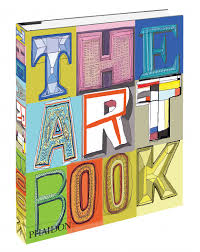
Phaidon Art BookThe Art Book, Phaidon (Second edition 2012)

An A to Z of artists, mostly painters, occasionally sculptors, installers and performers, with a few photographers and video-makers too. You can trace the development, culmination and corruption of high art all the way from Giotto and Fra Angelico through Van Eyck and Caravaggio to Auerbach and Twombly. But the modernist dreck heightens the power of the pre-modernist delights. A few pages after Pieter Claesz’s remarkable A Vanitas Still Life of 1645 there’s Joseph Cornell’s “Untitled” of 1950. One is a skull, watch and overturned glass, skilfully lit, minutely detailed, richly symbolic; the other is a wooden box containing a “frugal assortment of stamps, newspaper cuttings and other objects with no particular relevance to each other”. From the sublime to the slapdash. Over the page from Eleazar Lissitzky’s Composition of 1941 there’s Stefan Lochner’s The Virgin and Child in a Rose Arbour of 1442. One is like a child’s doodle, the other like a jewel. From the slapdash to the sublime.
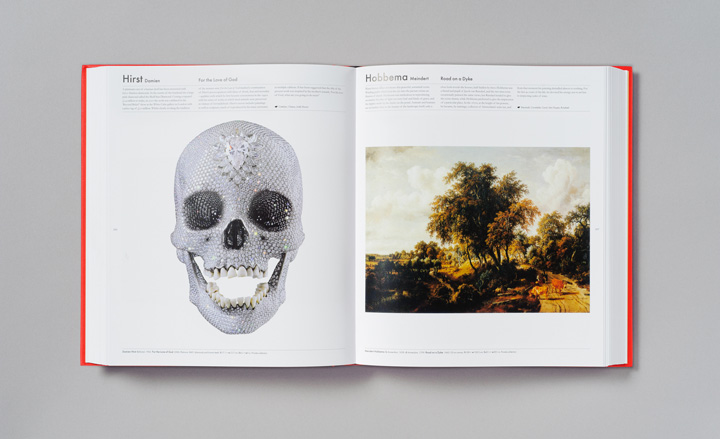
Hirst Skull and landscape
And so it goes on throughout the book, with beautiful art by great artists following or preceding ugly art by poseurs and charlatans. But some of the modern art is attractive or interesting, like Bridget Riley’s eye-alive Cataract 3 (1961) and Damien Hirst’s diamond-encrusted skull For the Love of God (2006). Riley and Hirst aren’t great and Hirst at least is more like an entrepreneur than an artist, but their art here is something that rewards the eye. So is Riley’s art elsewhere, as newcomers to her work might guess from the single example here. That is one of the purposes of a guide like this: to invite – or discourage – further investigation. I vaguely remember seeing the beautiful still-life of a boiled lobster, drinking horn and peeled lemon on page 283 before, but I wouldn’t have recognized the name of the Dutch artist: Willem Kalf (1619-93).
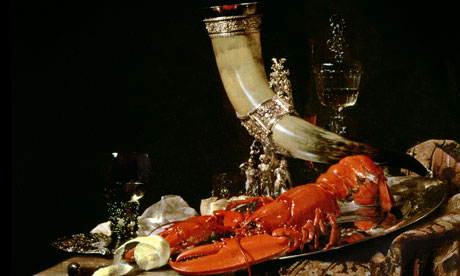
Willem Kalf, Still Life (c. 1653)

Willem Kalf, Still Life (c. 1653)


Elsewhere, I was surprised and pleased to see an old favourite: John Atkinson Grimshaw and his Nightfall on the Thames (1880). Many more people know Grimshaw’s atmospheric and eerie art than know his name, because it often appears on book-covers and as illustrations. If Phaidon are including him in popular guides with giants like Da Vinci, Dürer, Raphael and Titian, perhaps he’ll return to his previous fame. I certainly hope so.

Finding Grimshaw here made a good guide even better. The short texts above each art-work pack in a surprising amount of information and anecdote too. What you learn from the texts raises some interesting questions. For example: Why has one small nation contributed so much to the world’s treasury of art? From Van Eyck to Van Gogh by way of Hieronymus Bosch and Jan Vermeer, Holland is comparable to Italy in its importance. But only in painting, not sculpture or architecture. There aren’t just patterns of pigment, texture and geometry in this book: there are patterns of DNA, culture and evolution too. Brilliant, beautiful and banal; skilful, subtle and slapdash: The Art Book has all that and more. It puts jewels inside your skull.


Elsewhere other-posted:

Ai Wei to HellHow to Read Contemporary Art, Michael Wilson
Eyck’s EyesVan Eyck, Simone Ferrari
Face PaintA Face to the World: On Self-Portraits, Laura Cumming
N-route

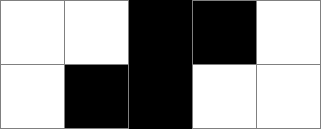
In maths, one thing leads to another. I wondered whether, in a spiral of integers, any number was equal to the digit-sum of the numbers on the route traced by moving to the origin first horizontally, then vertically. To illustrate the procedure, here is a 9×9 integer spiral containing 81 numbers:

| 65 | 64 | 63 | 62 | 61 | 60 | 59 | 58 | 57 |
| 66 | 37 | 36 | 35 | 34 | 33 | 32 | 31 | 56 |
| 67 | 38 | 17 | 16 | 15 | 14 | 13 | 30 | 55 |
| 68 | 39 | 18 | 05 | 04 | 03 | 12 | 29 | 54 |
| 69 | 40 | 19 | 06 | 01 | 02 | 11 | 28 | 53 |
| 70 | 41 | 20 | 07 | 08 | 09 | 10 | 27 | 52 |
| 71 | 42 | 21 | 22 | 23 | 24 | 25 | 26 | 51 |
| 72 | 43 | 44 | 45 | 46 | 47 | 48 | 49 | 50 |
| 73 | 74 | 75 | 76 | 77 | 78 | 79 | 80 | 81 |

Take the number 21, which is three places across and up from the bottom left corner of the spiral. The route to the origin contains the numbers 21, 22, 23, 8 and 1, because first you move right two places, then up two places. And 21 is what I call a route number, because 21 = 3 + 4 + 5 + 8 + 1 = digitsum(21) + digitsum(22) + digitsum(23) + digitsum(8) + digitsum(1). Beside the trivial case of 1, there are two more route numbers in the spiral:

58 = 13 + 14 + 6 + 7 + 7 + 6 + 4 + 1 = digitsum(58) + digitsum(59) + digitsum(60) + digitsum(61) + digitsum(34) + digitsum(15) + digitsum(4) + digitsum(1).

74 = 11 + 12 + 13 + 14 + 10 + 5 + 8 + 1 = digitsum(74) + digitsum(75) + digitsum(76) + digitsum(77) + digitsum(46) + digitsum(23) + digitsum(8) + digitsum(1).

Then I wondered about other possible routes to the origin. Think of the origin as one corner of a rectangle and the number being tested as the diagonal corner. Suppose that you always move away from the starting corner, that is, you always move up or right (or up and left, and so on, depending on where the corners lie). In a x by y rectangle, how many routes are there between the diagonal corners under those conditions?

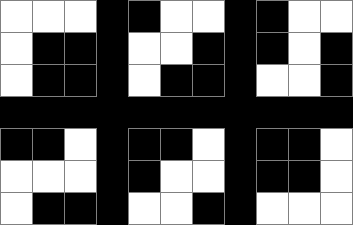
It’s an interesting question, but first I’ve looked at the simpler case of an n by n square. You can encode each route as a binary number, with 0 representing a vertical move and 1 representing a horizontal move. The problem then becomes equivalent to finding the number of distinct ways you can arrange equal numbers of 1s and 0s. If you use this method, you’ll discover that there are two routes across the 2×2 square, corresponding to the binary numbers 01 and 10:

2x2

Across the 3×3 square, there are six routes, corresponding to the binary numbers 0011, 0101, 0110, 1001, 1010 and 1100:

3x3

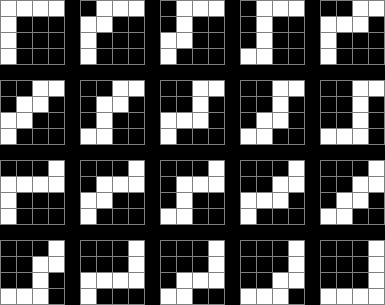
Across the 4×4 square, there are twenty routes:
4x4

(Please open in new window if it fails to animate)

(Please open in new window if it fails to animate)

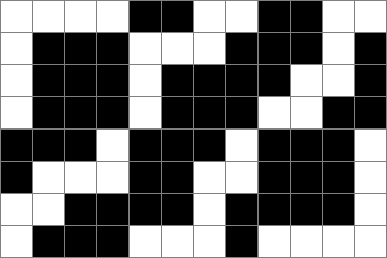
Across the 5×5 square, there are 70 routes:

5x5

(Please open in new window etc)

(Please open in new window etc)

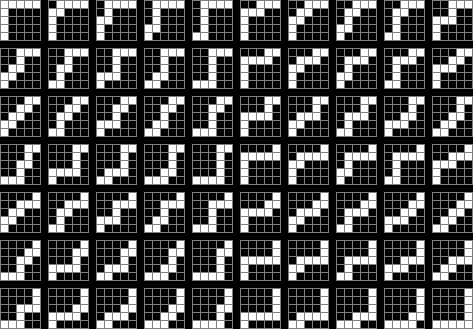
Across the 6×6 and 7×7 squares, there are 252 and 924 routes:

6x6

7x7

After that, the routes quickly increase in number. This is the list for n = 1 to 14:

1, 2, 6, 20, 70, 252, 924, 3432, 12870, 48620, 184756, 705432, 2704156, 10400600… (see A000984 at the Online Encyclopedia of Integer Sequences)

After that you can vary the conditions. What if you can move not just vertically and horizontally, but diagonally, i.e. vertically and horizontally at the same time? Now you can encode the route with a ternary number, or number in base 3, with 0 representing a vertical move, 1 a horizontal move and 2 a diagonal move. As before, there is one route across a 1×1 square, but there are three across a 2×2, corresponding to the ternary numbers 01, 2 and 10:

3x3t

There are 13 routes across a 3×3 square, corresponding to the ternary numbers 0011, 201, 021, 22, 0101, 210, 1001, 120, 012, 102, 0110, 1010, 1100:

4x4t

And what about cubes, hypercubes and higher?

Vibe Alibe

“The recent election of Syriza in Greece offers a vibrant glimmer of hope for the future of social and economic democracy in Europe.” — from a letter to The Guardian by Judith Butler, Slavoj Žižek, Jacqueline Rose, et al.

Performativizing Papyrocentricity #27

Papyrocentric Performativity Presents:

Sex/Dream Metaphors – Extreme Metaphors: Selected Interviews with J.G. Ballard, edited by Simon Sellars and Dan O’Hara (Fourth Estate 2014)

DNAncientNeanderthal Man: In Search of Lost Genomes, Svante Pääbo (Basic Books 2014)

The Cult of CthulhuH.P. Lovecraft: The Classic Horror Stories, edited by Roger Luckhurst (Oxford University Press 2013)

Rauc’ and RoleMortality, Christopher Hitchens (Atlantic Books 2012)

#BooksThatShouldNotBe — Tip-top Transgressive Texts…


Or Read a Review at Random: RaRaR

He Say, He Sigh, He Sow #24

“A cloud of incense is worth a thousand sermons.” — Nicolás Gómez Dávila (1913-94).

Will Two Power?

It’s such a simple thing: repeatedly doubling a number: 1, 2, 4, 8, 16, 32, 61, 128… And yet it yields such riches, reminiscent of DNA or a literary text:

2^0 = 1
2^1 = 2
2^2 = 4
2^3 = 8
2^4 = 16
2^5 = 32
2^6 = 64
2^7 = 128
2^8 = 256
2^9 = 512
2^10 = 1024
2^20 = 1048576
2^30 = 1073741824
2^40 = 1099511627776
2^50 = 1125899906842624
2^60 = 1152921504606846976
2^70 = 1180591620717411303424
2^80 = 1208925819614629174706176
2^90 = 1237940039285380274899124224
2^100 = 1267650600228229401496703205376
2^200 = 1606938044258990275541962092341162602522202993782792835301376

Although, by Benford’s law*, 1 is the commonest leading digit, do all numbers eventually appear as the leading digits of some power of 2? I conjecture that they do. indeed, I conjecture that they do infinitely often. If the function first(n) returns the power of 2 whose leading digits are the same as the digits of n, then:

first(1) = 2^0 = 1
first(2) = 2^1 = 2
first(3) = 2^5 = 32
first(4) = 2^2 = 4
first(5) = 2^9 = 512
first(6) = 2^6 = 64
first(7) = 2^46 = 70368744177664
first(8) = 2^3 = 8
first(9) = 2^53 = 9007199254740992
first(10) = 2^10 = 1024

And I conjecture that this is true of all bases except bases that are powers of 2, like 2, 4, 8, 16 and so on. A related question is whether the leading digits of any 2^n are the same as the digits of n. Yes:

2^6 = 64
2^10 = 1024
2^1542 = 1.54259995… * 10^464
2^77075 = 7.70754024… * 10^23201
2^113939 = 1.13939932… * 10^34299
2^1122772 = 1.12277217… * 10^337988

That looks like a look of calculation, but there’s a simple way to cut it down: restrict the leading digits. Eventually they will lose accuracy, because the missing digits are generating carries. With four leading digits, this happens:

1: 0001
2: 0002
4: 0004
8: 0008
16: 0016
32: 0032
64: 0064
128: 0128
256: 0256
512: 0512
1024: 1024
2048: 2048
4096: 4096
8192: 8192
16384: 1638…
32768: 3276…
65536: 6552…

But working with only fifteen leading digits, you can find that 1122772 = the leading digits of 2^1122772, which has 337989 digits when calculated in full.


Previously pre-posted (please peruse):

Talcum Power


*Not Zipf’s law, as I originally said.

Material Whirled

When we are conscious of being conscious, what are we consciousness-conscious with? If consciousness is a process in the brain, the process has become aware of itself, but how does it do so? And what purpose does consciousness-of-consciousness serve? Is it an artefact or an instrument? Is it an illusion? A sight or sound or smell is consciousness of a thing-in-itself, but that doesn’t apply here. We aren’t conscious of the thing-in-itself: the brain and its electro-chemistry. We’re conscious of the glitter on the swinging sword, but not the sword or the swing.

We can also be conscious of being conscious of being conscious, but beyond that my head begins to spin. Which brings me to an interesting reminder of how long the puzzle of consciousness has existed in its present form: how do we get from matter to mind? As far as I can see, science understands the material substrate of consciousness – the brain – in greater and greater detail, but is utterly unable to explain how objective matter becomes subjective consciousness. We have not moved an inch towards understanding how quanta become qualia since this was published in 1871:

Were our minds and senses so expanded, strengthened, and illuminated, as to enable us to see and feel the very molecules of the brain; were we capable of following all their motions, all their groupings, all their electric discharges, if such there be; and were we intimately acquainted with the corresponding states of thought and feeling, we should be as far as ever from the solution of the problem, “How are these physical processes connected with the facts of consciousness?” The chasm between the two classes of phenomena would still remain intellectually impassable.

Let the consciousness of love, for example, be associated with a right-handed spiral motion of the molecules of the brain, and the consciousness of hate with a left-handed spiral motion. We should then know, when we love, that the motion is in one direction, and, when we hate, that the motion is in the other; but the “Why?” would remain as unanswerable as before. — John Tyndall, Fragments of Science (1871), viâ Rational Buddhism.


Elsewhere other-posted:

Double Bubble
The Brain in Pain
The Brain in Train
This Mortal Doyle