The Sound of Silex

Some of the most beautiful patterns in nature arise from the interaction of three very simple things: sand and water, sand and air. Sculptrix Sabulorum, a side-project of the Exeter band Slow Exploding Gulls, are an attempt to do with sound what nature does with sand: turn simple ingredients into beautiful patterns. Here are extracts from an interview and review in the Plymouth fanzine EarHax:

Hector Anderton: OK. The obvious first. Sculptrix Sabulorum. What does it mean and why did you choose it?

Joe Corvin: It’s Latin and literally means “Sculptress of the Sands”. We chose it, well, because we thought it looked and sounded good. Good but mysterious.

Hector Anderton: And who is the sculptress? The sea?

Joe Corvin: Well, the sculptress is Mother Nature, in the fullest sense, but she uses the sea. The wind. Gravity. Simple things, but put them together with sand and interesting things happen.

Cath Orne: Which we wanted to explore, but we didn’t think S.E.G. [Slow Exploding Gulls] was the way to explore them.

Cover of Silica by Slow Exploding Gulls

Hector Anderton: But hadn’t you done that in Silica?

Joe Corvin: We’d started to, but Silica hadn’t exhausted the theme. Of sand, I mean. It’s something I’d always been interested in, but with S.E.G. we tend to go with the organic side of the sea, with sea life.

Hector Anderton: Whereas sand is inorganic?

Joe Corvin: Exactly. Silica was a bit of a departure for us, in that respect. It was as though we were walking down a corridor and we opened a door in passing and thought, yeah, that room looks interesting.

Sand Band: Sculptrix Sabulorum

Sand Band: Sculptrix Sabulorum

Cath Orne: So we’ll come back and have a proper look later.

Joe Corvin: Yeah. Under a new name. Which we’ve done. Hence, Sculptrix Sabulorum.

Extract © EarHax (1992)


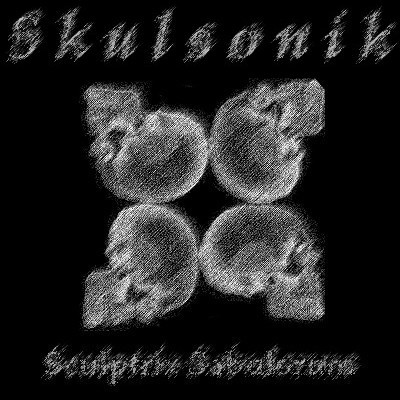
Skulsonik, Sculptrix Sabulorum (Umbra Mundi 1995)

Macca to Madonna: “Listen to the music playing in your head.” In fact, we never do anything else. We don’t experience the world: we experience a sensory simulacrum of the world. Light or sound-waves or chemicals floating in the air stimulate the nerves in our eyes or ears or nose and the brain turns the resultant stream of electrical pulses into sight or sound or smell.

Skulsonik (1995)

Sculptrix Sabulorum: Skulsonik (1995)

But it does more than that: it covers up the cracks. Raw nerve-stuff is not smooth and polished sensation. We have blind-spots, but the brain edits them out. Only a small part of our visual field is actually in clear focus, but we think otherwise. If we could see raw nerve-stuff, it would be a blurry, fuzzy mess.

The same is true of hearing. And Skulsonik is an attempt to record raw nerve-stuff: to capture not sound out there, but sound in here – the music playing in your head. Sculptrix Sabulorum have set out to answer a simple question: “What does music really sound like?” Or rather: what does music cerebrally sound like? What does it sound like in your head?

Extract © EarHax (1995)


Previously pre-posted (please peruse):

Mental Marine Music – Slow Exploding Gulls

Who Guards the Guardianistas?

“…We’re not so much a reaction against what’s going on – it’s more down to the music that we’re into – but in terms of guitar music there hasn’t been much in terms of louder groups.” – Bored of cookie-cutter conformity in music?, The Guardian, 6/iii/ 2014.


Elsewhere other-posted:

Ex-term-in-ate!

Performativizing Papyrocentricity #20

Papyrocentric Performativity Presents:

Clive AliveC.S. Lewis: A Life, Alister McGrath (Hodder & Staughton 2013)

Ink TuneNick Drake: Dreaming England, Nathan Wiseman-Trowse (Reaktion Books 2013)

Stan’s FansAwaydays, Kevin Sampson (Vintage 1998)

Words at WarPoetry of the First World War: An Anthology, ed. Tim Kendall (Oxford University Press 2013) (posted @ Overlord of the Über-Feral)


Or Read a Review at Random: RaRaR

Performativizing Papyrocentricity #19

Papyrocentric Performativity Presents:

Book in BlackBlack Sabbath: Symptom of the Universe, Mick Wall (Orion Books 2013)

Critical Math – A Mathematician Reads the Newspaper, John Allen Paulos (Penguin 1996)

Rude BoysRuthless: The Global Rise of the Yardies, Geoff Small (Warner 1995)

K-9 KonundrumDog, Peter Sotos (TransVisceral Books 2014)

Ghosts in the CathedralThe Neutrino Hunters: The Chase for the Ghost Particle and the Secrets of the Universe, Ray Jayawardhana (Oneworld 2013) (posted @ Overlord of the Über-Feral)


Or Read a Review at Random: RaRaR

Performativizing Papyrocentricity #18

Papyrocentric Performativity Presents:

Der ÜbergmenschDougal Haston: The Philosophy of Risk, Jeff Connors (Canongate Books 2002)

Book with Bite Steve Backshall’s Most Poisonous Creatures, Steve Backshall (New Holland 2013)

The Politics of PretenceMo Mowlam: The Biography, Julia Langdon (Little, Brown 2000)

Guns’n’GladioliA Light That Never Goes Out: The Enduring Saga of the Smiths, Tony Fletcher (Windmill Books 2013) (posted @ Overlord of the Über-Feral)

Think Ink50 Quantum Physics Ideas You Really Need to Know, Joanne Baker (Quercus 2013) (posted @ O.o.t.Ü.-F.)


Or Read a Review at Random: RaRaR

More Musings on Music

Black Mother Nirvana — from the potency of Purushmedh to the blast-beat barrage of Bodhisattva

Groaning and Grieving — the ashen passion of Slough of Despond

Pummelling Putridity — probing the purulence and putrefaction of Paraphistomiasis


Elsewhere other-posted:

• More Musings on Music

Voc and Rôle

Medieval music by Vox Vulgaris and Trouvère

At one time, people could never hear their own voices the way others heard them, because our own voices come to us partly through the flesh and bone of our skulls. Then phonographs and tape-recorders were invented and nowadays we all know what we really sound like. But what does the medieval music of groups like Vox Vulgaris and Trouvere really sound like? It comes to us through the flesh and bone of history and we listen to it with uninnocent ears, soaked in a hundred different genres. Medieval music doesn’t stand alone any more, it stands in contrast: acoustic, not amplified; simple, not complex; authentic, not artificial.

Or is it authentic? No, because it’s not the music that comes most readily to hand or to ear any more. Playing it and listening to it are roles you choose, not roles you’re born into, because it’s part of a cultic fringe nowadays. Ferns once ruled the forests; now they’re pushed to the damp or rocky margins by more advanced plants. So this is ferny music: fresh, green and simple, with a glamour of exile and overthrow. You can hear that glamour more strongly in Trouvere, who play slow, sad and sometimes stately music that seems both to celebrate and to lament the Middle Ages. Vox Vulgaris, which literally means “Popular Voice”, celebrate and don’t lament: they’re raucous and almost rocking and sound like a group for inns and peasants’ weddings, not for courts and cathedrals. They’re fun, not bittersweet like Trouvere, who remind me of the Early Music Consort of London. But, like Vox Vulgaris, Trouvere play instrumentals and don’t add lost languages to their lost music.

The music is enough, but they’re surely playing it with a modern accent that would raise smiles or laughter in a real medieval audience. We can’t go back and that is part of why their music is so attractive. It lilts, it longs and it laments, searching for something it will never find. And that is another way Trouvere evoke the Middle Ages:

La royne Blanche comme ung lys,
Qui chantoit à voix de sereine;
Berthe au grand pied, Bietris, Allys;
Harembourges, qui tint le Mayne,
Et Jehanne, la bonne Lorraine,
Qu’Anglois bruslèrent à Rouen;
Où sont-ilz, Vierge souveraine?…
Mais où sont les neiges d’antan!

“Ballade des dames du temps jadis”, François Villon (1431-c.1485)

White Queen Blanche, like a queen of lilies,
With a voice like any mermaiden,—
Bertha Broadfoot, Beatrice, Alice,
And Ermengarde the lady of Maine,—
And that good Joan whom Englishmen
At Rouen doomed and burned her there,—
Mother of God, where are they then?…
But where are the snows of yester−year.

Translation by Rossetti.

A Diet of Quiet

The astonishment one feels on learning of the success of the movement takes second place only to the astonishment that this success has been achieved almost without notice from the mainstream and the underground press alike. Nation-wide weeklies like the NME [New Musical Express] haven’t condescended as yet to feature a single band even vaguely affiliated to the movement, and the fanzines that spring up like mushrooms around any spasmodic “new genre” emptying of popular music’s overclogged bowels have found little nourishment in the only truly fresh development in the field since the earliest days of rap. So far only one or two of the bands on the very fringes of the movement have received any serious attention. Yet Dwaal, who by their own admission are one of the “baby” acts in Quiet, have sold nearly 20,000 of their debut album Slow Hearts in the eight months since its release; the really big boys like Morpheus and Dark could expect to shift this amount in the first week of release of their next albums. Tickets for tours by either of the last mentioned have been known to sell out within an hour of going on sale, and rumours of an imminent ocean-hop by Murmur, the Chicago band seen by many as the kings of Quiet, had the telephones at the offices of London’s GigWise booking agency tied up solid for nearly two days.

So, how has Quiet not merely got off the ground but got well on the way to the outer reaches of the Solar System without collecting a write-up or a review worthy of the name? Why do the names of the most important bands in the movement still mean nothing to the majority of music fans? Well, for a start, Quiet — in every sense — lives up to the name bestowed on by Hank O’Dowell, Murmur’s lead guitarist. To see how this is so, it’s necessary to take a look at its history.


• Continue reading A Diet of Quiet

Tattoo Your Ears

“The most merciful thing in the world,” said H.P. Lovecraft, “is the inability of the human mind to correlate all its contents.” Nowadays we can’t correlate all the contents of our hard-drives either. But occasionally bits come together. I’ve had two MP3s sitting on my hard-drive for months: “Drink or Die” by Erotic Support and “Hunter Gatherer” by Swords of Mars. I liked them both a lot, but until recently I didn’t realize that they were by two incarnations of the same Finnish band.
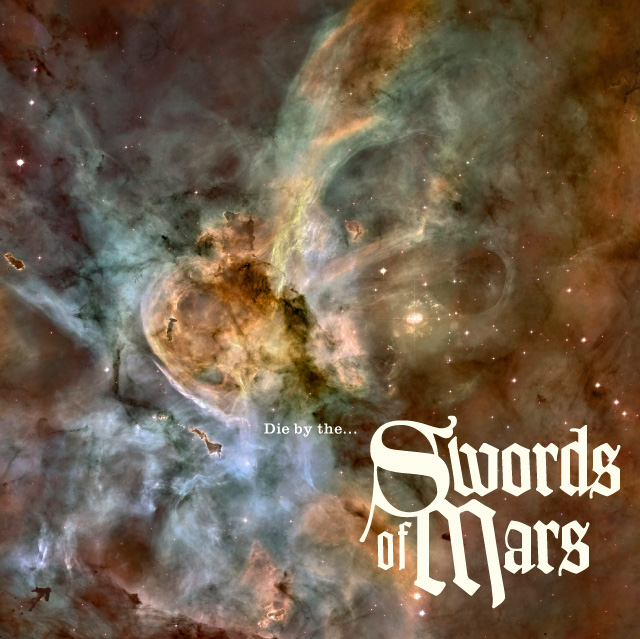
Cover of "Die by the..." Swords of Mars
They don’t sound very much alike, after all. But now that I’ve correlated them, they’ve inspired some thoughts on music and mutilation. “Drink or Die” is a dense, fuzzy, leather-lunged rumble-rocker that, like a good Mötley Crüe song, your ears can snort like cocaine. But, unlike Mötley Crüe, the auditory rush lasts the whole song, not just the first half. “Hunter Gatherer” is much more sombre. Erotic Support were “Helsinki beercore”; Swords of Mars are darker, doomier and dirgier. They’ve also got a better name – “Erotic Support” seems to have lost something in translation. Finnish is a long way from English: it’s in a different and unrelated language family, the Finno-Ugric, not the Indo-European. So it lines up with Hungarian and Estonian, not English, German and French. But Erotic Support’s lyrics are good English and “Drink or Die” is a clever title. They’d have been a more interesting band if they’d sung entirely in Finnish, but also less successful, because less accessible to the rest of the world.

Es war einmal eine Königstochter, die ging hinaus in den Wald und setzte sich an einen kühlen Brunnen. Sie hatte eine goldene Kugel, die war ihr liebstes Spielwerk, die warf sie in die Höhe und fing sie wieder in der Luft und hatte ihre Lust daran. Einmal war die Kugel gar hoch geflogen, sie hatte die Hand schon ausgestreckt und die Finger gekrümmt, um sie wieder zufangen, da schlug sie neben vorbei auf die Erde, rollte und rollte und geradezu in das Wasser hinein.

Some Indo-European


Mieleni minun tekevi, aivoni ajattelevi
lähteäni laulamahan, saa’ani sanelemahan,
sukuvirttä suoltamahan, lajivirttä laulamahan.
Sanat suussani sulavat, puhe’et putoelevat,
kielelleni kerkiävät, hampahilleni hajoovat.

Veli kulta, veikkoseni, kaunis kasvinkumppalini!
Lähe nyt kanssa laulamahan, saa kera sanelemahan
yhtehen yhyttyämme, kahta’alta käytyämme!
Harvoin yhtehen yhymme, saamme toinen toisihimme
näillä raukoilla rajoilla, poloisilla Pohjan mailla.

Some Finno-Ugric


All the same, being inaccessible sometimes helps a band’s appeal to the rest of the world: the mystique of black metal is much stronger in bands that use only Norwegian or one of the other Scandinavian languages. Erotic Support haven’t joined that rebellion against Coca-Colonization and tried to create an indigenous genre. They’re happy to reproduce more or less American music using the more or less American invention known as the electric guitar. But amplified music would have appeared in Europe even if North America had been colonized by the Chinese, so I wonder what rock would sound like if it had evolved in Europe instead. It wouldn’t be called rock, of course, but what other differences would it have? Would it be more sophisticated, for example? I think it would. The success of American exports depends in part on their strong and simple flavours. “Drink or Die” has those flavours: it’s about volume, rhythm and power. It’s full of a certain “drug-addled, crab-infested, tinnitus-nagged spirit” — the “urge to submerge in the raw bedrock viscerality of rock”, as some metaphor-mixing, über-emphasizing idiot once put it (I think it was me).
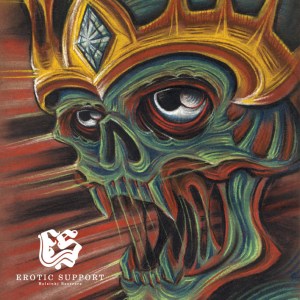
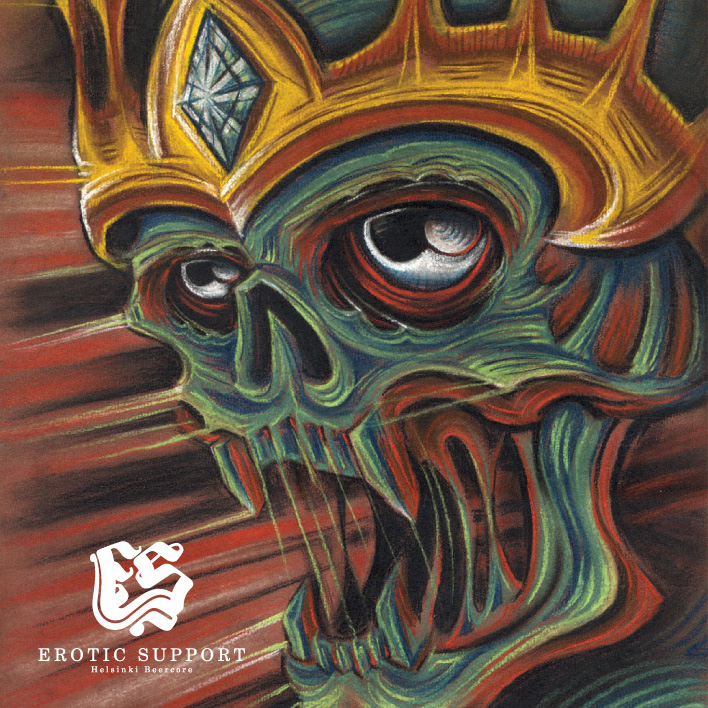
Cover of "II" by Erotic Support

Erotic Support are “beercore”, remember. Beer marks the brain with hangovers, just as tattoos mark the skin with ink. And just as loud music marks the ears with tinnitus. There are various kinds of self-mutilation in rock and that self-mutilation can have unhealthy motives. It can be an expression of boredom, angst, anomie and self-hatred. Unsurprisingly, Finland has the nineteenth highest suicide rate in the world. Beer, tattoos and tinnitus are part of the louder, dirtier and loutier end of rock: unlike Radiohead or Coldplay, Erotic Support sound like a band with tattoos who are used to hangovers. “Drink or Die” is a joke about exactly that. But what if rock had evolved in a wine-drinking culture? Would it be less of a sado-masochistic ritual, more a refined rite? Maybe not: the god of wine is Dionysos and he was Ho Bromios, the Thunderer. His brother Pan induces panic with loud noises. But black metal looks towards northern paganism: it’s music for pine forests, cold seas and beer-drinkers, not olive groves, warm seas and oenopotes.

Erotic Support don’t create soundscapes for Finland the way black metal creates soundscapes for Norway, but they do create beer-drinkers’ music, so they do express Finnishness to that extent. Swords of Mars, being darker, doomier and dirgier, are moving nearer an indigenous Finnish rock, or an indigenous Scandinavian rock, at least. This may be related to the fact that genes express themselves more strongly as an individual ages: for example, the correlation between the intelligence of parents and their children is strongest when the children are adults. Erotic Support create faster, more aggressive music than Swords of Mars, so it isn’t surprising that they’re the younger version of the same band. In biology, the genotype creates the phenotype: DNA codes for bodies and behaviour. Music is part of what Richard Dawkins calls the “extended phenotype”, like the nest of a bird or the termite-fishing-rods of a chimpanzee. A bird’s wings are created directly by its genes; a bird’s nest is created indirectly by its genes, viâ the brain. So a bird’s wings are part of the phenotype and a bird’s nest part of the extended phenotype.

Both are under the influence of the genes and both are expressions of biology. Music (like bird-song) is an expression of biology too, as is the difference between the music of Erotic Support and Swords of Mars. As brains age, the behaviour they create changes. Swords of Mars are older and not attracted to reckless self-mutilation as Erotic Support were: it’s not music to precede hangovers and induce tinnitus any more. Sword of Mars aren’t trying to tattoo your ears but to educate your mind.