Performativizing Papyrocentricity #35

Papyrocentric Performativity Presents:

Volc-LoreVolcanoes: A Beginner’s Guide, Rosaly Lopes (Oneworld 2010)

Stokes’ StrokesPhilosophy: 100 Essential Thinkers: The Ideas That Have Shaped Our World, Philip Stokes (Arcturus Publishing 2012)

Art of DarknessDoubled Slaughter: Barbarism, Brutalism and Bestial Bloodlust in the Music of Simon and Garfunkel, Dr Miriam B. Stimbers (Serpent’s Tail 2007)


Or Read a Review at Random: RaRaR

Pair on a D-String

What’s special about the binary number 10011 and the ternary number 1001120221? To answer the question, you have to see double. 10011 contains all possible pairs of numbers created from 0 and 1, just as 1001120221 contains all possible pairs created from 0, 1 and 2. And each pair appears exactly once. Now try the quaternary number 10011202130322331. That contains exactly one example of all possible pairs created from 0, 1, 2 and 3.

But there’s something more: in each case, the number is the smallest possible number with that property. As the bases get higher, that gets less obvious. In quinary, or base 5, the smallest number containing all possible pairs is 10011202130314042232433441. The digits look increasingly random. And what about base 10? There are 100 possible pairs of numbers created from the digits 0 to 9, starting with 00, 01, 02… and ending with …97, 98, 99. To accommodate 100 pairs, the all-pair number in base 10 has to be 101 digits long. It’s a string of digits, so let’s call it a d-string:

1, 0, 0, 1, 1, 2, 0, 2, 1, 3, 0, 3, 1, 4, 0, 4, 1, 5, 0, 5, 1, 6, 0, 6, 1, 7, 0, 7, 1, 8, 0, 8, 1, 9, 0, 9, 2, 2, 3, 2, 4, 2, 5, 2, 6, 2, 7, 2, 8, 2, 9, 3, 3, 4, 3, 5, 3, 6, 3, 7, 3, 8, 3, 9, 4, 4, 5, 4, 6, 4, 7, 4, 8, 4, 9, 5, 5, 6, 5, 7, 5, 8, 5, 9, 6, 6, 7, 6, 8, 6, 9, 7, 7, 8, 7, 9, 8, 8, 9, 9, 1

Again, the digits look increasingly random. They aren’t: they’re strictly determined. The d-string is in harmony. As the digits are generated from the left, they impose restrictions on the digits that appear later. It might appear that you could shift larger digits to the right and make the number smaller, but if you do that you no longer meet the conditions and the d-string collapses into dischord.

Now examine d-strings containing all possible triplets created from the digits of bases 2, 3 and 4:

1, 0, 0, 0, 1, 0, 1, 1, 1, 0 in base 2 = 558 in base 10

1, 0, 0, 0, 1, 0, 1, 1, 0, 2, 0, 0, 2, 1, 1, 1, 2, 0, 1, 2, 1, 2, 2, 0, 2, 2, 2, 1, 0 in base 3 = 23203495920756 in base 10

1, 0, 0, 0, 1, 0, 1, 1, 0, 2, 0, 0, 2, 1, 0, 3, 0, 0, 3, 1, 1, 1, 2, 0, 1, 2, 1, 1, 3, 0, 1, 3, 1, 2, 2, 0, 2, 2, 1, 2, 3, 0, 2, 3, 1, 3, 2, 0, 3, 2, 1, 3, 3, 0, 3, 3, 2, 2, 2, 3, 2, 3, 3, 3, 1, 0 in base 4 = 1366872334420014346556556812432766057460 in base 10

Note that there are 8 possible triplets in base 2, so the all-triplet number has to be 10 digits long. In base 10, there are 1000 possible triplets, so the all-triplet number has to be 1002 digits long. Here it is:

1, 0, 0, 0, 1, 0, 1, 1, 0, 2, 0, 0, 2, 1, 0, 3, 0, 0, 3, 1, 0, 4, 0, 0, 4, 1, 0, 5, 0, 0, 5, 1, 0, 6, 0, 0, 6, 1, 0, 7, 0, 0, 7, 1, 0, 8, 0, 0, 8, 1, 0, 9, 0, 0, 9, 1, 1, 1, 2, 0, 1, 2, 1, 1, 3, 0, 1, 3, 1, 1, 4, 0, 1, 4, 1, 1, 5, 0, 1, 5, 1, 1, 6, 0, 1, 6, 1, 1, 7, 0, 1, 7, 1, 1, 8, 0, 1, 8, 1, 1, 9, 0, 1, 9, 1, 2, 2, 0, 2, 2, 1, 2, 3, 0, 2, 3, 1, 2, 4, 0, 2, 4, 1, 2, 5, 0, 2, 5, 1, 2, 6, 0, 2, 6, 1, 2, 7, 0, 2, 7, 1, 2, 8, 0, 2, 8, 1, 2, 9, 0, 2, 9, 1, 3, 2, 0, 3, 2, 1, 3, 3, 0, 3, 3, 1, 3, 4, 0, 3, 4, 1, 3, 5, 0, 3, 5, 1, 3, 6, 0, 3, 6, 1, 3, 7, 0, 3, 7, 1, 3, 8, 0, 3, 8, 1, 3, 9, 0, 3, 9, 1, 4, 2, 0, 4, 2, 1, 4, 3, 0, 4, 3, 1, 4, 4, 0, 4, 4, 1, 4, 5, 0, 4, 5, 1, 4, 6, 0, 4, 6, 1, 4, 7, 0, 4, 7, 1, 4, 8, 0, 4, 8, 1, 4, 9, 0, 4, 9, 1, 5, 2, 0, 5, 2, 1, 5, 3, 0, 5, 3, 1, 5, 4, 0, 5, 4, 1, 5, 5, 0, 5, 5, 1, 5, 6, 0, 5, 6, 1, 5, 7, 0, 5, 7, 1, 5, 8, 0, 5, 8, 1, 5, 9, 0, 5, 9, 1, 6, 2, 0, 6, 2, 1, 6, 3, 0, 6, 3, 1, 6, 4, 0, 6, 4, 1, 6, 5, 0, 6, 5, 1, 6, 6, 0, 6, 6, 1, 6, 7, 0, 6, 7, 1, 6, 8, 0, 6, 8, 1, 6, 9, 0, 6, 9, 1, 7, 2, 0, 7, 2, 1, 7, 3, 0, 7, 3, 1, 7, 4, 0, 7, 4, 1, 7, 5, 0, 7, 5, 1, 7, 6, 0, 7, 6, 1, 7, 7, 0, 7, 7, 1, 7, 8, 0, 7, 8, 1, 7, 9, 0, 7, 9, 1, 8, 2, 0, 8, 2, 1, 8, 3, 0, 8, 3, 1, 8, 4, 0, 8, 4, 1, 8, 5, 0, 8, 5, 1, 8, 6, 0, 8, 6, 1, 8, 7, 0, 8, 7, 1, 8, 8, 0, 8, 8, 1, 8, 9, 0, 8, 9, 1, 9, 2, 0, 9, 2, 1, 9, 3, 0, 9, 3, 1, 9, 4, 0, 9, 4, 1, 9, 5, 0, 9, 5, 1, 9, 6, 0, 9, 6, 1, 9, 7, 0, 9, 7, 1, 9, 8, 0, 9, 8, 1, 9, 9, 0, 9, 9, 2, 2, 2, 3, 2, 2, 4, 2, 2, 5, 2, 2, 6, 2, 2, 7, 2, 2, 8, 2, 2, 9, 2, 3, 3, 2, 3, 4, 2, 3, 5, 2, 3, 6, 2, 3, 7, 2, 3, 8, 2, 3, 9, 2, 4, 3, 2, 4, 4, 2, 4, 5, 2, 4, 6, 2, 4, 7, 2, 4, 8, 2, 4, 9, 2, 5, 3, 2, 5, 4, 2, 5, 5, 2, 5, 6, 2, 5, 7, 2, 5, 8, 2, 5, 9, 2, 6, 3, 2, 6, 4, 2, 6, 5, 2, 6, 6, 2, 6, 7, 2, 6, 8, 2, 6, 9, 2, 7, 3, 2, 7, 4, 2, 7, 5, 2, 7, 6, 2, 7, 7, 2, 7, 8, 2, 7, 9, 2, 8, 3, 2, 8, 4, 2, 8, 5, 2, 8, 6, 2, 8, 7, 2, 8, 8, 2, 8, 9, 2, 9, 3, 2, 9, 4, 2, 9, 5, 2, 9, 6, 2, 9, 7, 2, 9, 8, 2, 9, 9, 3, 3, 3, 4, 3, 3, 5, 3, 3, 6, 3, 3, 7, 3, 3, 8, 3, 3, 9, 3, 4, 4, 3, 4, 5, 3, 4, 6, 3, 4, 7, 3, 4, 8, 3, 4, 9, 3, 5, 4, 3, 5, 5, 3, 5, 6, 3, 5, 7, 3, 5, 8, 3, 5, 9, 3, 6, 4, 3, 6, 5, 3, 6, 6, 3, 6, 7, 3, 6, 8, 3, 6, 9, 3, 7, 4, 3, 7, 5, 3, 7, 6, 3, 7, 7, 3, 7, 8, 3, 7, 9, 3, 8, 4, 3, 8, 5, 3, 8, 6, 3, 8, 7, 3, 8, 8, 3, 8, 9, 3, 9, 4, 3, 9, 5, 3, 9, 6, 3, 9, 7, 3, 9, 8, 3, 9, 9, 4, 4, 4, 5, 4, 4, 6, 4, 4, 7, 4, 4, 8, 4, 4, 9, 4, 5, 5, 4, 5, 6, 4, 5, 7, 4, 5, 8, 4, 5, 9, 4, 6, 5, 4, 6, 6, 4, 6, 7, 4, 6, 8, 4, 6, 9, 4, 7, 5, 4, 7, 6, 4, 7, 7, 4, 7, 8, 4, 7, 9, 4, 8, 5, 4, 8, 6, 4, 8, 7, 4, 8, 8, 4, 8, 9, 4, 9, 5, 4, 9, 6, 4, 9, 7, 4, 9, 8, 4, 9, 9, 5, 5, 5, 6, 5, 5, 7, 5, 5, 8, 5, 5, 9, 5, 6, 6, 5, 6, 7, 5, 6, 8, 5, 6, 9, 5, 7, 6, 5, 7, 7, 5, 7, 8, 5, 7, 9, 5, 8, 6, 5, 8, 7, 5, 8, 8, 5, 8, 9, 5, 9, 6, 5, 9, 7, 5, 9, 8, 5, 9, 9, 6, 6, 6, 7, 6, 6, 8, 6, 6, 9, 6, 7, 7, 6, 7, 8, 6, 7, 9, 6, 8, 7, 6, 8, 8, 6, 8, 9, 6, 9, 7, 6, 9, 8, 6, 9, 9, 7, 7, 7, 8, 7, 7, 9, 7, 8, 8, 7, 8, 9, 7, 9, 8, 7, 9, 9, 8, 8, 8, 9, 8, 9, 9, 9, 1, 0

Consider the quadruplet number in base 10. There are 10000 possible quadruplets, so the all-quadruplet number is 10003 digits long. And so on. In general, the “all n-tuplet” number in base b contains b^n n-tuplets and is (b^n + n-1) digits long. If b = 10 and n = 4, the d-string starts like this:

1, 0, 0, 0, 0, 1, 0, 0, 1, 1, 0, 0, 2, 0, 0, 0, 2, 1, 0, 0, 3, 0, 0, 0, 3, 1, 0, 0, 4, 0, 0, 0, 4, 1, 0, 0, 5, 0, 0, 0, 5, 1, 0, 0, 6, 0, 0, 0, 6, 1, 0, 0, 7, 0, 0, 0, 7, 1, 0, 0, 8, 0, 0, 0, 8, 1, 0, 0, 9, 0, 0, 0, 9, 1, 0, 1, 0, 1, 1, 1, 0, 1, 2, 0, 0, 1, 2, 1, 0, 1, 3, 0, 0, 1, 3, 1, 0, 1, 4, 0, 0, 1, 4, 1, 0, 1, 5, 0, 0, 1, 5, 1, 0, 1, 6, 0, 0, 1, 6, 1, 0, 1, 7, 0, 0, 1, 7, 1, 0, 1, 8, 0, 0, 1, 8, 1, 0, 1, 9, 0, 0, 1, 9, 1, 0, 2, 0, 1, 0, 2, 1, 1, 0, 2, 2, 0, 0, 2, 2, 1, 0, 2, 3, 0, 0, 2, 3, 1, 0, 2, 4, 0, 0, 2, 4, 1, 0, 2, 5, 0, 0, 2, 5, 1, 0, 2, 6…

What about when n = 100? Now the d-string is ungraspably huge – too big to fit in the known universe. But it starts with 1 followed by a hundred 0s and every digit after that is entirely determined. Perhaps there’s a simple way to calculate any given digit, given its position in the d-string. Either way, what is the ontological status of the d-string for n=100? Does it exist in some Platonic realm of number, independent of physical reality?

Some would say that it does, just like √2 or π or e. I disagree. I don’t believe in a Platonic realm. If the universe or multiverse ceased to exist, numbers and mathematics in general would also cease to exist. But this isn’t to say that mathematics depends on physical reality. It doesn’t. Nor does physical reality depend on mathematics. Rather, physical reality necessarily embodies mathematics, which might be defined as “entity in interrelation”. Humans have invented small-m mathematics, a symbolic way of expressing the physical embodiment of big-m mathematics.

But small-m mathematics is actually more powerful and far-ranging, because it increases the number, range and power of entities and their interaction. Where are √2 and π in physical reality? Nowhere. You could say that early mathematicians saw their shadows, cast from a Platonic realm, and deduced their existence in that realm, but that’s a metaphor. Do all events, like avalanches or thunderstorms, exist in some Platonic realm before they are realized? No, they arise as physical entities interact according to laws of physics. In a more abstract way, √2 and π arise as entities of another kind interact according to laws of logic: the concepts of a square and its diagonal, of a circle and its diameter.

The d-strings discussed above arise from the interaction of simpler concepts: the finite set of digits in a base and the ways in which they can be combined. Platonism is unnecessary: the arc and spray of a fountain are explained by the pressure of the water, the design of the pipes, the arrangement of the nozzles, not by reference to an eternal archetype of water and spray. In small-m mathematics, there are an infinite number of fountains, because small-m mathematics opens a door to a big-U universe, infinitely larger and richer than the small-u universe of physical reality.

The Mill to Power

Reading about Searle’s Chinese Room Argument at the Stanford Encyclopedia of Philosophy, I came across “Leibniz’s Mill” for the first time. At least, I think it was the first time:

It must be confessed, however, that perception, and that which depends upon it, are inexplicable by mechanical causes, that is to say, by figures and motions. Supposing that there were a machine whose structure produced thought, sensation, and perception, we could conceive of it as increased in size with the same proportions until one was able to enter into its interior, as he would into a mill. Now, on going into it he would find only pieces working upon one another, but never would he find anything to explain perception. It is accordingly in the simple substance, and not in the compound nor in a machine that the perception is to be sought. Furthermore, there is nothing besides perceptions and their changes to be found in the simple substance. And it is in these alone that all the internal activities of the simple substance can consist. (Monadology, 1714, section #17)

Andererseits muß man gestehen, daß die Vorstellungen, und Alles, was von ihnen abhängt, aus mechanischen Gründen, dergleichen körperliche Gestalten und Bewegungen sind, unmöglich erklärt werden können. Man stelle sich eine Maschine vor, deren Structur so eingerichtet sei, daß sie zu denken, zu fühlen und überhaupt vorzustellen vermöge und lasse sie unter Beibehaltung derselben Verhältnisse so anwachsen, daß man hinein, wie in das Gebäude einer Mühle eintreten kann. Dies vorausgesetzt, wird man bei Besichtigung des Innern nichts Anderes finden, als etliche Triebwerke, deren eins das andere bewegt, aber gar nichts, was hinreichen würde, den Grund irgend einer Vorstellung abzugeben. Die letztere gehört ausschließlich der einfachen Substanz an, nicht der zusammengesetzten, und dort, nicht hier, muß man sie suchen. Auch sind Vorstellungen und ihre Veränderungen zugleich das Einzige, was man in der einfachen Substanz antrifft. (Monadologie, 1714)

We can see that Leibniz’s argument applies to mechanism in general, not simply to the machines he could conceive in his own day. He’s claiming that consciousness isn’t corporeal. It can’t generated by interacting parts or particles. And intuitively, he seems to be right. How could a machine or mechanism, however complicated, be conscious? Intuition would say that it couldn’t. But is intuition correct? If we examine the brain, we see that consciousness begins with mechanism. Vision and the other senses are certainly electro-chemical processes in the beginning. Perhaps in the end too.

Some puzzles arise if we assume otherwise. If consciousness isn’t mechanistic, how does it interact with mechanism? If it’s immaterial, how does it interact with matter? But those questions go back much further, to Greek atomists like Democritus (c. 460-370 BC):

Δοκεῖ δὲ αὐτῶι τάδε· ἀρχὰς εἶναι τῶν ὅλων ἀτόμους καὶ κενόν, τὰ δ’ἀλλα πάντα νενομίσθαι.

He taught that the first principles of the universe are atoms and void; everything else is merely thought to exist.

Νόμωι (γάρ φησι) γλυκὺ καὶ νόμωι πικρόν, νόμωι θερμόν, νόμωι ψυχρόν, νόμωι χροιή, ἐτεῆι δὲ ἄτομα καὶ κενόν.

By convention sweet is sweet, bitter is bitter, hot is hot, cold is cold, color is color; but in truth there are only atoms and the void. (Democritus at Wikiquote)

Patterns of unconscious matter and energy influence consciousness and are perhaps entirely responsible for it. The patterns are tasteless, soundless, colourless, scentless, neither hot nor cold – in effect, units of information pouring through the circuits of reality. But are qualia computational? I think they are. I don’t think it’s possible to escape matter or mechanism and I certainly don’t think it’s possible to escape mathematics. But someone who thinks it’s possible to escape at least the first two is the Catholic philosopher Edward Feser. I wish I had come across his work a long time ago, because he raises some very interesting questions in a lucid way and confirms the doubts I’ve had for a long time about Richard Dawkins and other new atheists. His essay “Schrödinger, Democritus, and the paradox of materialism” (2009) is a good place to start.


Elsewhere other-posted:

Double Bubble
This Mortal Doyle
The Brain in Pain
The Brain in Train

He Say, He Sigh, He Sow #19

“The study of mathematics is the indispensable basis for all intellectual and spiritual progress.” — F.M. Cornford (1874-1943) quoted in The Sacred in Music (see also Pythagoreanism).

The Brain in Train

I feel odd when I consider this possibility: that all my thoughts are strictly determined, no more under my control than a straw in a gale or a stone in an avalanche. It seems paradoxical to have strictly determined thoughts about strictly determined thoughts. But is it? And is strict determinism fatal for finding the truth? I don’t think so. In fact, I think that strict determinism is essential for truth. But irrelevant associations get in the way of our understanding this. If our thoughts are determined, they seem like automatic trains running on rigid tracks. We might want to go to the station marked “Truth”, but if the switches are set wrong, the train will never get there. Or it will thunder through and never stop.


Continue reading The Brain in Train

The Brain in Pain

You can stop reading now, if you want. Or can you? Are your decisions really your own, or are you and all other human beings merely spectators in the mind-arena, observing but neither influencing nor initiating what goes on there? Are all your apparent choices in your brain, but out of your hands, made by mechanisms beyond, or below, your conscious control?

In short, do you have free will? This is a big topic – one of the biggest. For me, the three most interesting things in the world are the Problem of Consciousness, the Problem of Existence and the Question of Free Will. I call consciousness and existence problems because I think they’re real. They’re actually there to be investigated and explained. I call free will a question because I don’t think it’s real. I don’t believe that human beings can choose freely or that any possible being, natural or supernatural, can do so. And I don’t believe we truly want free will: it’s an excuse for other things and something we gladly reject in certain circumstances.


Continue reading The Brain in Pain

Ass You Like It

This is a guest post by Norman Foreman, B.A.


Mediaeval Catholic philosophers wrote about both praying and braying. The braying came from Buridan’s ass, a thought-experiment about choice and free will. Imagine a hungry ass set between two piles of hay that are identical in every way: size, shape, colour, tastiness and so on. Some philosophers argued that, if it had no reason to prefer one pile of hay to the other, the ass would be unable to choose and would therefore starve to death.

I don’t agree: inter alia, nervous systems don’t work symmetrically and we don’t experience objects as fully identical when they’re in different parts of our visual field. However, in a literary sense, I understand what it feels like to be Buridan’s ass. To assify myself, I start by imagining this:

• I’m offered £1000 to read a book by the transgressive author Will Self.

Would I accept? Yes. It would be distasteful, but I’d do it for £1000. Self’s writing is so bad that I might give the money back rather than finish the book, but I’d have a go. Now change the situation:

• I’m offered £1000 to read a book by the transgressive author Stewart Home.

Would I still accept? Yes. Again, it would be distasteful, but I’d do it for the money. Or I’d try, at least. The next step turns me into Buridan’s ass. I imagine this:

• I’m offered £1000 to read a book by either Will Self or Stewart Home (not both). And I have to make the choice for myself.

Now I’m on the horns of a dilemma. I would want the £1000, but I can’t decide which transgressive author I’d rather NOT read. Home is a downmarket version of Self, Self is an upmarket version of Home. It’s Self-as-chav vs Home-as-Oxbridge-grad. And/or vice versâ. They’re both keyly committed core components of the Guardianista community, with all that that implies in terms of issues around bad English, mixed metaphors and “in terms of”. I’m happy to say I’ve never read a book by either of them. So if I were offered £1000 to do so and had to choose either Self or Home, I couldn’t do it. Not unassisted. I’d have to toss a coin. Best of three. Or best of five dot dot dot


Previously pre-posted (please peruse):

Titus Graun
Ex-term-in-ate!
Reds under the Thread

Stories and Stars

A story is stranger than a star. Stronger too. What do I mean? I mean that the story has more secrets than a star and holds its secrets more tightly. A full scientific description of a star is easier than a full scientific description of a story. Stars are much more primitive, much closer to the fundamentals of the universe. They’re huge and impressive, but they’re relatively simple things: giant spheres of flaming gas. Mathematically speaking, they’re more compressible: you have to put fewer numbers into fewer formulae to model their behaviour. A universe with just stars in it isn’t very complex, as you would expect from the evolution of our own universe. There were stars in it long before there were stories.

A universe with stories in it, by contrast, is definitely complex. This is because stories depend on language and language is the scientific mother-lode, the most difficult and important problem of all. Or rather, the human brain is. The human brain understands a lot about stars, despite their distance, but relatively little about itself, despite brains being right on the spot. Consciousness is a tough nut to crack, for example. Perhaps it’s uncrackable. Language looks easier, but linguistics is still more like stamp-collecting than science. We can describe the structure of language in detail – use labels like “pluperfect subjunctive”, “synecdoche”, “bilabial fricative” and so on – but we don’t know how that structure is instantiated in the brain or where language came from. How did it evolve? How is it coded in the human genome? How does meaning get into and out of sounds and shapes, into and out of speech and writing? These are big, important and very interesting questions, but we’ve barely begun to answer them.

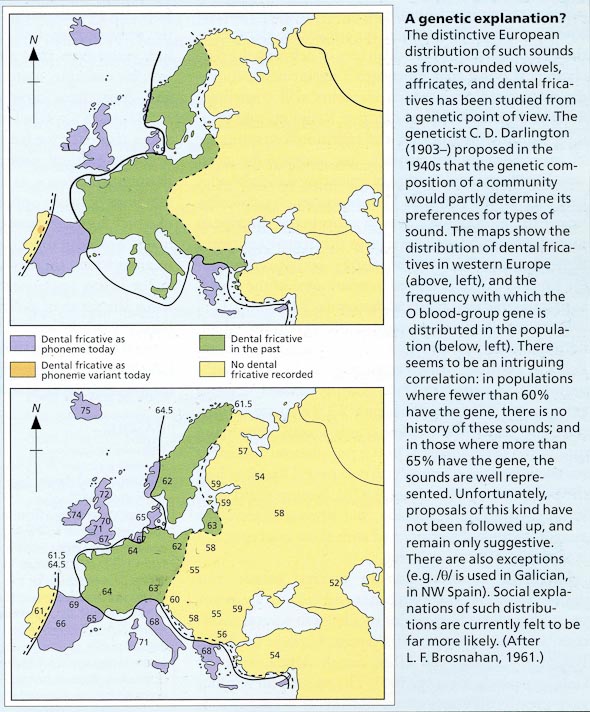
Distribution of dental fricatives and the O blood-group in Europe (from David Crystal's )

Distribution of dental fricatives and the O blood-group in Europe (from David Crystal’s Cambridge Encyclopedia of Language)

But certain things seem clear already. Language-genes must differ in important ways between different groups, influencing their linguistic skills and their preferences in phonetics and grammar. For example, there are some interesting correlations between blood-groups and use of dental fricatives in Europe. The invention of writing has exerted evolutionary pressures in Europe and Asia in ways it hasn’t in Africa, Australasia and the Americas. Glossogenetics, or the study of language and genes, will find important differences between races and within them, running parallel with differences in psychology and physiology. Language is a human universal, but that doesn’t mean one set of identical genes underlies the linguistic behaviour of all human groups. Skin, bones and blood are human universals too, but they differ between groups for genetic reasons.

Understanding the evolution and effects of these genetic differences is ultimately a mathematical exercise, and understanding language will be too. So will understanding the brain. For one thing, the brain must, at bottom, be a maths-engine or math-engine: a mechanism receiving, processing and sending information according to rules. But that’s a bit like saying fish are wet. Fish can’t escape water and human beings can’t escape mathematics. Nothing can: to exist is to stand in relation to other entities, to influence and be influenced by them, and mathematics is about that inter-play of entities. Or rather, that inter-play is Mathematics, with a big “M”, and nothing escapes it. Human beings have invented a way of modelling that fundamental micro- and macroscopic inter-play, which is mathematics with a small “m”. When they use this model, human beings can make mistakes. But when they do go wrong, they can do so in ways detectable to other human beings using the same model:

In 1853 William Shanks published his calculations of π to 707 decimal places. He used the same formula as [John] Machin and calculated in the process several logarithms to 137 decimal places, and the exact value of 2^721. A Victorian commentator asserted: “These tremendous stretches of calculation… prove more than the capacity of this or that computer for labor and accuracy; they show that there is in the community an increase in skill and courage…”

Augustus de Morgan thought he saw something else in Shanks’s labours. The digit 7 appeared suspiciously less often than the other digits, only 44 times against an average expected frequency of 61 for each digit. De Morgan calculated that the odds against such a low frequency were 45 to 1. De Morgan, or rather William Shanks, was wrong. In 1945, using a desk calculator, Ferguson found that Shanks had made an error; his calculation was wrong from place 528 onwards. Shanks, fortunately, was long dead. (The Penguin Dictionary of Curious and Interesting Numbers, 1986, David Wells, entry for π, pg. 51)

Unlike theology or politics, mathematics is not merely self-correcting, but multiply so: there are different routes to the same truths and different ways of testing a result. Science too is self-correcting and can test its results by different means, partly because science is a mathematical activity and partly because it is studying a mathematical artifact: the gigantic structure of space, matter and energy known as the Universe. Some scientists and philosophers have puzzled over what the physicist Eugene Wigner (1902-95) called “The Unreasonable Effectiveness of Mathematics in the Natural Sciences”. In his essay on the topic, Wigner tried to make two points:

The first point is that the enormous usefulness of mathematics in the natural sciences is something bordering on the mysterious and that there is no rational explanation for it. Second, it is just this uncanny usefulness of mathematical concepts that raises the question of the uniqueness of our physical theories. (Op. cit., in Communications in Pure and Applied Mathematics, vol. 13, No. I, February 1960)

I disagree with Wigner: it is not mysterious or uncanny and there is a rational explanation for it. The “effectiveness” of small-m maths for scientists is just as reasonable as the effectiveness of fins for fish or of wings for birds. The sea is water and the sky is air. The universe contains both sea and sky: and the universe is maths. Fins and wings are mechanisms that allow fish and birds to operate effectively in their water- and air-filled environments. Maths is a mechanism that allows scientists to operate effectively in their maths-filled environment. Scientists have, in a sense, evolved towards using maths just as fish and birds have evolved towards using fins and wings. Men have always used language to model the universe, but language is not “unreasonably effective” for understanding the universe. It isn’t effective at all.

It is effective, however, in manipulating and controlling other human beings, which explains its importance in politics and theology. In politics, language is used to manipulate; in science, language is used to explain. That is why mathematics is so important in science and so carefully avoided in politics. And in certain academic disciplines. But the paradox is that physics is much more intellectually demanding than, say, literary theory because the raw stuff of physics is actually much simpler than literature. To understand the paradox, imagine that two kinds of boulder are strewn on a plain. One kind is huge and made of black granite. The other kind is relatively small and made of chalk. Two tribes of academic live on the plain, one devoted to studying the black granite boulders, the other devoted to studying the chalk boulders.

The granite academics, being unable to lift or cut into their boulders, will have no need of physical strength or tool-making ability. Instead, they will justify their existence by sitting on their boulders and telling stories about them or describing their bumps and contours in minute detail. The chalk academics, by contrast, will be lifting and cutting into their boulders and will know far more about them. So the chalk academics will need physical strength and tool-making ability. In other words, physics, being inherently simpler than literature, is within the grasp of a sufficiently powerful human intellect in a way literature is not. Appreciating literature depends on intuition rather than intellect. And so strong intellects are able to lift and cut into the problems of physics as they aren’t able to lift and cut into the problems of literature, because the problems of literature depend on consciousness and on the hugely complex mechanisms of language, society and psychology.

Intuition is extremely powerful, but isn’t under conscious control like intellect and isn’t transparent to consciousness in the same way. In the fullest sense, it includes the senses, but who can control his own vision and hearing or understand how they turn the raw stuff of the sense-organs into the magic tapestry of conscious experience? Flickering nerve impulses create a world of sight, sound, scent, taste and touch and human beings are able to turn that world into the symbols of language, then extract it again from the symbols. This linguifaction is a far more complex process than the ignifaction that drives a star. At present it’s beyond the grasp of our intellects, so the people who study it don’t need and don’t build intellectual muscle in the way that physicists do.

Or one could say that literature is at a higher level of physics. In theory, it is ultimately and entirely reducible to physics, but the mathematics governing its emergence from physics are complex and not well-understood. It’s like the difference between a caterpillar and a butterfly. They are two aspects of one creature, but it’s difficult to understand how one becomes the other, as a caterpillar dissolves into chemical soup inside a chrysalis and turns into something entirely different in appearance and behaviour. Modelling the behaviour of a caterpillar is simpler than modelling the behaviour of a butterfly. A caterpillar’s brain has less to cope with than a butterfly’s. Caterpillars crawl and butterflies fly. Caterpillars eat and butterflies mate. And so on.

Stars can be compared to caterpillars, stories to butterflies. It’s easier to explain stars than to explain stories. And one of the things we don’t understand about stories is how we understand stories.

2:1 Now when Jesus was born in Bethlehem of Judaea in the days of Herod the king, behold, there came wise men from the east to Jerusalem, 2:2 Saying, Where is he that is born King of the Jews? for we have seen his star in the east, and are come to worship him. 2:3 When Herod the king had heard these things, he was troubled, and all Jerusalem with him. 2:4 And when he had gathered all the chief priests and scribes of the people together, he demanded of them where Christ should be born. 2:5 And they said unto him, In Bethlehem of Judaea: for thus it is written by the prophet, 2:6 And thou Bethlehem, in the land of Juda, art not the least among the princes of Juda: for out of thee shall come a Governor, that shall rule my people Israel. 2:7 Then Herod, when he had privily called the wise men, enquired of them diligently what time the star appeared. 2:8 And he sent them to Bethlehem, and said, Go and search diligently for the young child; and when ye have found him, bring me word again, that I may come and worship him also. 2:9 When they had heard the king, they departed; and, lo, the star, which they saw in the east, went before them, till it came and stood over where the young child was. 2:10 When they saw the star, they rejoiced with exceeding great joy. 2:11 And when they were come into the house, they saw the young child with Mary his mother, and fell down, and worshipped him: and when they had opened their treasures, they presented unto him gifts; gold, and frankincense and myrrh. – From The Gospel According to Saint Matthew.

Neuclid on the Block

How many blows does it take to demolish a wall with a hammer? It depends on the wall and the hammer, of course. If the wall is reality and the hammer is mathematics, you can do it in three blows, like this:

α’. Σημεῖόν ἐστιν, οὗ μέρος οὐθέν.
β’. Γραμμὴ δὲ μῆκος ἀπλατές.
γ’. Γραμμῆς δὲ πέρατα σημεῖα.

1. A point is that of which there is no part.
2. A line is a length without breadth.
3. The extremities of a line are points.

That is the astonishing, world-shattering opening in one of the strangest – and sanest – books ever written. It’s twenty-three centuries old, was written by an Alexandrian mathematician called Euclid (fl. 300 B.C.), and has been pored over by everyone from Abraham Lincoln to Bertrand Russell by way of Edna St. Vincent Millay. Its title is highly appropriate: Στοιχεῖα, or Elements. Physical reality is composed of chemical elements; mathematical reality is composed of logical elements. The second reality is much bigger – infinitely bigger, in fact. In his Elements, Euclid slipped the bonds of time, space and matter by demolishing the walls of reality with a mathematical hammer and escaping into a world of pure abstraction.

• Continue reading Neuclid on the Block

He Say, He Sigh, He Sow #2

Musica est exercitium arithmeticae occultum nescientis se numerare animi. — Leibniz.

Musik ist die versteckte arithmetische Tätigkeit der Seele, die sich nicht dessen bewußt ist, daß sie rechnet.

Music is a hidden arithmetic of the soul, which knows not that it calculates.