Think Inc — Book in Black

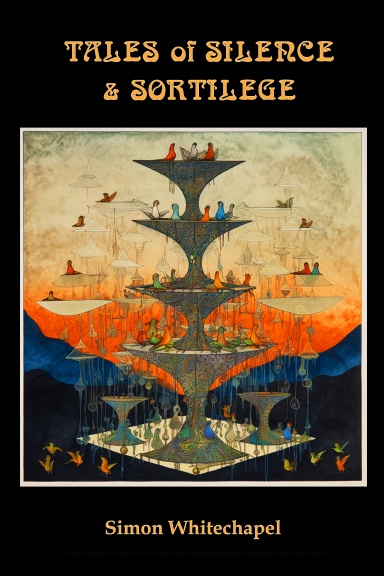
Incunabula Media have re-published Tales of Silence and Sortilege with a beautiful new cover:

Tales of Silence & Sortilege — Incunabula’s new edition


A review from Lulu of the first edition:

Tales of Silence & Sortilege, Simon Whitechapel (Ideophasis Books 2011)

If you love weird fantasy, if you love the English language, even if you don’t love Clark Ashton Smith, you should read this book. The back cover describes it as “the darkest and most disturbing fantasy” of this millennium, but that’s either sarcastic or tragically optimistic, because what these stories really are is beautiful. The breath of snow-wolves is described as “harsh-spiced.” A mysterious gargoyle leaning from the heights of a great cathedral has “wings still glistening with the rime of interplanetary flight.” Hummingbirds are “gem-feathered… their glittering breasts dusted with the gold of a hundred pollens.” If you cannot appreciate such imagery, then perhaps you are dead to beauty, or simply dead. These tales are very short, but some of them have stayed with me for years, such as “The Treasure of the Temple,” in which a thief seems to lose the greatest fortune he could ever have found by stealing a king’s ransom in actual treasure. Most of the stories are brilliant, one or two is only good, but the masterpieces are “Master of the Pyramid” and “The Return of the Cryomancer.” The sense of loss and mystery evoked by these two companion stories is almost physically painful, it is so haunting. There is nothing like these stories being published today. Reading them, I feel the excitement and wonder that fans of Weird Tales magazine must have known long ago when new stories would appear by H.P. Lovecraft, Clark Ashton Smith, and Robert E. Howard. Simon Whitechapel doesn’t imitate these authors so much as apply their greatest lessons to new forms of fantasy. This is one of the cheapest books I own, but I accord it one of my most valuable. It is easily the best work of art you will find in any form on Lulu. I cannot recommend it highly enough.


Elsewhere Other-Accessible…

Tales of Silence & Sortilege (Incunabula 2023)
Gweel & Other Alterities (Incunabula 2023)

Fine as Nine

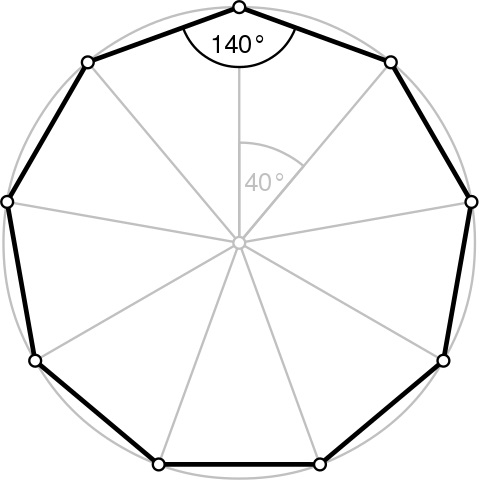
This is a regular nonagon (a polygon with nine sides):

A nonagon or enneagon (from Wikipedia)

And this is the endlessly repeating decimal of the reciprocal of 7:

1/7 = 0.142857142857142857142857…

What is the curious connection between 1/7 and nonagons? If I’d been asked that a week ago, I’d’ve had no answer. Then I found a curious connection when I was looking at the leading digits of polygonal numbers. A polygonal number is a number that can be represented in the form of a polygon. Triangular numbers look like this:


* = 1

*
** = 3

*
**
*** = 6

*
**
***
**** = 10

*
**
***
****
***** = 15

By looking at the shapes rather than the numbers, it’s easy to see that you generate the triangular numbers by simply summing the integers:


1 = 1
1+2=3
1+2+3=6
1+2+3+4=10
1+2+3+4+5=15

Now try the square numbers:


* = 1

**
** = 4

***
***
*** = 9

****
****
****
**** = 16

*****
*****
*****
*****
***** = 25


You generate the square numbers by summing the odd integers:


1 = 1
1+3 = 4
1+3+5 = 9
1+3+7 = 16
1+3+7+9 = 25

Next come the pentagonal numbers, the hexagonal numbers, the heptagonal numbers, and so on. I was looking at the leading digits of these numbers and trying to find patterns. For example, when do the leading digits of the k-th triangular number, tri(k), match the digits of k? This is when:


tri(1) = 1
tri(19) = 190
tri(199) = 19900
tri(1999) = 1999000
tri(19999) = 199990000
tri(199999) = 19999900000
[...]

That pattern is easy to explain. The formula for the k-th polygonal number is k * ((pn-2)*k + (4-pn)) / 2, where pn = 3 for the triangular numbers, 4 for the square numbers, 5 for the pentagonal numbers, and so on. Therefore the k-th triangular number is k * (k + 1) / 2. When k = 19, the formula is 19 * (19 + 1) / 2 = 19 * 20 / 2 = 19 * 10 = 190. And so on. Now try the pol(k) = leaddig(pol(k)) for higher polygonal numbers. The patterns are easy to predict until you get to the nonagonal numbers:


square(10) = 100
square(100) = 10000
square(1000) = 1000000
square(10000) = 100000000
square(100000) = 10000000000
[...]


pentagonal(7) = 70
pentagonal(67) = 6700
pentagonal(667) = 667000
pentagonal(6667) = 66670000
pentagonal(66667) = 6666700000
[...]


hexagonal(6) = 66
hexagonal(51) = 5151
hexagonal(501) = 501501
hexagonal(5001) = 50015001
hexagonal(50001) = 5000150001
[...]


heptagonal(5) = 55
heptagonal(41) = 4141
heptagonal(401) = 401401
heptagonal(4001) = 40014001
heptagonal(40001) = 4000140001
[...]


octagonal(4) = 40
octagonal(34) = 3400
octagonal(334) = 334000
octagonal(3334) = 33340000
octagonal(33334) = 3333400000
[...]


nonagonal(4) = 46
nonagonal(30) = 3075
nonagonal(287) = 287574
nonagonal(2858) = 28581429
nonagonal(28573) = 2857385719
nonagonal(285715) = 285715000000
nonagonal(2857144) = 28571444285716
nonagonal(28571430) = 2857143071428575
nonagonal(285714287) = 285714287571428574
nonagonal(2857142858) = 28571428581428571429
nonagonal(28571428573) = 2857142857385714285719
nonagonal(285714285715) = 285714285715000000000000
nonagonal(2857142857144) = 28571428571444285714285716
nonagonal(28571428571430) = 2857142857143071428571428575
nonagonal(285714285714287) = 285714285714287571428571428574
nonagonal(2857142857142858) = 28571428571428581428571428571429
nonagonal(28571428571428573) = 2857142857142857385714285714285719
nonagonal(285714285714285715) = 285714285714285715000000000000000000
nonagonal(2857142857142857144) = 28571428571428571444285714285714285716
nonagonal(28571428571428571430) = 2857142857142857143071428571428571428575
[...]


What’s going on with the leading digits of the nonagonals? Well, they’re generating a different reciprocal. Or rather, they’re generating the multiple of a different reciprocal:


1/7 * 2 = 2/7 = 0.285714285714285714285714285714...

And why does 1/7 have this curious connection with the nonagonal numbers? Because the nonagonal formula is k * (7k-5) / 2 = k * ((9-2) * k + (4-pn)) / 2. Now look at the pentadecagonal numbers, where pn = 15:


pentadecagonal(1538461538461538461540) = 15384615384615384615406923076923076923076930

2/13 = 0.153846153846153846153846153846...

pentadecagonal formula = k * (13k - 11) / 2 = k * ((15-2)*k + (4-15)) / 2

Penultimately, let’s look at the icosikaihenagonal numbers, where pn = 21:


icosikaihenagonal(2) = 21
icosikaihenagonal(12) = 1266
icosikaihenagonal(107) = 107856
icosikaihenagonal(1054) = 10544743
icosikaihenagonal(10528) = 1052878960
icosikaihenagonal(105265) = 105265947385
icosikaihenagonal(1052633) = 10526335263165
icosikaihenagonal(10526317) = 1052631731578951
icosikaihenagonal(105263159) = 105263159210526318
icosikaihenagonal(1052631580) = 10526315801578947370
icosikaihenagonal(10526315791) = 1052631579163157894746
icosikaihenagonal(105263157896) = 105263157896368421052636
icosikaihenagonal(1052631578949) = 10526315789497368421052643
icosikaihenagonal(10526315789475) = 1052631578947542105263157900
icosikaihenagonal(105263157894738) = 105263157894738263157894736845
icosikaihenagonal(1052631578947370) = 10526315789473706842105263157905
icosikaihenagonal(10526315789473686) = 1052631578947368689473684210526331
icosikaihenagonal(105263157894736843) = 105263157894736843000000000000000000
icosikaihenagonal(1052631578947368422) = 10526315789473684220526315789473684211
icosikaihenagonal(10526315789473684212) = 1052631578947368421257894736842105263166

2/19 = 0.1052631578947368421052631579

icosikaihenagonal formula = k * (19k - 17) / 2 = k * ((21-2)*k + (4-21)) / 2

And ultimately, let’s look at this other pattern in the leading digits of the triangular numbers, which I can’t yet explain at all:


tri(904) = 409060
tri(6191) = 19167336
tri(98984) = 4898965620
tri(996694) = 496699963165
tri(9989894) = 49898996060565
tri(99966994) = 4996699994681515
tri(999898994) = 499898999601055515
tri(9999669994) = 49996699999451815015
tri(99998989994) = 4999898999960055555015
tri(999996699994) = 499996699999945018150015
tri(9999989899994) = 49999898999996005055550015
tri(99999966999994) = 4999996699999994500181500015
tri(999999898999994) = 499999898999999600500555500015
[...]

Performativizing Papyrocentricity #75

Papyrocentric Performativity Presents…

Spare on a Me-StringSpare, Prince Harry (Penguin 2023)

Miserissimy MemoirsThe God Squad, Paddy Doyle (1988) / My Godawful Life, Sunny McCreary (2008)

Twice Was Half As NiceGoing to Sea in a Sieve: The Autobiography, Danny Baker (Orion 2012)

Visceral VolumeMonolithic Undertow: In Search of Sonic Oblivion, Harry Sword (White Rabbit 2021) / Heavy: How Metal Changes the Way We See the World, Dan Franklin (Constable 2020)

Vehicular VillainessChristine, Stephen King (1983)

Once More (With Gweeling)Gweel & Other Alterities, Simon Whitechapel (Incunabula Books 2023)

Wrecking BawlThe Lives of Brian: A Memoir, Brian Johnson (Michael Joseph 2022)

Angst in AckyThe Boy with the Perpetual Nervousness: A Memoir of an Adolescence, Graham Caveney (Picador 2017)


Or Read a Review at Random: RaRaR

Triumph of the ’Ville

Is it wrong that I find it amusing to be mistaken for a Guardian-reader or Guns’n’Roses fan? Yes. Very wrong. It’s also wrong that I’d be amused to learn that someone thought I was serious about the title Gweel & Other Alterities. Serious about the Alterities bit, I mean. “Alterity” is a word used by, well, I’d better not describe them. But one example is China Miéville. ’Nuff said. And here he uses the word with exactly the phrase I’d’ve hoped he’d use it with:

“I’m not interested in fantasy or SF as utopian blueprints, that’s a disastrous idea. There’s some kind of link in terms of alterity.” — “A life in writing: China Miéville”, The Guardian, 14v11


Elsewhere Other-Accessible

Ex-term-in-ate! — extremophilically engaging the teratic toxicity of “in terms of”…
’Ville to Power — Mythopoetic Miéville incisively interrogates issues around Trotsko-toxicity…

Floral Hex

I knew what the Sempervivum plant looked like:

Sempervivum × giuseppii (from Wikipedia)


But I’d never seen the flowers until a few days ago:

Sempervivum flowers (from Gardener’s Path)


They remind me of Clark Ashton Smith’s “The Demon of the Flower”:

Not as the plants and flowers of Earth, growing peacefully beneath a simple sun, were the blossoms of the planet Lophai. Coiling and uncoiling in double dawns; tossing tumultuously under vast suns of jade green and balas-ruby orange; swaying and weltering in rich twilights, in aurora-curtained nights, they resembled fields of rooted serpents that dance eternally to an other-worldly music. — “The Demon of the Flower”, Astounding Stories, Dec 1933

The Cruddiness of Cormac (continued)

Cormac McCarthy was a bad writer and an interesting phenomenon. Why did so many people say that he was a great writer, a genius, a giant of American letters? The puzzle isn’t as big as it appears. As with most over-rated artists, some of the people who said they liked him could see or glimpse the truth. They knew that he was pretentious and posturing, that he chose words clumsily and carelessly, had no sense of rhythm or the ridiculous, and wrote with all the natural grace and beauty of a chimpanzee riding a tricycle.

But most of those who saw the truth about Mccarthy didn’t dare to speak it. They stood beside the procession of praise and prizes and stayed shtum, when they should have shouted: “The emperor has no clothes!” A critic called B.R. Myers did dare to speak the truth. He shouted “The emperor has no clothes!” at the Atlantic in 2001:

McCarthy relies more on barrages of hit-and-miss verbiage than on careful use of just the right words. […] No novelist with a sense of the ridiculous would write such nonsense. Although his characters sometimes rib one another, McCarthy is among the most humorless writers in American history. […] It is a rare passage that can make you look up, wherever you may be, and wonder if you are being subjected to a diabolically thorough Candid Camera prank. I can just go along with the idea that horses might mistake human retching for the call of wild animals. But “wild animals” isn’t epic enough: McCarthy must blow smoke about some rude provisional species, as if your average quadruped had impeccable table manners and a pension plan. […] All the Pretty Horses received the National Book Award in 1992. “Not until now,” the judges wrote in their fatuous citation, “has the unhuman world been given its own holy canon.” What a difference a pseudo-biblical style makes; this so-called canon has little more to offer than the conventional belief that horses, like dogs, serve us well enough to merit exemption from an otherwise sweeping disregard for animal life. (No one ever sees a cow’s soul.) – “A Reader’s Manifesto”, The Atlantic (July 2001)

Myers is also right on the money when he says that McCarthy “thinks it more important to sound literary than to make sense.” He lets the gas out of McCarthy’s bloated reputation like a bad simile firing a bazooka into a dead whale. If you can’t see the cruddiness of Cormac, I recommend that you read Myers’ essay. It covers more bad writers than McCarthy, though, so if you’re pressed for time, just search for “Cormac” and have your eyes opened. Or not, as the case may be.

As for me, I’d like to re-quote a passage from McCarthy’s Pulitzer-prize-winning The Road (2006). I’ve already looked at it in “King Cormac”, but I have more to say:

When he woke in the woods in the dark and the cold of the night he’d reach out to touch the child sleeping beside him. Nights dark beyond darkness and the days more gray each one than what had gone before. Like the onset of some cold glaucoma dimming away the world. His hand rose and fell softly with each precious breath. He pushed away the plastic tarpaulin and raised himself in the stinking robes and blankets and looked toward the east for any light but there was none. In the dream from which he’d wakened he had wandered in a cave where the child led him by the hand. Their light playing over the wet flowstone walls. Like pilgrims in a fable swallowed up and lost among the inward parts of some granitic beast.

Is that good writing? No, it’s cruddy writing. Please consider these two sentences:

Like the onset of some cold glaucoma dimming away the world. His hand rose and fell softly with each precious breath.

You’ve got the pretentious and portentous “some cold glaucoma” followed by the hackneyed, Oprah-esque “precious breath”. The noun didn’t need any adjective. This is far stronger:

His hand rose and fell softly with each breath.

With “precious breath”, McCarthy was telling his readers what to think about the feelings of a father for his son. With just “breath”, he would have let his readers think it for themselves. Now look at this sentence:

He pushed away the plastic tarpaulin and raised himself in the stinking robes and blankets and looked toward the east for any light but there was none.

Is that good writing? No, again it’s cruddy writing. The sentence has no grace or rhythm and ends as McCarthy’s sentences so often do: with a bathetic thud. As Myers says of another of Cormac’s cruds: it can’t be “read aloud in a natural fashion.” This re-write of the sentence is stronger:

He pushed away the tarpaulin and raised himself in the stinking blankets and looked toward the east for light. But there was none.

And the re-write can be “read aloud in a natural fashion”. The Road is full of sentences that cry out in vain for a re-write. So are McCarthy’s other books. Not that I’ve read those other books, but I can see it from Myers’ essay and from quotes like this:

You can appreciate the language in McCarthy’s fiction for its lexical richness, gothic rhythms, and descriptive precision. In Suttree, you positively live on the grimy shore of the Tennessee River, where the “water was warm to the touch and had a granular lubricity like graphite.” Same for Blood Meridian. The Southwest desert is your home, or prison. You look up at the night sky. “All night sheetlightning quaked sourceless to the west beyond the midnight thunderheads, making a bluish day of the distant desert, the mountains on the sudden skyline stark and black and livid like a land of some other order out there whose true geology was not stone but fear.” – “a href=”https://www.theparisreview.org/blog/2023/06/16/on-cormac-mccarthy/”>On Cormac McCarthy”, The Paris Review (June 2023)

No, McCarthy’s language did not have “descriptive precision”. As B.R. Myers repeatedly demonstrates, it had the opposite: descriptive imprecision. That bit about the “true geology” being “fear” is, like so much of McCarthy’s writing, unintentionally funny. It suffers from the same fault as A.E. Housman identified in some of Swinburne’s more careless moments:

[M]uch worse can be said of another kind of simile, which grows common in his later writings. When a poet says that hatred is hot as fire or chastity white as snow, we can only object that we have often heard this before and that, considered as ornament, it is rather trite and cheap. But when he inverts his comparison and says that fire is hot as hatred and snow white as chastity, he is a fool for his pains. The heat of fire and the whiteness of snow are so much more sharply perceived than those qualities of hatred and chastity which have heat and whiteness for courtesy titles, that these similes actually blur the image and dilute the force of what is said. – “Swinburne” by A.E. Housman (1910)

A geology of stone is “much more sharply perceived” than a geology of fear. Whatever that is anyway. The cruddiness of Cormac also inspired cruddy writing by others. And still does:

McCarthy wrote figures, like Judge Holden, who were the genocidal tycoons of that brutal machine [of American history] and greased its wheels. Others, like Billy Parham, became its more indirect, melancholic grist. – “On Cormac McCarthy”, The Paris Review (June 2023)

Tycoons don’t grease wheels. That’s a job for underlings, not tycoons. And grist is what’s ground in a mill, not what fuels a brutal machine with wheels. “Indirect grist” doesn’t make sense. What do you do with indirect grist? Pretend to put it in a mill? As for “melancholic grist”: that’s both clumsy and funny. Cormac’s cruddiness continues. Le Roi Est Mort, Vive Le Roi!


Previously Pre-Posted (please peruse)

King Cormac — a look at the malign influence of McCarthy on the far better writer Stephen King

King Cormac

I had only one problem with Cormac McCarthy. He was crap.

More later.

Okay?

For now, let’s consider another famous writer. Millions of people have been writing English for hundreds of years. So the competition is intense for “Worst Simile Ever Written in English”. I still think this must be a leading contender:

Billy Nolan was at the pink fuzz-covered wheel [of the car]. Jackie Talbot, Henry Blake, Steve Deighan, and the Garson brothers, Kenny and Lou, were also squeezed in. Three joints were going, passing through the inner dark like the lambent eyes of some rotating Cerberus.

That’s from Stephen King’s Carrie (1974), describing some ill-intentioned teenagers smoking joints in a car. The paragraph starts gently and unpretentiously, lulling you into a false sense of security. Then wham! It hits you with “like the lambent eyes of some rotating Cerberus”. And where do I begin to dissect the wrongness of that simile? It’s simultaneously pretentious and illogical and ill-judged and anachronistic and clankingly clumsy and just plain stoopid. So where do I begin? Okay, I’ll begin with this observation: Cerberus had six eyes, not three (he had three heads, remember). So how did his six “lambent eyes” look like three glowing joints? Were his eyes very close-set? Did he keep three of them closed? Was he in fact part-dog, part-Cyclops, so that he only had three eyes after all? Yes, by “rotating” King means that now the three right eyes, now the three left eyes of Cerberus are visible, but there would be times when all six eyes were visible. And why is Cerberus rotating anyway?

I don’t know. And those questions by no means exhaust the idiotic possibilities raised by the simile. Let’s now ask how King’s lambent-eyed Cerberus was “rotating”. If his whole body was rotating on a vertical axis through his shoulders, say, then his three heads and six eyes would have been following too big an arc to fit the scene. So one has to assume that it was only his three heads and six eyes rotating on his one neck. Round and round and round. Which is a ridiculous image, not an eerie or ominous one.

No, we gotta face facts: King aimed for the Underworld and shot himself in the arse. And for the icing on the cake, we’ve got that poetic “some”. It wasn’t “a rotating Cerberus”, which would have been quite bad enough. It was “some rotating Cerberus”, as though King was setting his simile gently and carefully down on a bed of black velvet or plinth of polished obsidian, awestruck by the depth of his own erudition and the breadth of his own imagination. Fair enough: he’s human, he erred, I can forgive him. But how did the simile get past his editor and publisher and wife? Why did someone not say to him: “Steve, I like the book, in fact I love the book, but that appalling simile in part one has just gotta go?” Or why didn’t an editor suggest a re-write? I’d suggest this:

• Three joints were going, shifting in the inner dark like the glowing eyes of a watchful Cerberus.

Now the simile kinda works. The teenagers are up to something evil, but they don’t know that they’re going to unleash hell and harm themselves too. There’s authorial irony in the simile now: the hell-hound Cerberus is with them in spirit, conjured by the passing of the joints, but they, as characters in the story, don’t know it. They don’t know that Cerberus is patiently watching them, waiting to feast on their souls. I think the re-write removes the pretentiousness of linking ’70s American teenagers in a car with a monster from Greek mythology. The teenagers are evil but petty. It’s appropriate that they’re ignorant of grander and grotesquer things, like the three-headed hell-hound Cerberus and the telekinetic powers of the girl they’re planning to humiliate.

Alas, King or one of his editors didn’t re-write the simile. The original stayed put and turned the sentence into one of the worst I’ve ever read. And it was definitely the worst I’ve ever read in a book by Stephen King. That simile was bad by King’s own standards, because he’s not usually a pretentious or preening writer. So why did he write so badly there? I suspect the malign influence of another and much more critically acclaimed writer: the recently deceased Cormac McCarthy, who is easily the most pretentious and over-rated writer I’ve ever come across. I couldn’t finish Blood Meridian (1985) and although I did manage to finish The Road (2006), it didn’t change my opinion of the author. Cormac is crap. But Stephen King takes him seriously and, I suspect, was paying some kind of misguided homage to him when he came up with that appallingly bad “like the lambent eyes of some rotating Cerberus.”

If I’d read more of Cormac McCarthy’s books, I might be able to provide stronger evidence of my theory about his malign influence on that particular sentence in Carrie. But why would I want to read more of Cormac McCarthy’s books? I’m not a masochist and I don’t like reading bad English and pretentious prose. All the same, here’s a bit from The Road that suggests to me that King was imitating Cormac:

When he woke in the woods in the dark and the cold of the night he’d reach out to touch the child sleeping beside him. Nights dark beyond darkness and the days more gray each one than what had gone before. Like the onset of some cold glaucoma dimming away the world. His hand rose and fell softly with each precious breath. He pushed away the plastic tarpaulin and raised himself in the stinking robes and blankets and looked toward the east for any light but there was none. In the dream from which he’d wakened he had wandered in a cave where the child led him by the hand. Their light playing over the wet flowstone walls. Like pilgrims in a fable swallowed up and lost among the inward parts of some granitic beast.

There’s a lot of bad writing there, but I want to look at the two similes. They both use bad and pretentious imagery and they both have a would-be poetic “some”. Take the first simile. What on earth is a “cold glaucoma”? That doesn’t make sense. It isn’t the glaucoma that’s cold: it’s the way the glaucoma makes the world appear. “Cold glaucoma” is certainly an interesting medical concept, but it’s crap writing in a novel. Now take the second simile. What on earth is a “granitic beast”? If a beast is made of granite, how does it swallow people, let alone digest them? Granite is very solid and very rigid. The simile doesn’t work. And why did McCarthy say “inward parts” rather than the stronger “bowels”? Because he was doing what he did so often: writing badly and carelessly and pretentiously. “Granitic beast” is a stoopid image and the pretentious “granitic” makes it even worse.

Okay, neither simile is as bad as King’s “lambent-eyes-of-Cerberus” atrocity, but I detect a family resemblance and I think that King was trying to imitate some earlier writing by McCarthy. He shouldn’t have done. The ironic thing is that King himself is a better writer than McCarthy. I am too. But then who isn’t? It’s much easier to think of writers who are better than Cormac McCarthy than of writers who are worse. Let’s see: Will Self is worse. But who else? I’m glad to say that I can’t come up with anyone else. If I could come up with someone else, I would’ve suffered by reading another very bad writer.

Anyway, here’s my re-write of that extract from The Road:

When he woke in the woods in the dark and cold he’d reach out and touch the child sleeping beside him. Nights dark beyond darkness and each day grayer than the day before, as though he viewed the world through dying eyes. His hand rose and fell softly with each breath. He pushed away the tarpaulin and raised himself in the stinking blankets and looked toward the east for light. In the dream from which he’d wakened he had wandered in a cave where the child led him by the hand. Light played over the wet flowstone walls. They seemed like travelers in a story, swallowed and lost in the bowels of a petrified giant.

That’s still not very good, but it’s a definite improvement. If you don’t agree, you have a cloth ear for prose. And here’s my review of the whole book from 2013:

Highway to Hell

Cormac McCarthy won the Pulitzer Prize for The Road in 2007. The book is set in the aftermath of a world-wide cataclysm.

So is Stephen King’s The Stand (1978).

But The Road is much shorter than The Stand.

It makes up for this by being

much more pre

tentious

too.

Okay?

It is also much

less enter

taining.

Which is not to say that

The Road doesn’t have its

entertain

ing

bits.

For example

(spoiler alert)

the bit where the

unnamedfatherandsonprotagonists

go

into a wood and find

a fire where

some folks (far from

unferal)

have been preparing to

roast

and

eat a

b

a

b

y

.

.

.

For me

this was a

laugh-

out-loud mo

ment.

The “catamites” were pretty

funny

,

also

.

If you take Cormac McCarthy

seriously

my brother (or

sister)

I think that

you need to

grow up.

Okay?

But you

probably

nev

er

w

i

l

l

.

.

.


Elsewhere Other-Accessible…

A Reader’s Manifesto — B.R. Myers agrees with me about McCarthy, inter alios (et alias)