
Inky Bloaters (1987) is the name of an album by psycho-songstress Danielle Dax. Frinky growthers are those who are interested in frincremental growth. That’s growth by fractions, as in the equation x = x + 1/x. If the initial x = 1, its frincremental growth looks like this:
1
1 + 1/1 = 1 + 1 = 2
2 + 1/2 = 2_1/2
2_1/2 + 1/2_1/2 = 2_9/10
2_9/10 + 1/2_9/10 = 3_71/290
3_71/290 + 1/3_71/290 = 3_150911/272890
3_150911/272890 → 3_220789390391/264588959090 → 4_25570190327910692085061/268440386798659418988490 → 4_100170363026578204006507990129853967021051645381/295105036840595214385430531020664149472669868290
As you can see, the numerators and denominators of the fractional part of x get very large very quickly. So you can’t track the frincremental growth of x with perfect accuracy. Even the most compendious computer will run out of space. But representing x as a decimal is usually enough for us frinky growthers:
1 + 1 = 2
2 + 1/2 = 2 + 0.5 = 2.5
2.5 + 1/2.5 = 2.9
3.244827586206896551724137931…
3.553010370478947561288431236…
3.834461842815967366750790750…
4.095254632258778985771918456…
4.339439692724345181049239663…
4.569884190357676650018985962…
4.788708116379690742064597208…
4.997532704493448986664559639…
5.197631445038131469095668466…
5.390026771750770995914851381…
5.575554607204394029915651664…
5.754908962142979073283550015…
5.928673657045750549124213874…
6.097345447373015508408978797…
6.261351244425377152997703626…
6.421061179383957004641284553…
6.576798676981813718180627345…
The larger x gets, the slower it grows. But it never stops growing and will pass any finite integer in finite time. I was interested in the fractional part of x += 1/x (a shorthand for x = x + 1/x). Plainly, it’s almost unique for every integer seed (the fractional part is identical, just displaced by one step, for initial x = 1 = 2). I graphed the fractional part of x += 1/x for 1, 2, 3, 4, 5… and discovered some interesting patterns:

frac(x) of x += 1/x for x = 1, 2, 3, 4, 5…

Later frac(x) of x += 1/x



In time, the rounded patterns disappear for lower initial x. But you also get symmetrical patterns for x += sqrt(x), that is, x = x + square_root(x). And they last longer:
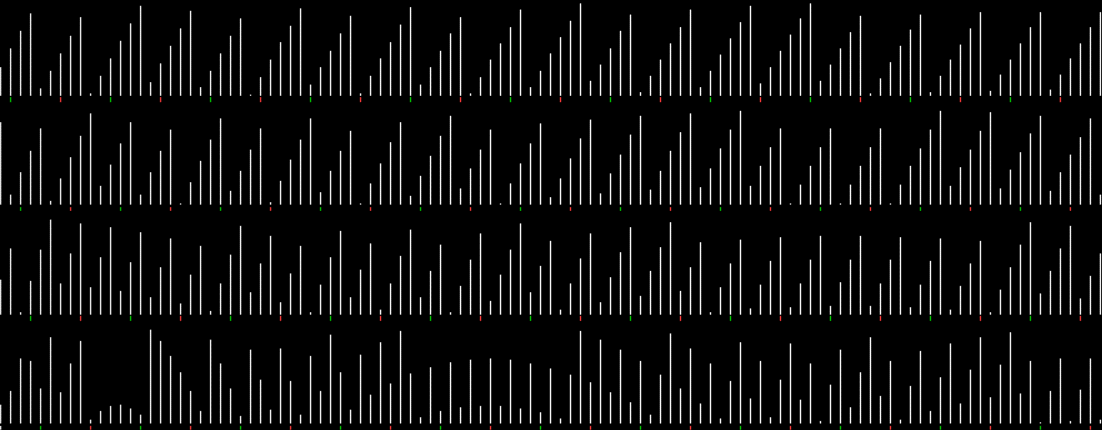
frac(x) of x += sqrt(x) for 1, 2, 3, 4, 5… #1

frac(x) of x += sqrt(x) for 1, 2, 3, 4, 5… #2

frac(x) of x += sqrt(x) for 1, 2, 3, 4, 5… #3

frac(x) of x += sqrt(x) for 1, 2, 3, 4, 5… #4

frac(x) of x += sqrt(x) for 1, 2, 3, 4, 5… #5
Here’s an animation of the first fifty steps of x += sqrt(x):
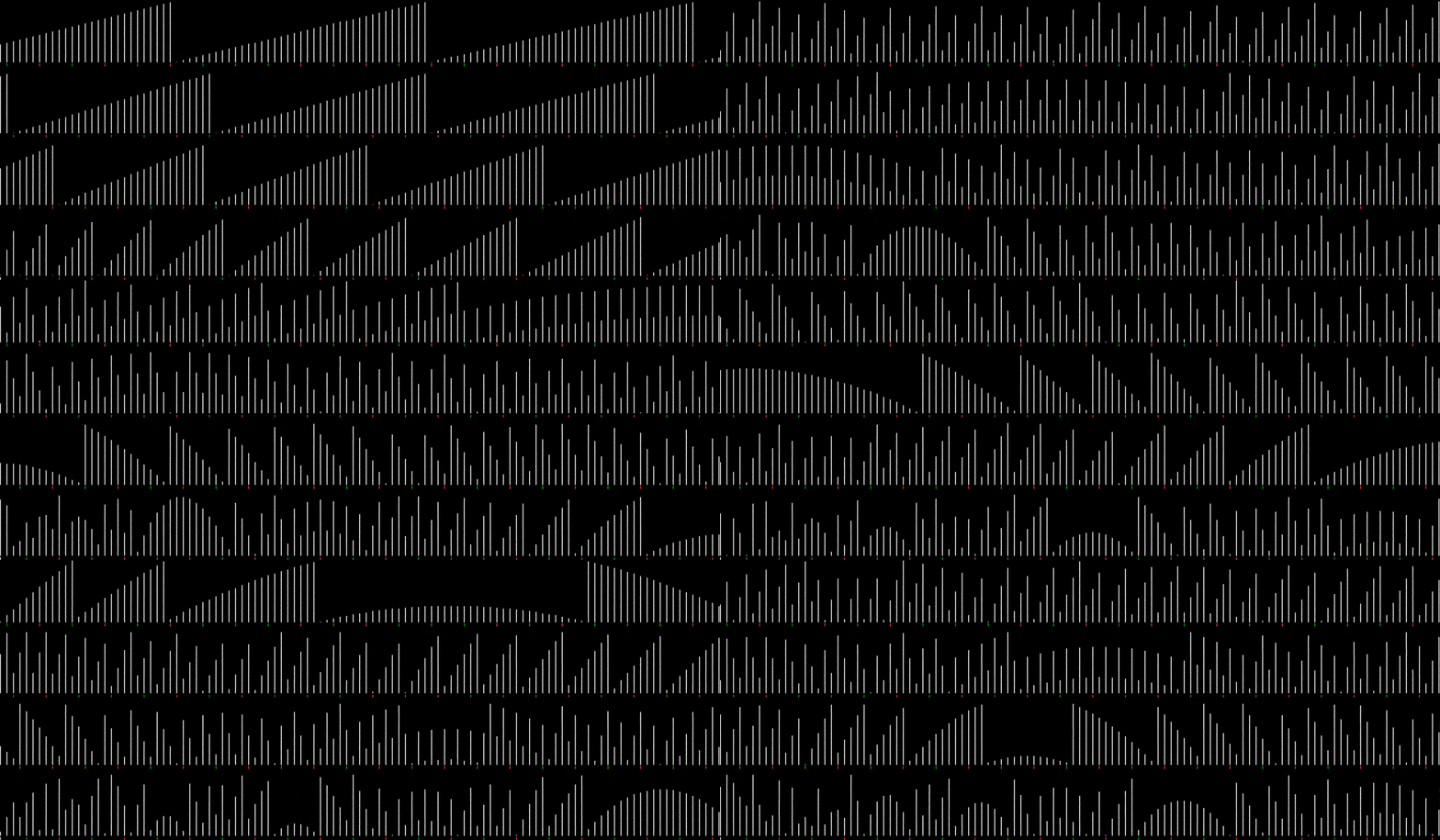
animated frac(x) of x += sqrt(x) for 1, 2, 3, 4, 5… (animated at EZgif) (click for larger image)
And what about x += ln(x), or x = x + natural_logarithm(x)? The patterns are both more dynamic and longer-lasting for lower initial x:

frac(x) of x += ln(x) for 1, 2, 3, 4, 5… #1

frac(x) of x += ln(x) for 1, 2, 3, 4, 5… #2

frac(x) of x += ln(x) for 1, 2, 3, 4, 5… #3

frac(x) of x += ln(x) for 1, 2, 3, 4, 5… #4
And two animations of x += ln(x), one slower, one faster:

animated frac(x) of x += sqrt(x) for 1, 2, 3, 4, 5… (EZgif) (click for larger)

faster animated frac(x) of x += sqrt(x) for 1, 2, 3, 4, 5… (click for larger)

