Sumbertime Views

Like 666 (see Revelation 13:18), 153 (see John 21:11) appears in the Bible. And perhaps for the same reason: because it is the sum of successive integers. 153 = 1+2+3+…+17 = Σ(17), just as 666 = Σ(36). So both numbers are sum-numbers or sumbers. But 153 has other interesting properties, including one that can’t have been known in Biblical times, because numbers weren’t represented in the right way. It’s also the sum of the cubes of its digits: 153 = 1^3 + 5^3 + 3^3 = 1 + 125 + 27. So 153 is a cube-sumber or 3-sumber. The other 3-sumbers are 370, 371 and 407. There are 4-sumbers too, like 1,634 = 1^4 + 6^4 + 3^4 + 4^4, and 5-sumbers, like 194,979 = 1^5 + 9^5 + 4^5 + 9^5 + 7^5 + 9^5, and 6-sumbers, like 548,834 = 5^6 + 4^6 + 8^6 + 8^6 + 3^6 + 4^6.

But there are no 2-sumbers, or numbers that are the sum of the squares of their digits. It doesn’t take long to confirm this, because numbers above a certain size can’t be 2-sumbers. 9^2 + 9^2 = 162, but 9^2 + 9^2 + 9^2 = 243. So 2-sumbers can’t exist above 99 and if you search that high you’ll find that they don’t exist at all. At least not in this house, but they do exist in the houses next door. Base 10 yields nothing, so what about base 9?

4^2 + 5^2 = 45[9] = 41[10]
5^2 + 5^2 = 55[9] = 50

And base 11?

5^2 + 6^2 = 56[11] = 61[10]
6^2 + 6^2 = 66[11] = 72

This happens because odd bases always yield a pair of 2-sumbers whose second digit is one more than half the base and whose first digit is the same or one less. See above (and the appendix). Such a pair is found among the 14 sumbers of base 47, which is the best total till base 157 and its 22 sumbers. Here are the 2-sumbers for base 47:

2^2 + 10^2 = 104
3^2 + 12^2 = 153
5^2 + 15^2 = 250
9^2 + 19^2 = 442
12^2 + 21^2 = 585
14^2 + 22^2 = 680
23^2 + 24^2 = 1,105
24^2 + 24^2 = 1,152
33^2 + 22^2 = 1,573
35^2 + 21^2 = 1,666
38^2 + 19^2 = 1,805
42^2 + 15^2 = 1,989
44^2 + 12^2 = 2,080
45^2 + 10^2 = 2,125

As the progressive records for 2-sumber-totals are set, subsequent bases seem to either match or surpass them, except in three cases below base 450:

2 in base 5
4 in base 7
6 in base 13
10 in base 43
14 in base 47
22 in base 157
8 in base 182*
16 in base 268*
30 in base 307
18 in base 443*

Totals for sums of squares in bases 4 to 450

Totals for sums-of–squares in bases 4 to 450 (click for larger image)

Appendix: Odd Bases and 2-sumbers

Take an even number and half of that even number: say 12 and 6. 12 x 6 = 11 x 6 + 6. Further, 12 x 6 = 2 x 6 x 6 = 2 x 6^2 = 6^2 + 6^2. Accordingly, 66[11] = 6 x 11 + 6 = 12 x 6 = 6^2 + 6^2. So 66 in base 11 is a 2-sumber. Similar reasoning applies to every other odd base except base-3 [update: wrong!]. Now, take 12 x 5 = 2 x 6 x 5 = 2 x (5×5 + 5) = 5^2+5 + 5^5+5 = 5^5 + 5^5+2×5. Further, 5^5+2×5 = (5+1)(5+1) – 1 = 6^2 – 1. Accordingly, 56[11] = 11×5 + 6 = 12×5 + 1 = 5^2 + 6^2. Again, similar reasoning applies to every other odd base except base-3 [update: no — 1^2 + 2^2 = 12[3] = 5; 2^2 + 2^2 = 22[3] = 8]. This means that every odd base b, except base-3, will supply a pair of 2-sumbers with digits [d-1][d] and [d][d], where d = (b + 1) / 2.

Cat out of Bel

The Belgian symbolist Fernand Khnopff (1858-1921) is one of my favourite artists; Caresses (1896) is one of his most famous paintings. I like it a lot, though I find it more interesting than attractive. It’s a good example of Khnopff’s art in that the symbols are detached from clear meaning and float mysteriously in a world of their own. As Khnopff used to say: On n’a que soi “One has only oneself.” But he was clearly inspired by the story of Oedipus and the Sphinx, which is thousands of years old. Indeed, an alternate title for the painting is The Sphinx.

Caresses by Fernand Khnopff (click for larger image)

Caresses (1896) by Fernand Khnopff (click for larger image)

Even older than the Oedipus story is another link to the incestuous themes constantly explored by Khnopff, who was obsessed with his sister Marguerite and portrayed her again and again in his art. That’s her heavy-jawed face rubbing against the heavy-jawed face of the oddly nippled man, but Khnopff has given her the body of a large spotted felid. Many people misidentify it as a leopard, Panthera pardus. It’s actually a stranger and rarer felid: a cheetah, Acinonyx jubatus, which occupies a genus of its own among the great cats. And A. jubatus, unlike P. pardus, is an incestuous animal par excellence:

Cheetahs are very inbred. They are so inbred that genetically they are almost identical. The current theory is that they became inbred when a “natural” disaster dropped their total world population down to less than seven individual cheetahs – probably about 10,000 years ago. They went through a “Genetic Bottleneck”, and their genetic diversity plummeted. They survived only through brother-to-sister or parent-to-child mating. (Cheetah Extinction)

It must have been a large disaster. Perhaps cheetahs barely survived the inferno of a strike by a giant meteor, which would make them a cat out of hell. In 1896, they became a cat out of Bel too when Khnopff unveiled Caresses. Back then, biologists could not analyse DNA and discover the ancient history of a species like that. So how did Khnopff know the cheetah would add extra symbolism to his painting? Presumably he didn’t, though he must have recognized the cheetah as unique in other ways. All the same, I like to think that perhaps he had extra-rational access to scientific knowledge from the future. As he dove into the subconscious, Khnopff used symbols like weights to drag himself and his art deeper and darker. So perhaps far down, in the mysterious black, where time and space lose their meaning, he encountered a current of telepathy bearing the news of the cheetah’s incestuous nature. And that’s why he chose to give his sphinx-sister a cheetah’s body.

Live and Let Dice

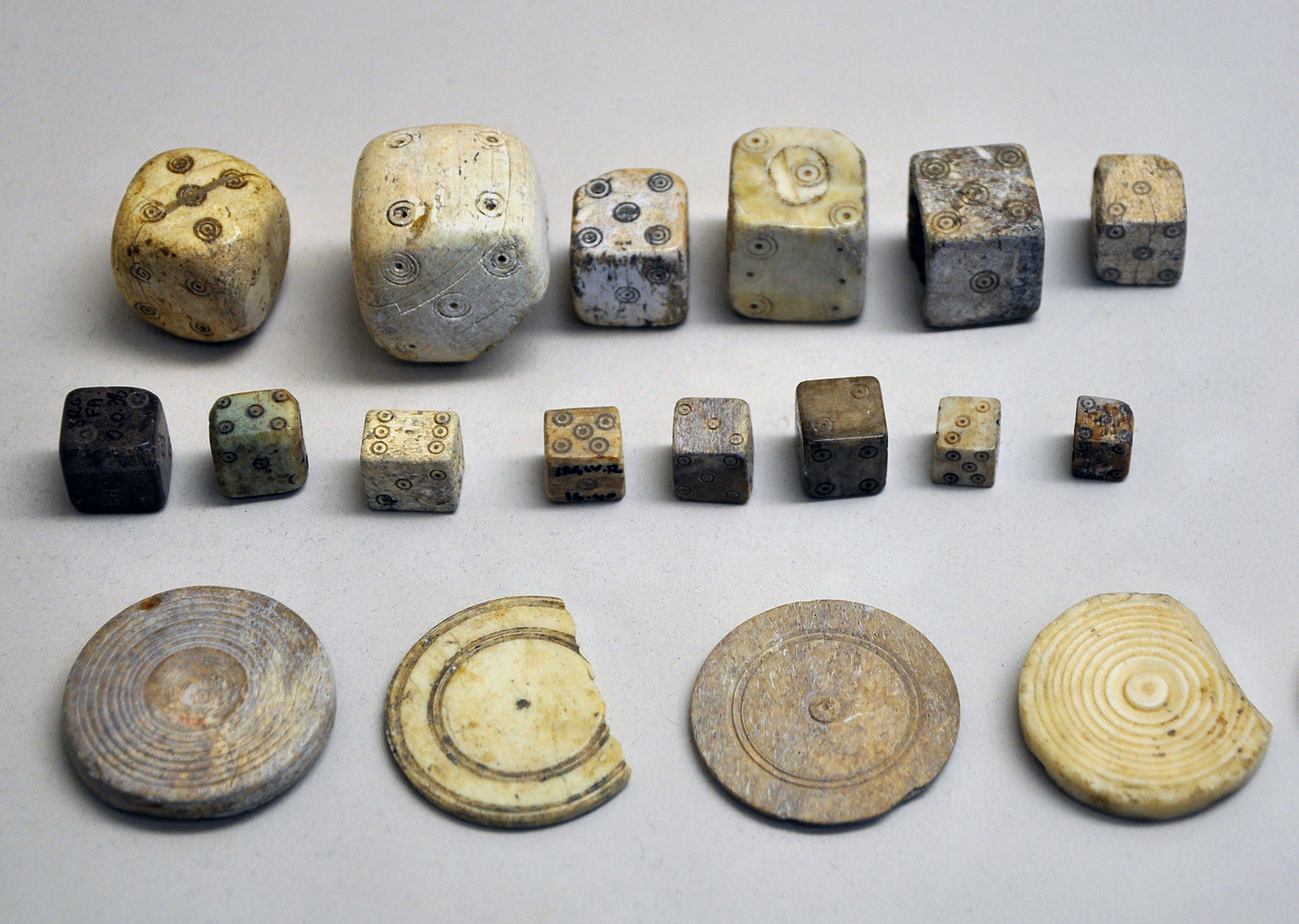
How many ways are there to die? The answer is actually five, if by “die” you mean “roll a die” and by “rolled die” you mean “Platonic polyhedron”. The Platonic polyhedra are the solid shapes in which each polygonal face and each vertex (meeting-point of the edges) are the same. There are surprisingly few. Search as long and as far as you like: you’ll find only five of them in this or any other universe. The standard cubic die is the most familiar: each of its six faces is square and each of its eight vertices is the meeting-point of three edges. The other four Platonic polyhedra are the tetrahedron, with four triangular faces and four vertices; the octahedron, with eight triangular faces and six vertices; the dodecahedron, with twelve pentagonal faces and twenty vertices; and the icosahedron, with twenty triangular faces and twelve vertices. Note the symmetries of face- and vertex-number: the dodecahedron can be created inside the icosahedron, and vice versa. Similarly, the cube, or hexahedron, can be created inside the octahedron, and vice versa. The tetrahedron is self-spawning and pairs itself. Plato wrote about these shapes in his Timaeus (c. 360 B.C.) and based a mathemystical cosmology on them, which is why they are called the Platonic polyhedra.

An animated gif of a tetrahedron

Tetrahedron


An animated gif of a hexahedron

Hexahedron

An animated gif of an octahedron

Octahedron


An animated gif of a dodecahedron

Dodecahedron

An animated gif of an icosahedron

Icosahedron

They make good dice because they have no preferred way to fall: each face has the same relationship with the other faces and the centre of gravity, so no face is likelier to land uppermost. Or downmost, in the case of the tetrahedron, which is why it is the basis of the caltrop. This is a spiked weapon, used for many centuries, that always lands with a sharp point pointing upwards, ready to wound the feet of men and horses or damage tyres and tracks. The other four Platonic polyhedra don’t have a particular role in warfare, as far as I know, but all five might have a role in jurisprudence and might raise an interesting question about probability. Suppose, in some strange Tycholatric, or fortune-worshipping, nation, that one face of each Platonic die represents death. A criminal convicted of a serious offence has to choose one of the five dice. The die is then rolled f times, or as many times as it has faces. If the death-face is rolled, the criminal is executed; if not, he is imprisoned for life.

The question is: Which die should he choose to minimize, or maximize, his chance of getting the death-face? Or doesn’t it matter? After all, for each die, the odds of rolling the death-face are 1/f and the die is rolled f times. Each face of the tetrahedron has a 1/4 chance of being chosen, but the tetrahedron is rolled only four times. For the icosahedron, it’s a much smaller 1/20 chance, but the die is rolled twenty times. Well, it does matter which die is chosen. To see which offers the best odds, you have to raise the odds of not getting the death-face to the power of f, like this:

3/4 x 3/4 x 3/4 x 3/4 = 3/4 ^4 = 27/256 = 0·316…

5/6 ^6 = 15,625 / 46,656 = 0·335…

7/8 ^8 = 5,764,801 / 16,777,216 = 0·344…

11/12 ^12 = 3,138,428,376,721 / 8,916,100,448,256 = 0·352…

19/20 ^20 = 37,589,973,457,545,958,193,355,601 / 104,857,600,000,000,000,000,000,000 = 0·358…

Those represent the odds of avoiding the death-face. Criminals who want to avoid execution should choose the icosahedron. For the odds of rolling the death-face, simply subtract the avoidance-odds from 1, like this:

1 – 3/4 ^4 = 0·684…

1 – 5/6 ^6 = 0·665…

1 – 7/8 ^8 = 0·656…

1 – 11/12 ^12 = 0·648…

1 – 19/20 ^20 = 0·642…

So criminals who prefer execution to life-imprisonment should choose the tetrahedron. If the Tycholatric nation offers freedom to every criminal who rolls the same face of the die f times, then the tetrahedron is also clearly best. The odds of rolling a single specified face f times are 1/f ^f:

1/4 x 1/4 x 1/4 x 1/4 = 1/4^4 = 1 / 256

1/6^6 = 1 / 46,656

1/8^8 = 1 / 16,777,216

1/12^12 = 1 / 8,916,100,448,256

1/20^20 = 1 / 104,857,600,000,000,000,000,000,000

But there are f faces on each polyhedron, so the odds of rolling any face f times are 1/f ^(f-1). On average, of every sixty-four (256/4) criminals who choose to roll the tetrahedron, one will roll the same face four times and be reprieved. If a hundred criminals face the death-penalty each year and all choose to roll the tetrahedron, one criminal will be reprieved roughly every eight months. But if all criminals choose to roll the icosahedron and they have been rolling since the Big Bang, just under fourteen billion years ago, it is very, very, very unlikely that any have yet been reprieved.

He Say, He Sigh, He Sow #7

“I had, also, during many years followed a golden rule, namely, that whenever a published fact, a new observation or thought came across me, which was opposed to my general results, to make a memorandum of it without fail and at once; for I had found by experience that such facts and thoughts were far more apt to escape from the memory than favourable ones.” — The Autobiography of Charles Darwin (1958).

Rep-Tile Reflections

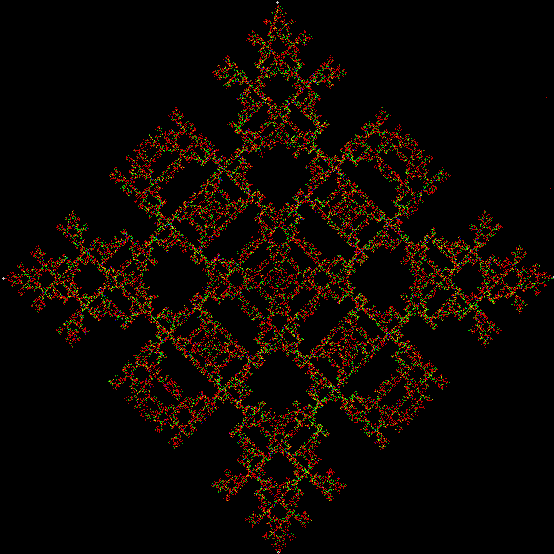
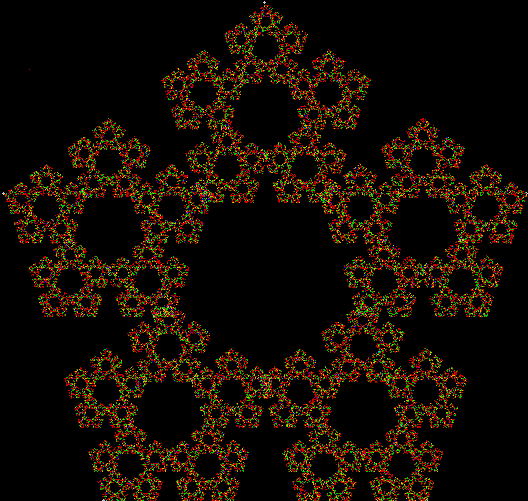
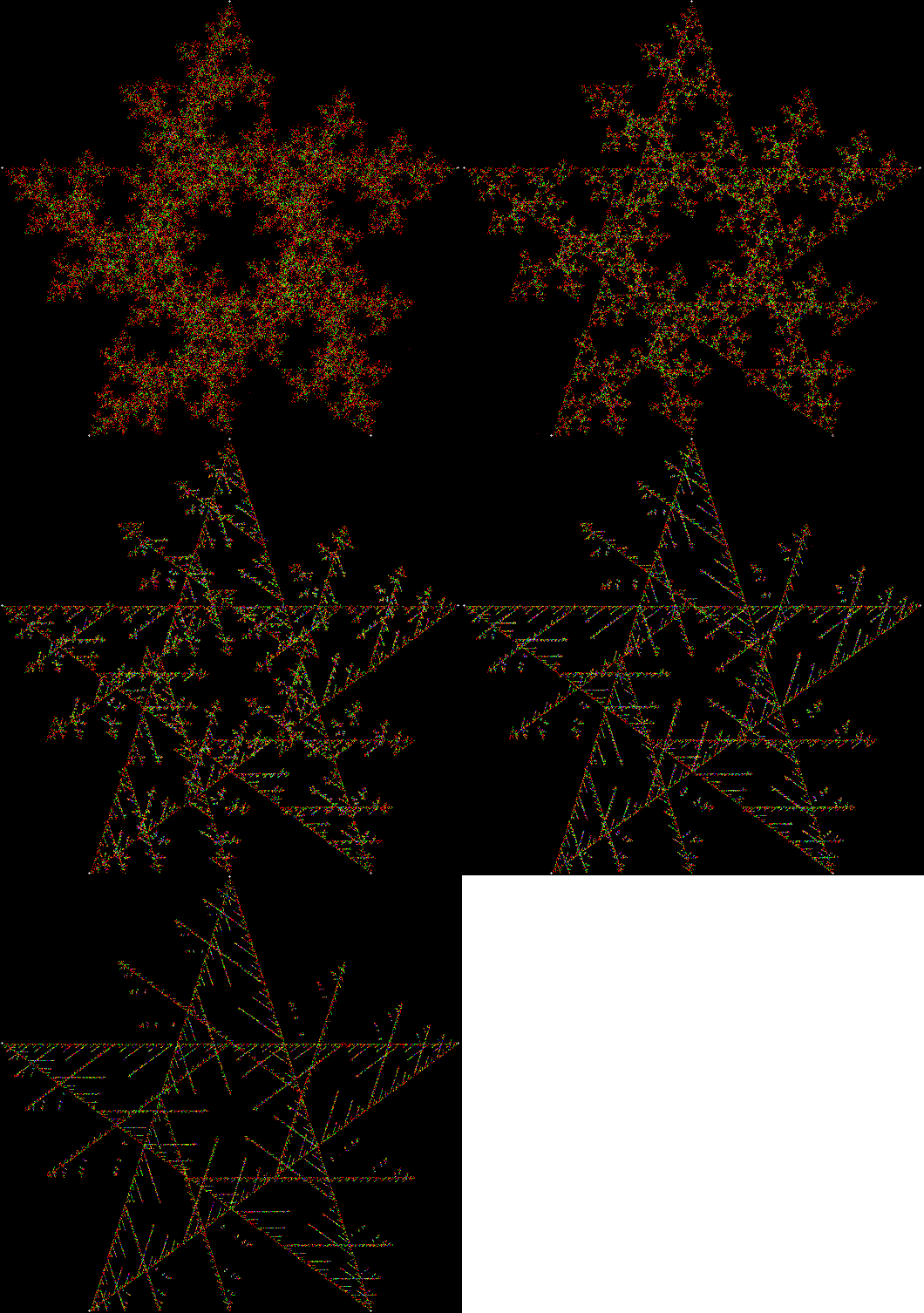
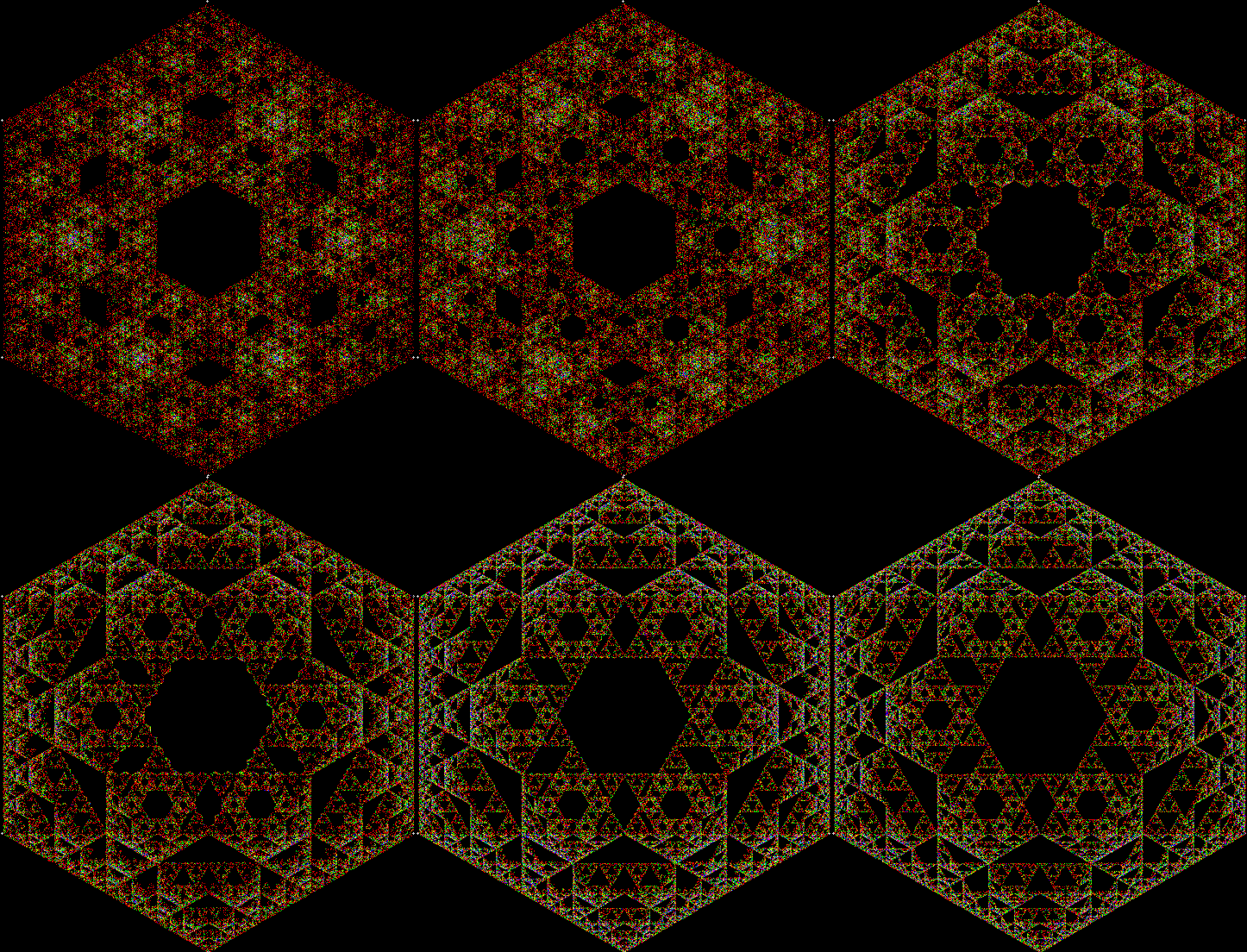
A rep-tile, or repeat-tile, is a two-dimensional shape that can be divided completely into copies of itself. A square, for example, can be divided into smaller squares: four or nine or sixteen, and so on. Rectangles are the same. Triangles can be divided into two copies or three or more, depending on their precise shape. Here are some rep-tiles, including various rep-triangles:

Various rep-tiles

Various rep-tiles — click for larger image

Some are simple, some are complex. Some have special names: the sphinx and the fish are easy to spot. I like both of those, particularly the fish. It would make a good symbol for a religion: richly evocative of life, eternally sub-divisible of self: 1, 9, 81, 729, 6561, 59049, 531441… I also like the double-square, the double-triangle and the T-tile in the top row. But perhaps the most potent, to my mind, is the half-square in the bottom left-hand corner. A single stroke sub-divides it, yet its hypotenuse, or longer side, represents the mysterious and mind-expanding √2, a number that exists nowhere in the physical universe. But the half-square itself is mind-expanding. All rep-tiles are. If intelligent life exists elsewhere in the universe, perhaps other minds are contemplating the fish or the sphinx or the half-square and musing thus: “If intelligent life exists elsewhere in the universe, perhaps…”

Mathematics unites human minds across barriers of language, culture and politics. But perhaps it unites minds across barriers of biology too. Imagine a form of life based on silicon or gas, on unguessable combinations of matter and energy in unreachable, unobservable parts of the universe. If it’s intelligent life and has discovered mathematics, it may also have discovered rep-tiles. And it may be contemplating the possibility of other minds doing the same. And why confine these speculations to this universe and this reality? In parallel universes, in alternative realities, minds may be contemplating rep-tiles and speculating in the same way. If our universe ends in a Big Crunch and then explodes again in a Big Bang, intelligent life may rise again and discover rep-tiles again and speculate again on their implications. The wildest speculation of all would be to hypothesize a psycho-math-space, a mental realm beyond time and matter where, in mathemystic communion, suitably attuned and aware minds can sense each other’s presence and even communicate.

The rep-tile known as the fish

Credo in Piscem…

So meditate on the fish or the sphinx or the half-square. Do you feel the tendrils of an alien mind brush your own? Are you in communion with a stone-being from the far past, a fire-being from the far future, a hive-being from a parallel universe? Well, probably not. And even if you do feel those mental tendrils, how would you know they’re really there? No, I doubt that the psycho-math-space exists. But it might and science might prove its existence one day. Another possibility is that there is no other intelligent life, never has been, and never will be. We may be the only ones who will ever muse on rep-tiles and other aspects of mathematics. Somehow, though, rep-tiles themselves seem to say that this isn’t so. Particularly the fish. It mimics life and can spawn itself eternally. As I said, it would make a good symbol for a religion: a mathemysticism of trans-biological communion. Credo in Piscem, Unum et Infinitum et Æternum. “I believe in the Fish, One, Unending, Everlasting.” That might be the motto of the religion. If you want to join it, simply wish upon the fish and muse on other minds, around other stars, who may be doing the same.

Numbered Days

Numbered Days: Literature, Mathematics and the Deus Ex Machina

Think French. Think genius. Think rebellious, tormented, iconoclastic. Finally, think dead tragically young in the nineteenth century… And if you’re thinking of anyone at all, I think you’ll be thinking of Rimbaud.

And you’d be right to do so. But only half-right. Because there were in fact two rebellious, tormented, iconoclastic French geniuses who died tragically young in the nineteenth century. One was called Arthur Rimbaud (1854-91) and the other Évariste Galois (1811-32). Rimbaud is still famous, Galois never has been. At least not to the general educated public, though on all objective criteria – but one – you might expect his fame to be greater. In every way – but one – Galois has the more powerful appeal.

Continue reading Numbered Days

Pest Test

Health warning: I am not a mathematician. That said, here is a mathematical question:

Suppose there is a 99% accurate test for a medical condition – say a symptomless infection. You take the test and get a positive result. What are your chances of having the infection?

That obvious answer might seem to be 99%. But the obvious answer is wrong. The accuracy of the test is only half the information you need to answer the question. You also need to know how common the infection is. Say it occurs once in every hundred people. On average, then, if you test a hundred people, one of whom has the infection, you will get two positive results: one that is accurate and one that is inaccurate, i.e., a false positive. Under those circumstances, a positive result means that you have a ½, or 50%, chance of having the infection (see appendix for further discussion). Under some other circumstances, a positive result on an 80% or 90% accurate test would mean that you have a higher chance of having the infection. Here’s a graphic to illustrate this apparent paradox:

Graph illustrating confidence rates for medical tests of various accuracy

The x-axis represents infection rate per 10,000 of the population, the y-axis represents one’s chance of being infected, from 0%, for no chance, to 100%, for complete certainty. The coloured curves represent tests of different accuracy: 1% accurate, for the bottom curve, and 99% accurate, for the uppermost curve. The curves between the two represent tests of 10% to 90% accuracy. Note how the curves mirror each other: the 99% accurate test rises towards certainty very quickly, but takes a long time to finally get there. The 1% accurate test stays near complete uncertainty for a long time, then finally rises rapidly towards certainty. In other words, a positive result on a 99% accurate test is equivalent to a negative result on a 1% accurate test, and vice versa. Ditto for the 90% and 10% accurate tests, and so on. But a positive (or negative) result on a 50% accurate test is useless, because it never tells you anything new: your chance of being infected, given a positive result, is the same as the rate of infection in the population. And when exactly half the population is infected, your chance of being infected, given a positive result, is the same as the accuracy of the test, whether it’s 1%, 50%, or 99%.

Here is a table illustrating the same points:

Accuracy of test →


Infection rate ↓

1% 10% 20% 30% 40% 50% 60% 70% 80% 90% 99%
1/100 <1% 0.1% 0.3% 0.4% 0.7% 1% 1.5% 2.3% 3.9% 8.3% 50%
10/100 0.1% 1.2% 2.7% 4.5% 6.9% 10% 14.3% 20.6% 30.8% 50% 91.7%
20/100 0.3% 2.7% 5.9% 9.7% 14.3% 20% 27.3% 36.8% 50% 69.2% 96.1%
30/100 0.4% 4.5% 9.7% 15.5% 22.2% 30% 39.1% 50% 63.2% 79.4% 97.7%
40/100 0.7% 6.9% 14.3% 22.2% 30.8% 40% 50% 60.9% 72.7% 85.7% 98.5%
50/100 1% 10% 20% 30% 40% 50% 60% 70% 80% 90% 99%
60/100 1.5% 14.3% 27.3% 39.1% 50% 60% 69.2% 77.8% 85.7% 93.1% 99.3%
70/100 2.3% 20.6% 36.8% 50% 60.9% 70% 77.8% 84.5% 90.3% 95.5% 99.6%
80/100 3.9% 30.8% 50% 63.2% 72.7% 80% 85.7% 90.3% 94.1% 97.3% 99.7%
90/100 8.3% 50% 69.2% 79.4% 85.7% 90% 93.1% 95.5% 97.3% 98.8% 99.9%
99/100 50% 91.7% 96.1% 97.7% 98.5% 99% 99.3% 99.6% 99.7% 99.9% >99.9%
100/100 100% 100% 100% 100% 100% 100% 100% 100% 100% 100% 100%

Appendix

We’ve seen that we have to take false positives into account, but what about false negatives? Suppose that the rate of infection is 1 in 100 and the accuracy of the test is 99%. If the population is 10,000, then 100 people will have the disease and 9,900 will not. If the population is tested, on average 100 x 99% = 99 of the infected people will get an accurate positive result and 100 x 1% = 1 will get an inaccurate negative result, i.e., a false negative. Similarly, 9,900 x 1% = 99 of the non-infected people will get a false positive. So there will be 99 + 99 = 198 positive results, of which 99 are accurate. 99/198 = 1/2 = 50%.

Performativizing Papyrocentricity #8

Papyrocentric Performativity Presents:

Auto-BiommiIron Man: My Journey through Heaven and Hell with Black Sabbath, Tony Iommi, as told to T.J. Lammers (Simon & Schuster, 2011)

Halfway to ParalysedHalfway to Paradise: The Birth of British Rock, Alwyn W. Turner (V&A Publishing, 2008)


Or Read a Review at Random: RaRaR