The Power of Babel

“…par la suggestive lecture d’un ouvrage racontant de lointains voyages…” – J.K. Huysmans, À Rebours (1884).

The language you know best is also the language you know least: your mother tongue, the language you acquired by instinct and speak by intuition. Asking a native speaker to describe English, French or Quechua is rather like asking a fish to describe water. The native speaker, like the fish, knows the answer very intimately, yet in some ways doesn’t know as well as a non-native speaker. In other words, standing outside can help you better understand standing inside: there is good in the gap. What is it like to experience gravity? Like most humans, I’ve known all my life, but I’d know better if I were in orbit or en route to the moon, experiencing the absence of gravity.

And what is it like to be human? We all know and we’ve all read countless stories about other human beings. But in some ways they don’t answer that question as effectively as stories that push humanity to the margins, like Richard Adams’ Watership Down (1972), which is about rabbits, or Isaac Asimov’s The Gods Themselves (also 1972), which is about trisexual aliens in a parallel dimension. There is good in the gap, in stepping outside the familiar and looking back to see the familiar anew.


Continuing reading The Power of Babel

No Plaice Like Olm

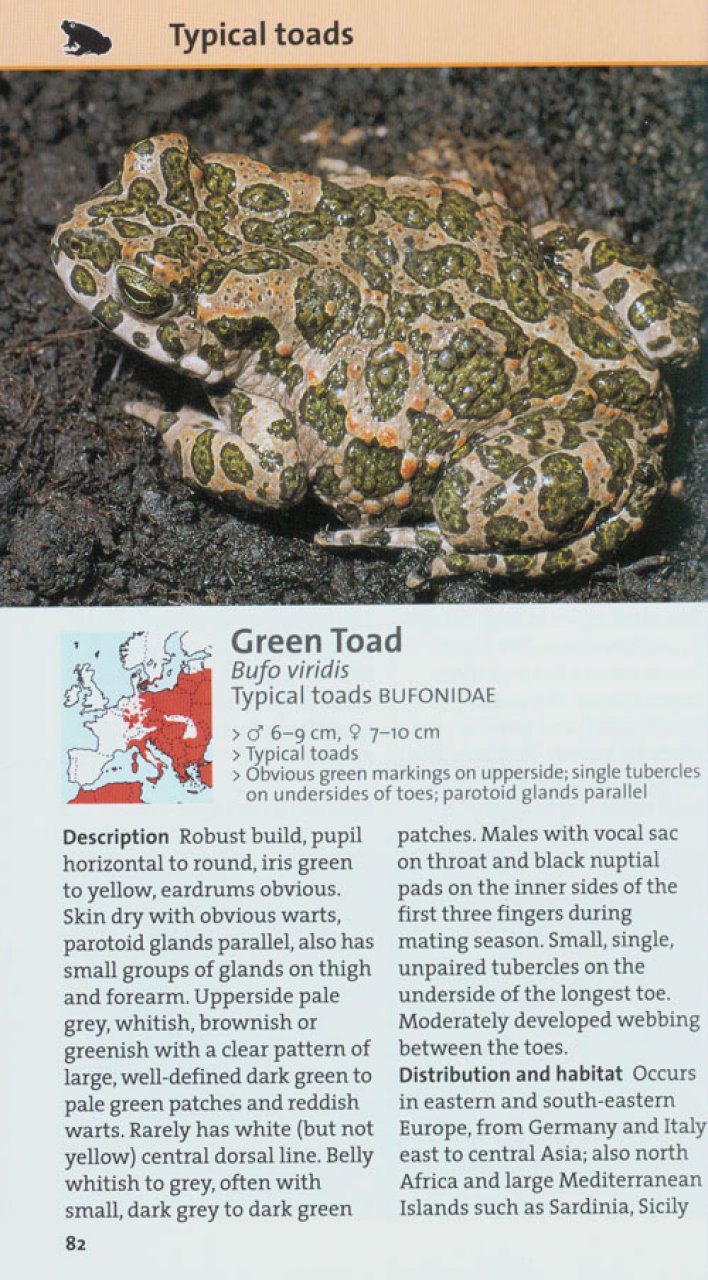
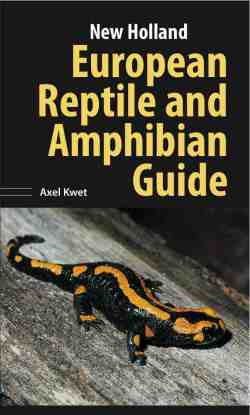
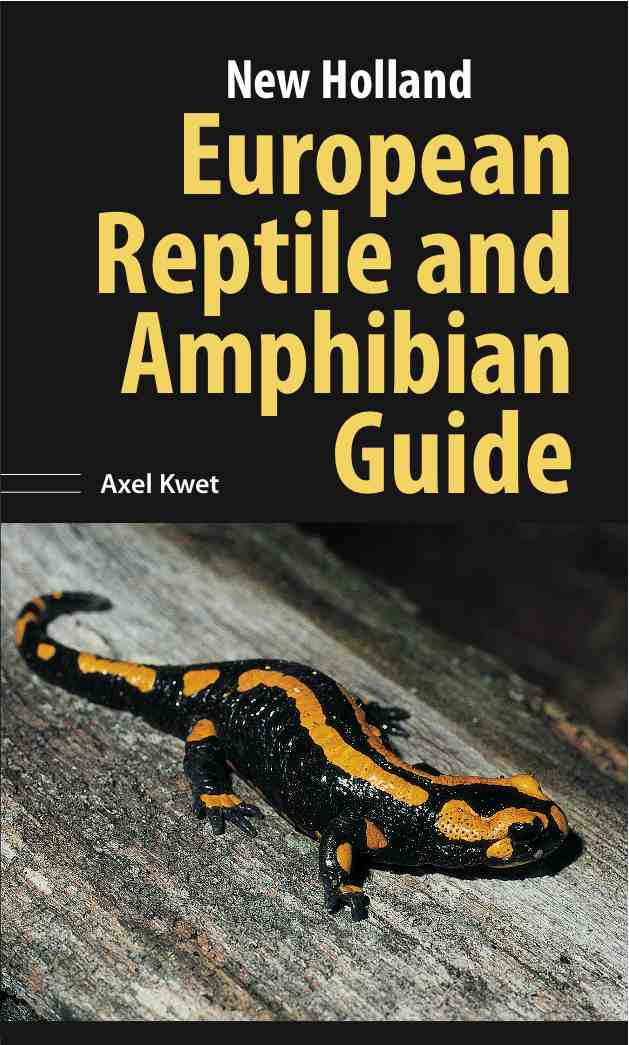
European Reptile and Amphibian Guide by Axel KwetEuropean Reptile and Amphibian Guide, Axel Kwet (New Holland 2009)

An attractive book about animals that are mostly attractive, sometimes strange, always interesting. It devotes photographs and descriptive text to all the reptiles and amphibians found in Europe, from tree-frogs to terrapins, from skinks to slow-worms. Some of the salamanders look like heraldic mascots, some of the lizards like enamel jewellery, and some of the toads like sumo wrestlers with exotic skin-diseases. When you leaf through the book, you’ve moving through several kinds of space: geographic and evolutionary, aesthetic and psychological. Europe is a big place and has a lot of reptilian and amphibian variety, including one species of turtle, the loggerhead, Caretta caretta, and one species of chameleon, the Mediterranean, Chamaeleo chamaeleon.

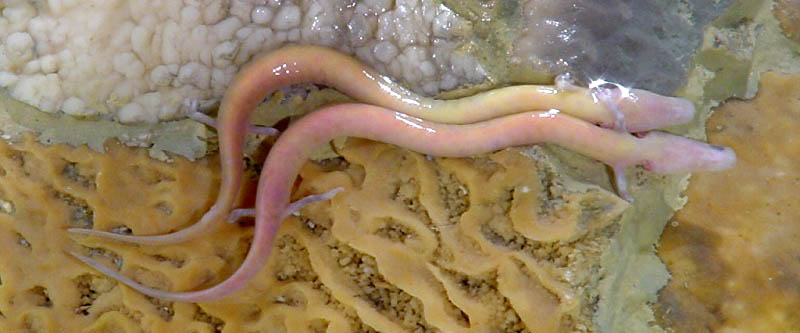
But every species, no matter how dissimilar in size and appearance, has a common ancestor: the tiny crested newt (Triturus cristatus) to the far north-west in Scotland and the two-and-a-half metre whip snake (Dolichophis caspius) to the far south-east in Greece; the sun-loving Hermann’s tortoise (Testudo hermanni), with its sturdy shell, and the pallid and worm-like olm (Proteus anguinus), which lives in “underground streams in limestone karst country along the coast from north-east Italy to Montenegro” (pg. 55). Long-limbed or limbless, sun-loving or sun-shunning, soft-skinned or scaly – they’re all variations on a common theme.
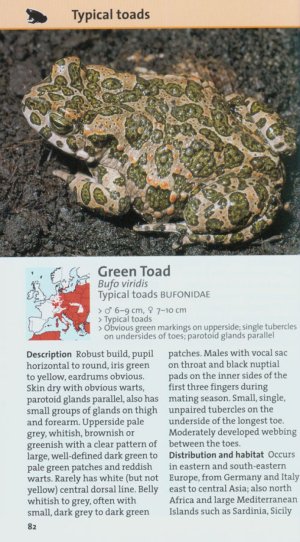
Sample page

Sample page from European Reptile and Amphibian Guide


And that’s where aesthetic and psychological space comes in, because different species and families evoke different impressions and emotions. Why do snakes look sinister and skinks look charming? But snakes are sinuous too and in a way it’s a shame that a photograph can capture their endlessly varying loops and curves as easily as it can capture the ridigity of a tortoise. At one time a book like this would have had paintings or drawings. Nowadays, it has photographs. The images are more realistic but less enchanted: the images are no longer mediated by the hand, eye and brain of an artist. But some enchantment remains: the glass lizard, Pseudopus apodus, peering from a holly bush on page 199 reminds me of Robert E. Howard’s “The God in the Bowl”, because there’s an alien intelligence in its gaze. Glass lizards are like snakes but can blink and retain “tiny, barely visible vestiges of the hind legs” (pg. 198).

Other snake-like reptiles retain vestiges of the fore-limbs too, like the Italian three-toed skink (Chalcides chalcides). The slow-worm, Anguis fragilis, has lost its limbs entirely, but doesn’t look sinister like a snake and can still blink. Elsewhere, some salamanders have lost not limbs but lungs: the Italian cave salamander, Speleomantes italicus, breathes through its skin and the lining of its mouth. So does Gené’s cave salamander, Speleomantes genei, which is found only on the island of Sardinia. It “emits an aromatic scent when touched” (pg. 54). Toads can emit toxins and snakes can inject venoms: movement in evolutionary space means movement in chemical space, because every alteration in an animal’s appearance and anatomy involves an alteration in the chemicals created by its body. But chemical space is two-fold: genotypic and phenotypic. The genes change and so the products of the genes change. The external appearance of every species is like a bookmark sticking out of the Book of Life, fixing its position in gene-space. You have to open that book to see the full recipe for the animal’s anatomy, physiology and behaviour, though not everything is specified by the genes.

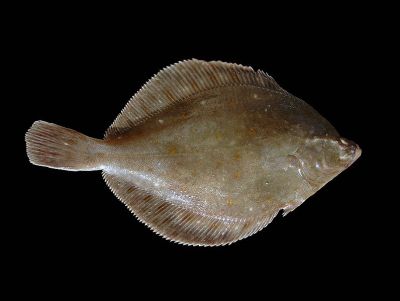
Pleuronectes platessa on the sea-floor

Pleuronectes platessa on the sea-floor


The force of gravity is one ingredient in an animal’s development, for example. So is sunlight or its absence. Or water, sand, warmth, cold. The descendants of that common ancestor occupy many ecological niches. And in fact one of those descendants wrote this book: humans and all other mammals share an ancestor with frogs, skinks and vipers. Before that, we were fish. So a plaice is a distant cousin of an olm, despite the huge difference in their appearance and habitat. One is flat, one is tubular. One lives in the sea, one lives in caves. But step by step, moving through genomic and topological space, you can turn a plaice into an olm. Or into anything else in this book. Just step back through time to the common ancestor, then take another evolutionary turning. One ancestor, many descendants. That ancestor was itself one descendant among many of something even earlier.
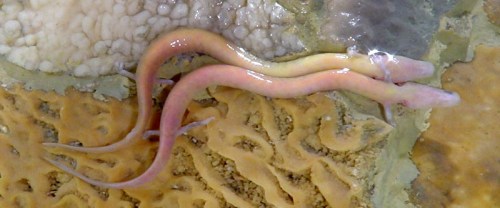
Olm in a Slovenian cave

Olm in a Slovenian cave


But there’s another important point: once variety appeared, it began to interact with itself. Evolutionary environment includes much more than the inanimate and inorganic. We mammals share more than an ancestor with reptiles and amphibians: we’ve also shared the earth. So we’re written into their genes and some of them are probably written into ours. Mammalian predators have influenced the evolution of skin-colour and psychology, making some animals camouflaged and cautious, others obtrusive and aggressive. But it works both ways: perhaps snakes seem sinister because we’re born with snake-sensitive instincts. If it’s got no limbs and it doesn’t blink, it might have a dangerous bite. That’s why the snake section of this book seems so different to the salamander section or the frog section. But all are interesting and all are important. This is a small book with some big themes.

Breeding Bunnies

Front cover of The Golden Ratio by Mario Livio
The Golden Ratio: The Story of Phi, the Extraordinary Number of Nature, Art and Beauty, Mario Livio (Headline Review 2003)

A good short popular guide to perhaps the most interesting, and certainly the most irrational, of all numbers: the golden ratio or phi (φ), which is approximately equal to 1·6180339887498948482… Prominent in mathematics since at least the ancient Greeks and Euclid, phi is found in many places in nature too, from pineapples and sunflowers to the flight of hawks. Livio catalogues its appearances in both maths and nature, looking closely at the Fibonacci sequence and rabbit-breeding, before going on to debunk mistaken claims that phi also appears a lot in art, music and poetry. Dalí certainly used it, but da Vinci, Debussy and Virgil almost certainly didn’t. Nor, almost certainly, did the builders of the Parthenon and pyramids. Finally, he examines what has famously been called (by the physicist Eugene Wiegner) the unreasonable effectiveness of mathematics: why is this human invention so good at describing the behaviour of the Universe? Livio quotes one of the best short answers I’ve seen:

Human logic was forced on us by the physical world and is therefore consistent with it. Mathematics derives from logic. That is why mathematics is consistent with the physical world. (ch. 9, “Is God a mathematician?”, pg. 252)

It’s not hard to recommend a book that quotes everyone from Johannes Kepler and William Blake to Lewis Carroll, Christopher Marlowe and Jef Raskin, “the creator of the Macintosh computer”, whose answer is given above. Recreational mathematicians should also find lots of ideas for further investigation, from fractal strings to the fascinating number patterns governed by Benford’s law. It isn’t just human beings who look after number one: as a leading figure, 1 turns up much more often in data from the real world, and in mathematical constructs like the Fibonacci sequence, than intuition would lead you to expect. If you’d like to learn more about that and about many other aspects of mathematics, hunt down a copy of this book.


Elsewhere other-posted:

Roses Are Golden – φ and floral homicide

Solids and Shadows

Front cover of An Adventure in Multidimensional Space by Koji MiyazakiAn Adventure in Multidimensional Space: The Art and Geometry of Polygons, Polyhedra, and Polytopes, Koji Miyazaki (Wiley-Interscience 1987)

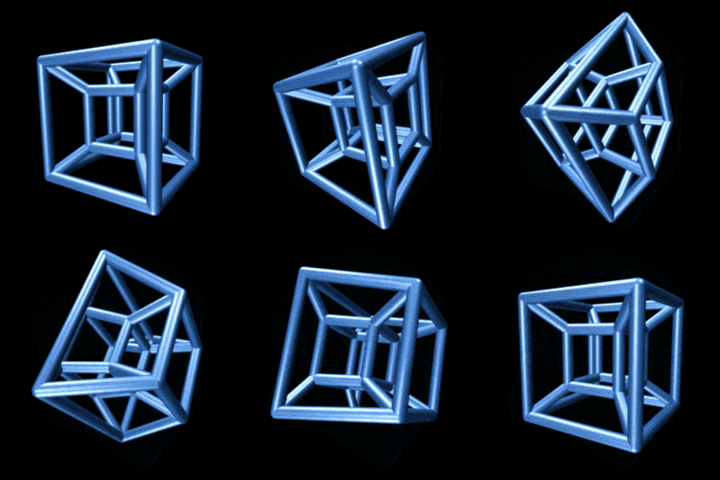
Two, three, four – or rather, two, three, ∞. Polygons are closed shapes in two dimensions (e.g., the square), polyhedra closed shapes in three dimensions (the cube), and polytopes closed shapes in four or more (the hypercube). You could spend a lifetime exploring any one of these geometries, but unless you take psychedelic drugs or brain-modification becomes much more advanced, you’ll be able to see only two of them: the geometries of polygons and polyhedra. Polytopes are beyond imagining but you can glimpse their shadows here – literally, because we can represent polytopes by the shadows they cast in 3-space or by the shadows of their shadows in 2-space.

An animated gif of a tesseract

A four-dimensional shape in two dimensions (see Tesseract)

Elsewhere Miyazaki doesn’t have to convey wonder and beauty by shadows: not only is this book full of beautiful shapes, it’s beautifully designed too and the way it alternates black-and-white pages with colour actually increases the power of both. It isn’t restricted to pure mathematics either: Miyazaki also looks at the modern and ancient art and architecture inspired by geometry, and at geometry in nature: the dodecahedral pollen of Gypsophilum elegans (Showy Baby’s-Breath), for example, and the tetrahedral seeds of the Water Chestnut (Trapa spp.), which the Japanese spies and assassins called the ninja used as natural caltrops. A regular tetrahedron always lies on a flat surface with a vertex facing directly upward, and when a pursued ninja scattered the sharply pointed tetrahedral seeds of the Water Chestnut, they were regular enough to injure “the soles of feet of his pursuers”.

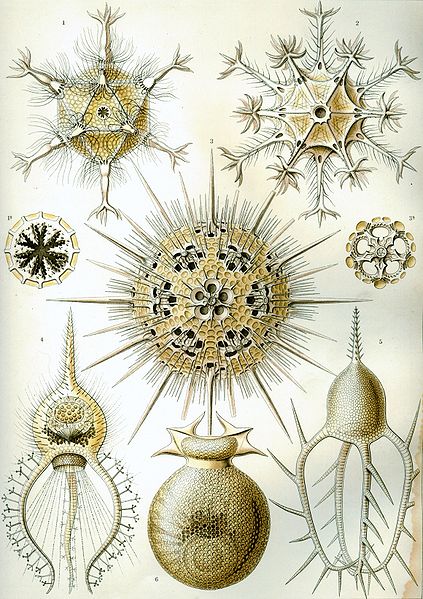
Polyhedral plankton by Ernst Haeckel

Polyhedral plankton by Ernst Haeckel

The slightly odd English there is another example of what I like about this book, because it proves the parochialism of language and the universality of mathematics. Miyazaki’s mathematics, as far as I can tell, is flawless, like that of many other Japanese mathematicians, but his self-translated English occasionally isn’t. Japanese mathematics was highly developed before Japan fell under strong Western influence. It would continue to develop if the West disappeared tomorrow. Language is something we have to absorb intuitively from the particular culture we’re born into, but mathematics is learnt and isn’t tied to any particular culture. That’s why it’s accessible in the same way to minds everywhere in the world. Miyazaki’s pictures and prose are an extended proof of all that, and the book is actually more valuable because it was written by a Japanese speaker. I think it’s probably more attractively designed for the same reason: the skill with which the pictures have been selected and laid out reflects something characteristically Japanese. Elegance and simplicity perhaps sum it up, and elegance and simplicity are central to mathematics and some of the greatest art.

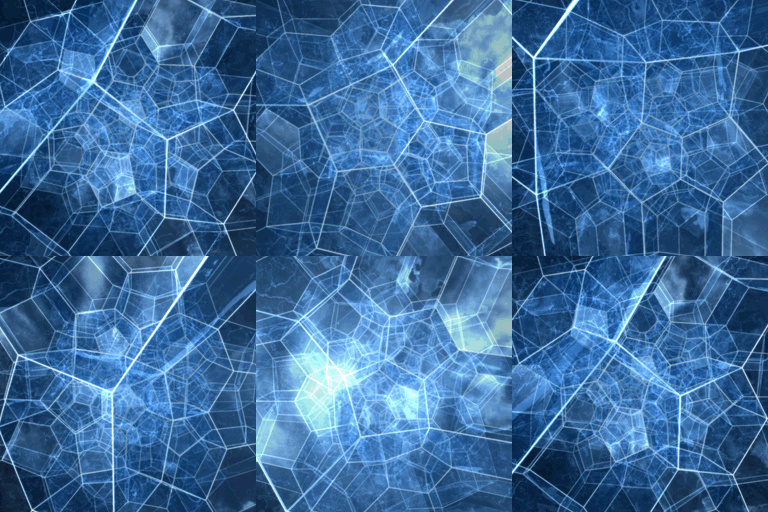
An animated gif of an 120-cell

Another four-dimensional shape in two dimensions (see 120-cell)

Magna Mater Marina

Front cover of The Illustrated World Encyclopedia of Marine Fish and Sea CreaturesThe Illustrated World Encyclopedia of Marine Fish and Sea Creatures, Amy-Jane Beer and Derek Hall (Lorenz Books, 2007)

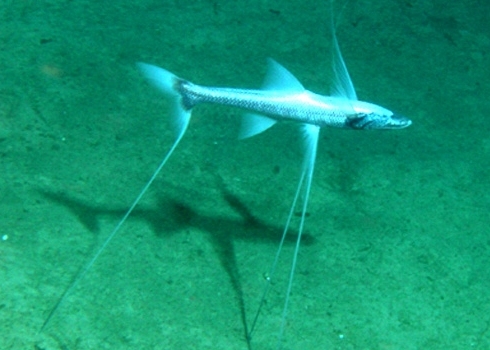
Books about marine life need to be big, like this one, because the sea is a big place and has been occupied for far longer than the land. You’ll learn here that some land creatures have even returned to it, like the ancestors of cetaceans (whales et al), sirenians (dugongs and manatees), and sea-snakes. The saltiness of human blood means that we each carry around a miniature ocean of our own, symbol of our own marine ancestry. The Illustrated World Encyclopedia of Marine Fish and Sea Creatures is an excellent guide to the remainers and the returners of our ancient home. It isn’t a proper scientific encyclopedia, but you can get a good sense of the richness and variety of marine life here, from jellyfish to electric rays by way of the deep-water sea-cucumber, Irpa abyssicola, and the very strange tripod fish, Bathypterois grallator.

Bathypterois grallator

The tripod fish, Bathypterois grallator

That scientific name literally means “the deep-wing stilt-walker”, because the tripod fish lives very deep, up to 3·5km down, and props itself up on extended fin-rays to save energy on swimming. Its tiny prey float towards to it on the current: it isn’t an active hunter. It’s also hermaphroditic, so that each fish can fertilize its own eggs if, thanks to depth and darkness, it doesn’t find a mate. Unlike many other deep-sea fish, however, it isn’t particularly ugly or grotesque and wouldn’t easily find place in an H.P. Lovecraft story. Vampyroteuthis infernalis, or “the vampire squid from hell”, definitely would. It looks rather like an animated umbrella, with dark webs between its tentacles and huge, light-thirsty eyes.

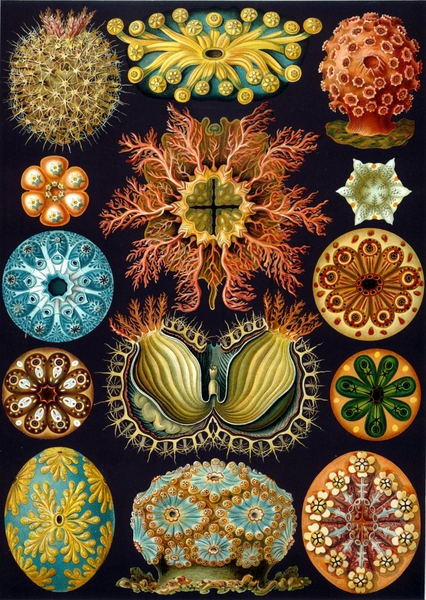
Sea anemones by Ernst Haeckel

Sea anemones by Ernst Haeckel

Elsewhere there’s proof that the sea contains not just abysmal ugliness but sublime beauty too, from cone shells (Conus spp.) and jewel “anemones” (Corynactis viridis) (really a form of coral, the book notes) to gorgeous fish like the copperband butterflyfish (Chelmon rostratus) and the Moorish idol (Zanclus cornutus). And the greater blue-ringed octopus (Hapalochlaena lunulata) is beautiful too, despite the “toxin in its saliva estimated to be 10,000 times more deadly than cyanide”. There isn’t enough here about plankton, which can be strange, ugly, and beautiful, but plankton could fill several encyclopedias, and this one does incorporate some more recent scientific discoveries, including the marine life that doesn’t depend ultimately on sunlight, however deep down dark it lives. The giant beardworm, Riftia pachyptila, lives in symbiosis with sulphide-digesting bacteria at hydrothermal vents on the ocean floor. It’s not part of the sun-chain and might have homologues beneath the ice-cap of Jupiter’s moon Europa. Life needs liquid, so far as we can see, and certainly on earth it had to get its start there. This book is an excellent introduction to the great biological cradle that is the sea and would be an ideal gift for a budding marine biologist or scientifically inclined sailer or fisherman.


Elsewhere other-posted:

Guise and Molls — review of Octopus: The Ocean’s Intelligent Invertebrate (2010)
Mental Marine Music — the band who supplied the title of this review