Oh My Guardian #5

‘We’re stepping out of a binary’ – celebrating the art of marginalized LGBT Muslims

[…] The show features artwork themed around issues of Islamophobia, racism and homophobia to “highlight the struggles common among contemporary Muslim queer, trans and gender non-conforming communities,” said co-curator and activist Yas Ahmed. — ‘We’re stepping out of a binary’, The Guardian, 22/i/2018.


Elsewhere other-accessible:

Oh My Guardian #1
Oh My Guardian #2
Oh My Guardian #3
Oh My Guardian #4
Reds under the Thread

Game of Zones

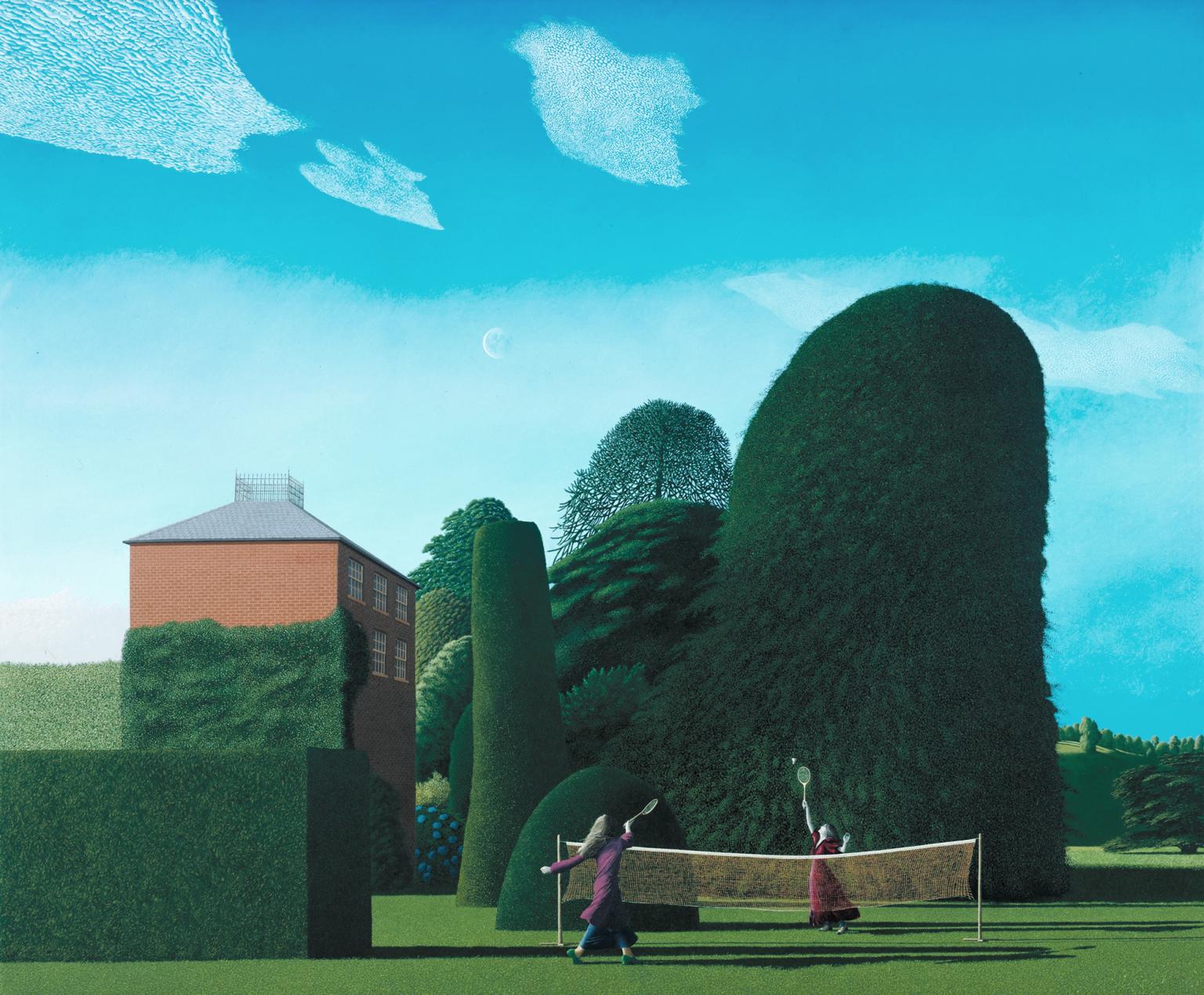
The Badminton Game by David Inshaw

David Inshaw, The Badminton Game (1972-3)

I first came across this beautiful and mysterious painting in a book devoted to British art. Then I forgot the name of both artist and painting, and couldn’t get at the book any more. Years later, I’ve found it again on the cover of a paperback in a secondhand shop. I like the way it combines zones: the domestic and the dendric, the lunar and the ludic, the terrestrial and the celestial. And it’s full of fractals: the trees, the clouds and, implicitly, the moon and the two girls playing badminton.


Elsewhere Other-Accessible…

David Inshaw — official website
David Inshaw at Wikipedia

Pedal to the Medal

“Once, in a contest with a rival, he painted a blue curve on a huge sheet of paper. Then he dipped the feet of a chicken in red paint and persuaded the bird to walk all over the paper. The resulting image, he said, represented the Tatsuta river with red maple leaves floating in it. The judge gave him the prize.” — The Japanese artist Katsushika Hokusai (c. 1760-1849) described in Thomas W. Hodgkinson’s and Hubert van den Bergh’s How to Sound Cultured (2015)

Oneiric Ocean

20000-leagues-under-the-sea


I like this illustration of a scene in Jules Vernes’s Twenty Thousand Leagues Under the Sea (1870) even more because it has at least one mistake in it. At least, I think it’s a mistake: the jellyfish on the upper left are two Portuguese men-o’-war (really colonial hydrozoans, not jellyfish). They have gas-filled float-bladders, so in reality you see them only on the surface, not hanging in midwater like that. The mistake makes the scene like a dream. The absence of colour is good too: it fixes the illustration firmly in the past and the colours you imagine are more vivid. The artist is imagining, dreaming, conjuring a vision of an oneiric ocean.

Rock’n’Roll Suislide

Q. Each face of a convex polyhedron can serve as a base when the solid is placed on a horizontal plane. The center of gravity of a regular polyhedron is at the center, therefore it is stable on any face. Irregular polyhedrons are easily constructed that are unstable on certain faces; that is, when placed on a table with an unstable face as the base, they topple over. Is it possible to make a model of an irregular convex polyhedron that is unstable on every face?

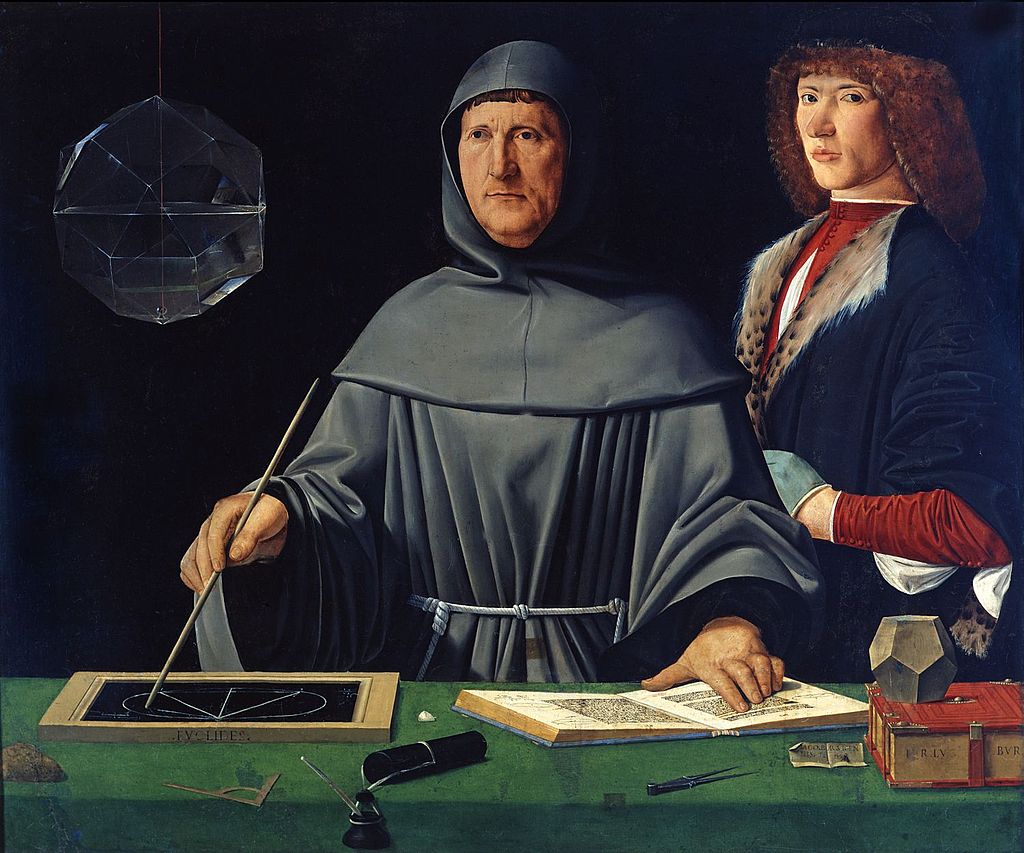
Portrait of Luca Pacioli (1495)

Portrait of Luca Pacioli (1495)


A. No. If a convex polyhedron were unstable on every face, a perpetual motion machine could be built. Each time the solid toppled over onto a new base it would be unstable and would topple over again.

 — From “Ridiculous Questions” in Martin Gardner’s Mathematical Magical Show (1965), chapter 10.