James Tissot, Octobre (1877)
Previously pre-posted:
• Oil Say — another painting by Tissot
Q. Each face of a convex polyhedron can serve as a base when the solid is placed on a horizontal plane. The center of gravity of a regular polyhedron is at the center, therefore it is stable on any face. Irregular polyhedrons are easily constructed that are unstable on certain faces; that is, when placed on a table with an unstable face as the base, they topple over. Is it possible to make a model of an irregular convex polyhedron that is unstable on every face?

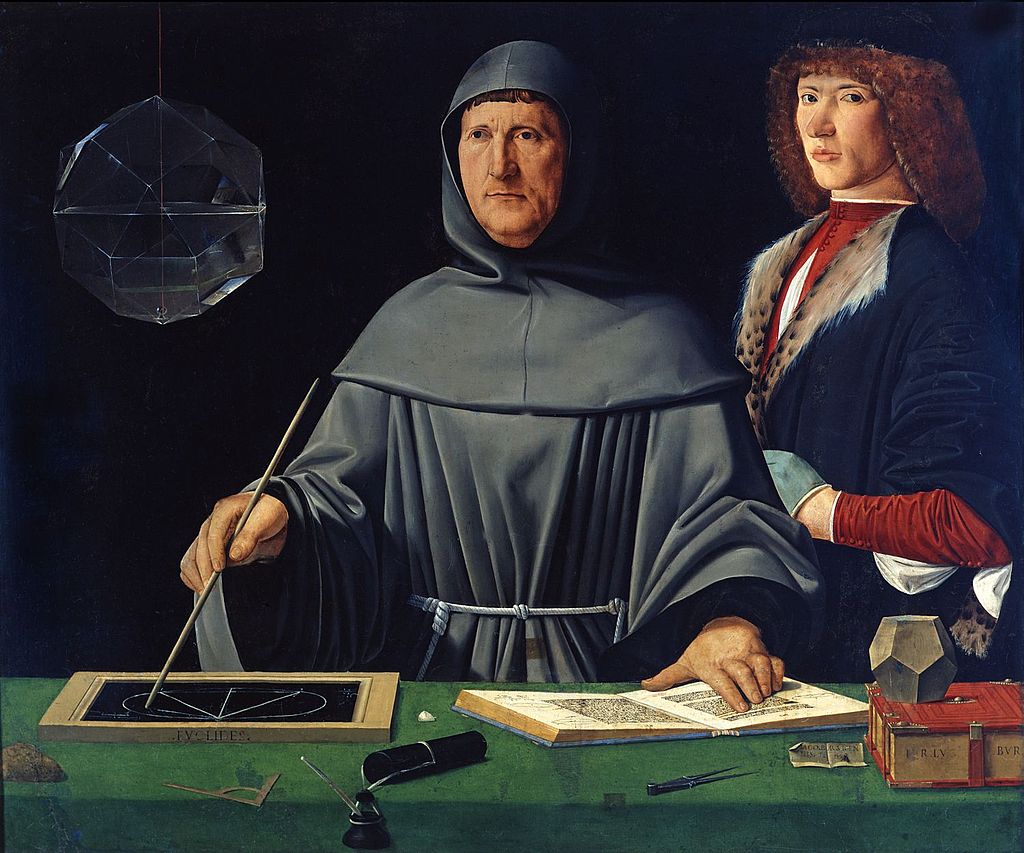
Portrait of Luca Pacioli (1495)
A. No. If a convex polyhedron were unstable on every face, a perpetual motion machine could be built. Each time the solid toppled over onto a new base it would be unstable and would topple over again.
— From “Ridiculous Questions” in Martin Gardner’s Mathematical Magical Show (1965), chapter 10.

Frederick Gustavus Burnaby by James Tissot (1870)
Papyrocentric Performativity Presents:
• Machina Mundi – The Invention of Science: A New History of the Scientific Revolution, David Wootton (Allen Lane 2015)
• Wandering Wonders – Plankton: Wonders of the Drifting World, Christian Sardet (The University of Chicago Press 2015)
• Love Buzz – A Buzz in the Meadow, Dave Goulson (Jonathan Cape 2014)
• Quake’s Progress – The Million Death Quake: The Science of Predicting Earth’s Deadliest Natural Disaster, Roger Musson (Palgrave Macmillan 2012)
• Sin after Cin – Gargoyle Girls from Beelzebub’s Ballsack: The Sickest, Sleaziest, Splanchnophagousest Slimefests in Scum Cinema, Dr Joan Jay Jefferson (TransToxic Texts 2016)
Or Read a Review at Random: RaRaR

Young Hare (1502) by Albrecht Dürer
Anyone interested in recreational mathematics should seek out three compendiums by Ian Stewart: Professor Stewart’s Cabinet of Mathematical Curiosities (2008), Professor Stewart’s Hoard of Mathematical Treasures (2009) and Professor Stewart’s Casebook of Mathematical Mysteries (2014). They’re full of ideas and puzzles and are excellent introductions to the scope and subtlety of maths. I first came across Alexander’s Horned Sphere in one of them. I also came across this simpler shape that packs infinity into a finite area:
I call it a horned triangle or unicorn triangle and it reminds me of a wave curling over, like Katsushika Hokusai’s The Great Wave off Kanagawa (c. 1830) (“wave” is unda in Latin and onda in Spanish).

The Great Wave off Kanagawa by Katsushika Hokusai (1760–1849)
To construct the unicorn triangle, you take an equilateral triangle with sides of length 1 and erect a triangle with sides of length 0.5 on one of its corners. Then on the corresponding corner of the new triangle you erect a triangle with sides of length 0.25. And so on, for ever.
When you double the sides of a polygon, you quadruple the area: a 1×1 square has an area of 1, a 2×2 square has an area of 4. Accordingly, when you halve the sides of a polygon, you quarter the area: a 1×1 square has an area of 1, a 0.5 x 0.5 square has an area of 0.25 or 1/4. So if the original triangle of the unicorn triangle above has an area of 1 rather than sides of 1, the first triangle added has an area of 0.25 = 1/4, the next an area of 0.0625 = 1/16, and so on. The infinite sum is this:
1/4 + 1/16 + 1/256 + 1/1024 + 1/4096 + 1/16384…
Which equals 1/3. This becomes important when you see the use made of the shape in Stewart’s book. The unicorn triangle is a rep-tile, or a shape that can be divided into smaller copies of the same shape:
An equilateral triangle can be divided into four copies of itself, each 1/4 of the original area. If an equilateral triangle with an area of 4 is divided into three unicorn triangles, each unicorn has an area of 1 + 1/3 and 3 * (1 + 1/3) = 4.
Because it’s a rep-tile, a unicorn triangle is also a fractal, a shape that is self-similar at smaller and smaller scales. When one of the sub-unicorns is dropped, the fractals become more obvious:
Elsewhere other-posted:
Papyrocentric Performativity Presents:
• Plants on Paper – Drawing and Painting Plants, Christina Brodie (A & C Black 2006)
• Lewminiferous – Guide to Garden Wildlife, Richard Lewington (British Wildlife Publishing 2008)
• Old Gold – Puskás: Madrid, the Magyars and the Amazing Adventures of the World’s Greatest Goalscorer, György Szöllős (Freight Books 2015)
• Rosetta Rok – Rok 1984, George Orwell (MUZA SA, Warszawa 2001)
Or Read a Review at Random: RaRaR

Gustave Caillebotte, Jour de pluie à Paris (1877)
Papyrocentric Performativity Presents:
• Feats for the Eyes – Drawn from Paradise: The discovery, art and natural history of the birds of paradise, David Attenborough and Errol Fuller (Collins 2012)
• Heart of the Mather – Chaotic Fishponds and Mirror Universes: the maths that governs our world, Richard Elwes (Quercus 2013)
• Bergblumen – Enchanting Alpine Flowers, Alfred Pohler, trans. Jacqueline Schweighofer
Or Read a Review at Random: RaRaR
Papyrocentric Performativity Presents:
• Touring the Tower – Physics in Minutes: 200 key concepts explained in an instant, Giles Sparrow (Quercus 2014)
• Living with Rainbows – Miller’s Field Guide: Glass, Judith Miller (Octopus 2015)
• Men on the Margins – Edgelands: Journeys into England’s True Wilderness, Paul Farley and Michael Symmons Roberts (Chivers 2011)
• Sward and Sorcery – Watership Down, Richard Adams (1972) (posted @ Overlord of the Über-Feral)
• Obscene Screen – Necro-Sluts from Satan’s Anus: Fifty Filthy Fester-Films to F*** You Up, Freak You Out and Feralize Your Fetidest Fantasies, Dr Joan Jay Jefferson (TransToxic Texts* 2015)
Or Read a Review at Random: RaRaR
(*TransToxic Texts is an infra-imprint of TransVisceral Books.)