Roses Are Golden

Sir Lawrence Alma-Tadema’s painting The Roses of Heliogabalus (1888) is based on an apocryphal episode in the sybaritic life of the Roman Emperor Elagabalus (204-222 A.D.), who is said to have suffocated guests with flowers at one of his feasts. The painting is in a private collection, but I saw it for real in an Alma-Tadema exhibition at the Walker Art Gallery in Liverpool sometime during the late 1990s. I wasn’t disappointed: it was a memorable meeting with a painting I’d been interested in for years. Roses is impressively large and impressively skilful. Close-up, the brush-strokes are obvious, obtrusive and hard to interpret as people and objects. It isn’t till you step back, far beyond the distance at which Alma-Tadema was painting, that the almost photographic realism becomes apparent. But you get more of the many details at close range, like the Latin inscription on a bowl below and slightly to the right of that scowling water-mask. Alas, I forgot to take a note of what the inscription was, though perhaps the memory is still locked away somewhere in my subconscious.

The Roses of Heliogabalus (1888)

The Roses of Heliogabalus (1888)

Whatever it is, I feel sure it is significant, because Roses is rich with meaning. That’s a large part of why I’m interested in it. Yes, I like it a lot as art, but the women would have to be more attractive for it to be higher in the list of my favourite paintings. As it is, I think there are only four reasonably good-looking people in it: the man with the beard on the right; the flautist striding past the marble pillar on the left; the red-headed girl with a crown of white flowers; and Heliogabalus himself, crowned in roses and clutching a handful of grapes beside the overweight man who’s wearing a wreath and sardonically saluting one of the rose-pelted guests in the foreground. When I first wrote about Roses in a pub-zine whose name escapes me, I misidentified the overweight man as Heliogabalus himself, even though I noted that he seemed many years old than Heliogabalus, toppled as a teen tyrant, should have been. It was a bad mistake, but one that, with less knowledge and more excuse, many people must make when they look at Roses, because the overweight man and his sardonic salute are a natural focus for the eye. Once your eye has settled on and noted him, you naturally follow the direction of his gaze down to the man in the foreground, who’s gazing right back.

A comparison between Alma-Tadema's portrayal of Heliogabalus and a bust of Heliogabalus from the Musei Capitolini in Rome

Something Like the Sun

And by following that gaze, you’ve performed a little ratio-ritual, just as Alma-Tadema intended you to do. Yes, Roses is full of meaning and much of that meaning is mathematical. I think the angle of the gaze is one of many references in Roses to the golden ratio, or φ (phi), a number that is supposed to have special aesthetic importance and has certainly been used by many artists and musicians to guide their work. A rectangle with sides in the proportions 8:13, for example, approximates the golden ratio pretty closely, but φ itself is impossible to represent physically, because it’s an irrational number with infinitely many decimal digits, like π or √2, the square root of two. π represents the ratio of a circle’s circumference to its diameter and √2 the ratio of a square’s diagonal to its side, but no earthly circle and no earthly square can ever capture these numbers with infinite precision. Similarly, no earthly rectangle can capture φ, but the rectangle of Roses is a good attempt, because it measures 52″ x 84 1/8". That extra eighth of an inch was my first clue to the painting’s mathematical meaningfulness. And sure enough, 52/84·125 = 416/673 = 0·61812…, which is a good approximation to φ’s never-ending 0·6180339887498948482045868343656…*
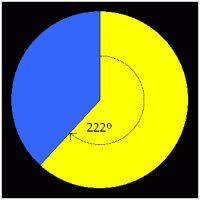
A circle with radii at 0 and 222 degrees
That deliberate choice of dimensions for the canvas led me to look for more instances of φ in the painting, though one of the most important and obvious might be called a meta-presence. The Roses of Heliogabalus is dated 1888, or 1666 years after the death of Heliogabalus in 222 AD. A radius at 222º divides a circle in the golden ratio, because 222/360 = 0·616… It’s very hard to believe Alma-Tadema didn’t intend this reference and I also think there’s something significant in 1888 itself, which equals 2 x 2 x 2 x 2 x 2 x 59 = 25 x 59. Recall that 416 is the expanded short side of Roses. This equals 25 x 13, while 673, the expanded long side, is the first prime number after 666. As one of the most technically skilled painters who ever lived, Alma-Tadema was certainly an exceptional implicit mathematician. But he clearly had explicit mathematical knowledge too and this painting is a phi-pie cooked by a master matho-chef. In short, when Roses is read, Roses turns out to be golden.


*φ is more usually represented as 1·6180339887498948482045868343656…, but it has the pecularity that 1/φ = φ-1, so the decimal digits don’t change and 0·6180339887498948482045868343656… is also legitimate.

Appendix I

I’ve looked at more of Alma-Tadema’s paintings to see if their dimensions approximate φ, √2, √3 or π, or their reciprocals. These were the results (ε = error, i.e. the difference between the constant and the ratio of the dimensions).

The Roman Wine Tasters (1861), 50" x 69 2/3": 150/209 = 0·717… ≈ 1/√2 (ε=0·02)
A Roman Scribe (1865), 21 1/2" x 15 1/2": 43/31 = 1·387… ≈ √2 (ε=0·027)
A Picture Gallery (1866), 16 1/8" x 23": 129/184 = 0·701… ≈ 1/√2 (ε=0·012)
A Roman Dance (1866), 16 1/8" x 22 1/8": 43/59 = 0·728… ≈ 1/√2 (ε=0·042)
In the Peristyle (1866), 23" x 16": 23/16 = 1·437… ≈ √2 (ε=0·023)
Proclaiming Emperor Claudius (1867), 18 1/2" x 26 1/3": 111/158 = 0·702… ≈ 1/√2 (ε=0·009)
Phidias and the Frieze of the Parthenon Athens (1868), 29 2/3" x 42 1/3": 89/127 = 0·7… ≈ 1/√2 (ε=0·012)
The Education of Children of Clovis (1868), 50" x 69 2/3": 150/209 = 0·717… ≈ 1/√2 (ε=0·02)
An Egyptian Juggler (1870), 31" x 19 1/4": 124/77 = 1·61… ≈ φ (ε=0·007)
A Roman Art Lover (1870), 29" x 40": 29/40 = 0·725… ≈ 1/√2 (ε=0·034)
Good Friends (1873), 4 1/2" x 7 1/4": 18/29 = 0·62… ≈ φ (ε=0·006)
Pleading (1876), 8 1/2" x 12 3/8": 68/99 = 0·686… ≈ 1/√2 (ε=0·041)
An Oleander (1882), 36 1/2" x 25 1/2": 73/51 = 1·431… ≈ √2 (ε=0·017)
Dolce Far Niente (1882), 9 1/4" x 6 1/2": 37/26 = 1·423… ≈ √2 (ε=0·008)
Anthony and Cleopatra (1884), 25 3/4" x 36 1/3": 309/436 = 0·708… ≈ 1/√2 (ε=0·003)
Rose of All Roses (1885), 15 1/4" x 9 1/4": 61/37 = 1·648… ≈ φ (ε=0·03)
The Roses of Heliogabalus (1888), 52" x 84 1/8": 416/673 = 0·618… ≈ φ (ε<0.001)
The Kiss (1891), 18" x 24 3/4": 8/11 = 0·727… ≈ 1/√2 (ε=0·039)
Unconscious Rivals (1893), 17 3/4" x 24 3/4": 71/99 = 0·717… ≈ 1/√2 (ε=0·019)
A Coign of Vantage (1895), 25 1/4" x 17 1/2": 101/70 = 1·442… ≈ √2 (ε=0·028)
A Difference of Opinion (1896), 15" x 9": 5/3 = 1·666… ≈ φ (ε=0·048)
Whispering Noon (1896), 22" x 15 1/2": 44/31 = 1·419… ≈ √2 (ε=0·005)
Her Eyes Are With Her Thoughts And Her Thoughts Are Far Away (1897), 9" x 15": 3/5 = 0·6… ≈ φ (ε=0·048)
The Baths of Caracalla (1899), 60" x 37 1/2": 8/5 = 1·6… ≈ φ (ε=0·018)
The Year’s at the Spring, All’s Right with the World (1902), 13 1/2" x 9 1/2": 27/19 = 1·421… ≈ √2 (ε=0·006)
Ask Me No More (1906), 31 1/2" x 45 1/2": 9/13 = 0·692… ≈ 1/√2 (ε=0·03)

Appendix II

The Roses of Heliogabalus is based on this section from Aelius Lampridius’ pseudonymous and largely apocryphal Vita Heliogabali, or Life of Heliogabalus, in the Historia Augusta (late fourth century):

XXI. 1 Canes iecineribus anserum pavit. Habuit leones et leopardos exarmatos in deliciis, quos edoctos per mansuetarios subito ad secundam et tertiam mensam iubebat accumbere ignorantibus cunctis, quod exarmati essent, ad pavorem ridiculum excitandum. 2 Misit et uvas Apamenas in praesepia equis suis et psittacis atque fasianis leones pavit et alia animalia. 3 Exhibuit et sumina apruna per dies decem tricena cottidie cum suis vulvis, pisum cum aureis, lentem cum cerauniis, fabam cum electris, orizam cum albis exhibens. 4 Albas praeterea in vicem piperis piscibus et tuberibus conspersit. 5 Oppressit in tricliniis versatilibus parasitos suos violis et floribus, sic ut animam aliqui efflaverint, cum erepere ad summum non possent. 6 Condito piscinas et solia temperavit et rosato atque absentato…

Historia Augusta: Vita Heliogabali

XXI. 1 He fed his dogs on goose-livers. He had pet lions and leopards, which had been rendered harmless and trained by tamers, and these he would suddenly order during the dessert and the after-dessert to get on the couches, thereby causing laughter and panic, for none knew that they were harmless. 2 He sent grapes from Apamea to his stables for the horses, and he fed parrots and pheasants to his lions and other beasts. 3 For ten days in a row, moreover, he served wild sows’ udders with the matrices, at a rate of thirty a day, serving, besides, peas with gold-pieces, lentils with onyx, beans with amber, and rice with pearls; 4 and he also sprinkled pearls on fish and used truffles instead of pepper. 5 In a banqueting-room with a reversible ceiling he once buried his parasites in violets and other flowers, so that some were actually smothered to death, being unable to crawl out to the top. 6 He flavoured his swimming-pools and bath-tubs with essence of spices or of roses or wormwood…

Augustan History: Life of Heliogabalus

Mental Marine Music

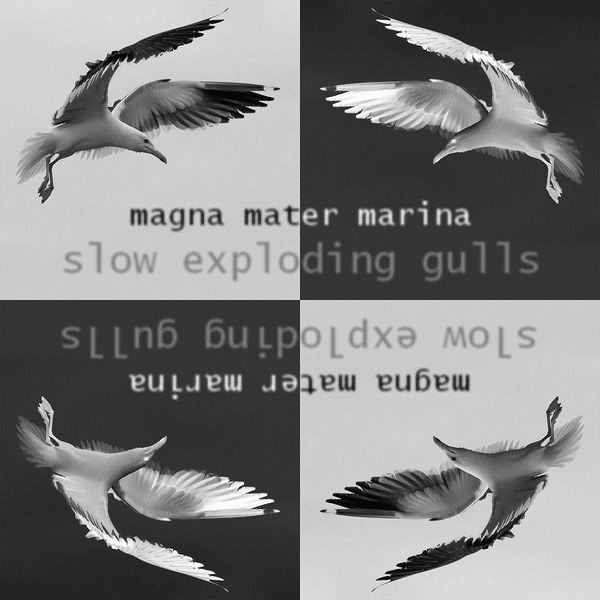
Cover of Magna Mater Marina by Slow Exploding Gulls (CD re-issue)

“Thalassa! Thalassa!” The chant that began the first song on the first side of the first S.E.G. album is still inspiring the group twenty-six years and eighteen albums later. Few fans will need reminding that it is ancient Greek for “The Sea! The Sea!”, as shouted in ecstasy by a mercenary army after a long and dangerous retreat across Asia Minor in 401 BC. Ecstasy is not so much an inspiration to the group as an aspiration. They try to use melody, rhythm and “drowned sound” to take their listeners out of the everyday and into the otherwhere, to sink them “full fathom five” in music as rich and mysterious as the sea. The S.E.G. story begins in 1987, when Joseph Corvin, the ever-present Kapitän und Kappellmeister, as he jokingly calls himself, was living in an old house in the ancient Celto-Roman town of Exeter on the southern English coast. When the sea-wind blew, his living quarters became lowing quarters: “an eerie wailing used to sound from the roof and there were all sorts of weird sound effects in the bathroom, because of air moving in the overflow pipe and the walls. I liked what I heard and I thought I could do something with it, musically speaking.”

Corvin recorded some of the wind-sounds, mixed them with gull-cries and underwater engine-noise, added vocals and electronically treated flute and drums, and put out the results on a cassette-only album called Magna Mater Marina (Latin for Great Marine Mother), under the odd but memorable moniker of Slow Exploding Gulls. The name was inspired by Corvin’s love of the surrealists Salvador Dalí and Max Ernst, but it would dog him and his cohorts for years to come, partly because it pigeon-holed the group as “Kraut-rock” and partly because it suggested cruelty to animals, which was not appreciated by some of his potential audience. Both assumptions were completely wrong: Corvin says, first, that, as a fan, he was then much more into The Cure, The Smiths and Siouxsie and the Banshees than anything electronic or experimental, and, second, that far from advocating cruelty to gulls, he was celebrating them:

Not for one moment was I suggesting any harm to anything with wings or feathers. Gulls are my favourite birds, highly potent symbols of freedom, grace and the life-force. The title was meant to be metaphorical, not literal, and it was partly a reference to the explosion of joy that sudden sight of a flying gull can waken in your heart. There’s something very Nietzschean about them and yeah, I will admit to a Friedrich-fixation in the 1980s, though the Kraut-rock label was an albatross around our necks, no pun intended, for most of the ’90s. It came mainly from a review in the N.M.E. [New Musical Express, one of Britain’s big “pop-papers”] claiming to detect similarities between us and Einstürzende Neubaten, which means “Collapsing New Buildings”. Well, I can’t say there wasn’t a subliminal influence, name-wise, but I’d heard very little by any of the German groups at the time and when I did hear more, I didn’t detect many similarities between their music and ours. We were and always will be inspired by sea-sounds, everything you can hear under and over the water of the British coast. The next label they tried to stick on us was “goth”, on the ground that we made gloomy music and always dressed in black. We didn’t: it was dark blue, it wasn’t all the time and there’s nothing gloomy about our music, if it’s listened to right. (Interview on the fan-site GullSegg, November, 2003)

Corvin’s protests were to no avail: S.E.G.’s next album, A Grey Mist (1989), was reviewed under titles like “Submarine Electro-Goths” and “Solipsistic Entrail-Gazing”. Again he says the press had got hold of the wrong end of the stick: “The title of the album comes from ‘Sea-Fever’, a very beautiful poem by John Masefield, and far from attempting to be gloomy or depressing, it was all about the joy of the sea, the cold in the early morning and the bite of the wind, ‘the white clouds flying’ and mist as a symbol of mystery and possibility, not as anything glum and gothic.” Happily, S.E.G. would outlive that early hostility and journalists’ insistence on labelling, rather than listening to, the music they created, but a lasting effect of both has been the playful name-switching they’ve indulged in since their early days. They’ve released albums under at least eight different names and performed gigs under all those and more, but every name has been based on the acronym S.E.G. and had a maritime theme. 1994’s Mew Upsilon Sigma, for example, came out under the name Swim with Elegant Gods, and 2003’s re-mixed Yr Wylan Ddu (Welsh for The Black Gull) under the name Seaside Excursion Guide. They’ve also recorded songs with titles like “Sunken Etruscan Gold”, “Sailing to Ecstatic Gnosis”, “Submersed in the Eternal Gulf” and “She’s an Exeter Girl” (a reference to Cathleen Orne, Joseph’s then girlfriend, now wife, who is indeed an Exeter girl).

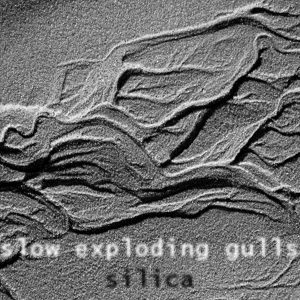
Cover of Silica by Slow Exploding Gulls

This S.E.G. motif means that hardcore fans, of whom they’ve garnered and retained a flighty fair few down the decades, are generally referred to as SEGheads, while their biggest – and best – fan-site is GullSegg, where you can find the earliest and most accurate news on the group’s activities, plus detailed and reasonably objective reviews of every piece of music they’ve ever recorded. So can S.E.G. be described as Shadowy Exeter Goths? No, Soaring Elemental Gods is much closer the mark and I join many mental-marine-music fans in wishing them well in their ambition of recording music in every major sea-side town of the British Isles. Wexford on the eastern coast of Ireland is next, according to GullSegg, and Wassernyxe, album #19 (and German/Greek for “Mermaid-Night”), should be released before the end of the year. It’s unlikely it will sail new seas, or sound new depths, but after twenty-six years of mer-music-making who could expect it to? Yes, never mind the rowlocks! S.E.G.’s Saline Esoterica Gangs on – and gongs on – every time someone plays a classic album like Mew or Thalas/Socratic, their 1996 split-EP with their own whale-song side-project Schatten über Exeter Gruppe (German for “Shadow over Exeter Group”).


Elsewhere other-posted:

• More Musings on Music

Previously pre-posted (please peruse):

Stoch’! (In the Name of Dove)

Proviously post-posted (please peruse):

The Sound of Silex

’Dith and the Maiden

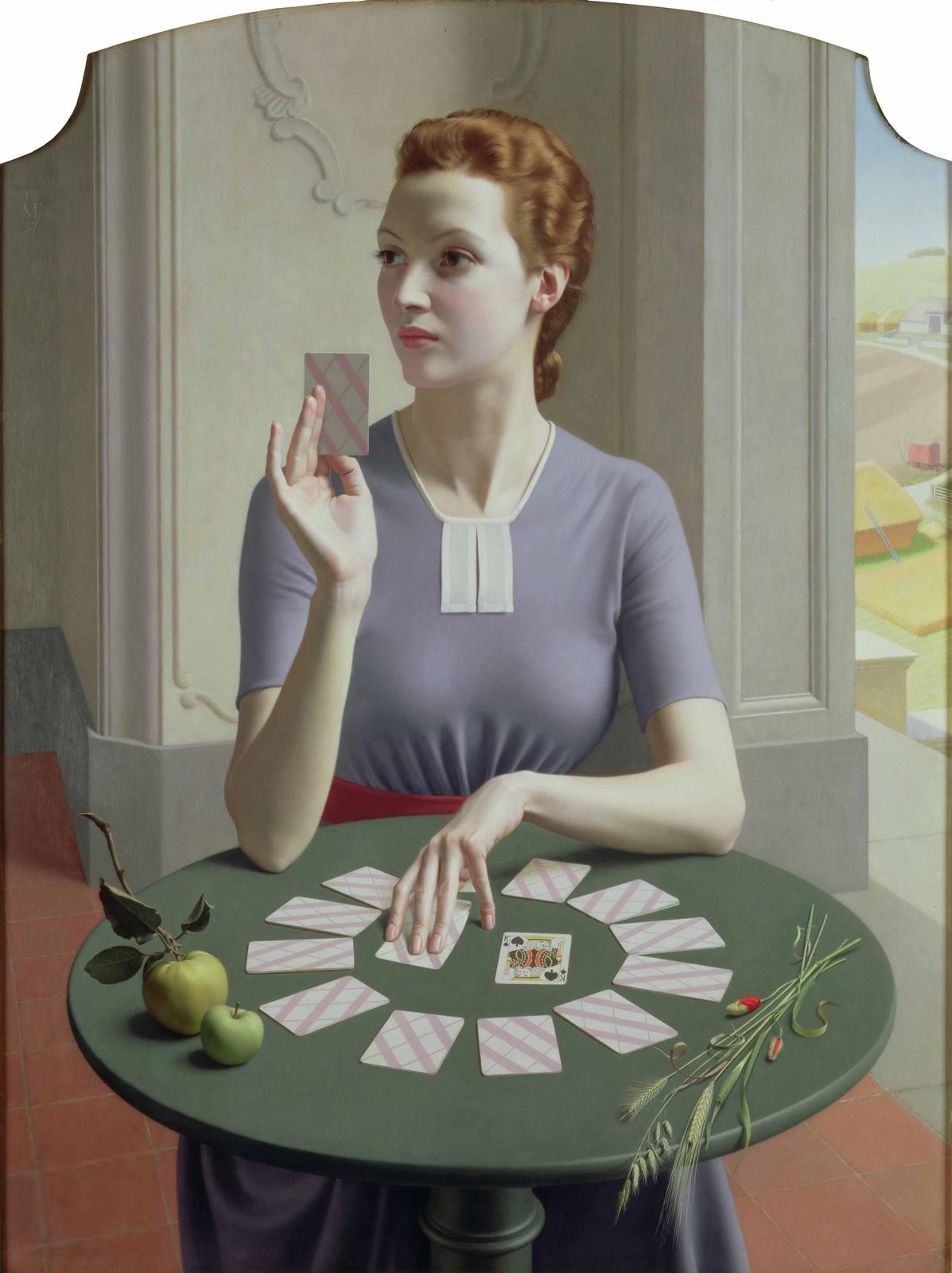
Meredith Frampton's A Game of Patience (1937)

A Game of Patience (1937) by Meredith Frampton (1894-1984), from the Ferens Art Gallery in Kingston-on-Hull, Yorkshire.

Lauditor Temporis Acti

Music of the Crusades, David Munrow and the Early Music Consort of London (1991)

If a real mediæval audience could hear this magical and sometimes spine-tinglingly beautiful collection of mediæval ballads, I suspect they’d burst into roars of disbelieving laughter. It might sound like the real thing to us, but nobody knows what the real thing sounded like and this album must be getting something badly wrong. But it can’t be getting everything wrong and I think the spirit of the Middle Ages is here, or several spirits: some songs are wistful and yearning, some boisterous and playful, some pious and icily perfect. As was the medieval way, the artists and musicians did their work gratiâ Dei, for God’s sake, not their own, and most of the songs are attributed to a simple “Anonymous”. But one, “Ja nus hons pris” (“No Man Who’s Gaoled”), is attributed to a certain imprisoned “Richard Coeur-de-lion”. The best performances are by a tenor called James Bowman, who has a voice that would have made him famous across Europe back then; nowadays, when “early music” has to compete with thousands of other genres, it’s a treasure known only to a discerning few, rather like the languages – Latin and mediæval French – in which the songs are performed.

Music of the Crusades

You have to know both the Vulgate and mediæval history to appreciate titles like “Sede, Syon, in Pulvere” (“Seat Thyself, Zion, in the Dust”), but “Palästinalied”, or “Palestine-Song”, the only title in German, shows that the Middle Ages have never really gone away. Wars in the Middle East and the threat of militant Islam have been with us before, and though part of the joy of this album is the way it allows you to escape the modern world, there are some things you can’t escape and a dose of real mediæval life would cure many modern discontents and dissatisfactions. Still, as the human race enters its final days, some of us continue to look back and regret what we’re going to lose and what we’ve already lost. It’s a pleasing irony that a compact disc, product of the scientific hangman, can contain so much of both.

Monteverde’s Mathemorphosis

Here are some fractals based on the Angelo di Monteverde or Angelo della Resurrezione carved by the Italian sculptor Giulio Monteverde (1837-1917) for the monumental cemetery of Staglieno in Genoa.

A fractal based on an angel carved by Giulio Monteverde

A fractal based on an angel carved by Giulio Monteverde

A fractal based on an angel carved by Giulio Monteverde

A fractal based on an angel carved by Giulio Monteverde

A fractal based on an angel carved by Giulio Monteverde

A fractal based on an angel carved by Giulio Monteverde

A fractal based on an angel carved by Giulio Monteverde

Stoch’! (In the Name of Dove)

Stochasma, In Abysso (2012)

The Sueco-Georgian avant-gardists Stochasma were formed, in their own words, “to interrogate, eviscerate, and exterminate the ultimate experimental envelope of acoustic idiosyncrasy”. That’s “Sueco-” as in Sweden and “Georgian” as in the Eurasian nation, not the American state, by the way. Going one up on some bands from Wales, Ireland and Scotland, who issue their material bilingually, in English and one or another of the Celtic languages, Stochasma issue all their material tri-lingually, in English, Swedish, and Georgian. The strangeness and beauty of the Georgian script match and enhance the strangeness and (occasional) beauty of their music, but, unlike their last two releases, there’s no spoken English, Swedish or Georgian here: In Abysso is intended to be an “abhuman listen”.

Front cover of Stochasma's album In Abysso 

Believe me, it is! The title of the album is Latin for “In the Abyss” and the liner-notes extend thanks to H.P. Lovecraft, Clark Ashton Smith and Stanislaw Ulam for “infernal inspiration”. If the last name makes you think “Who?” (or “U?”), you must be new/nu to Stochasma, who draw inspiration not just from art and literature, but from mathematics too. Stanislaw Ulam (1909-84) was a Polish mathematician perhaps most famous for inventing the “Ulam spiral”, a graphical representation of the prime numbers that reveals mysterious patterns in this strange and fascinating set of integers. Ulam stumbled across the spiral while “doodling” during a boring lecture at a scientific meeting. That kind of serendipity has always been important to Stochasma, who explore the musical abyss/chasm partly through random, or stochastic, techniques. For the first track, “Pr1m4l Skr33m”, the five members of the band had electrodes attached to their nipples before being asked, at random, to indicate, with a nod or shake of the head, whether a randomly selected number between 1 and 10,000 was prime or composite (for example, 1,433 is prime, being divisible by no numbers but itself and 1; 1,434 is composite, being divisible by 2, 3 and 239). If they were wrong, they received a painful electric shock.

The resultant collection of grunts, gasps, and screams was electronically worked over in fully traditional Stochasma fashion to create “Pr1m4l Skr33m”, which sounds like a fully traditional Stochasma track: fucking weird and unsettling! Is the irregular chorus of voices in agony or ecstasy? Are the band being tortured in a hell run by sadists or pleasured in a heaven run for masochists? Or both? It’s hard to decide, and at times hard to listen, but as Stochasma themselves put it: “We’re queasy listening, not easy – easy listening is for cubes.”

Elsewhere, the band have used the ultra-sensitive microphones they first experimented with on 2003’s AnguisaquA (sic – it literally means “SnakewateR”). This time they’ve recorded the bloodflow of a dove and the movements of parasites in its feathers for “Täubchen”, which sounds even stranger than it reads. That and “Pr1m4l Skr33m” are the first two tracks: the next fifteen are entitled “Ignisigil I” to “Ignisigil XV”. Stochasma used a fire-proof microphone to record the sound of books being burned. They selected fifteen wildly different authors for this literally incendiary homage, from “J. Aldapuerta to J. Archer, from K. Marx to K. Minogue”, as they themselves put it. (That’s the über-trangressive Spanish horror-writer Jesús Aldapuerta and the über-cruddy British thriller-writer Jeffrey Archer, and the Anglo-German philosophaster Karl Marx and the Australian pop-pixie Kylie Minogue, for those unfamiliar with the names.) And the band insist, perhaps tongue-in-cheek, that the sonic textures of the recordings are dependent not just on the physical nature of the paper and ink being burnt, but also on the ideological and aesthetic nature of the burning text.

It’s hard to agree: the “Ignisigils” all sound pretty much alike to me, though that sound is uncharacteristically soothing and relaxing by Stochasma standards (on my first listen, I dropped off during “Ignisigil VIII” and didn’t wake up till “Ignisigil XI”). The album is rounded off with three of the strangest pieces of music I’ve heard this century: “Musgomorrah”, “Gradus ad Parnassum”, and “CoMoXoCoI”. The first sounds like a slowed recording of men in armour fighting in thick mud; the second like a choir of giant glass insects singing themselves to splinters; and the third like echoes chasing each another in a collapsing or burning maze. These three might grow on me or might not: for now, “Pr1m4l Skr33m”, “Täubchen”, and “Ignisigil IV” hit the sonic sweet’n’sour spot that Stochasma seem to have copyrighted. I don’t know why “IV” hits the spot and the rest of the Ignisigils don’t, but that’s often the way with Stochasma: you like the sounds they create and you haven’t a clue as to why. In company with a select band of other electronicognoscenti, I look forward to their seventh album, whenever it appears and whatever musical mélanges or macedoines it manages to mulch, mangle, and miscegenate.


Elsewhere other-engageable:

Musings on Music