RanDOOM Numbers

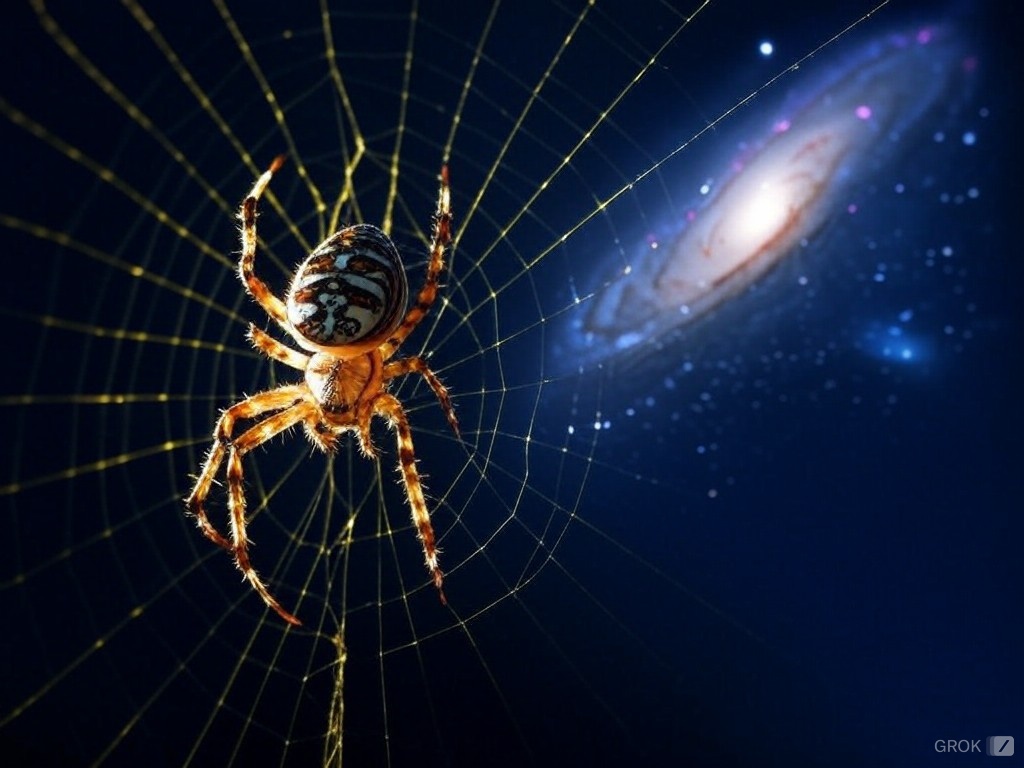
In my story “The Web of Nemilloth”, I wrote about a wizard, Vmirr-Psumm, who sought to escape the web of necessity spun over all matter in the universe by the spider-goddess Nemilloth. Vmirr-Psumm knew the legend of a fore-wizard, Tšenn-Gilë, who had sought the same escape and had cast a giant spell to tear the entire planet of Pmimmb from Nemilloth’s web. Alas, the legend ran, Tšenn-Gilë had made an error in his working and Pmimmb had exploded, broadcasting fragments of itself throughout the universe in the form of a seemingly worthless black mineral called sorraim.

The spider-goddess Nemilloth binds the Universe in Her web (AI-rtist’s impression)

Pieces of sorraim were found on Vmirr-Psumm’s own planet and he reasoned that, were the legend true, he could lift Nemilloth’s web from his own brain by carving and throwing a die of the mineral, wherein the virtue of Tšenn-Gilë’s spell still lingered. A die of any ordinary material would be within the web and therefore bound by necessity, generating only pseudo-random numbers in its throws. But a die of sorraim, being outside the web, would generate veri-random numbers that would alter the working of his brain, inspire thoughts unbound by Nemilloth, and grant him true freedom from Her tyranny.

Unfortunately for Vmirr-Psumm, he did not realize that “he who loosens the web of Nemilloth in rebellion grants matter itself leave to rebel.” A fragment of sorraim was small enough to remain outside the web and survive, but anything larger, from a planet to a human brain, would be destroyed. And that is why, absorbing the veri-random throws of the sorraim die, Vmirr-Psumm’s brain exploded with the power of an atom bomb at the end of the story, “succumbing, on its vastly smaller scale, to the same forces that had torn apart the planet of Pmimmb.”

Reflections on ranDOOM

Thinking about “The Web of Nemilloth” again at the end of 2024, I’ve realized that it raises some interesting questions. If a truly random sequence of numbers could cause a brain to explode, how long would the sequence have to be? I conjecture that a single number, and single throw of Vmirr-Psumm’s deadly die, would suffice, because it would be truly random in a way no number generated in any normal way could be. After all, if the brain of the die-thrower didn’t explode after one throw, why should it explode after two or three or any other finite number of throws? If the true randomness of the sequence is not established after one throw, then (one might reason) it could be established only after infinite throws. But Vmirr-Psumm did not throw the die infinitely often. Therefore, I conjecture, he must have rolled it only once, seen but one uppermost face of his dodecahedral die of sorraim, and die-d on that instant, as his brain absorbed the first veri-random number and exploded.

But why should sorraim need to be carved into a die to be deadly? If the mineral were truly outside the web of Nemilloth, then would not merely seeing or touching sorraim introduce unnecessitated sense-data into the brain of the beholder or betoucher and provoke an explosion? And why would the influence of the sorraim need to be on a conscious brain? If it’s insentient matter itself that rebels when outside the web, then ordinary matter influenced by sorraim would explode. And that explosion itself would be unnecessitated and thereby provoke further explosion in all the ordinary matter that it influenced.

And the influence of such an explosion would propagate at the speed of light, because the photons it created would be unnecessitated and therefore explosive in their influence. One could conclude, then, that the fore-wizard’s spell would have destroyed not only the planet of Pmimmb whereon it was worked but, in time, the entire universe, as the photons bearing the news of the initial explosion sped outward and triggered further explosions in all the ordinary matter they effected in some way. Vmirr-Psumm could never have found his sorraim and carved his die, because photons from Pmimmb would have reached his planet far before fragments of sorraim ever did. And it seems illogical or arbitrary to suppose that sorraim could exist anyway. Would not all matter be destroyed – turn into electro-magnetic radiation – if outside the web or if influenced by unnecessitated fundamental particles?

Psychopaths and Stoics

Still, let’s suppose that my story doesn’t succumb to this explosive logic, that sorraim could exist and be carved into a die, and that a single truly random number could cause a brain to explode. What a method of assassination or murder that would be! But it would be like the head of Medusa: you would have to emulate Perseus and avoid beholding your own weapon. If sorraim really existed and you could carve a die from it, you’d have to set up an automatic mechanism to roll that die, record the number first generated, then transmit that number to your target in some way. But to use such a weapon you’d have to have a psychopathic indifference to collateral damage: when your target’s brain absorbed the single veri-random number and exploded, this would destroy any city that your target happened to be present in at the time. But suppose you were indeed a psychopath and wanted to destroy a city or a nation or a continent or the entire world. Then you’d simply arrange for your single truly random number to be seen by the requisite number of people.

A final thought: I have a recollection that the Stoics believed necessity rules the universe and true randomness is therefore impossible, because it would trigger destruction in the necessitated material order of the universe. But I can’t remember where (or if) I read this and am pretty sure I read it only after I’d written “The Web of Nemilloth”.


Post-Performative Post-Scriptum

• “The Web of Nemilloth” appears in the CAS-inspired collection Tales of Silence and Sortilege, re-published by Incunabula Books in 2023.

Triumph of the ’Ville

Is it wrong that I find it amusing to be mistaken for a Guardian-reader or Guns’n’Roses fan? Yes. Very wrong. It’s also wrong that I’d be amused to learn that someone thought I was serious about the title Gweel & Other Alterities. Serious about the Alterities bit, I mean. “Alterity” is a word used by, well, I’d better not describe them. But one example is China Miéville. ’Nuff said. And here he uses the word with exactly the phrase I’d’ve hoped he’d use it with:

“I’m not interested in fantasy or SF as utopian blueprints, that’s a disastrous idea. There’s some kind of link in terms of alterity.” — “A life in writing: China Miéville”, The Guardian, 14v11


Elsewhere Other-Accessible

Ex-term-in-ate! — extremophilically engaging the teratic toxicity of “in terms of”…
’Ville to Power — Mythopoetic Miéville incisively interrogates issues around Trotsko-toxicity…

Double-Gweeling


My short-story collection Gweel & Other Alterities has very kindly been re-published by D.M. Mitchell at Incunabula:

Gweel & Other Alterities – Incunabula’s new edition
Once More (With Gweeling) – my short review of the new edition
Incunabula Media — wildness and weirdness in words and more


(click for larger image)

Swan Klong

Ghìrkýthi mhlóSphálákhtthi mhlóDwèlrthi / The Swans of Queen Sphalaghd1

(Translated and edited by Simon Whitechapel)

In the black mirroring surface of the canal, these things: a sky very high and clear, the blue infinite interior of the skull of a god2 brooding beauty and pain into the world; the walls that line the canal, white marble, sharp-edged; the vivid mosaics of precious stone with which the walls are set: oval belladonnic eyes of emerald and obsidian in faces of sculpted mammoth ivory; the mouths of jade3-lipped bayadères leaking ruby threads of wine; the topaz fingers and wrists of rhodolite4-crowned lutanists; quartz-glistered sinews in the arms of capon5-plump eunuchs fanning the dances of turquoise6-skinned odalisques who prance and beck in frozen heated showers of opal-drop sweat.

But all, in the mirroring water, is grey.7

In the black mirroring surface of the canal, these things: a broad slab of basalt to which is bound a naked man8, white against the stone’s darkness, black-haired and bound with soft unbreakable bonds of purple silk; on his belly have been painted the red strokes and hooks and curls of the ideogram for death, like the roaring fist-talon and shank of a stooping hawk9 or the opening hungry maw of a leopard10, a splash of red tissues ringed and spiked and shaped by white barbs of teeth.

But all, in the mirroring water, is grey.

In the black mirroring surface of the canal, these things: five swans; their bright, forward-sweeping eyes are set in white, oval-skulled heads that are enwedged with yellow, black-rooted beaks; their white, smooth-feathered, twice-curved necks, slender as stems, are shivered on the ripples of the passage of bodies that are white seed-pods curling to smooth, hooked tails. Five swans, silent white swans. Their beaks are small and regular as the hardened gold heads of the ritual axes of the Temple of the Thanatocrator11, which sound tchlunk tchlunk tchlunk in the skulls of the sacrifices, opening slotted, red-welling ways for the prosempyreal passage of the soul.

But all, in the mirroring water, is grey.

In the black, mirroring surface of the canal, this: the white swans clustered on the white body of the sacrifice. Their necks dart and sway, sowing moist red blooms into the fertile milk of his skin. He strains against his bonds, but the necks fall, the heads hammer with steady, unconscious grace, opening the blooms to full flower. In the mirroring water they are beautiful, like strewn blossoms12 for the feet of the Thanatocrator, who dances his hatred into the waking dreams of the world. The sacrifice is dead and the swans are streaked and smirched and spotted with gore, like heavy white flowers in a garden of torture.

Their necks bend and sway, and their beaks open and close, but in the mirroring water their voices are silent, and how may we tell what they say?

NOTES

1. Trained swans were the favored form of execution under the insane and semi-legendary nymphomane Queen Sphalaghd (1-143 Anno Dominæ; 1137-1279 Anno Secundi Imperii), whose extravagances came nigh to ruining the kingdom before, after many hesitations on and retreats from the threshold, she converted fully to the austere and life-denying doctrines of the Thorn-God in the final lustrum of her nigromantically prolonged life.13 She was canonized by the Temple thirteen years after her death.

2. An obvious reference to the Thorn-God, and in another context the Yihhian (mhló)Kiùlthi might be translated “(of) the god”, but the use of the non-hieratic noun marker gives the flavor of the indefinite article in English and contributes to the sense of brooding anonymity in the story.

3. This is believed to be a satirical reference to Yokh-Tsiolphë’s own religion (see note 8 below), that of the Moon-Deity, whose abstemious priestesses wore strongly colored make-up while performing their ritual dances under the full moon.

4. From its use in other texts retrieved oneirically from the Temple, the hieroglyph appears to refer to some rose-colored semi-precious mineral, and I have chosen to translate the word as “rhodolite”: coronemus nos rosis antequam marcescant (“let us crown us with roses before they be withered”, Sapientia Solomonis 2:8) was a sentiment accepted in its widest possible sense at the week-long feasts held during the long years of Queen Sphalagdh’s dissipation.

5. Possibly a castrated form not of the domestic hen (Gallus domesticus) but of the peacock (Pavo cristatus).

6. Again a possible satirical reference to the priestesses of the Moon-Deity.

7. Mirrors in the Temple were only of dark minerals, principally basalt, haematite, and black coral (Gorgonia spp), for the priests taught that color was one of the snares of sensuality by which the world entrapped men’s souls. Accordingly, possession of a fully reflecting mirror was an excommunicable offence for members of the Thorn-God’s congregation.

8. The story is believed to refer to the execution of a nobleman called Yokh-Tsiolphë (Yugg-Siurphë in some texts), who had offended the Queen either by refusing to sacrifice his eldest son and daughter to the Thorn-God or (as most scholars now believe) by falling under suspicion of having composed an anonymous pasquinade against the Thorn-God which was briefly circulated at the royal court in 38 A.D./1174 A.S.I. The execution would have been one of the earliest signs of the Queen’s growing regard for the Thorn-God.

9. The Yihhian here is a little unclear and the reference is perhaps to the Osprey (Pandion haliætus), which was second only to the Great Grey Shrike (Lanius excubitor) in the ornithomancy of the Temple.

10. The Yihhian kiuthi literally means “spotted one” and can refer to several species of animal; “leopard” seems the most appropriate translation in this context.

11. Niédýthithlà (mhló)Nhriúlr, literally “deathly lord(’s)”, was a title of the Thorn-God, but the foreign derivation of the words in Yihhian means it is perhaps best translated into English as “thanatocrator”.

12. Blossoms of gorse (Ulex spp) and other spinose plants were thrown beneath the feet of dancing priests during rituals at the Temple, and many of the Temple’s hymns refer to osmomancy, or divination by the scents released from the crushed petals.

13. She is said to have been planning another round of the puerile and puellar sacrifices with which she purchased her unnatural youth at the time of her death, occasioned when she slipped on trampled petals in the Temple of the Thorn-God whilst approaching the altar for blessing and was impaled on the silver thorns topping a newly erected altar-rail. Some contemporary commentators hinted at numerological significance in her death, saying that the priests of the Thorn-God had persuaded her that by laying down her life at that age she would regain it at the beginning of the next cosmic cycle. It is possible, therefore, that the encephalotomy and cardiotomy of her ritual mummification were feigned.

Science or Sorcery?

Note: I was surprised when I re-read this article on CAS from 2004, because I didn’t find its prose particularly painful or embarrassing. I’ve made only one big change, restoring the comparison that I originally began the essay with but which I suppressed for publication at the Eldritch Dark for fear of seeming gratuitously offensive. Everything in the essay, including the comparison, is of course intended to be taken with complete seriousness. Tolkien is one of the authors I have most often re-read, but, as I’ve said before, I wish that someone would translate Lord of the Rings into English.


Science or Sorcery? Interrogating the Supratextual Interface of Klarkash-Ton and the Hobbitual Offender, Simon Whitechapel

The scientific spirit, which cannot leave anything alone and aspires to draw the whole universe of objects, people, ideas and even feelings into its own dull, inhuman empire, was certain, sooner or later, to cast its screwed-up, calculating eyes on the splendour in the grass and the glory in the flower. — Peter Simple, The Stretchford Chronicles (1980).1

Où sont les neiges d’antan? (Where are the snows of yesteryear?) — François Villon, Ballade des Dames du Temps Jadis (1461).

If the Earth were a human body, the United States of America might well be identified as a cancer. There are three strong parallels: growth, greed, and influence. Cancers grow explosively, gobble energy, and spread in their worst forms to every part of the body. Mutatis mutandis, the United States has done the same, growing in a couple of centuries from a tiny colony to a continental superpower that now consumes perhaps a fifth of the world’s resources with only a twentieth of the world’s population,2 and that exports its culture and language to every corner of the world. More and more people outside its borders are growing up to think, act, and talk like Americans, discarding their own histories and cultures as they do so. This American triumph has coincided with, and in part been built on, the triumph of modern science, and like science the United States is based on a rejection of tradition and a belief in the possibility, and even the necessity, of progress.

But as Sir Isaac Newton (1643-1727), one of the founders of modern science, pointed out, for every action there is an opposite and equal reaction. He was talking about physics, but actions have reactions in the mistier world of culture too and simultaneous with the rise of America in the late nineteenth and early twentieth centuries came the rise of the literary genre of fantasy. Like its coeval science fiction, fantasy represents a flight from the present, but where science fiction flies more or less optimistically into the future, fantasy flees more or less pessimistically into the past: it could be defined as an attempt to write as though America did not exist. America offers democracy, science, and rationalism; fantasy rejects them in favor of monarchy, magic, and mystery.

And understandably so: like America itself, democracy, science, and rationalism are profoundly unnatural things, appearing very late in human existence and truly accepted and appreciated by very few of us, for they do not appeal to the irrational and numinous aspects of our nature. America is unnatural because it is deracinated, a conscious, rational experiment in nation-building whose immigrant citizens are cut off from their roots in ancestral history and homeland. The popularity of fantasy in America and the societies its rootless culture has most heavily influenced proves that millions of us feel the loss. Fantasy’s rejection of science and flight from the scientific American present can be summed up by these lines from J.R.R. Tolkien’s The Lord of the Rings (1954-5) in which the wizard Gandalf describes his confrontation with the wizard Saruman, who has recently exchanged his white robes for robes of many colors:


“I liked white better,” I said.
“White!” he sneered. “It serves as a beginning. White cloth may be dyed. The white page can be overwritten; and the white light can be broken.”
“In which case it no longer white,” said I. “And he that breaks a thing to find out what it is has left the path of wisdom.”3


Isaac Newton broke white light in precisely that way with a prism, gaining knowledge as he discarded wisdom. But there was more to Tolkien’s rejection of Newtonian reductionism than simply science: Newton was also a Protestant, and America is a Protestant nation. Like science, Protestantism is based on a rejection of tradition, and because, like America, it is deracinated, it withers very readily: where its offspring rationalist secularism leads, Protestantism sooner or later follows.4 Tolkien (1892-1973) was Catholic, belonging to a church with deep roots, and though his books are early symptoms of her present decadence, they contain all the anti-rational, loss-assuaging ingredients listed above: monarchy, magic, and mystery. One of those books is, after all, called The Return of the King, and the pessimistic, future-fleeing aspects of fantasy are clearly symbolized by the way Tolkien sets his evil empire of Mordor in the east, where the sun rises, and his haven of peace in the west, where the sun sets.

But beside being Catholic and anti-rationalist, Tolkien was, more importantly, a bad writer. His most famous book, The Lord of the Rings, epitomizes what Europeans would see as the worst failings of American popular culture: it is sentimental, shallow, and clumsy.5 His attempt to flee the American present in some ways carries America with it. And that is one of the great ironies of fantasy literature: its most popular, and least subtle, exponent is European, while one of its greatest and most subtle is not merely American but Californian, living and dying in the most “future-crazed”6 state of all: Clark Ashton Smith was born in 1893 in Long Valley, near Sacramento, and died in 1961 a few miles north in Auburn.

But CAS had an English father and did not grow up in any of California’s cities, which may be much more important than it appears. California is one of the youngest states of one of the world’s youngest nations, but its landscape is ancient and its landscape is what CAS was most familiar with: he grew up on his father’s “forty acres” of homestead.7 Straight lines and right angles are rare in nature, ubiquitous in modern cities, and they may have much stronger effects on our psychology than we realize.8 In the old worlds of Europe and Asia, where cities are thousands of years old, streets wind and twist, because the cities of Europe and Asia have grown rather like plants; in the new world of America, streets run in straight lines intersecting at right angles. American cities are planned, rational attempts to conquer and control unplanned, irrational geography, and perhaps the reputation of New Englanders for subtlety and guile rises from their surroundings. Cities like Boston are old enough to have grown in the winding, twisting old world fashion, and perhaps they train their modern inhabitants in the oblique and indirect. CAS’s friend and mentor H.P. Lovecraft (1890-1937) was an urban New Englander: could he have developed his subtle, allusive fiction had he grown up in a city like Chicago or New York, where the streets may train the mind in linearity and directness?9 Could the rural CAS have developed his subtle, allusive fiction had he grown up in a city like San Francisco or Los Angeles?

I would suggest not, but that there is more to an artist’s growth than his physical surroundings is clearly proved by Tolkien, who lived in ancient, alinear England and wrote his crude fantasy amid the winding, twisting streets of Oxford. However, human beings inhabit societies too, and though Lovecraft and CAS may have escaped the stultifying effects of American town-planning, perhaps they benefited from the liberating effects of American politics. The races of Tolkien’s world are clearly based on the English class system: the hobbits, for example, are the rural proletariat and minor bourgeoisie, the orcs are the industrial proletariat, and the elves are the aristocracy whose well-nourished scions Tolkien encountered at Oxford. Compare these passages, the first from Evelyn Waugh’s Oxford novel Brideshead Revisited (1945), the second from Tolkien’s The Hobbit (1937):


About six of them came into my room, the rest stood mouthing outside. My dear, they looked too extraordinary. They had been having one of their ridiculous club dinners, and they were all wearing coloured tail-coats – a sort of livery. ‘My dears,’ I said to them, ‘you look like a lot of most disorderly footmen.’ Then one of them, rather a juicy little piece, accused me of unnatural vices. ‘My dear,’ I said, ‘I may be inverted but I am not insatiable. Come back when you are alone.’10


‘Well, well!’ said a[n Elvish] voice. ‘Just look! Bilbo the hobbit on a pony, my dear! Isn’t it delicious!’ ‘Most astonishing wonderful!’ Then off they went into another song as ridiculous as the one I have written down in full. At last one, a tall young fellow, came out from the trees and bowed to Gandalf and to Thorin.11

Tolkien and Waugh were both snobs and both, as it happens, of below average height. Tall Lovecraft’s and tall CAS’s fiction does not suffer from this snobbery, and although the stories of their friend Robert E. Howard (1906-1936) – who grew up in rural Texas – continually pluck the chords of monarchy, magic, and mystery, his hero Conan becomes a king by brawn and brain, not by birth. But Howard, although a far better writer than Tolkien, is the least interesting of the Weird Tales triumvirate, and CAS’s fiction is aristocratic in more than its mention of kings and emperors. He did not write for the canaille, which is why he used words like canaille:


Yes, indeed, one could write numerous reams on the subject of style. The style – or lack of it – required by nearly all magazine editors, [sic] would require a separate treatise. The idea seems to be that everything should be phrased in a manner that will obviate mental effort on the part of the lowest grade moron. I was told the other day that my “Door to Saturn” could only be read with a dictionary.12

One of the reasons popular American culture has been so successfully exported is that it has evolved to appeal to the lowest common denominator: it is “phrased” so to “obviate mental effort”, and ideally to bypass the intellect altogether. The simplicity and directness of an American export like rock’n’roll, whose appeal is based on strong rhythms and high volume, are mirrored in the simplicity and directness of American exports like hamburgers and Coca-Cola, whose appeal is based on fat, salt, and sugar. In short, American culture is democratic and inclusive, not aristocratic and exclusive like European culture. And so a second great irony of fantasy literature is that the European Tolkien is far more democratic and far more successfully exported than the Californian Clark Ashton Smith: Tolkien’s writing is crude and strongly flavored, the literary equivalent of hamburger and coke, while the haute cuisine of CAS remains unknown to many of the millions who read and re-read Lord of the Rings – or watch and re-watch its recent translation into film.

And perhaps that is another part of the key to CAS: fiction that can be translated readily and successfully into film, as Tolkien’s has been, tends to be superficial and direct. CAS’s greatest stories could not be successfully translated into film without being transformed in fundamental ways; that is, without being mutilated. This is another way in which CAS is profoundly un-American. America’s most successful and most characteristic export, advertising its culture to the world, has been film, and film, because it is the most powerful of media, is also the most destructive, killing imagination and feeding passivity and voyeurism.13 Cinema’s inbred cousin, television, exaggerates cinema’s failings and commits the additional crimes of trivialization and superficiality: watching a film at the cinema at least has a sense of ritual and occasion, and lasts about as long as a religious service; watching the same film using a television has no sense of ritual or occasion and can be interrupted and postponed at will.

CAS, born blessedly long before television and no movie-goer, was defiantly logophilic and logocentric, and in that sense is far more modern than artists who work in or are influenced by film: vision has existed for many millions of years among animals and the art based on it, appealing to universal simplicities, crosses boundaries of culture and even species with relative ease: recall the Greek tale of Zeuxis’s trompe l’oeil grapes pecked by birds. True language, on the other hand, appeared only with human beings and the art based on it, being far richer and far more subtle, does not cross barriers of culture with ease and without transformation and distortion. And here is a third great irony of CAS’s relation to JRRT. Tolkien, the professional scholar of language in the homeland of English, wrote with far less sensitivity and richness, beating drums and blasting trumpets where CAS played flutes and citheræ. But if fantasy is an attempt to write as though America did not exist, perhaps it took an American to know precisely how best to perform the nullification.


Notes

1. The Stretchford Chronicles: 25 Years of Peter Simple, The Daily Telegraph, Purnell & Sons, Bristol, 1980, “A graded land”, pg. 165.


2. A factoid often dragged out (with varying figures – sometimes consumption goes as high as two-thirds) by whining liberals and eco-puritans. The precise ratio is impossible to know, but America certainly out-consumes Europe, just as Europe out-consumes the Third World.

3. The Fellowship of the Ring, Book Two, ch. II, “The Council of Elrond”.

4. “Mark 4:5 And some [seed] fell on stony ground, where it had not much earth; and immediately it sprang up, because it had no depth of earth: 6 But when the sun was up, it was scorched; and because it had no root, it withered away.” Because they have deep roots, Catholic and Orthodox Christianity resist the scorching sun of secularism much more effectively.

5. The Hobbit, with much less ambition, achieves much more.

6. Peter Simple, The Stretchford Chronicles: 25 Years of Peter Simple, The Daily Telegraph, Purnell & Sons, Bristol, 1980, “Let them be left”, pg. 173: “Environmentalists, conservationists, anti-pollutionists: the dull, pseudo-scientific words, endlessly repeated – imports, like so much else, from future-crazed America – can arouse in certain moods a perverse rage to build oil-refineries all over Dartmoor.”

7. “As I Remember Klarkash-Ton”, George F. Haas, from The Black Book of Clark Ashton Smith, Arkham House (see online copy).

8. In one famous psychological experiment, Zulus who lived in round huts and ploughed in curves were found to be much less susceptible to certain optical illusions (e.g. the Müller-Lyer arrow illusion). See, for example, the discussion in R.L. Gregory’s Eye and Brain: the Psychology of Seeing.

9. See Lovecraft’s short story “Haunter of the Dark” (1936), set in the New England city of Providence but with a protagonist from the straight-lined, right-angled Wisconsin city of Milwaukee: “As Blake climbed higher, the region seemed stranger and stranger, with bewildering mazes of brooding brown alleys leading eternally off to the south. … Twice he lost his way …”

10. Op. cit., Book One, “Et in Arcadia Ego”, ch. 2

11. Op. cit., Chapter 3, “A Short Rest”.

12. Clark Ashton Smith: Letters to H.P. Lovecraft, Necronomicon Press, West Warwick (Rhode Island), 1987, pg. 23, “c. mid-December 1930” (see online copy).

13. In fantasy’s sister genre, horror, England and America again provide the most successful writer and one of the greatest, but this time England wins: the American Stephen King (1947-     ), the most successful writer of horror, is a cinematic writer weaned on film and has nothing of the subtlety and depth of the English M.R. James (1862-1936) (see CAS’s appreciation “The Weird Works of M.R. James”).

© 2004 Simon Whitechapel

Term-in-ator!

V. disappointed by China Miéville on BBC Radio 4’s Book Club (Sunday 1st November). It took him eight minutes to say “in terms of”.

The Power of Babel

“…par la suggestive lecture d’un ouvrage racontant de lointains voyages…” – J.K. Huysmans, À Rebours (1884).

The language you know best is also the language you know least: your mother tongue, the language you acquired by instinct and speak by intuition. Asking a native speaker to describe English, French or Quechua is rather like asking a fish to describe water. The native speaker, like the fish, knows the answer very intimately, yet in some ways doesn’t know as well as a non-native speaker. In other words, standing outside can help you better understand standing inside: there is good in the gap. What is it like to experience gravity? Like most humans, I’ve known all my life, but I’d know better if I were in orbit or en route to the moon, experiencing the absence of gravity.

And what is it like to be human? We all know and we’ve all read countless stories about other human beings. But in some ways they don’t answer that question as effectively as stories that push humanity to the margins, like Richard Adams’ Watership Down (1972), which is about rabbits, or Isaac Asimov’s The Gods Themselves (also 1972), which is about trisexual aliens in a parallel dimension. There is good in the gap, in stepping outside the familiar and looking back to see the familiar anew.


Continuing reading The Power of Babel

At the Peaks of Prejudice

<gag> The Evil White Male. <retch> When will Persons of Color, Persons of Wombyn-ness, Persons of LGBT-ity, Persons of All Alternative Ontologies finally succeed in cleansing the world of his tenebrose toxicity? When will the Rainbow Days of Equality, Justice and Harmony begin? When will his uncountable victims truly be able to say: “Free at last! Free at last! Thank the Lady Almighty, we are free at last!”?

Not soon enough. In the meantime, the E.W.M./Yoom continues to pollute the so-called white-male-invented so-called Internet with his foulness and fetidity. But most depraved, deplorable and despicable of all are those occasions when one Yoom “celebrates” the work of another Yoom.

A case in point:

Cosmic Horror – Howard Phillips Lovecraft (1890–1937)

“Unspeakable” is not the word. (If it were, then it wouldn’t be “unspeakable”, would it?)


Previously pre-posted (please peruse):

Hateful, Bestial, Demonic
Knowing Mi, Knowing Yoom