Material Whirled

When we are conscious of being conscious, what are we consciousness-conscious with? If consciousness is a process in the brain, the process has become aware of itself, but how does it do so? And what purpose does consciousness-of-consciousness serve? Is it an artefact or an instrument? Is it an illusion? A sight or sound or smell is consciousness of a thing-in-itself, but that doesn’t apply here. We aren’t conscious of the thing-in-itself: the brain and its electro-chemistry. We’re conscious of the glitter on the swinging sword, but not the sword or the swing.

We can also be conscious of being conscious of being conscious, but beyond that my head begins to spin. Which brings me to an interesting reminder of how long the puzzle of consciousness has existed in its present form: how do we get from matter to mind? As far as I can see, science understands the material substrate of consciousness – the brain – in greater and greater detail, but is utterly unable to explain how objective matter becomes subjective consciousness. We have not moved an inch towards understanding how quanta become qualia since this was published in 1871:

Were our minds and senses so expanded, strengthened, and illuminated, as to enable us to see and feel the very molecules of the brain; were we capable of following all their motions, all their groupings, all their electric discharges, if such there be; and were we intimately acquainted with the corresponding states of thought and feeling, we should be as far as ever from the solution of the problem, “How are these physical processes connected with the facts of consciousness?” The chasm between the two classes of phenomena would still remain intellectually impassable.

Let the consciousness of love, for example, be associated with a right-handed spiral motion of the molecules of the brain, and the consciousness of hate with a left-handed spiral motion. We should then know, when we love, that the motion is in one direction, and, when we hate, that the motion is in the other; but the “Why?” would remain as unanswerable as before. — John Tyndall, Fragments of Science (1871), viâ Rational Buddhism.


Elsewhere other-posted:

Double Bubble
The Brain in Pain
The Brain in Train
This Mortal Doyle

Blue is the Killer

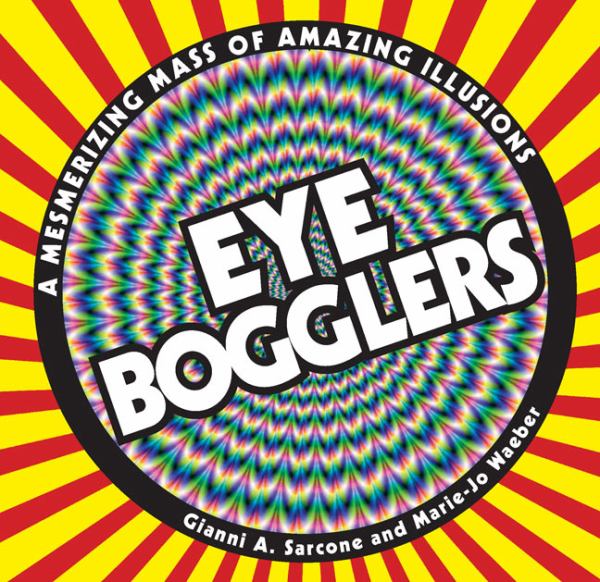
Eye Bogglers by Gianni A. Sarcone and Marie-Jo WaeberEye Bogglers: A Mesmerizing Mass of Amazing Illusions, Gianni A. Sarcone and Marie-Jo Waeber (Carlton Books 2011; paperback 2013)

A simple book with some complex illusions. It’s aimed at children but scientists have spent decades understanding how certain arrangements of colour and line fool the eye so powerfully. I particularly like the black-and-white tiger set below a patch of blue on page 60. Stare at the blue “for 15 seconds”, then look quickly at a tiny cross set between the tiger’s eyes and the killer turns colour.

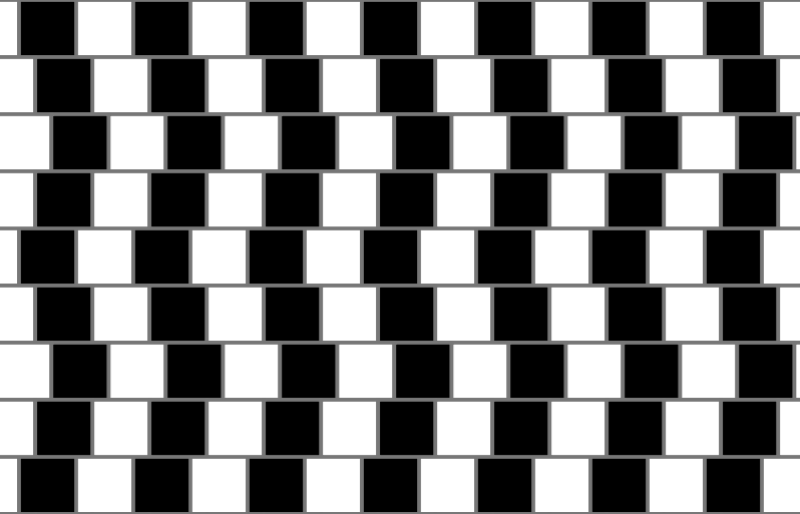
So what’s not there appears to be there, just as, elsewhere, what’s there appears not to be. Straight lines seem curved; large figures seem small; the same colour seems light on the right, dark on the left. There are also some impossible figures, as made famous by M.C. Escher and now studied seriously by geometricians, but the only true art here is a “Face of Fruits” by Arcimboldo. The rest is artful, not art, but it’s interesting to think what Escher might have made of some of the ideas here. Mind is mechanism; mechanism can be fooled. Optical illusions are the most compelling examples, because vision is the most powerful of our senses, but the lesson you learn here is applicable everywhere. This book fools you for fun; others try to fool you for profit. Caveat spectator.

Simple but complex: The café wall illusion

Simple but complex: The café wall illusion

Mi Is Mirror

I hope that nobody thinks I’m being racially prejudiced when I say that, much though I am fascinated by her, I do not find the Anglo-American academic Mikita Brottman physically attractive. It is her mind that has raised my longstanding interest, nothing more.

Honest.

This is because, for me, Ms B is like a mirror that reverses not left and right, but male and female.

Obviously, we’re different in a lot of ways: I don’t smoke and I don’t have any tattoos, for example.

But there are big similarities too.

We were born in the same year (1956) and we were both keyly core contributors to seminal early issues of the transgressive journal Headpress Journal.

And we have various other things in common, like our mutually shared passion for corpse’n’cannibal cinema, our Glaswegian accents and (at different times) our season tickets for Hull Kingston Rovers.

So it is that, looking at Ms B, I have the uncanny experience of seeing myself as I might have been, had I been born female.

But it’s not just uncanny.

It’s horrifying at times too.

Okay, I’m comfortable with the idea that, born female, I would have been less intelligent and more conformist. So I don’t mind that Ms B is a Guardianista. Not particularly. I can face the fact that I would quite likely have been one of them too, as a female.

But there are worse things than being a Guardianista, believe it or not.

Ms B has a PhD in EngLit.

A PhD!

In EngLit.

It’s not at all easy for me to face the fact that I might have had one too, as a female. It really isn’t. But how can I deny it? I might have. That despicable, deplorable, thoroughly disreputable subject might have attracted me. In fact, it would probably have attracted me.

<retch>

But it gets worse still.

Ms B is a psychoanalyst.

A psychoanalyst.

Ach du lieber Gott!

See what I mean by “horrifying”?

I mean, even if I’d been born female I wouldn’t have sunk to such depths, would I? Would I? No, I have to face facts: I might. But I don’t think so. I have a feeling that there’s more to Brotty’s interest in Freud than her gender statusicity and her key commitment to core componency of the counter-cultural community.

But I’d better say no more. Verb sap.

This Mortal Doyle

Challenger chopped and changed. That is to say, in one important respect, Arthur Conan Doyle’s character Professor Challenger lacked continuity. His philosophical views weren’t consistent. At one time he espoused materialism, at another he opposed it. He espoused it in “The Land of Mist” (1927):

“Don’t tell me, Daddy, that you with all your complex brain and wonderful self are a thing with no more life hereafter than a broken clock!”

“Four buckets of water and a bagful of salts,” said Challenger as he smilingly detached his daughter’s grip. “That’s your daddy, my lass, and you may as well reconcile your mind to it.”

But earlier, in “The Poison Belt” (1913), he had opposed it:

“No, Summerlee, I will have none of your materialism, for I, at least, am too great a thing to end in mere physical constituents, a packet of salts and three bucketfuls of water. Here ― here” ― and he beat his great head with his huge, hairy fist ― “there is something which uses matter, but is not of it ― something which might destroy death, but which death can never destroy.”

That story was published just over a century ago, but Challenger’s boast has not been vindicated in the meantime. So far as science can see, matter rules mind, not vice versa. Conan Doyle thought the same as the earlier Challenger, but Conan Doyle’s rich and teeming brain seems to have ended in “mere physical constituents”. To all appearances, when the organization of his brain broke down, so did his consciousness. And that concluded the cycle described by A.E. Housman in “Poem XXXII” of A Shropshire Lad (1896):

From far, from eve and morning
  And yon twelve-winded sky,
The stuff of life to knit me
  Blew hither: here am I.

Now – for a breath I tarry
  Nor yet disperse apart –
Take my hand quick and tell me,
  What have you in your heart.

Speak now, and I will answer;
  How shall I help you, say;
Ere to the wind’s twelve quarters
  I take my endless way. (ASL, XXXII)

Continue reading This Mortal Doyle

She Say, She Sigh, She Sow

“Those who view mathematical science, not merely as a vast body of abstract and immutable truths, whose intrinsic beauty, symmetry and logical completeness, when regarded in their connection together as a whole, entitle them to a prominent place in the interest of all profound and logical minds, but as possessing a yet deeper interest for the human race, when it is remembered that this science constitutes the language through which alone we can adequately express the great facts of the natural world, and those unceasing changes of mutual relationship which, visibly or invisibly, consciously or unconsciously to our immediate physical perceptions, are interminably going on in the agencies of the creation we live amidst: those who thus think on mathematical truth as the instrument through which the weak mind of man can most effectively read his Creator’s works, will regard with especial interest all that can tend to facilitate the translation of its principles into explicit practical forms.” — Ada Lovelace (née Byron) (1815-52).

The Brain in Train

I feel odd when I consider this possibility: that all my thoughts are strictly determined, no more under my control than a straw in a gale or a stone in an avalanche. It seems paradoxical to have strictly determined thoughts about strictly determined thoughts. But is it? And is strict determinism fatal for finding the truth? I don’t think so. In fact, I think that strict determinism is essential for truth. But irrelevant associations get in the way of our understanding this. If our thoughts are determined, they seem like automatic trains running on rigid tracks. We might want to go to the station marked “Truth”, but if the switches are set wrong, the train will never get there. Or it will thunder through and never stop.


Continue reading The Brain in Train

Performativizing Papyrocentricity #14

Papyrocentric Performativity Presents:

Scheming DemonThe Screwtape Letters, C.S. Lewis (1942)

Ai Wei to HellHow to Read Contemporary Art, Michael Wilson (Thames & Hudson, 2013)

Toxic TwosomeDoll, Peter Sotos and James Havoc (TransVisceral Books, 2013)

Know Your LimaçonsThe Penguin Dictionary of Curious and Interesting Geometry, David Wells (1991) (posted @ Overlord of the Über-Feral)

Pestilent, Pustulent and Pox-Pocked – various books by Dr Miriam B. Stimbers (@ O.o.t.Ü.-F.)


Or Read a Review at Random: RaRaR

The Brain in Pain

You can stop reading now, if you want. Or can you? Are your decisions really your own, or are you and all other human beings merely spectators in the mind-arena, observing but neither influencing nor initiating what goes on there? Are all your apparent choices in your brain, but out of your hands, made by mechanisms beyond, or below, your conscious control?

In short, do you have free will? This is a big topic – one of the biggest. For me, the three most interesting things in the world are the Problem of Consciousness, the Problem of Existence and the Question of Free Will. I call consciousness and existence problems because I think they’re real. They’re actually there to be investigated and explained. I call free will a question because I don’t think it’s real. I don’t believe that human beings can choose freely or that any possible being, natural or supernatural, can do so. And I don’t believe we truly want free will: it’s an excuse for other things and something we gladly reject in certain circumstances.


Continue reading The Brain in Pain

Electrify Your Eyes

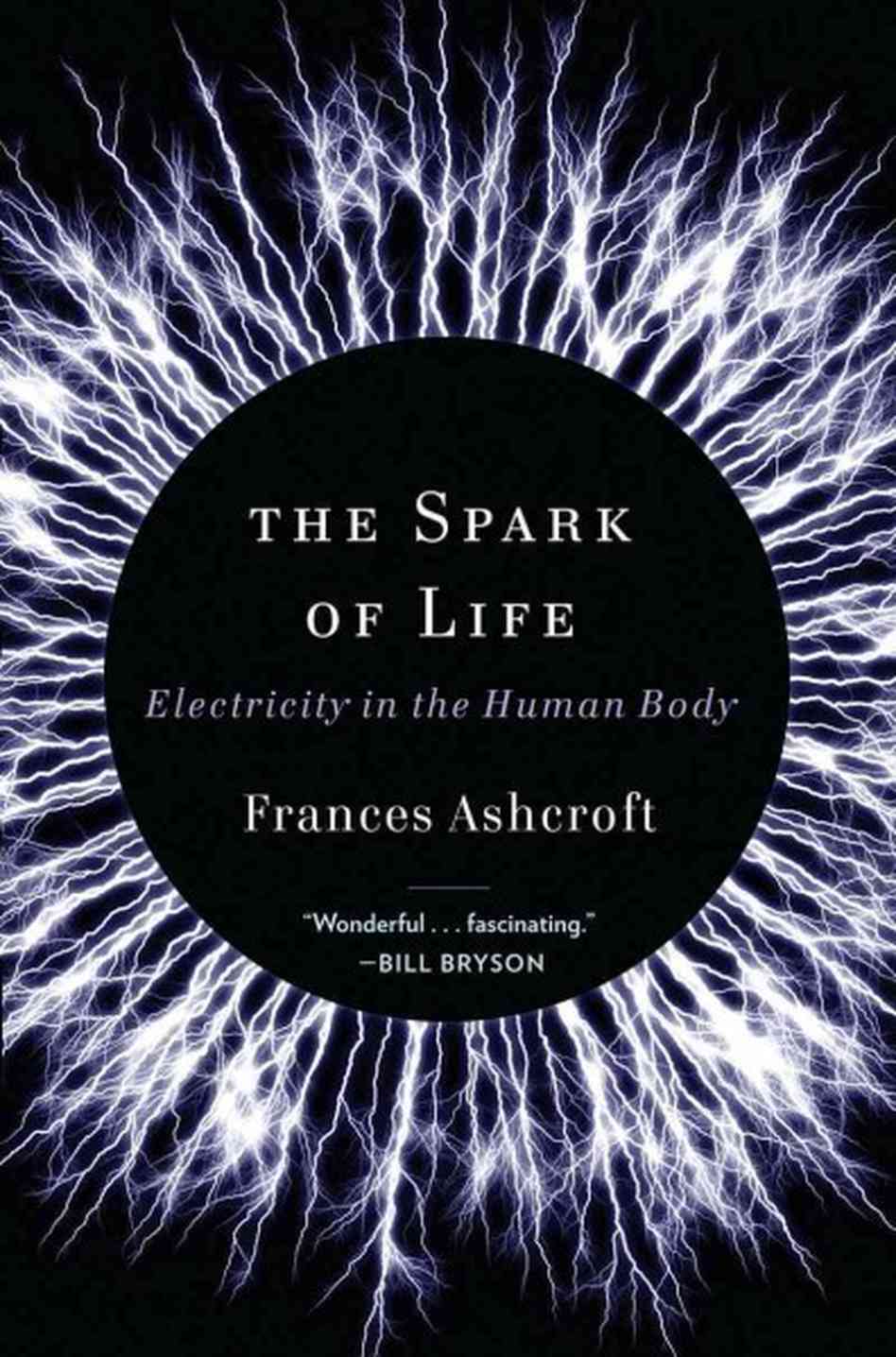
Front cover of The Spark of Life by Frances AshcroftThe Spark of Life: Electricity in the Human Body, Frances Ashcroft (Penguin 2013)

“Electricity in the Human Body” is the subtitle of this book. Make that the goat, frog, eel, shark, torpedo-ray, snake, platypus, spiny anteater, sooty shearwater and fruit-fly body too. And if Venus flytraps, maize and algae have bodies, throw them in next. Frances Ashcroft gives you a bargeload of buzz for your buck, a shedload of shock for your shekel: The Spark of Life describes the use of electricity by many different forms of life. But it discusses death a lot too, from lightning-strikes and electric chairs to heart-attacks and toxicology. Poisons can be a cheap and highly effective way of interfering with the electro-chemistry of the body:

The importance of sodium and potassium channels in generating the nerve impulse is demonstrated by the fact that a vast array of poisons from spiders, shellfish, sea anemones, frogs, snakes, scorpions and many other exotic creatures interact with these channels and thereby modify the function of nerve and muscle. … The tetrodotoxin contained in the liver and other tissues of this fish [the fugu or puffer-fish, Takifugu spp., Lagocephalus spp., etc] is a potent blocker of the sodium channels found in your nerves and skeletal muscles. It causes numbness and tingling of the lips and mouth within as little as thirty minutes … This sensation of “pins and needles” spreads rapidly to the face and neck, moves onto the fingers and toes, and is then followed by gradual paralysis of the skeletal muscles … Ultimately the respiratory muscles are paralysed, which can be fatal. The heart is not affected, as it has a different kind of sodium channel that is far less sensitive to tetrodotoxin. The toxin is also unable to cross the blood-brain barrier so that, rather horrifyingly, although unable to move and near death, the patient remains conscious. (ch. 3, “Acting on Impulse”, pp. 69-70)

In short, fugu-poisoning is the opposite of electrocution: it’s the absence rather than the excess of electricity that kills its victims. Those “channels” are a reminder that electro-chemistry could also be called electro-mechanics: unlike an electricity-filled computer, an electricity-filled body has moving parts – and in more ways than one. Our muscles move because ions move in and out of our cells. This means that a body has to be wet inside, not dry like a computer, but it’s easy to imagine a human brain controlling a robotic body. But would a brain still be conscious if it became metal-and-plastic too? Perhaps a brain has to be both soggy and sparky to be conscious.

The electrical nature of the brain certainly seems important, though that may be a superstitious conclusion. Electricity is a mysterious phenomenon and so is consciousness, so they seem to go together well. Ashcroft writes a lot about the sense-organs and the data they supply to the brain, but like all scientists she cannot explain how those data are turned into conscious experience as the maths-engine of the brain applies its neuro-functions and neuro-algorithms. However, she does suggest ways in which our consciousness might be expanded in future. Humans have colour vision, based on the three types of cone-cells in our eyes:

Most mammals, such as cats and dogs, have only two types of cone photopigment and so see only a limited range of colour … Other animals live in a world entirely without colour. But humans should not be too complacent, for we are far from having the best colour vision in the animal world and lag far behind the mantis shrimp, which enjoys ten or more different visual pigments. Even tropical fish possess four or five types of cones. (ch. 9, “The Doors of Perception”, pg. 199)

Bio-engineering may one day sharpen and extend all our senses, from sight and hearing to touch, taste and smell. It may also give us new senses, like the ability to form sound-pictures like bats and detect infra-red like pit-vipers. And why not X-rays and radio-waves too? It’s an exciting prospect, but in a sense it won’t be anything new: our new senses, like our old ones, will depend on nerve-impulses and the way they’re mashed and mathed in that handful of “electrified clay” known as the brain.

“Electrified clay” is Shelley’s phrase: like his wife Mary, he was fascinated by the early electric experiments of the Italian scientists Luigi Galvani and Alessandro Volta. Mary turned her fascination into a book called Frankenstein (1818) and her invention is part of the scientific history in this book. The story of bio-electricity is still going strong: there are electric mysteries in all kinds of bodies waiting to be solved. Maybe consciousness is one of them. And if science proves unable to crack consciousness, it’s certainly able to expand it. Reading this book is one way to experience the mind-expanding powers of science, but seeing like a mantis shrimp would be good too.

Ass You Like It

This is a guest post by Norman Foreman, B.A.


Mediaeval Catholic philosophers wrote about both praying and braying. The braying came from Buridan’s ass, a thought-experiment about choice and free will. Imagine a hungry ass set between two piles of hay that are identical in every way: size, shape, colour, tastiness and so on. Some philosophers argued that, if it had no reason to prefer one pile of hay to the other, the ass would be unable to choose and would therefore starve to death.

I don’t agree: inter alia, nervous systems don’t work symmetrically and we don’t experience objects as fully identical when they’re in different parts of our visual field. However, in a literary sense, I understand what it feels like to be Buridan’s ass. To assify myself, I start by imagining this:

• I’m offered £1000 to read a book by the transgressive author Will Self.

Would I accept? Yes. It would be distasteful, but I’d do it for £1000. Self’s writing is so bad that I might give the money back rather than finish the book, but I’d have a go. Now change the situation:

• I’m offered £1000 to read a book by the transgressive author Stewart Home.

Would I still accept? Yes. Again, it would be distasteful, but I’d do it for the money. Or I’d try, at least. The next step turns me into Buridan’s ass. I imagine this:

• I’m offered £1000 to read a book by either Will Self or Stewart Home (not both). And I have to make the choice for myself.

Now I’m on the horns of a dilemma. I would want the £1000, but I can’t decide which transgressive author I’d rather NOT read. Home is a downmarket version of Self, Self is an upmarket version of Home. It’s Self-as-chav vs Home-as-Oxbridge-grad. And/or vice versâ. They’re both keyly committed core components of the Guardianista community, with all that that implies in terms of issues around bad English, mixed metaphors and “in terms of”. I’m happy to say I’ve never read a book by either of them. So if I were offered £1000 to do so and had to choose either Self or Home, I couldn’t do it. Not unassisted. I’d have to toss a coin. Best of three. Or best of five dot dot dot


Previously pre-posted (please peruse):

Titus Graun
Ex-term-in-ate!
Reds under the Thread