Stories and Stars

A story is stranger than a star. Stronger too. What do I mean? I mean that the story has more secrets than a star and holds its secrets more tightly. A full scientific description of a star is easier than a full scientific description of a story. Stars are much more primitive, much closer to the fundamentals of the universe. They’re huge and impressive, but they’re relatively simple things: giant spheres of flaming gas. Mathematically speaking, they’re more compressible: you have to put fewer numbers into fewer formulae to model their behaviour. A universe with just stars in it isn’t very complex, as you would expect from the evolution of our own universe. There were stars in it long before there were stories.

A universe with stories in it, by contrast, is definitely complex. This is because stories depend on language and language is the scientific mother-lode, the most difficult and important problem of all. Or rather, the human brain is. The human brain understands a lot about stars, despite their distance, but relatively little about itself, despite brains being right on the spot. Consciousness is a tough nut to crack, for example. Perhaps it’s uncrackable. Language looks easier, but linguistics is still more like stamp-collecting than science. We can describe the structure of language in detail – use labels like “pluperfect subjunctive”, “synecdoche”, “bilabial fricative” and so on – but we don’t know how that structure is instantiated in the brain or where language came from. How did it evolve? How is it coded in the human genome? How does meaning get into and out of sounds and shapes, into and out of speech and writing? These are big, important and very interesting questions, but we’ve barely begun to answer them.
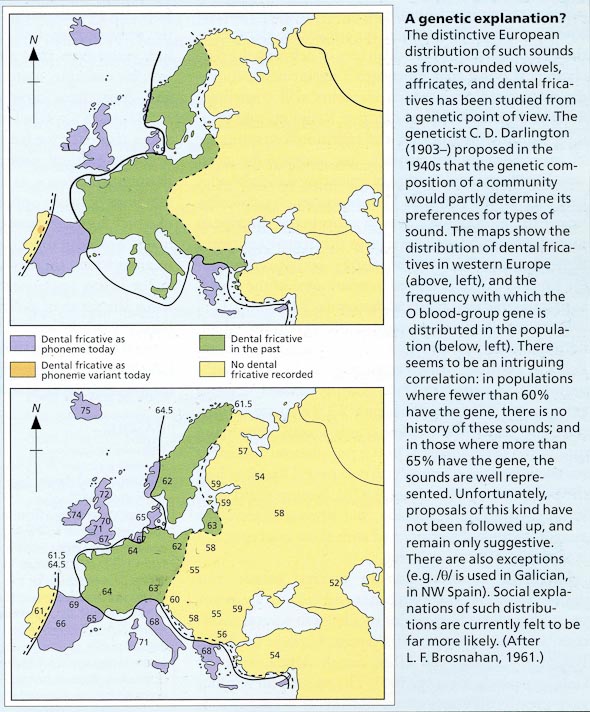
Distribution of dental fricatives and the O blood-group in Europe (from David Crystal's )

Distribution of dental fricatives and the O blood-group in Europe (from David Crystal’s Cambridge Encyclopedia of Language)

But certain things seem clear already. Language-genes must differ in important ways between different groups, influencing their linguistic skills and their preferences in phonetics and grammar. For example, there are some interesting correlations between blood-groups and use of dental fricatives in Europe. The invention of writing has exerted evolutionary pressures in Europe and Asia in ways it hasn’t in Africa, Australasia and the Americas. Glossogenetics, or the study of language and genes, will find important differences between races and within them, running parallel with differences in psychology and physiology. Language is a human universal, but that doesn’t mean one set of identical genes underlies the linguistic behaviour of all human groups. Skin, bones and blood are human universals too, but they differ between groups for genetic reasons.

Understanding the evolution and effects of these genetic differences is ultimately a mathematical exercise, and understanding language will be too. So will understanding the brain. For one thing, the brain must, at bottom, be a maths-engine or math-engine: a mechanism receiving, processing and sending information according to rules. But that’s a bit like saying fish are wet. Fish can’t escape water and human beings can’t escape mathematics. Nothing can: to exist is to stand in relation to other entities, to influence and be influenced by them, and mathematics is about that inter-play of entities. Or rather, that inter-play is Mathematics, with a big “M”, and nothing escapes it. Human beings have invented a way of modelling that fundamental micro- and macroscopic inter-play, which is mathematics with a small “m”. When they use this model, human beings can make mistakes. But when they do go wrong, they can do so in ways detectable to other human beings using the same model:

In 1853 William Shanks published his calculations of π to 707 decimal places. He used the same formula as [John] Machin and calculated in the process several logarithms to 137 decimal places, and the exact value of 2^721. A Victorian commentator asserted: “These tremendous stretches of calculation… prove more than the capacity of this or that computer for labor and accuracy; they show that there is in the community an increase in skill and courage…”

Augustus de Morgan thought he saw something else in Shanks’s labours. The digit 7 appeared suspiciously less often than the other digits, only 44 times against an average expected frequency of 61 for each digit. De Morgan calculated that the odds against such a low frequency were 45 to 1. De Morgan, or rather William Shanks, was wrong. In 1945, using a desk calculator, Ferguson found that Shanks had made an error; his calculation was wrong from place 528 onwards. Shanks, fortunately, was long dead. (The Penguin Dictionary of Curious and Interesting Numbers, 1986, David Wells, entry for π, pg. 51)

Unlike theology or politics, mathematics is not merely self-correcting, but multiply so: there are different routes to the same truths and different ways of testing a result. Science too is self-correcting and can test its results by different means, partly because science is a mathematical activity and partly because it is studying a mathematical artifact: the gigantic structure of space, matter and energy known as the Universe. Some scientists and philosophers have puzzled over what the physicist Eugene Wigner (1902-95) called “The Unreasonable Effectiveness of Mathematics in the Natural Sciences”. In his essay on the topic, Wigner tried to make two points:

The first point is that the enormous usefulness of mathematics in the natural sciences is something bordering on the mysterious and that there is no rational explanation for it. Second, it is just this uncanny usefulness of mathematical concepts that raises the question of the uniqueness of our physical theories. (Op. cit., in Communications in Pure and Applied Mathematics, vol. 13, No. I, February 1960)

I disagree with Wigner: it is not mysterious or uncanny and there is a rational explanation for it. The “effectiveness” of small-m maths for scientists is just as reasonable as the effectiveness of fins for fish or of wings for birds. The sea is water and the sky is air. The universe contains both sea and sky: and the universe is maths. Fins and wings are mechanisms that allow fish and birds to operate effectively in their water- and air-filled environments. Maths is a mechanism that allows scientists to operate effectively in their maths-filled environment. Scientists have, in a sense, evolved towards using maths just as fish and birds have evolved towards using fins and wings. Men have always used language to model the universe, but language is not “unreasonably effective” for understanding the universe. It isn’t effective at all.

It is effective, however, in manipulating and controlling other human beings, which explains its importance in politics and theology. In politics, language is used to manipulate; in science, language is used to explain. That is why mathematics is so important in science and so carefully avoided in politics. And in certain academic disciplines. But the paradox is that physics is much more intellectually demanding than, say, literary theory because the raw stuff of physics is actually much simpler than literature. To understand the paradox, imagine that two kinds of boulder are strewn on a plain. One kind is huge and made of black granite. The other kind is relatively small and made of chalk. Two tribes of academic live on the plain, one devoted to studying the black granite boulders, the other devoted to studying the chalk boulders.

The granite academics, being unable to lift or cut into their boulders, will have no need of physical strength or tool-making ability. Instead, they will justify their existence by sitting on their boulders and telling stories about them or describing their bumps and contours in minute detail. The chalk academics, by contrast, will be lifting and cutting into their boulders and will know far more about them. So the chalk academics will need physical strength and tool-making ability. In other words, physics, being inherently simpler than literature, is within the grasp of a sufficiently powerful human intellect in a way literature is not. Appreciating literature depends on intuition rather than intellect. And so strong intellects are able to lift and cut into the problems of physics as they aren’t able to lift and cut into the problems of literature, because the problems of literature depend on consciousness and on the hugely complex mechanisms of language, society and psychology.

Intuition is extremely powerful, but isn’t under conscious control like intellect and isn’t transparent to consciousness in the same way. In the fullest sense, it includes the senses, but who can control his own vision and hearing or understand how they turn the raw stuff of the sense-organs into the magic tapestry of conscious experience? Flickering nerve impulses create a world of sight, sound, scent, taste and touch and human beings are able to turn that world into the symbols of language, then extract it again from the symbols. This linguifaction is a far more complex process than the ignifaction that drives a star. At present it’s beyond the grasp of our intellects, so the people who study it don’t need and don’t build intellectual muscle in the way that physicists do.

Or one could say that literature is at a higher level of physics. In theory, it is ultimately and entirely reducible to physics, but the mathematics governing its emergence from physics are complex and not well-understood. It’s like the difference between a caterpillar and a butterfly. They are two aspects of one creature, but it’s difficult to understand how one becomes the other, as a caterpillar dissolves into chemical soup inside a chrysalis and turns into something entirely different in appearance and behaviour. Modelling the behaviour of a caterpillar is simpler than modelling the behaviour of a butterfly. A caterpillar’s brain has less to cope with than a butterfly’s. Caterpillars crawl and butterflies fly. Caterpillars eat and butterflies mate. And so on.

Stars can be compared to caterpillars, stories to butterflies. It’s easier to explain stars than to explain stories. And one of the things we don’t understand about stories is how we understand stories.

2:1 Now when Jesus was born in Bethlehem of Judaea in the days of Herod the king, behold, there came wise men from the east to Jerusalem, 2:2 Saying, Where is he that is born King of the Jews? for we have seen his star in the east, and are come to worship him. 2:3 When Herod the king had heard these things, he was troubled, and all Jerusalem with him. 2:4 And when he had gathered all the chief priests and scribes of the people together, he demanded of them where Christ should be born. 2:5 And they said unto him, In Bethlehem of Judaea: for thus it is written by the prophet, 2:6 And thou Bethlehem, in the land of Juda, art not the least among the princes of Juda: for out of thee shall come a Governor, that shall rule my people Israel. 2:7 Then Herod, when he had privily called the wise men, enquired of them diligently what time the star appeared. 2:8 And he sent them to Bethlehem, and said, Go and search diligently for the young child; and when ye have found him, bring me word again, that I may come and worship him also. 2:9 When they had heard the king, they departed; and, lo, the star, which they saw in the east, went before them, till it came and stood over where the young child was. 2:10 When they saw the star, they rejoiced with exceeding great joy. 2:11 And when they were come into the house, they saw the young child with Mary his mother, and fell down, and worshipped him: and when they had opened their treasures, they presented unto him gifts; gold, and frankincense and myrrh. – From The Gospel According to Saint Matthew.
Lit Is It

You know, I’m getting worried at my inability to have unmediated experiences. Everything reminds me of something in literature. It reminds me of this passage in Brideshead Revisited (1945):

“Oh, don’t talk in that damned bounderish way. Why must you see everything second-hand? Why must this be a play? Why must my conscience be a Pre-Raphaelite picture?”

“It’s a way I have.”

“I hate it.” (Op. cit.)

Neuclid on the Block

How many blows does it take to demolish a wall with a hammer? It depends on the wall and the hammer, of course. If the wall is reality and the hammer is mathematics, you can do it in three blows, like this:

α’. Σημεῖόν ἐστιν, οὗ μέρος οὐθέν.
β’. Γραμμὴ δὲ μῆκος ἀπλατές.
γ’. Γραμμῆς δὲ πέρατα σημεῖα.

1. A point is that of which there is no part.
2. A line is a length without breadth.
3. The extremities of a line are points.

That is the astonishing, world-shattering opening in one of the strangest – and sanest – books ever written. It’s twenty-three centuries old, was written by an Alexandrian mathematician called Euclid (fl. 300 B.C.), and has been pored over by everyone from Abraham Lincoln to Bertrand Russell by way of Edna St. Vincent Millay. Its title is highly appropriate: Στοιχεῖα, or Elements. Physical reality is composed of chemical elements; mathematical reality is composed of logical elements. The second reality is much bigger – infinitely bigger, in fact. In his Elements, Euclid slipped the bonds of time, space and matter by demolishing the walls of reality with a mathematical hammer and escaping into a world of pure abstraction.

• Continue reading Neuclid on the Block

Rep-Tile Reflections

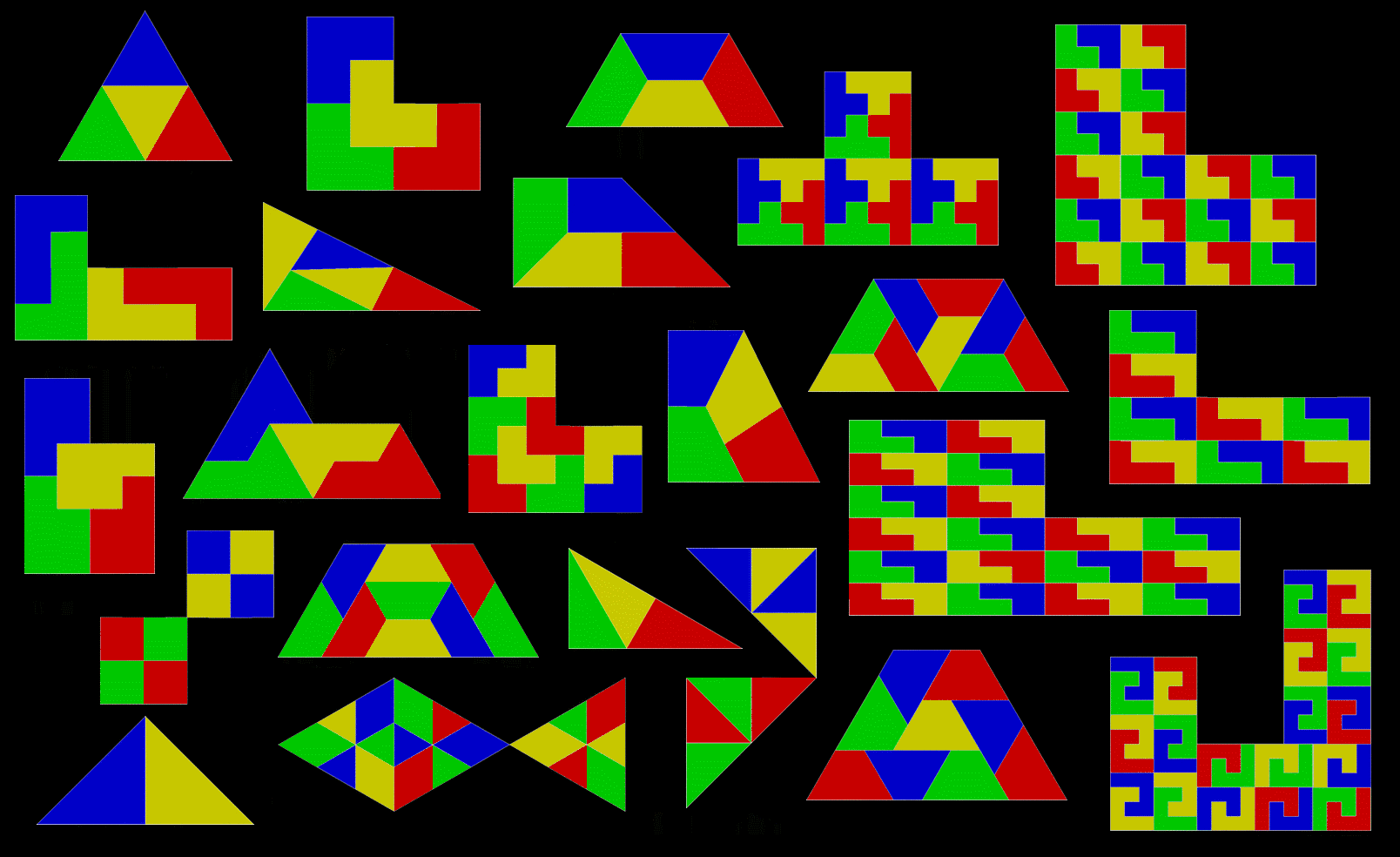
A rep-tile, or repeat-tile, is a two-dimensional shape that can be divided completely into copies of itself. A square, for example, can be divided into smaller squares: four or nine or sixteen, and so on. Rectangles are the same. Triangles can be divided into two copies or three or more, depending on their precise shape. Here are some rep-tiles, including various rep-triangles:

Various rep-tiles

Various rep-tiles — click for larger image

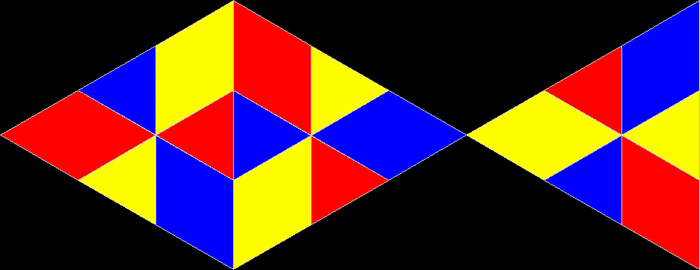
Some are simple, some are complex. Some have special names: the sphinx and the fish are easy to spot. I like both of those, particularly the fish. It would make a good symbol for a religion: richly evocative of life, eternally sub-divisible of self: 1, 9, 81, 729, 6561, 59049, 531441… I also like the double-square, the double-triangle and the T-tile in the top row. But perhaps the most potent, to my mind, is the half-square in the bottom left-hand corner. A single stroke sub-divides it, yet its hypotenuse, or longer side, represents the mysterious and mind-expanding √2, a number that exists nowhere in the physical universe. But the half-square itself is mind-expanding. All rep-tiles are. If intelligent life exists elsewhere in the universe, perhaps other minds are contemplating the fish or the sphinx or the half-square and musing thus: “If intelligent life exists elsewhere in the universe, perhaps…”

Mathematics unites human minds across barriers of language, culture and politics. But perhaps it unites minds across barriers of biology too. Imagine a form of life based on silicon or gas, on unguessable combinations of matter and energy in unreachable, unobservable parts of the universe. If it’s intelligent life and has discovered mathematics, it may also have discovered rep-tiles. And it may be contemplating the possibility of other minds doing the same. And why confine these speculations to this universe and this reality? In parallel universes, in alternative realities, minds may be contemplating rep-tiles and speculating in the same way. If our universe ends in a Big Crunch and then explodes again in a Big Bang, intelligent life may rise again and discover rep-tiles again and speculate again on their implications. The wildest speculation of all would be to hypothesize a psycho-math-space, a mental realm beyond time and matter where, in mathemystic communion, suitably attuned and aware minds can sense each other’s presence and even communicate.

The rep-tile known as the fish

Credo in Piscem…

So meditate on the fish or the sphinx or the half-square. Do you feel the tendrils of an alien mind brush your own? Are you in communion with a stone-being from the far past, a fire-being from the far future, a hive-being from a parallel universe? Well, probably not. And even if you do feel those mental tendrils, how would you know they’re really there? No, I doubt that the psycho-math-space exists. But it might and science might prove its existence one day. Another possibility is that there is no other intelligent life, never has been, and never will be. We may be the only ones who will ever muse on rep-tiles and other aspects of mathematics. Somehow, though, rep-tiles themselves seem to say that this isn’t so. Particularly the fish. It mimics life and can spawn itself eternally. As I said, it would make a good symbol for a religion: a mathemysticism of trans-biological communion. Credo in Piscem, Unum et Infinitum et Æternum. “I believe in the Fish, One, Unending, Everlasting.” That might be the motto of the religion. If you want to join it, simply wish upon the fish and muse on other minds, around other stars, who may be doing the same.

Numbered Days

Numbered Days: Literature, Mathematics and the Deus Ex Machina

Think French. Think genius. Think rebellious, tormented, iconoclastic. Finally, think dead tragically young in the nineteenth century… And if you’re thinking of anyone at all, I think you’ll be thinking of Rimbaud.

And you’d be right to do so. But only half-right. Because there were in fact two rebellious, tormented, iconoclastic French geniuses who died tragically young in the nineteenth century. One was called Arthur Rimbaud (1854-91) and the other Évariste Galois (1811-32). Rimbaud is still famous, Galois never has been. At least not to the general educated public, though on all objective criteria – but one – you might expect his fame to be greater. In every way – but one – Galois has the more powerful appeal.

Continue reading Numbered Days

Bones, Blinks, Books

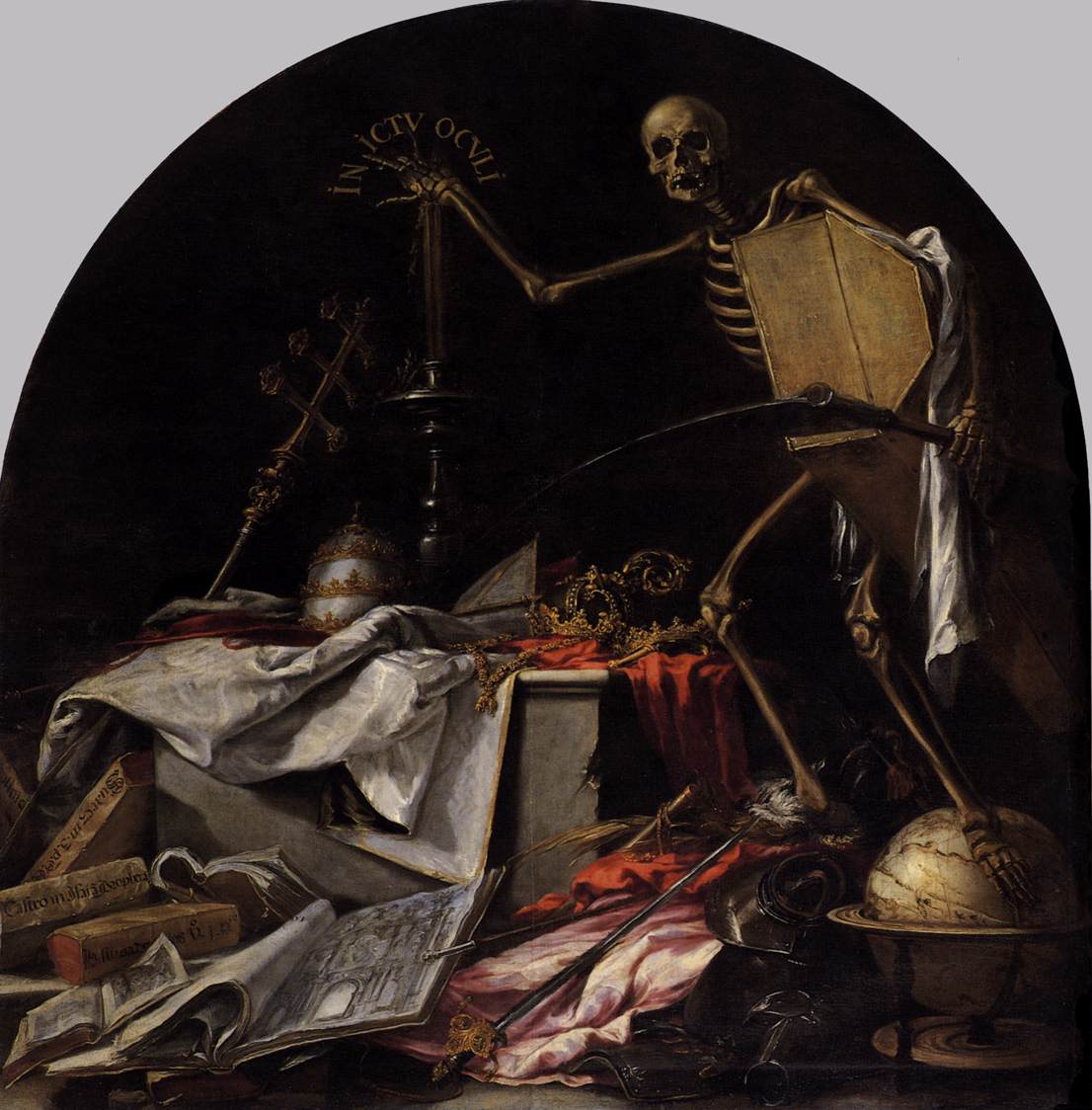
In Ictu Oculi by Juan de Valdés Leal (c. 1671)

In Ictu Oculi (In the Blink of an Eye) by Juan de Valdés Leal (c. 1671).

Double Bubble

The most mysterious thing in the universe is also the most intimate: consciousness. It’s an inti-mystery, something we experience constantly at first hand and yet cannot describe or explain. We are each a double bubble: a bubble of flesh and a bubble of conscious experience. The second bubble bursts regularly, when we sleep. Sooner or later, the first bubble will burst too, when we die. And that will be it for the second bubble, the bubble of consciousness. Or will it? Can consciousness survive death? Can it exist without a material substrate? Or without a particular kind of material substrate: the soggy, sparky substance of the brain? Can the clean, dry metal of a computer be conscious? Who knows? The double bubble attracts lots of double-u’s: what, where, why, when, (w)how. What is consciousness? What is its relation to matter? Is it king or courtier? Where does it exist? Why does it exist? When? And how?

Continue reading Double Bubble

Whip Poor Wilhelm

Nietzscheans are a lot like Christians, just as Nietzsche was a lot like Christ. They’re often very bad adverts for their master, and their master would have been horrified to see some of his followers. Or perhaps not: Nietzsche believed in amor fati, or acceptance of fate, after all. He also thought that the omelette of the Übermensch wouldn’t be made without breaking a lot of human eggs. But I’m sure amusement, rather than horror, would have been his reaction to Bertrand Russell’s very hostile chapter about him in A History of Western Philosophy (1945). Russell wasn’t everything Nietzsche despised – I’m not sure a single human being could combine everything Nietzsche despised – but he came pretty close. He was liberal, humanitarian, altruistic, philanthropic, philogynist, and English (kind of). If Russell had liked Nietzsche, Nietzsche would surely have whirled in his grave. But Russell didn’t, and certainly not from the perspective of the Second World War, when he wrote A History of Western Philosophy and Nietzsche still seemed heavily implicated in Nazism.

He wasn’t, of course: the naughty and nasty Nazis misinterpreted him very badly. But he’s much easier for Nazis to misinterpret than Marx is, as proved by the respective status of these two philosophers in Nazi Germany and the Soviet Union. Russell doesn’t so much misinterpret him as mutilate and muffle him. I would have thought that anyone, Nietzschophile or not, would acknowledge the intellectual power and range of Nietzsche’s writing. I have never felt so strongly in the presence of genius as when I first read one of his books. In Wagnerian terms, he combines Wotan with Donner, infusing the subtlety and cunning of Odin into the strength and energy of Thor. I can’t read him in German and he himself said he’d have preferred to write in French. But enough of his power comes across in English even for Russell, I’d’ve thought. Not so, and not so for many other Anglophone readers, who dismiss Nietzsche as meaningless and trivial. You might as well call the sun dull and thunder quiet: Nietzsche blazes and bellows with meaning. He also, unlike many of his followers, has a sense of humour. Russell did too, but his polemic refuses to acknowledge Nietzsche’s jokes and playfulness:

His general outlook remained very similar to that of Wagner in the Ring; Nietzsche’s superman is very like Siegfried, except that he knows Greek. This may seem odd, but that is not my fault. In spite of Nietzsche’s criticism of the romantics, his outlook owes much to them; it is that of aristocratic anarchism, like Byron’s, and one is not surprised to find him admiring Byron. He attempts to combine two sets of values which are not easily harmonized: on the one hand he likes ruthlessness, war, and aristocratic pride; on the other hand, he loves philosophy and literature and the arts, especially music. Historically, these values coexisted in the Renaissance; Pope Julius II, fighting for Bologna and employing Michelangelo, might be taken as the sort of man whom Nietzsche would wish to see in control of governments. (Op. cit.)

Yes, but he justifies his likes, loves, and loathings in some of the most original, exhilarating, and interesting books ever written. Perhaps the problem was the one diagnosed by Lytton Strachey in Eminent Victorians (1918) when he discussed the antagonism between Newman and Charles Kingsley: “The controversy was not a very fruitful one, chiefly because Kingsley could no more understand the nature of Newman’s intelligence than a subaltern in a line regiment can understand a Brahmin of Benares.” Russell was the subaltern, Nietzsche the Brahmin. If Russell was clever, Nietzsche was cleverer. If Russell had read widely, Nietzsche had read wider. Russell was undoubtedly better at maths, but there have been lots of good mathematicians. Nietzsche could have echoed what Beethoven is supposed to have said to an aristocrat who offended him: “There are and will be a thousand princes; there is only one Beethoven.” Without Russell, I don’t think the world would be a very different place: other people would have thought and written pretty much what he did. It’s difficult to say how different the world would be without Nietzsche, but one thing is certain: it would be less interesting and contain less iconoclasm. Nietzsche thought and wrote things no-one else would have or could have. As a philosopher, Russell was a competent but replaceable journalist, Nietzsche a brilliant and irreplaceable poet. He appeals to writers and artists partly because he confirms their self-importance, but the confirmation hasn’t always been wrong. I think a Deus ex Machina is likelier than the Übermensch, but either way mankind will be surpassed and Nietzsche was the one to prophesy it, not Russell. Born earlier, living shorter, he saw further, wrote better, and will be remembered longer. His moustache was bigger too. Russell was wrong to whip poor Wilhelm, but Wilhelm wouldn’t have wanted it any other way.

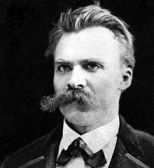
Nietzsche c. 1875

Nietzsche c. 1875

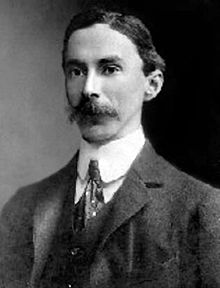
Bertrand Russell in 1907

Russell in 1907

At the Mountains of Mathness

Shakespeare was a gilded ape.

More later.

For now, join me in wondering something I’ve often wondered: What it would be like to experience an asteroid striking the earth. You might be dead before you knew it. You might be woken by the glare and be dead a few seconds later. Slain by the sound of the strike alone. Or the heat alone. There are asteroids that could wipe out every human on earth, or every vertebrate, or every complex form of life. Or you might survive and wish you hadn’t. After some asteroid-strikes, the living would envy the dead.

Continue reading At the Mountains of Mathness