Pair on a D-String

What’s special about the binary number 10011 and the ternary number 1001120221? To answer the question, you have to see double. 10011 contains all possible pairs of numbers created from 0 and 1, just as 1001120221 contains all possible pairs created from 0, 1 and 2. And each pair appears exactly once. Now try the quaternary number 10011202130322331. That contains exactly one example of all possible pairs created from 0, 1, 2 and 3.

But there’s something more: in each case, the number is the smallest possible number with that property. As the bases get higher, that gets less obvious. In quinary, or base 5, the smallest number containing all possible pairs is 10011202130314042232433441. The digits look increasingly random. And what about base 10? There are 100 possible pairs of numbers created from the digits 0 to 9, starting with 00, 01, 02… and ending with …97, 98, 99. To accommodate 100 pairs, the all-pair number in base 10 has to be 101 digits long. It’s a string of digits, so let’s call it a d-string:

1, 0, 0, 1, 1, 2, 0, 2, 1, 3, 0, 3, 1, 4, 0, 4, 1, 5, 0, 5, 1, 6, 0, 6, 1, 7, 0, 7, 1, 8, 0, 8, 1, 9, 0, 9, 2, 2, 3, 2, 4, 2, 5, 2, 6, 2, 7, 2, 8, 2, 9, 3, 3, 4, 3, 5, 3, 6, 3, 7, 3, 8, 3, 9, 4, 4, 5, 4, 6, 4, 7, 4, 8, 4, 9, 5, 5, 6, 5, 7, 5, 8, 5, 9, 6, 6, 7, 6, 8, 6, 9, 7, 7, 8, 7, 9, 8, 8, 9, 9, 1

Again, the digits look increasingly random. They aren’t: they’re strictly determined. The d-string is in harmony. As the digits are generated from the left, they impose restrictions on the digits that appear later. It might appear that you could shift larger digits to the right and make the number smaller, but if you do that you no longer meet the conditions and the d-string collapses into dischord.

Now examine d-strings containing all possible triplets created from the digits of bases 2, 3 and 4:

1, 0, 0, 0, 1, 0, 1, 1, 1, 0 in base 2 = 558 in base 10

1, 0, 0, 0, 1, 0, 1, 1, 0, 2, 0, 0, 2, 1, 1, 1, 2, 0, 1, 2, 1, 2, 2, 0, 2, 2, 2, 1, 0 in base 3 = 23203495920756 in base 10

1, 0, 0, 0, 1, 0, 1, 1, 0, 2, 0, 0, 2, 1, 0, 3, 0, 0, 3, 1, 1, 1, 2, 0, 1, 2, 1, 1, 3, 0, 1, 3, 1, 2, 2, 0, 2, 2, 1, 2, 3, 0, 2, 3, 1, 3, 2, 0, 3, 2, 1, 3, 3, 0, 3, 3, 2, 2, 2, 3, 2, 3, 3, 3, 1, 0 in base 4 = 1366872334420014346556556812432766057460 in base 10

Note that there are 8 possible triplets in base 2, so the all-triplet number has to be 10 digits long. In base 10, there are 1000 possible triplets, so the all-triplet number has to be 1002 digits long. Here it is:

1, 0, 0, 0, 1, 0, 1, 1, 0, 2, 0, 0, 2, 1, 0, 3, 0, 0, 3, 1, 0, 4, 0, 0, 4, 1, 0, 5, 0, 0, 5, 1, 0, 6, 0, 0, 6, 1, 0, 7, 0, 0, 7, 1, 0, 8, 0, 0, 8, 1, 0, 9, 0, 0, 9, 1, 1, 1, 2, 0, 1, 2, 1, 1, 3, 0, 1, 3, 1, 1, 4, 0, 1, 4, 1, 1, 5, 0, 1, 5, 1, 1, 6, 0, 1, 6, 1, 1, 7, 0, 1, 7, 1, 1, 8, 0, 1, 8, 1, 1, 9, 0, 1, 9, 1, 2, 2, 0, 2, 2, 1, 2, 3, 0, 2, 3, 1, 2, 4, 0, 2, 4, 1, 2, 5, 0, 2, 5, 1, 2, 6, 0, 2, 6, 1, 2, 7, 0, 2, 7, 1, 2, 8, 0, 2, 8, 1, 2, 9, 0, 2, 9, 1, 3, 2, 0, 3, 2, 1, 3, 3, 0, 3, 3, 1, 3, 4, 0, 3, 4, 1, 3, 5, 0, 3, 5, 1, 3, 6, 0, 3, 6, 1, 3, 7, 0, 3, 7, 1, 3, 8, 0, 3, 8, 1, 3, 9, 0, 3, 9, 1, 4, 2, 0, 4, 2, 1, 4, 3, 0, 4, 3, 1, 4, 4, 0, 4, 4, 1, 4, 5, 0, 4, 5, 1, 4, 6, 0, 4, 6, 1, 4, 7, 0, 4, 7, 1, 4, 8, 0, 4, 8, 1, 4, 9, 0, 4, 9, 1, 5, 2, 0, 5, 2, 1, 5, 3, 0, 5, 3, 1, 5, 4, 0, 5, 4, 1, 5, 5, 0, 5, 5, 1, 5, 6, 0, 5, 6, 1, 5, 7, 0, 5, 7, 1, 5, 8, 0, 5, 8, 1, 5, 9, 0, 5, 9, 1, 6, 2, 0, 6, 2, 1, 6, 3, 0, 6, 3, 1, 6, 4, 0, 6, 4, 1, 6, 5, 0, 6, 5, 1, 6, 6, 0, 6, 6, 1, 6, 7, 0, 6, 7, 1, 6, 8, 0, 6, 8, 1, 6, 9, 0, 6, 9, 1, 7, 2, 0, 7, 2, 1, 7, 3, 0, 7, 3, 1, 7, 4, 0, 7, 4, 1, 7, 5, 0, 7, 5, 1, 7, 6, 0, 7, 6, 1, 7, 7, 0, 7, 7, 1, 7, 8, 0, 7, 8, 1, 7, 9, 0, 7, 9, 1, 8, 2, 0, 8, 2, 1, 8, 3, 0, 8, 3, 1, 8, 4, 0, 8, 4, 1, 8, 5, 0, 8, 5, 1, 8, 6, 0, 8, 6, 1, 8, 7, 0, 8, 7, 1, 8, 8, 0, 8, 8, 1, 8, 9, 0, 8, 9, 1, 9, 2, 0, 9, 2, 1, 9, 3, 0, 9, 3, 1, 9, 4, 0, 9, 4, 1, 9, 5, 0, 9, 5, 1, 9, 6, 0, 9, 6, 1, 9, 7, 0, 9, 7, 1, 9, 8, 0, 9, 8, 1, 9, 9, 0, 9, 9, 2, 2, 2, 3, 2, 2, 4, 2, 2, 5, 2, 2, 6, 2, 2, 7, 2, 2, 8, 2, 2, 9, 2, 3, 3, 2, 3, 4, 2, 3, 5, 2, 3, 6, 2, 3, 7, 2, 3, 8, 2, 3, 9, 2, 4, 3, 2, 4, 4, 2, 4, 5, 2, 4, 6, 2, 4, 7, 2, 4, 8, 2, 4, 9, 2, 5, 3, 2, 5, 4, 2, 5, 5, 2, 5, 6, 2, 5, 7, 2, 5, 8, 2, 5, 9, 2, 6, 3, 2, 6, 4, 2, 6, 5, 2, 6, 6, 2, 6, 7, 2, 6, 8, 2, 6, 9, 2, 7, 3, 2, 7, 4, 2, 7, 5, 2, 7, 6, 2, 7, 7, 2, 7, 8, 2, 7, 9, 2, 8, 3, 2, 8, 4, 2, 8, 5, 2, 8, 6, 2, 8, 7, 2, 8, 8, 2, 8, 9, 2, 9, 3, 2, 9, 4, 2, 9, 5, 2, 9, 6, 2, 9, 7, 2, 9, 8, 2, 9, 9, 3, 3, 3, 4, 3, 3, 5, 3, 3, 6, 3, 3, 7, 3, 3, 8, 3, 3, 9, 3, 4, 4, 3, 4, 5, 3, 4, 6, 3, 4, 7, 3, 4, 8, 3, 4, 9, 3, 5, 4, 3, 5, 5, 3, 5, 6, 3, 5, 7, 3, 5, 8, 3, 5, 9, 3, 6, 4, 3, 6, 5, 3, 6, 6, 3, 6, 7, 3, 6, 8, 3, 6, 9, 3, 7, 4, 3, 7, 5, 3, 7, 6, 3, 7, 7, 3, 7, 8, 3, 7, 9, 3, 8, 4, 3, 8, 5, 3, 8, 6, 3, 8, 7, 3, 8, 8, 3, 8, 9, 3, 9, 4, 3, 9, 5, 3, 9, 6, 3, 9, 7, 3, 9, 8, 3, 9, 9, 4, 4, 4, 5, 4, 4, 6, 4, 4, 7, 4, 4, 8, 4, 4, 9, 4, 5, 5, 4, 5, 6, 4, 5, 7, 4, 5, 8, 4, 5, 9, 4, 6, 5, 4, 6, 6, 4, 6, 7, 4, 6, 8, 4, 6, 9, 4, 7, 5, 4, 7, 6, 4, 7, 7, 4, 7, 8, 4, 7, 9, 4, 8, 5, 4, 8, 6, 4, 8, 7, 4, 8, 8, 4, 8, 9, 4, 9, 5, 4, 9, 6, 4, 9, 7, 4, 9, 8, 4, 9, 9, 5, 5, 5, 6, 5, 5, 7, 5, 5, 8, 5, 5, 9, 5, 6, 6, 5, 6, 7, 5, 6, 8, 5, 6, 9, 5, 7, 6, 5, 7, 7, 5, 7, 8, 5, 7, 9, 5, 8, 6, 5, 8, 7, 5, 8, 8, 5, 8, 9, 5, 9, 6, 5, 9, 7, 5, 9, 8, 5, 9, 9, 6, 6, 6, 7, 6, 6, 8, 6, 6, 9, 6, 7, 7, 6, 7, 8, 6, 7, 9, 6, 8, 7, 6, 8, 8, 6, 8, 9, 6, 9, 7, 6, 9, 8, 6, 9, 9, 7, 7, 7, 8, 7, 7, 9, 7, 8, 8, 7, 8, 9, 7, 9, 8, 7, 9, 9, 8, 8, 8, 9, 8, 9, 9, 9, 1, 0

Consider the quadruplet number in base 10. There are 10000 possible quadruplets, so the all-quadruplet number is 10003 digits long. And so on. In general, the “all n-tuplet” number in base b contains b^n n-tuplets and is (b^n + n-1) digits long. If b = 10 and n = 4, the d-string starts like this:

1, 0, 0, 0, 0, 1, 0, 0, 1, 1, 0, 0, 2, 0, 0, 0, 2, 1, 0, 0, 3, 0, 0, 0, 3, 1, 0, 0, 4, 0, 0, 0, 4, 1, 0, 0, 5, 0, 0, 0, 5, 1, 0, 0, 6, 0, 0, 0, 6, 1, 0, 0, 7, 0, 0, 0, 7, 1, 0, 0, 8, 0, 0, 0, 8, 1, 0, 0, 9, 0, 0, 0, 9, 1, 0, 1, 0, 1, 1, 1, 0, 1, 2, 0, 0, 1, 2, 1, 0, 1, 3, 0, 0, 1, 3, 1, 0, 1, 4, 0, 0, 1, 4, 1, 0, 1, 5, 0, 0, 1, 5, 1, 0, 1, 6, 0, 0, 1, 6, 1, 0, 1, 7, 0, 0, 1, 7, 1, 0, 1, 8, 0, 0, 1, 8, 1, 0, 1, 9, 0, 0, 1, 9, 1, 0, 2, 0, 1, 0, 2, 1, 1, 0, 2, 2, 0, 0, 2, 2, 1, 0, 2, 3, 0, 0, 2, 3, 1, 0, 2, 4, 0, 0, 2, 4, 1, 0, 2, 5, 0, 0, 2, 5, 1, 0, 2, 6…

What about when n = 100? Now the d-string is ungraspably huge – too big to fit in the known universe. But it starts with 1 followed by a hundred 0s and every digit after that is entirely determined. Perhaps there’s a simple way to calculate any given digit, given its position in the d-string. Either way, what is the ontological status of the d-string for n=100? Does it exist in some Platonic realm of number, independent of physical reality?

Some would say that it does, just like √2 or π or e. I disagree. I don’t believe in a Platonic realm. If the universe or multiverse ceased to exist, numbers and mathematics in general would also cease to exist. But this isn’t to say that mathematics depends on physical reality. It doesn’t. Nor does physical reality depend on mathematics. Rather, physical reality necessarily embodies mathematics, which might be defined as “entity in interrelation”. Humans have invented small-m mathematics, a symbolic way of expressing the physical embodiment of big-m mathematics.

But small-m mathematics is actually more powerful and far-ranging, because it increases the number, range and power of entities and their interaction. Where are √2 and π in physical reality? Nowhere. You could say that early mathematicians saw their shadows, cast from a Platonic realm, and deduced their existence in that realm, but that’s a metaphor. Do all events, like avalanches or thunderstorms, exist in some Platonic realm before they are realized? No, they arise as physical entities interact according to laws of physics. In a more abstract way, √2 and π arise as entities of another kind interact according to laws of logic: the concepts of a square and its diagonal, of a circle and its diameter.

The d-strings discussed above arise from the interaction of simpler concepts: the finite set of digits in a base and the ways in which they can be combined. Platonism is unnecessary: the arc and spray of a fountain are explained by the pressure of the water, the design of the pipes, the arrangement of the nozzles, not by reference to an eternal archetype of water and spray. In small-m mathematics, there are an infinite number of fountains, because small-m mathematics opens a door to a big-U universe, infinitely larger and richer than the small-u universe of physical reality.

The Mill to Power

Reading about Searle’s Chinese Room Argument at the Stanford Encyclopedia of Philosophy, I came across “Leibniz’s Mill” for the first time. At least, I think it was the first time:

It must be confessed, however, that perception, and that which depends upon it, are inexplicable by mechanical causes, that is to say, by figures and motions. Supposing that there were a machine whose structure produced thought, sensation, and perception, we could conceive of it as increased in size with the same proportions until one was able to enter into its interior, as he would into a mill. Now, on going into it he would find only pieces working upon one another, but never would he find anything to explain perception. It is accordingly in the simple substance, and not in the compound nor in a machine that the perception is to be sought. Furthermore, there is nothing besides perceptions and their changes to be found in the simple substance. And it is in these alone that all the internal activities of the simple substance can consist. (Monadology, 1714, section #17)

Andererseits muß man gestehen, daß die Vorstellungen, und Alles, was von ihnen abhängt, aus mechanischen Gründen, dergleichen körperliche Gestalten und Bewegungen sind, unmöglich erklärt werden können. Man stelle sich eine Maschine vor, deren Structur so eingerichtet sei, daß sie zu denken, zu fühlen und überhaupt vorzustellen vermöge und lasse sie unter Beibehaltung derselben Verhältnisse so anwachsen, daß man hinein, wie in das Gebäude einer Mühle eintreten kann. Dies vorausgesetzt, wird man bei Besichtigung des Innern nichts Anderes finden, als etliche Triebwerke, deren eins das andere bewegt, aber gar nichts, was hinreichen würde, den Grund irgend einer Vorstellung abzugeben. Die letztere gehört ausschließlich der einfachen Substanz an, nicht der zusammengesetzten, und dort, nicht hier, muß man sie suchen. Auch sind Vorstellungen und ihre Veränderungen zugleich das Einzige, was man in der einfachen Substanz antrifft. (Monadologie, 1714)

We can see that Leibniz’s argument applies to mechanism in general, not simply to the machines he could conceive in his own day. He’s claiming that consciousness isn’t corporeal. It can’t generated by interacting parts or particles. And intuitively, he seems to be right. How could a machine or mechanism, however complicated, be conscious? Intuition would say that it couldn’t. But is intuition correct? If we examine the brain, we see that consciousness begins with mechanism. Vision and the other senses are certainly electro-chemical processes in the beginning. Perhaps in the end too.

Some puzzles arise if we assume otherwise. If consciousness isn’t mechanistic, how does it interact with mechanism? If it’s immaterial, how does it interact with matter? But those questions go back much further, to Greek atomists like Democritus (c. 460-370 BC):

Δοκεῖ δὲ αὐτῶι τάδε· ἀρχὰς εἶναι τῶν ὅλων ἀτόμους καὶ κενόν, τὰ δ’ἀλλα πάντα νενομίσθαι.

He taught that the first principles of the universe are atoms and void; everything else is merely thought to exist.

Νόμωι (γάρ φησι) γλυκὺ καὶ νόμωι πικρόν, νόμωι θερμόν, νόμωι ψυχρόν, νόμωι χροιή, ἐτεῆι δὲ ἄτομα καὶ κενόν.

By convention sweet is sweet, bitter is bitter, hot is hot, cold is cold, color is color; but in truth there are only atoms and the void. (Democritus at Wikiquote)

Patterns of unconscious matter and energy influence consciousness and are perhaps entirely responsible for it. The patterns are tasteless, soundless, colourless, scentless, neither hot nor cold – in effect, units of information pouring through the circuits of reality. But are qualia computational? I think they are. I don’t think it’s possible to escape matter or mechanism and I certainly don’t think it’s possible to escape mathematics. But someone who thinks it’s possible to escape at least the first two is the Catholic philosopher Edward Feser. I wish I had come across his work a long time ago, because he raises some very interesting questions in a lucid way and confirms the doubts I’ve had for a long time about Richard Dawkins and other new atheists. His essay “Schrödinger, Democritus, and the paradox of materialism” (2009) is a good place to start.


Elsewhere other-posted:

Double Bubble
This Mortal Doyle
The Brain in Pain
The Brain in Train

Material Whirled

When we are conscious of being conscious, what are we consciousness-conscious with? If consciousness is a process in the brain, the process has become aware of itself, but how does it do so? And what purpose does consciousness-of-consciousness serve? Is it an artefact or an instrument? Is it an illusion? A sight or sound or smell is consciousness of a thing-in-itself, but that doesn’t apply here. We aren’t conscious of the thing-in-itself: the brain and its electro-chemistry. We’re conscious of the glitter on the swinging sword, but not the sword or the swing.

We can also be conscious of being conscious of being conscious, but beyond that my head begins to spin. Which brings me to an interesting reminder of how long the puzzle of consciousness has existed in its present form: how do we get from matter to mind? As far as I can see, science understands the material substrate of consciousness – the brain – in greater and greater detail, but is utterly unable to explain how objective matter becomes subjective consciousness. We have not moved an inch towards understanding how quanta become qualia since this was published in 1871:

Were our minds and senses so expanded, strengthened, and illuminated, as to enable us to see and feel the very molecules of the brain; were we capable of following all their motions, all their groupings, all their electric discharges, if such there be; and were we intimately acquainted with the corresponding states of thought and feeling, we should be as far as ever from the solution of the problem, “How are these physical processes connected with the facts of consciousness?” The chasm between the two classes of phenomena would still remain intellectually impassable.

Let the consciousness of love, for example, be associated with a right-handed spiral motion of the molecules of the brain, and the consciousness of hate with a left-handed spiral motion. We should then know, when we love, that the motion is in one direction, and, when we hate, that the motion is in the other; but the “Why?” would remain as unanswerable as before. — John Tyndall, Fragments of Science (1871), viâ Rational Buddhism.


Elsewhere other-posted:

Double Bubble
The Brain in Pain
The Brain in Train
This Mortal Doyle

Blue is the Killer

Eye Bogglers by Gianni A. Sarcone and Marie-Jo WaeberEye Bogglers: A Mesmerizing Mass of Amazing Illusions, Gianni A. Sarcone and Marie-Jo Waeber (Carlton Books 2011; paperback 2013)

A simple book with some complex illusions. It’s aimed at children but scientists have spent decades understanding how certain arrangements of colour and line fool the eye so powerfully. I particularly like the black-and-white tiger set below a patch of blue on page 60. Stare at the blue “for 15 seconds”, then look quickly at a tiny cross set between the tiger’s eyes and the killer turns colour.

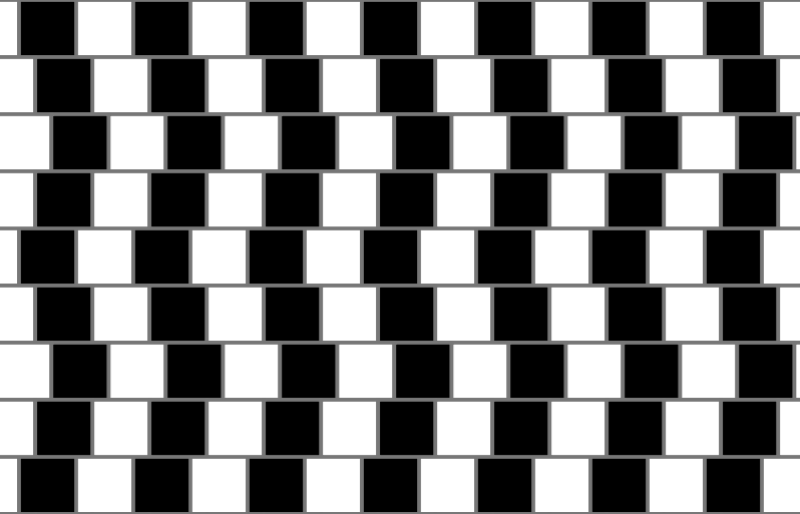
So what’s not there appears to be there, just as, elsewhere, what’s there appears not to be. Straight lines seem curved; large figures seem small; the same colour seems light on the right, dark on the left. There are also some impossible figures, as made famous by M.C. Escher and now studied seriously by geometricians, but the only true art here is a “Face of Fruits” by Arcimboldo. The rest is artful, not art, but it’s interesting to think what Escher might have made of some of the ideas here. Mind is mechanism; mechanism can be fooled. Optical illusions are the most compelling examples, because vision is the most powerful of our senses, but the lesson you learn here is applicable everywhere. This book fools you for fun; others try to fool you for profit. Caveat spectator.

Simple but complex: The café wall illusion

Simple but complex: The café wall illusion

Mi Is Mirror

I hope that nobody thinks I’m being racially prejudiced when I say that, much though I am fascinated by her, I do not find the Anglo-American academic Mikita Brottman physically attractive. It is her mind that has raised my longstanding interest, nothing more.

Honest.

This is because, for me, Ms B is like a mirror that reverses not left and right, but male and female.

Obviously, we’re different in a lot of ways: I don’t smoke and I don’t have any tattoos, for example.

But there are big similarities too.

We were born in the same year (1956) and we were both keyly core contributors to seminal early issues of the transgressive journal Headpress Journal.

And we have various other things in common, like our mutually shared passion for corpse’n’cannibal cinema, our Glaswegian accents and (at different times) our season tickets for Hull Kingston Rovers.

So it is that, looking at Ms B, I have the uncanny experience of seeing myself as I might have been, had I been born female.

But it’s not just uncanny.

It’s horrifying at times too.

Okay, I’m comfortable with the idea that, born female, I would have been less intelligent and more conformist. So I don’t mind that Ms B is a Guardianista. Not particularly. I can face the fact that I would quite likely have been one of them too, as a female.

But there are worse things than being a Guardianista, believe it or not.

Ms B has a PhD in EngLit.

A PhD!

In EngLit.

It’s not at all easy for me to face the fact that I might have had one too, as a female. It really isn’t. But how can I deny it? I might have. That despicable, deplorable, thoroughly disreputable subject might have attracted me. In fact, it would probably have attracted me.

<retch>

But it gets worse still.

Ms B is a psychoanalyst.

A psychoanalyst.

Ach du lieber Gott!

See what I mean by “horrifying”?

I mean, even if I’d been born female I wouldn’t have sunk to such depths, would I? Would I? No, I have to face facts: I might. But I don’t think so. I have a feeling that there’s more to Brotty’s interest in Freud than her gender statusicity and her key commitment to core componency of the counter-cultural community.

But I’d better say no more. Verb sap.

This Mortal Doyle

Challenger chopped and changed. That is to say, in one important respect, Arthur Conan Doyle’s character Professor Challenger lacked continuity. His philosophical views weren’t consistent. At one time he espoused materialism, at another he opposed it. He espoused it in “The Land of Mist” (1927):

“Don’t tell me, Daddy, that you with all your complex brain and wonderful self are a thing with no more life hereafter than a broken clock!”

“Four buckets of water and a bagful of salts,” said Challenger as he smilingly detached his daughter’s grip. “That’s your daddy, my lass, and you may as well reconcile your mind to it.”

But earlier, in “The Poison Belt” (1913), he had opposed it:

“No, Summerlee, I will have none of your materialism, for I, at least, am too great a thing to end in mere physical constituents, a packet of salts and three bucketfuls of water. Here ― here” ― and he beat his great head with his huge, hairy fist ― “there is something which uses matter, but is not of it ― something which might destroy death, but which death can never destroy.”

That story was published just over a century ago, but Challenger’s boast has not been vindicated in the meantime. So far as science can see, matter rules mind, not vice versa. Conan Doyle thought the same as the earlier Challenger, but Conan Doyle’s rich and teeming brain seems to have ended in “mere physical constituents”. To all appearances, when the organization of his brain broke down, so did his consciousness. And that concluded the cycle described by A.E. Housman in “Poem XXXII” of A Shropshire Lad (1896):

From far, from eve and morning
  And yon twelve-winded sky,
The stuff of life to knit me
  Blew hither: here am I.

Now – for a breath I tarry
  Nor yet disperse apart –
Take my hand quick and tell me,
  What have you in your heart.

Speak now, and I will answer;
  How shall I help you, say;
Ere to the wind’s twelve quarters
  I take my endless way. (ASL, XXXII)

Continue reading This Mortal Doyle

She Say, She Sigh, She Sow

“Those who view mathematical science, not merely as a vast body of abstract and immutable truths, whose intrinsic beauty, symmetry and logical completeness, when regarded in their connection together as a whole, entitle them to a prominent place in the interest of all profound and logical minds, but as possessing a yet deeper interest for the human race, when it is remembered that this science constitutes the language through which alone we can adequately express the great facts of the natural world, and those unceasing changes of mutual relationship which, visibly or invisibly, consciously or unconsciously to our immediate physical perceptions, are interminably going on in the agencies of the creation we live amidst: those who thus think on mathematical truth as the instrument through which the weak mind of man can most effectively read his Creator’s works, will regard with especial interest all that can tend to facilitate the translation of its principles into explicit practical forms.” — Ada Lovelace (née Byron) (1815-52).

The Brain in Train

I feel odd when I consider this possibility: that all my thoughts are strictly determined, no more under my control than a straw in a gale or a stone in an avalanche. It seems paradoxical to have strictly determined thoughts about strictly determined thoughts. But is it? And is strict determinism fatal for finding the truth? I don’t think so. In fact, I think that strict determinism is essential for truth. But irrelevant associations get in the way of our understanding this. If our thoughts are determined, they seem like automatic trains running on rigid tracks. We might want to go to the station marked “Truth”, but if the switches are set wrong, the train will never get there. Or it will thunder through and never stop.


Continue reading The Brain in Train

Performativizing Papyrocentricity #14

Papyrocentric Performativity Presents:

Scheming DemonThe Screwtape Letters, C.S. Lewis (1942)

Ai Wei to HellHow to Read Contemporary Art, Michael Wilson (Thames & Hudson, 2013)

Toxic TwosomeDoll, Peter Sotos and James Havoc (TransVisceral Books, 2013)

Know Your LimaçonsThe Penguin Dictionary of Curious and Interesting Geometry, David Wells (1991) (posted @ Overlord of the Über-Feral)

Pestilent, Pustulent and Pox-Pocked – various books by Dr Miriam B. Stimbers (@ O.o.t.Ü.-F.)


Or Read a Review at Random: RaRaR

The Brain in Pain

You can stop reading now, if you want. Or can you? Are your decisions really your own, or are you and all other human beings merely spectators in the mind-arena, observing but neither influencing nor initiating what goes on there? Are all your apparent choices in your brain, but out of your hands, made by mechanisms beyond, or below, your conscious control?

In short, do you have free will? This is a big topic – one of the biggest. For me, the three most interesting things in the world are the Problem of Consciousness, the Problem of Existence and the Question of Free Will. I call consciousness and existence problems because I think they’re real. They’re actually there to be investigated and explained. I call free will a question because I don’t think it’s real. I don’t believe that human beings can choose freely or that any possible being, natural or supernatural, can do so. And I don’t believe we truly want free will: it’s an excuse for other things and something we gladly reject in certain circumstances.


Continue reading The Brain in Pain