You Sixy Beast

666 is the Number of the Beast. But it’s much more than that. After all, it’s a number, so it has mathematical properties (everything has mathematical properties, but it’s a sine-qua-non of numbers). For example, 666 is a palindromic number, reading the same forwards and backwards. And it’s a repdigit, consisting of a single repeated digit. Now try answering this question: how many pebbles are there in this triangle?


••
•••
••••
•••••
••••••
•••••••
••••••••
•••••••••
••••••••••
•••••••••••
••••••••••••
•••••••••••••
••••••••••••••
•••••••••••••••
••••••••••••••••
•••••••••••••••••
••••••••••••••••••
•••••••••••••••••••
••••••••••••••••••••
•••••••••••••••••••••
••••••••••••••••••••••
•••••••••••••••••••••••
••••••••••••••••••••••••
•••••••••••••••••••••••••
••••••••••••••••••••••••••
•••••••••••••••••••••••••••
••••••••••••••••••••••••••••
•••••••••••••••••••••••••••••
••••••••••••••••••••••••••••••
•••••••••••••••••••••••••••••••
••••••••••••••••••••••••••••••••
•••••••••••••••••••••••••••••••••
••••••••••••••••••••••••••••••••••
•••••••••••••••••••••••••••••••••••
••••••••••••••••••••••••••••••••••••


Counting the pebbles one by one would take a long time, but there’s a short-cut. Each line of the triangle after the first is one pebble longer than the previous line. There are 36 lines and therefore 36 pebbles in the final line. So the full number of pebbles = 1 + 2 + 3 + 4 + 5 + 6 + 7 + 8 + 9 + 10 + 11 + 12 + 13 + 14 + 15 + 16 + 17 + 18 + 19 + 20 + 21 + 22 + 23 + 24 + 25 + 26 + 27 + 28 + 29 + 30 + 31 + 32 + 33 + 34 + 35 + 36. And there’s an easy formula for that sum: (36^2 + 36) / 2 = (1296 + 36) / 2 = 1332 / 2 = 666.

So 666 is the 36th triangular number:


1 = 1
1+2 = 3
1+2+3 = 6
1+2+3+4 = 10
1+2+3+4+5 = 15
1+2+3+4+5+6 = 21
1+2+3+4+5+6+7 = 28
1+2+3+4+5+6+7+8 = 36
1+2+3+4+5+6+7+8+9 = 45
1+2+3+4+5+6+7+8+9+10 = 55
[...]
1+2+3+4+5+6+7+8+9+10+11+12+13+14+15+16+17+18+19+20+21+22+23+24+25+26+27+28+29+30+31+32+33+34+35+36 = 666

But what’s tri(666), the 666th triangular number? By the formula above, it equals (666^2 + 666) / 2 = (443556 + 666) / 2 = 444222 / 2 = 222111. But recall something else from above: tri(6) = 1+2+3+4+5+6 = 21. Is it a coincidence that tri(6) = 21 and tri(666) = 222111? No, it isn’t:


tri(6) = 21 = (6^2 + 6) / 2 = (36 + 6) / 2 = 42 / 2
tri(66) = 2211 = (66^2 + 66) / 2 = (4356 + 66) / 2 = 4422 / 2
tri(666) = 222111 = (666^2 + 666) / 2 = (443556 + 666) / 2 = 444222 / 2
tri(6666) = 22221111
tri(66666) = 2222211111
tri(666666) = 222222111111
tri(6666666) = 22222221111111
tri(66666666) = 2222222211111111
tri(666666666) = 222222222111111111
tri(6666666666) = 22222222221111111111
tri(66666666666) = 2222222222211111111111
tri(666666666666) = 222222222222111111111111
tri(6666666666666) = 22222222222221111111111111
tri(66666666666666) = 2222222222222211111111111111
tri(666666666666666) = 222222222222222111111111111111

So we’ve looked at tri(36) = 666 and tri(666) = 222111. Let’s go a step further: tri(222111) = 24666759216. So 666 appears again. And the sixiness carries on here:


tri(36) = 666
tri(3366) = 5666661
tri(333666) = 55666666611
tri(33336666) = 555666666666111
tri(3333366666) = 5555666666666661111
tri(333333666666) = 55555666666666666611111
tri(33333336666666) = 555555666666666666666111111
tri(3333333366666666) = 5555555666666666666666661111111
tri(333333333666666666) = 55555555666666666666666666611111111
tri(33333333336666666666) = 555555555666666666666666666666111111111
tri(3333333333366666666666) = 5555555555666666666666666666666661111111111
tri(333333333333666666666666) = 55555555555666666666666666666666666611111111111
tri(33333333333336666666666666) = 555555555555666666666666666666666666666111111111111
tri(3333333333333366666666666666) = 5555555555555666666666666666666666666666661111111111111
tri(333333333333333666666666666666) = 55555555555555666666666666666666666666666666611111111111111

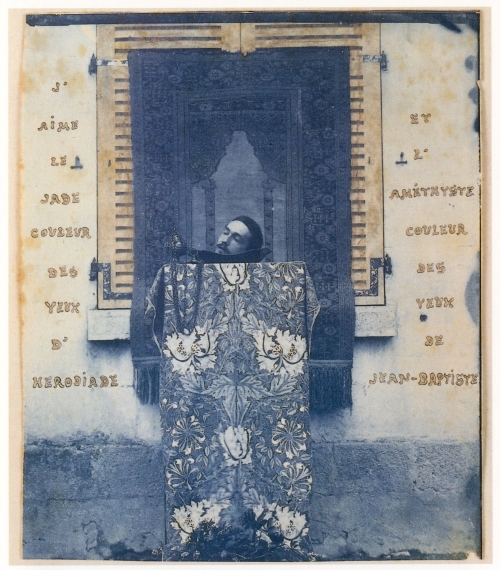
Tête avec Texte


Above you can see the Peacock on a Platter, or Robert de Montesquiou posing as the severed head of John the Baptist and flanked by relevant lines of his own poetry. But there’s a better version of the poetry, as you can see by comparing the photo with this:

J’aime le jade,
Couleur des yeux
D’Hérodiade

Et l’améthyste,
Couleur du sang
De Jean-Baptiste. — from “Robert de Montesquiou: The Magnificent Dandy” (1962) by Cornelia Otis Skinner


I love jade,
Color of the eyes
Of Herodias

And amethyst,
Color of the blood
Of John the Baptist.


Elsewhere Other-Accessible…

Portrait of a Peacock — Cornelia Otis Skinner’s excellent essay on Montesquiou
Le Paon dans les Pyrénées — review of Julian Barnes’ not-so-good book partly about Montesquiou

Agogic Arithmetic

This is one of my favorite integer sequences:

• 1, 3, 6, 10, 15, 21, 28, 36, 45, 55, 66, 78, 91, 105, 120, 136, 153, 171, 190, 210, 231, 253, 276, 300, 325, 351, 378, 406, 435, 465, 496, 528, 561, 595, 630, 666, 703, 741, 780, 820, 861, 903, 946, 990, 1035, 1081, 1128, 1176, 1225, 1275, 1326, 1378, 1431, ... — A000217 at OEIS


And it’s easy to work out the rule that generates the sequence. It’s the sequence of triangular numbers, of course, which you get by summing the integers:

1
1 + 2 = 3
3 + 3 = 6
6 + 4 = 10
10 + 5 = 15
15 + 6 = 21
21 + 7 = 28
28 + 8 = 36
36 + 9 = 45
[...]


I like this sequence too, but it isn’t a sequence of integers and it’s much harder to work out the rule that generates it:

• 1, 3/2, 11/6, 25/12, 137/60, 49/20, 363/140, 761/280, 7129/2520, 7381/2520, 83711/27720, 86021/27720, 1145993/360360, 1171733/360360...


But you could say that it’s the inverse of the triangular numbers, because you generate it like this:

1
1 + 1/2 = 3/2
3/2 + 1/3 = 11/6
11/6 + 1/4 = 25/12
25/12 + 1/5 = 137/60
137/60 + 1/6 = 49/20
49/20 + 1/7 = 363/140
363/140 + 1/8 = 761/280
761/280 + 1/9 = 7129/2520
[...]

It’s the harmonic series, which is defined at Wikipedia as “the infinite series formed by summing all positive unit fractions”. I can’t understand its subtleties or make any important discoveries about it, but I thought I could ask (and begin to answer) a question that perhaps no-one else in history had ever asked: When are the leading digits of the k-th harmonic number, hs(k), equal to the digits of k in base 10?

hs(1) = 1
hs(43) = 4.349...
hs(714) = 7.1487...
hs(715) = 7.1501...
hs(9763) = 9.76362...
hs(122968) = 12.296899...
hs(122969) = 12.296907...
hs(1478366) = 14.7836639...
hs(17239955) = 17.23995590...
hs(196746419) = 19.6746419...
hs(2209316467) = 22.0931646788...


Do those numbers have any true mathematical significance? I doubt it. But they were fun to find, even though I wasn’t the first person in history to ask about them:

• 1, 43, 714, 715, 9763, 122968, 122969, 1478366, 17239955, 196746419, 2209316467, 24499118645, 268950072605 — A337904 at OEIS, Numbers k such that the decimal expansion of the k-th harmonic number starts with the digits of k, in the same order.

Moz on Mogz

“The basic fascination I have with cats is nothing unusual. I find them very intelligent and very superior. And I feel entranced by them. If I see one in the street I feel immediately drawn to the cat. I have a friend, Chrissie Hynde [the singer with The Pretenders], she’s exactly the same. You can be walking with her along the street, she sees a cat, she walks away. You continue to walk on, talking to no one. You look around and she’s crouched down with a cat in a hedge. I’m exactly the same way. I’m fascinated by them.” — “Morrissey on… privacy, the Queen and The Smiths”, The Daily Telegraph, 17vi11

Hymn to Heresy

Hymn to Proserpine

After the Proclamation in Rome
of the Christian Faith

by ALGERNON CHARLES SWINBURNE


Vicisti, Galilæe.

I have lived long enough, having seen one thing, that love hath an end;
Goddess and maiden and queen, be near me now and befriend.
Thou art more than the day or the morrow, the seasons that laugh or that weep;
For these give joy and sorrow; but thou, Proserpina, sleep.
Sweet is the treading of wine, and sweet the feet of the dove;
But a goodlier gift is thine than foam of the grapes or love.
Yea, is not even Apollo, with hair and harpstring of gold,
A bitter God to follow, a beautiful God to behold?
I am sick of singing; the bays burn deep and chafe: I am fain
To rest a little from praise and grievous pleasure and pain.
For the Gods we know not of, who give us our daily breath,
We know they are cruel as love or life, and lovely as death.
O Gods dethroned and deceased, cast forth, wiped out in a day!
From your wrath is the world released, redeemed from your chains, men say.
New Gods are crowned in the city; their flowers have broken your rods;
They are merciful, clothed with pity, the young compassionate Gods.
But for me their new device is barren, the days are bare;
Things long past over suffice, and men forgotten that were.
Time and the Gods are at strife; ye dwell in the midst thereof,
Draining a little life from the barren breasts of love.
I say to you, cease, take rest; yea, I say to you all, be at peace,
Till the bitter milk of her breast and the barren bosom shall cease.
Wilt thou yet take all, Galilean? but these thou shalt not take,
The laurel, the palms and the pæan, the breasts of the nymphs in the brake;
Breasts more soft than a dove’s, that tremble with tenderer breath;
And all the wings of the Loves, and all the joy before death;
All the feet of the hours that sound as a single lyre,
Dropped and deep in the flowers, with strings that flicker like fire.
More than these wilt thou give, things fairer than all these things?
Nay, for a little we live, and life hath mutable wings.
A little while and we die; shall life not thrive as it may?
For no man under the sky lives twice, outliving his day.
And grief is a grievous thing, and a man hath enough of his tears:
Why should he labour, and bring fresh grief to blacken his years?
Thou hast conquered, O pale Galilean; the world has grown grey from thy breath;
We have drunken of things Lethean, and fed on the fullness of death.
Laurel is green for a season, and love is sweet for a day;
But love grows bitter with treason, and laurel outlives not May.
Sleep, shall we sleep after all? for the world is not sweet in the end;
For the old faiths loosen and fall, the new years ruin and rend.
Fate is a sea without shore, and the soul is a rock that abides;
But her ears are vexed with the roar and her face with the foam of the tides.
O lips that the live blood faints in, the leavings of racks and rods!
O ghastly glories of saints, dead limbs of gibbeted Gods!
Though all men abase them before you in spirit, and all knees bend,
I kneel not neither adore you, but standing, look to the end.
All delicate days and pleasant, all spirits and sorrows are cast
Far out with the foam of the present that sweeps to the surf of the past:
Where beyond the extreme sea-wall, and between the remote sea-gates,
Waste water washes, and tall ships founder, and deep death waits:
Where, mighty with deepening sides, clad about with the seas as with wings,
And impelled of invisible tides, and fulfilled of unspeakable things,
White-eyed and poisonous-finned, shark-toothed and serpentine-curled,
Rolls, under the whitening wind of the future, the wave of the world.
The depths stand naked in sunder behind it, the storms flee away;
In the hollow before it the thunder is taken and snared as a prey;
In its sides is the north-wind bound; and its salt is of all men’s tears;
With light of ruin, and sound of changes, and pulse of years:
With travail of day after day, and with trouble of hour upon hour;
And bitter as blood is the spray; and the crests are as fangs that devour:
And its vapour and storm of its steam as the sighing of spirits to be;
And its noise as the noise in a dream; and its depth as the roots of the sea:
And the height of its heads as the height of the utmost stars of the air:
And the ends of the earth at the might thereof tremble, and time is made bare.
Will ye bridle the deep sea with reins, will ye chasten the high sea with rods?
Will ye take her to chain her with chains, who is older than all ye Gods?
All ye as a wind shall go by, as a fire shall ye pass and be past;
Ye are Gods, and behold, ye shall die, and the waves be upon you at last.
In the darkness of time, in the deeps of the years, in the changes of things,
Ye shall sleep as a slain man sleeps, and the world shall forget you for kings.
Though the feet of thine high priests tread where thy lords and our forefathers trod,
Though these that were Gods are dead, and thou being dead art a God,
Though before thee the throned Cytherean be fallen, and hidden her head,
Yet thy kingdom shall pass, Galilean, thy dead shall go down to thee dead.
Of the maiden thy mother men sing as a goddess with grace clad around;
Thou art throned where another was king; where another was queen she is crowned.
Yea, once we had sight of another: but now she is queen, say these.
Not as thine, not as thine was our mother, a blossom of flowering seas,
Clothed round with the world’s desire as with raiment, and fair as the foam,
And fleeter than kindled fire, and a goddess, and mother of Rome.
For thine came pale and a maiden, and sister to sorrow; but ours,
Her deep hair heavily laden with odour and colour of flowers,
White rose of the rose-white water, a silver splendour, a flame,
Bent down unto us that besought her, and earth grew sweet with her name.
For thine came weeping, a slave among slaves, and rejected; but she
Came flushed from the full-flushed wave, and imperial, her foot on the sea.
And the wonderful waters knew her, the winds and the viewless ways,
And the roses grew rosier, and bluer the sea-blue stream of the bays.
Ye are fallen, our lords, by what token? we wise that ye should not fall.
Ye were all so fair that are broken; and one more fair than ye all.
But I turn to her still, having seen she shall surely abide in the end;
Goddess and maiden and queen, be near me now and befriend.
O daughter of earth, of my mother, her crown and blossom of birth,
I am also, I also, thy brother; I go as I came unto earth.
In the night where thine eyes are as moons are in heaven, the night where thou art,
Where the silence is more than all tunes, where sleep overflows from the heart,
Where the poppies are sweet as the rose in our world, and the red rose is white,
And the wind falls faint as it blows with the fume of the flowers of the night,
And the murmur of spirits that sleep in the shadow of Gods from afar
Grows dim in thine ears and deep as the deep dim soul of a star,
In the sweet low light of thy face, under heavens untrod by the sun,
Let my soul with their souls find place, and forget what is done and undone.
Thou art more than the Gods who number the days of our temporal breath;
Let these give labour and slumber; but thou, Proserpina, death.
Therefore now at thy feet I abide for a season in silence. I know
I shall die as my fathers died, and sleep as they sleep; even so.
For the glass of the years is brittle wherein we gaze for a span;
A little soul for a little bears up this corpse which is man.
So long I endure, no longer; and laugh not again, neither weep.
For there is no God found stronger than death; and death is a sleep.
So long I endure, no longer; and laugh not again, neither weep.
For there is no God found stronger than death; and death is a sleep.


Elsewhere Other-Accessible…

• “Hymn to Proserpine” (1866) at Wikipedia

Strange “S” in the Light

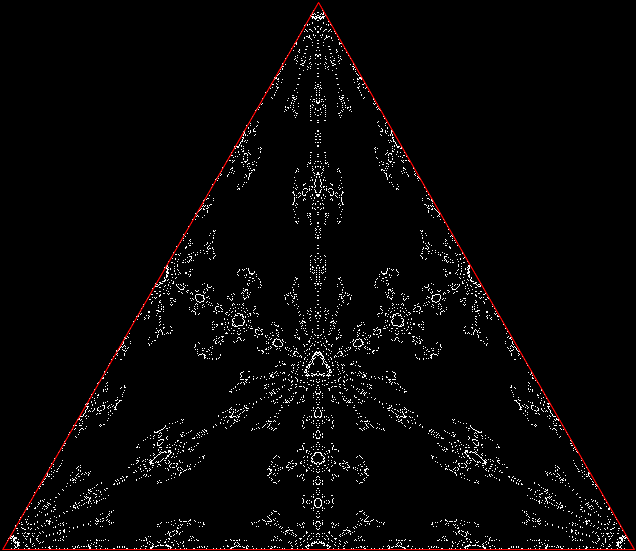
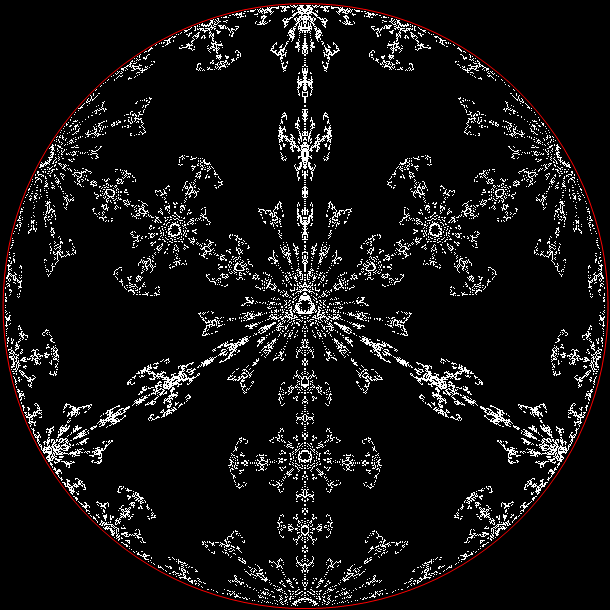
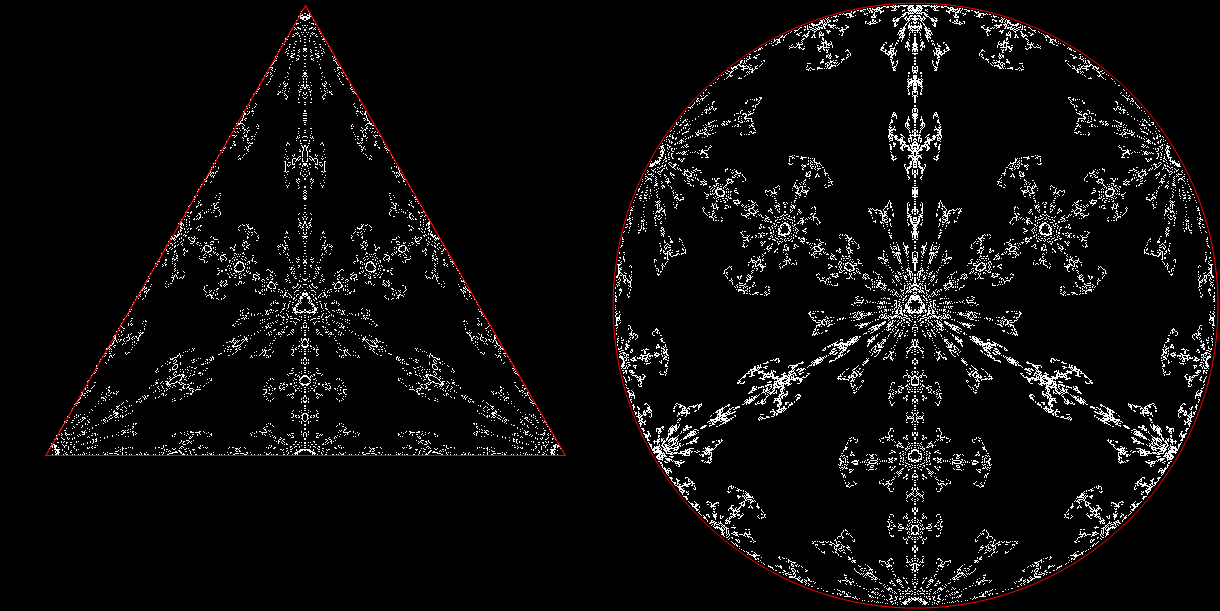
Unexpected discoveries are one of the joys of mathematics, even for amateurs. And computers help you make more of them, because computers make it easy to adjust variables or search faster and further through math-space than any unaided human ever could (on the downside, computers can make you lazy and blunt your intuition). Here’s an unexpected discovery I made using a computer in November 2020:

A distorted and dissected capital “S”


It’s a strange “S” that looks complex but is constructed very easily from three simple lines. And it’s a fractal, a shape that contains copies of itself at smaller and smaller scales:

Five sub-fractals of the Strange “S”


Elsewhere Other-Accessible…

Fractangular Frolics — the Strange “S” in more light