Tattoo Your Ears

“The most merciful thing in the world,” said H.P. Lovecraft, “is the inability of the human mind to correlate all its contents.” Nowadays we can’t correlate all the contents of our hard-drives either. But occasionally bits come together. I’ve had two MP3s sitting on my hard-drive for months: “Drink or Die” by Erotic Support and “Hunter Gatherer” by Swords of Mars. I liked them both a lot, but until recently I didn’t realize that they were by two incarnations of the same Finnish band.

Cover of "Die by the..." Swords of Mars
They don’t sound very much alike, after all. But now that I’ve correlated them, they’ve inspired some thoughts on music and mutilation. “Drink or Die” is a dense, fuzzy, leather-lunged rumble-rocker that, like a good Mötley Crüe song, your ears can snort like cocaine. But, unlike Mötley Crüe, the auditory rush lasts the whole song, not just the first half. “Hunter Gatherer” is much more sombre. Erotic Support were “Helsinki beercore”; Swords of Mars are darker, doomier and dirgier. They’ve also got a better name – “Erotic Support” seems to have lost something in translation. Finnish is a long way from English: it’s in a different and unrelated language family, the Finno-Ugric, not the Indo-European. So it lines up with Hungarian and Estonian, not English, German and French. But Erotic Support’s lyrics are good English and “Drink or Die” is a clever title. They’d have been a more interesting band if they’d sung entirely in Finnish, but also less successful, because less accessible to the rest of the world.

Es war einmal eine Königstochter, die ging hinaus in den Wald und setzte sich an einen kühlen Brunnen. Sie hatte eine goldene Kugel, die war ihr liebstes Spielwerk, die warf sie in die Höhe und fing sie wieder in der Luft und hatte ihre Lust daran. Einmal war die Kugel gar hoch geflogen, sie hatte die Hand schon ausgestreckt und die Finger gekrümmt, um sie wieder zufangen, da schlug sie neben vorbei auf die Erde, rollte und rollte und geradezu in das Wasser hinein.

Some Indo-European


Mieleni minun tekevi, aivoni ajattelevi
lähteäni laulamahan, saa’ani sanelemahan,
sukuvirttä suoltamahan, lajivirttä laulamahan.
Sanat suussani sulavat, puhe’et putoelevat,
kielelleni kerkiävät, hampahilleni hajoovat.

Veli kulta, veikkoseni, kaunis kasvinkumppalini!
Lähe nyt kanssa laulamahan, saa kera sanelemahan
yhtehen yhyttyämme, kahta’alta käytyämme!
Harvoin yhtehen yhymme, saamme toinen toisihimme
näillä raukoilla rajoilla, poloisilla Pohjan mailla.

Some Finno-Ugric


All the same, being inaccessible sometimes helps a band’s appeal to the rest of the world: the mystique of black metal is much stronger in bands that use only Norwegian or one of the other Scandinavian languages. Erotic Support haven’t joined that rebellion against Coca-Colonization and tried to create an indigenous genre. They’re happy to reproduce more or less American music using the more or less American invention known as the electric guitar. But amplified music would have appeared in Europe even if North America had been colonized by the Chinese, so I wonder what rock would sound like if it had evolved in Europe instead. It wouldn’t be called rock, of course, but what other differences would it have? Would it be more sophisticated, for example? I think it would. The success of American exports depends in part on their strong and simple flavours. “Drink or Die” has those flavours: it’s about volume, rhythm and power. It’s full of a certain “drug-addled, crab-infested, tinnitus-nagged spirit” — the “urge to submerge in the raw bedrock viscerality of rock”, as some metaphor-mixing, über-emphasizing idiot once put it (I think it was me).

Cover of "II" by Erotic Support

Erotic Support are “beercore”, remember. Beer marks the brain with hangovers, just as tattoos mark the skin with ink. And just as loud music marks the ears with tinnitus. There are various kinds of self-mutilation in rock and that self-mutilation can have unhealthy motives. It can be an expression of boredom, angst, anomie and self-hatred. Unsurprisingly, Finland has the nineteenth highest suicide rate in the world. Beer, tattoos and tinnitus are part of the louder, dirtier and loutier end of rock: unlike Radiohead or Coldplay, Erotic Support sound like a band with tattoos who are used to hangovers. “Drink or Die” is a joke about exactly that. But what if rock had evolved in a wine-drinking culture? Would it be less of a sado-masochistic ritual, more a refined rite? Maybe not: the god of wine is Dionysos and he was Ho Bromios, the Thunderer. His brother Pan induces panic with loud noises. But black metal looks towards northern paganism: it’s music for pine forests, cold seas and beer-drinkers, not olive groves, warm seas and oenopotes.

Erotic Support don’t create soundscapes for Finland the way black metal creates soundscapes for Norway, but they do create beer-drinkers’ music, so they do express Finnishness to that extent. Swords of Mars, being darker, doomier and dirgier, are moving nearer an indigenous Finnish rock, or an indigenous Scandinavian rock, at least. This may be related to the fact that genes express themselves more strongly as an individual ages: for example, the correlation between the intelligence of parents and their children is strongest when the children are adults. Erotic Support create faster, more aggressive music than Swords of Mars, so it isn’t surprising that they’re the younger version of the same band. In biology, the genotype creates the phenotype: DNA codes for bodies and behaviour. Music is part of what Richard Dawkins calls the “extended phenotype”, like the nest of a bird or the termite-fishing-rods of a chimpanzee. A bird’s wings are created directly by its genes; a bird’s nest is created indirectly by its genes, viâ the brain. So a bird’s wings are part of the phenotype and a bird’s nest part of the extended phenotype.

Both are under the influence of the genes and both are expressions of biology. Music (like bird-song) is an expression of biology too, as is the difference between the music of Erotic Support and Swords of Mars. As brains age, the behaviour they create changes. Swords of Mars are older and not attracted to reckless self-mutilation as Erotic Support were: it’s not music to precede hangovers and induce tinnitus any more. Sword of Mars aren’t trying to tattoo your ears but to educate your mind.

Guise and Molls

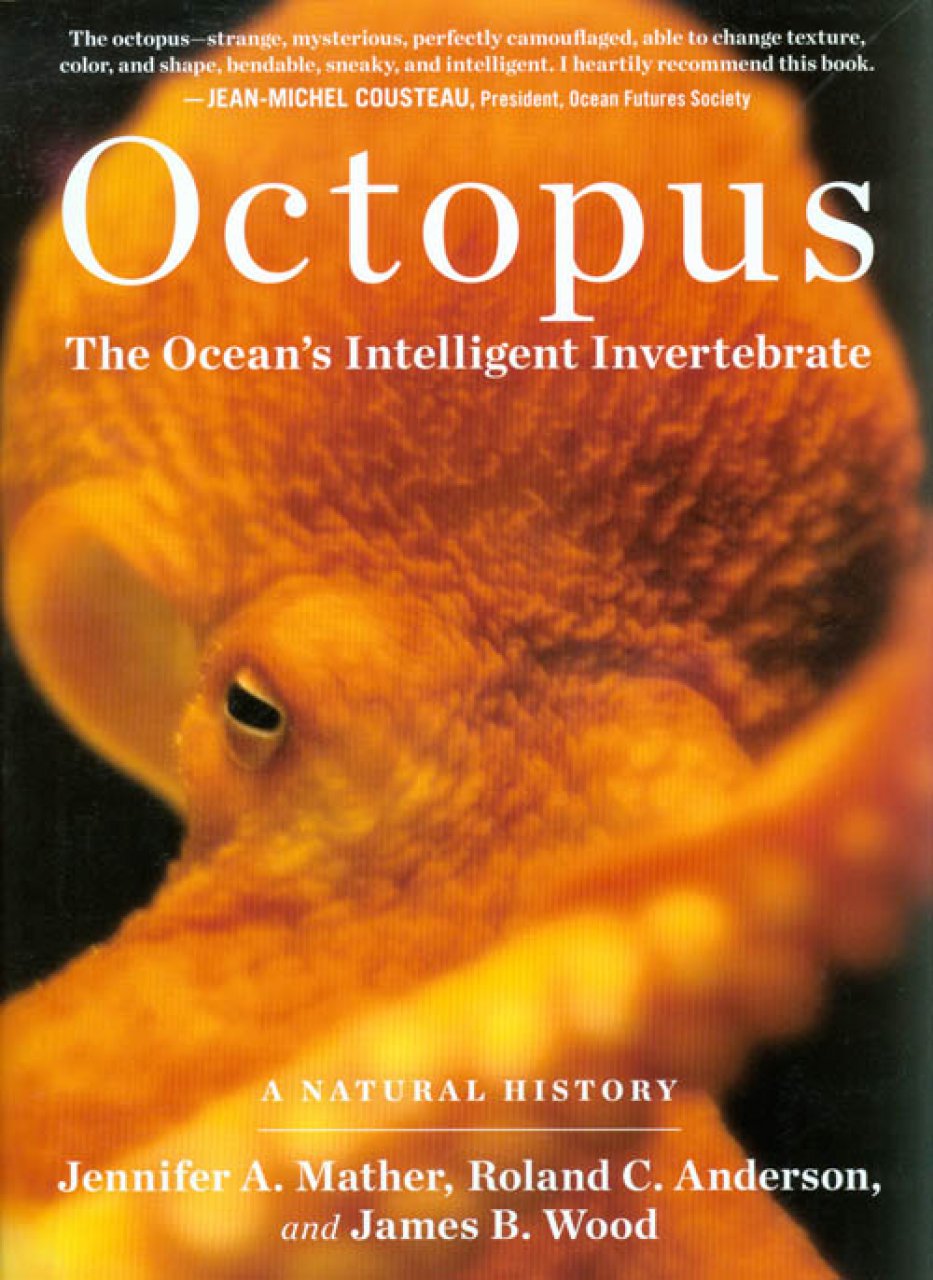
Front cover of Octopus: The Ocean’s Intelligent Invertebrate: A Natural History, by Jennifer A. Mather et al
Octopus: The Ocean’s Intelligent Invertebrate: A Natural History, Jennifer A. Mather, Roland C. Anderson and James B. Wood (Timber Press, 2010)

Who knows humanity who only human knows? We understand ourselves better by looking at other animals, but most other animals are not as remarkable as the octopus. These eight-armed invertebrates are much more closely related to oysters, limpets and ship-worms than they are to fish, let alone to mammals, but they lead fully active lives and seem fully conscious creatures of strong and even unsettling intelligence. Octopuses are molluscs, or “soft ones” (the same Latin root is found in “mollify”), with no internal skeleton and no rigid structure. Unlike some of their relatives, however, they do have brains. And more than one brain apiece, in a sense, because their arms are semi-autonomous. They don’t really have bodies, though, which is why they belong to the class known as Cephalopoda, or “head-foots”. Squid and cuttlefish, which are also covered in this book, are in the same class but do have more definite bodies, because they swim in open water rather than, like octopuses, living on the sea-floor. Another difference between the groups is that octopuses don’t have tentacles. Their limbs are too adaptable for that:

Because the arms are lined with suckers along the underside, octopuses can grasp anything. And since the animal has no skeleton, it can flex its arms and move them in any direction. The arms aren’t tentacles: tentacles are used for prey capture in squid, and these arms, with their flexibility, are used for many different actions. (“Introduction: Meet the Octopus”, pg. 15)

Octopuses would be interesting even if we humans knew ourselves perfectly. But one of the interesting things is whether they could be us, given time and opportunity. That is, could they become a tool-making, culture-forming, language-using species like us? After all, unlike most animals, they don’t use their limbs simply for locomotion or aggression: octopuses can manipulate objects with reasonably good precision. I used to think that one obstacle to their use of tools was their inability to make fine discriminations between shapes, because I remembered reading in the Oxford Book of the Mind (2004) that they couldn’t tell cubes from spheres. The explanation there was that their arms are too flexible and can’t, like rigid human arms and fingers, be used as fixed references to judge a manipulated object against. But this book says otherwise:

[The British researcher J.M.] Wells found that common octopuses can learn by touch and can tell a smooth cylinder from a grooved one or a cube from a sphere. They had much more trouble, though, telling a cube with smoothed-off corners from a sphere… They couldn’t learn to distinguish a heavy cylinder from a lighter one with the same surface texture. (ch. 9, “Intelligence”, pg. 130)

The problem isn’t simply that their arms are too flexible: their arms are also too independent:

Maybe the common octopus could not use information about the amount of sucker bending to send to the brain and calculate what an object’s shape would be, or calculate how much the arm bent to figure out weight. Octopuses have a lot of local control of arm movement: there are chains of ganglia [nerve-centres] down the arm and even sucker ganglia to control their individual actions. If local information is processed as reflexes in these ganglia, most touch and position information might not go to the brain and then couldn’t used in associative learning. (Ibid., pg. 130-1)

Or in manipulating an object with high precision and accuracy. An octopus can use rocks to make the entrance to its den narrower and less accessible to predators, but that’s a long way from being able to build a den. It is a start, however, and if man and other apes left the scene, octopuses would be a candidate to occupy his vacant throne one day. But I would give better odds to squirrels and to corvids (crow-like birds) than to cephalopods. Living in the sea may be a big obstacle to developing full, language-using, world-manipulating intelligence. The brevity of that life in the sea is definitely an obstacle: one deep-sea species of octopus may live over ten years, which would be “the longest for any octopus” (ch. 1, “In the Egg”). In shallower, warmer water, the Giant Pacific Octopus, Enteroctopus dofleini, is senescent at three or four years; some other species are senescent at a year or less. Males die after fertilizing the females, females die after guarding their eggs to hatching. In such an active, enquiring animal, senescence is an odd and unsettling process. A male octopus will stop eating, lose weight and start behaving in unnatural ways:

Senescent male giant Pacific octopuses and red octopuses are found crawling out of the water onto the beach [which is] likely to lead to attacks by gulls, crows, foxes, river otters or other animals… Senescent males have even been found in river mouths, going upstream to their eventual death from the low salinity of the fresh water. (ch. 10, “Sex at Last”, pg. 148)

Female octopuses stop eating and lose weight, but can’t behave unnaturally like that, because they have eggs to guard. Evolution keeps them on duty, because females that abandoned their eggs would leave fewer offspring. Meanwhile, males can become what might be called demob-demented: once they’ve mated, their behaviour doesn’t affect their offspring. In the deep sea, longer-lived species follow the same pattern of maturing, mating and senescing, but aren’t so much living longer as living slower. These short, or slow, lives wouldn’t allow octopuses to learn in the way human beings do. The most important part of human learning is, of course, central to this book and this review: language. Cephalopods don’t have good hearing, but they do have excellent sight and the ability to change the colour and patterning of their skin. So Arthur C. Clarke (1917-2008) suggested in his short-story “The Shining Ones” (1962) that they could become autodermatographers, or “self-skin-writers”, speaking with their skin. The fine control necessary for language is already there:

Within the outer layers of octopus skin are many chromatophores – sacs that contain yellow, red or brown pigment within an elastic container. When a set of muscles pulls a chromatophore sac out to make it bigger, its color is allowed to show. When the muscles relax, the elastic cover shrinks the sac and the color seems to vanish. A nerve connects to each set of chromatophore muscles, so that nervous signals from the brain can cause an overall change in color in less than 100 milliseconds at any point in the body… When chromatophores are contracted, there is another color-producing layer beneath them. A layer of reflecting cells, white leucophores or green iridophores depending on the area of the body, produces color in a different way: Like a hummingbird’s feathers, which only reflect color at a specific angle, these cells have no pigment themselves but reflect all or some of the colors in the environment back to the observer… (ch. 6, “Appearances”, pg. 89)

“Observer” is the operative word: changes in skin-colour, -texture and -shape are a way to fool the eyes and brains of predators. The molluscan octopus can adopt many guises: it can look like rocks, sand or seaweed. But the champion changer is Thaumoctopus mimicus, which lives in shallow waters off Indonesia. Its generic name means “marvel-octopus” and its specific name means “mimicking”. And its modes of mimicry are indeed marvellous:

This octopus can flatten its body and move across the sand, using its jet for propulsion and trailing its arms, with the same undulating motion as a flounder or sole. It can swim above the mud with its striped arms outspread, looking like a venomous lionfish or jellyfish. It can narrow the width of its combined slender body and arms to look like a striped sea-snake. And it may be able to carry out other mimicries we have yet to see. Particularly impressive about the mimic octopus is that not only can it take on the appearance of another animal but it can also assume the behaviour of that animal. (ch. 7, “Not Getting Eaten”, pg. 109)

But octopuses also change their skin to fool the eyes and brains of prey. The “Passing Cloud” may sound like a martial arts technique, but it’s actually a molluscan hunting technique. And it’s produced entirely within the skin, as the authors of this book observed after videotaping octopuses “in an outdoor saltwater pond on Coconut Island”, Hawaii:

Back in the lab and replaying the video frame by frame, we found how complex the Passing Cloud display is. The Passing Cloud formed on the posterior mantle, flowed forward past the head and became more of a bar in shape, then condensed into a small blob below the head. The shape then enlarged and moved out onto the outstretched mantle, flowing off the anterior mantle and disappearing. (ch. 6, “Appearances”, pg. 93)

It’s apparently used to startle crabs that have frozen and are hard to see. When the crab moves in response to the Passing Cloud, the octopus can grab it and bite it to death with its “parrotlike beak”. They “also use venom from the posterior salivary gland that can paralyze prey and start digestion” (ch. 3, “Making a Living”, pg. 62). But a bite from an octopus can kill much bigger things than crabs:

Blue-ringed octopuses, the four species that are members of the genus Hapalochlaena, display stunning coloration. Like other spectacular forms of marine and terrestrial life, they have vivid color patterns as a warning signal. These small octopuses pose a serious threat to humans. They pack a potent venomous bite that makes them among the most dangerous creatures on Earth. Their venom, the neurotoxin tetrodotoxin (TTX) described by Scheumack et al in 1978, is among the few cephalopod venoms that can affect humans. A variety of marine and terrestrial animals produce TTX [including] poisonous arrow frogs [untrue, according to Wikipedia, which refers to “toads of the genus Atelopus” instead], newts, and salamanders… but the classic example, and what the compound is named after, is the tetraodon puffer fish. The puffers are what the Japanese delicacy fufu is made from. If the fish is prepared correctly, extremely small amounts of TTX cause only a tingling or numbing sensation. But if it is prepared incorrectly, the substance kills by blocking sodium channels on the surface of nerve membranes. A single milligram, 1/2500 of the weight of a penny, will kill an adult human… Even in the minuscule doses delivered by a blue-ringed octopus’s nearly unnoticeable bite, TTX can shut down the nervous system of a large person in just minutes; the risk of death is very high. (“Postscript: Keeping a Captive Octopus”, pg. 170)

It’s interesting to see how often toxicity has evolved among animals. Puffer-fish and blue-ringed octopuses may get their toxin from bacteria or algae, while poison-arrow frogs get the even more potent batrachotoxin from eating beetles, as do certain species of bird on New Guinea. Accordingly, toxicity is found in animals with no legs, two legs, four legs, six legs, eight legs and ten legs (if squid have a poisonous bite too). Evolution has found similar solutions to similar problems in unrelated groups, because evolution is a way of exploring space: that of possibility. And it is all, in one way or another, chemical possibility. Blue-ringed octopuses have found a chemical solution to hunting and evading predators. Other cephalopods have found a chemical solution to staying afloat:

Another substance used to keep plankton buoyant is ammonia, again lighter than water. Ammonia is primarily used by the large squid species, including the giant squid (Architeuthis dux), in their tissues, although the glass squid (Cranchia scabra) concentrates ammonia inside a special organ. The ammonia in the tissues of these squid makes the living or dead animal smell pungent. Dead or dying squid on the ocean’s surface smell particularly foul. The ammonia in these giant squid also makes them inedible – there will be no giant squid calamari. (ch. 2, “Drifting and Settling”)

Other deep-sea solutions from chemical possibility-space include bioluminescence. This is used by a cephalopod that was little-known until it was used as a metaphor for the greedy behaviour of Goldman-Sachs and other bankers:

…although they do not have an ink-sac, vampire squid have a bioluminescent mucus that they can jet out, presumably at the approach of a potential predator, likely distracting it in the same way as a black ink jet for a shallow-water octopus or squid. Second, they have a pair of light organs at the base of the fins with a moveable flap that can be used as a shutter. These could act as a searchlight, turning a beam of light onto a potential prey species that tactile sensing from the [tentacle-like] filaments has picked up. And third, they have a huge number of tiny photophores all over the body and arms. These could work two ways: they might give a general dim lighting as a visual counter-shading. With even a little light from above, a dark animal would stand out in silhouette from below. With low-level light giving just enough illumination, it could blend in. And the second function of these lights has been seen by ROV [remotely operated underwater vehicle] viewers: a disturbed vampire squid threw its arms back over its body and flashed the lights on the arms, which should startle any creature. (ch. 11, “The Rest of the Group”, pg. 161)

I was surprised to learn that vampire squid can be prey, but in fact their scientific name – Vampyroteuthis infernalis – is almost as big as they are: “for those imagining that vampire squid are monsters of the deep, they are tiny – only up to 5 in. (13 cm) long” (ibid., pg. 162). Even less-studied, even deeper-living, and even longer-named is Vulcanoctopus hydrothermalis, the “specialized deep-sea vent octopus”, which is “found, as its name suggests, near deep-sea hydrothermal vents way down at 6000 ft. (2000 m)” (“Introduction: Meet the Octopus”, pg. 15). Life around hydrothermal vents, or mini-volcanoes on the ocean floor, is actually independent of the sun, because the food-pyramid there is based on bacteria that live on the enriched water flowing from the vents. So an asteroid strike or mega-volcano that clouded the skies and stopped photosynthesis wouldn’t directly affect that underwater economy. But vents sometimes go extinct and Vulcanoctopus hydrothermalis must lead a precarious existence.

I’d like to know more about the species, but it’s one interesting octopus among many. This book is an excellent introduction to this eight-limbed group and cousins like the ten-limbed squid and the sometimes ninety-limbed nautiluses. It will guide you through all aspects of their lives and behaviour, from chromatophores, detachable arms and jet propulsion to siphuncles, glue-glands and the hectocotylus, the “modified mating arm” of male cephalopods that was once thought to be a parasitic worm. That mystery has been solved, but lots more remain. Octopus: The Ocean’s Intelligent Invertebrate should appeal to any thalassophile who shares the enthusiasm of H.P. Lovecraft or Arthur C. Clarke for a group that has evolved high intelligence without ever leaving the ocean.

Poetry and Putridity

Poetry and Putridity: Interrogating Issues of Narrativistic Necrocentricity in A.E. Housman and Clark Ashton Smith

Thanatic fanatic. Say it. Savour it, if you’re that way inclined. I certainly am: I am obsessed with words. The sound of them, the shape of them, their history, meaning and flavours. If I were a Guardianista, I’d say I was “passionate about” words. But it’s partly because I’m obsessed with words that I’m not a Guardianista. The Guardian and its readers use them badly. I like people who use them well: A.E. Housman and Clark Ashton Smith, for example. AEH (1859-1936) was an English classicist, CAS (1893-1961) a Californian jack-of-all-trades. But they were both masters of the English language.

They were also thanatic fanatics: obsessed with death. But in different ways. You could say that Housman was more death-as-dying, Smith more death-as-decaying. Not that Smith didn’t deal in dying too: he wrote powerfully and disturbingly about our departure from life, not just about what happens to us beyond it. But Housman didn’t dabble in decomposition and decay. In A Shropshire Lad (1896), the death is fresh, not foetid: necks break, throats are slit, athletes die young, men muse on drowning, fiancées arrive at church in coffins, not coaches. Sometimes the effect, and affect, are ludicrous. Sometimes they’re not. Sometimes it’s hard to decide:

On moonlit heath and lonesome bank
  The sheep beside me graze;
And yon the gallows used to clank
  Fast by the four cross ways.

A careless shepherd once would keep
  The flocks by moonlight there,*
And high amongst the glimmering sheep
  The dead man stood on air.

They hang us now in Shrewsbury jail:
  The whistles blow forlorn,
And trains all night groan on the rail
  To men that die at morn.

There sleeps in Shrewsbury jail to-night,
  Or wakes, as may betide,
A better lad, if things went right,
  Than most that sleep outside.

And naked to the hangman’s noose
  The morning clocks will ring
A neck God made for other use
  Than strangling in a string.

And sharp the link of life will snap,
  And dead on air will stand
Heels that held up as straight a chap
  As treads upon the land.

So here I’ll watch the night and wait
  To see the morning shine,
When he will hear the stroke of eight
  And not the stroke of nine;

And wish my friend as sound a sleep
  As lads’ I did not know,
That shepherded the moonlit sheep
  A hundred years ago.

*Hanging in chains was called keeping sheep by moonlight.

A Shropshire Lad, IX.

That poem mingles beauty and bathos as it contemplates death. Other poems have more or less of one or the other, but for Housman death is metaphor and metaphysics, not morbidity and mephitis. He uses it as a symbol of loss and despair and those are his real concerns. There is no literal death here:

’Tis time, I think, by Wenlock town
  The golden broom should blow;
The hawthorn sprinkled up and down
  Should charge the land with snow.

Spring will not wait the loiterer’s time
  Who keeps so long away;
So others wear the broom and climb
  The hedgerows heaped with may.

Oh tarnish late on Wenlock Edge,
  Gold that I never see;
Lie long, high snowdrifts in the hedge
  That will not shower on me.

A Shropshire Lad, XXXIX.

That is an example of multum in parvo: “much in little”. Using simple words and simple metre, Housman creates great beauty and can conjure overwhelming emotion. He was one of the greatest classicists in history, an expert in the rich and complex literature of the ancient world, a profound scholar of Latin and Greek. But his poetry is remarkable for its lack of classical vocabulary. There is no Latin or Greek in the poem above and only two words of French. Clark Ashton Smith was quite different:

“Look well,” said the necromancer, “on the empire that was yours, but shall be yours no longer.” Then, with arms outstretched toward the sunset, he called aloud the twelve names that were perdition to utter, and after them the tremendous invocation: Gna padambis devompra thungis furidor avoragomon.

Instantly, it seemed that great ebon clouds of thunder beetled against the sun. Lining the horizon, the clouds took the form of colossal monsters with heads and members somewhat resembling those of stallions. Rearing terribly, they trod down the sun like an extinguished ember; and racing as if in some hippodrome of Titans, they rose higher and vaster, coming towards Ummaos. Deep, calamitous rumblings preceded them, and the earth shook visibly, till Zotulla saw that these were not immaterial clouds, but actual living forms that had come forth to tread the world in macrocosmic vastness. Throwing their shadows for many leagues before them, the coursers charged as if devil-ridden into Xylac, and their feet descended like falling mountain crags upon far oases and towns of the outer wastes.

Like a many-turreted storm they came, and it seemed that the world shrank gulfward, tilting beneath the weight. Still as a man enchanted into marble, Zotulla stood and beheld the ruining that was wrought on his empire. And closer drew the gigantic stallions, racing with inconceivable speed, and louder was the thundering of their footfalls, that now began to blot the green fields and fruited orchards lying for many miles to the west of Ummaos. And the shadow of the stallions climbed like an evil gloom of eclipse, till it covered Ummaos; and looking up, the emperor saw their eyes halfway between earth and zenith, like baleful suns that glare down from soaring cumuli.

“The Dark Eidolon” (1935).

Smith’s logomania could not be satisfied beyond the bounds of English, in Latin, Greek and French: he stepped outside history altogether and created his own languages to weave word-spells with. If you didn’t know CAS or AEH or their writing, who would seem more like the world-famous classicist? Based on what I have quoted so far, it would perhaps be Smith. But that is part of what is astonishing about his writing: he wasn’t merely a Beethoven of prose, creating gigantic melodies with rich and rolling words, he was a poorly educated Beethoven. Here is another contrast with his fellow thanatic fanatic. Housman was not poorly educated and was given a chance Smith never had: to attend and adorn one of the world’s greatest universities. The chance was dropped. Housman attended, but he didn’t adorn:

After showing himself, as an undergraduate [at Oxford], to be a brilliant – even arrogantly brilliant – student of Latin and Greek, apparently set for a lifetime of scholarship, he produced a performance in his final examination that astonished all who knew him. He handed in a series of blank, or nearly blank, papers and was failed outright. Retrieving the situation as best he could, he completed the requirements for a pass degree, got through the Civil Service examination, and secured a post at the Patent Office. (The Collected Poems of A.E. Housman, Wordsworth, 2005, Michael Irwin’s Introduction, pg. 8)

Housman would end his life, laden with honours, as a Professor of Latin at Cambridge, but that isn’t surprising. The fiasco at Oxford certainly was. Why did it happen? A nervous breakdown or failure to work, perhaps, because of his unrequited love for a fellow student: Moses Jackson, who was healthy, heterosexual, and had no time for classical scholarship. In later life, travelling to cities like Paris and Venice, Housman would indulge much more than his gastronomic and aesthetic appetites. But he seems to have believed that sex without love is like food without flavour. And he never ceased loving Jackson. When he completed volume one of his magnum opus, a definitive edition of the Roman poet Manilius (fl. 1st century A.D.), he dedicated it to Jackson in Latin, dubbing him harum litterarum contemptor, “a scorner of these writings”. That was in 1903, when Jackson was married and living in India. Jackson would later move to Canada, where he died of anaemia in 1923. His death was anticipated by this cri du cœur from Housman:

The half-moon westers low, my love,
  And the wind brings up the rain;
And wide apart lie we, my love,
  And seas between the twain.

I know not if it rains, my love,
  In the land where you do lie;
And oh, so sound you sleep, my love,
  You know no more than I.

Last Poems (1922), XXVI.

But cri du cœur is not the mot juste: it is a very simple poem with only a single foreign word. That is, if “apart” can be called foreign, after centuries on the tongues and lips of English-speakers. Almost everything else has been there millennia and that is part of Housman’s word-magic. His poems are really about depth, not distance. One of the most famous says, in the same simple vocabulary, that far away is close at hand:

On Wenlock Edge the wood’s in trouble;
  His forest fleece the Wrekin heaves;
The gale, it plies the saplings double,
  And thick on Severn snow the leaves.

’Twould blow like this through holt and hanger
  When Uricon the city stood:
’Tis the old wind in the old anger,
  But then it threshed another wood.

Then, ’twas before my time, the Roman
  At yonder heaving hill would stare:
The blood that warms an English yeoman,
  The thoughts that hurt him, they were there.

There, like the wind through woods in riot,
  Through him the gale of life blew high;
The tree of man was never quiet:
  Then ’twas the Roman, now ’tis I.

The gale, it plies the saplings double,
  It blows so hard, ’twill soon be gone:
To-day the Roman and his trouble
  Are ashes under Uricon.

A Shropshire Lad, XXXI.

Death for Housman, as it was for Swinburne, is “a sleep”: when the body is ashes, the brain is troubled no more. Death does not necessarily sleep in Clark Ashton Smith:

Natanasna (chanting):

Muntbauut, maspratha butu, [Mumbavut, lewd and evil spirit,]
Varvas runu, vha rancutu. [Wheresoever thou roamest, hear me.]
Incubus, my cousin, come,
Drawn from out the night you haunt,
From the hollow mist and murk
Where discarnate larvae lurk,
By the word of masterdom.
Hell will keep its covenant,
You shall have the long-lost thing
That you howl and hunger for.
Borne on sable, sightless wing,
Leave the void that you abhor,
Enter in this new-made grave,
You that would a body have:
Clothed with the dead man’s flesh,
Rising through the riven earth
In a jubilant rebirth,
Wend your ancient ways afresh,
By the mantra laid on you
Do the deed I bid you do.
Vora votha Thasaidona [By (or through) Thasaidon’s power]
Sorgha nagrakronitlhona. [Arise from the death-time-dominion.]

(After a pause)

Vachat pantari vora nagraban [The spell (or mantra) is finished by the necromancer.]

Kalguth: Za, mozadrim: vachama vongh razan. [Yes, master: the vongh (corpse animated by a demon) will do the rest. (These words are from Umlengha, an ancient language of Zothique, used by scholars and wizards.)]

(The turf heaves and divides, and the incubus-driven Lich of Galeor rises from the grave. The grime of interment is on its face, hands, and clothing. It shambles forward and presses close to the outer circle, in a menacing attitude. Natanasna raises the staff, and Kalguth the arthame, used to control rebellious sprits. The Lich shrinks back.)

The Lich (in a thick, unhuman voice): You have summoned me,
And I must minister
To your desire.

Natanasna: Heed closely these instructions:
By alleys palled and posterns long disused,
Well-hidden from the moon and from men’s eyes,
You shall find ingress to the palace. There,
Through stairways only known to mummied kings
And halls forgotten save by ghosts, you must
Seek out the chamber of the queen Somelis,
And woo her lover-wise till that be done
Which incubi and lovers burn to do.

That is from Smith’s The Dead Will Cuckold You (1951), “A Drama in Six Scenes”. It is also a drama with a sex-scene, by implication, at least. The re-animated corpse follows its instructions, seeks out the palace and enters the “chamber of the queen Somelis”, who addresses it thus as her husband, King Smaragd, beats on the locked door:

Poor Galeor, the grave has left you cold:
I’ll warm you in my bed and in my arms
For those short moments ere the falling sword
Shatter the fragile bolts of mystery
And open what’s beyond. (Op. cit., Scene IV)

I read the play daunted by its erudition, delighted by its epeolatry, and disturbed by its emetic extremity. Some of Smith’s work is about something other than death. This play is about nothing but death. Compare it with Smith’s short-story “The Isle of Torturers” (1933), which contains both poetry and putridity. It’s part richness, part retching. There is poetry like this:

Creaming with a winy foam, full of strange murmurous voices and vague tales of exotic things, the halcyon sea was about the voyagers now beneath the high-lifting summer sun. But the sea’s enchanted voices and its long languorous, immeasurable cradling could not soothe the sorrow of Fulbra; and in his heart a despair abided, black as the gem that was set in the red ring of Vemdeez.

Howbeit, he held the great helm of the ebon barge, and steered as straightly as he could by the sun toward Cyntrom. The amber sail was taut with the favoring wind; and the barge sped onward all that day, cleaving the amaranth waters with its dark prow that reared in the carven form of an ebony goddess. And when the night came with familiar austral stars, Fulbra was able to correct such errors as he had made in reckoning the course.

“The Isle of Torturers” (1933).

There is also putridity like this:

Anon the drowned and dripping corpses went away; and Fulbra was stripped by the Torturers and was laid supine on the palace floor, with iron rings that bound him closely to the flags at knee and wrist, at elbow and ankle. Then they brought in the disinterred body of a woman, nearly eaten, in which a myriad maggots swarmed on the uncovered bones and tatters of dark corruption; and this body they placed on the right hand of Fulbra. And also they fetched the carrion of a black goat that was newly touched with beginning decay; and they laid it down beside him on the left hand. Then, across Fulbra, from right to left, the hungry maggots crawled in a long and undulant wave…

In The Dead Will Cuckold You, the poetry never escapes the putridity. After reading it, you will understand why L. Sprague de Camp remarked this of Smith: “Nobody since Poe has so loved a well-rotted corpse” (Literary Swordsmen and Sorcerers: the Makers of Heroic Fantasy, Arkham House 1976, pg. 206). Nor has anyone since Poe so loved an ingenious torture: in Scene V of the play, King Smaragd threatens his guards with a “douche” of “boiling camel-stale”. There’s humour in Smith’s morbidity, but I think that he dwelt too long on unhealthy themes. It shows both in his stories and in his popularity: the Weird Tales Big Three, H.P. Lovecraft (1890-1937), Robert E. Howard (1906-36), and Clark Ashton Smith, are rather like the three stars in the belt of Orion. Lovecraft and Howard are bright Alnilam and Mintaka, Smith is dimmer Alnitak. His luxuriant lexicon explains part of this, but his necrocentric narratives must repel people too.

Housman wrote about death more delicately and distantly. His work doesn’t so much narrativize the necrotic as thematicize the thanatic. It talks about dying, not decaying, and it doesn’t relish the repellent as Smith’s work often did. This helps explain why Housman is a bigger name in English literature than Smith, though I don’t think he was a greater writer. Housman is a minor poet with a major name. I think he deserves it for the beauty and simplicity of his verse. He’s a word-magician who can conjure tears. Smith is a word-magician who can conjure titans. He did more with English and deserves some of Housman’s fame. With his poetry, he might have won it; with his putridity, he lost his chance.

Light at Night

The Sky at Night: Answers to Questions from Across the Universe, Patrick Moore and Chris North (BBC Books, 2012)

Astronomy, one of the most successful and far-reaching of all sciences, has been largely based on almost nothing. Human beings have pushed their knowledge of the physical universe out over huge stretches of space and time without using anything physical, in the everyday sense of the word. This is because astronomy is largely based on the collection and analysis of tiny, weightless particles known as photons, which can’t be touched, tasted, smelt, or heard, only seen. And sometimes not seen either: visible light is only a small part of the electro-magnetic spectrum occupied by photons at different wavelengths and energies. Move a little in one direction and you meet invisible ultra-violet; move a little in the other direction and you meet invisible infra-red. Move further and you’ll meet radio-waves and gamma-rays. To make all those visible, we need technology, but we also need technology to collect the visible light of dim or distant celestial objects.

That technology is called the telescope and without it modern astronomy wouldn’t exist. The telescope opened a door in the attic of the universe just as the microscope opened a door in the cellar. But astronomy was an advanced subject well before the telescope was invented, in part because it is an essentially simple subject. Unlike human beings and animals, planets and stars behave in relatively stereotyped, predictable ways. That’s why their behaviour is so easily expressed and analysed using mathematics. Thousands of years ago, men could create mathematical models of the universe and accurately predict celestial behaviour in detail. But they couldn’t create mathematical models of animal or human behaviour and make accurate predictions. We still can’t do that, but we’ve getting better and better at applying mathematics to the photons we collect from the sky. Patrick Moore (1923-2012) was the eccentric BBC presenter of a series called The Sky at Night and devoted his life to those photons, particularly the ones that bounced off the surface of the moon. He wasn’t a professional astronomer or an advanced mathematician, but he could recognize the importance of mathematics and the devices that run on it:

What single technological advance over the past 53 years has facilitated the greatest increase in our knowledge and understanding of the cosmos?

Tony Davies (Shoreham-by-Sea, West Sussex)

I think we’ve got to say here the development of electronics in astronomy. Old-fashioned photography has gone out, and electronic devices have taken over. They have led to amazing advances, in all branches of science, not just astronomy. Coupled with the advances in electronic computing, they have allowed discoveries astronomers could only dream of even as recently as a decade ago. So I must say the advent of the Electronic Age. (“Patrick Moore and the Sky at Night”, pg. 424)

I can almost hear Patrick Moore’s slightly clipped, almost stuttering tones as I read that answer. He was an odd character, but I think he led a worthwhile life and odd characters are attracted to subjects like astronomy. It’s on the philatelic side of science and this description by George Orwell of his job in a bookshop might also apply to astronomy:

Like most second-hand bookshops we had various sidelines. We sold second-hand typewriters, for instance, and also stamps — used stamps, I mean. Stamp-collectors are a strange, silent, fish-like breed, of all ages, but only of the male sex; women, apparently, fail to see the peculiar charm of gumming bits of coloured paper into albums. (“Bookshop Memories”, 1936)

Women also mostly fail to see the peculiar charm of astronomy. One of the reasons I like it is that it contains a lot of big ideas and tantalizing possibilities, from the lingering birth-bawl in the Cosmic Microwave Background to the prospect of life beneath the ice-cap of Jupiter’s moon Europa, by way of T.L.P., or Transient Lunar Phenomena, the mysterious fleeting changes that occasionally occur on the moon. This book covers all of those and much more. Another reason I like astronomy is that, so far, it hasn’t often involved killing things and cutting them up. Or worse, not killing them and still cutting them up. H.G. Wells couldn’t have written The Island of Dr Moreau (1896) about an astronomer and part of H.P. Lovecraft’s genius was to combine the grandeurs and glories of astronomy with the intimacy and viscerality of biology. Lovecraft would certainly have liked this book. This sounds like a giant cosmic conspiracy right out of a story like “Dreams in the Witch House” (1932):

…our Galaxy is moving relative… to the Universe… at a speed of around 600 km/s… The cause of the motion, enigmatically known as the “Great Attractor”, was a mystery for several decades, partly because whatever is causing it is hidden behind the material in the disc of our Galaxy. The source of the motion is now thought to be a massive cluster of galaxies in the constellation of Norma, which is attracting not just our Galaxy and its immediate neighbours, but also the much larger Virgo cluster. (“Cosmology: The Expansion of the Universe”, pg. 208)

It’s a large and complicated universe out there and it’s amazing that we’ve managed to learn so much about it from our own tiny corner, using mostly nothing but light and working mostly nowhere but the earth itself. But that is the power of mathematics: Archimedes said of levers that, given a place to stand, he could move the world. Using the lever of mathematics, men can move the universe standing only in their own heads. The co-author of this book, Dr Chris North of the School of Physics and Astronomy at Cardiff University, is one of those men. He does the heavy intellectual lifting here, answering the most advanced questions, but I’m sure that he would acknowledge that Patrick Moore was one of the world’s greatest popularizers of astronomy. The questions themselves range from the naïve to the nuanced, the elementary to the exoplanetary. But I was surprised, given that this is a book issued by the Bolshevik Broadcasting Corporation, that almost all of them seemed to be asked by white males, sometimes from hideously unvibrant parts of Britain like County Durham. Was there no edict to invent some astrophile Ayeshas and Iqbals from Bradford and some budding Afro-physicists from Brixton?

Perhaps there was, but Moore ignored it. He was an old-fashioned character with old-fashioned views, after all, and he says here that he was introduced to astronomy by a book, G.F. Chambers’ The Story of the Solar System, that was published in 1898 (pg. 409). So his astronomy touched three centuries. He also met three very important men: Orville Wright, the first man to fly properly; Yuri Gagarin, the first man into space; and Neil Armstrong, the first man on the moon. Those were three steps towards our permanent occupation of space. To understand what attracts men there and the questions they hope to answer, this book is a good place to start.

The Call of Cthuneus

Cuneiform, adj. and n. Having the form of a wedge, wedge-shaped. (← Latin cuneus wedge + -form) (Oxford English Dictionary)

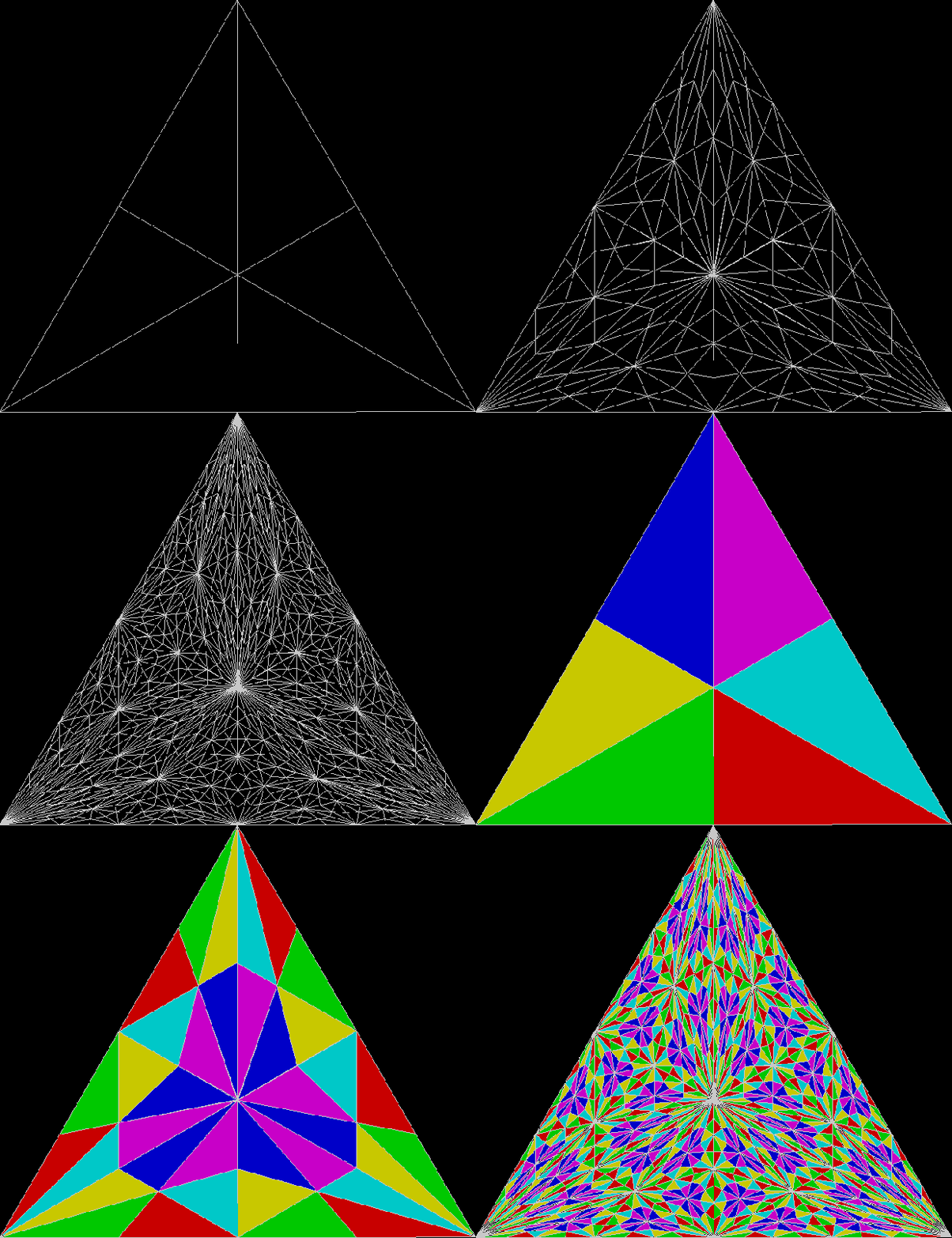
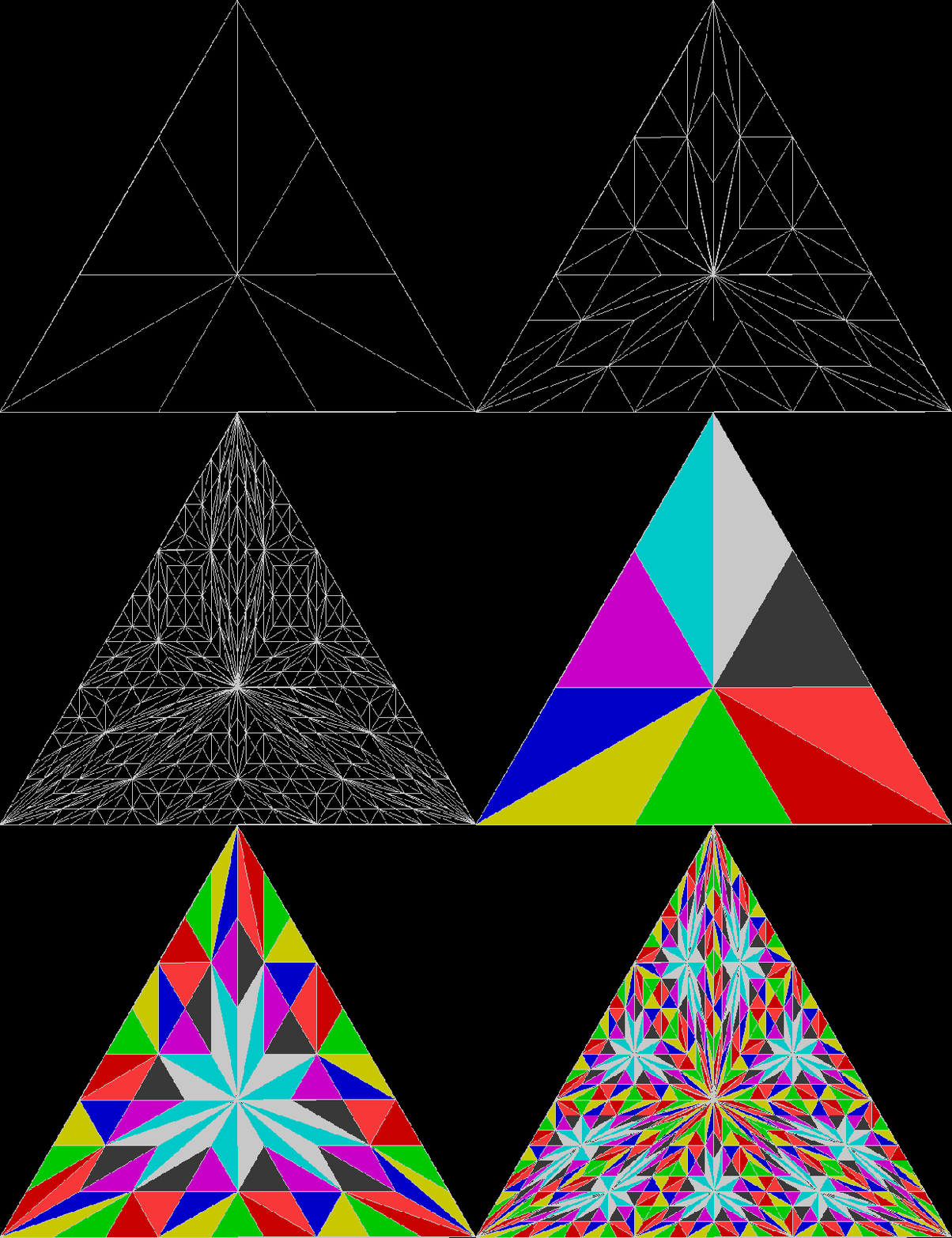
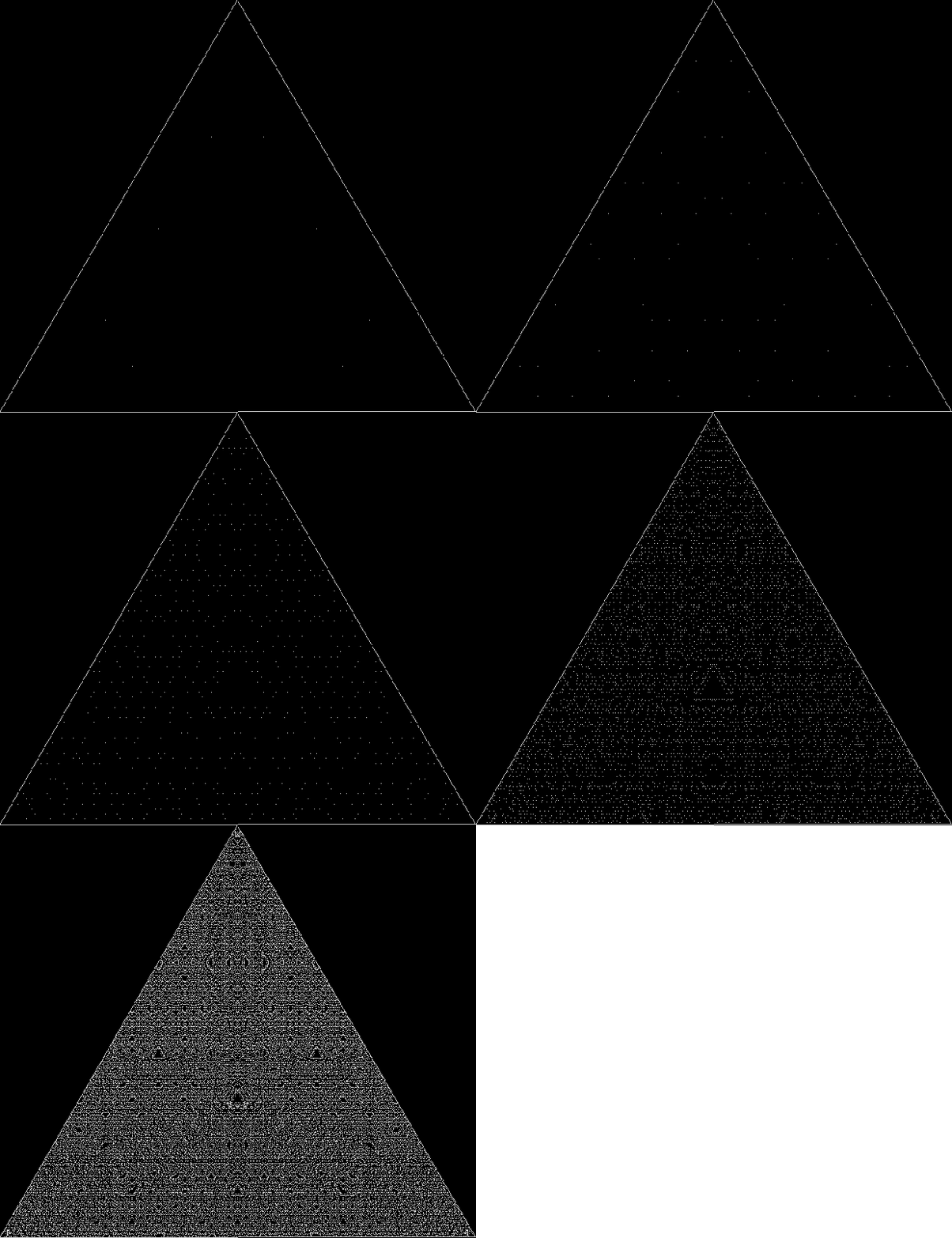
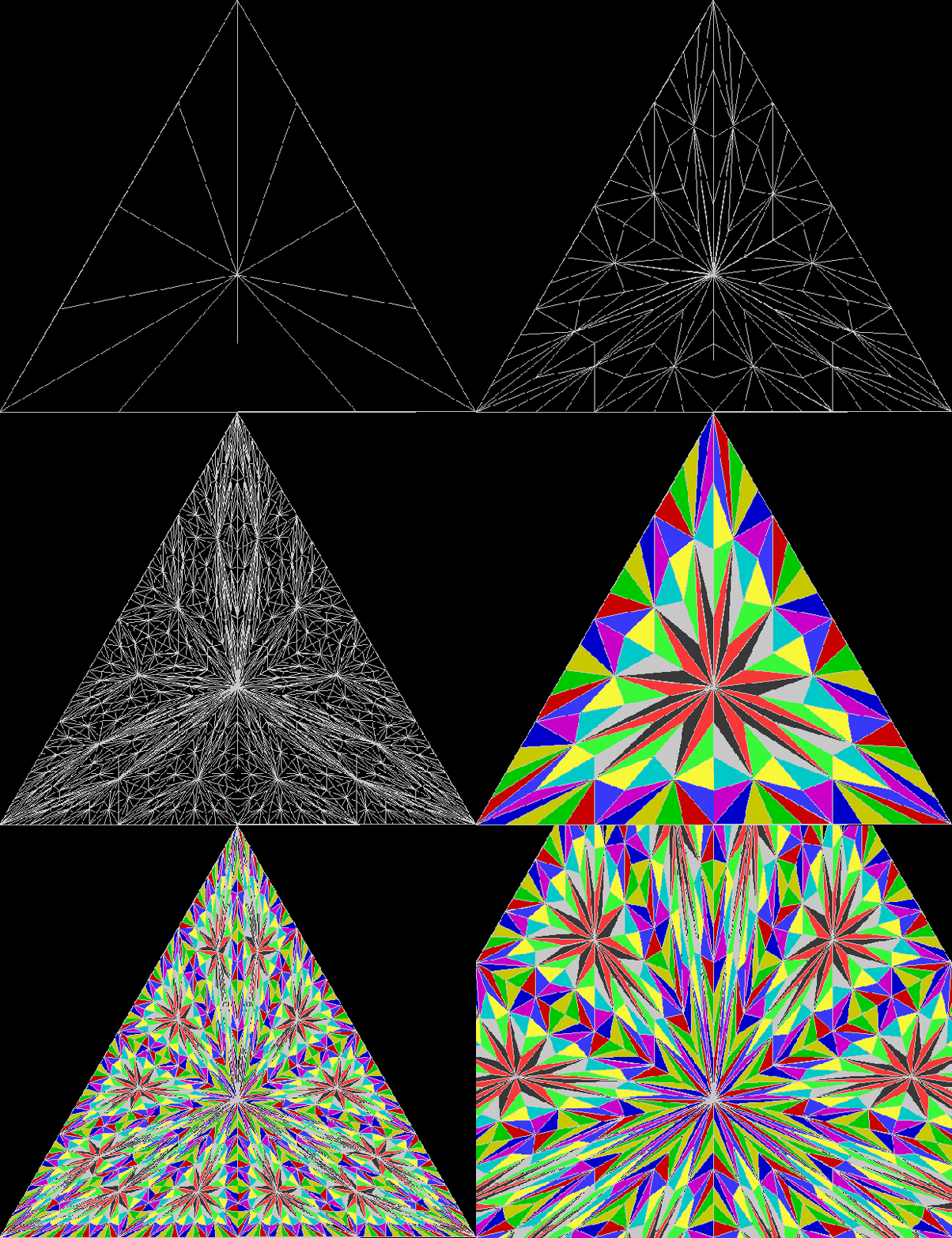
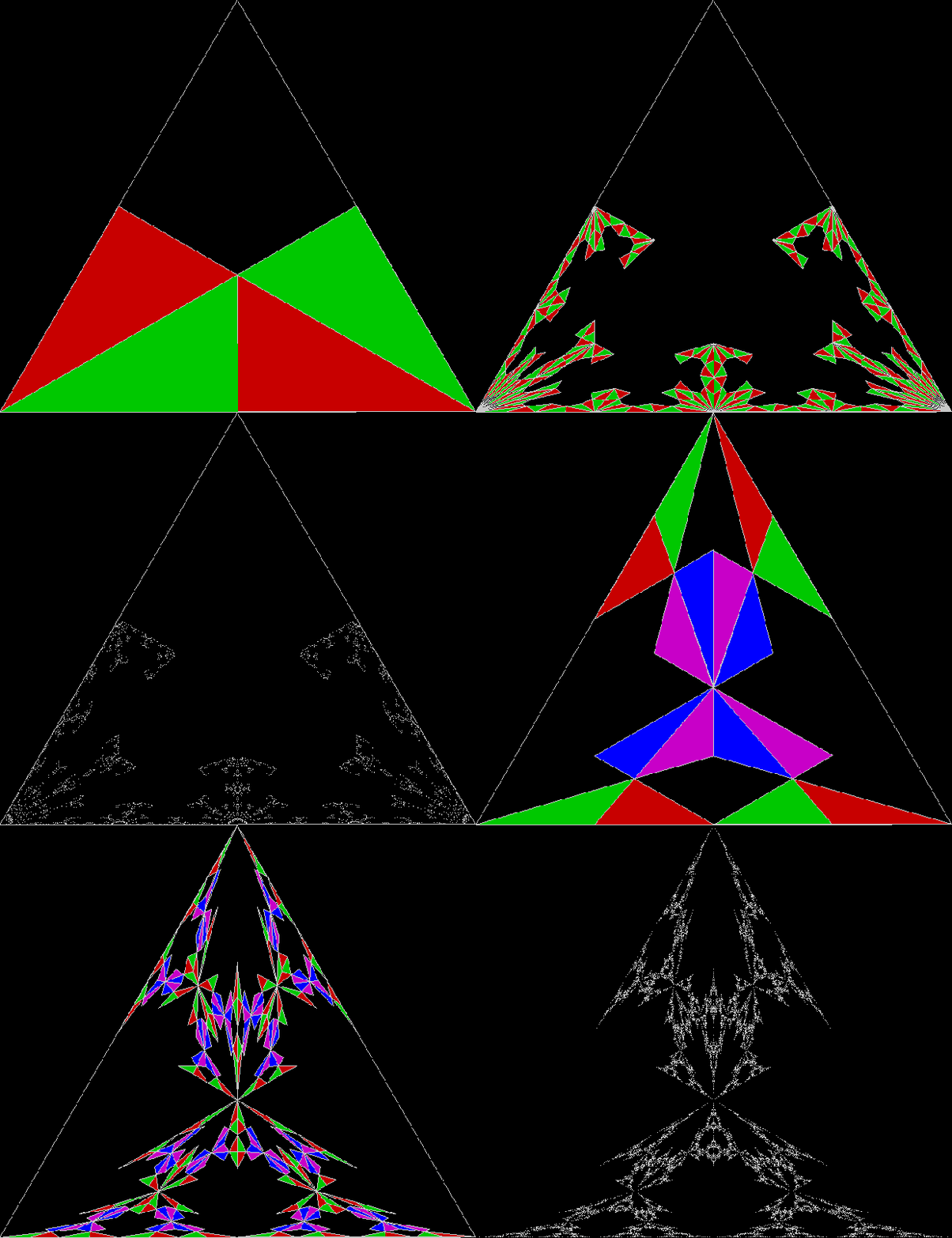
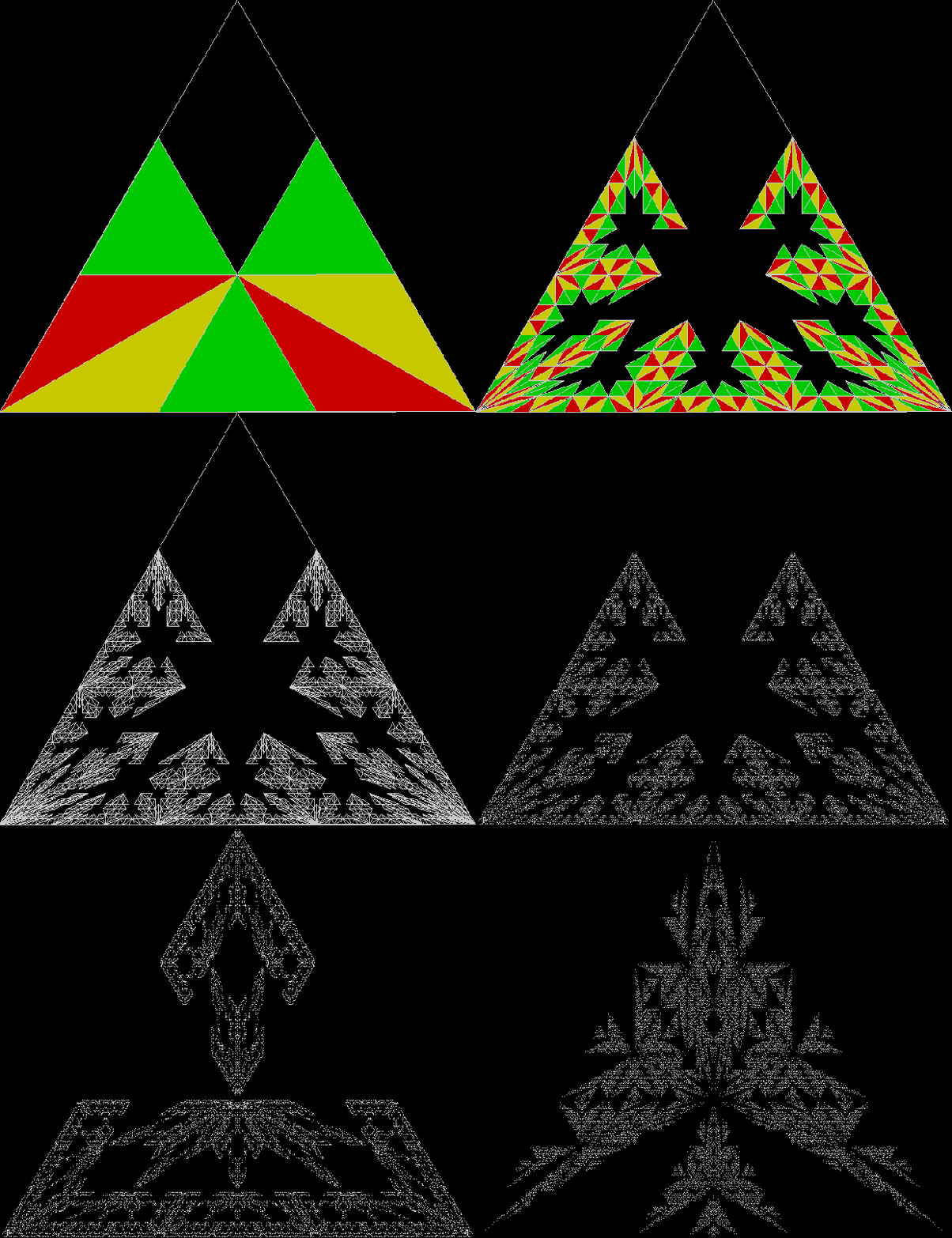
This fractal is created by taking an equilateral triangle and finding the centre and the midpoint of each side. Using all these points, plus the three vertices, six new triangles can be created from the original. The process is then repeated with each new triangle (if the images don’t animate, please try opening them in a new window):

triangle_div2

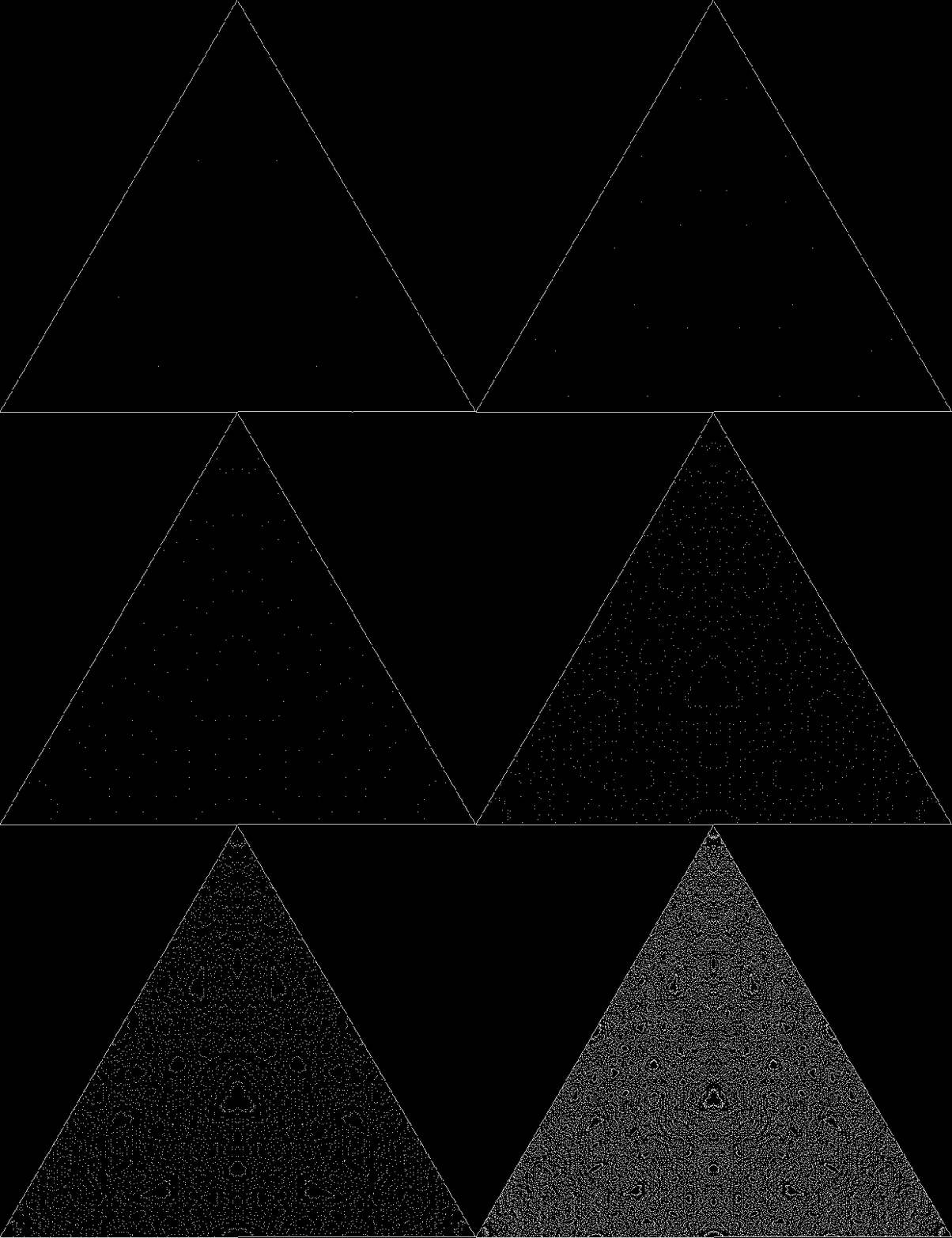
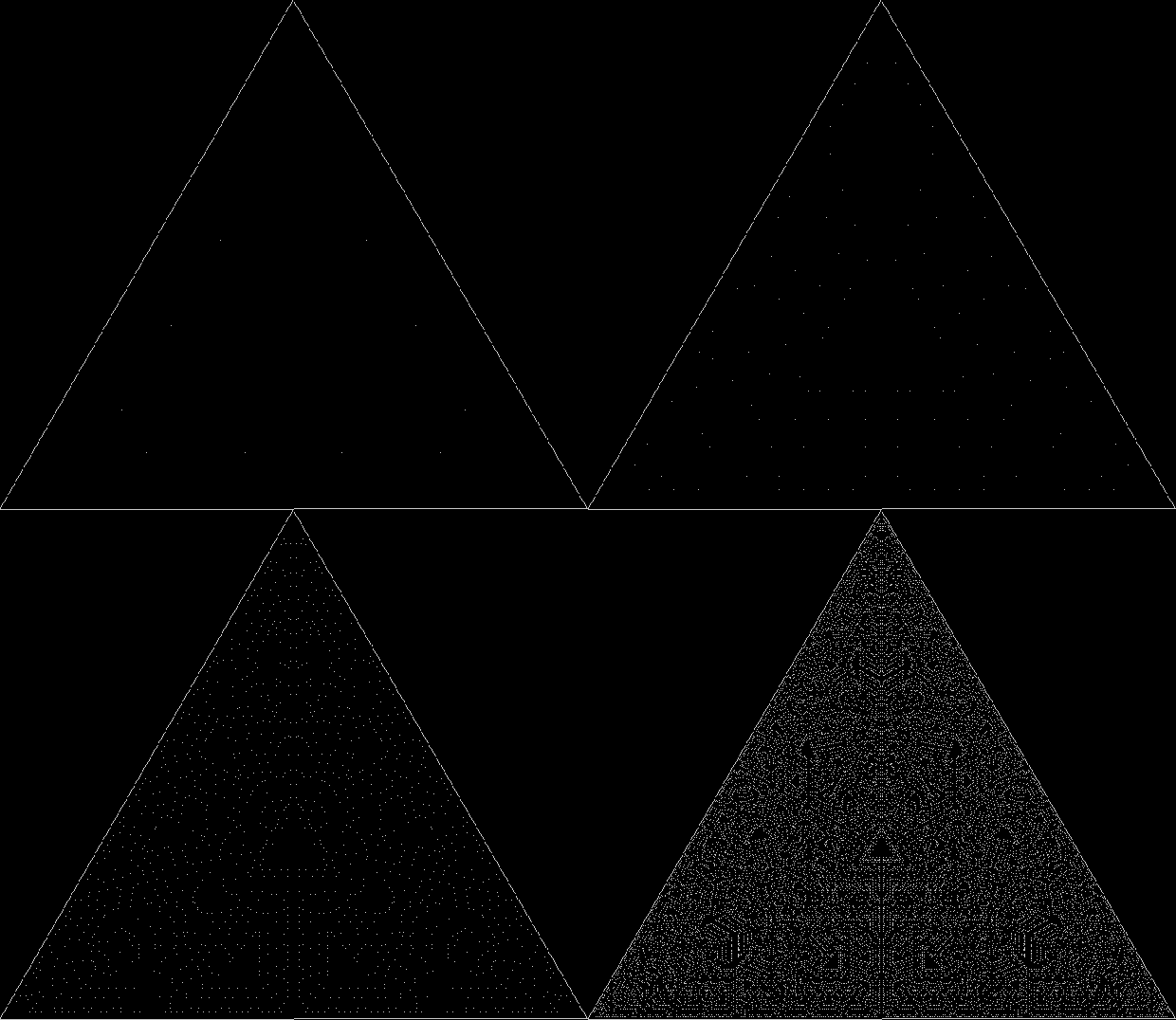
If the centre-point of each triangle is shown, rather than the sides, this is the pattern created:

triangle_div2_dots

Triangles in which the sides are divided into thirds and quarters look like this:

triangle_div3

triangle_div3_dots

triangle_div4

triangle_div4_dots

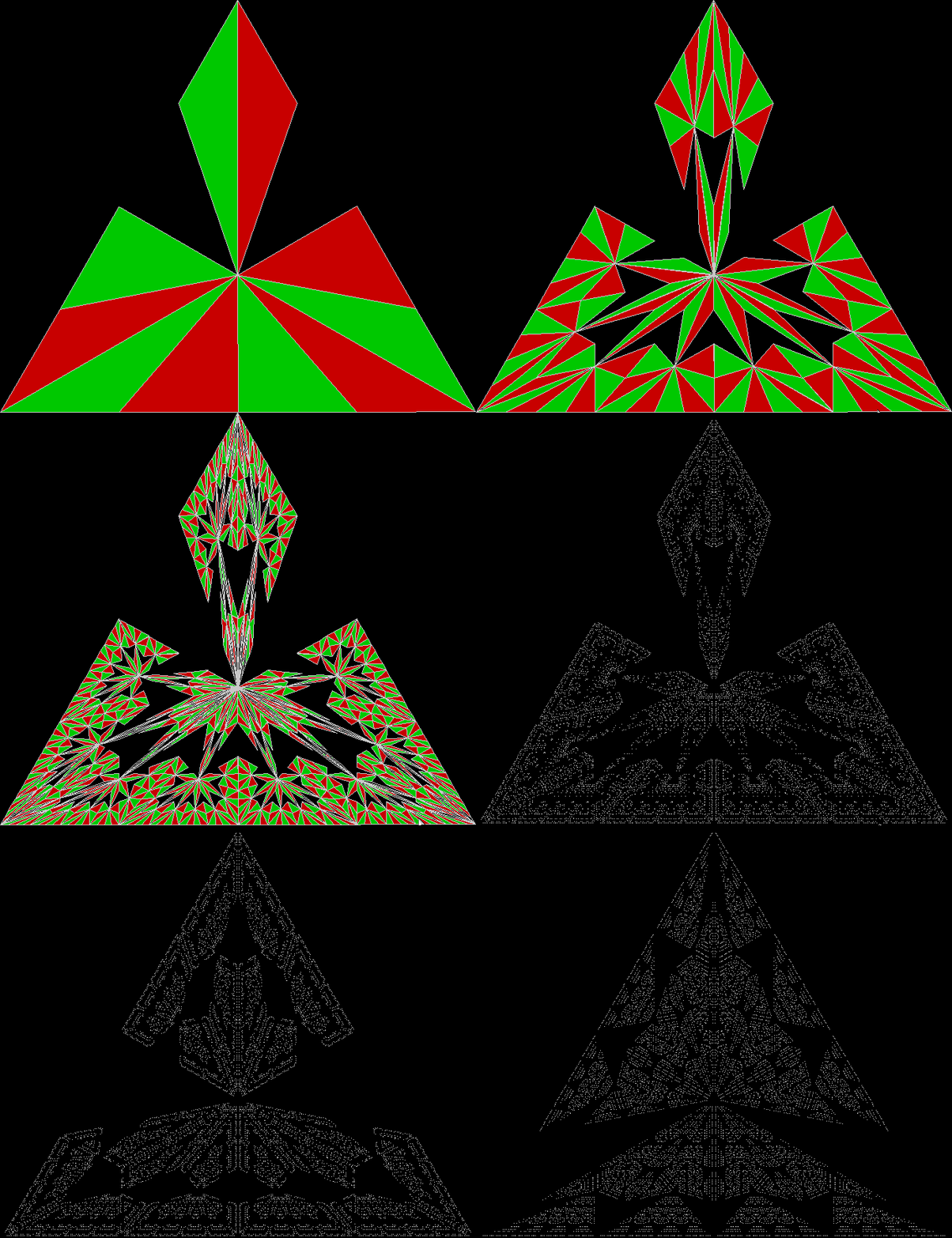
And if sub-triangles are discarded, more obvious fractals appear, some of which look like Lovecraftian deities and owl- or hawk-gods:


cthuneus1

cthuneus2

cthuneus3


Elsewhere Other-Accessible

Circus Trix — a later and better-illustrated look at these fractals

Lulu Lunatic Luz

It’s disturbing what you can find online…

Tales of Silence & Sortilege, Simon Whitechapel, Paperback, 111 Pages

May 28, 2012

If you love weird fantasy, if you love the English language, even if you don’t love Clark Ashton Smith, you should read this book. The back cover describes it as “the darkest and most disturbing fantasy” of this millennium, but that’s either sarcastic or tragically optimistic, because what these stories really are is beautiful. The breath of snow-wolves is described as “harsh-spiced.” A mysterious gargoyle leaning from the heights of a great cathedral has “wings still glistening with the rime of interplanetary flight.” Hummingbirds are “gem-feathered… their glittering breasts dusted with the gold of a hundred pollens.” If you cannot appreciate such imagery, then perhaps you are dead to beauty, or simply dead. These tales are very short, but some of them have stayed with me for years, such as “The Treasure of the Temple,” in which a thief seems to lose the greatest fortune he could ever have found by stealing a king’s ransom in actual treasure. Most of the stories are brilliant, one or two is only good, but the masterpieces are “Master of the Pyramid” and “The Return of the Cryomancer.” The sense of loss and mystery evoked by these two companion stories is almost physically painful, it is so haunting. There is nothing like these stories being published today. Reading them, I feel the excitement and wonder that fans of Weird Tales magazine must have known long ago when new stories would appear by H.P. Lovecraft, Clark Ashton Smith, and Robert E. Howard. Simon Whitechapel doesn’t imitate these authors so much as apply their greatest lessons to new forms of fantasy. This is one of the cheapest books I own, but I accord it one of my most valuable. It is easily the best work of art you will find in any form on Lulu. I cannot recommend it highly enough.

The Roses of Hsūlag-Beiolă, Simon Whitechapel, Paperback, 154 Pages

Jun 8, 2012

This collection of weird fantasy is filled with mystery, wonder and a sense of the ineffable. Not every story is a mind-blowing masterpiece, but the best of them are absolutely spectacular. Even the worst are good and all are haunting in one way or another. My two favorites were: 1. “The Mercy of the Osmomancer,” wherein a knight on a mission to investigate the tower of a scent-wizard encounters demons made of smells and even learns the language of odors… 2. “The Swans,” in which a pawnbroker tracks down all the known paintings of a seemingly insane artist who paints his canvases entirely black, nothing but black, for reasons best and most poetically left to Simon Whitechapel to explain… Any fan of H.P. Lovecraft, Robert E. Howard, Clark Ashton Smith, Edgar Allan Poe, Comte de Lautréamont, Charles Baudelaire or William S. Burroughs will find something wonderful to love in here. I sure did.


Even more disturbing is the thought that this individual may be able to pass themself off as normal in real life: there are no spelling mistakes or solecisms. (Then again, perhaps I’m reviewing my own books in my sleep. (But I wouldn’t compare myself to B*rr**ghs, surely? (Unless it’s a bluff or double-bluff. (Disturbing, as I said. (I agree.)))))

Stoch’! (In the Name of Dove)

Stochasma, In Abysso (2012)

The Sueco-Georgian avant-gardists Stochasma were formed, in their own words, “to interrogate, eviscerate, and exterminate the ultimate experimental envelope of acoustic idiosyncrasy”. That’s “Sueco-” as in Sweden and “Georgian” as in the Eurasian nation, not the American state, by the way. Going one up on some bands from Wales, Ireland and Scotland, who issue their material bilingually, in English and one or another of the Celtic languages, Stochasma issue all their material tri-lingually, in English, Swedish, and Georgian. The strangeness and beauty of the Georgian script match and enhance the strangeness and (occasional) beauty of their music, but, unlike their last two releases, there’s no spoken English, Swedish or Georgian here: In Abysso is intended to be an “abhuman listen”.

Front cover of Stochasma's album In Abysso 

Believe me, it is! The title of the album is Latin for “In the Abyss” and the liner-notes extend thanks to H.P. Lovecraft, Clark Ashton Smith and Stanislaw Ulam for “infernal inspiration”. If the last name makes you think “Who?” (or “U?”), you must be new/nu to Stochasma, who draw inspiration not just from art and literature, but from mathematics too. Stanislaw Ulam (1909-84) was a Polish mathematician perhaps most famous for inventing the “Ulam spiral”, a graphical representation of the prime numbers that reveals mysterious patterns in this strange and fascinating set of integers. Ulam stumbled across the spiral while “doodling” during a boring lecture at a scientific meeting. That kind of serendipity has always been important to Stochasma, who explore the musical abyss/chasm partly through random, or stochastic, techniques. For the first track, “Pr1m4l Skr33m”, the five members of the band had electrodes attached to their nipples before being asked, at random, to indicate, with a nod or shake of the head, whether a randomly selected number between 1 and 10,000 was prime or composite (for example, 1,433 is prime, being divisible by no numbers but itself and 1; 1,434 is composite, being divisible by 2, 3 and 239). If they were wrong, they received a painful electric shock.

The resultant collection of grunts, gasps, and screams was electronically worked over in fully traditional Stochasma fashion to create “Pr1m4l Skr33m”, which sounds like a fully traditional Stochasma track: fucking weird and unsettling! Is the irregular chorus of voices in agony or ecstasy? Are the band being tortured in a hell run by sadists or pleasured in a heaven run for masochists? Or both? It’s hard to decide, and at times hard to listen, but as Stochasma themselves put it: “We’re queasy listening, not easy – easy listening is for cubes.”

Elsewhere, the band have used the ultra-sensitive microphones they first experimented with on 2003’s AnguisaquA (sic – it literally means “SnakewateR”). This time they’ve recorded the bloodflow of a dove and the movements of parasites in its feathers for “Täubchen”, which sounds even stranger than it reads. That and “Pr1m4l Skr33m” are the first two tracks: the next fifteen are entitled “Ignisigil I” to “Ignisigil XV”. Stochasma used a fire-proof microphone to record the sound of books being burned. They selected fifteen wildly different authors for this literally incendiary homage, from “J. Aldapuerta to J. Archer, from K. Marx to K. Minogue”, as they themselves put it. (That’s the über-trangressive Spanish horror-writer Jesús Aldapuerta and the über-cruddy British thriller-writer Jeffrey Archer, and the Anglo-German philosophaster Karl Marx and the Australian pop-pixie Kylie Minogue, for those unfamiliar with the names.) And the band insist, perhaps tongue-in-cheek, that the sonic textures of the recordings are dependent not just on the physical nature of the paper and ink being burnt, but also on the ideological and aesthetic nature of the burning text.

It’s hard to agree: the “Ignisigils” all sound pretty much alike to me, though that sound is uncharacteristically soothing and relaxing by Stochasma standards (on my first listen, I dropped off during “Ignisigil VIII” and didn’t wake up till “Ignisigil XI”). The album is rounded off with three of the strangest pieces of music I’ve heard this century: “Musgomorrah”, “Gradus ad Parnassum”, and “CoMoXoCoI”. The first sounds like a slowed recording of men in armour fighting in thick mud; the second like a choir of giant glass insects singing themselves to splinters; and the third like echoes chasing each another in a collapsing or burning maze. These three might grow on me or might not: for now, “Pr1m4l Skr33m”, “Täubchen”, and “Ignisigil IV” hit the sonic sweet’n’sour spot that Stochasma seem to have copyrighted. I don’t know why “IV” hits the spot and the rest of the Ignisigils don’t, but that’s often the way with Stochasma: you like the sounds they create and you haven’t a clue as to why. In company with a select band of other electronicognoscenti, I look forward to their seventh album, whenever it appears and whatever musical mélanges or macedoines it manages to mulch, mangle, and miscegenate.


Elsewhere other-engageable:

Musings on Music

It’s The Gweel Thing…

Gweel & Other Alterities, Simon Whitechapel (Ideophasis Books, 2011)

Oh no. Say it ain’t so, Shmoe. I thought we’d heard the last of this vile piece-a-shit after his richly deserved execution for hate-crimes – inter alia, he’d claimed that maverick underground editor Dave Kerekes was a M*n *td f*n, that über-maverick gay aesthetician John Coulthart was a G**rd**n-r**d*r, and that post-über-maverick cultural titan Alan Moore had a *ea**. He might, just might, have got away with double-life for those first two crimes against humanity… but fortunately one of the last acts of the righteous New Labour government in Britain had been to pass a law mandating death for any and all forms of pogonophobia. Accordingly, Whitechapel’s attempted genocide against Alan M. earnt him the electric Blair (don’t ask, or you might feel a twinge of sympathy even for a depraved speech-criminal like Whitechapel).

Anyhows, that SHOULDA been the last we’d ever hear of him. No such luck. Either some deluded disciple’s been on the ouija board or the astral, or Whitechapel left material to some deluded disciple for posthumous publication, like a final fetid fart from a putrefying, maggot-infested corpse. It’s difficult to know where to begin hinting at how hateful’n’horrible this book is – “hint” is all I’m gonna do, because I’ve got something Whitechapel obviously never came within a million miles of acquiring, namely, a social conscience. Did you ever read anything and then feel as though you needed to take a looooong shower? Me too. More’n once. But it’s never been as bad as this. I felt as though I needed a shower after the first word of the first sentence of the first story in Gweel. That’s how reprehensible’n’repulsive this book is in terms of issues around feralness’n’fetidity. I’ve read Sade, I’ve read Guyotat, I’ve read Archer – I have never read anything that made me despair of life and humanity the way Gweel did. And still does. I’ll lay it on the line: I am completely and uncompromisingly in favor of absolute and unconditional freedom of speech – except for racists, sexists, and homophobes, natch – but I would gladly see Gweel burned and its ashes ground to powder before being encased in concrete and blasted off for a rendezvous with the all-cleansing fusional furnace of Father Sol himself.

Why? Well, I’m not gonna tell you the worst of what’s within – I’m not even sure I know the worst, given that I couldn’t get some pages unstuck after I threw up on the book halfway thru the second paragraph of that first story – but how’d’ya like these little green apples?:

The suggestion that prime numbers like 17, 31, and 89 could be used as hallucinogenic drugs (as made in the story “Tutu-3”)? Or the suggestion that the digits of √2 somehow encode a Lovecraftian pastiche about two archaeomysteriologists descending to the bottom of the Atlantic in a bathysphere, drinking “whisky-laced coffee” as they go (as in “Kopfwurmkundalini”)? Or how’s about the über-esoteric hidden channel that some prisoner discovers on an old TV and that, left playing overnight, coats his cell in gold-and-scarlet lichen (as in, er, “Lichen”)? And I don’t even like to recall, let alone mention, the microscopic red mite in “Acariasis” and the Martian musings it prompts in another “banged-up” protagonist. As for “Beating the Meat” and “Santa Ana City Jail” – let’s leave it at the titles, shall we? You don’t wanna go there. I have, and I wish to God I hadn’t.

Yeah, I also wish Whitechapel could be brought back to life… and sentenced to death all over again for what he’s done to H.P. Lovecraft, M.R. James, and Ramsey Campbell. As a committed fan of all three, I can’t tell you how horrified and disgusted I was to see their influence all over Gweel. It was like sipping and savoring a glass of fine wine, then discovering that someone had been washing his syphilitic dick in it. And then some. If you try reading this, Jesus will sob on Mary’s shoulder and Satan will high-five Mephistopheles. Trust me. If you possibly can, get the full width of the planet between yourself and any copy of Gweel that survives the sweep that will begin as soon as I’ve dialled my local hate-crime hotline. (Reviewed by Peter Sotos.)