Square on a Three String

222 A.D. was the year in which the Emperor Heliogabalus was assassinated by his own soldiers. Exactly 1666 years later, the Anglo-Dutch classicist Sir Lawrence Alma-Tadema exhibited his painting The Roses of Heliogabalus (1888). I suggested in “Roses Are Golden” that Alma-Tadema must have chosen the year as deliberately as he chose the dimensions of his canvas, which, at 52″ x 84 1/8“, is an excellent approximation to the golden ratio.

But did Alma-Tadema know that lines at 0º and 222º divide a circle in the golden ratio? He could easily have done, just as he could easily have known that 222 precedes the 48th prime, 223. But it is highly unlikely that he knew that 223 yields a magic square whose columns, rows and diagonals all sum to 222. To create the square, simply list the 222 multiples of the reciprocal 1/223 in base 3, or ternary. The digits of the reciprocal repeat after exactly 222 digits and its multiples begin and end like this:

001/223 = 0.00001002102101021212111012022211122022... in base 3
002/223 = 0.00002011211202120201222101122200021121...
003/223 = 0.00010021021010212121110120222111220221...
004/223 = 0.00011100200112011110221210022100120020...
005/223 = 0.00012110002220110100102222122012012120...

[...]

218/223 = 0.22210112220002112122120000100210210102... in base 3
219/223 = 0.22211122022110211112001012200122102202...
220/223 = 0.22212201201212010101112102000111002001...
221/223 = 0.22220211011020102021000121100022201101...
222/223 = 0.22221220120121201010111210200011100200...

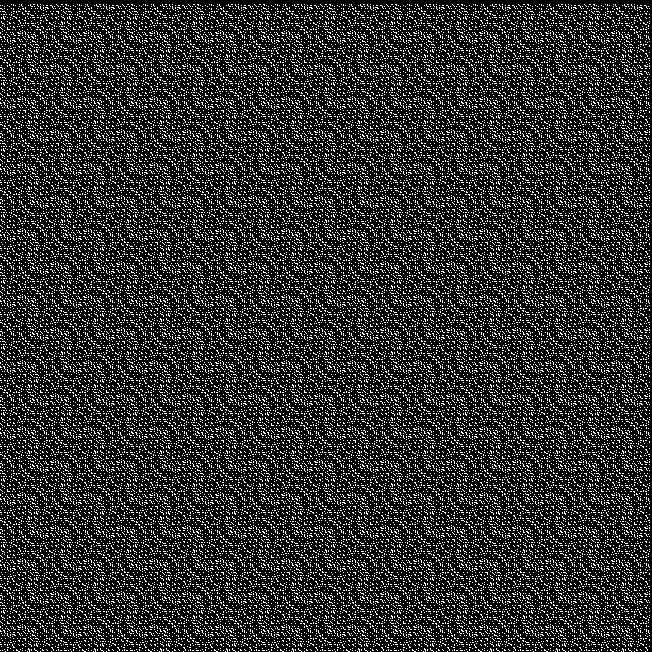
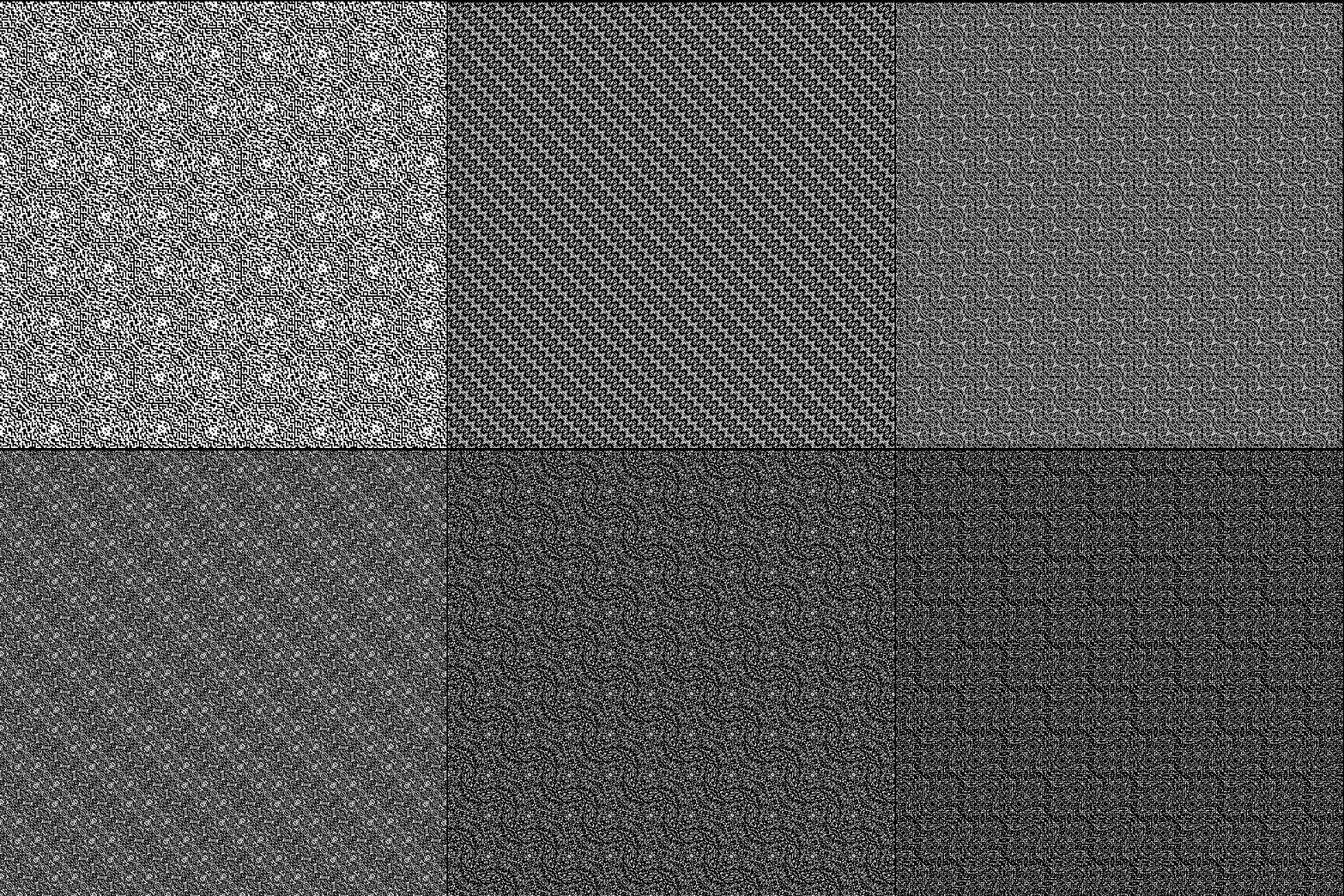
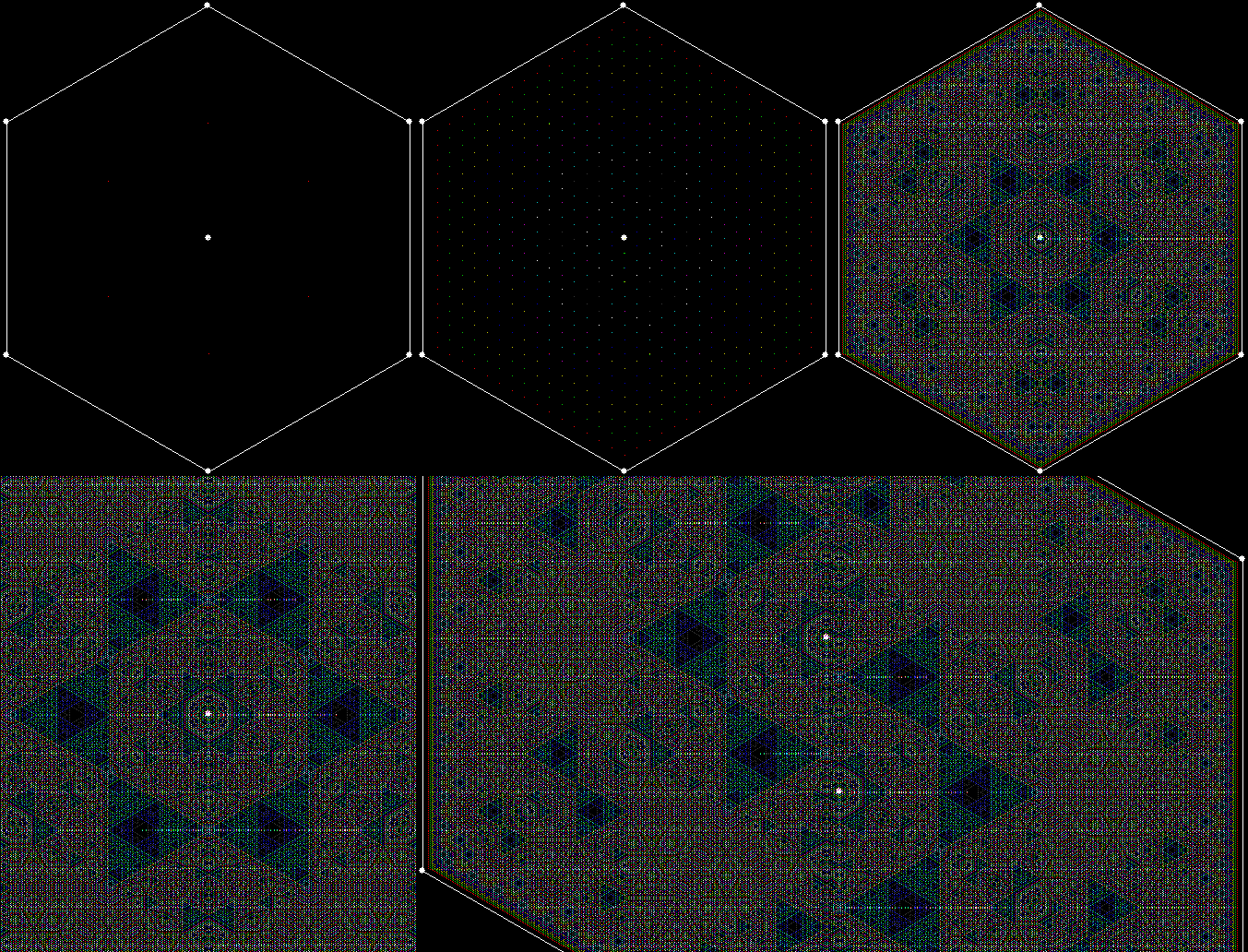
Each column, row and diagonal of ternary digits sums to 222. Here is the full n/223 square represented with 0s in grey, 1s in white and 2s in red:

(Click for larger)


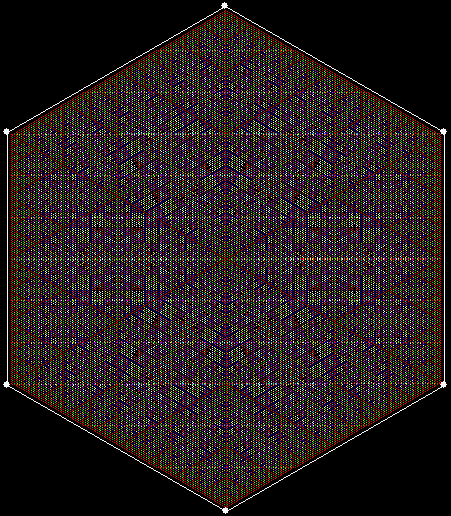
It isn’t difficult to see that the white squares are mirror-symmetrical on a horizontal axis. Here is the symmetrical pattern rotated by 90º:
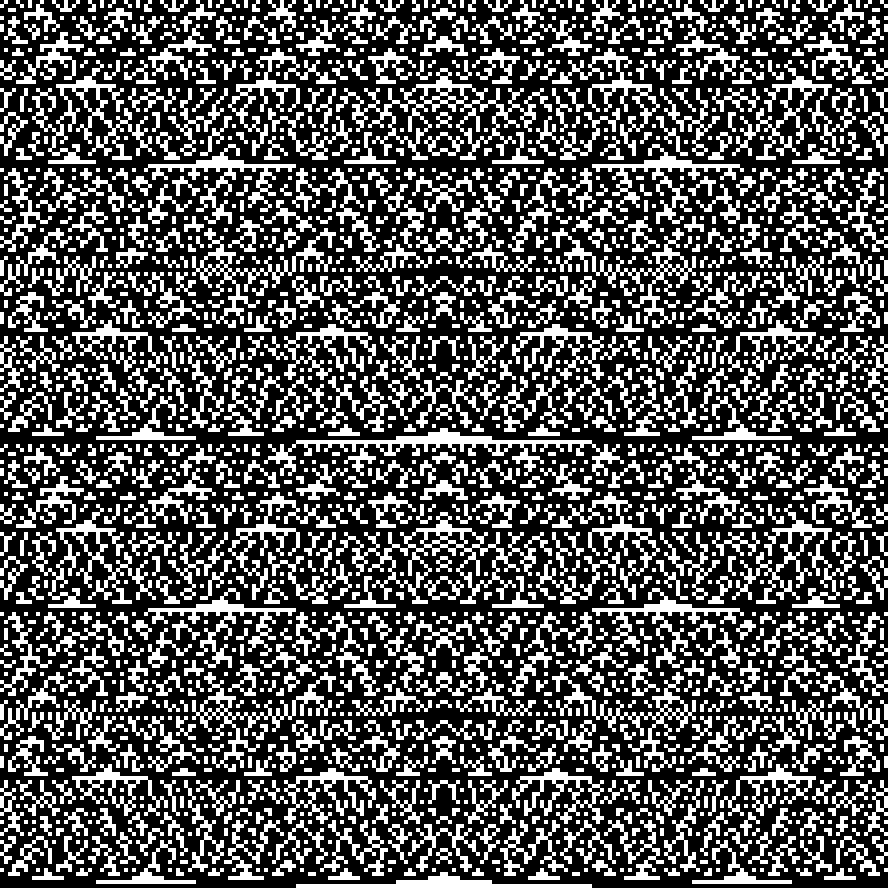
(Click for larger)


But why should the 1s be symmetrical? This isn’t something special to 1/223, because it happens with prime reciprocals like 1/7 too:

1/7 = 0.010212... in base 3
2/7 = 0.021201...
3/7 = 0.102120...
4/7 = 0.120102...
5/7 = 0.201021...
6/7 = 0.212010...

And you can notice something else: 0s mirror 2s and 2s mirror 0s. A related pattern appears in base 10:

1/7 = 0.142857...
2/7 = 0.285714...
3/7 = 0.428571...
4/7 = 0.571428...
5/7 = 0.714285...
6/7 = 0.857142...

The digit 1 in the decimal digits of n/7 corresponds to the digit 8 in the decimal digits of (7-n)/7; 4 corresponds to 5; 2 corresponds to 7; 8 corresponds to 1; 5 corresponds to 4; and 7 corresponds to 2. In short, if you’re given the digits d1 of n/7, you know the digits d2 of (n-7)/7 by the rule d2 = 9-d1.

Why does that happen? Examine these sums:

 1/7 = 0.142857142857142857142857142857142857142857...
+6/7 = 0.857142857142857142857142857142857142857142...
 7/7 = 0.999999999999999999999999999999999999999999... = 1.0

 2/7 = 0.285714285714285714285714285714285714285714...
+5/7 = 0.714285714285714285714285714285714285714285...
 7/7 = 0.999999999999999999999999999999999999999999... = 1.0

 3/7 = 0.428571428571428571428571428571428571428571...
+4/7 = 0.571428571428571428571428571428571428571428...
 7/7 = 0.999999999999999999999999999999999999999999... = 1.0

And here are the same sums in ternary (where the first seven integers are 1, 2, 10, 11, 12, 20, 21):

  1/21 = 0.010212010212010212010212010212010212010212...
+20/21 = 0.212010212010212010212010212010212010212010...
 21/21 = 0.222222222222222222222222222222222222222222... = 1.0

  2/21 = 0.021201021201021201021201021201021201021201...
+12/21 = 0.201021201021201021201021201021201021201021...
 21/21 = 0.222222222222222222222222222222222222222222... = 1.0

 10/21 = 0.102120102120102120102120102120102120102120...
+11/21 = 0.120102120102120102120102120102120102120102...
 21/21 = 0.222222222222222222222222222222222222222222... = 1.0

Accordingly, in base b with the prime p, the digits d1 of n/p correspond to the digits (p-n)/p by the rule d2 = (b-1)-d1. This explains why the 1s mirror themselves in ternary: 1 = 2-1 = (3-1)-1. In base 5, the 2s mirror themselves by the rule 2 = 4-2 = (5-1) – 2. In all odd bases, some digit will mirror itself; in all even bases, no digit will. The mirror-digit will be equal to (b-1)/2, which is always an integer when b is odd, but never an integer when b is even.

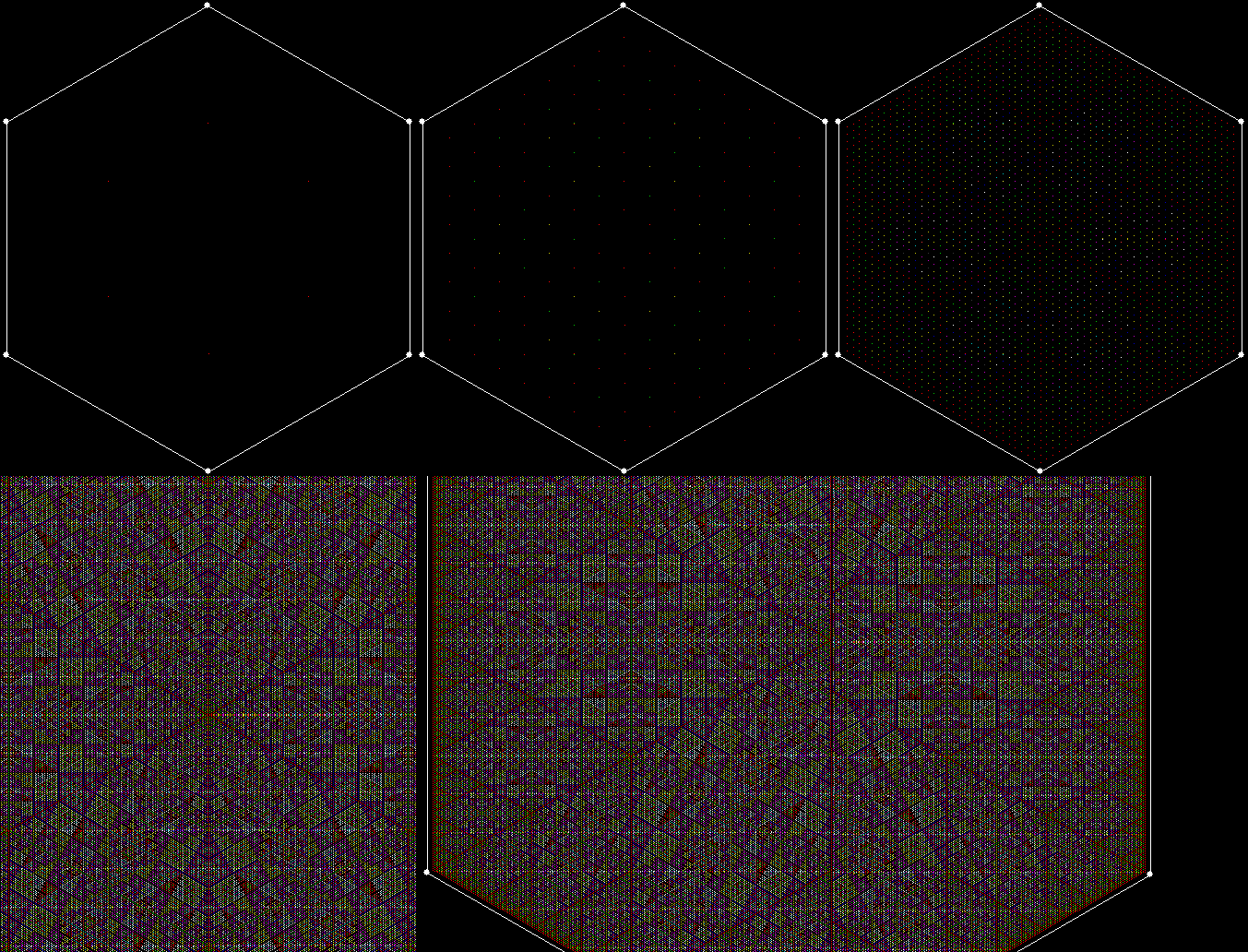
Here are some more examples of the symmetrical patterns found in odd bases:

Patterns of 1s in 1/19 in base 3


Patterns of 6s in 1/19 in base 13


Patterns of 7s in 1/19 in base 15


Elsewhere other-posted:

Roses Are Golden — more on The Roses of Heliogabalus (1888)
Three Is The Key — more on the 1/223 square

T4K1NG S3LF13S

It’s like watching a seed grow. You take a number and count how many 0s it contains, then how many 1s, how many 2s, 3s, 4s and so on. Then you create a new number by writing the count of each digit followed by the digit itself. Then you repeat the process with the new number.

Here’s how it works if you start with the number 1:

1

The count of digits is one 1, so the new number is this:

→ 11

The count of digits for 11 is two 1s, so the next number is:

→ 21

The count of digits for 21 is one 1, one 2, so the next number is:

→ 1112

The count of digits for 1112 is three 1s, one 2, so the next number is:

→ 3112

The count of digits for 3112 is two 1s, one 2, one 3, so the next number is:

→ 211213

What happens after that? Here are the numbers as a sequence:

1 → 11 → 21 → 1112 → 3112 → 211213 → 312213 → 212223 → 114213 → 31121314 → 41122314 → 31221324 → 21322314

That’s all you need, because something interesting happens with 21322314. The digit count is two 1s, three 2s, two 3s, one 4, so the next number is:

→ 21322314

In other words, 21322314 is what might be called a self-descriptive number: it describes the count of its own digits. That’s why I think this procedure is like watching a seed grow. You start with the tiny seed of 1 and end in the giant oak of 21322314, whose factorization is 2 * 3^2 * 13 * 91121. But there are many more self-descriptive numbers in base ten and some of them are much bigger than 21322314. A047841 at the Online Encyclopedia of Integer Sequences lists all 109 of them (and calls them “autobiographical numbers”). Here are a few, starting with the simplest possible:

22 → two 2s → 22
10213223 → one 0, two 1s, three 2s, two 3s → 10213223
10311233 → one 0, three 1s, one 2, three 3s → 10311233
21322314 → two 1s, three 2s, two 3s, one 4 → 21322314
21322315 → two 1s, three 2s, two 3s, one 5 → 21322315
21322316 → two 1s, three 2s, two 3s, one 6 → 21322316*
1031223314 → one 0, three 1s, two 2s, three 3s, one 4 → 10
31223314
3122331415 → three 1s, two 2s, three 3s, one 4, one 5
→ 3122331415
3122331416 → three 1s, two 2s, three 3s, one 4, one 6
→ 3122331416*

*And for 21322317, 21322318, 21322319; 3122331417, 3122331418, 3122331419.


And here’s what happens when you seed a sequence with a number containing all possible digits in base ten:

1234567890 → 10111213141516171819 → 101111213141516171819 → 101211213141516171819 → 101112213141516171819

That final number is self-descriptive:

101112213141516171819 → one 0, eleven 1s, two 2s, one 3, one 4, one 5, one 6, one 7, one 8, one 9 → 101112213141516171819

So some numbers are self-descriptive and some start a sequence that ends in a self-descriptive number. But that doesn’t exhaust the possibilities. Some numbers are part of a loop:

103142132415 → 104122232415 → 103142132415
104122232415 → 103142132415 → 104122232415
1051421314152619 → 1061221324251619 → 1051421314152619…
5142131415261819 → 6122132425161819 → 5142131415261819
106142131416271819 → 107122132426171819 → 106142131416271819


10512223142518 → 10414213142518 → 10512213341518 → 10512223142518
51222314251718 → 41421314251718 → 51221334151718 →
51222314251718

But all that is base ten. What about other bases? In fact, nearly all self-descriptive numbers in base ten are also self-descriptive in other bases. An infinite number of other bases, in fact. 22 is a self-descriptive number for all b > 2. The sequence seeded with 1 is identical in all b > 4:

1 → 11 → 21 → 1112 → 3112 → 211213 → 312213 → 212223 → 114213 → 31121314 → 41122314 → 31221324 → 2132231421322314

In bases 2, 3 and 4, the sequence seeded with 1 looks like this:

1 → 11 → 101 → 10101 → 100111 → 1001001 → 1000111 → 11010011101001… (b=2) (1101001[2] = 105 in base 10)
1 → 11 → 21 → 1112 → 10112 → 1010112 → 2011112 → 10111221011122… (b=3) (1011122[3] = 854 in base 10)
1 → 11 → 21 → 1112 → 3112 → 211213 → 312213 → 212223 → 1110213 → 101011213 → 201111213 → 101112213101112213… (b=4) (101112213[4] = 71079 in base 10)

In base 2 there are only two self-descriptive numbers (and no loops):

111 → three 1s → 111… (b=2) (111 = 7 in base 10)
1101001 → three 0s, four 1s → 1101001… (b=2) (1101001 = 105 in base 10)

So if you apply the “count digits” procedure in base 2, all numbers, except 111, begin a sequence that ends in 1101001. Base 3 has a few more self-descriptive numbers and also some loops:

2222… (b >= 3)
10111 → one 0, four 1s → 10111… (b=3)
11112 → four 1s, one 2 → 11112
100101 → three 0s, three 1s → 100101… (b=3)
1011122 → one 0, four 1s, two 2s → 1011122… (b=3)
2021102 → two 0s, two 1s, three 2s → 2021102… (b=3)
10010122 → three 0s, three 1s, two 2s → 10010122


2012112 → 10101102 → 10011112 → 2012112
10011112 → 2012112 → 10101102 → 10011112
10101102 → 10011112 → 2012112 → 10101102

A question I haven’t been able to answer: Is there a base in which loops can be longer than these?

103142132415 → 104122232415 → 103142132415
10512223142518 → 10414213142518 → 10512213341518 → 10512223142518

A question I have been able to answer: What is the sequence when it’s seeded with the title of this blog-post? T4K1NGS3LF13S is a number in all bases >= 30 and its base-30 form equals 15,494,492,743,722,316,018 in base 10 (with the factorization 2 * 72704927 * 106557377767). If T4K1NGS3LF13S seeds a sequence in any b >= 30, the result looks like this:

T4K1NGS3LF13S → 2123141F1G1K1L1N2S1T → 813213141F1G1K1L1N1S1T → A1122314181F1G1K1L1N1S1T → B1221314181A1F1G1K1L1N1S1T → C1221314181A1B1F1G1K1L1N1S1T → D1221314181A1B1C1F1G1K1L1N1S1T → E1221314181A1B1C1D1F1G1K1L1N1S1T → F1221314181A1B1C1D1E1F1G1K1L1N1S1T → G1221314181A1B1C1D1E2F1G1K1L1N1S1T → F1321314181A1B1C1D1E1F2G1K1L1N1S1T → F1222314181A1B1C1D1E2F1G1K1L1N1S1T → E1421314181A1B1C1D1E2F1G1K1L1N1S1T → F1221324181A1B1C1D2E1F1G1K1L1N1S1T → E1421314181A1B1C1D1E2F1G1K1L1N1S1T

Can You Dij It? #2

It’s very simple, but I’m fascinated by it. I’m talking about something I call the digit-line, or the stream of digits you get when you split numbers in a particular base into individual digits. For example, here are the numbers one to ten in bases 2 and 3:

Base = 2: 1, 10, 11, 100, 101, 110, 111, 1000, 1001, 1010…
Base = 3: 1, 2, 10, 11, 12, 20, 21, 22, 100, 101…


If you turn them into digit-lines, they look like this:

Base = 2: 1, 1, 0, 1, 1, 1, 0, 0, 1, 0, 1, 1, 1, 0, 1, 1, 1, 1, 0, 0, 0, 1, 0, 0, 1, 1, 0, 1, 0… (A030190 in the Online Encyclopedia of Integer Sequences)
Base = 3: 1, 2, 1, 0, 1, 1, 1, 2, 2, 0, 2, 1, 2, 2, 1, 0, 0, 1, 0, 1… (A003137 in the OEIS)


At the tenth digit of the two digit-lines, both digits equal zero for the first time:

Base = 2: 1, 1, 0, 1, 1, 1, 0, 0, 1, 0
Base = 3: 1, 2, 1, 0, 1, 1, 1, 2, 2, 0


When the binary and ternary digits are represented together, the digit-lines look like this:

(1,1), (1,2), (0,1), (1,0), (1,1), (1,1), (0,1), (0,2), (1,2), (0,0)


But in base 4, the tenth digit of the digit-line is 1. So when do all the digits of the digit-line first equal zero for bases 2 to 4? Here the early integers in those bases:

Base 2: 1, 10, 11, 100, 101, 110, 111, 1000, 1001, 1010, 1011, 1100, 1101, 1110, 1111, 10000, 10001, 10010, 10011, 10100, 10101…

Base 3: 1, 2, 10, 11, 12, 20, 21, 22, 100, 101, 102, 110, 111, 112, 120, 121, 122, 200, 201, 202, 210, 211, 212, 220, 221, 222, 1000, 1001, 1002…

Base 4: 1, 2, 3, 10, 11, 12, 13, 20, 21, 22, 23, 30, 31, 32, 33, 100, 101, 102, 103, 110, 111, 112, 113, 120, 121, 122, 123, 130, 131, 132, 133, 200…


And here are the digits of the digit-line in bases 2 to 4 represented together:

(1,1,1), (1,2,2), (0,1,3), (1,0,1), (1,1,0), (1,1,1), (0,1,1), (0,2,1), (1,2,2), (0,0,1), (1,2,3), (1,1,2), (1,2,0), (0,2,2), (1,1,1), (1,0,2), (1,0,2), (1,1,2), (0,0,3), (0,1,3), (0,1,0), (1,0,3), (0,2,1), (0,1,3), (1,1,2), (1,0,3), (0,1,3), (1,1,1), (0,1,0), (1,1,0), (0,1,1), (1,2,0), (1,1,1), (1,2,1), (1,0,0), (0,1,2), (0,2,1), (1,1,0), (1,1,3), (0,2,1), (1,2,1), (1,2,0), (1,0,1), (1,0,1), (0,2,1), (1,0,1), (1,1,1), (1,2,2), (1,0,1), (1,2,1), (0,2,3), (0,1,1), (0,0,2), (0,2,0), (1,1,1), (0,1,2), (0,2,1), (0,1,1), (1,2,2), (1,2,2), (0,2,1), (0,0,2), (1,2,3), (0,2,1), (1,1,3), (0,2,0), (0,2,1), (1,2,3), (1,1,1), (1,0,1), (0,0,3), (1,0,2), (0,1,1), (0,0,3), (1,0,3), (0,1,2), (1,1,0), (0,0,0)

At the 78th digit, all three digits equal zero. But the 78th digit of the digit-line in base 5 is 1. So when are the digits first equal to zero in bases 2 to 5? It’s not difficult to find out, but the difficulty of the search increases fast as the bases get bigger. Here are the results up to base 13 (note that bases 11 and 12 both have zeroes at digit 103721663):

dig=0 in bases 2 to 3 at the 10th digit of the digit-line
dig=0 in bases 2 to 4 at the 78th digit of the digit-line
dig=0 in bases 2 to 5 at the 182nd digit of the digit-line
dig=0 in bases 2 to 6 at the 302nd digit of the digit-line
dig=0 in bases 2 to 7 at the 12149th digit of the digit-line
dig=0 in bases 2 to 8 at the 45243rd digit of the digit-line
dig=0 in bases 2 to 9 at the 255261st digit of the digit-line
dig=0 in bases 2 to 10 at the 8850623rd digit of the digit-line
dig=0 in bases 2 to 12 at the 103721663rd digit of the digit-line
dig=0 in bases 2 to 13 at the 807778264th digit of the digit-line


I assume that, for any base b > 2, you can find some point in the digit-line at which d = 0 for all bases 2 to b. Indeed, I assume that this happens infinitely often. But I don’t know any short-cut for finding the first digit at which this occurs.


Previously pre-posted:

Can You Dij It? #1

For Revver and Fevver

This shape reminds me of the feathers on an exotic bird:

feathers

(click or open in new window for full size)


feathers_anim

(animated version)


The shape is created by reversing the digits of a number, so you could say it involves revvers and fevvers. I discovered it when I was looking at the Halton sequence. It’s a sequence of fractions created according to a simple but interesting rule. The rule works like this: take n in base b, reverse it, and divide reverse(n) by the first power of b that is greater than n.

For example, suppose n = 6 and b = 2. In base 2, 6 = 110 and reverse(110) = 011 = 11 = 3. The first power of 2 that is greater than 6 is 2^3 or 8. Therefore, halton(6) in base 2 equals 3/8. Here is the same procedure applied to n = 1..20:

1: halton(1) = 1/10[2] → 1/2
2: halton(10) = 01/100[2] → 1/4
3: halton(11) = 11/100[2] → 3/4
4: halton(100) = 001/1000[2] → 1/8
5: halton(101) = 101/1000[2] → 5/8
6: halton(110) = 011/1000 → 3/8
7: halton(111) = 111/1000 → 7/8
8: halton(1000) = 0001/10000 → 1/16
9: halton(1001) = 1001/10000 → 9/16
10: halton(1010) = 0101/10000 → 5/16
11: halton(1011) = 1101/10000 → 13/16
12: halton(1100) = 0011/10000 → 3/16
13: halton(1101) = 1011/10000 → 11/16
14: halton(1110) = 0111/10000 → 7/16
15: halton(1111) = 1111/10000 → 15/16
16: halton(10000) = 00001/100000 → 1/32
17: halton(10001) = 10001/100000 → 17/32
18: halton(10010) = 01001/100000 → 9/32
19: halton(10011) = 11001/100000 → 25/32
20: halton(10100) = 00101/100000 → 5/32…

Note that the sequence always produces reduced fractions, i.e. fractions in their lowest possible terms. Once 1/2 has appeared, there is no 2/4, 4/8, 8/16…; once 3/4 has appeared, there is no 6/8, 12/16, 24/32…; and so on. If the fractions are represented as points in the interval [0,1], they look like this:

line1_1_2

point = 1/2


line2_1_4

point = 1/4


line3_3_4

point = 3/4


line4_1_8

point = 1/8


line5_5_8

point = 5/8


line6_3_8

point = 3/8


line7_7_8

point = 7/8


line_b2_anim

(animated line for base = 2, n = 1..63)


It’s apparent that Halton points in base 2 will evenly fill the interval [0,1]. Now compare a Halton sequence in base 3:

1: halton(1) = 1/10[3] → 1/3
2: halton(2) = 2/10[3] → 2/3
3: halton(10) = 01/100[3] → 1/9
4: halton(11) = 11/100[3] → 4/9
5: halton(12) = 21/100[3] → 7/9
6: halton(20) = 02/100 → 2/9
7: halton(21) = 12/100 → 5/9
8: halton(22) = 22/100 → 8/9
9: halton(100) = 001/1000 → 1/27
10: halton(101) = 101/1000 → 10/27
11: halton(102) = 201/1000 → 19/27
12: halton(110) = 011/1000 → 4/27
13: halton(111) = 111/1000 → 13/27
14: halton(112) = 211/1000 → 22/27
15: halton(120) = 021/1000 → 7/27
16: halton(121) = 121/1000 → 16/27
17: halton(122) = 221/1000 → 25/27
18: halton(200) = 002/1000 → 2/27
19: halton(201) = 102/1000 → 11/27
20: halton(202) = 202/1000 → 20/27
21: halton(210) = 012/1000 → 5/27
22: halton(211) = 112/1000 → 14/27
23: halton(212) = 212/1000 → 23/27
24: halton(220) = 022/1000 → 8/27
25: halton(221) = 122/1000 → 17/27
26: halton(222) = 222/1000 → 26/27
27: halton(1000) = 0001/10000 → 1/81
28: halton(1001) = 1001/10000 → 28/81
29: halton(1002) = 2001/10000 → 55/81
30: halton(1010) = 0101/10000 → 10/81

And here is an animated gif representing the Halton sequence in base 3 as points in the interval [0,1]:

line_b3_anim


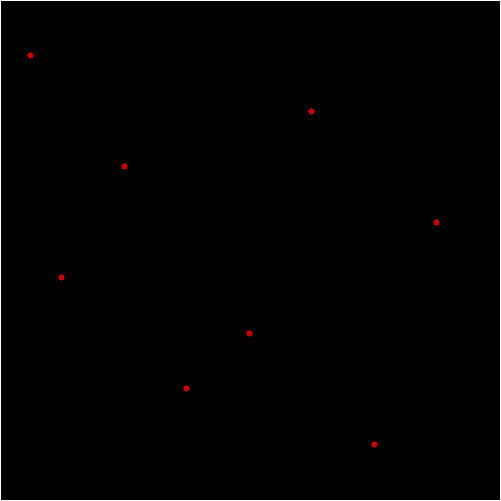
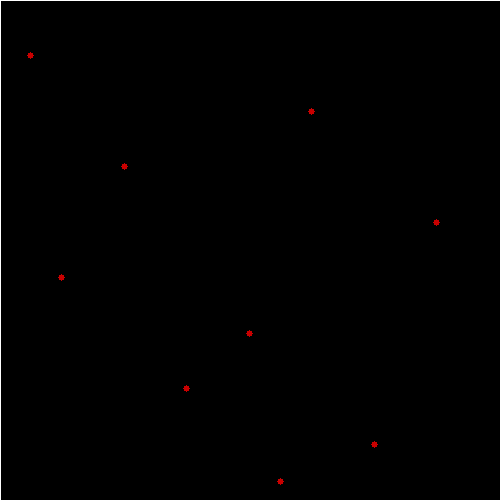
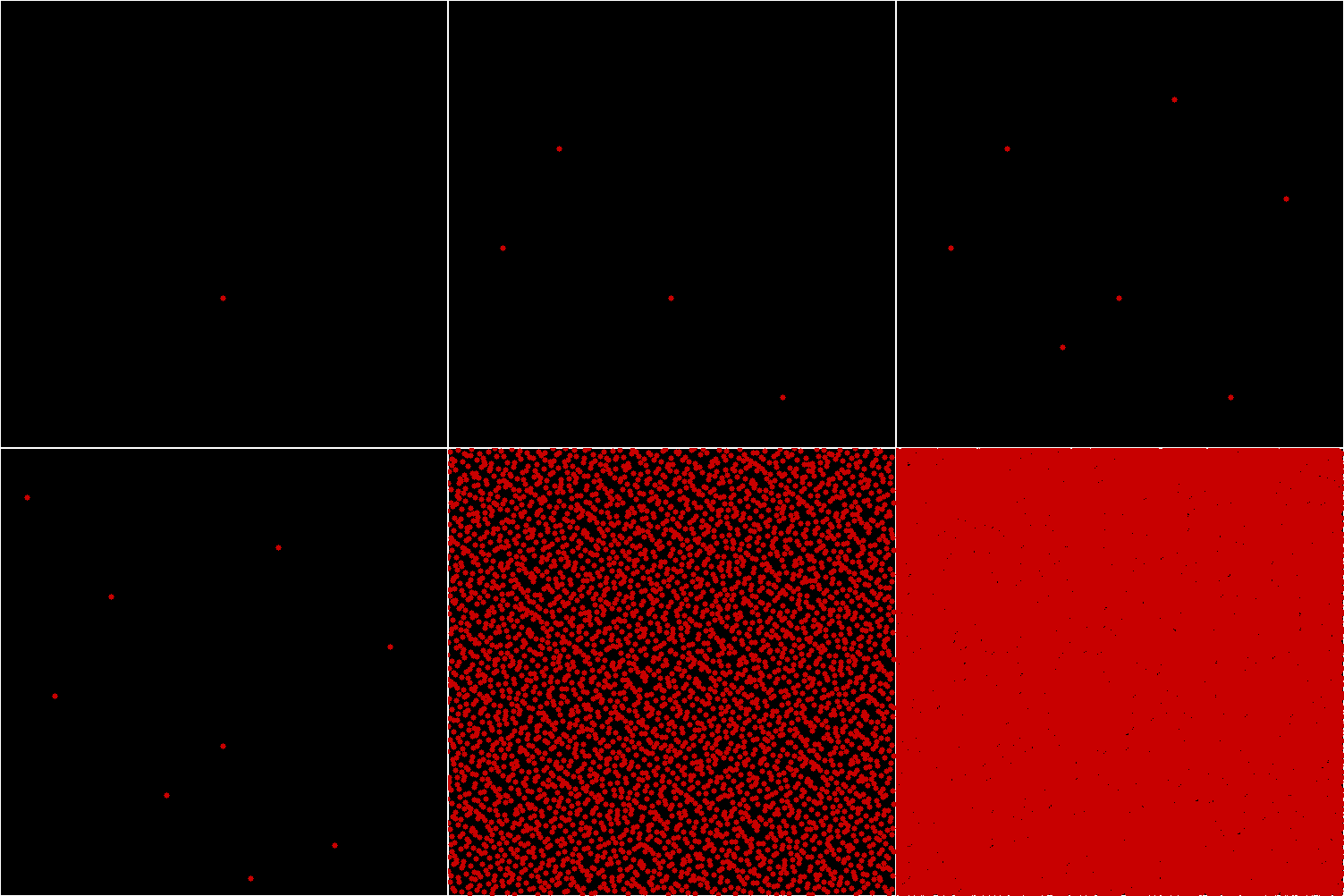
Halton points in base 3 also evenly fill the interval [0,1]. What happens if you apply the Halton sequence to a two-dimensional square rather a one-dimensional line? Suppose the bottom left-hand corner of the square has the co-ordinates (0,0) and the top right-hand corner has the co-ordinates (1,1). Find points (x,y) inside the square, with x supplied by the Halton sequence in base 2 and y supplied by the Halton sequence in base 3. The square will gradually fill like this:

square1

x = 1/2, y = 1/3


square2

x = 1/4, y = 2/3


square3

x = 3/4, y = 1/9


square4

x = 1/8, y = 4/9


square5

x = 5/8, y = 7/9


square6

x = 3/8, y = 2/9


square7

x = 7/8, y = 5/9


square8

x = 1/16, y = 8/9


square9

x = 9/16, y = 1/27…


square_anim

animated square


Read full page: For Revver and Fevver

Get Your Ox Off

Boustrophedon (pronounced “bough-stra-FEE-dun” or “boo-stra-FEE-dun”) is an ancient Greek word literally meaning “as the ox turns (in ploughing)”, that is, moving left-right, right-left, and so on. The word is used of writing that runs down the page in the same way. To see what that means, examine two versions of the first paragraph of Clark Ashton Smith’s story “The Demon of the Flower” (1933). The first is written in the usual way, the second is written boustrophedon:

Not as the plants and flowers of Earth, growing peacefully beneath a simple sun, were the blossoms of the planet Lophai. Coiling and uncoiling in double dawns; tossing tumultuously under vast suns of jade green and balas-ruby orange; swaying and weltering in rich twilights, in aurora-curtained nights, they resembled fields of rooted servants that dance eternally to an other-worldly music.


Not as the plants and flowers of Earth, growing peacefully
.iahpoL tenalp eht fo smossolb eht erew ,nus elpmis a htaeneb
Coiling and uncoiling in double dawns; tossing tumultuously
;egnaro ybur-salab dna neerg edaj fo snus tsav rednu
swaying and weltering in rich twilights, in aurora-curtained
ecnad taht stnavres detoor fo sdleif delbmeser yeht ,sthgin
eternally to an other-worldly music.


Boustrophedon writing was once common and sometimes the left-right lines would also be mirror-reversed, like this:


You could also use the term “boustrophedon” to describe the way this table of numbers is filled:

primes_table


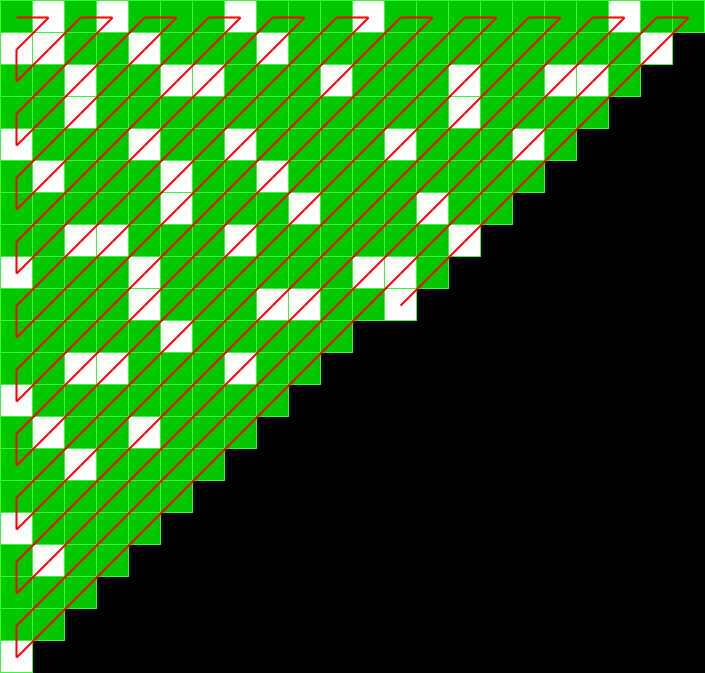
The table begins with “1” in the top left-hand corner, then moves right for “2”, then down for “3”, then right-and-up for “4”, “5” and “6”, then right for “7”, then left-and-down for “8”, “9” and “10”, and so on. You could also say that the numbers snake through the table. I’ve marked the primes among them, because I was interested in the patterns made by the primes when the numbers were represented as blocks on a grid, like this:

primes_large


Primes are in solid white (compare the Ulam spiral). Here’s the boustrophedon prime-grid on a finer scale:
primes

(click for full image)


And what about other number-tests? Here are the even numbers marked on the grid (i.e. n mod 2 = 0):

mod2

n mod 2 = 0


And here are some more examples of a modulus test:

mod3

n mod 3 = 0


mod5

n mod 5 = 0


mod9

n mod 9 = 0


mod15

n mod 15 = 0


mod_various

n mod various = 0 (animated gif)


Next I looked at reciprocals (numbers divided into 1) marked on the grid, with the digits of a reciprocal marking the number of blank squares before a square is filled in (if the digit is “0”, the square is filled immediately). For example, in base ten 1/7 = 0.142857142857142857…, where the block “142857” repeats for ever. When represented on the grid, 1/7 has 1 blank square, then a filled square, then 4 blank squares, then a filled square, then 2 blank squares, then a filled square, and so on:

recip7_base10

1/7 in base 10


And here are some more reciprocals (click for full images):

recip9_base2

1/9 in base 2


recip13_base10

1/13 in base 10


recip27_base10

1/27 in base 10


recip41_base10

1/41 in base 10


recip63_base10

1/63 in base 10


recip82_base10

1/82 in base 10


recip101_base10

1/101 in base 10


recip104_base10

1/104 in base 10


recip124_base10

1/124 in base 10


recip143_base10

1/143 in base 10


recip175_base10

1/175 in base 10


recip604_base8

1/604 in base 8


recip_various

1/n in various bases (animated gif)


Fingering the Frigit

Fingers are fractal. Where a tree has a trunk, branches and twigs, a human being has a torso, arms and fingers. And human beings move in fractal ways. We use our legs to move large distances, then reach out with our arms over smaller distances, then move our fingers over smaller distances still. We’re fractal beings, inside and out, brains and blood-vessels, fingers and toes.

But fingers are fractal are in another way. A digit – digitus in Latin – is literally a finger, because we once counted on our fingers. And digits behave like fractals. If you look at numbers, you’ll see that they contain patterns that echo each other and, in a sense, recur on smaller and smaller scales. The simplest pattern in base 10 is (0, 1, 2, 3, 4, 5, 6, 7, 8, 9). It occurs again and again at almost very point of a number, like a ten-hour clock that starts at zero-hour:

0, 1, 2, 3, 4, 5, 6, 7, 8, 9…
10, 11, 12, 13, 14, 15, 16, 17, 18, 19…
200… 210… 220… 230… 240… 250… 260… 270… 280… 290…

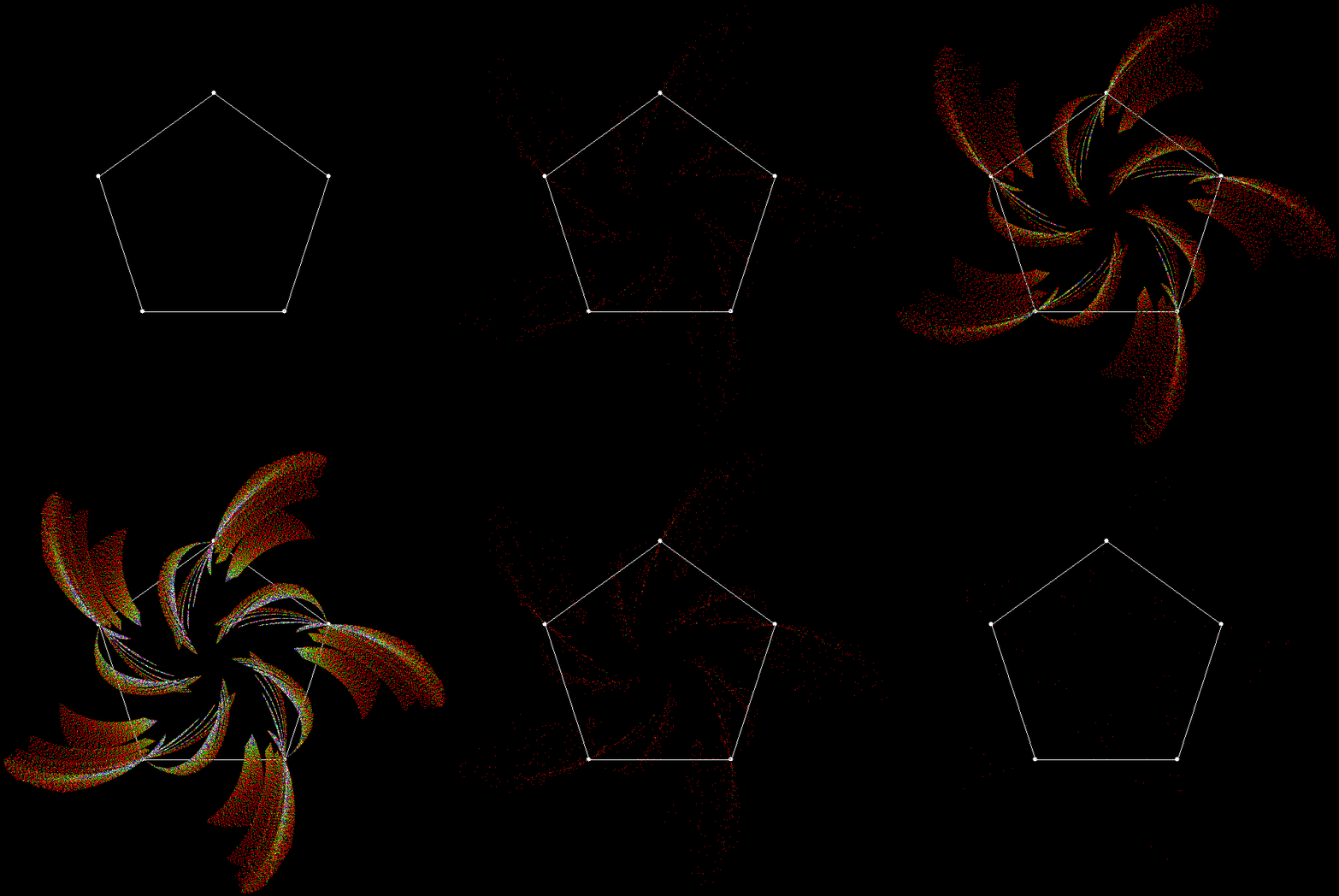
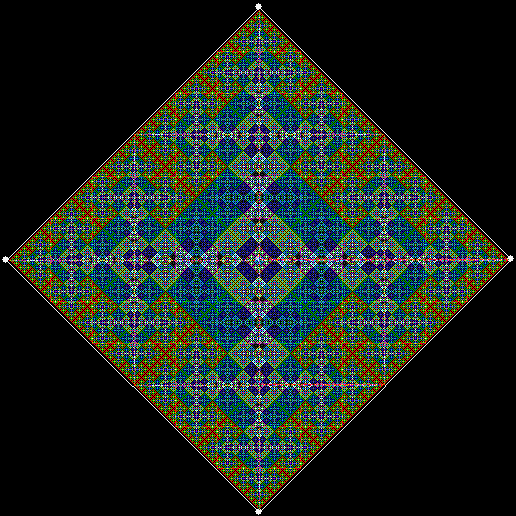
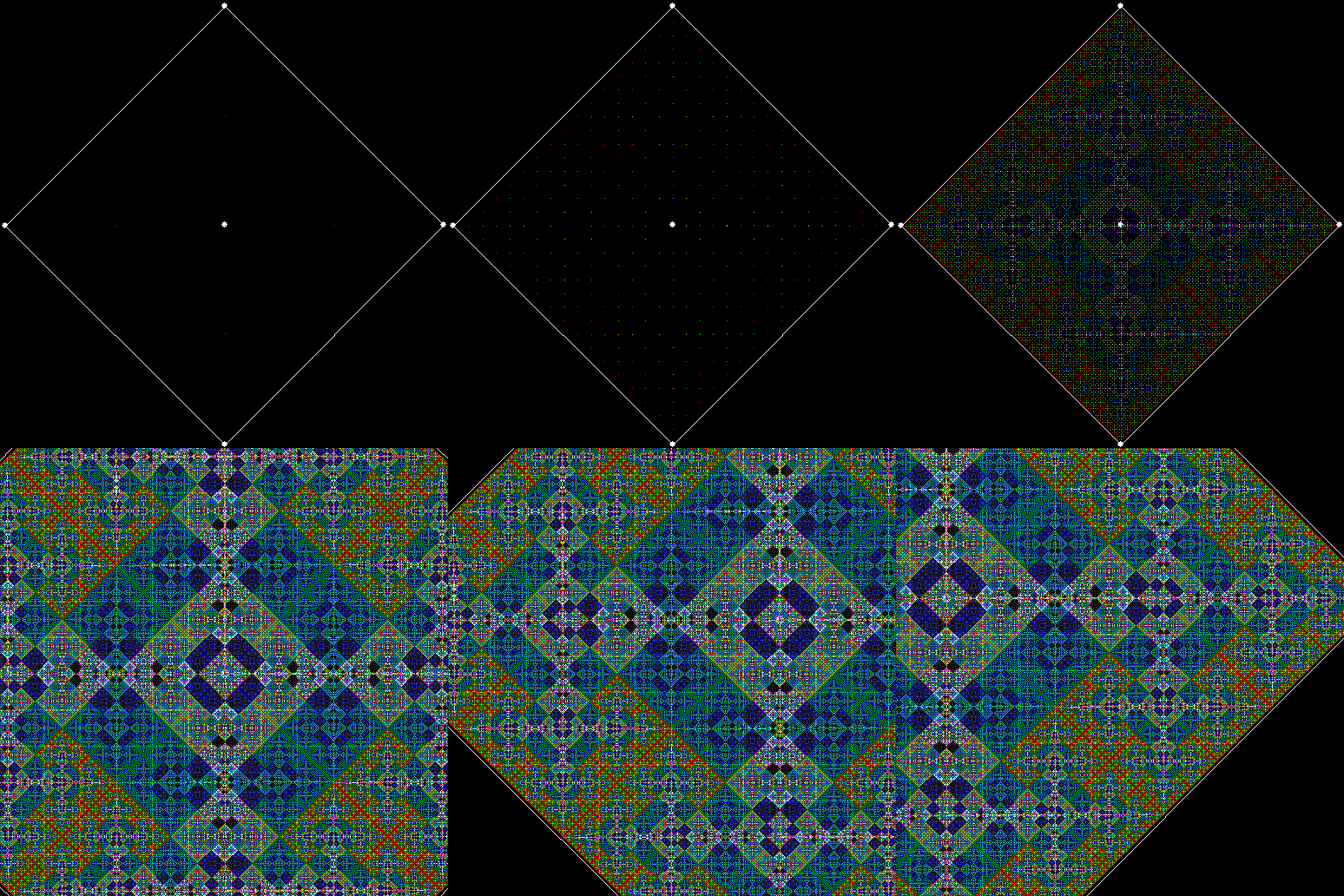
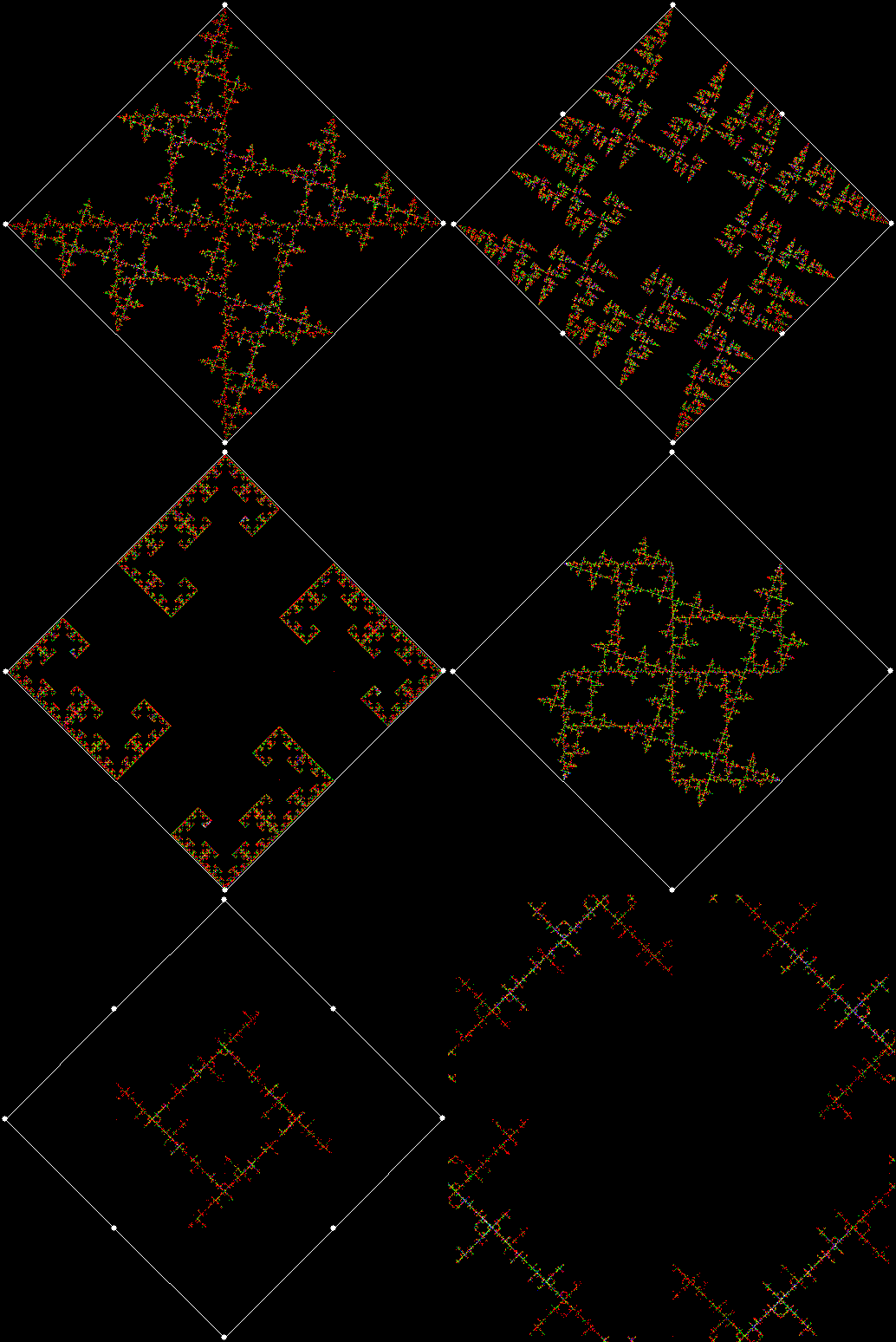
These fractal patterns become visible if you turn numbers into images. Suppose you set up a square with four fixed points on its corners and a fixed point at its centre. Let the five points correspond to the digits (1, 2, 3, 4, 5) of numbers in base 6 (not using 0, to simplify matters):

1, 2, 3, 4, 5, 11, 12, 13, 14, 15, 21, 22, 23, 24, 25, 31, 32, 33, 34, 35, 41, 42, 43, 44, 45, 51, 52, 53, 54, 55, 61, 62, 63, 64, 65… 2431, 2432, 2433, 2434, 2435, 2441, 2442, 2443, 2444, 2445, 2451, 2452…

Move between the five points of the square by stepping through the individual digits of the numbers in the sequence. For example, if the number is 2451, the first set of successive digits is (2, 4), so you move to a point half-way between point 2 and point 4. Next come the successive digits (4, 5), so you move to a point half-way between point 4 and point 5. Then come (5, 1), so you move to a point half-way between point 5 and point 1.

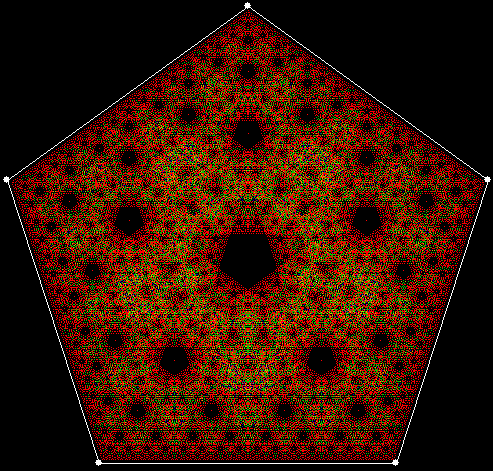
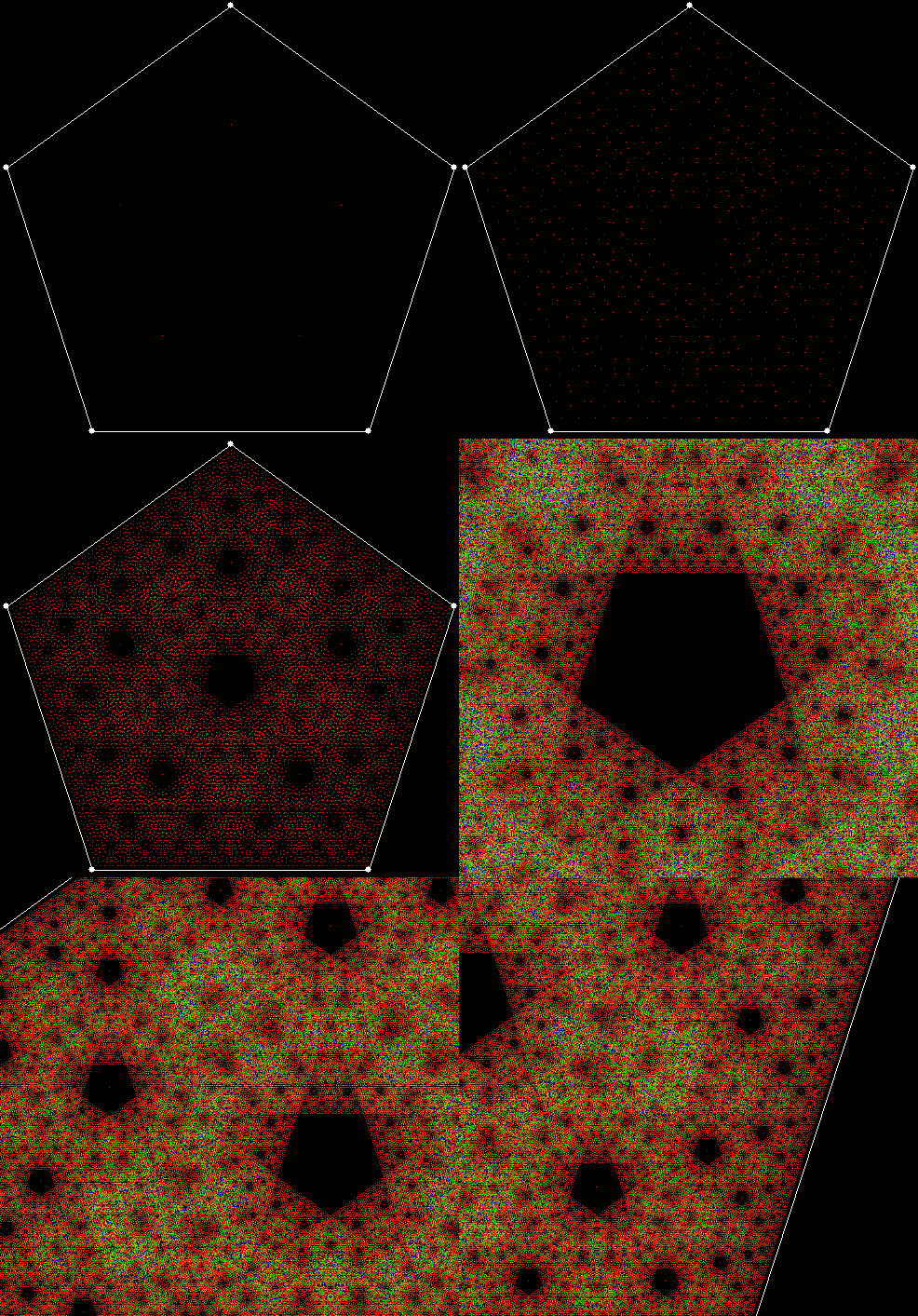
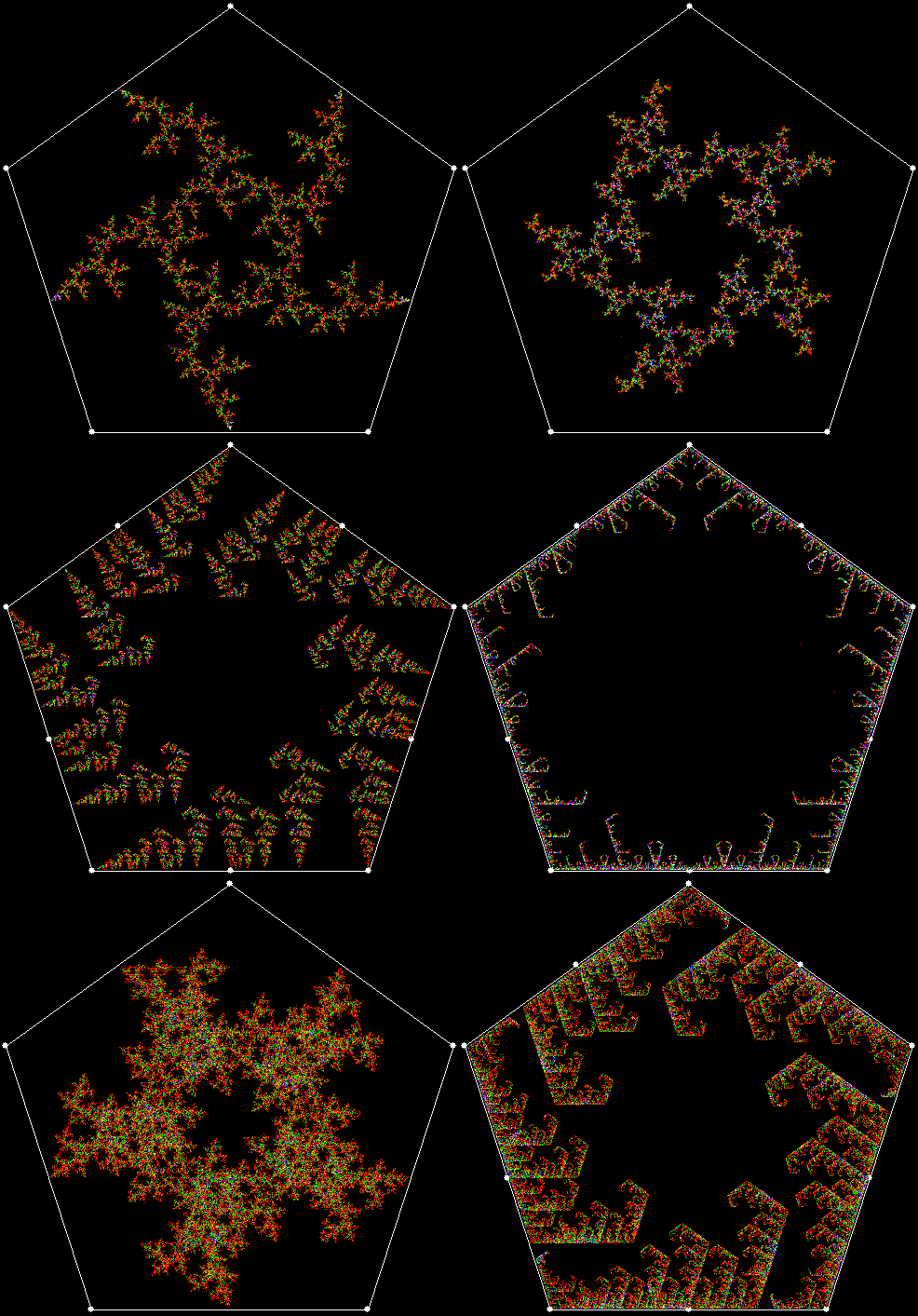
When you’ve exhausted the digits (or frigits) of a number, mark the final point you moved to (changing the colour of the pixel if the point has been occupied before). If you follow this procedure using a five-point square, you will create a fractal something like this:
fractal4_1single

fractal4_1
A pentagon without a central point using numbers in a zero-less base 7 looks like this:
fractal5_0single

fractal5_0
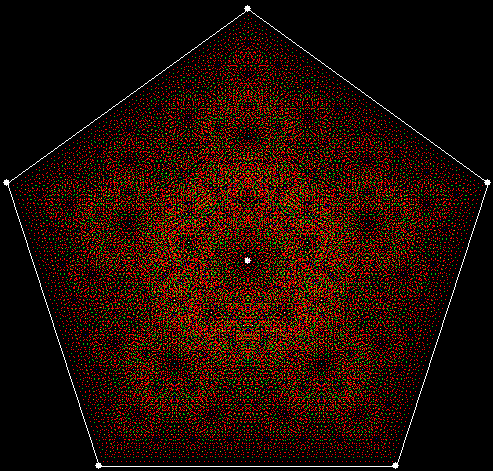
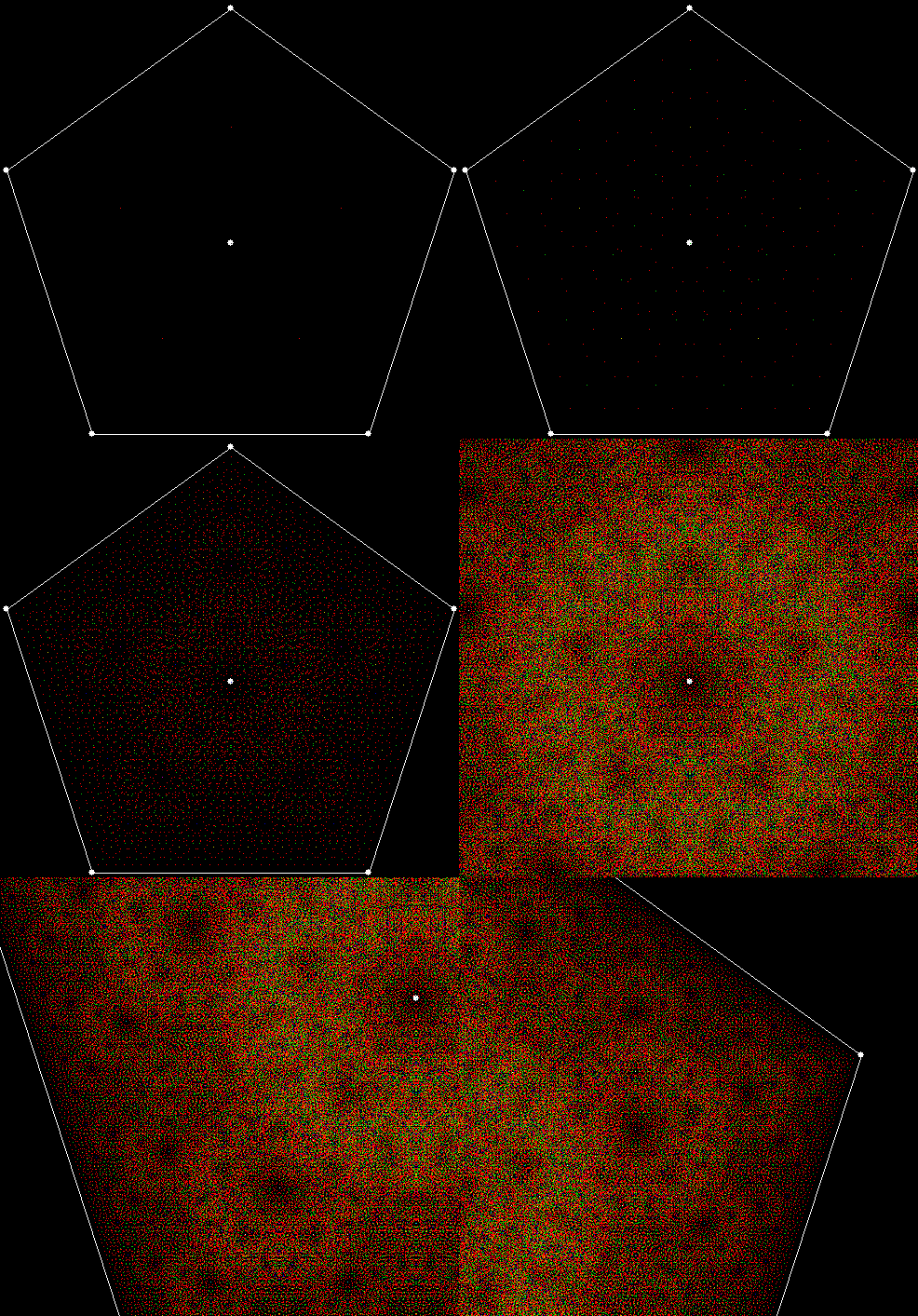
A pentagon with a central point looks like this:
fractal5_1single

fractal5_1
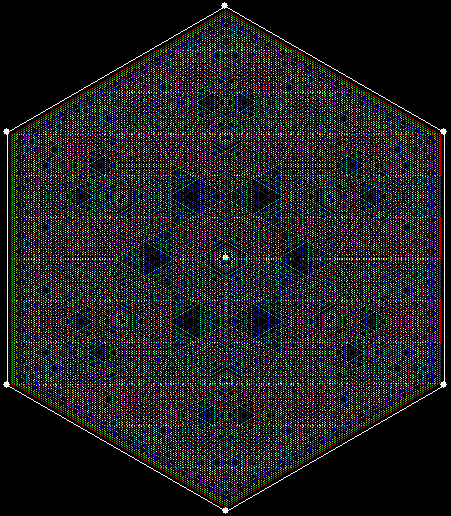
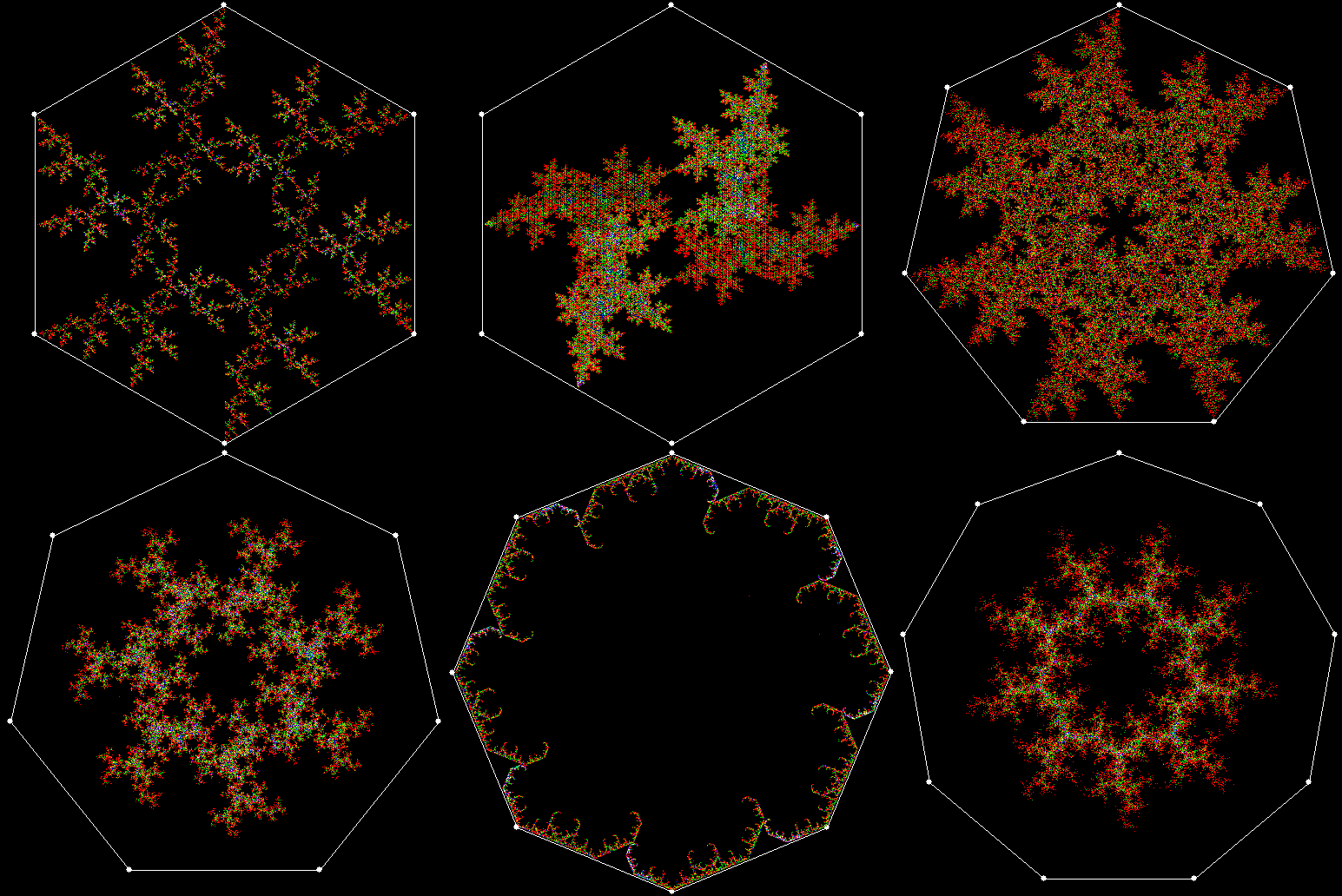
Hexagons using a zero-less base 8 look like this:
fractal6_1single

fractal6_1


fractal6_0single

fractal6_0
But the images above are just the beginning. If you use a fixed base while varying the polygon and so on, you can create images like these (here is the program I used):
fractal4


fractal5


fractal6789

Shareway to Seven

An adaptation of an interesting distribution puzzle from Joseph Degrazia’s Math is Fun (1954):

After a successful year of plunder on the high seas, a pirate ship returns to its island base. The pirate chief, who enjoys practical jokes and has a mathematical bent, hands out heavy bags of gold coins to his seven lieutenants. But when the seven lieutenants open the bags, they discover that each of them has received a different number of coins.

They ask the captain why they don’t have equal shares. The pirate chief laughs and tells them to re-distribute the coins according to the following rule: “At each stage, the lieutenant with most coins must give each of his comrades as many coins as that comrade already possesses.”

The lieutenants follow the rule and each one in turn becomes the lieutenant with most coins. When the seventh distribution is over, all seven of them have 128 coins, the coins are fairly distributed, and the rule no longer applies.

The puzzle is this: How did the pirate captain originally allocate the coins to his lieutenants?


If you start at the beginning and work forward, you’ll have to solve a fiendishly complicated set of simultaneous equations. If you start at the end and work backwards, the puzzle will resolve itself almost like magic.

The puzzle is actually about powers of 2, because 128 = 2^7 and when each of six lieutenants receives as many coins as he already has, he doubles his number of coins. Accordingly, before the seventh and final distribution, six of the lieutenants must have had 64 coins and the seventh must have had 128 + 6 * 64 coins = 512 coins.

At the stage before that, five of the lieutenants must have had 32 coins (so that they will have 64 coins after the sixth distribution), one must have had 256 coins (so that he will have 512 coins after the sixth distribution), and one must have had 64 + 5 * 32 + 256 coins = 480 coins. And so on. This is what the solution looks like:

128, 128, 128, 128, 128, 128, 128
512, 64, 64, 64, 64, 64, 64
256, 480, 32, 32, 32, 32, 32
128, 240, 464, 16, 16, 16, 16
64, 120, 232, 456, 8, 8, 8
32, 60, 116, 228, 452, 4, 4
16, 30, 58, 114, 226, 450, 2
8, 15, 29, 57, 113, 225, 449

So the pirate captain must have originally allocated the coins like this: 8, 15, 29, 57, 113, 225, 449 (note how 8 * 2 – 1 = 15, 15 * 2 – 1 = 29, 29 * 2 – 1 = 57…).

The puzzle can be adapted to other powers. Suppose the rule runs like this: “At each stage, the lieutenant with most coins must give each of his comrades twice as many coins as that comrade already possesses.” If the pirate captain has six lieutenants, after each distribution each of five will have n + 2n = three times the number of coins that he previously possessed. The six lieutenants each end up with 729 coins = 3^6 coins and the solution looks like this:

13, 37, 109, 325, 973, 2917
39, 111, 327, 975, 2919, 3
117, 333, 981, 2925, 9, 9
351, 999, 2943, 27, 27, 27
1053, 2997, 81, 81, 81, 81
3159, 243, 243, 243, 243, 243
729, 729, 729, 729, 729, 729

For powers of 4, the rule runs like this: “At each stage, the lieutenant with most coins must give each of his comrades three times as many coins as that comrade already possesses.” With five lieutenants, each of them ends up with 1024 coins = 4^5 coins and the solution looks like this:

16, 61, 241, 961, 3841
64, 244, 964, 3844, 4
256, 976, 3856, 16, 16
1024, 3904, 64, 64, 64
4096, 256, 256, 256, 256
1024, 1024, 1024, 1024, 1024

For powers of 5, the rule runs like this: “At each stage, the lieutenant with most coins must give each of his comrades four times as many coins as that comrade already possesses.” With four lieutenants, each of them ends up with 625 coins = 5^4 coins and the solution looks like this:

17, 81, 401, 2001
85, 405, 2005, 5
425, 2025, 25, 25
2125, 125, 125, 125
625, 625, 625, 625

Self-Raising Power

The square root of 2 is the number that, raised to the power of 2, equals 2. That is, if r^2 = r * r = 2, then r = √2. The cube root of 2 is the number that, raised to the power of 3, equals 2. That is, if r^3 = r * r * r = 2, then r = [3]√2.

But what do you call the number that, raised to the power of itself, equals 2? I suggest “the auto-root of 2”. Here, if r^r = 2, then r = [r]√2. I don’t know a quick way to calculate the auto-root, but you can adapt a well-known algorithm for approximating the square root of a number. The square-root algorithm looks like this:

n = 2
r = 1
for c = 1 to 20
    r = (r + n/r) / 2
next c
print r

r = 1.414213562…

Note the fourth line of the algorithm: r = (r + n/r) / 2. When r is an over-estimate of √2, then 2/r will be an under-estimate (and vice versa). (r + 2/r) / 2 splits the difference and refines the estimate. Using the lines above as the model, the auto-root algorithm looks like this:

n = 2
r = 1
for c = 1 to 20
    r = (r + [r]√n) / 2[*]
next c
print r

r = 1.559610469…


*This is equivalent to r = (r + n^(1/r)) / 2

Here are the first 100 digits of [r]√2 = r in base 10:

1, 5, 5, 9, 6, 1, 0, 4, 6, 9, 4, 6, 2, 3, 6, 9, 3, 4, 9, 9, 7, 0, 3, 8, 8, 7, 6, 8, 7, 6, 5, 0, 0, 2, 9, 9, 3, 2, 8, 4, 8, 8, 3, 5, 1, 1, 8, 4, 3, 0, 9, 1, 4, 2, 4, 7, 1, 9, 5, 9, 4, 5, 6, 9, 4, 1, 3, 9, 7, 3, 0, 3, 4, 5, 4, 9, 5, 9, 0, 5, 8, 7, 1, 0, 5, 4, 1, 3, 4, 4, 4, 6, 9, 1, 2, 8, 3, 9, 7, 3…

And here is [r]n = r for n = 2..20:

autopower(2) = 1.5596104694623693499703887…
autopower(3) = 1.8254550229248300400414692…
autopower(4) = 2
autopower(5) = 2.1293724827601566963803119…
autopower(6) = 2.2318286244090093673920215…
autopower(7) = 2.3164549587856123013255030…
autopower(8) = 2.3884234844993385564187215…
autopower(9) = 2.4509539280155796306228059…
autopower(10) = 2.5061841455887692562929409…
autopower(11) = 2.5556046121008206152514542…
autopower(12) = 2.6002950000539155877172082…
autopower(13) = 2.6410619164843958084118390…
autopower(14) = 2.6785234858912995813011990…
autopower(15) = 2.7131636040042392095764012…
autopower(16) = 2.7453680235674634847098492…
autopower(17) = 2.7754491049442334313328329…
autopower(18) = 2.8036632456580215496843618…
autopower(19) = 2.8302234384970308956026277…
autopower(20) = 2.8553085030012414128332189…

I assume that the auto-root is always an irrational number, except when n is a perfect power of suitable form, i.e. n = p^p for some integer p. For example, autoroot(4) = 2, because 2^2 = 4, autoroot(27) = 3, because 3^3 = 27, and so on.

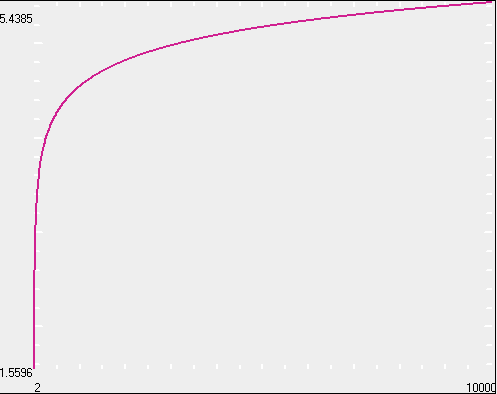
And here is the graph of autoroot(n) for n = 2..10000:
autoroot

Power Trip

Here are the first few powers of 2:

2 = 1 * 2
4 = 2 * 2
8 = 4 * 2
16 = 8 * 2
32 = 16 * 2
64 = 32 * 2
128 = 64 * 2
256 = 128 * 2
512 = 256 * 2
1024 = 512 * 2
2048 = 1024 * 2
4096 = 2048 * 2
8192 = 4096 * 2
16384 = 8192 * 2
32768 = 16384 * 2
65536 = 32768 * 2
131072 = 65536 * 2
262144 = 131072 * 2
524288 = 262144 * 2
1048576 = 524288 * 2
2097152 = 1048576 * 2
4194304 = 2097152 * 2
8388608 = 4194304 * 2
16777216 = 8388608 * 2
33554432 = 16777216 * 2
67108864 = 33554432 * 2…

As you can see, it’s a one-way power-trip: the numbers simply get larger. But what happens if you delete the digit 0 whenever it appears in a result? For example, 512 * 2 = 1024, which becomes 124. If you apply this rule, the sequence looks like this:

2 * 2 = 4
4 * 2 = 8
8 * 2 = 16
16 * 2 = 32
32 * 2 = 64
64 * 2 = 128
128 * 2 = 256
256 * 2 = 512
512 * 2 = 1024 → 124
124 * 2 = 248
248 * 2 = 496
496 * 2 = 992
992 * 2 = 1984
1984 * 2 = 3968
3968 * 2 = 7936
7936 * 2 = 15872
15872 * 2 = 31744
31744 * 2 = 63488
63488 * 2 = 126976
126976 * 2 = 253952
253952 * 2 = 507904 → 5794
5794 * 2 = 11588
11588 * 2 = 23176
23176 * 2 = 46352
46352 * 2 = 92704 → 9274…

Is this a power-trip? Not quite: it’s a return trip, because the numbers can never grow beyond a certain size and the sequence falls into a loop. If the result 2n contains a zero, then zerodelete(2n) < n, so the sequence has an upper limit and a number will eventually occur twice. This happens at step 526 with 366784, which matches 366784 at step 490.

The rate at which we delete zeros can obviously be varied. Call it 1:z. The sequence above sets z = 1, so 1:z = 1:1. But what if z = 2, so that 1:z = 1:2? In other words, the procedure deletes every second zero. The first zero occurs when 1024 = 2 * 512, so 1024 is left as it is. The second zero occurs when 2 * 1024 = 2048, so 2048 becomes 248. When z = 2 and every second zero is deleted, the sequence begins like this:

1 * 2 = 2
2 * 2 = 4
4 * 2 = 8
8 * 2 = 16
16 * 2 = 32
32 * 2 = 64
64 * 2 = 128
128 * 2 = 256
256 * 2 = 512
512 * 2 = 1024 → 1024
1024 * 2 = 2048 → 248
248 * 2 = 496
496 * 2 = 992
992 * 2 = 1984
1984 * 2 = 3968
3968 * 2 = 7936
7936 * 2 = 15872
15872 * 2 = 31744
31744 * 2 = 63488
63488 * 2 = 126976
126976 * 2 = 253952
253952 * 2 = 507904 → 50794
50794 * 2 = 101588 → 101588
101588 * 2 = 203176 → 23176
23176 * 2 = 46352
46352 * 2 = 92704 → 92704
92704 * 2 = 185408 → 18548

This sequence also has a ceiling and repeats at step 9134 with 5458864, which matches 5458864 at step 4166. And what about the sequence in which z = 3 and every third zero is deleted? Does this have a ceiling or does the act of multiplying by 2 compensate for the slower removal of zeros?

In fact, it can’t do so. The larger 2n becomes, the more zeros it will tend to contain. If 2n is large enough to contain 3 zeros on average, the deletion of zeros will overpower multiplication by 2 and the sequence will not rise any higher. Therefore the sequence that deletes every third zero will eventually repeat, although I haven’t been able to discover the relevant number.

But this reasoning applies to any rate, 1:z, of zero-deletion. If z = 100 and every hundredth zero is deleted, numbers in the sequence will rise to the point at which 2n contains sufficient zeros on average to counteract multiplication by 2. The sequence will have a ceiling and will eventually repeat. If z = 10^100 or z = 10^(10^100) and every googolth or googolplexth zero is deleted, the same is true. For any rate, 1:z, at which zeros are deleted, the sequence n = zerodelete(2n,z) has an upper limit and will eventually repeat.


Update (30×21)

Six years later, I’ve found the answer for z = 3. And uncovered a serious error in this article. See:

Power Trap

Block n Rule

One of my favourite integer sequences uses the formula n(i) = n(i-1) + digsum(n(i-1)), where digsum(n) sums the digits of n. In base 10, it goes like this:

1, 2, 4, 8, 16, 23, 28, 38, 49, 62, 70, 77, 91, 101, 103, 107, 115, 122, 127, 137, 148, 161, 169, 185, 199, 218, 229, 242, 250, 257, 271, 281, 292, 305, 313, 320, 325, 335, 346, 359, 376, 392, 406, 416, 427, 440, 448, 464, 478, 497, 517, 530, 538, 554, 568, 587, 607, 620, 628, 644, 658, 677, 697, 719, 736, 752, 766, 785, 805, 818, 835, 851, 865, 884, 904, 917, 934, 950, 964, 983, 1003…

Another interesting sequence uses the formula n(i) = n(i-1) + digprod(n(i-1)), where digprod(n) multiplies the digits of n (excluding 0). In base 10, it goes like this:

1, 2, 4, 8, 16, 22, 26, 38, 62, 74, 102, 104, 108, 116, 122, 126, 138, 162, 174, 202, 206, 218, 234, 258, 338, 410, 414, 430, 442, 474, 586, 826, 922, 958, 1318, 1342, 1366, 1474, 1586, 1826, 1922, 1958, 2318, 2366, 2582, 2742, 2854, 3174, 3258, 3498, 4362, 4506, 4626, 4914, 5058, 5258, 5658, 6858, 8778, 11914, 11950, 11995…

You can apply these formulae in other bases and it’s trivially obvious that the sequences rise most slowly in base 2, because you’re never summing or multiplying anything but the digit 1. However, there is a sequence for which base 2 is by far the best performer. It has the formula n(i) = n(i-1) + blockmult(n(i-1)), where blockmult(n) counts the lengths of distinct blocks of the same digit, including 0, then multiplies those lengths together. For example:

blockmult(3,b=2) = blockmult(11) = 2
blockmult(28,b=2) = blockmult(11100) = 3 * 2 = 6
blockmult(51,b=2) = blockmult(110011) = 2 * 2 * 2 = 8
blockmult(140,b=2) = blockmult(10001100) = 1 * 3 * 2 * 2 = 12
blockmult(202867,b=2) = blockmult(110001100001110011) = 2 * 3 * 2 * 4 * 3 * 2 * 2 = 576

The full sequence begins like this (numbers are represented in base 10, but the formula is being applied to their representations in binary):

1, 2, 3, 5, 6, 8, 11, 13, 15, 19, 23, 26, 28, 34, 37, 39, 45, 47, 51, 59, 65, 70, 76, 84, 86, 88, 94, 98, 104, 110, 116, 122, 126, 132, 140, 152, 164, 168, 171, 173, 175, 179, 187, 193, 203, 211, 219, 227, 245, 249, 259, 271, 287, 302, 308, 316, 332, 340, 342, 344, 350, 354, 360, 366, 372, 378, 382, 388, 404, 412, 436, 444, 460, 484, 500, 510, 518, 530, 538, 546, 555, 561, 579, 595, 603, 611, 635, 651, 657, 663, 669, 675, 681…

In higher bases, it rises much more slowly. This is base 3:

1, 2, 3, 4, 6, 7, 8, 10, 11, 12, 14, 16, 17, 19, 20, 21, 22, 24, 26, 29, 31, 33, 34, 35, 37, 39, 42, 44, 48, 49, 51, 53, 56, 58, 60, 61, 62, 64, 65, 66, 68, 70, 71, 73, 75, 77, 79, 82, 85, 89, 93, 95, 97, 98, 100, 101, 102, 103, 105, 107, 110, 114, 116, 120, 124, 127, 129, 131, 133, 137, 139, 141, 142, 143, 145, 146, 147, 149, 151, 152, 154, 156, 158, 160, 163…

And this is base 10:

1, 2, 3, 4, 5, 6, 7, 8, 9, 10, 11, 13, 14, 15, 16, 17, 18, 19, 20, 21, 22, 24, 25, 26, 27, 28, 29, 30, 31, 32, 33, 35, 36, 37, 38, 39, 40, 41, 42, 43, 44, 46, 47, 48, 49, 50, 51, 52, 53, 54, 55, 57, 58, 59, 60, 61, 62, 63, 64, 65, 66, 68, 69, 70, 71, 72, 73, 74, 75, 76, 77, 79, 80, 81, 82, 83, 84, 85, 86, 87, 88, 90…

Note how, in bases 3 and 10, blockmult(n) often equals 1. In base 3, the sequence contains [141, 142, 143, 145]:

blockmult(141,b=3) = blockmult(12020) = 1 * 1 * 1 * 1 = 1
blockmult(142,b=3) = blockmult(12021) = 1 * 1 * 1 * 1 = 1
blockmult(143,b=3) = blockmult(12022) = 1 * 1 * 1 * 2 = 2

The formula also returns 1 much further along the sequence in base 3. For example, the 573809th number in the sequence, or n(573809), is 5775037 and blockmult(5775037) = blockmult(101212101212021) = 1^15 = 1. But in base 2, blockmult(n) = 1 is very rare. It happens three times at the beginning of the sequence:

1, 2, 3, 5, 6, 8, 11…

After that, I haven’t found any more examples of blockmult(n) = 1, although blockmult(n) = 2 occurs regularly. For example,

blockmult(n(100723)) = blockmult(44739241) = blockmult(10101010101010101010101001) = 2
blockmult(n(100724)) = blockmult(44739243) = blockmult(10101010101010101010101011) = 2
blockmult(n(100725)) = blockmult(44739245) = blockmult(10101010101010101010101101) = 2

Does the sequence in base 2 return another example of blockmult(n) = 1? The odds seem against it. For any given number of digits in base 2, there is only one number for which blockmult(n) = 1. For example: 1, 10, 101, 1010, 10101, 101010, 1010101… As the sequence increases, the percentage of these numbers becomes smaller and smaller. But the sequence is infinite, so who knows what happens in the end? Perhaps blockmult(n) = 1 occurs infinitely often.