DeVil to Power

666 is the Number of the Beast described in the Book of Revelation:

13:18 Here is wisdom. Let him that hath understanding count the number of the beast: for it is the number of a man; and his number is Six hundred threescore and six.

But 666 is not just diabolic: it’s narcissistic too. That is, it mirrors itself using arithmetic, like this:

666^47 =

5,049,969,684,420,796,753,173,148,798,405,
  564,772,941,516,295,265,408,188,117,632,
  668,936,540,446,616,033,068,653,028,889,
  892,718,859,670,297,563,286,219,594,665,
  904,733,945,856 → 5 + 0 + 4 + 9 + 9 + 6 + 9 + 6 + 8 + 4 + 4 + 2 + 0 + 7 + 9 + 6 + 7 + 5 + 3 + 1 + 7 + 3 + 1 + 4 + 8 + 7 + 9 + 8 + 4 + 0 + 5 + 5 + 6 + 4 + 7 + 7 + 2 + 9 + 4 + 1 + 5 + 1 + 6 + 2 + 9 + 5 + 2 + 6 + 5 + 4 + 0 + 8 + 1 + 8 + 8 + 1 + 1 + 7 + 6 + 3 + 2 + 6 + 6 + 8 + 9 + 3 + 6 + 5 + 4 + 0 + 4 + 4 + 6 + 6 + 1 + 6 + 0 + 3 + 3 + 0 + 6 + 8 + 6 + 5 + 3 + 0 + 2 + 8 + 8 + 8 + 9 + 8 + 9 + 2 + 7 + 1 + 8 + 8 + 5 + 9 + 6 + 7 + 0 + 2 + 9 + 7 + 5 + 6 + 3 + 2 + 8 + 6 + 2 + 1 + 9 + 5 + 9 + 4 + 6 + 6 + 5 + 9 + 0 + 4 + 7 + 3 + 3 + 9 + 4 + 5 + 8 + 5 + 6 = 666

666^51 =

993,540,757,591,385,940,334,263,511,341,
295,980,723,858,637,469,431,008,997,120,
691,313,460,713,282,967,582,530,234,558,
214,918,480,960,748,972,838,900,637,634,
215,694,097,683,599,029,436,416 → 9 + 9 + 3 + 5 + 4 + 0 + 7 + 5 + 7 + 5 + 9 + 1 + 3 + 8 + 5 + 9 + 4 + 0 + 3 + 3 + 4 + 2 + 6 + 3 + 5 + 1 + 1 + 3 + 4 + 1 + 2 + 9 + 5 + 9 + 8 + 0 + 7 + 2 + 3 + 8 + 5 + 8 + 6 + 3 + 7 + 4 + 6 + 9 + 4 + 3 + 1 + 0 + 0 + 8 + 9 + 9 + 7 + 1 + 2 + 0 + 6 + 9 + 1 + 3 + 1 + 3 + 4 + 6 + 0 + 7 + 1 + 3 + 2 + 8 + 2 + 9 + 6 + 7 + 5 + 8 + 2 + 5 + 3 + 0 + 2 + 3 + 4 + 5 + 5 + 8 + 2 + 1 + 4 + 9 + 1 + 8 + 4 + 8 + 0 + 9 + 6 + 0 + 7 + 4 + 8 + 9 + 7 + 2 + 8 + 3 + 8 + 9 + 0 + 0 + 6 + 3 + 7 + 6 + 3 + 4 + 2 + 1 + 5 + 6 + 9 + 4 + 0 + 9 + 7 + 6 + 8 + 3 + 5 + 9 + 9 + 0 + 2 + 9 + 4 + 3 + 6 + 4 + 1 + 6 = 666

But those are tiny numbers compared to 6^(6^6). That means 6^46,656 and equals roughly 2·6591… x 10^36,305. It’s 36,306 digits long and its full digit-sum is 162,828. However, 666 lies concealed in those digits too. To see how, consider the function Σ(x1,xn), which returns the sum of digits 1 to n of x. For example, π = 3·14159265…, so Σ(π14) = 3 + 1 + 4 + 1 = 9. The first 150 digits of 6^(6^6) are these:

26591197721532267796824894043879185949053422002699
24300660432789497073559873882909121342292906175583
03244068282650672342560163577559027938964261261109
… (150 digits)

If x = 6^(6^6), then Σ(x1,x146) = 666, Σ(x2,x148) = 666, and Σ(x2,x149) = 666.

There’s nothing special about these patterns: infinitely many numbers are narcissistic in similar ways. However, 666 has a special cultural significance, so people pay it more attention and look for patterns related to it more carefully. Who cares, for example, that 667 = digit-sum(667^48) = digit-sum(667^54) = digit-sum(667^58)? Fans of recreational maths will, but not very much. The Number of the Beast is much more fun, narcissistically and otherwise:

666 = digit-sum(6^194)
666 = digit-sum(6^197)

666 = digit-sum(111^73)
666 = digit-sum(111^80)

666 = digit-sum(222^63)
666 = digit-sum(222^66)

666 = digit-sum(333^58)
666 = digit-sum(444^53)
666 = digit-sum(777^49)
666 = digit-sum(999^49)


Previously pre-posted (please peruse):

More Narcissisum
Digital Disfunction
The Hill to Power
Narcissarithmetic #1
Narcissarithmetic #2

Performativizing Papyrocentricity #15

Papyrocentric Performativity Presents:

Brought to BookA Book of English Essays, selected by W.E. Williams (Pelican 1942)

GlamourdämmerungTreasures of Nirvana, Gillian G. Gaar (Carlton 2011)

Highway to Hell – The Road, Cormac McCarthy (2006)

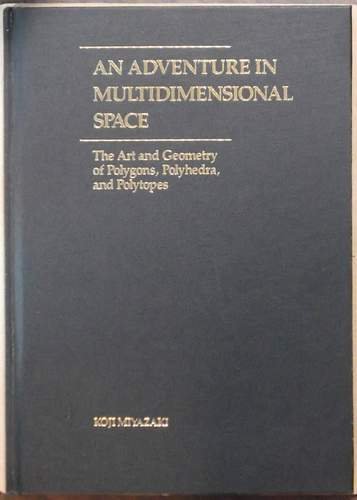
Solids and ShadowsAn Adventure in Multidimensional Space: The Art and Geometry of Polygons, Polyhedra, and Polytopes, Koji Miyazaki (Wiley-Interscience 1987) (posted @ Overlord of the Über-Feral)

Magna Mater MarinaThe Illustrated World Encyclopedia of Marine Fish and Sea Creatures, Amy-Jane Beer and Derek Hall (Lorenz Books 2007) (@ O.o.t.Ü.-F.)


Or Read a Review at Random: RaRaR

Solids and Shadows

Front cover of An Adventure in Multidimensional Space by Koji MiyazakiAn Adventure in Multidimensional Space: The Art and Geometry of Polygons, Polyhedra, and Polytopes, Koji Miyazaki (Wiley-Interscience 1987)

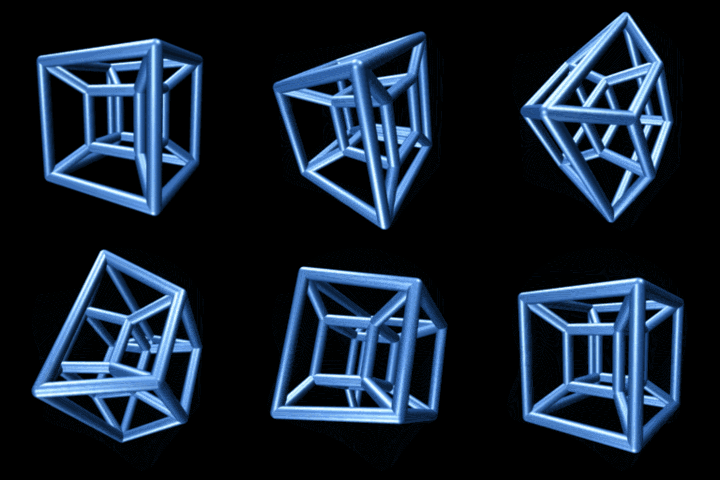
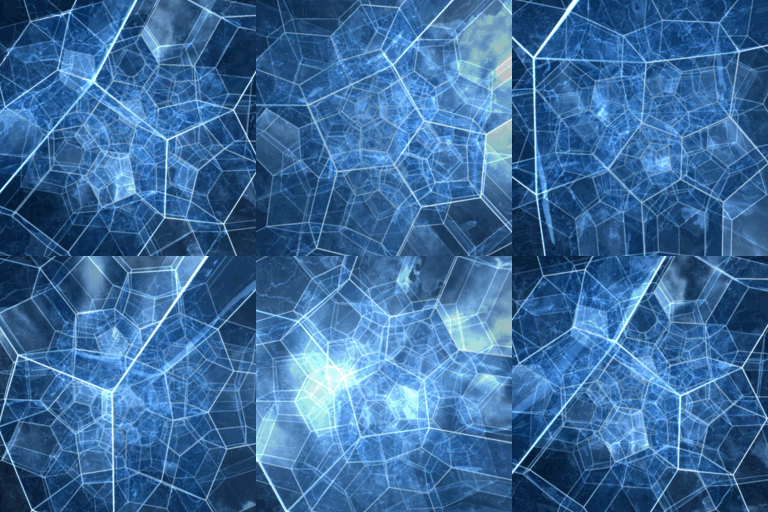
Two, three, four – or rather, two, three, ∞. Polygons are closed shapes in two dimensions (e.g., the square), polyhedra closed shapes in three dimensions (the cube), and polytopes closed shapes in four or more (the hypercube). You could spend a lifetime exploring any one of these geometries, but unless you take psychedelic drugs or brain-modification becomes much more advanced, you’ll be able to see only two of them: the geometries of polygons and polyhedra. Polytopes are beyond imagining but you can glimpse their shadows here – literally, because we can represent polytopes by the shadows they cast in 3-space or by the shadows of their shadows in 2-space.

An animated gif of a tesseract

A four-dimensional shape in two dimensions (see Tesseract)

Elsewhere Miyazaki doesn’t have to convey wonder and beauty by shadows: not only is this book full of beautiful shapes, it’s beautifully designed too and the way it alternates black-and-white pages with colour actually increases the power of both. It isn’t restricted to pure mathematics either: Miyazaki also looks at the modern and ancient art and architecture inspired by geometry, and at geometry in nature: the dodecahedral pollen of Gypsophilum elegans (Showy Baby’s-Breath), for example, and the tetrahedral seeds of the Water Chestnut (Trapa spp.), which the Japanese spies and assassins called the ninja used as natural caltrops. A regular tetrahedron always lies on a flat surface with a vertex facing directly upward, and when a pursued ninja scattered the sharply pointed tetrahedral seeds of the Water Chestnut, they were regular enough to injure “the soles of feet of his pursuers”.

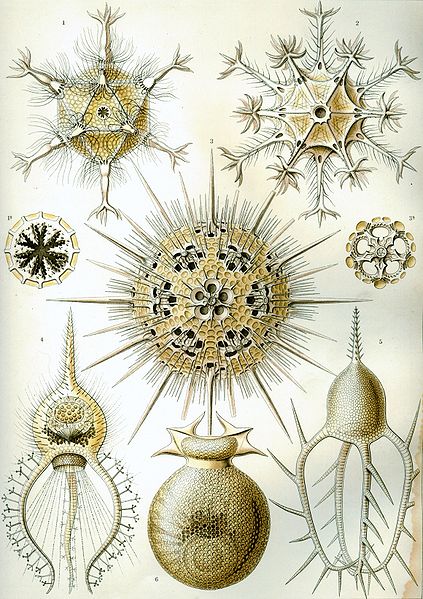
Polyhedral plankton by Ernst Haeckel

Polyhedral plankton by Ernst Haeckel

The slightly odd English there is another example of what I like about this book, because it proves the parochialism of language and the universality of mathematics. Miyazaki’s mathematics, as far as I can tell, is flawless, like that of many other Japanese mathematicians, but his self-translated English occasionally isn’t. Japanese mathematics was highly developed before Japan fell under strong Western influence. It would continue to develop if the West disappeared tomorrow. Language is something we have to absorb intuitively from the particular culture we’re born into, but mathematics is learnt and isn’t tied to any particular culture. That’s why it’s accessible in the same way to minds everywhere in the world. Miyazaki’s pictures and prose are an extended proof of all that, and the book is actually more valuable because it was written by a Japanese speaker. I think it’s probably more attractively designed for the same reason: the skill with which the pictures have been selected and laid out reflects something characteristically Japanese. Elegance and simplicity perhaps sum it up, and elegance and simplicity are central to mathematics and some of the greatest art.

An animated gif of an 120-cell

Another four-dimensional shape in two dimensions (see 120-cell)

More Narcissisum

The number 23 is special, inter alia, because it’s prime, divisible by only itself and 1. It’s also special because its reciprocal has maximum period. That is, the digits of 1/23 come in repeated blocks of 22, like this:

1/23 = 0·0434782608695652173913  0434782608695652173913  0434782608695652173913…

But 1/23 fails to be special in another way: you can’t sum its digits and get 23:

0 + 4 + 3 + 4 + 7 = 18
0 + 4 + 3 + 4 + 7 + 8 = 26
0 + 4 + 3 + 4 + 7 + 8 + 2 + 6 + 0 + 8 + 6 + 9 + 5 + 6 + 5 + 2 + 1 + 7 + 3 + 9 + 1 + 3 = 99

1/7 is different:

1/7 = 0·142857… → 1 + 4 + 2 = 7

This means that 7 is narcissistic: it reflects itself by manipulation of the digits of 1/7. But that’s in base ten. If you try base eight, 23 becomes narcissistic too (note that 23 = 2 x 8 + 7, so 23 in base eight is 27):

1/27 = 0·02620544131… → 0 + 2 + 6 + 2 + 0 + 5 + 4 + 4 = 27 (base=8)

Here are more narcissistic reciprocals in base ten:

1/3 = 0·3… → 3 = 3
1/7 = 0·142857… → 1 + 4 + 2 = 7
1/8 = 0·125 → 1 + 2 + 5 = 8
1/13 = 0·076923… → 0 + 7 + 6 = 13
1/14 = 0·0714285… → 0 + 7 + 1 + 4 + 2 = 14
1/34 = 0·02941176470588235… → 0 + 2 + 9 + 4 + 1 + 1 + 7 + 6 + 4 = 34
1/43 = 0·023255813953488372093… → 0 + 2 + 3 + 2 + 5 + 5 + 8 + 1 + 3 + 9 + 5 = 43
1/49 = 0·020408163265306122448979591836734693877551… → 0 + 2 + 0 + 4 + 0 + 8 + 1 + 6 + 3 + 2 + 6 + 5 + 3 + 0 + 6 + 1 + 2 = 49
1/51 = 0·0196078431372549… → 0 + 1 + 9 + 6 + 0 + 7 + 8 + 4 + 3 + 1 + 3 + 7 + 2 = 51
1/76 = 0·01315789473684210526… → 0 + 1 + 3 + 1 + 5 + 7 + 8 + 9 + 4 + 7 + 3 + 6 + 8 + 4 + 2 + 1 + 0 + 5 + 2 = 76
1/83 = 0·01204819277108433734939759036144578313253… → 0 + 1 + 2 + 0 + 4 + 8 + 1 + 9 + 2 + 7 + 7 + 1 + 0 + 8 + 4 + 3 + 3 + 7 + 3 + 4 + 9 = 83
1/92 = 0·010869565217391304347826… → 0 + 1 + 0 + 8 + 6 + 9 + 5 + 6 + 5 + 2 + 1 + 7 + 3 + 9 + 1 + 3 + 0 + 4 + 3 + 4 + 7 + 8 = 92
1/94 = 0·01063829787234042553191489361702127659574468085… → 0 + 1 + 0 + 6 + 3 + 8 + 2 + 9 + 7 + 8 + 7 + 2 + 3 + 4 + 0 + 4 + 2 + 5 + 5 + 3 + 1 + 9 + 1 + 4 = 94
1/98 = 0·0102040816326530612244897959183673469387755… → 0 + 1 + 0 + 2 + 0 + 4 + 0 + 8 + 1 + 6 + 3 + 2 + 6 + 5 + 3 + 0 + 6 + 1 + 2 + 2 + 4 + 4 + 8 + 9 + 7 + 9 + 5 = 98


Previously pre-posted (please peruse):

Digital Disfunction
The Hill to Power
Narcissarithmetic #1
Narcissarithmetic #2

Digital Disfunction

It’s fun when functions disfunc. The function digit-sum(n^p) takes a number, raises it to the power of p and sums its digits. If p = 1, n is unchanged. So digit-sum(1^1) = 1, digit-sum(11^1) = 2, digit-sum(2013^1) = 6. The following numbers set records for the digit-sum(n^1) from 1 to 1,000,000:

digit-sum(n^1): 1, 2, 3, 4, 5, 6, 7, 8, 9, 19, 29, 39, 49, 59, 69, 79, 89, 99, 199, 299, 399, 499, 599, 699, 799, 899, 999, 1999, 2999, 3999, 4999, 5999, 6999, 7999, 8999, 9999, 19999, 29999, 39999, 49999, 59999, 69999, 79999, 89999, 99999, 199999, 299999, 399999, 499999, 599999, 699999, 799999, 899999, 999999.

The pattern is easy to predict. But the function disfuncs when p = 2. Digit-sum(3^2) = 9, which is more than digit-sum(4^2) = 1 + 6 = 7 and digit-sum(5^2) = 2 + 5 = 7. These are the records from 1 to 1,000,000:

digit-sum(n^2): 1, 2, 3, 7, 13, 17, 43, 63, 83, 167, 264, 313, 707, 836, 1667, 2236, 3114, 4472, 6833, 8167, 8937, 16667, 21886, 29614, 32617, 37387, 39417, 42391, 44417, 60663, 63228, 89437, 141063, 221333, 659386, 791833, 976063, 987917.

Higher powers are similarly disfunctional:

digit-sum(n^3): 1, 2, 3, 4, 9, 13, 19, 53, 66, 76, 92, 132, 157, 353, 423, 559, 842, 927, 1192, 1966, 4289, 5826, 8782, 10092, 10192, 10275, 10285, 10593, 11548, 11595, 12383, 15599, 22893, 31679, 31862, 32129, 63927, 306842, 308113.

digit-sum(n^4): 1, 2, 3, 4, 6, 8, 13, 16, 18, 23, 26, 47, 66, 74, 118, 256, 268, 292, 308, 518, 659, 1434, 1558, 1768, 2104, 2868, 5396, 5722, 5759, 6381, 10106, 12406, 14482, 18792, 32536, 32776, 37781, 37842, 47042, 51376, 52536, 84632, 255948, 341156, 362358, 540518, 582477.

digit-sum(n^5): 1, 2, 3, 5, 6, 14, 15, 18, 37, 58, 78, 93, 118, 131, 139, 156, 179, 345, 368, 549, 756, 1355, 1379, 2139, 2759, 2779, 3965, 4119, 4189, 4476, 4956, 7348, 7989, 8769, 9746, 10566, 19199, 19799, 24748, 31696, 33208, 51856, 207198, 235846, 252699, 266989, 549248, 602555, 809097, 814308, 897778.

You can also look for narcissistic numbers with this function, like digit-sum(9^2) = 8 + 1 = 9 and digit-sum(8^3) = 5 + 1 + 2 = 8. 9^2 is the only narcissistic square in base ten, but 8^3 has these companions:

17^3 = 4913 → 4 + 9 + 1 + 3 = 17
18^3 = 5832 → 5 + 8 + 3 + 2 = 18
26^3 = 17576 → 1 + 7 + 5 + 7 + 6 = 26
27^3 = 19683 → 1 + 9 + 6 + 8 + 3 = 27

Twelfth powers are as unproductive as squares:

108^12 = 2518170116818978404827136 → 2 + 5 + 1 + 8 + 1 + 7 + 0 + 1 + 1 + 6 + 8 + 1 + 8 + 9 + 7 + 8 + 4 + 0 + 4 + 8 + 2 + 7 + 1 + 3 + 6 = 108

But thirteenth powers are fertile:

20 = digit-sum(20^13)
40 = digit-sum(40^13)
86 = digit-sum(86^13)
103 = digit-sum(103^13)
104 = digit-sum(104^13)
106 = digit-sum(106^13)
107 = digit-sum(107^13)
126 = digit-sum(126^13)
134 = digit-sum(134^13)
135 = digit-sum(135^13)
146 = digit-sum(146^13)

There are also numbers that are narcissistic with different powers, like 90:

90^19 = 1·350851717672992089 x 10^37 → 1 + 3 + 5 + 0 + 8 + 5 + 1 + 7 + 1 + 7 + 6 + 7 + 2 + 9 + 9 + 2 + 0 + 8 + 9 = 90
90^20 = 1·2157665459056928801 x 10^39 → 1 + 2 + 1 + 5 + 7 + 6 + 6 + 5 + 4 + 5 + 9 + 0 + 5 + 6 + 9 + 2 + 8 + 8 + 0 + 1 = 90
90^21 = 1·09418989131512359209 x 10^41 → 1 + 0 + 9 + 4 + 1 + 8 + 9 + 8 + 9 + 1 + 3 + 1 + 5 + 1 + 2 + 3 + 5 + 9 + 2 + 0 + 9 = 90
90^22 = 9·84770902183611232881 x 10^42 → 9 + 8 + 4 + 7 + 7 + 0 + 9 + 0 + 2 + 1 + 8 + 3 + 6 + 1 + 1 + 2 + 3 + 2 + 8 + 8 + 1 = 90
90^28 = 5·23347633027360537213511521 x 10^54 → 5 + 2 + 3 + 3 + 4 + 7 + 6 + 3 + 3 + 0 + 2 + 7 + 3 + 6 + 0 + 5 + 3 + 7 + 2 + 1 + 3 + 5 + 1 + 1 + 5 + 2 + 1 = 90

One of the world’s most famous numbers is also multi-narcissistic:

666 = digit-sum(666^47)
666 = digit-sum(666^51)

1423 isn’t multi-narcissistic, but I like the way it’s a prime that’s equal to the sum of the digits of its power to 101, which is also a prime:

1423^101 = 2,
976,424,759,070,864,888,448,625,568,610,774,713,351,233,339,
006,775,775,271,720,934,730,013,444,193,709,672,452,482,197,
898,160,621,507,330,824,007,863,598,230,100,270,989,373,401,
979,514,790,363,102,835,678,646,537,123,754,219,728,748,171,
764,802,617,086,504,534,229,621,770,717,299,909,463,416,760,
781,260,028,964,295,036,668,773,707,186,491,056,375,768,526,
306,341,717,666,810,190,220,650,285,746,057,099,312,179,689,
423 →

2 + 9 + 7 + 6 + 4 + 2 + 4 + 7 + 5 + 9 + 0 + 7 + 0 + 8 + 6 + 4 + 8 + 8 + 8 + 4 + 4 + 8 + 6 + 2 + 5 + 5 + 6 + 8 + 6 + 1 + 0 + 7 + 7 + 4 + 7 + 1 + 3 + 3 + 5 + 1 + 2 + 3 + 3 + 3 + 3 + 9 + 0 + 0 + 6 + 7 + 7 + 5 + 7 + 7 + 5 + 2 + 7 + 1 + 7 + 2 + 0 + 9 + 3 + 4 + 7 + 3 + 0 + 0 + 1 + 3 + 4 + 4 + 4 + 1 + 9 + 3 + 7 + 0 + 9 + 6 + 7 + 2 + 4 + 5 + 2 + 4 + 8 + 2 + 1 + 9 + 7 + 8 + 9 + 8 + 1 + 6 + 0 + 6 + 2 + 1 + 5 + 0 + 7 + 3 + 3 + 0 + 8 + 2 + 4 + 0 + 0 + 7 + 8 + 6 + 3 + 5 + 9 + 8 + 2 + 3 + 0 + 1 + 0 + 0 + 2 + 7 + 0 + 9 + 8 + 9 + 3 + 7 + 3 + 4 + 0 + 1 + 9 + 7 + 9 + 5 + 1 + 4 + 7 + 9 + 0 + 3 + 6 + 3 + 1 + 0 + 2 + 8 + 3 + 5 + 6 + 7 + 8 + 6 + 4 + 6 + 5 + 3 + 7 + 1 + 2 + 3 + 7 + 5 + 4 + 2 + 1 + 9 + 7 + 2 + 8 + 7 + 4 + 8 + 1 + 7 + 1 + 7 + 6 + 4 + 8 + 0 + 2 + 6 + 1 + 7 + 0 + 8 + 6 + 5 + 0 + 4 + 5 + 3 + 4 + 2 + 2 + 9 + 6 + 2 + 1 + 7 + 7 + 0 + 7 + 1 + 7 + 2 + 9 + 9 + 9 + 0 + 9 + 4 + 6 + 3 + 4 + 1 + 6 + 7 + 6 + 0 + 7 + 8 + 1 + 2 + 6 + 0 + 0 + 2 + 8 + 9 + 6 + 4 + 2 + 9 + 5 + 0 + 3 + 6 + 6 + 6 + 8 + 7 + 7 + 3 + 7 + 0 + 7 + 1 + 8 + 6 + 4 + 9 + 1 + 0 + 5 + 6 + 3 + 7 + 5 + 7 + 6 + 8 + 5 + 2 + 6 + 3 + 0 + 6 + 3 + 4 + 1 + 7 + 1 + 7 + 6 + 6 + 6 + 8 + 1 + 0 + 1 + 9 + 0 + 2 + 2 + 0 + 6 + 5 + 0 + 2 + 8 + 5 + 7 + 4 + 6 + 0 + 5 + 7 + 0 + 9 + 9 + 3 + 1 + 2 + 1 + 7 + 9 + 6 + 8 + 9 + 4 + 2 + 3 = 1423


Previously pre-posted (please peruse):

The Hill to Power
Narcissarithmetic #1
Narcissarithmetic #2

Go with the Floe

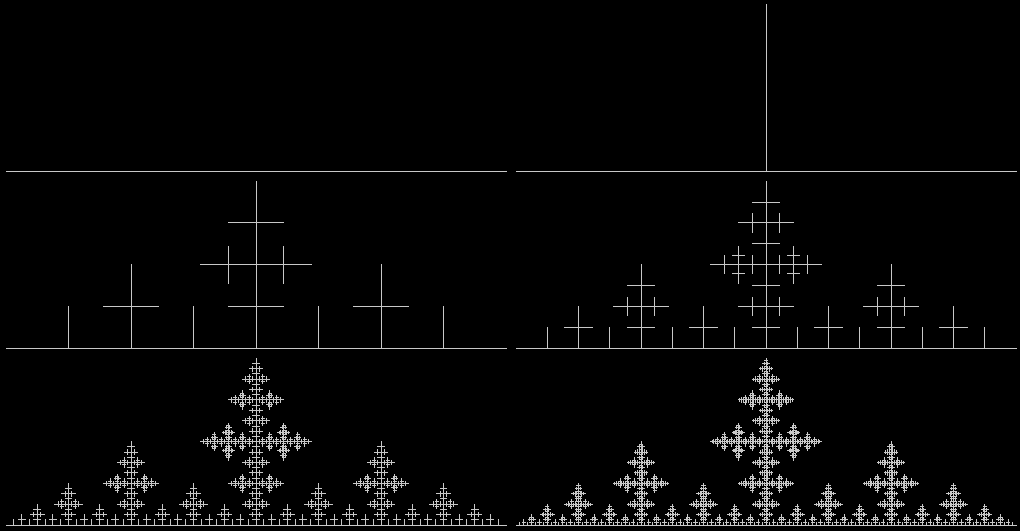
Fractals are shapes that contain copies of themselves on smaller and smaller scales. There are many of them in nature: ferns, trees, frost-flowers, ice-floes, clouds and lungs, for example. Fractals are also easy to create on a computer, because you all need do is take a single rule and repeat it at smaller and smaller scales. One of the simplest fractals follows this rule:

1. Take a line of length l and find the midpoint.
2. Erect a new line of length l x lm on the midpoint at right angles.
3. Repeat with each of the four new lines (i.e., the two halves of the original line and the two sides of the line erected at right angles).

When lm = 1/3, the fractal looks like this:

stick1

(Please open image in a new window if it fails to animate)

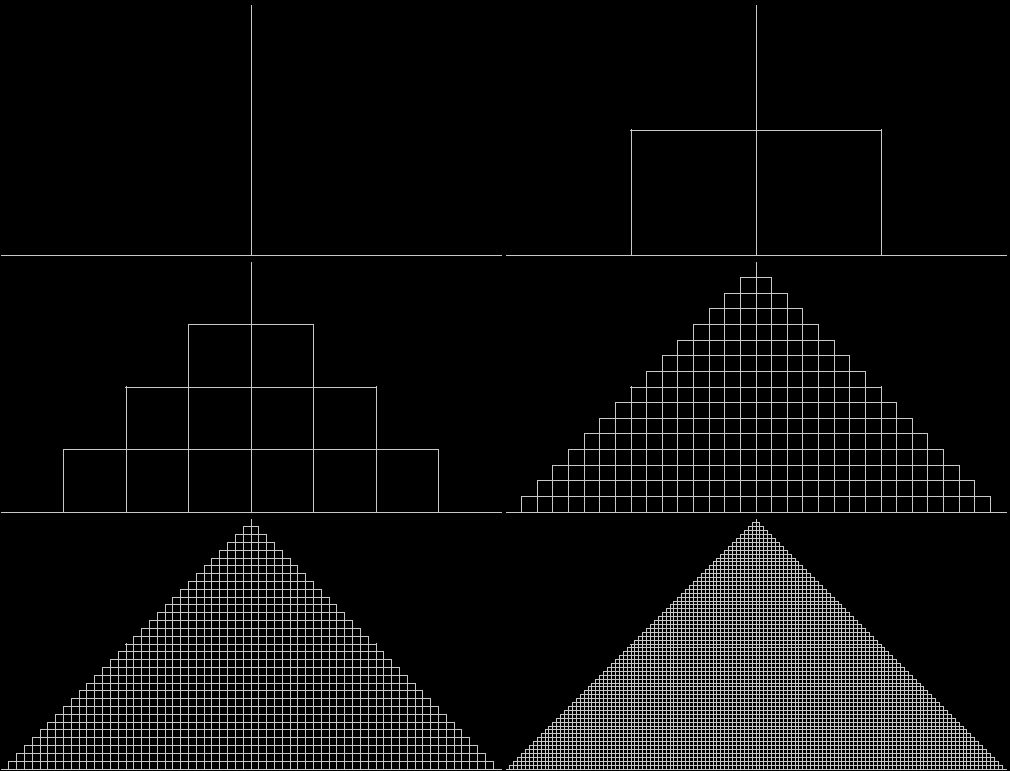
When lm = 1/2, the fractal is less interesting:

stick2

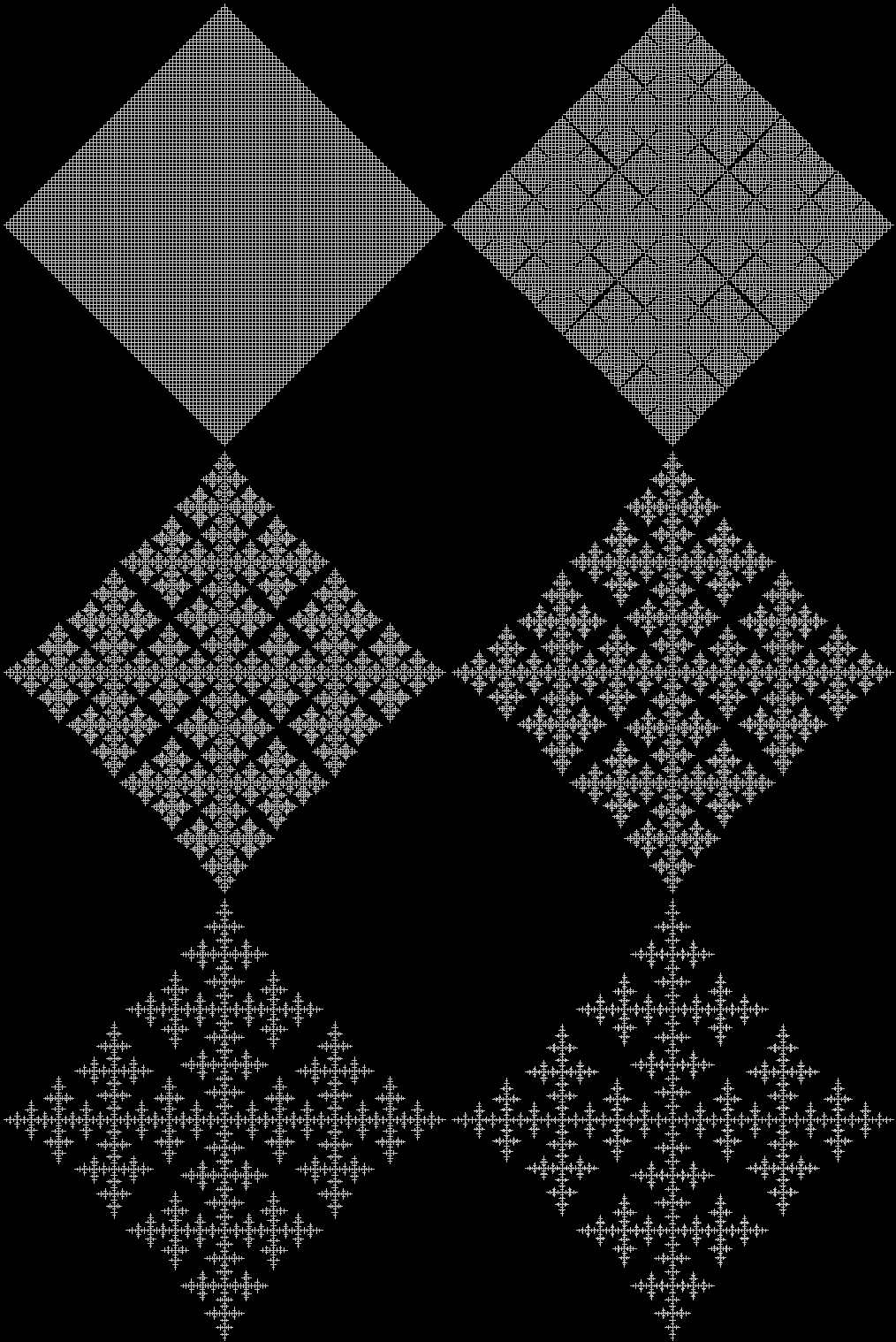
But you can adjust rule 2 like this:

2. Erect a new line of length l x lm x lm1 on the midpoint at right angles.

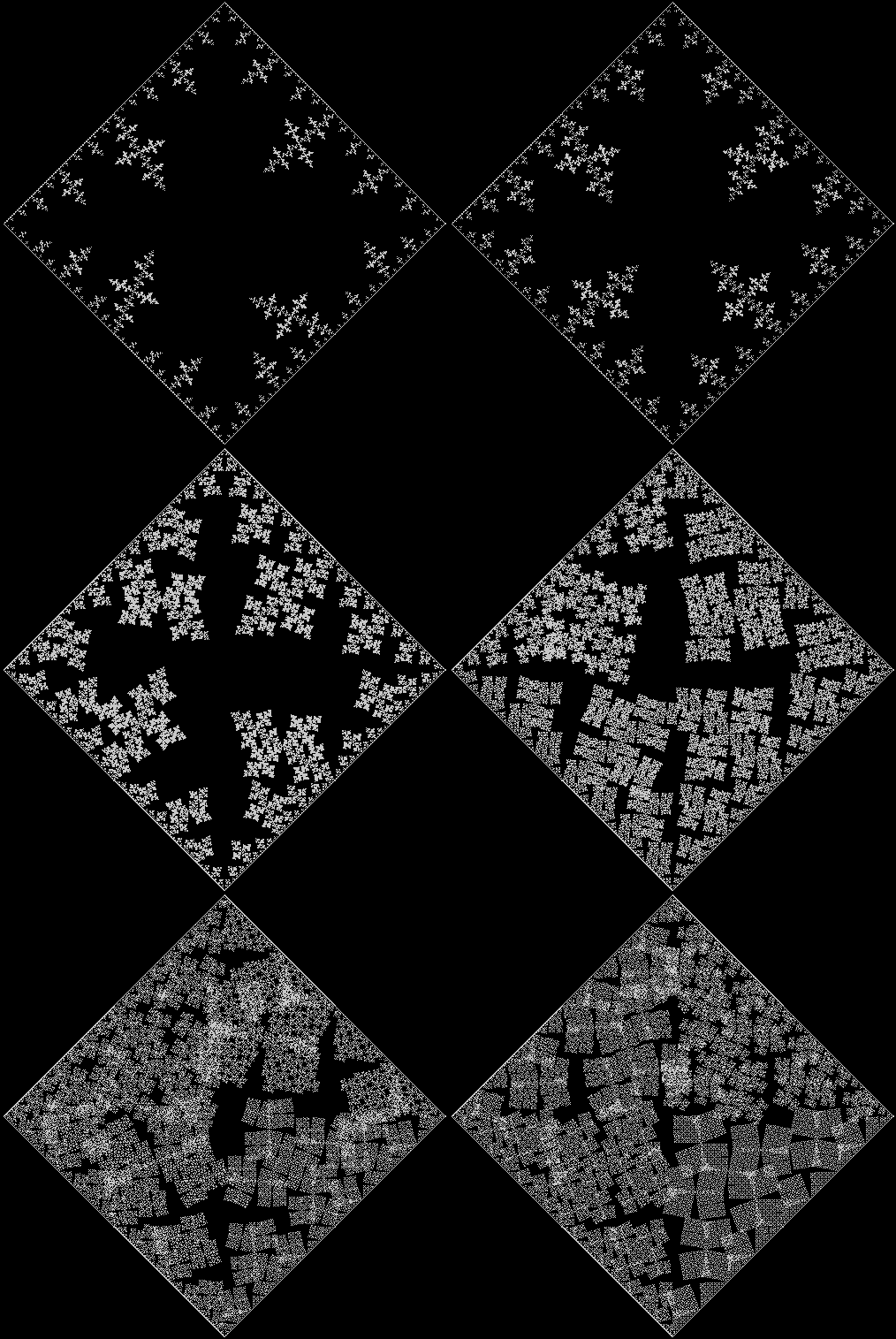
When lm1 = 1, 0.99, 0.98, 0.97…, this is what happens:

stick3

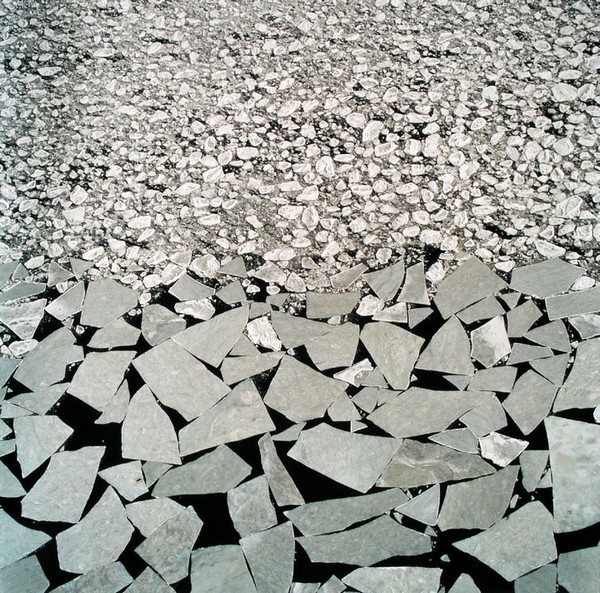
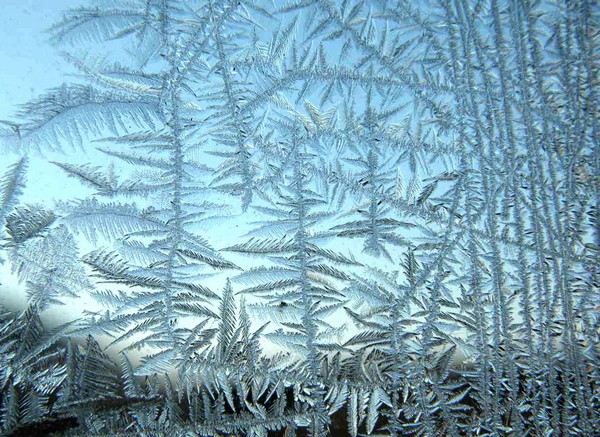
The fractals resemble frost-flowers on a windowpane or ice-floes on a bay or lake. You can randomize the adjustments and angles to make the resemblance even stronger:

frostfloe

Ice floes (see Owen Kanzler)

Ice floes (see Owen Kanzler)

Frost on window (see Kenneth G. Libbrecht, )

Frost on window (see Kenneth G. Libbrecht)

Performativizing Papyrocentricity #14

Papyrocentric Performativity Presents:

Scheming DemonThe Screwtape Letters, C.S. Lewis (1942)

Ai Wei to HellHow to Read Contemporary Art, Michael Wilson (Thames & Hudson, 2013)

Toxic TwosomeDoll, Peter Sotos and James Havoc (TransVisceral Books, 2013)

Know Your LimaçonsThe Penguin Dictionary of Curious and Interesting Geometry, David Wells (1991) (posted @ Overlord of the Über-Feral)

Pestilent, Pustulent and Pox-Pocked – various books by Dr Miriam B. Stimbers (@ O.o.t.Ü.-F.)


Or Read a Review at Random: RaRaR

The Brain in Pain

You can stop reading now, if you want. Or can you? Are your decisions really your own, or are you and all other human beings merely spectators in the mind-arena, observing but neither influencing nor initiating what goes on there? Are all your apparent choices in your brain, but out of your hands, made by mechanisms beyond, or below, your conscious control?

In short, do you have free will? This is a big topic – one of the biggest. For me, the three most interesting things in the world are the Problem of Consciousness, the Problem of Existence and the Question of Free Will. I call consciousness and existence problems because I think they’re real. They’re actually there to be investigated and explained. I call free will a question because I don’t think it’s real. I don’t believe that human beings can choose freely or that any possible being, natural or supernatural, can do so. And I don’t believe we truly want free will: it’s an excuse for other things and something we gladly reject in certain circumstances.


Continue reading The Brain in Pain

The Hill to Power

89 is special because it’s a prime number, divisible by only itself and 1. It’s also a sum of powers in a special way: 89 = 8^1 + 9^2. In base ten, no other two-digit number is equal to its own ascending power-sum like that. But the same pattern appears in these three-digit numbers, as the powers climb with the digits:

135 = 1^1 + 3^2 + 5^3 = 1 + 9 + 125 = 135
175 = 1^1 + 7^2 + 5^3 = 1 + 49 + 125 = 175
518 = 5^1 + 1^2 + 8^3 = 5 + 1 + 512 = 518
598 = 5^1 + 9^2 + 8^3 = 5 + 81 + 512 = 598

And in these four-digit numbers:

1306 = 1^1 + 3^2 + 0^3 + 6^4 = 1 + 9 + 0 + 1296 = 1306
1676 = 1^1 + 6^2 + 7^3 + 6^4 = 1 + 36 + 343 + 1296 = 1676
2427 = 2^1 + 4^2 + 2^3 + 7^4 = 2 + 16 + 8 + 2401 = 2427

The pattern doesn’t apply to any five-digit number in base-10 and six-digit numbers supply only this near miss:

263248 + 1 = 2^1 + 6^2 + 3^3 + 2^4 + 4^5 + 8^6 = 2 + 36 + 27 + 16 + 1024 + 262144 = 263249

But the pattern re-appears among seven-digit numbers:

2646798 = 2^1 + 6^2 + 4^3 + 6^4 + 7^5 + 9^6 + 8^7 = 2 + 36 + 64 + 1296 + 16807 + 531441 + 2097152 = 2646798

Now try some base behaviour. Some power-sums in base-10 are power-sums in another base:

175 = 1^1 + 7^2 + 5^3 = 1 + 49 + 125 = 175
175 = 6D[b=27] = 6^1 + 13^2 = 6 + 169 = 175

1306 = 1^1 + 3^2 + 0^3 + 6^4 = 1 + 9 + 0 + 1296 = 1306
1306 = A[36][b=127] = 10^1 + 36^2 = 10 + 1296 = 1306

Here is an incomplete list of double-base power-sums:

83 = 1103[b=4] = 1^1 + 1^2 + 0^3 + 3^4 = 1 + 1 + 0 + 81 = 83
83 = 29[b=37] = 2^1 + 9^2 = 2 + 81 = 83

126 = 105[b=11] = 1^1 + 0^2 + 5^3 = 1 + 0 + 125 = 126
126 = 5B[b=23] = 5^1 + 11^2 = 5 + 121 = 126

175 = 1^1 + 7^2 + 5^3 = 1 + 49 + 125 = 175
175 = 6D[b=27] = 6^1 + 13^2 = 6 + 169 = 175

259 = 2014[b=5] = 2^1 + 0^2 + 1^3 + 4^4 = 2 + 0 + 1 + 256 = 259
259 = 3G[b=81] = 3^1 + 16^2 = 3 + 256 = 259

266 = 176[b=13] = 1^1 + 7^2 + 6^3 = 1 + 49 + 216 = 266
266 = AG[b=25] = 10^1 + 16^2 = 10 + 256 = 266

578 = 288[b=15] = 2^1 + 8^2 + 8^3 = 2 + 64 + 512 = 578
578 = 2[24][b=277] = 2^1 + 24^2 = 2 + 576 = 578

580 = 488[b=11] = 4^1 + 8^2 + 8^3 = 4 + 64 + 512 = 580
580 = 4[24][b=139] = 4^1 + 24^2 = 4 + 576 = 580

731 = 209[b=19] = 2^1 + 0^2 + 9^3 = 2 + 0 + 729 = 731
731 = 2[27][b=352] = 2^1 + 27^2 = 2 + 729 = 731

735 = 609[b=11] = 6^1 + 0^2 + 9^3 = 6 + 0 + 729 = 735
735 = 6[27][b=118] = 6^1 + 27^2 = 6 + 729 = 735

1306 = 1^1 + 3^2 + 0^3 + 6^4 = 1 + 9 + 0 + 1296 = 1306
1306 = A[36][b=127] = 10^1 + 36^2 = 10 + 1296 = 1306

1852 = 3BC[b=23] = 3^1 + 11^2 + 12^3 = 3 + 121 + 1728 = 1852
1852 = 3[43][b=603] = 3^1 + 43^2 = 3 + 1849 = 1852

2943 = 3EE[b=29] = 3^1 + 14^2 + 14^3 = 3 + 196 + 2744 = 2943
2943 = [27][54][b=107] = 27^1 + 54^2 = 27 + 2916 = 2943


Previously pre-posted (please peruse):

Narcissarithmetic #1
Narcissarithmetic #2

Know Your Limaçons

Front cover of The Penguin Dictionary of Curious and Interesting Geometry by David WellsThe Penguin Dictionary of Curious and Interesting Geometry, David Wells (1991)

Mathematics is an ocean in which a child can paddle and an elephant can swim. Or a whale, indeed. This book, a sequel to Wells’ excellent Penguin Dictionary of Curious and Interesting Mathematics, is suitable for both paddlers and plungers. Plumbers, even, because you can dive into some very deep mathematics here.

Far too deep for me, I have to admit, but I can wade a little way into the shallows and enjoy looking further out at what I don’t understand, because the advantage of geometry over number theory is that it can appeal to the eye even when it baffles the brain. If this book is more expensive than its prequel, that’s because it needs to be. It’s a paperback, but a large one, to accommodate the illustrations.

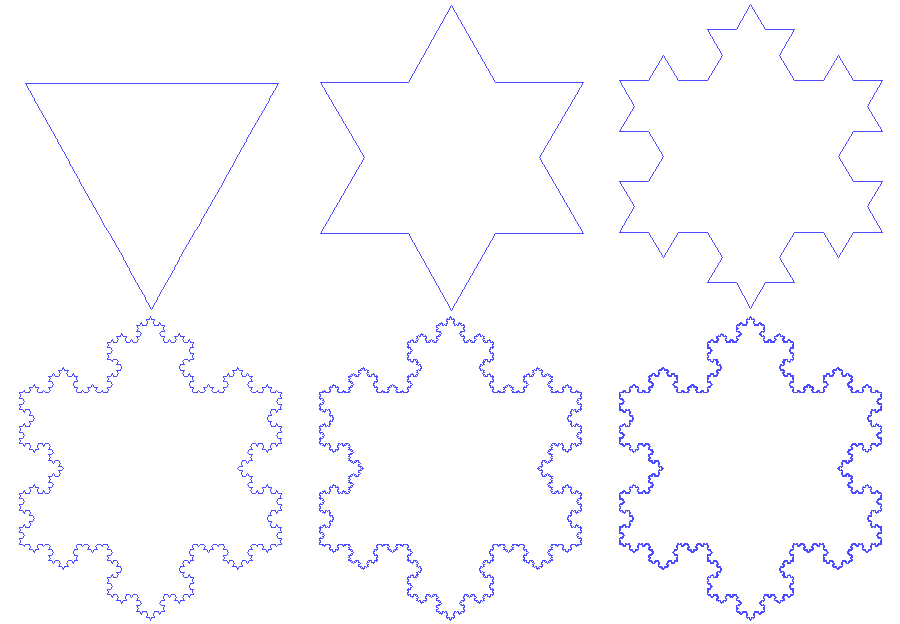
Fortunately, plenty of them appeal to the eye without baffling the brain, like the absurdly simple yet mindstretching Koch snowflake. Take a triangle and divide each side into thirds. Erect another triangle on each middle third. Take each new line of the shape and do the same: divide into thirds, erect another triangle on the middle third. Then repeat. And repeat. For ever.

A Koch snowflake (from Wikipedia)

A Koch snowflake (from Wikipedia)

The result is a shape with a finite area enclosed by an infinite perimeter, and it is in fact a very early example of a fractal. Early in this case means it was invented in 1907, but many of the other beautiful shapes and theorems in this book stretch back much further: through Étienne Pascal and his oddly organic limaçon (which looks like a kidney) to the ancient Greeks and beyond. Some, on the other hand, are very modern, and this book was out-of-date on the day it was printed. Despite the thousands of years devoted by mathematicians to shapes and the relationship between them, new discoveries are being made all the time. Knots have probably been tied by human beings for as long as human beings have existed, but we’ve only now started to classify them properly and even find new uses for them in biology and physics.

Which is not to say knots are not included here, because they are. But even the older geometry Wells looks at would be enough to keep amateur and recreational mathematicians happy for years, proving, re-creating, and generalizing as they work their way through variations on all manner of trigonomic, topological, and tessellatory themes.


Previously pre-posted (please peruse):

Poulet’s Propeller — discussion of Wells’ Penguin Dictionary of Curious and Interesting Numbers (1986)