
Flock of Scarlet Ibis, Eudocimus ruber, over Caroni Swamp, Trinidad (from Flickr)
(click for larger image)

Flock of Scarlet Ibis, Eudocimus ruber, over Caroni Swamp, Trinidad (from Flickr)
(click for larger image)
Currently listening…
• We Worship Silence, Pass the Gates (2011)
• House of Pyromania, Many Seek (Few Find) (1987)
• X-Newly Inc, Oz Wuwu 9 (2003)
• Iujisba, Abominable Abdominal (Killer Bees EP) (1986)
• Danny Yaup, Vision Ov (1969)
• Fizzy Glamsters, Keict (1991)
• Roxane Redmoor, Voxational DJ (2008)
• Kogar Fjö, Capnotic Micrographs (1993)
• Dynamic and the Zone, Cocodrilo Rock (1977)
• იჰვიუხე, პეპლები მთვარის (2002)
• Quickfinger, Ship on a Painted Ocean (1980)
• Earl Vanburgh, Glad (but) Sad (1965)
• Aquilæ ζ, Songs of Seventeen Stars (1979)
• Kozmik Krusaders, Hexen Zoo (1998)
• Quanta Thalassia, This Is Si Siht (2010)
• Thallium Addicts, Thanatographic (1999)
• X Xepj Xo, On an Ebb (2014)
• Orion’s Cradle, Live in Oslo (1987)
• Gazing on Bifrost, By the Swords (1976)
• Ausna, Z.M.E. (1977)
• Obelisk Pact, Long You’ll Slide (2003)
• Um Nuhotóbareac, L’Xac Rey (2011)
Previously pre-posted:
Toxic Turntable #1 • #2 • #3 • #4 • #5 • #6 • #7 • #8 • #9 • #10 • #11 • #12 • #13 • #14 • #15 • #16 • #17 • #18 • #19 • #20 • #21 • #22 • #23 •
A passionately socialist Anglican priest and proud member of the LGBTQ+ Community no longer approves of Moz:
The song I can no longer listen to
“This Charming Man”. Much as I like the song, Morrissey has ceased to be charming for me.
• ‘No Jacket Required would be the soundtrack of hell’: the Rev Richard Coles’s honest playlist, The Guardian, 10i22
In terms of my core ambitions for 2022, I hope to continue the fight against such things as the reprehensible and repulsive phrase “in terms of”, the pretentious and throbbingly urgent adjective “core”, and the cheap trick of trailing dots… I know that I won’t win and that the Hive-Mind will continue to buzz deafeningly at core venues like The Guardian, The London Review of Books and The Shropshire Advertiser, but so what? In the core words of Samuel in terms of Johnson:
[I]t remains that we retard what we cannot repel, that we palliate what we cannot cure. Life may be lengthened by care, though death cannot be ultimately defeated: tongues, like governments, have a natural tendency to degeneration; we have long preserved our constitution, let us make some struggles for our language. — Samuel Johnson, Preface to a Dictionary of the English Language (1755)
Elsewhere Other-Accessible
• Ex-term-in-ate! — core interrogation of why “in terms of” is so despicable, deplorable and downright disgusting…
• Don’t Do Dot — core interrogation of why “…” is so despicable, deplorable and downright disgusting dot dot dot
Post-Performative Post-Scriptum
How should the first line of this incendiary intervention begin? I suggest: “In terms of my core ambitions for 2022…” → “Among my main ambitions…”
The numbers that are both square and triangular are beautifully related to the best approximations to √2:
|
Number |
Square Root |
Factors of root |
| 1 | 1 | 1 |
| 36 | 6 | 2 * 3 |
| 1225 | 35 | 5 * 7 |
| 41616 | 204 | 12 * 17 |
and so on.
In each case the factors of the root are the numerator and denominator of the next approximation to √2. — David Wells, The Penguin Dictionary of Curious and Interesting Mathematics (1986), entry for “36”.
Elsewhere other-accessible
• A001110 — Square triangular numbers: numbers that are both triangular and square
I enjoy doing crosswords occasionally, but I’m not very good at them. Even so, I’m still surprised at how hard I can find a kind of crossword where you look at three words and have to find another word that links them. Some of the answers can be very simple, but it sometimes takes me a long time to get them. Here’s an example with an attractively symmetric grids:
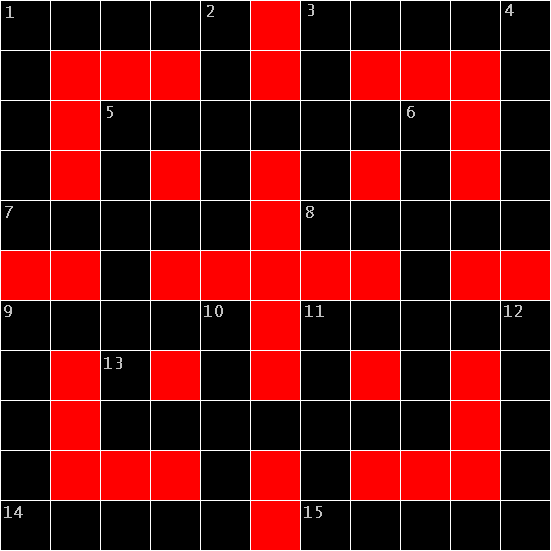
Across
1. Band, Farthing, Top
2. Jobs, Less, While
5. Bullet, Money, Surgeon
7. Back, Bank, Over
8. Half, Hiker, Up
9. Golden, Maple, Rosehip
11. Razor, Shooter, Tongue
13. Lunar, Solar, Total
14. Break, Buckets, Shirt
15. Angle, Away, Down
Down
1. Board, Roll, Sweet
2. Alec, Out, Phone
3. Night, Tower, Wrist
4. Cross, Loft, Serving
5. Dog, Oyster, Wolf
6. Cheese, Industry, Pie
9. Gum, Platform, Snow
10. Light, Test, Whale
11. Market, Power, Sonic
12. Ball, Stripper, Wet

White cat running on snow (from OneBigPhoto)
Post-Performative Post-Scriptum
The title of this incendiary intervention is once again self-explanatory.
Papyrocentric Performativity Presents:
• Psyches and Psychoses – the work of Guy de Maupassant
• Buzz Off – The Wasp Factory, Iain Banks (1984)
• Drink Ink – The Way to Dusty Death, Alistair MacLean (1973)
• Littlerature – In Miniature: How Small Things Illuminate the World, Simon Garfield (Canongate 2018)
• Le Paon dans les Pyrénées – The Man in the Red Coat, Julian Barnes (Penguin 2019)
• Bon and Off – Two Sides to Every Glory: AC/DC: The Complete Biography, Paul Stenning (Chrome Dreams 2005)
• The Fuel in the Skull – The Jewel in the Skull, Michael Moorcock (1969)
• Suspicious Substance – Substance: Inside New Order, Peter Hook (Simon & Schuster, 2016)
Or Read a Review at Random: RaRaR

Copepoda by Ernst Haeckel from Kunstformen der Natur / Artforms of Nature (1904)
Here is the square root of 2:
√2 = 1·414213562373095048801688724209698078569671875376948073176679738...
Here is the square root of 20:
√20 = 4·472135954999579392818347337462552470881236719223051448541794491...
And here are the first few triangular numbers:
1, 3, 6, 10, 15, 21, 28, 36, 45, 55, 66, 78, 91, 105, 120, 136, 153, 171, 190, 210, 231, 253, 276, 300, 325, 351, 378, 406, 435, 465, 496, 528, 561, 595, 630, 666, 703, 741, 780, 820, 861, 903, 946, 990, 1035...
What links √2 and √20 strongly with the triangular numbers? At first glance, nothing does. The square roots of 2 and 20 are very different from the triangular numbers. Square roots like those are irrational, that is, they can’t be represented as a fraction or ratio of integers. This means that their digits go on for ever, never falling into a regular pattern. So the digits are hard to calculate. The sequence of triangular numbers also goes on for ever, but it’s very easy to calculate. The triangular numbers get their name from the way they can be arranged into simple triangles, like this:
* = 1
*
** = 3
*
**
*** = 6
*
**
***
**** = 10
*
**
***
****
***** = 15
The 1st triangular number is 1, the 2nd is 3 = 1+2, the 3rd is 6 = 1+2+3, the 4th is 10 = 1+2+3+4, and so on. The n-th triangular number = 1+2+3…+n, so the formula for the n-th triangular number is n*(n+1)/2 = (n^2+n)/2. So what’s the 123456789th triangular number? Easy: it’s 7620789436823655 (see A077694 at the OEIS). But what’s the 123456789th digit of √2 or √20? That’s not easy to answer. But here’s something else that is easy to answer. If tri(n) is the n-th triangular number, what are the values of n when tri(n) is one digit longer than tri(n-1)? That is, what are the values of n when tri(n) increases in length by one digit? If you look at the beginning of the sequence, you can see the first three answers:
1, 3, 6, 10, 15, 21, 28, 36, 45, 55, 66, 78, 91, 105...
1 is one digit longer than nothing, as it were, and 1 = tri(1); 10 is one digit longer than 6 and 10 = tri(4); 105 is one digit longer than 91 and 105 = tri(14). Here are some more answers, giving triangular numbers on the left, as they increase in length by one digit, and the n of tri(n) on the right:
1 ← 1
10 ← 4
105 ← 14
1035 ← 45
10011 ← 141
100128 ← 447
1000405 ← 1414
10001628 ← 4472
100005153 ← 14142
1000006281 ← 44721
10000020331 ← 141421
100000404505 ← 447214
1000001326005 ← 1414214
10000002437316 ← 4472136
100000012392316 ← 14142136
1000000042485480 ← 44721360
10000000037150046 ← 141421356
100000000000018810 ← 447213595
1000000000179470703 ← 1414213562
10000000002237948990 ← 4472135955
100000000010876002500 ← 14142135624
1000000000022548781025 ← 44721359550
10000000000026940078203 ← 141421356237
100000000000242416922750 ← 447213595500
1000000000000572687476751 ← 1414213562373
10000000000004117080477500 ← 4472135955000
100000000000007771272992046 ← 14142135623731
1000000000000031576491575006 ← 44721359549996
10000000000000140731196136705 ← 141421356237310
100000000000000250760786750861 ← 447213595499958
1000000000000000638090771126060 ← 1414213562373095
10000000000000000479330922588410 ← 4472135954999579
100000000000000000169466805816725 ← 14142135623730950
1000000000000000025572412483843115 ← 44721359549995794
10000000000000000087657358700327265 ← 141421356237309505
100000000000000000097566473134542830 ← 447213595499957939
1000000000000000000987561276980703725 ← 1414213562373095049
10000000000000000003048443380954913921 ← 4472135954999579393
100000000000000000006832246143819194316 ← 14142135623730950488
1000000000000000000014155501020518731556 ← 44721359549995793928
Can you spot the patterns? When tri(n) has an odd number of digits, n approximates the digits of √2; when tri(n) has an even number of digits, n approximates the digits of √20. And what can you call the approximations? Well, in a way they’re triangular roots so I’m calling them troots. Here are the troots for tri(n) with an odd number of digits:
1 → 1
14 → 105
141 → 10011
1414 → 1000405
14142 → 100005153
141421 → 10000020331
1414214 → 1000001326005
14142136 → 100000012392316
141421356 → 10000000037150046
1414213562 → 1000000000179470703
14142135624 → 100000000010876002500
141421356237 → 10000000000026940078203
1414213562373 → 1000000000000572687476751
14142135623731 → 100000000000007771272992046
141421356237310 → 10000000000000140731196136705
1414213562373095 → 1000000000000000638090771126060
14142135623730950 → 100000000000000000169466805816725
141421356237309505 → 10000000000000000087657358700327265
1414213562373095049 → 1000000000000000000987561276980703725
14142135623730950488 → 100000000000000000006832246143819194316
14142135623730950488... = √2 (without the decimal point)
When I first found these patterns, I thought I might have discovered something mathematically profound. I hadn’t. Troots are trivial. I think troots are beautiful too, but a little thought soon showed me how easily and obviously they arise. Remember that the formula for tri(n), the n-th triangular number, is tri(n) = (n^2+n)/2. As you can see above, when tri(n) is increasing in length by one digit, it rises above the next power of 10, which always begins with 1 followed by only 0s. Therefore n^2+n will begin with the digit 2 followed by some 0s, which then becomes 1 followed by some 0s as (n^2+n) is divided by 2. So n for tri(n) increasing-by-one-digit will be the first integer, n, where n^2+n yields a number with 2 as the leading digit followed by more and more 0s.
And that’s why n approximates the digits of √2·0000… and √20·0000…, for tri(n) with an odd and even number of digits, respectively. Similar trootful patterns exist in other bases and for other polygonal numbers, like the square numbers, the pentagonal numbers and so on. The troots are beautiful to see but trivial to explain. All the same, there is a sense in which you can say the mindless sequence of triangular numbers is “calculating” the digits of √2 and √20. It even rounds up the final digits when necessary:
1414214 → 1000001326005
14142136 → 100000012392316
141421356 → 10000000037150046
141421356... = √2
[...]
14142135624 → 100000000010876002500
141421356237 → 10000000000026940078203
141421356237... = √2
[...]
14142135623731 → 100000000000007771272992046
141421356237310 → 10000000000000140731196136705
1414213562373095 → 1000000000000000638090771126060
1414213562373095... = √2
[...]
1414213562373095049 → 1000000000000000000987561276980703725
14142135623730950488 → 100000000000000000006832246143819194316
14142135623730950488... = √2
 Overlord In Terms of Core Issues Around Maximal Engagement with Key Notions of the Über-Feral
