
Surfer amid sea-foam on Main beach, Stradbroke Island, Queensland (by Piotr Parzybok in The Ex-Term-in-a-tor)

Surfer amid sea-foam on Main beach, Stradbroke Island, Queensland (by Piotr Parzybok in The Ex-Term-in-a-tor)
All fans of recreational math love palindromic numbers. It’s mandatory, man. 101, 727, 532235, 8810188, 1367755971795577631 — I love ’em! But where can you go after palindromes? Well, you can go to palindromes in a higher dimension. Numbers like 101, 727, 532235 and 8810188 are 1-d palindromes. That is, they’re palindromic in one dimension: backwards and forwards. But numbers like 181818189 and 646464640 aren’t palindromic in one dimension. They’re palindromic in two dimensions:
1 8 1
8 9 8
1 8 1
n=181818189
6 4 6
4 0 4
6 4 6
n=646464640
They’re 2-d palindromes or spiral numbers, that is, numbers that are symmetrical when written as a spiral. You start with the first digit on the top left, then spiral inwards to the center, like this for a 9-digit spiral (9 = 3×3):

And this for a 36-digit spiral (36 = 6×6):
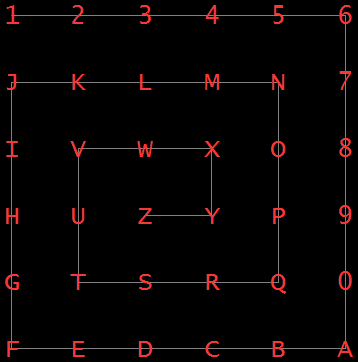
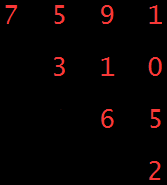
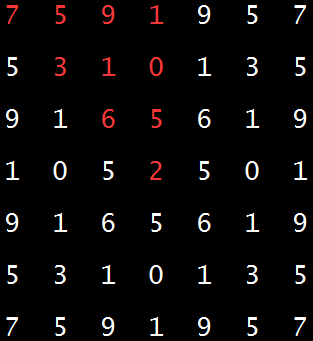
Spiral numbers are easy to construct, because you can reflect and rotate the numbers in one triangular slice of the spiral to find all the others:
↓
↓

You could say that the seed for the spiral number above is 7591310652, because you can write that number in descending lines, left-to-right, as a triangle.
Here are some palindromic numbers with nine digits in base 3 — as you can see, some are both palindromic numbers and spiral numbers. That is, some are palindromic in both one and two dimensions:
1 0 1
0 1 0
1 0 1
n=101010101
1 0 1
0 2 0
1 0 1
n=101010102
1 1 1
1 0 1
1 1 1
n=111111110
1 1 1
1 1 1
1 1 1
n=111111111
2 0 2
0 1 0
2 0 2
n=202020201
2 0 2
0 2 0
2 0 2
n=202020202
2 2 2
2 1 2
2 2 2
n=222222221
2 2 2
2 2 2
2 2 2
n=222222222
But palindromic primes are even better than ordinary palindromes. Here are a few 1-d palindromic primes in base 10:
101
151
73037
7935397
97356765379
1091544334334451901
1367755971795577631
70707270707
39859395893
9212129
7436347
166000661
313
929
And after 1-d palindromic primes, you can go to 2-d palindromic primes. That is, to spiral primes or sprimes — primes that are symmetrical when written as a spiral:
3 6 3
6 7 6
3 6 3
n=363636367 (prime)
seed=367 (see definition above)
9 1 9
1 3 1
9 1 9
n=919191913 (prime)
seed=913
3 7 8 6 3 6 8 7 3
7 9 1 8 9 8 1 9 7
8 1 9 0 9 0 9 1 8
6 8 0 5 5 5 0 8 6
3 9 9 5 7 5 9 9 3
6 8 0 5 5 5 0 8 6
8 1 9 0 9 0 9 1 8
7 9 1 8 9 8 1 9 7
3 7 8 6 3 6 8 7 3
n=378636873786368737863687378636879189819189819189819189819090909090909090555555557 (prime)
seed=378639189909557 (l=15)
And why stop with spiral numbers — and sprimes — in two dimensions? 363636367 is a 2-sprime, being palindromic in two dimensions. But the digits of a number could be written to form a symmetrical cube in three, four, five and more dimensions. So I assume that there are 3-sprimes, 4-sprimes, 5-sprimes and more out there. Watch this space.

Belzebong playing live by Rafał Kudyba
(click for larger image)
• Racine carrée de 2, c’est 1,414 et des poussières… Et quelles poussières ! Des grains de sable qui empêchent d’écrire racine de 2 comme une fraction. Autrement dit, cette racine n’est pas dans Q. — Rationnel mon Q: 65 exercices de styles, Ludmilla Duchêne et Agnès Leblanc (2010)
• The square root of 2 is 1·414 and dust… And what dust! Grains of sand that stop you writing the root of 2 as a fraction. Put another way, this root isn’t in Q [the set of rational numbers].
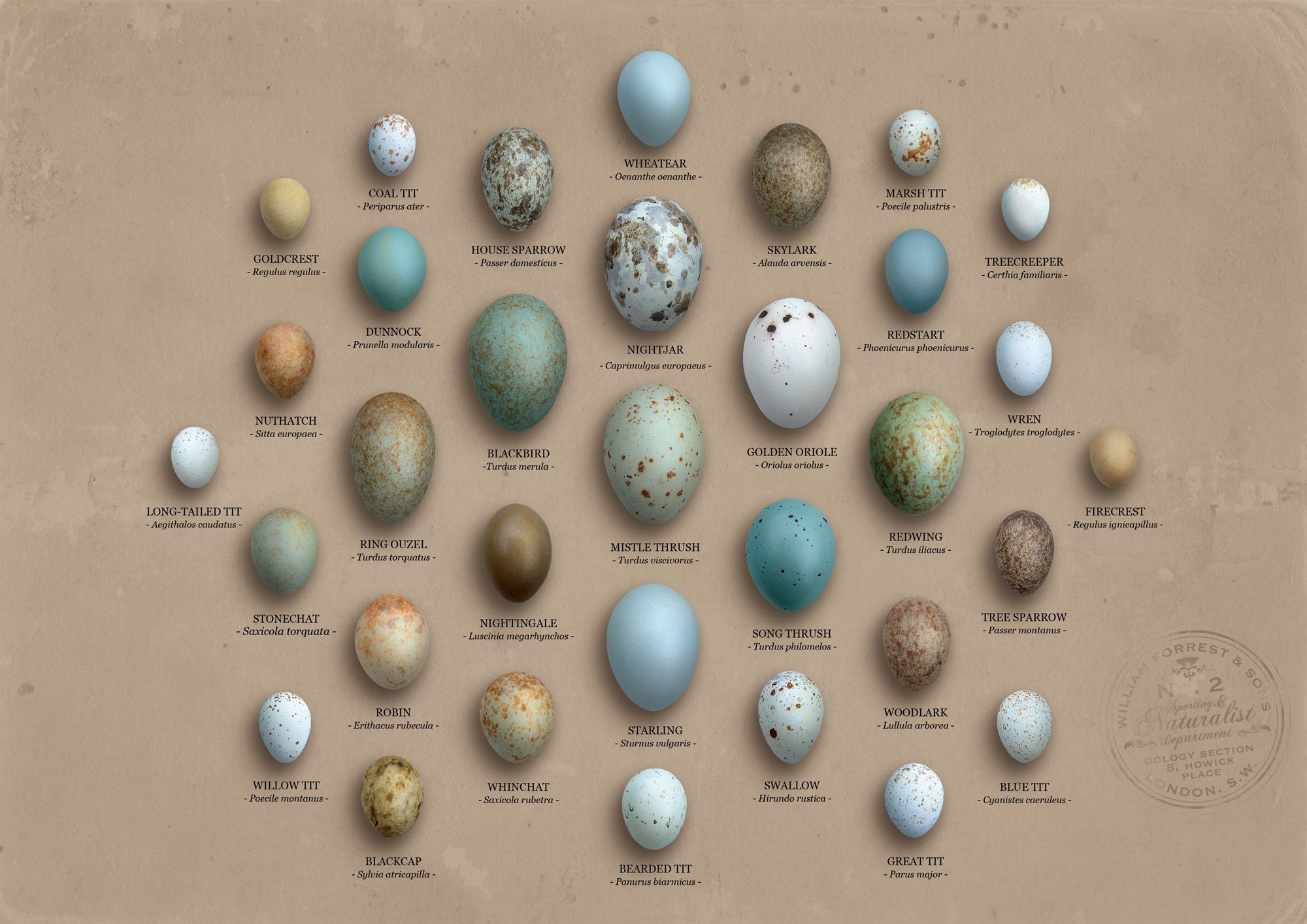
Eggs of various common species of British wild bird
(click for larger image)
A once very difficult but now very simple problem in probability from Ian Stewart’s Do Dice Play God? (2019):
For three dice [Girolamo] Cardano solved a long-standing conundrum [in the sixteenth century]. Gamblers had long known from experience that when throwing three dice, a total of 10 is more likely than 9. This puzzled them, however, because there are six ways to get a total of 10:
1+4+5; 1+3+6; 2+4+4; 2+2+6; 2+3+5; 3+3+4
But also six ways to get a total of 9:
1+2+6; 1+3+5; 1+4+4; 2+2+5; 2+3+4; 3+3+3
So why does 10 occur more often?
To see the answer, imagine throwing three dice of different colors: red, blue and yellow. How many ways can you get 9 and how many ways can you get 10?
| Roll | Total=9 | Dice #1 (Red) | Dice #2 (Blue) | Dice #3 (Yellow) |
| 01 | 9 = | 1 | 2 | 6 |
| 02 | 9 = | 1 | 3 | 5 |
| 03 | 9 = | 1 | 4 | 4 |
| 04 | 9 = | 1 | 5 | 3 |
| 05 | 9 = | 1 | 6 | 2 |
| 06 | 9 = | 2 | 1 | 6 |
| 07 | 9 = | 2 | 2 | 5 |
| 08 | 9 = | 2 | 3 | 4 |
| 09 | 9 = | 2 | 4 | 3 |
| 10 | 9 = | 2 | 5 | 2 |
| 11 | 9 = | 2 | 6 | 1 |
| 12 | 9 = | 3 | 1 | 5 |
| 13 | 9 = | 3 | 2 | 4 |
| 14 | 9 = | 3 | 3 | 3 |
| 15 | 9 = | 3 | 4 | 2 |
| 16 | 9 = | 3 | 5 | 1 |
| 17 | 9 = | 4 | 1 | 4 |
| 18 | 9 = | 4 | 2 | 3 |
| 19 | 9 = | 4 | 3 | 2 |
| 20 | 9 = | 4 | 4 | 1 |
| 21 | 9 = | 5 | 1 | 3 |
| 22 | 9 = | 5 | 2 | 2 |
| 23 | 9 = | 5 | 3 | 1 |
| 24 | 9 = | 6 | 1 | 2 |
| 25 | 9 = | 6 | 2 | 1 |
| Roll | Total=10 | Dice #1 (Red) | Dice #2 (Blue) | Dice #3 (Yellow) |
| 01 | 10 = | 1 | 3 | 6 |
| 02 | 10 = | 1 | 4 | 5 |
| 03 | 10 = | 1 | 5 | 4 |
| 04 | 10 = | 1 | 6 | 3 |
| 05 | 10 = | 2 | 2 | 6 |
| 06 | 10 = | 2 | 3 | 5 |
| 07 | 10 = | 2 | 4 | 4 |
| 08 | 10 = | 2 | 5 | 3 |
| 09 | 10 = | 2 | 6 | 2 |
| 10 | 10 = | 3 | 1 | 6 |
| 11 | 10 = | 3 | 2 | 5 |
| 12 | 10 = | 3 | 3 | 4 |
| 13 | 10 = | 3 | 4 | 3 |
| 14 | 10 = | 3 | 5 | 2 |
| 15 | 10 = | 3 | 6 | 1 |
| 16 | 10 = | 4 | 1 | 5 |
| 17 | 10 = | 4 | 2 | 4 |
| 18 | 10 = | 4 | 3 | 3 |
| 19 | 10 = | 4 | 4 | 2 |
| 20 | 10 = | 4 | 5 | 1 |
| 21 | 10 = | 5 | 1 | 4 |
| 22 | 10 = | 5 | 2 | 3 |
| 23 | 10 = | 5 | 3 | 2 |
| 24 | 10 = | 5 | 4 | 1 |
| 25 | 10 = | 6 | 1 | 3 |
| 26 | 10 = | 6 | 2 | 2 |
| 27 | 10 = | 6 | 3 | 1 |

Multicolored rock strata at Zhangye National Geopark, 張掖國家地質公園, China
Currently listening…
• Dźmutia Zirih, Plz Yrslf (1976)
• Far Beyond Xanadu, Dionysus’ Holy Name (1992)
• Yolanda Grovedrew, Not for Duke War (1997)
• Egzotiq, Vous N’Êtes Que (1984)
• Doctor Yacht, Invoke the Geigar (2009)
• Forschung-239, Jisirlo (1995)
• Gary Jophe, Silver Sands (1992)
• მზის მგელი, მგლისთვალება (2008)
• Helios Epoch, Nahtloser Neuntöter (2009)
• WihlhiW, Gaze Fix (1996)
• Ossafracht, Lokomotiv Zinken (2002)
• Vora xMqa, Future Is An Asylum (2015)
• հաց և գինի, Պետրիկոր (2020)
• Floris Nox, God is Caffeinated (1988)
• Phonophoro L.G., El Coro del Abismo (1988)
• Oscar’s Vital Glove, We Hate Tweeve (2003)
• Ecofoxes, When the Hen (1994)
• ბვემწა, ფვიტი ჰმრე (2017)
• Aoatt Leit, Trey Drake (1993)
• Audiosun, Lucus (Non Lucendo) (1995)
• Hildegard von Bingen, Hortus Deliciarum (2018)
• Ikexon, H.M.T. (2014)
Previously pre-posted
Toxic Turntable #1 • #2 • #3 • #4 • #5 • #6 • #7 • #8 • #9 • #10 • #11 • #12 • #13 • #14 • #15 • #16 • #17 • #18 • #19 • #20 • #21 •
“A formal manipulator in mathematics often experiences the discomforting feeling that his pencil surpasses him in intelligence.” — Howard Whitley Eves (1911-2004)
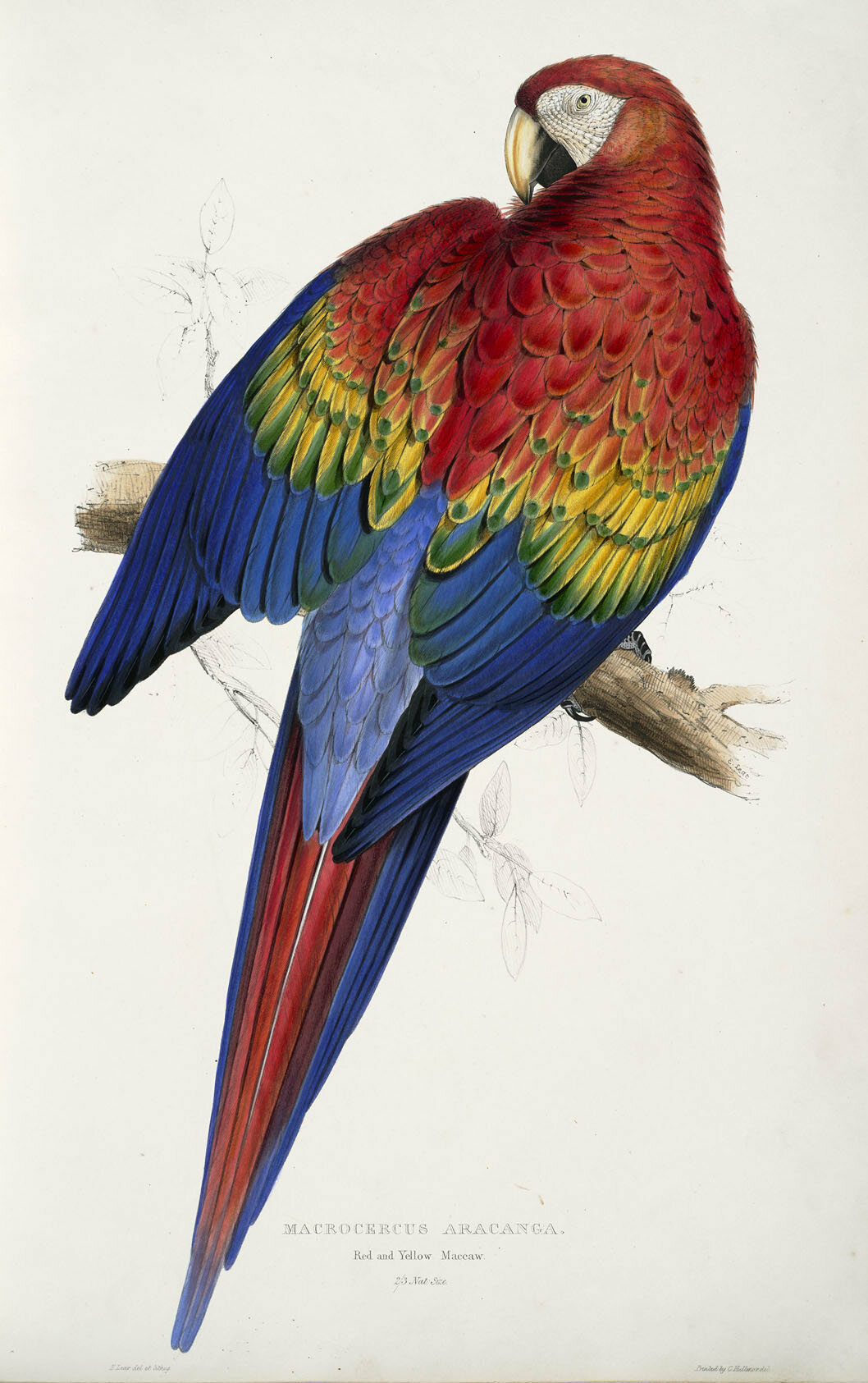
Red and yellow maccaw, Macrocercus aracanga, by Edward Lear (1812-1888)
(Open in new window for larger image)
(Now Scarlet Macaw, Ara macao)
Elsewhere other-accessible…
 Overlord In Terms of Core Issues Around Maximal Engagement with Key Notions of the Über-Feral