Performativizing Papyrocentricity #29

Papyrocentric Performativity Presents:

Sky StoryThe Cloud Book: How to Understand the Skies, Richard Hamblyn (David & Charles 2008)

Wine WordsThe Oxford Companion to Wine, ed. Janice Robinson (Oxford University Press 2006)

Nu WorldsNumericon, Marianne Freiberger and Rachel Thomas (Quercus Editions 2014)

ThalassobiblionOcean: The Definitive Visual Guide, introduction by Fabien Cousteau (Dorling Kindersley 2014) (posted @ Overlord of the Über-Feral)


Or Read a Review at Random: RaRaR

Thalassobiblion

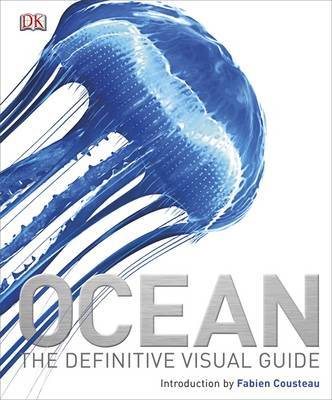
Ocean The Definitive Visual GuideOcean: The Definitive Visual Guide, introduction by Fabien Cousteau (Dorling Kindersley 2014)

A big book for a big subject: the sea. But “guide” isn’t the mot juste. “Encyclopaedia” is better, because the book covers all aspects of oceanography and marine life, drawing on physics, chemistry and biology to describe everything inorganic from waves and icebergs to whirlpools and underwater volcanoes, everything organic from a beautiful flower like beach morning-glory, Ipomoea imperati, to a grotesque fish like the Pacific blackdragon, Idiacanthus antrostomus. The flower is on the shore, the fish is in the abyss, but both of them descend from a single ancestor.

And that ancestor may have evolved in the sea. It certainly moved there before it gave rise to flowers and fish. This big subject is also a very important one: the sea is central to the evolution and continued existence of life on earth. Only the sun matters as much, but some marine life could potentially survive the disappearance of the sun:

Hydrothermal vents are similar to hot springs on land. Located near ocean ridges and rifts, at an average depth of 2,100m (7,000ft), they spew out mineral-rich, superheated seawater. Some have tall chimneys, formed from dissolved minerals that precipitate when the hot vent water meets cold, deep-ocean water. The mix of heat and chemicals supports animal communities around the vents – the first life known to exist entirely without the energy of sunlight. (pg. 188, “The Open Ocean and Ocean Floor”)

The deep ocean is a fascinating and little-known place: much nearer than the other side of the earth, but much harder to get to. Like climbing mountains, plumbing the abyss is difficult and dangerous. It’s interesting that both endeavours have been dominated by a particular group of human being: both the highest and lowest points on the planet were first reached by white males. Fabien Cousteau, who introduces this book, continues the tradition. He’s the grandson of Jacques Cousteau (1910-97), who popularized diving and marine biology for millions of people. Jacques saw huge advances in marine technology and science and his son and grandson have seen more. But the discoveries are still coming: as Fabien points out, it’s estimated that “over 90 per cent of the world’s biodiversity resides in its oceans”.

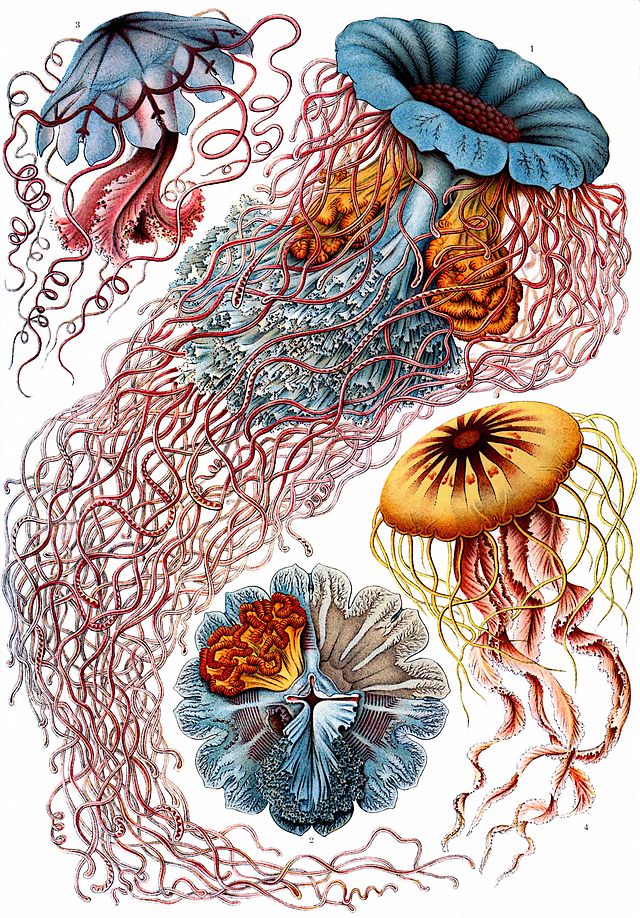
Discomedesae by Ernst Haeckel

Discomedusae by Ernst Haeckel

Some of that biodiversity left the water for the land and evolved new forms. Some of those new forms went back to the water, like the ceteceans and sea-snakes. Like human beings, they’re descended from fish, the most varied of all vertebrate groups. But some marine life never left its cradle. Where else can you find the beauty and strangeness of groups like the jellyfish? Radial symmetry is a marine speciality and when H.P. Lovecraft was inventing his aliens, he looked to under-space as much as outer:

But to give it a name at this stage was mere folly. It looked like a radiate, but was clearly something more. It was partly vegetable, but had three-fourths of the essentials of animal structure. That it was marine in origin, its symmetrical contour and certain other attributes clearly indicated; yet one could not be exact as to the limit of its later adaptations. The wings, after all, held a persistent suggestion of the aerial. How it could have undergone its tremendously complex evolution on a new-born earth in time to leave prints in Archaean rocks was so far beyond conception as to make Lake whimsically recall the primal myths about Great Old Ones who filtered down from the stars and concocted earth life as a joke or mistake; and the wild tales of cosmic hill things from outside told by a folklorist colleague in Miskatonic’s English department. (At the Mountains of Madness, 1931)

Lovecraft would have enjoyed Ocean as much as Jacques Cousteau. It closes with a detailed “Atlas of the Oceans”, with maps of the ocean floor all around the world. Before that, you can learn how the Corryvreckan whirlpool nearly killed George Orwell in 1947, where to find manganese nodules, why so many deep-sea creatures are red and what the narwhale’s horn really is. You can also feast your eyes on photography that records everything from microscopic plankton to swirling hurricanes hundreds of kilometres across. Big subject, big book. Beautiful subject and beautiful book too.

Performativizing Papyrocentricity #28

Papyrocentric Performativity Presents:

HimmelangstNo Empty Chairs: The Short and Heroic Lives of the Young Aviators Who Fought and Died in the First World War, Ian Mackersey (Phoenix 2012)

Arioch’n’RollThe White Stuff: Archetype, Anomie and Allegorical Albinism in the Music of Hawkwind, 1972-81, Dr Miriam B. Stimbers (University of Nebraska Press 1996)

Jewels in the SkullThe Art Book, Phaidon (Second edition 2012) (posted @ Overlord of the Über-Feral)


Or Read a Review at Random: RaRaR

Jewels in the Skull

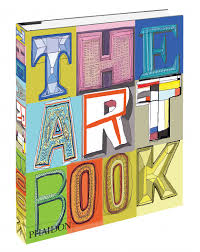
Phaidon Art BookThe Art Book, Phaidon (Second edition 2012)

An A to Z of artists, mostly painters, occasionally sculptors, installers and performers, with a few photographers and video-makers too. You can trace the development, culmination and corruption of high art all the way from Giotto and Fra Angelico through Van Eyck and Caravaggio to Auerbach and Twombly. But the modernist dreck heightens the power of the pre-modernist delights. A few pages after Pieter Claesz’s remarkable A Vanitas Still Life of 1645 there’s Joseph Cornell’s “Untitled” of 1950. One is a skull, watch and overturned glass, skilfully lit, minutely detailed, richly symbolic; the other is a wooden box containing a “frugal assortment of stamps, newspaper cuttings and other objects with no particular relevance to each other”. From the sublime to the slapdash. Over the page from Eleazar Lissitzky’s Composition of 1941 there’s Stefan Lochner’s The Virgin and Child in a Rose Arbour of 1442. One is like a child’s doodle, the other like a jewel. From the slapdash to the sublime.
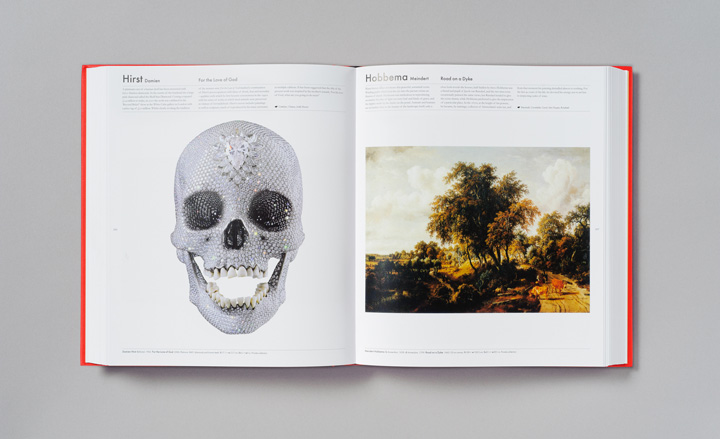
Hirst Skull and landscape
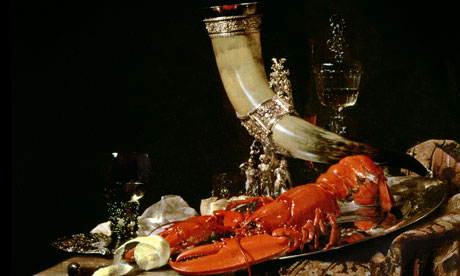
And so it goes on throughout the book, with beautiful art by great artists following or preceding ugly art by poseurs and charlatans. But some of the modern art is attractive or interesting, like Bridget Riley’s eye-alive Cataract 3 (1961) and Damien Hirst’s diamond-encrusted skull For the Love of God (2006). Riley and Hirst aren’t great and Hirst at least is more like an entrepreneur than an artist, but their art here is something that rewards the eye. So is Riley’s art elsewhere, as newcomers to her work might guess from the single example here. That is one of the purposes of a guide like this: to invite – or discourage – further investigation. I vaguely remember seeing the beautiful still-life of a boiled lobster, drinking horn and peeled lemon on page 283 before, but I wouldn’t have recognized the name of the Dutch artist: Willem Kalf (1619-93).

Willem Kalf, Still Life (c. 1653)

Willem Kalf, Still Life (c. 1653)


Elsewhere, I was surprised and pleased to see an old favourite: John Atkinson Grimshaw and his Nightfall on the Thames (1880). Many more people know Grimshaw’s atmospheric and eerie art than know his name, because it often appears on book-covers and as illustrations. If Phaidon are including him in popular guides with giants like Da Vinci, Dürer, Raphael and Titian, perhaps he’ll return to his previous fame. I certainly hope so.

Finding Grimshaw here made a good guide even better. The short texts above each art-work pack in a surprising amount of information and anecdote too. What you learn from the texts raises some interesting questions. For example: Why has one small nation contributed so much to the world’s treasury of art? From Van Eyck to Van Gogh by way of Hieronymus Bosch and Jan Vermeer, Holland is comparable to Italy in its importance. But only in painting, not sculpture or architecture. There aren’t just patterns of pigment, texture and geometry in this book: there are patterns of DNA, culture and evolution too. Brilliant, beautiful and banal; skilful, subtle and slapdash: The Art Book has all that and more. It puts jewels inside your skull.


Elsewhere other-posted:

Ai Wei to HellHow to Read Contemporary Art, Michael Wilson
Eyck’s EyesVan Eyck, Simone Ferrari
Face PaintA Face to the World: On Self-Portraits, Laura Cumming

Performativizing Papyrocentricity #27

Papyrocentric Performativity Presents:

Sex/Dream Metaphors – Extreme Metaphors: Selected Interviews with J.G. Ballard, edited by Simon Sellars and Dan O’Hara (Fourth Estate 2014)

DNAncientNeanderthal Man: In Search of Lost Genomes, Svante Pääbo (Basic Books 2014)

The Cult of CthulhuH.P. Lovecraft: The Classic Horror Stories, edited by Roger Luckhurst (Oxford University Press 2013)

Rauc’ and RoleMortality, Christopher Hitchens (Atlantic Books 2012)

#BooksThatShouldNotBe — Tip-top Transgressive Texts…


Or Read a Review at Random: RaRaR

Performativizing Papyrocentricity #26

Papyrocentric Performativity Presents:

World Wide WingsThe Big Book of Flight, Rowland White (Bantam Press 2013)

Kite WriteThe Kite-Making Handbook, compiled by Rossella Guerra and Giuseppe Ferlenga (David & Charles 2004)

Gun GuideSmall Arms: 1914-45, Michael E. Haskew (Amber Books 2012)

The Basis of the BeastKillers: The Origins of Iron Maiden, 1975-1983, Neil Daniels (Soundcheck Books 2014)


Or Read a Review at Random: RaRaR

Performativizing Papyrocentricity #25

Papyrocentric Performativity Presents:

Colouring the ChameleonOlivier, Philip Ziegler (MacLehose Press 2013)

Paper-DeepTreasure Island (1883) and Dr. Jekyll and Mr. Hyde (1885), Robert Louis Stevenson

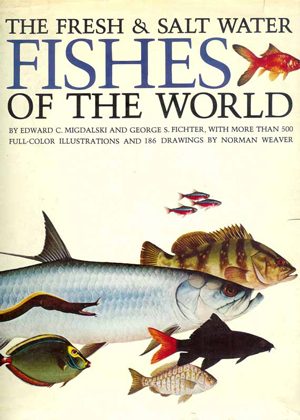
Fins and FangsThe Fresh and Salt Water Fishes of the World, Edward C. Migdalski and George S. Fichter, illustrated by Norman Weaver (1977) (posted @ Overlord of the Über-Feral)


Or Read a Review at Random: RaRaR

Sime Time

I came across the writings of Simon Whitechapel a year ago after picking up the first twenty or so issues of Headpress, a 1990s ’zine that dealt with the relentlessly grim, the esoteric and prurient. His style was fascinating, coming across as intelligent and well-read and — at least from first reading — subtly ironic.

In fact he must have impressed some other people during this time too as Headpress’ Critical Vision imprint spun his collected articles together for publication under the title Intense Device: A Journey Through Lust, Murder and the Fires of Hell — they have all the typical interests that run through Whitechapel’s work — there is an obsession with numerology, with Whitehouse-style distortion music, with Hitler and de Sade. There are also articles on farting, on Jack Chick and novelisations of TV shows. They are fascinating, written in a scholarly way with footnotes aplenty but never difficult to understand. He also wrote two non-fiction works during the late 1990s and early 2000s that centred around sadism and the murder of women in South America. They are dark.

There are also the works of fiction. To say that Whitechapel is transgressive is an understatement. His writing bleeds. The ‘official’ work The Slaughter King is filled with the detailed descriptions of sadistic murder, beginning with a serial killer murdering a gay prostitute whilst listening to distortion-atrocity music. The plot is schlocky but serviceable, jumping around inconsistently but the images it creates are terrifying. A bourgeois dinner party straight out of Buñuel and Pasolini’s nightmares where guests are served poisons as if they were the finest consommés: they eat bees until their faces swell, dropping dead at the table, finishing with a trifle “made from the berries of the several varieties of belladonna, of cuckoo-pint, and of the flowers of monkshood”. It’s a sinister book, but nothing compared to his second work.

Whitechapel wrote The Eyes. This is clear just from a simple comparison between his texts, the fascination with language, with sadism, with de Sade. The thing is, The Eyes is supposedly written by some guy called Aldapuerta, Spanish apparently. ‘Aldapuerta’ can be written Alda Puerta — ‘at the gate’, a telling description of these short stories, which go past this point many, many times. The tale of ‘Aldapuerta’ himself is too exact to be believed: a young boy with an interest in de Sade, corrupted by the local pornographer, medical-school training that honed his knowledge, then a mysterious death (echoing shades of Pasolini’s own) and finishing with the “and he might be baaaack” closer. But this point isn’t really an issue and it’s understandable that Whitechapel would want to keep his name away from this work. It is also surrealistically brilliant at times: amongst the brutality, the images it creates are unforgettable.

Of course, Whitechapel is a fake name, redolent of Jack the Ripper, and even Simon was taken from elsewhere — a colleague perhaps? He disappeared during the 2000s, no longer writing for Headpress, a few self-published chapbooks pastiching Clark Ashton Smith… where did he go? There are the rumours of prison time — they are convincing to my mind, as they too revolve around different identities, around extremity and anonymity. I wonder though, if true, just how much this individual actually believed in them. His most recent writings, at his tricksy blog, hint at this, as well as make his ‘relationship’ with Aldapuerta clearer but it’s not in my ability to directly connect the personas.

If you want to be fascinated and repulsed, then the non-author Simon Whitechapel is for you.
Lancashire


Elsewhere other-posted:

It’s The Gweel Thing…Gweel & Other Alterities, Simon Whitechapel (Ideophasis Books, 2011)

Fins and Fangs

Fresh and Salt-Water Fishes of the World by Edward C. Migdalski and George S. Fichter illustrated by Norman WeaverThe Fresh and Salt Water Fishes of the World, Edward C. Migdalski and George S. Fichter, illustrated by Norman Weaver (1977)

A big book with a big subject: fish are the most numerous and varied of the vertebrates, from the bus-sized Rhincodon typus or whale shark, which feeds its vast bulk on plankton, to the little-finger-long Vandellia cirrhosa, the parasitic catfish that can give bathers a nasty surprise by swimming into their “uro-genitary openings” – “the pain is agonizing and the fish can be removed only by surgery”. The book is full of interesting asides like that, but I doubt that readers will read every page carefully. They’ll certainly look at every page carefully, to see Norman Weaver’s gorgeous drawings, which capture both the colour and the shine of fish’s bodies. Another aspect of the enormous variation of fish is not just their differences in size, shape and colouring, but their differences in aesthetic appeal. Some are among the most beautiful of living creatures, others among the most grotesque, like the Lovecraftian horrors that literally dwell in the abyss: inhabitants of the very deep ocean like Chauliodus macouni, the Pacific viperfish, whose teeth are too long and sharp for it to close its mouth.

The crushing pressure and freezing darkness in which these fish live are alien to human beings and so are the appearance and behaviour of the fish. But fish that live in shallow water, like the hammerhead shark and the electric eel, can seem alien too and some of the strangest fish of all, the horizontally flattened rays and mantas, can even fly briefly in the open air. Some of the piscine beauties, on the other hand, like Cheirodon axelrodi, the neon-bodied cardinal tetra, are routinely kept in aquariums, but then so is the very strange Anoptichthys jordani, the blind cavefish. There’s a blind torpedo ray too, Typhlonarke aysoni, “which has no functional eyes and ‘stumps’ along the bottom on its thick, leglike ventral fins”. But the appearance, behaviour and habitat of fish aren’t the only things man finds interesting about them. Some are good eating or offer good sport and the authors often discuss both cuisine and fishing in relation to a particular species or family. That raises the second of the two questions I keep asking myself when I look at this book. The first question is: “Why are some fish so beautiful and some so ugly?” The second is: “Are fish capable of suffering, and if they are, do they suffer much?”

I don’t know if the first question can be answered or is even sensible to ask; the second will, I hope, be answered by science in the negative. It’s not pleasant to think of what a positive answer would mean, because we’ve been hooking and hauling fish from fresh and salt water for countless generations. In the past, it was for food, but when we do it today it’s often for fun. I hope the fun isn’t at fish’s expense in more than the obvious sense: that it deprives them permanently of life or, for those returned to the water, temporarily of peaceful existence. I hope the deprivation is not painful in any strong sense. Either way, fish will continue to die at each other’s fangs and to serve as food for many species of mammal and bird. Nature is red in tooth and claw, after all, but it’s a lot more beside and this is one of the books that will show you how. From luminous sharks to uncannily accurate archerfish, from what men do to fish to what fish do to men: the 315 pages of the large and lavishly illustrated Fishes of the World can offer only a glimpse into a very rich and fascinating world, but a glimpse is dazzling.


Previously pre-posted (please peruse):

Slug is a DrugCollins Complete Guide to British Coastal Wildlife (2012)

Performativizing Papyrocentricity #24

Papyrocentric Performativity Presents:

Mud FeudTrench: A History of Trench Warfare on the Western Front, Stephen Bull (Osprey Publishing 2010)

Sycamores and SatanDanger UXB: The Heroic Story of the WWII Bomb Disposal Teams, James Owen (Abacus 2010; paperback 2011)

Four to ThreeNailed to History: The Story of Manic Street Preachers, Martin Power (Omnibus Press 2010)

Blue is the KillerEye Bogglers: A Mesmerizing Mass of Amazing Illusions, Gianni A. Sarcone and Marie-Jo Waeber (Carlton Books 2011; paperback 2013) (posted @ Overlord of the Über-Feral)


Or Read a Review at Random: RaRaR