Performativizing Papyrocentricity #24

Papyrocentric Performativity Presents:

Mud FeudTrench: A History of Trench Warfare on the Western Front, Stephen Bull (Osprey Publishing 2010)

Sycamores and SatanDanger UXB: The Heroic Story of the WWII Bomb Disposal Teams, James Owen (Abacus 2010; paperback 2011)

Four to ThreeNailed to History: The Story of Manic Street Preachers, Martin Power (Omnibus Press 2010)

Blue is the KillerEye Bogglers: A Mesmerizing Mass of Amazing Illusions, Gianni A. Sarcone and Marie-Jo Waeber (Carlton Books 2011; paperback 2013) (posted @ Overlord of the Über-Feral)


Or Read a Review at Random: RaRaR

Performativizing Papyrocentricity #23

Papyrocentric Performativity Presents:

Face PaintA Face to the World: On Self-Portraits, Laura Cumming (HarperPress 2009; paperback 2010)

The Aesthetics of AnimalsLife: Extraordinary Animals, Extreme Behaviour, Martha Holmes and Michael Gunton (BBC Books 2009)

Less Light, More NightThe End of Night: Searching for Natural Darkness in an Age of Artifical Light, Paul Bogard (Fourth Estate 2013)

The Power of Babel – Clark Ashton Smith, Huysmans, Maupassant


Or Read a Review at Random: RaRaR

Performativizing Papyrocentricity #22

Papyrocentric Performativity Presents:

Plates from the GreatShots from the Front: The British Soldier 1914-18, Richard Holmes (HarperPress 2008; paperback 2010)

Math for the MistressA Mathematician’s Apology, G.H. Hardy (1940)

Sinister SinemaScalarama: A Celebration of Subterranean Cinema at Its Sleazy, Slimy and Sinister Best, ed. Norman Foreman, B.A. (TransVisceral Books 2015)

Rick PickingsLost, Stolen or Shredded: Stories of Missing Works of Art and Literature, Rick Gekoski (Profile Books 2013/2014)

Slug is a DrugCollins Complete Guide to British Coastal Wildlife, Paul Sterry and Andrew Cleave (HarperCollins 2012) (posted @ Overlord of the Über-Feral)


Or Read a Review at Random: RaRaR

The Power of Babel

“…par la suggestive lecture d’un ouvrage racontant de lointains voyages…” – J.K. Huysmans, À Rebours (1884).

The language you know best is also the language you know least: your mother tongue, the language you acquired by instinct and speak by intuition. Asking a native speaker to describe English, French or Quechua is rather like asking a fish to describe water. The native speaker, like the fish, knows the answer very intimately, yet in some ways doesn’t know as well as a non-native speaker. In other words, standing outside can help you better understand standing inside: there is good in the gap. What is it like to experience gravity? Like most humans, I’ve known all my life, but I’d know better if I were in orbit or en route to the moon, experiencing the absence of gravity.

And what is it like to be human? We all know and we’ve all read countless stories about other human beings. But in some ways they don’t answer that question as effectively as stories that push humanity to the margins, like Richard Adams’ Watership Down (1972), which is about rabbits, or Isaac Asimov’s The Gods Themselves (also 1972), which is about trisexual aliens in a parallel dimension. There is good in the gap, in stepping outside the familiar and looking back to see the familiar anew.


Continuing reading The Power of Babel

Performativizing Papyrocentricity #20

Papyrocentric Performativity Presents:

Clive AliveC.S. Lewis: A Life, Alister McGrath (Hodder & Staughton 2013)

Ink TuneNick Drake: Dreaming England, Nathan Wiseman-Trowse (Reaktion Books 2013)

Stan’s FansAwaydays, Kevin Sampson (Vintage 1998)

Words at WarPoetry of the First World War: An Anthology, ed. Tim Kendall (Oxford University Press 2013) (posted @ Overlord of the Über-Feral)


Or Read a Review at Random: RaRaR

Words at War

Front cover of Poetry of the First World War edited by Tim KendallPoetry of the First World War: An Anthology, ed. Tim Kendall (Oxford University Press 2013)

J.R.R. Tolkien and C.S. Lewis are famous names today, but both might have died young in the First World War. If so, they would now be long forgotten. Generally speaking, novelists, essayists and scholars take time to mature and need time to create. Poets are different: they can create something of permanent value in a few minutes. This helps explain why nearly half the men chosen for this book did not reach their thirties:

• Rupert Brooke (1887-1915)
• Julian Grenfell (1888-1915)
• Charles Sorley (1895-1915)
• Patrick Shaw Stewart (1888-1917)
• Arthur Graeme West (1891-1917)
• Isaac Rosenberg (1890-1918)
• Wilfred Owen (1893-1918)

And none of them left substantial bodies of work. Indeed, “except for some schoolboy verse”, Patrick Shaw Stewart is known for only one poem, which “was found written on the back flyleaf of his copy of A.E. Housman’s A Shropshire Lad after his death” (pg. 116). It begins like this:

I saw a man this morning
  Who did not wish to die:
I ask and cannot answer,
  If otherwise wish I.

(From I saw a man this morning)

Housman is here too, with Epitaph on an Army of Mercenaries, which Kipling, also here, is said to have called “the finest poem of the First World War” (pg. 14). I don’t agree and I would prefer less Kipling and no Thomas Hardy. That would have left space for something I wish had been included: translations from French and German. The First World War was fought by speakers of Europe’s three major languages and this book makes me realize that I know nothing about war poetry in French and German.

It would be interesting to compare it with the poetry in English. Were traditional forms mingling with modernism in the same way? I assume so. Wilfred Owen looked back to Keats and the assonance of Anglo-Saxon verse:

Our brains ache, in the merciless iced winds that knive us…
Wearied we keep awake because the night is silent…
Low, drooping flares confuse our memory of the salient…
Worried by silence, sentries whisper, curious, nervous,
  But nothing happens. (Exposure)

David Jones (1895-1974) looked forward:

   You can hear the silence of it:
You can hear the rat of no-man’s-land
rut-out intricacies,
weasel-out his patient workings,
scrut, scrut, sscrut,
harrow-out earthly, trowel his cunning paw;
redeem the time of our uncharity, to sap his own amphibi-
ous paradise.
   You can hear his carrying-parties rustle our corruptions
through the night-weeds – contest the choicest morsels in his
tiny conduits, bead-eyed feast on us; by a rule of his nature,
at night-feast on the broken of us. (In Parenthesis)

But is there Gerard Manley Hopkins in that? And in fact In Parenthesis was begun “in 1927 or 1928” and published in 1937. T.S. Eliot called it “a work of genius” (pg. 200). I’d prefer to disagree, but I can’t: you can feel the power in the extract given here. Isaac Rosenberg had a briefer life and left briefer work, but was someone else who could work magic with words:

A worm fed on the heart of Corinth,
Babylon and Rome.
Not Paris raped tall Helen,
But this incestuous worm
Who lured her vivid beauty
To his amorphous sleep.
England! famous as Helen
Is thy betrothal sung.
To him the shadowless,
More amorous than Solomon.

A beautiful poem about an ugly thing: death. A mysterious poem too. And a sardonic one. Rosenberg says much with little and I think he was a much better poet than the more famous Siegfried Sassoon and Robert Graves. They survived the war and wrote more during it, which helps explain their greater fame. But the flawed poetry of Graves was sometimes appropriate to its ugly theme:

To-day I found in Mametz Wood
A certain cure for lust of blood:

Where, propped against a shattered trunk,
  In a great mess of things unclean,
Sat a dead Boche; he scowled and stunk
  With clothes and face a sodden green,
Big-bellied, spectacled, crop-haired,
Dribbling black blood from nose and beard.

A poem like that is a cure for romanticism, but that’s part of what makes Wilfred Owen a better and more interesting poet than Graves. Owen’s romanticism wasn’t cured: there’s conflict in his poems about conflict:

I saw his round mouth’s crimson deepen as it fell,
  Like a sun, in his last deep hour;
Watched the magnificent recession of farewell,
  Clouding, half gleam, half glower,
And a last splendour burn the heavens of his cheek.
  And in his eyes
The cold stars lighting, very old and bleak,
  In different skies.

But how good is Owen’s work? He was a Kurt Cobain of his day: good-looking, tormented and dying young. You can’t escape the knowledge of early death when you read the poetry of one or listen to the music of other. That interferes with objective appraisal. But the flaws in Owen’s poetry add to its power, increasing the sense of someone writing against time and struggling for greatness in a bad place. The First World War destroyed a lot of poets and perhaps helped destroy poetry too, raising questions about tradition that some answered with nihilism. As Owen asks in Futility:

Was it for this the clay grew tall?
—O what made fatuous sun-beams toil
To break earth’s sleep at all?

Some of the poets here were happy to go to war, but it wasn’t the Homeric adventure anticipated by Patrick Shaw Stewart. He learnt that high explosive is impersonal, bullets kill at great distance and machines don’t need rest. Poetry of the First World War is about a confrontation: between flesh and metal, brains and machinery. It’s an interesting anthology that deserves much more time than I have devoted to it. The notes aren’t intrusive, the biographies are brief but illuminating, and although Tim Kendall is a Professor of English Literature he has let his profession down by writing clear prose and eschewing jargon. He’s also included some “Music-Hall and Trench Songs” and they speak for the ordinary and sometimes illiterate soldier. The First World War may be the most important war in European history and this is a good introduction to some of the words it inspired.


Voc and Rôle

Medieval music by Vox Vulgaris and Trouvère

At one time, people could never hear their own voices the way others heard them, because our own voices come to us partly through the flesh and bone of our skulls. Then phonographs and tape-recorders were invented and nowadays we all know what we really sound like. But what does the medieval music of groups like Vox Vulgaris and Trouvere really sound like? It comes to us through the flesh and bone of history and we listen to it with uninnocent ears, soaked in a hundred different genres. Medieval music doesn’t stand alone any more, it stands in contrast: acoustic, not amplified; simple, not complex; authentic, not artificial.

Or is it authentic? No, because it’s not the music that comes most readily to hand or to ear any more. Playing it and listening to it are roles you choose, not roles you’re born into, because it’s part of a cultic fringe nowadays. Ferns once ruled the forests; now they’re pushed to the damp or rocky margins by more advanced plants. So this is ferny music: fresh, green and simple, with a glamour of exile and overthrow. You can hear that glamour more strongly in Trouvere, who play slow, sad and sometimes stately music that seems both to celebrate and to lament the Middle Ages. Vox Vulgaris, which literally means “Popular Voice”, celebrate and don’t lament: they’re raucous and almost rocking and sound like a group for inns and peasants’ weddings, not for courts and cathedrals. They’re fun, not bittersweet like Trouvere, who remind me of the Early Music Consort of London. But, like Vox Vulgaris, Trouvere play instrumentals and don’t add lost languages to their lost music.

The music is enough, but they’re surely playing it with a modern accent that would raise smiles or laughter in a real medieval audience. We can’t go back and that is part of why their music is so attractive. It lilts, it longs and it laments, searching for something it will never find. And that is another way Trouvere evoke the Middle Ages:

La royne Blanche comme ung lys,
Qui chantoit à voix de sereine;
Berthe au grand pied, Bietris, Allys;
Harembourges, qui tint le Mayne,
Et Jehanne, la bonne Lorraine,
Qu’Anglois bruslèrent à Rouen;
Où sont-ilz, Vierge souveraine?…
Mais où sont les neiges d’antan!

“Ballade des dames du temps jadis”, François Villon (1431-c.1485)

White Queen Blanche, like a queen of lilies,
With a voice like any mermaiden,—
Bertha Broadfoot, Beatrice, Alice,
And Ermengarde the lady of Maine,—
And that good Joan whom Englishmen
At Rouen doomed and burned her there,—
Mother of God, where are they then?…
But where are the snows of yester−year.

Translation by Rossetti.

Poulet’s Propeller

The Penguin Dictionary of Curious and Interesting Numbers (1986) is one of my favourite books. It’s a fascinating mixture of math, mathecdote and math-joke:

2·618 0333…

The square of φ, the golden ratio, and the only positive number such that √n = n-1. (pg. 45)


6

Kepler discussed the 6-fold symmetry of snowflakes, and attempted to explain it by considering the close packing of spheres in a hexagonal array. (pg. 69)


39

This appears to be the first uninteresting number, which of course makes it an especially interesting number, because it is the smallest number to have the property of being uninteresting.

It is therefore also the first number to be simultaneously interesting and uninteresting. (pg. 120)

David Wells, who wrote the Dictionary, “had the rare distinction of being a Cambridge scholar in mathematics and failing his degree”. He must be the mathematical equivalent of the astronomer Patrick Moore: a popularizer responsible for opening many minds and inspiring many careers. He’s also written books on geometry and mathematical puzzles. But not everyone appreciates his efforts. This is a sideswipe in a review of William Hartston’s The Book of Numbers:

Thankfully, this book is more concerned with facts than mathematics. Anyone wanting to learn more about [π] or the Fibonacci sequence should turn to the Penguin Dictionary of Curious and Interesting Numbers, a volume which none but propeller-heads will find either curious or interesting. (Review in The Independent, 18th December 1997)


Continue reading: Poulet’s Propeller

Septics vs Dirties

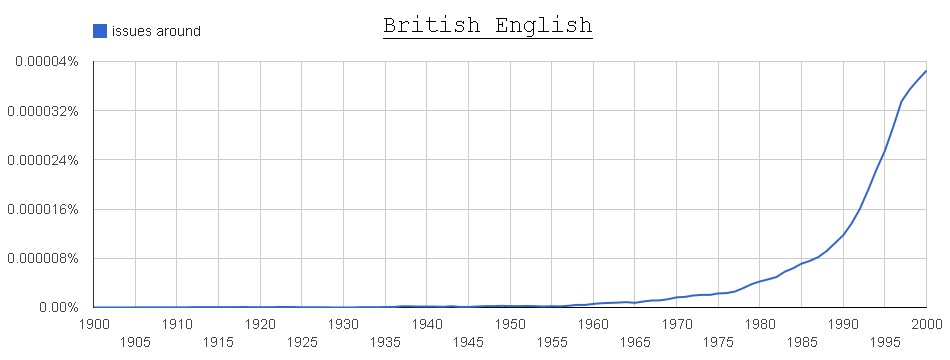
Some interesting patterns at Google’s Ngram Viewer (please follow the links to see the original images with further statistics):

in terms of (American + British English)

in terms of (American + British English)


in terms of (American English)

in terms of (American English)


in terms of (British English)

in terms of (British English)


issues around (American + British English)

issues around (American + British English)


issues around (American English)

issues around (American English)


issues around (British English)

issues around (British English)


Previously pre-posted (please peruse):

Titus Graun
Ex-term-in-ate!
Reds under the Thread

He Say, He Sigh, He Sow #13

“In the early thirties Trotsky also spoke of ‘Bonapartism’ in the Stalinist regime. In 1935, however, he observed that in the French Revolution Thermidor had come first and Napoleon afterwards; the order should be the same in Russia, and, as there was already a Bonaparte, Thermidor must have come and gone.” — Leszek Kołakowski in Main Currents of Marxism: Vol. III, The Breakdown (1978).