Rankle Biter

rankle, verb 1. (transitive or intransitive) To cause irritation, bitterness or acrimony. 2. (intransitive) To fester.

Etymology: From Middle English ranklen, ranclen, from Old French rancler, räoncler, draoncler (“to ulcerate, to form a boil”), from Old French draoncle (“a boil”), from Latin dracunculus (“little serpent”), diminutive of Latin dracō (“serpent, dragon”).

rankle at Wiktionary

Weird Tails

Squirrel

Meaning

One or other of various species of slender, graceful, agile rodents (characterized by a long bushy tail, furry coat, and bright eyes), belonging to the genus Sciurus, or to the widely-distributed sub-family Sciurina including this; esp. the common species Sciurus vulgaris, native to Britain, Europe, and parts of Asia.

Etymology

Anglo-Norman esquirel, Old French esquireul, escureul, ‑ol, etc. (modern French écureuil), = Provençal escurols, Spanish esquirol, medieval Latin (e)scurellus, scurellius, scuriolus, diminutives from popular Latin *scūrius, for Latin sciūrus, < Greek σκίουρος, apparently < σκιά shade + οὐρά tail.

Oxford English Dictionary, entry for “Squirrel”.

Le Neige d’Antan

snow (n.) Middle English snou, from Old English snaw “snow, that which falls as snow; a fall of snow; a snowstorm,” from Proto-Germanic *snaiwaz (source also of Old Saxon and Old High German sneo, Old Frisian and Middle Low German sne, Middle Dutch snee, Dutch sneeuw, German Schnee, Old Norse snjor, Gothic snaiws “snow”), from PIE root *sniegwh– “snow; to snow” (source also of Greek νίφα, nipha, Latin nix (genitive nivis), Old Irish snechta, Irish sneachd, Welsh nyf, Lithuanian sniegas, Old Prussian snaygis, Old Church Slavonic snegu, Russian snieg’, Slovak sneh “snow”). The cognate in Sanskrit, स्निह्यति snihyati, came to mean “he gets wet.” — “Snow” at EtymOnline

Ciss Bliss

Si hortum in bibliotheca habes, deerit nihil. – Cicero (106-43 BC), Epistulae ad Familiares, Liber IX, Epistula IV

• “If you have a garden and a library, you lack for nothing.” — Cicero, Letters to Friends, Book 9, Letter 4

Nail Supremacy

Ὁ γαρ ἡδονής και ἀλγηδόνος ἧλος, ὃς πρὸς το σώμα τήν ψυχην προσηλοῖ, μέγιστον κακὸν ἔχειν ἔοικε, τὸ τα αἰσθητά ποιεῖν ἐναργέστερα τῶν νοητῶν, καὶ καταβιάζεσθαι καὶ πάθει μᾶλλον ἢ λόγῳ κρίνειν τήν διάνοιαν.

• ΠΡΟΒΛΗΜΑ Β’. Πώς Πλάτων ἔλεγε τον θεὸν άεὶ γεωμετρεῖν.


Nam voluptatis et doloris ille clavus, quo animus corpori affigitur, id videtur maximum habere malum, quod sensilia facit intelligibilibus evidentiora, vimque facit intellectui, ut affectionem magis quam rationem in judicando sequatur.

• QUÆSTIO II: Qua ratione Plato dixerit, Deum semper geometriam tractare.


For the nail of pain and pleasure, which fastens the soul to the body, seems to do us the greatest mischief, by making sensible things more powerful over us than intelligible, and by forcing the understanding to determine them rather by passion than by reason.

• Plutarch’s Symposiacs, QUESTION II: What is Plato’s Meaning, When He Says that God Always Plays the Geometer?

Sphere Hear

οὐσίαν θεοῦ σφαιροειδῆ, μηδὲν ὅμοιον ἔχουσαν ἀνθρώπωι· ὅλον δὲ ὁρᾶν καὶ ὅλον ἀκούειν, μὴ μέντοι ἀναπνεῖν· σύμπαντά τε εἶναι νοῦν καὶ φρόνησιν καὶ ἀίδιον. — Διογένης Λαέρτιος, Βίοι καὶ γνῶμαι τῶν ἐν φιλοσοφίᾳ εὐδοκιμησάντων

    “The substance of God is spherical, in no way resembling man. He is all eye and all ear, but does not breathe; he is the totality of mind and thought, and is eternal.” — Xenophanes’ concept of God in Diogenes Laërtius’ Lives of Eminent Philosophers (c. 280-320 AD), Book IX, chapter 2 (translated by R.D. Hicks, 1925)

Bestia Bestialissima

Auberon Waugh called himself a “practitioner of the vituperative arts”. Perhaps it was a Catholic thing. And unless you know Latin, you won’t understand. Or you won’t understand as much as you might. I don’t know Latin well, but I can appreciate some of the wonderful vituperation in a book of Latin exorcisms I’ve found scanned at Google Books. The title alone is good: Flagellum Daemonum: Exorcismos Terribiles, Potentissimos et Efficaces, which means (I think) The Flail of Demons: Exorcisms Terrible, Most Potent and Effective. Or is the title Fustis Daemonum: Adiurationes Formidabiles, Potentissimas et Efficaces, meaning The Cudgel of Demons: Adjurations Formidable, Most Potent and Effective?
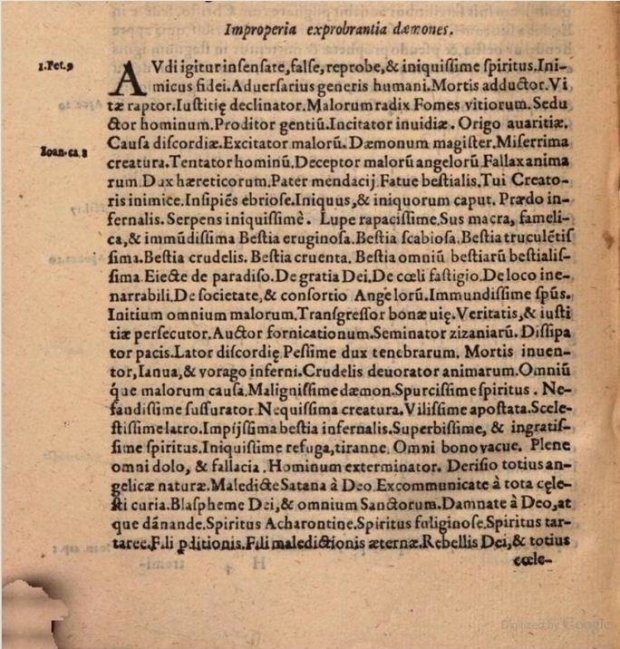
Vituperation from the Flagellum Daemonum (1644)

Vituperation from the Flagellum Daemonum (1644)


Either way, one of the exorcisms contains a good list of curses directed at the Devil. He’s called Bestia Omnium Bestiarum Bestialissima, meaning “Beast of All Beasts the Most Beastly”. Beside that, there are Dux Hæreticorum and Lupus Rapacissimus, “Duke of Heretics” and “Most Rapacious Wolf”. There’s an odd Sus Macra, Famelica, et Immundissima, which means something like “Scrawny, Famished and Most Filthy Hog”. Lovecraft would have liked Nefandissimus Susurrator, “Most Unspeakable Whisperer”, and Draco Iniquissimus, “Most Iniquitous Dragon”.

Pessimus Dux Tenebrarum is “Most Evil Duke of Darkness” and Janua et Vorago Inferni is “Door and Abyss of Hell”. Seminator Zizaniarum, meaning “Sower of Tares”, refers to Matthew xiii, 25: “But while men slept, his enemy came and sowed tares among the wheat, and went his way.” And those are only a few of the curses poured on the Devil’s head. I’ve turned the full list into plain text. As it says in the book that originally led me to the Flagellum Daemonum, “The following is a specimen of one of these vituperative addresses”:

Audi igitur insensate, false, reprobe, et iniquissime Spiritus. Inimice fidei. Adversarie generis humani. Mortis adductor. Vitæ raptor. Justitiæ declinator. Malorum radix. Fomes vitiorum. Seductor hominum. Proditor gentium. Incitator invidiæ. Origo aravitiæ. Causa discordiæ. Excitator malorum. Dæmonum magister. Miserrima Creature. Tentator Homininum. Deceptor malorum Angelorum. Fallax animarum. Dux Hæreticorum. Pater Mendacii. Fatue Bestialis. Tui creatoris Inimicus. Insipiens ebriose. Inique et iniquorum caput. Prædo infernalis. Serpens iniquissime. Lupe rapacissime. Sus macra, famelica, et immundissima. Bestia eruginosa. Bestia scabiosa. Bestia truculentissima. Bestia crudelis. Bestia cruenta. Bestia omnium Bestiarum Bestialissima. Ejecte de Paradise. De gratiâ Dei. De Cœli fastigio. De loco inerrabili. De Societate et consortia Angelorum. Immundissime Spiritus Initium omnium malorum. Trangressor bonæ vitæ. Veritatis et Justitiæ persecutor. Auctor fornicationum. Seminator zizaniarum. Dissipator pacis. Latro discordiæ. Pessime dux tenebrarum. Mortis inventor. Janua et vorago Inferni. Crudelis devorator animarum omniumque malorum causa. Malignissime Dæmon. Spurcissime Spiritus. Nefandissime susurrator. Nequissima Creatura. Vilissime apostata. Scelestissima latro. Impiissima bestia infernalis. Superbissime et ingratissime Spiritus. Iniquissime refuga. Tyranne, Omni bono vacue. Plene omni dolo et fallaciâ. Hominum exterminator. Derisio totius Angelicæ Naturæ. Maledicte Satana a Deo. Excommunicate a totâ cœlesti curiâ. Blaspheme Dei et omnium Sanctorum. Damnate a Deo atque Damnande. Spiritus Acherontine. Spiritus Tartaree. Fili Perditionis. Fili maledictionis æternæ. Rebellis Dei et totius cœlestis curiæ. Serpens crudelissime. Draco iniquissime. Creatura damnata, reprobata et maledicta a Deo in æternum ob superbiam nequitiam tuam.

The first line, Audi igitur insensate, false, reprobe, et iniquissime Spiritus means something like “Hear, then, Senseless, False, Reprobate and Most Iniquitous Spirit”. Then the Devil is called Inimicus Fidei, “Enemy of the Faith”, Adversarius Generis Humani, “Adversary of the Human Race”, Mortis Adductor, “Dragger to Death”, and Vitæ Raptor, “Snatcher of Life”. Then the vituperation really begins.

I Have a Threem

And now I have another. My first “threem”, or “three-M”, for this bijou bloguette was the alliterative three-word Latin phrase Mathematica Magistra Mundi, meaning “Mathematics Mistress of the World”. I also use it in the form Mathematica Machina Mundi, which has a variety of translations. In both Latin phrases, the words have five, three and two syllables, respectively. That’s the first three prime numbers in reverse and also part of the Fibonacci sequence in reverse.

You can find the same alliteration in languages derived from Latin, like the French La Mathématique, Maîtresse du Monde, but you don’t get the same syllable-count. So how likely was it that everything – the same alliteration and the same syllable-count – would appear in a language unrelated to Latin? But it does. Here’s a Georgian translation of the threem:

მათემატიკა მსოფლიოს მეფე

Matemat’ik’a Msoplios Mepe

“Mathematics the World’s King”

Msoplios isn’t a typo: Georgian is famous for its exotic consonant clusters and მს- / ms- isn’t a particularly unusual example. But it’s one I particularly like.

He Say, He Sigh, He Show #33

Apud me omnia fiunt Mathematicè in NaturaRené Descartes (1596-1650).
  • For me, all things in nature occur mathematically. — Correspondence with Martin Mersenne (1640).

He Say, He Sigh, He Sow #30

• Cognitio nostra est adeo debilis quod nullus philosophus potuit unquam perfecte investigare naturam unius muscae: unde legitur quod unus philosophus fuit triginta annis in solitudine, ut cognosceret naturam apis. — Sancti Thomae de Aquino Expositio in Symbolum Apostolorum (1273).

• Our knowledge is so weak that no philosopher has ever perfectly discovered the nature of a single fly, whence we read that one philosopher was thirty years in the wilderness that he might know the nature of a bee. — Thomas Aquinas, The Apostles’ Creed.