There was a young man of Cape Horn,
Who wished that he’d never been born;
And he wouldn’t have been,
If his father had seen
That the end of the rubber was torn.
(Possibly by Swinburne)

There was a young man of Cape Horn,
Who wished that he’d never been born;
And he wouldn’t have been,
If his father had seen
That the end of the rubber was torn.
(Possibly by Swinburne)
“I once received a letter from an eminent logician, Mrs. Christine Ladd-Franklin, saying that she was a solipsist, and was surprised that there were no others.” — Bertrand Russell, Human Knowledge: Its Scope and Limits (1948)
Peri-Performative Post-Scriptum
The title of this post is, of course, a radical reference to core Jethro Tull album Aladdin Sane (1973).
• Flight for Life — The Flight of the Phoenix, Elleston Trevor (1964)
(Translated and edited by Simon Whitechapel)
In the black mirroring surface of the canal, these things: a sky very high and clear, the blue infinite interior of the skull of a god2 brooding beauty and pain into the world; the walls that line the canal, white marble, sharp-edged; the vivid mosaics of precious stone with which the walls are set: oval belladonnic eyes of emerald and obsidian in faces of sculpted mammoth ivory; the mouths of jade3-lipped bayadères leaking ruby threads of wine; the topaz fingers and wrists of rhodolite4-crowned lutanists; quartz-glistered sinews in the arms of capon5-plump eunuchs fanning the dances of turquoise6-skinned odalisques who prance and beck in frozen heated showers of opal-drop sweat.
But all, in the mirroring water, is grey.7
In the black mirroring surface of the canal, these things: a broad slab of basalt to which is bound a naked man8, white against the stone’s darkness, black-haired and bound with soft unbreakable bonds of purple silk; on his belly have been painted the red strokes and hooks and curls of the ideogram for death, like the roaring fist-talon and shank of a stooping hawk9 or the opening hungry maw of a leopard10, a splash of red tissues ringed and spiked and shaped by white barbs of teeth.
But all, in the mirroring water, is grey.
In the black mirroring surface of the canal, these things: five swans; their bright, forward-sweeping eyes are set in white, oval-skulled heads that are enwedged with yellow, black-rooted beaks; their white, smooth-feathered, twice-curved necks, slender as stems, are shivered on the ripples of the passage of bodies that are white seed-pods curling to smooth, hooked tails. Five swans, silent white swans. Their beaks are small and regular as the hardened gold heads of the ritual axes of the Temple of the Thanatocrator11, which sound tchlunk tchlunk tchlunk in the skulls of the sacrifices, opening slotted, red-welling ways for the prosempyreal passage of the soul.
But all, in the mirroring water, is grey.
In the black, mirroring surface of the canal, this: the white swans clustered on the white body of the sacrifice. Their necks dart and sway, sowing moist red blooms into the fertile milk of his skin. He strains against his bonds, but the necks fall, the heads hammer with steady, unconscious grace, opening the blooms to full flower. In the mirroring water they are beautiful, like strewn blossoms12 for the feet of the Thanatocrator, who dances his hatred into the waking dreams of the world. The sacrifice is dead and the swans are streaked and smirched and spotted with gore, like heavy white flowers in a garden of torture.
Their necks bend and sway, and their beaks open and close, but in the mirroring water their voices are silent, and how may we tell what they say?
NOTES
1. Trained swans were the favored form of execution under the insane and semi-legendary nymphomane Queen Sphalaghd (1-143 Anno Dominæ; 1137-1279 Anno Secundi Imperii), whose extravagances came nigh to ruining the kingdom before, after many hesitations on and retreats from the threshold, she converted fully to the austere and life-denying doctrines of the Thorn-God in the final lustrum of her nigromantically prolonged life.13 She was canonized by the Temple thirteen years after her death.
2. An obvious reference to the Thorn-God, and in another context the Yihhian (mhló)Kiùlthi might be translated “(of) the god”, but the use of the non-hieratic noun marker gives the flavor of the indefinite article in English and contributes to the sense of brooding anonymity in the story.
3. This is believed to be a satirical reference to Yokh-Tsiolphë’s own religion (see note 8 below), that of the Moon-Deity, whose abstemious priestesses wore strongly colored make-up while performing their ritual dances under the full moon.
4. From its use in other texts retrieved oneirically from the Temple, the hieroglyph appears to refer to some rose-colored semi-precious mineral, and I have chosen to translate the word as “rhodolite”: coronemus nos rosis antequam marcescant (“let us crown us with roses before they be withered”, Sapientia Solomonis 2:8) was a sentiment accepted in its widest possible sense at the week-long feasts held during the long years of Queen Sphalagdh’s dissipation.
5. Possibly a castrated form not of the domestic hen (Gallus domesticus) but of the peacock (Pavo cristatus).
6. Again a possible satirical reference to the priestesses of the Moon-Deity.
7. Mirrors in the Temple were only of dark minerals, principally basalt, haematite, and black coral (Gorgonia spp), for the priests taught that color was one of the snares of sensuality by which the world entrapped men’s souls. Accordingly, possession of a fully reflecting mirror was an excommunicable offence for members of the Thorn-God’s congregation.
8. The story is believed to refer to the execution of a nobleman called Yokh-Tsiolphë (Yugg-Siurphë in some texts), who had offended the Queen either by refusing to sacrifice his eldest son and daughter to the Thorn-God or (as most scholars now believe) by falling under suspicion of having composed an anonymous pasquinade against the Thorn-God which was briefly circulated at the royal court in 38 A.D./1174 A.S.I. The execution would have been one of the earliest signs of the Queen’s growing regard for the Thorn-God.
9. The Yihhian here is a little unclear and the reference is perhaps to the Osprey (Pandion haliætus), which was second only to the Great Grey Shrike (Lanius excubitor) in the ornithomancy of the Temple.
10. The Yihhian kiuthi literally means “spotted one” and can refer to several species of animal; “leopard” seems the most appropriate translation in this context.
11. Niédýthithlà (mhló)Nhriúlr, literally “deathly lord(’s)”, was a title of the Thorn-God, but the foreign derivation of the words in Yihhian means it is perhaps best translated into English as “thanatocrator”.
12. Blossoms of gorse (Ulex spp) and other spinose plants were thrown beneath the feet of dancing priests during rituals at the Temple, and many of the Temple’s hymns refer to osmomancy, or divination by the scents released from the crushed petals.
13. She is said to have been planning another round of the puerile and puellar sacrifices with which she purchased her unnatural youth at the time of her death, occasioned when she slipped on trampled petals in the Temple of the Thorn-God whilst approaching the altar for blessing and was impaled on the silver thorns topping a newly erected altar-rail. Some contemporary commentators hinted at numerological significance in her death, saying that the priests of the Thorn-God had persuaded her that by laying down her life at that age she would regain it at the beginning of the next cosmic cycle. It is possible, therefore, that the encephalotomy and cardiotomy of her ritual mummification were feigned.
• A Goggle at Gogol — review of The Collected Tales of Nikolai Gogol, translated by Richard Pevear and Larissa Volokhonsky (Granta 1998)
Cultural gayness has a fraught history in pop culture. Ever since Aids began to pick off members of the queer cultural elite in the 80s, femininity and queer signifiers (ahem, like glitter) became red flags for disease and moral corruption. The tabloid media systematically crucified gay people, using these feminine signifiers as tracking beacons. Closeting oneself and cloaking one’s femininity became a matter of survival, and not just for celebrities. — Claiming Shawn Mendes is queer is an own goal for gay men, Brian O’Flynn, The Guardian, 28xi2018.
“Ich habe unter meinen Papieren ein Blatt gefunden,” sagte Goethe, “wo ich die Baukunst eine erstarrte Musik nenne.” — Gespräche mit Goethe, Johann Peter Eckermann (1836)
• “I have found a sheet among my papers,” said Goethe, “where I call architecture a frozen music.” — Conversations with Goethe
N.B. The aphorism “Architecture is frozen music” has also sometimes been attributed to Friedrich von Schelling (1775-1854) and Ganopati Sthapat (1927-2011).
Peri-Performative Post-Scriptum
The toxic title of this paronomastic post is a key reference to core Beatles album Please Please Me (1963).
« La musique exprime ce qui ne peut être dit et sur quoi il est impossible de rester silencieux. » — Victor Hugo (1802-85)
• “Music expresses what cannot be said and on which it is impossible to remain silent.” — Victor Hugo
Вряд ли где можно было найти человека, который так жил бы в своей должности. Мало сказать: он служил ревностно, нет, он служил с любовью. Там, в этом переписываньи, ему виделся какой-то свой разнообразный и приятный мир. Наслаждение выражалось на лице его; некоторые буквы у него были фавориты, до которых если он добирался, то был сам не свой: и подсмеивался, и подмигивал, и помогал губами, так что в лице его, казалось, можно было прочесть всякую букву, которую выводило перо его. — Николай Гоголь, «Шинель» (1842)
It would be difficult to find another man who lived so entirely for his duties. It is not enough to say that Akakiy laboured with zeal: no, he laboured with love. In his copying, he found a varied and agreeable world. Enjoyment was written on his face: some letters were even favourites with him; and when he encountered these, he smiled, winked, and worked with his lips, till it seemed as though each letter might be read in his face, as his pen traced it. — Nikolai Gogol, “The Overcoat” (1842)
Post-Performative Post-Scriptum
Бу́ква, búkva, the Russian for “letter”, may be related to the German Buche, meaning “beech”, which in its turn may be related to the English word “book”. Why so? Because beech-bark was once used for writing.
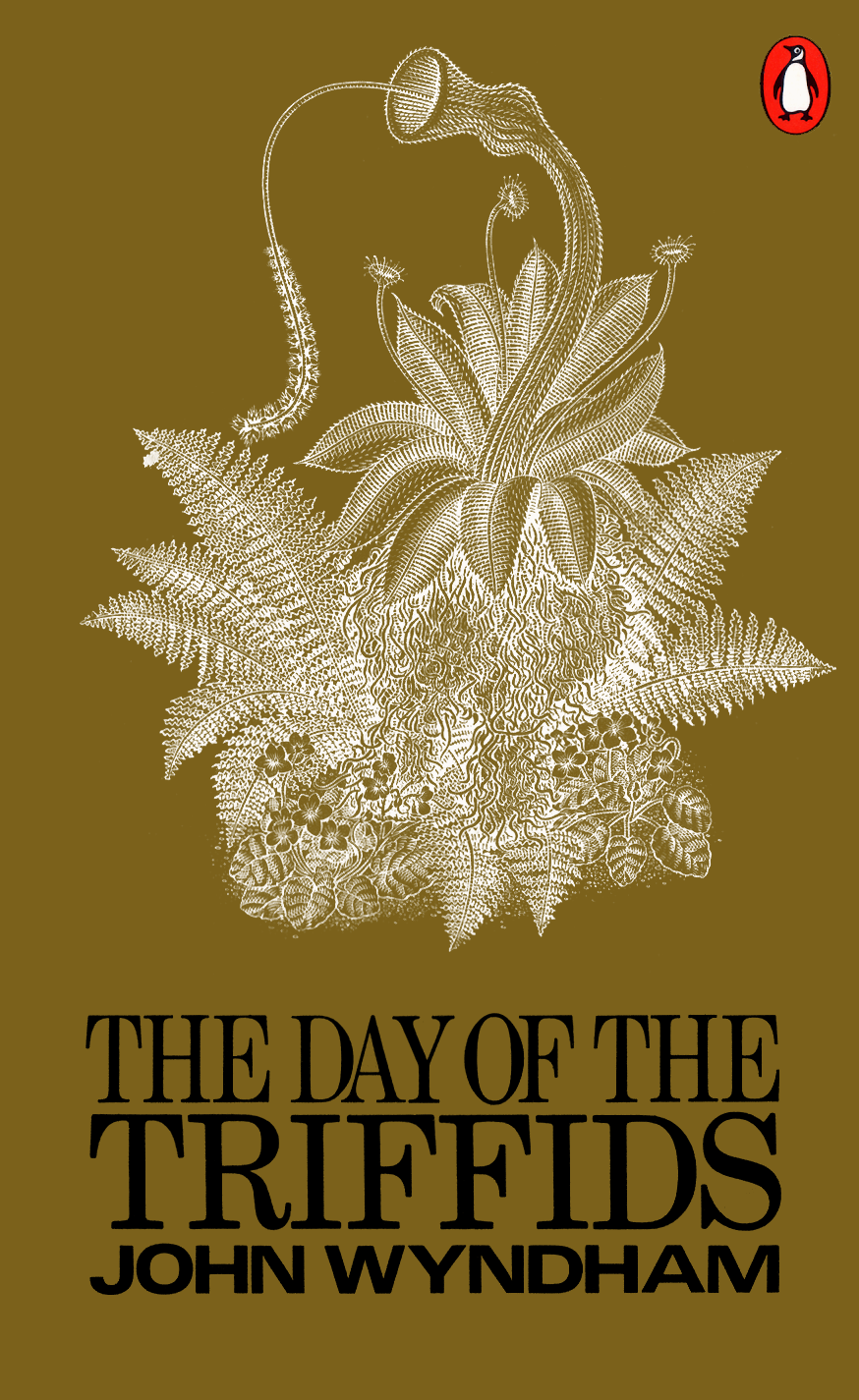
The Day of the Triffids, John Wyndham (1951)
If you want to know the difference between talent and genius, compare The Day of the Triffids (1951) with the book that obviously inspired it: The War of the Worlds (1897). John Wyndham (1903-69) had talent; H.G. Wells (1866-1946) had genius. But Wyndham had a lot of talent, all the same. And it’s powerfully displayed in The Day of the Triffids. However, although it’s his most famous book, it isn’t his best. I’m not sure what it is. Wyndham was an uneven writer, not very good at dialogue or characterization, and although he was born decades after Wells, in some ways his books have dated more.
And maybe he was better at short stories than novels. Either way, his big ideas were almost always good and so were the titles of his novels. There’s the humanity-hating submarine race in The Kraken Awakes (1953); the mysterious telepathic alien in Chocky (1968); the persecuted telepathic mutants in The Chrysalids (1955); and the world-threatening super-children in The Midwich Cuckoos (1955). In The Day of the Triffids there are really two big ideas: walking plants and worldwide blindness. In the chronology of the book, but not the narration, the walking plants come first: they’re the triffids, three-legged, seven-feet tall and equipped with a deadly whip-sting. Once you’ve mentally pictured them, the triffids will never leave your head. I think they’re a clever, chlorophyllic adaptation of the giant three-legged Martian war-machines in War of the Worlds.
But how can the triffids get loose and wreak havoc on the human race as the Martian war-machines did? Triffids are blind and sense rather than see their targets, so they are no match for sighted humans. Obviously, then, Wyndham had to take sight away from humans to get triffids and humans battling for possession of the earth. He did it in rather contrived but still memorable fashion, recorded like this by the first-person narrator as he lies in a hospital bed with bandaged eyes after a triffid attack:
“The sky’s simply full of shooting stars,” [a nurse] said. “All bright green. They make people’s faces look frightfully ghastly. Everybody’s out there watching them, and sometimes it’s almost as light as day – only all the wrong colour. Every now and then there’s a big one so bright that it hurts to look at it. It’s a marvellous sight. They say there’s never been anything like it before. It’s a pity you can’t see it, isn’t it? (ch. 1, “The End Begins”)
In fact, it isn’t a pity: it saves his life. It’s soon apparent that the green light from the “shooting stars” has destroyed the sight of everyone who watched them. The narrator describes how he takes the bandages off his eyes and discovers that he’s one of the very few sighted people left in a blinded world: London becomes “The Groping City”, as the title of chapter 3 puts it. The blindness would have been bad enough, but the triffids now begin breaking loose from the farms on which they’re being kept. The green light of the meteor-storm, probably an optical weapon accidentally released by a military satellite, has created a world where chlorophyll is king. Triffids don’t need sight to slash and slay, so blinded humans now have a simple choice: stay in hiding or try to find food and risk being stung to death by one of the triffids invading London in search of prey.
In the second chapter, the narrator looks back to describe the origin and spread of the triffids, and how he came to receive that a sight-preserving dose of triffid-poison in his eyes. Those opening few chapters have scenes and images that have always stayed with me since I first read the book as a kid. There’s the wonder and beauty of the meteor-storm; the horror of sudden, near-universal blindness and the first spate of suicides; the strangeness and deadliness of the triffids; and so on. Here’s one of the memorable images Wyndham conjures with words:
Perhaps Umberto’s plane exploded, perhaps it just fell to pieces. Whatever it was, I am sure that when the fragments began their long, long fall towards the sea they left behind them something which looked at first like a white vapour.
It was not vapour. It was a cloud of seeds, floating, so infinitely light they were, even in the rarefied air. Millions of gossamer-slung triffid seeds, free now to drift wherever the winds of the world should take them… (ch. 2, “The Coming of the Triffids”)
The triffids have been created artificially and mysteriously behind the Iron Curtain and yield a highly valuable vegetable oil. But that raises questions that aren’t answered. Why did they need to walk? Why are they equipped with long and deadly stings? Why are they uncannily intelligent? And how do they nourish themselves once they mature and begin walking? Their tripodic roots can’t dig very deep when they’re at rest and although Wyndham describes how they pull pieces of flesh off the decaying bodies of people they’ve killed, he doesn’t describe their digestive systems.
These unanswered questions mean that The Day of the Triffids is sometimes more like magic realism than hard science fiction. Particularly when the triffids show signs of intelligence, coordination and even cunning. But none of that is apparent when the triffids begin to sprout all over the world after the seeds in that “white vapour” reach the ground. The growing triffids attract curiosity but not wonder or fear. And even when they begin walking and stinging, they seem easy to manage. Thanks to that valuable vegetable oil, they’re soon being farmed in huge numbers. Their whip-stings are deadly, of course, and if the stings are docked, triffids yield less oil. But sighted humans can kept triffids under control easily enough, despite an occasional unlucky accident and the triffids’ unsettling ability to communicate between themselves. They have a kind of intelligence even though they don’t have brains. The narrator is a botanist conducting research on triffids and suffers one of the unlucky accidents, when a triffid lashes at the wire-mesh mask covering his face and a few drops from the poison-sacs reach his eyes.
So he’s in hospital when the meteor-storm lights up skies all around the world for a couple of days. He and a few other fortunates can’t watch the storm for one reason or another, so they keep their sight and have to fight the triffids to have a future. Wyndham describes how bands of survivors come together in various ways and decide on different ways of fighting the triffids. And that’s when the quality of the writing and the power of the imagery take a turn for the worse. The opening few chapters of The Day of the Triffids have always stayed with me since that first reading. I’ve re-read the book several times since then, but on this latest re-reading I found I’d almost completely forgotten what happened in the second half of the book.
But I can recommend it highly all the same. It might not be Wyndham’s best, but the triffids and their menacing ways will be with you for life once Wyndham’s words have become pictures in your head. And more than pictures:
The evening was peaceful, almost the only sounds that broke it were the occasional rattlings of the triffids’ little sticks against their stems. Walter [a triffid-researcher] regarded them with his head slightly on one side. He removed his pipe.
“They’re talkative tonight,” he said. (ch. 2)
Elsewhere other-accessible
• Reds in the Head — review of H.G. Wells’ The War of the Worlds (1897)
 Overlord In Terms of Core Issues Around Maximal Engagement with Key Notions of the Über-Feral