He Say, He Sigh, He Sow #14

“39: This appears to be the first uninteresting number, which of course makes it an especially interesting number, because it is the smallest number to have the property of being uninteresting. It is therefore also the first number to be simultaneously interesting and uninteresting.” — David Wells, The Penguin Dictionary of Curious and Interesting Numbers (1986), entry for “39”, pg. 120

He Say, He Sigh, He Sow #13

“In the early thirties Trotsky also spoke of ‘Bonapartism’ in the Stalinist regime. In 1935, however, he observed that in the French Revolution Thermidor had come first and Napoleon afterwards; the order should be the same in Russia, and, as there was already a Bonaparte, Thermidor must have come and gone.” — Leszek Kołakowski in Main Currents of Marxism: Vol. III, The Breakdown (1978).

Lit Is It

You know, I’m getting worried at my inability to have unmediated experiences. Everything reminds me of something in literature. It reminds me of this passage in Brideshead Revisited (1945):

“Oh, don’t talk in that damned bounderish way. Why must you see everything second-hand? Why must this be a play? Why must my conscience be a Pre-Raphaelite picture?”

“It’s a way I have.”

“I hate it.” (Op. cit.)

He Say, He Sigh, He Sow #12

“There were no bears, but at one point I disturbed an eagle on a ledge — and perhaps have seen nothing more beautiful than the one lazy flap of its wings that set it on a seemingly effortless vertical flight up the sun-warmed cliff behind it.” — the art-critic Brian Sewell describing a Turkish journey in Outsider II: Always Almost, Never Quite (2012).

O Apollo

One of Swinburne’s most powerful, but least-known, poems is “The Last Oracle”, from Poems and Ballads, Second Series (1878). A song in honour of the god Apollo, it begins in lamentation:

Years have risen and fallen in darkness or in twilight,
   Ages waxed and waned that knew not thee nor thine,
While the world sought light by night and sought not thy light,
   Since the sad last pilgrim left thy dark mid shrine.
Dark the shrine and dumb the fount of song thence welling,
   Save for words more sad than tears of blood, that said:
Tell the king, on earth has fallen the glorious dwelling,
   And the watersprings that spake are quenched and dead.
Not a cell is left the God, no roof, no cover
   In his hand the prophet laurel flowers no more.

And ends in exultation:

         For thy kingdom is past not away,
            Nor thy power from the place thereof hurled;
         Out of heaven they shall cast not the day,
            They shall cast not out song from the world.
         By the song and the light they give
         We know thy works that they live;
         With the gift thou hast given us of speech
         We praise, we adore, we beseech,
         We arise at thy bidding and follow,
            We cry to thee, answer, appear,
   O father of all of us, Paian, Apollo,
            Destroyer and healer, hear! (“The Last Oracle”)

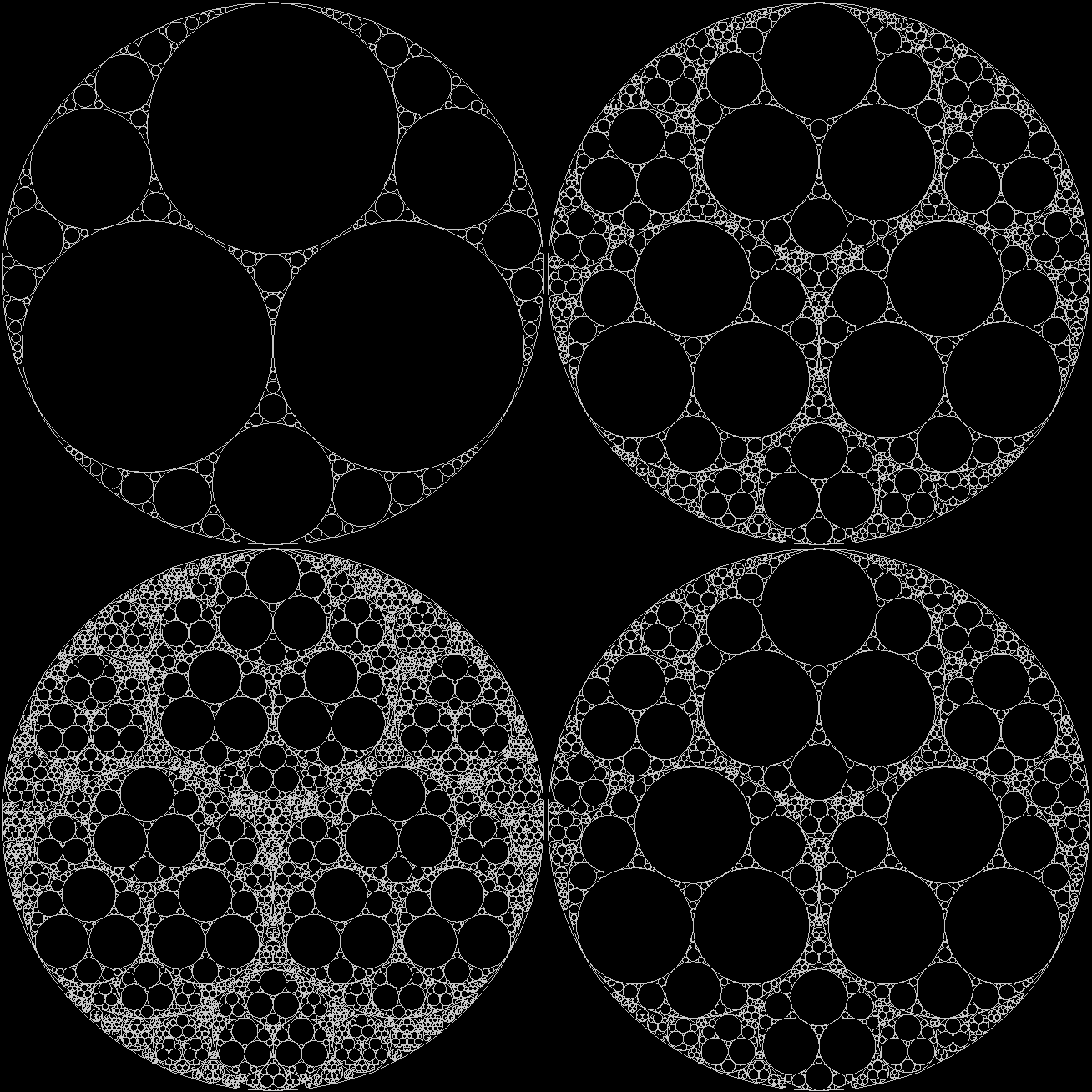
The power, grandeur and beauty of this poem remind me of the music of Beethoven. Swinburne is also, on a smaller scale and in a different medium, one of the geniuses of European art. He and Beethoven were both touched by Apollo, but Apollo was more than the god of music and poetry: he also presided mathematics. But then mathematics is much more visible, or audible, in music and poetry than it is in other arts. Rhythm, harmony, scansion, melody and rhyme are mathematical concepts. Music is built of notes, poetry of stresses and rhymes, and the rules governing them are easier to formalize than those governing, say, sculpture or prose.  Nor do poetry and music have to make sense or convey explicit meaning like other arts. That’s why I think a shape like this is closer to poetry or music than it is to painting:

Apollonian gasket (Wikipedia)

(Image from Wikipedia.)

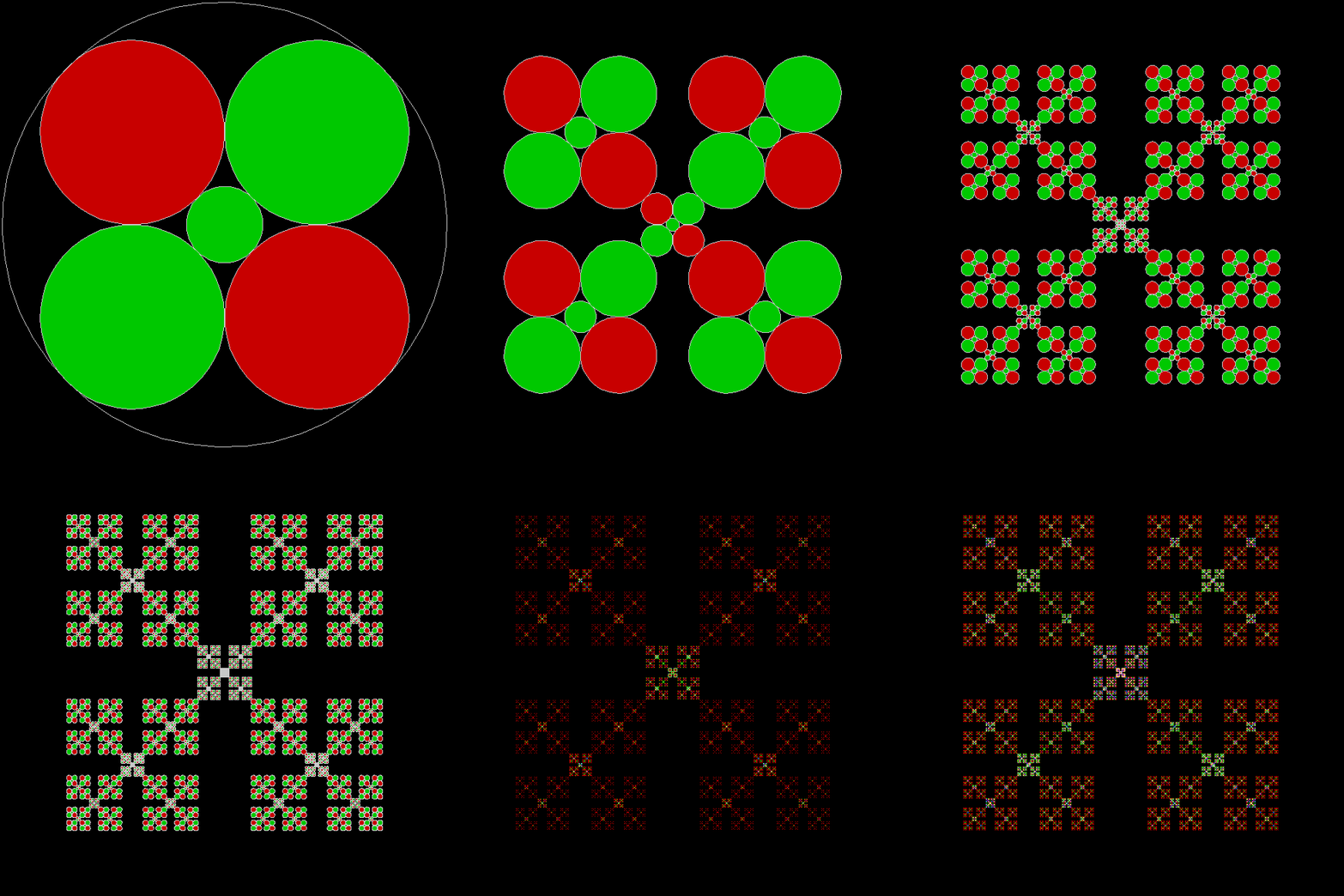
This shape has formal structure and beauty, but it has no explicit meaning. Its name has a divine echo: the Apollonian gasket or net, named after the Greek mathematician Apollonius of Perga (c.262 BC–c.190 BC), who was named after Apollo, god of music, poetry and mathematics. The Apollonian gasket is a fractal, but the version above is not as fractal as it could be. I wondered what it would look like if, like fleas preying on fleas, circles appeared inside circles, gaskets within gaskets. I haven’t managed to program the shape properly yet, but here is my first effort at an Intra-Apollonian gasket:

Apollonian gasket

(If the image does not animate or looks distorted, please try opening it in a new window)

When the circles are solid, they remind me of ice-floes inside ice-floes:
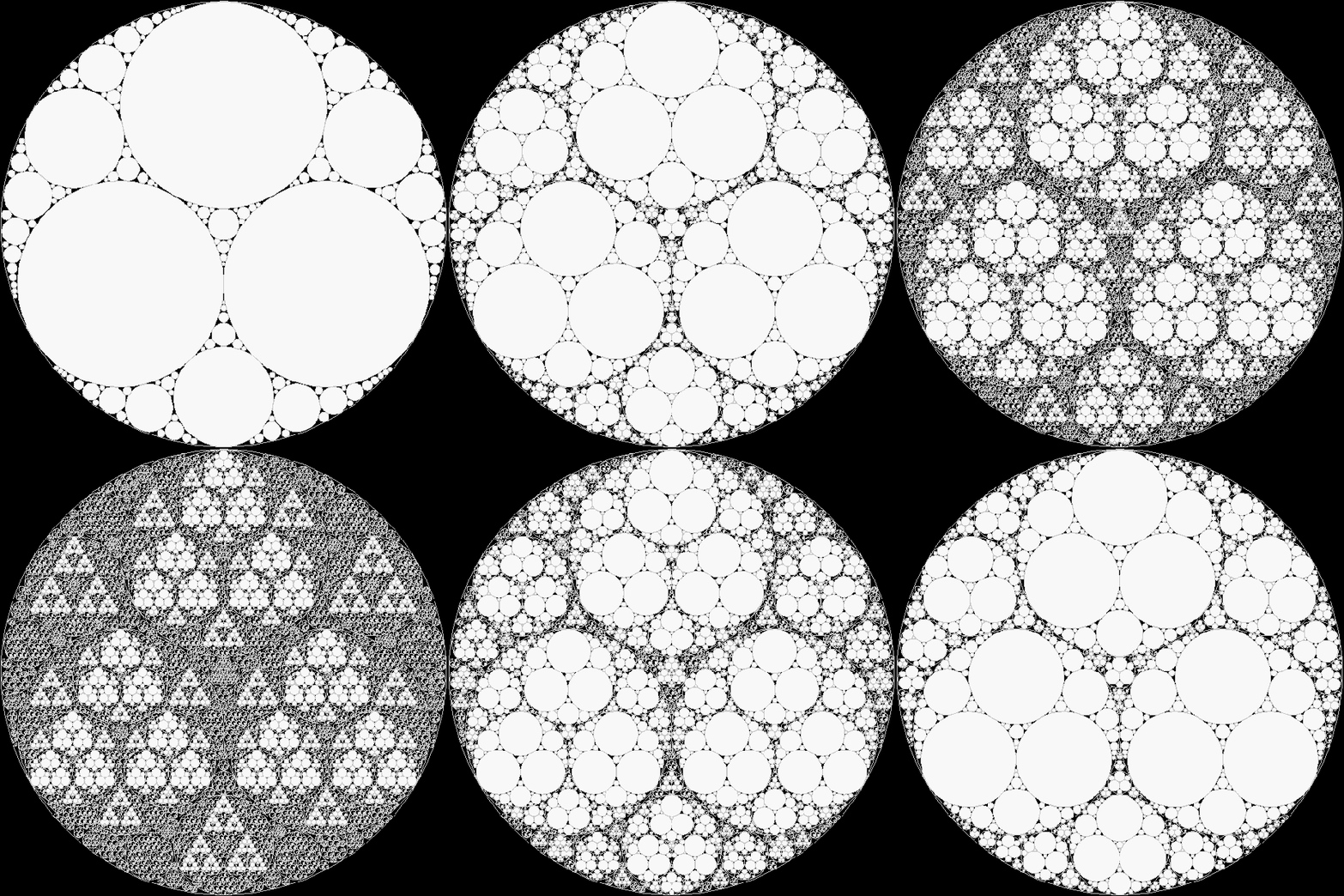
Apollonian gasket (solid)

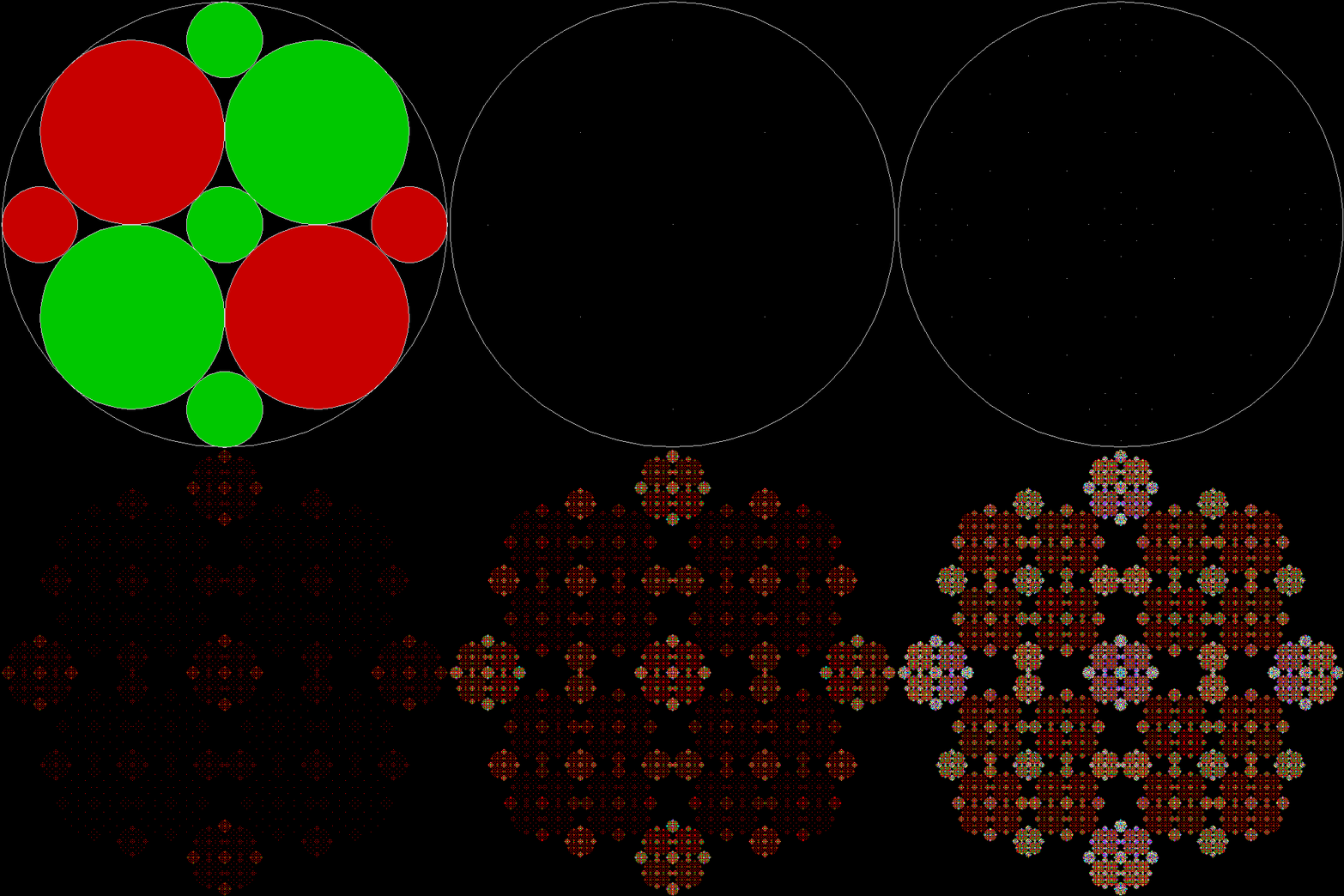
Simpler gaskets can be interesting too:

five-circle gasket


five+four-circle gasket


nine-circle gasket

He Say, He Sigh, He Sow #9 and #10

“One of mighty union-smashing Maggie’s few big mistakes – along with increasing comprehensive education, letting third-world immigration and enforced multiculturalism rip, leaving the NHS and BBC ‘safe in our hands’, smashing the fisheries, selling out the Northern Irish Protestants, increasing welfarism, ending academic freedom and trying to push through the Poll Tax – was to be unfriendly to German reunification.” — Chris Brand, gFactor.


“Homosexual men are nature’s Petri dishes.” — Greg Cochran, West Hunter.

He Say, He Sigh, He Sow #7

“I had, also, during many years followed a golden rule, namely, that whenever a published fact, a new observation or thought came across me, which was opposed to my general results, to make a memorandum of it without fail and at once; for I had found by experience that such facts and thoughts were far more apt to escape from the memory than favourable ones.” — The Autobiography of Charles Darwin (1958).

Numbered Days

Numbered Days: Literature, Mathematics and the Deus Ex Machina

Think French. Think genius. Think rebellious, tormented, iconoclastic. Finally, think dead tragically young in the nineteenth century… And if you’re thinking of anyone at all, I think you’ll be thinking of Rimbaud.

And you’d be right to do so. But only half-right. Because there were in fact two rebellious, tormented, iconoclastic French geniuses who died tragically young in the nineteenth century. One was called Arthur Rimbaud (1854-91) and the other Évariste Galois (1811-32). Rimbaud is still famous, Galois never has been. At least not to the general educated public, though on all objective criteria – but one – you might expect his fame to be greater. In every way – but one – Galois has the more powerful appeal.

Continue reading Numbered Days…