
Weight-Botchers

Suppose you have a balance scale and four weights of 1 unit, 2 units, 4 units and 8 units. How many different weights can you match? If you know binary arithmetic, it’s easy to see that you can match any weight up to fifteen units inclusive. With the object in the left-hand pan of the scale and the weights in the right-hand pan, these are the matches:

01 = 1
02 = 2
03 = 2+1
04 = 4
05 = 4+1
06 = 4+2
07 = 4+2+1
08 = 8
09 = 8+1
10 = 8+2
11 = 8+2+1
12 = 8+4
13 = 8+4+1
14 = 8+4+2
15 = 8+4+2+1

Balance scale


The weights that sum to n match the 1s in the digits of n in binary.

01 = 0001 in binary
02 = 0010 = 2
03 = 0011 = 2+1
04 = 0100 = 4
05 = 0101 = 4+1
06 = 0110 = 4+2
07 = 0111 = 4+2+1
08 = 1000 = 8
09 = 1001 = 8+1
10 = 1010 = 8+2
11 = 1011 = 8+2+1
12 = 1100 = 8+4
13 = 1101 = 8+4+1
14 = 1110 = 8+4+2
15 = 1111 = 8+4+2+1

But there’s another set of four weights that will match anything from 1 unit to 40 units. Instead of using powers of 2, you use powers of 3: 1, 3, 9, 27. But how would you match an object weighing 2 units using these weights? Simple. You put the object in the left-hand scale, the 3-weight in the right-hand scale, and then add the 1-weight to the left-hand scale. In other words, 2 = 3-1. Similarly, 5 = 9-3-1, 6 = 9-3 and 7 = 9-3+1. When the power of 3 is positive, it’s in the right-hand pan; when it’s negative, it’s in the left-hand pan.

This system is actually based on base 3 or ternary, which uses three digits, 0, 1 and 2. However, the relationship between ternary numbers and the sums of positive and negative powers of 3 is more complicated than the relationship between binary numbers and sums of purely positive powers of 2. See if you can work out how to derive the sums in the middle from the ternary numbers on the right:

01 = 1 = 1 in ternary
02 = 3-1 = 2
03 = 3 = 10
04 = 3+1 = 11
05 = 9-3-1 = 12
06 = 9-3 = 20
07 = 9-3+1 = 21
08 = 9-1 = 22
09 = 9 = 100
10 = 9+1 = 101
11 = 9+3-1 = 102
12 = 9+3 = 110
13 = 9+3+1 = 111
14 = 27-9-3-1 = 112
15 = 27-9-3 = 120
16 = 27-9-3+1 = 121
17 = 27-9-1 = 122
18 = 27-9 = 200
19 = 27-9+1 = 201
20 = 27-9+3-1 = 202
21 = 27-9+3 = 210
22 = 27-9+3+1 = 211
23 = 27-3-1 = 212
24 = 27-3 = 220
25 = 27-3+1 = 221
26 = 27-1 = 222
27 = 27 = 1000
28 = 27+1 = 1001
29 = 27+3-1 = 1002
30 = 27+3 = 1010
31 = 27+3+1 = 1011
32 = 27+9-3-1 = 1012
33 = 27+9-3 = 1020
34 = 27+9-3+1 = 1021
35 = 27+9-1 = 1022
36 = 27+9 = 1100
37 = 27+9+1 = 1101
38 = 27+9+3-1 = 1102
39 = 27+9+3 = 1110
40 = 27+9+3+1 = 1111

To begin understanding the sums, consider those ternary numbers containing only 1s and 0s, like n = 1011[3], which equals 31 in decimal. The sum of powers is straightforward, because all of them are positive and they’re easy to work out from the digits of n in ternary: 1011 = 1*3^3 + 0*3^2 + 1*3^1 + 1*3^0 = 27+3+1. Now consider n = 222[3] = 26 in decimal. Just as a decimal number consisting entirely of 9s is always 1 less than a power of 10, so a ternary number consisting entirely of 2s is always 1 less than a power of three:

999 = 1000 - 1 = 10^3 - 1 (decimal)
222 = 1000[3] - 1 (ternary) = 26 = 27-1 = 3^3 - 1 (decimal)

If a ternary number contains only 2s and is d digits long, it will be equal to 3^d – 1. But what about numbers containing a mixture of 2s, 1s and 0s? Well, all ternary numbers containing at least one 2 will have a negative power of 3 in the sum. You can work out the sum by using the following algorithm. Suppose the number is five digits long and the rightmost digit is digit #1 and the leftmost is digit #5:

01. i = 1, sum = 0, extra = 0, posi = true.
02. if posi = false, goto step 07.
03. if digit #i = 0, sum = sum + 0.
04. if digit #i = 1, sum = sum + 3^(i-1).
05. if digit #i = 2, sum = sum - 3^(i-1), extra = 3^5, posi = false.
06. goto step 10.
07. if digit #i = 0, sum = sum + 3^(i-1), extra = 0, posi = true.
08. if digit #i = 1, sum = sum - 3^(i-1).
09. if digit #i = 2, sum = sum + 0.
10. i = i+1. if i <= 5, goto step 2.
11. print sum + extra.

As the number of weights grows, the advantages of base 3 get bigger:

With 02 weights, base 3 reaches 04 and base 2 reaches 3: 04-3 = 1.
With 03 weights, base 3 reaches 13 and base 2 reaches 7: 13-7 = 6.
With 04 weights, 000040 - 0015 = 000025
With 05 weights, 000121 - 0031 = 000090
With 06 weights, 000364 - 0063 = 000301
With 07 weights, 001093 - 0127 = 000966
With 08 weights, 003280 - 0255 = 003025
With 09 weights, 009841 - 0511 = 009330
With 10 weights, 029524 - 1023 = 028501
With 11 weights, 088573 - 2047 = 086526
With 12 weights, 265720 - 4095 = 261625...

But what about base 4, or quaternary? With four weights of 1, 4, 16 and 64, representing powers of 4 from 4^0 to 4^3, you should be able to weigh objects from 1 to 85 units using sums of positive and negative powers. In fact, some weights can’t be matched. As you can see below, if n in base 4 contains a 2, it usually can’t be represented as a sum of positive and negative powers of 4 (one exception is 23 = 2*4 + 3 = 11 in base 10). Certain other numbers are also impossible to represent as that kind of sum:

1 = 1 ← 1
2 has no sum = 2
3 = 4-1 ← 3
4 = 4 ← 10 in base 4
5 = 4+1 ← 11 in base 4
6 has no sum = 12 in base 4
7 has no sum = 13
8 has no sum = 20
9 has no sum = 21
10 has no sum = 22
11 = 16-4-1 ← 23
12 = 16-4 ← 30
13 = 16-4+1 ← 31
14 has no sum = 32
15 = 16-1 ← 33
16 = 16 ← 100
17 = 16+1 ← 101
18 has no sum = 102
19 = 16+4-1 ← 103
20 = 16+4 ← 110
21 = 16+4+1 ← 111
22 has no sum = 112
23 has no sum = 113
24 has no sum = 120
25 has no sum = 121
26 has no sum = 122
27 has no sum = 123
[...]

With a more complicated balance scale, it’s possible to use weights representing powers of base 4 and base 5 (use two pans on each arm of the scale instead of one, placing the extra pan at the midpoint of the arm). But with a standard balance scale, base 3 is the champion. However, there is a way to do slightly better than standard base 3. You do it by botching the weights. Suppose you have four weights of 1, 4, 10 and 28 (representing 1, 3+1, 9+1 and 27+1). There are some weights n you can’t match, but because you can match n-1 and n+1, you know what these unmatchable weights are. Accordingly, while weights of 1, 3, 9 and 27 can measure objects up to 40 units, weights of 1, 4, 10 and 28 can measure objects up to 43 units:

1 = 1 ← 1
2 has no sum = 2
3 = 4-1 ← 10 in base 3
4 = 4 ← 11 in base 3
5 = 4+1 ← 12 in base 3
6 = 10-4 ← 20
7 = 10-4+1 ← 21
8 has no sum = 22
9 = 10-1 ← 100
10 = 10 ← 101
11 = 10+1 ← 102
12 has no sum = 110
13 = 10+4-1 ← 111
14 = 10+4 ← 112
15 = 10+4+1 ← 120
16 has no sum = 121
17 = 28-10-1 ← 122
18 = 28-10 ← 200
19 = 28-10+1 ← 201
20 has no sum = 202
21 = 28-10+4-1 ← 210
22 = 28-10+4 ← 211
23 = 28-4-1 ← 212
24 = 28-4 ← 220
25 = 28-4+1 ← 221
26 has no sum = 222
27 = 28-1 ← 1000
28 = 28 ← 1001
29 = 28+1 ← 1002
30 has no sum = 1010
31 = 28+4-1 ← 1011
32 = 28+4 ← 1012
33 = 28+4+1 ← 1020
34 = 28+10-4 ← 1021
35 = 28+10-4+1 ← 1022
36 has no sum = 1100
37 = 28+10-1 ← 1101
38 = 28+10 ← 1102
39 = 28+10+1 ← 1110
40 = has no sum = 1111*
41 = 28+10+4-1 ← 1112
42 = 28+10+4 ← 1120
43 = 28+10+4+1 ← 1121


*N.B. 40 = 82-28-10-4, i.e. has a sum when another botched weight, 82 = 3^4+1, is used.
Zequality Now

Here are the numbers one to eight in base 2:

1, 10, 11, 100, 101, 110, 111, 1000…

Now see what happens when you count the zeroes:


1, 10[1], 11, 10[2]0[3], 10[4]1, 110[5], 111, 10[6]0[7]0[8]...

In base 2, the numbers one to eight contain exactly eight zeroes, that is, zerocount(1..8,b=2) = 8. But it doesn’t work out so exactly in base 3:


1, 2, 10[1], 11, 12, 20[2], 21, 22, 10[3]0[4], 10[5]1, 10[6]2, 110[7], 111, 112, 120[8], 121, 122, 20[9]0[10], 20[11]1, 20[12]2, 210[13], 211, 212, 220[14], 221, 222, 10[15]0[16]0[17], 10[18]0[19]1, 10[20]0[21]2, 10[22]10[23], 10[24]11, 10[25]12, 10[26]20[27], 10[28]21, 10[29]22, 110[30]0[31], 110[32]1, 110[33]2, 1110[34], 1111, 1112, 1120[35], 1121, 1122, 120[36]0[37], 120[38]1, 120[39]2, 1210[40], 1211, 1212, 1220[41], 1221, 1222, 20[42]0[43]0[44], 20[45]0[46]1, 20[47]0[48]2, 20[49]10[50], 20[51]11, 20[52]12, 20[53]20[54], 20[55]21, 20[56]22, 210[57]0[58], 210[59]1, 210[60]2, 2110[61], 2111, 2112, 2120[62], 2121, 2122, 220[63]0[64], 220[65]1, 220[66]2, 2210[67], 2211, 2212, 2220[68], 2221, 2222, 10[69]0[70]0[71]0[72], 10[73]0[74]0[75]1, 10[76]0[77]0[78]2, 10[79]0[80]10[81], 10[82]0[83]11, 10[84]0[85]12, 10[86]0[87]20[88]...

In base 3, 10020 = 87 and zerocount(1..87,b=3) = 88. And what about base 4? zerocount(1..1068,b=4) = 1069 (n=100,230 in base 4). After that, zerocount(1..16022,b=5) = 16023 (n=1,003,043 in base 5) and zerocount(1..284704,b=6) = 284,705 (n=10,034,024 in base 6).

The numbers are getting bigger fast and it’s becoming increasingly impractible to count the zeroes individually. What you need is an algorithm that will take any given n and work out how many zeroes are required to write the numbers 1 to n. The simplest way to do this is to work out how many times 0 has appeared in each position of the number. The 1s position is easy: you simply divide the number by the base and discard the remainder. For example, in base 10, take the number 25. The 0 must have appeared in the 1s position twice, for 10 and 20, so zerocount(1..25) = 25 \ 10 = 2. In 2017, the 0 must have appeared in the 1s position 201 times = 2017 \ 10. And so on.

It gets a little trickier for the higher positions, the 10s, 100s, 1000s and so on, but the same basic principle applies. And so you can easily create an algorithm that takes a number, n, and produces zerocount(1..n) in a particular base. With this algorithm, you can quickly find zerocount(1..n) >= n in higher bases:


zerocount(1..1000,b=2) = 1,000 (n=8)*
zerocount(1..10020,b=3) = 10,021 (n=87)
zerocount(1..100230,b=4) = 100,231 (n=1,068)
zerocount(1..1003042,b=5) = 1,003,043 (n=16,022)
zerocount(1..10034024,b=6) = 10,034,025 (n=284,704)
zerocount(1..100405550,b=7) = 100,405,551 (n=5,834,024)
zerocount(1..1004500236,b=8) = 1,004,500,237 (n=135,430,302)
zerocount(1..10050705366,b=9) = 10,050,705,367 (n=3,511,116,537)
zerocount(1..100559404366,b=10) = 100,559,404,367
zerocount(1..1006083A68919,b=11) = 1,006,083,A68,919 (n=3,152,738,985,031)*
zerocount(1..10066AA1430568,b=12) = 10,066,AA1,430,569 (n=107,400,330,425,888)
zerocount(1..1007098A8719B81,b=13) = 100,709,8A8,719,B81 (n=3,950,024,143,546,664)*
zerocount(1..10077C39805D81C7,b=14) = 1,007,7C3,980,5D8,1C8 (n=155,996,847,068,247,395)
zerocount(1..10080B0034AA5D16D,b=15) = 10,080,B00,34A,A5D,171 (n=6,584,073,072,068,125,453)
zerocount(1..10088DBE29597A6C77,b=16) = 100,88D,BE2,959,7A6,C77 (n=295,764,262,988,176,583,799)*
zerocount(1..10090C5309AG72CBB3F,b=17) = 1,009,0C5,309,AG7,2CB,B3G (n=14,088,968,131,538,370,019,982)
zerocount(1..10099F39070FC73C1G73,b=18) = 10,099,F39,070,FC7,3C1,G75 (n=709,394,716,006,812,244,474,473)
zerocount(1..100A0DC1258614CA334EB,b=19) = 100,A0D,C12,586,14C,A33,4EC (n=37,644,984,315,968,494,382,106,708)
zerocount(1..100AAGDEEB536IBHE87006,b=20) = 1,00A,AGD,EEB,536,IBH,E87,008 (n=2,099,915,447,874,594,268,014,136,006)

And you can also easily find the zequal numbers, that is, the numbers n for which, in some base, zerocount(1..n) exactly equals n:


zerocount(1..1000,b=2) = 1,000 (n=8)
zerocount(1..1006083A68919,b=11) = 1,006,083,A68,919 (n=3,152,738,985,031)
zerocount(1..1007098A8719B81,b=13) = 100,709,8A8,719,B81 (n=3,950,024,143,546,664)
zerocount(1..10088DBE29597A6C77,b=16) = 100,88D,BE2,959,7A6,C77 (n=295,764,262,988,176,583,799)
zerocount(1..100CCJFFAD4MI409MI0798CJB3,b=24) = 10,0CC,JFF,AD4,MI4,09M,I07,98C,JB3 (n=32,038,681,563,209,056,709,427,351,442,469,835)
zerocount(1..100DDL38CIO4P9K0AJ7HK74EMI7L,b=26) = 1,00D,DL3,8CI,O4P,9K0,AJ7,HK7,4EM,I7L (n=160,182,333,966,853,031,081,693,091,544,779,177,187)
zerocount(1..100EEMHG6OE8EQKO0BF17LCCIA7GPE,b=28) = 100,EEM,HG6,OE8,EQK,O0B,F17,LCC,IA7,GPE (n=928,688,890,453,756,699,447,122,559,347,771,300,777,482)
zerocount(1..100F0K7MQO6K9R1S616IEEL2JRI73PF,b=29) = 1,00F,0K7,MQO,6K9,R1S,616,IEE,L2J,RI7,3PF (n=74,508,769,042,363,852,559,476,397,161,338,769,391,145,562)
zerocount(1..100G0LIL0OQLF2O0KIFTK1Q4DC24HL7BR,b=31) = 100,G0L,IL0,OQL,F2O,0KI,FTK,1Q4,DC2,4HL,7BR (n=529,428,987,529,739,460,369,842,168,744,635,422,842,585,510,266)
zerocount(1..100H0MUTQU3A0I5005WL2PD7T1ASW7IV7NE,b=33) = 10,0H0,MUT,QU3,A0I,500,5WL,2PD,7T1,ASW,7IV,7NE (n=4,262,649,311,868,962,034,947,877,223,846,561,239,424,294,726,563,632)
zerocount(1..100HHR387RQHK9OP6EDBJEUDAK35N7MN96LB,b=34) = 100,HHR,387,RQH,K9O,P6E,DBJ,EUD,AK3,5N7,MN9,6LB (n=399,903,937,958,473,433,782,862,763,628,747,974,628,490,691,628,136,485)
zerocount(1..100IISLI0CYX2893G9E8T4I7JHKTV41U0BKRHT,b=36) = 10,0II,SLI,0CY,X28,93G,9E8,T4I,7JH,KTV,41U,0BK,RHT (n=3,831,465,379,323,568,772,890,827,210,355,149,992,132,716,389,119,437,755,185)
zerocount(1..100LLX383BPWE[40]ZL0G1M[40]1OX[39]67KOPUD5C[40]RGQ5S6W9[36],b=42) = 10,0LL,X38,3BP,WE[40],ZL0,G1M,[40]1O,X[39]6,7KO,PUD,5C[40],RGQ,5S6,W9[36] (n=6,307,330,799,917,244,669,565,360,008,241,590,852,337,124,982,231,464,556,869,653,913,711,854)
zerocount(1..100MMYPJ[38]14KDV[37]OG[39]4[42]X75BE[39][39]4[43]CK[39]K36H[41]M[37][43]5HIWNJ,b=44) = 1,00M,MYP,J[38]1,4KD,V[37]O,G[39]4,[42]X7,5BE,[39][39]4,[43]CK,[39]K3,6H[41],M[37][43],5HI,WNJ (n=90,257,901,046,284,988,692,468,444,260,851,559,856,553,889,199,511,017,124,021,440,877,333,751,943)
zerocount(1..100NN[36]3813[38][37]16F6MWV[41]UBNF5FQ48N0JRN[40]E76ZOHUNX2[42]3[43],b=46) = 100,NN[36],381,3[38][37],16F,6MW,V[41]U,BNF,5FQ,48N,0JR,N[40]E,76Z,OHU,NX2,[42]3[43] (n=1,411,636,908,622,223,745,851,790,772,948,051,467,006,489,552,352,013,745,000,752,115,904,961,213,172,605)
zerocount(1..100O0WBZO9PU6O29TM8Y0QE3I[37][39]A7E4YN[44][42]70[44]I[46]Z[45][37]Q2WYI6,b=47) = 1,00O,0WB,ZO9,PU6,O29,TM8,Y0Q,E3I,[37][39]A,7E4,YN[44],[42]70,[44]I[46],Z[45][37],Q2W,YI6 (n=182,304,598,281,321,725,937,412,348,242,305,189,665,300,088,639,063,301,010,710,450,793,661,266,208,306,996)
zerocount(1..100PP[39]37[49]NIYMN[43]YFE[44]TDTJ00EAEIP0BIDFAK[46][36]V6V[45]M[42]1M[46]SSZ[40],b=50) = 1,00P,P[39]3,7[49]N,IYM,N[43]Y,FE[44],TDT,J00,EAE,IP0,BID,FAK,[46][36]V,6V[45],M[42]1,M[46]S,SZ[40] (n=444,179,859,561,011,965,929,496,863,186,893,220,413,478,345,535,397,637,990,204,496,296,663,272,376,585,291,071,790)
zerocount(1..100Q0Y[46][44]K[49]CKG[45]A[47]Z[43]SPZKGVRN[37]2[41]ZPP[36]I[49][37]EZ[38]C[44]E[46]00CG[38][40][48]ROV,b=51) = 10,0Q0,Y[46][44],K[49]C,KG[45],A[47]Z,[43]SP,ZKG,VRN,[37]2[41],ZPP,[36]I[49],[37]EZ,[38]C[44],E[46]0,0CG,[38][40][48],ROV (n=62,191,970,278,446,971,531,566,522,791,454,395,351,613,891,150,548,291,266,262,575,754,206,359,828,753,062,692,619,547)
zerocount(1..100QQ[40]TL[39]ZA[49][41]J[41]7Q[46]4[41]66A1E6QHHTM9[44]8Z892FRUL6V[46]1[38][41]C[40][45]KB[39],b=52) = 100,QQ[40],TL[39],ZA[49],41]J[41],7Q[46],4[41]6,6A1,E6Q,HHT,M9[44],8Z8,92F,RUL,6V[46],1[38][41],C[40][45],KB[39] (n=8,876,854,501,927,007,077,802,489,292,131,402,136,556,544,697,945,824,257,389,527,114,587,644,068,732,794,430,403,381,731)
zerocount(1..100S0[37]V[53]Y6G[51]5J[42][38]X[40]XO[38]NSZ[42]XUD[47]1XVKS[52]R[39]JAHH[49][39][50][54]5PBU[42]H3[45][46]DEJ,b=55) = 100,S0[37],V[53]Y,6G[51],5J[42],[38]X[40],XO[38],NSZ,[42]XU,D[47]1,XVK,S[52]R,[39]JA,HH[49],[39][50][54],5PB,U[42]H,3[45][46],DEJ (n=28,865,808,580,366,629,824,612,818,017,012,809,163,332,327,132,687,722,294,521,718,120,736,868,268,650,080,765,802,786,141,387,114)

Autonomata

“Describe yourself.” You can say it to people. And you can say it to numbers too. For example, here’s the number 3412 describing the positions of its own digits, starting at 1 and working upward:


3412 – the 1 is in the 3rd position, the 2 is in the 4th position, the 3 is in the 1st position, and the 4 is in the 2nd position.

In other words, the positions of the digits 1 to 4 of 3412 recreate its own digits:


3412 → (3,4,1,2) → 3412

The number 3412 describes itself – it’s autonomatic (from Greek auto, “self” + onoma, “name”). So are these numbers:


1
21
132
2143
52341
215634
7243651
68573142
321654798

More precisely, they’re panautonomatic numbers, because they describe the positions of all their own digits (Greek pan or panto, “all”). But what if you use the positions of only, say, the 1s or the 3s in a number? In base ten, only one number describes itself like that: 1. But we’re not confined to base 10. In base 2, the positions of the 1s in 110 (= 6) are 1 and 10 (= 2). So 110 is monautonomatic in binary (Greek mono, “single”). 10 is also monautonomatic in binary, if the digit being described is 0: it’s in 2nd position or position 10 in binary. These numbers are monoautonomatic in binary too:


110100 = 52 (digit = 1)
10100101111 = 1327 (d=0)

In 110100, the 1s are in 1st, 2nd and 4th position, or positions 1, 10, 100 in binary. In 10100101111, the 0s are in 2nd, 4th, 5th and 7th position, or positions 10, 100, 101, 111 in binary. Here are more monautonomatic numbers in other bases:


21011 in base 4 = 581 (digit = 1)
11122122 in base 3 = 3392 (d=2)
131011 in base 5 = 5131 (d=1)
2101112 in base 4 = 9302 (d=1)
11122122102 in base 3 = 91595 (d=2)
13101112 in base 5 = 128282 (d=1)
210111221 in base 4 = 148841 (d=1)

For example, in 131011 the 1s are in 1st, 3rd, 5th and 6th position, or positions 1, 3, 10 and 11 in quinary. But these numbers run out quickly and the only monautonomatic number in bases 6 and higher is 1. However, there are infinitely long monoautonomatic integer sequences in all bases. For example, in binary this sequence at the Online Encyclopedia of Integer Sequences describes itself using the positions of its 1s:


A167502: 1, 10, 100, 111, 1000, 1001, 1010, 1110, 10001, 10010, 10100, 10110, 10111, 11000, 11010, 11110, 11111, 100010, 100100, 100110, 101001, 101011, 101100, 101110, 110000, 110001, 110010, 110011, 110100, 111000, 111001, 111011, 111101, 11111, …

In base 10, it looks like this:


A167500: 1, 2, 4, 7, 8, 9, 10, 14, 17, 18, 20, 22, 23, 24, 26, 30, 31, 34, 36, 38, 41, 43, 44, 46, 48, 49, 50, 51, 52, 56, 57, 59, 61, 62, 63, 64, 66, 67, 68, 69, 70, 71, 75, 77, 80, 83, 86, 87, 89, 91, 94, 95, 97, 99, 100, 101, 103, 104, 107, 109, 110, 111, 113, 114, 119, 120, 124, … (see A287515 for a similar sequence using 0s)

T4K1NG S3LF13S

It’s like watching a seed grow. You take a number and count how many 0s it contains, then how many 1s, how many 2s, 3s, 4s and so on. Then you create a new number by writing the count of each digit followed by the digit itself. Then you repeat the process with the new number.

Here’s how it works if you start with the number 1:

1

The count of digits is one 1, so the new number is this:

→ 11

The count of digits for 11 is two 1s, so the next number is:

→ 21

The count of digits for 21 is one 1, one 2, so the next number is:

→ 1112

The count of digits for 1112 is three 1s, one 2, so the next number is:

→ 3112

The count of digits for 3112 is two 1s, one 2, one 3, so the next number is:

→ 211213

What happens after that? Here are the numbers as a sequence:

1 → 11 → 21 → 1112 → 3112 → 211213 → 312213 → 212223 → 114213 → 31121314 → 41122314 → 31221324 → 21322314…

That’s all you need, because something interesting happens with 21322314. The digit count is two 1s, three 2s, two 3s, one 4, so the next number is:

→ 21322314

In other words, 21322314 is what might be called a self-descriptive number: it describes the count of its own digits. That’s why I think this procedure is like watching a seed grow. You start with the tiny seed of 1 and end in the giant oak of 21322314, whose factorization is 2 * 3^2 * 13 * 91121. But there are many more self-descriptive numbers in base ten and some of them are much bigger than 21322314. A047841 at the Online Encyclopedia of Integer Sequences lists all 109 of them (and calls them “autobiographical numbers”). Here are a few, starting with the simplest possible:

22 → two 2s → 22
10213223 → one 0, two 1s, three 2s, two 3s → 10213223
10311233 → one 0, three 1s, one 2, three 3s → 10311233
21322314 → two 1s, three 2s, two 3s, one 4 → 21322314
21322315 → two 1s, three 2s, two 3s, one 5 → 21322315
21322316 → two 1s, three 2s, two 3s, one 6 → 21322316*
1031223314 → one 0, three 1s, two 2s, three 3s, one 4 → 10
31223314
3122331415 → three 1s, two 2s, three 3s, one 4, one 5
→ 3122331415
3122331416 → three 1s, two 2s, three 3s, one 4, one 6
→ 3122331416*

*And for 21322317, 21322318, 21322319; 3122331417, 3122331418, 3122331419.


And here’s what happens when you seed a sequence with a number containing all possible digits in base ten:

1234567890 → 10111213141516171819 → 101111213141516171819 → 101211213141516171819 → 101112213141516171819…

That final number is self-descriptive:

101112213141516171819 → one 0, eleven 1s, two 2s, one 3, one 4, one 5, one 6, one 7, one 8, one 9 → 101112213141516171819

So some numbers are self-descriptive and some start a sequence that ends in a self-descriptive number. But that doesn’t exhaust the possibilities. Some numbers are part of a loop:

103142132415 → 104122232415 → 103142132415…
104122232415 → 103142132415 → 104122232415…
1051421314152619 → 1061221324251619 → 1051421314152619…
5142131415261819 → 6122132425161819 → 5142131415261819…
106142131416271819 → 107122132426171819 → 106142131416271819…


10512223142518 → 10414213142518 → 10512213341518 → 10512223142518…
51222314251718 → 41421314251718 → 51221334151718 →
51222314251718

But all that is base ten. What about other bases? In fact, nearly all self-descriptive numbers in base ten are also self-descriptive in other bases. An infinite number of other bases, in fact. 22 is a self-descriptive number for all b > 2. The sequence seeded with 1 is identical in all b > 4:

1 → 11 → 21 → 1112 → 3112 → 211213 → 312213 → 212223 → 114213 → 31121314 → 41122314 → 31221324 → 21322314 → 21322314…

In bases 2, 3 and 4, the sequence seeded with 1 looks like this:

1 → 11 → 101 → 10101 → 100111 → 1001001 → 1000111 → 1101001 → 1101001… (b=2) (1101001[2] = 105 in base 10)
1 → 11 → 21 → 1112 → 10112 → 1010112 → 2011112 → 1011122 → 1011122… (b=3) (1011122[3] = 854 in base 10)
1 → 11 → 21 → 1112 → 3112 → 211213 → 312213 → 212223 → 1110213 → 101011213 → 201111213 → 101112213 → 101112213… (b=4) (101112213[4] = 71079 in base 10)

In base 2 there are only two self-descriptive numbers (and no loops):

111 → three 1s → 111… (b=2) (111 = 7 in base 10)
1101001 → three 0s, four 1s → 1101001… (b=2) (1101001 = 105 in base 10)

So if you apply the “count digits” procedure in base 2, all numbers, except 111, begin a sequence that ends in 1101001. Base 3 has a few more self-descriptive numbers and also some loops:

22 → 22… (b >= 3)
10111 → one 0, four 1s → 10111… (b=3)
11112 → four 1s, one 2 → 11112…
100101 → three 0s, three 1s → 100101… (b=3)
1011122 → one 0, four 1s, two 2s → 1011122… (b=3)
2021102 → two 0s, two 1s, three 2s → 2021102… (b=3)
10010122 → three 0s, three 1s, two 2s → 10010122…


2012112 → 10101102 → 10011112 → 2012112…
10011112 → 2012112 → 10101102 → 10011112…
10101102 → 10011112 → 2012112 → 10101102…

A question I haven’t been able to answer: Is there a base in which loops can be longer than these?

103142132415 → 104122232415 → 103142132415…
10512223142518 → 10414213142518 → 10512213341518 → 10512223142518…

A question I have been able to answer: What is the sequence when it’s seeded with the title of this blog-post? T4K1NGS3LF13S is a number in all bases >= 30 and its base-30 form equals 15,494,492,743,722,316,018 in base 10 (with the factorization 2 * 72704927 * 106557377767). If T4K1NGS3LF13S seeds a sequence in any b >= 30, the result looks like this:

T4K1NGS3LF13S → 2123141F1G1K1L1N2S1T → 813213141F1G1K1L1N1S1T → A1122314181F1G1K1L1N1S1T → B1221314181A1F1G1K1L1N1S1T → C1221314181A1B1F1G1K1L1N1S1T → D1221314181A1B1C1F1G1K1L1N1S1T → E1221314181A1B1C1D1F1G1K1L1N1S1T → F1221314181A1B1C1D1E1F1G1K1L1N1S1T → G1221314181A1B1C1D1E2F1G1K1L1N1S1T → F1321314181A1B1C1D1E1F2G1K1L1N1S1T → F1222314181A1B1C1D1E2F1G1K1L1N1S1T → E1421314181A1B1C1D1E2F1G1K1L1N1S1T → F1221324181A1B1C1D2E1F1G1K1L1N1S1T → E1421314181A1B1C1D1E2F1G1K1L1N1S1T

Can You Dij It? #2

It’s very simple, but I’m fascinated by it. I’m talking about something I call the digit-line, or the stream of digits you get when you split numbers in a particular base into individual digits. For example, here are the numbers one to ten in bases 2 and 3:

Base = 2: 1, 10, 11, 100, 101, 110, 111, 1000, 1001, 1010…
Base = 3: 1, 2, 10, 11, 12, 20, 21, 22, 100, 101…


If you turn them into digit-lines, they look like this:

Base = 2: 1, 1, 0, 1, 1, 1, 0, 0, 1, 0, 1, 1, 1, 0, 1, 1, 1, 1, 0, 0, 0, 1, 0, 0, 1, 1, 0, 1, 0… (A030190 in the Online Encyclopedia of Integer Sequences)
Base = 3: 1, 2, 1, 0, 1, 1, 1, 2, 2, 0, 2, 1, 2, 2, 1, 0, 0, 1, 0, 1… (A003137 in the OEIS)


At the tenth digit of the two digit-lines, both digits equal zero for the first time:

Base = 2: 1, 1, 0, 1, 1, 1, 0, 0, 1, 0…
Base = 3: 1, 2, 1, 0, 1, 1, 1, 2, 2, 0…


When the binary and ternary digits are represented together, the digit-lines look like this:

(1,1), (1,2), (0,1), (1,0), (1,1), (1,1), (0,1), (0,2), (1,2), (0,0)…


But in base 4, the tenth digit of the digit-line is 1. So when do all the digits of the digit-line first equal zero for bases 2 to 4? Here the early integers in those bases:

Base 2: 1, 10, 11, 100, 101, 110, 111, 1000, 1001, 1010, 1011, 1100, 1101, 1110, 1111, 10000, 10001, 10010, 10011, 10100, 10101…

Base 3: 1, 2, 10, 11, 12, 20, 21, 22, 100, 101, 102, 110, 111, 112, 120, 121, 122, 200, 201, 202, 210, 211, 212, 220, 221, 222, 1000, 1001, 1002…

Base 4: 1, 2, 3, 10, 11, 12, 13, 20, 21, 22, 23, 30, 31, 32, 33, 100, 101, 102, 103, 110, 111, 112, 113, 120, 121, 122, 123, 130, 131, 132, 133, 200…


And here are the digits of the digit-line in bases 2 to 4 represented together:

(1,1,1), (1,2,2), (0,1,3), (1,0,1), (1,1,0), (1,1,1), (0,1,1), (0,2,1), (1,2,2), (0,0,1), (1,2,3), (1,1,2), (1,2,0), (0,2,2), (1,1,1), (1,0,2), (1,0,2), (1,1,2), (0,0,3), (0,1,3), (0,1,0), (1,0,3), (0,2,1), (0,1,3), (1,1,2), (1,0,3), (0,1,3), (1,1,1), (0,1,0), (1,1,0), (0,1,1), (1,2,0), (1,1,1), (1,2,1), (1,0,0), (0,1,2), (0,2,1), (1,1,0), (1,1,3), (0,2,1), (1,2,1), (1,2,0), (1,0,1), (1,0,1), (0,2,1), (1,0,1), (1,1,1), (1,2,2), (1,0,1), (1,2,1), (0,2,3), (0,1,1), (0,0,2), (0,2,0), (1,1,1), (0,1,2), (0,2,1), (0,1,1), (1,2,2), (1,2,2), (0,2,1), (0,0,2), (1,2,3), (0,2,1), (1,1,3), (0,2,0), (0,2,1), (1,2,3), (1,1,1), (1,0,1), (0,0,3), (1,0,2), (0,1,1), (0,0,3), (1,0,3), (0,1,2), (1,1,0), (0,0,0)…

At the 78th digit, all three digits equal zero. But the 78th digit of the digit-line in base 5 is 1. So when are the digits first equal to zero in bases 2 to 5? It’s not difficult to find out, but the difficulty of the search increases fast as the bases get bigger. Here are the results up to base 13 (note that bases 11 and 12 both have zeroes at digit 103721663):

dig=0 in bases 2 to 3 at the 10th digit of the digit-line
dig=0 in bases 2 to 4 at the 78th digit of the digit-line
dig=0 in bases 2 to 5 at the 182nd digit of the digit-line
dig=0 in bases 2 to 6 at the 302nd digit of the digit-line
dig=0 in bases 2 to 7 at the 12149th digit of the digit-line
dig=0 in bases 2 to 8 at the 45243rd digit of the digit-line
dig=0 in bases 2 to 9 at the 255261st digit of the digit-line
dig=0 in bases 2 to 10 at the 8850623rd digit of the digit-line
dig=0 in bases 2 to 12 at the 103721663rd digit of the digit-line
dig=0 in bases 2 to 13 at the 807778264th digit of the digit-line


I assume that, for any base b > 2, you can find some point in the digit-line at which d = 0 for all bases 2 to b. Indeed, I assume that this happens infinitely often. But I don’t know any short-cut for finding the first digit at which this occurs.


Previously pre-posted:

• Can You Dij It? #1

Digital Rodeo

What a difference a digit makes. Suppose you take all representations of n in bases b <= n. When n = 3, the bases are 2 and 3, so 3 = 11 and 10, respectively. Next, count the occurrences of the digit 1:

digitcount(3, digit=1, n=11, 10) = 3

Add this digit-count to 3:

3 + digitcount(3, digit=1, n=11, 10) = 3 + 3 = 6.

Now apply the same procedure to 6. The bases will be 2 to 6:

6 + digitcount(6, digit=1, n=110, 20, 12, 11, 10) = 6 + 6 = 12

The procedure, n = n + digitcount(n,digit=1,base=2..n), continues like this:

12 + digcount(12,dig=1,n=1100, 110, 30, 22, 20, 15, 14, 13, 12, 11, 10) = 12 + 11 = 23
23 + digcount(23,dig=1,n=10111, 212, 113, 43, 35, 32, 27, 25, 23, 21, 1B, 1A, 19, 18, 17, 16, 15, 14, 13, 12, 11, 10) = 23 + 21 = 44
44 + digcount(44,dig=1,n=101100, 1122, 230, 134, 112, 62, 54, 48, 44, 40, 38, 35, 32, 2E, 2C, 2A, 28, 26, 24, 22, 20, 1L, 1K, 1J, 1I, 1H, 1G, 1F, 1E, 1D, 1C, 1B, 1A, 19, 18, 17, 16, 15, 14, 13, 12, 11, 10) = 44 + 31 = 75

And the sequence develops like this:

3, 6, 12, 23, 44, 75, 124, 202, 319, 503, 780, 1196, 1824, 2766, 4191, 6338, 9546, 14383, 21656, 32562, 48930, 73494, 110361, 165714, 248733, 373303, 560214, 840602, 1261237, 1892269, 2838926, 4258966, 6389157, 9584585, 14377879…

Now try the same procedure using the digit 0: n = n + digcount(n,dig=0,base=2..n). The first step is this:

3 + digcount(3,digit=0,n=11, 10) = 3 + 1 = 4

Next come these:

4 + digcount(4,dig=0,n=100, 11, 10) = 4 + 3 = 7
7 + digcount(7,dig=0,n=111, 21, 13, 12, 11, 10) = 7 + 1 = 8
8 + digcount(8,dig=0,n=1000, 22, 20, 13, 12, 11, 10) = 8 + 5 = 13
13 + digcount(13,dig=0,n=1101, 111, 31, 23, 21, 16, 15, 14, 13, 12, 11, 10) = 13 + 2 = 15
15 + digcount(15,dig=0,n=1111, 120, 33, 30, 23, 21, 17, 16, 15, 14, 13, 12, 11, 10) = 15 + 3 = 18
18 + digcount(18,dig=0,n=10010, 200, 102, 33, 30, 24, 22, 20, 18, 17, 16, 15, 14, 13, 12, 11, 10) = 18 + 9 = 27
27 + digcount(27,dig=0,n=11011, 1000, 123, 102, 43, 36, 33, 30, 27, 25, 23, 21, 1D, 1C, 1B, 1A, 19, 18, 17, 16, 15, 14, 13, 12, 11, 10) = 27 + 7 = 34
34 + digcount(34,dig=0,n=100010, 1021, 202, 114, 54, 46, 42, 37, 34, 31, 2A, 28, 26, 24, 22, 20, 1G, 1F, 1E, 1D, 1C, 1B, 1A, 19, 18, 17, 16, 15, 14, 13, 12, 11, 10) = 34 + 8 = 42
42 + digcount(42,dig=0,n=101010, 1120, 222, 132, 110, 60, 52, 46, 42, 39, 36, 33, 30, 2C, 2A, 28, 26, 24, 22, 20, 1K, 1J, 1I, 1H, 1G, 1F, 1E, 1D, 1C, 1B, 1A, 19, 18, 17, 16, 15, 14, 13, 12, 11, 10) = 42 + 9 = 51

The sequence develops like this:

3, 4, 7, 8, 13, 15, 18, 27, 34, 42, 51, 59, 62, 66, 80, 94, 99, 111, 117, 125, 132, 151, 158, 163, 173, 180, 204, 222, 232, 244, 258, 279, 292, 307, 317, 324, 351, 364, 382, 389, 400, 425, 437, 447, 454, 466, 475, 483, 494, 509, 517, 536, 553, 566, 576, 612, 637, 649, 669, 679, 693, 712, 728, 753, 768, 801, 822, 835, 849, 862, 869, 883, 895, 906, 923, 932, 943, 949, 957, 967, 975, 999, 1011…

If you compare it with the sequence for digit=1, it appears that digcount(n,dig=1,b=2..n) is always larger than digcount(n,dig=0,b=2..n). That is in fact the case, with one exception, when n = 2:

digcount(2,dig=1,n=10) = 1
digcount(2,dig=0,n=10) = 1

When n = 10 (in base ten), there are twice as many ones as zeros:

digcount(10,dig=1,n=1010, 101, 22, 20, 14, 13, 12, 11, 10) = 10
digcount(10,dig=0,n=1010, 101, 22, 20, 14, 13, 12, 11, 10) = 5

As n gets larger, the difference grows dramatically:

digcount(100,dig=1,base=2..n) = 64
digcount(100,dig=0,base=2..n) = 16

digcount(1000,dig=1,base=2..n) = 533
digcount(1000,dig=0,base=2..n) = 25

digcount(10000,dig=1,base=2..n) = 5067
digcount(10000,dig=0,base=2..n) = 49

digcount(100000,dig=1,base=2..n) = 50140
digcount(100000,dig=0,base=2..n) = 73

digcount(1000000,dig=1,base=2..n) = 500408
digcount(1000000,dig=0,base=2..n) = 102

digcount(10000000,dig=1,base=2..n) = 5001032
digcount(10000000,dig=0,base=2..n) = 134

digcount(100000000,dig=1,base=2..n) = 50003137
digcount(100000000,dig=0,base=2..n) = 160

In fact, digcount(n,dig=1,b=2..n) is greater than the digit-count for any other digit: 0, 2, 3, 4, 5… (with the exception n = 2, as shown above). But digit=0 sometimes beats digits >= 2. For example, when n = 18:

digcount(18,dig=0,n=10010, 200, 102, 33, 30, 24, 22, 20, 18, 17, 16, 15, 14, 13, 12, 11, 10) = 9
digcount(18,dig=2,n=10010, 200, 102, 33, 30, 24, 22, 20, 18, 17, 16, 15, 14, 13, 12, 11, 10) = 7
digcount(18,dig=3,n=10010, 200, 102, 33, 30, 24, 22, 20, 18, 17, 16, 15, 14, 13, 12, 11, 10) = 4
digcount(18,dig=4,n=10010, 200, 102, 33, 30, 24, 22, 20, 18, 17, 16, 15, 14, 13, 12, 11, 10) = 2
digcount(18,dig=5,n=10010, 200, 102, 33, 30, 24, 22, 20, 18, 17, 16, 15, 14, 13, 12, 11, 10) = 1

But as n gets larger, digcount(0) will fall permanently behind all these digits. However, digcount(0) will always be greater than some digit d, for the obvious reason that some digits only appear when the base is high enough. For example, the hexadecimal digit A (with the decimal value 10) first appears when n = 21:

digcount(21,dig=A,n=10101, 210, 111, 41, 33, 30, 25, 23, 21, 1A, 19, 18, 17, 16, 15, 14, 13, 12, 11, 10) = 1 digcount(21,dig=0,n=10101, 210, 111, 41, 33, 30, 25, 23, 21, 1A, 19, 18, 17, 16, 15, 14, 13, 12, 11, 10) = 5

There is a general rule for the n at which digit d first appears, n = 2d + 1 (this doesn’t apply when d = 0 or d = 1):

d = 2, n = 5 = 2*2 + 1
digcount(5,dig=2,n=101, 12, 11, 10) = 1

d = 3, n = 7 = 2*3 + 1
digcount(7,dig=3,n=111, 21, 13, 12, 11, 10) = 1

d = 4, n = 9 = 2*4 + 1
digcount(9,dig=4,n=1001, 100, 21, 14, 13, 12, 11, 10) = 1

d = 5, n = 11 = 2*5 + 1
digcount(11,dig=5,n=1011, 102, 23, 21, 15, 14, 13, 12, 11, 10) = 1

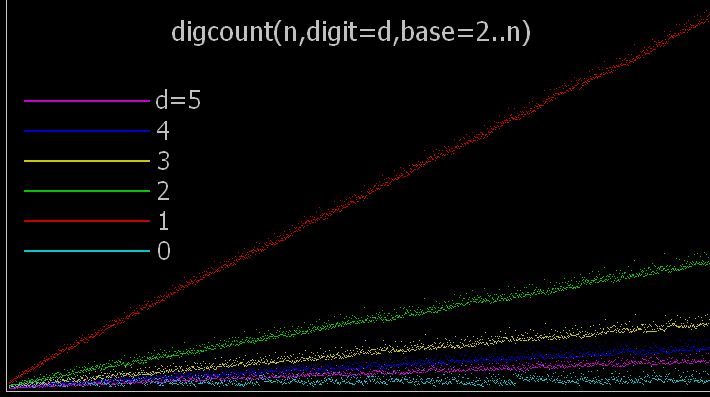
It should be apparent, then, that the digit-count for a particular digit starts at 1 and gets gradually higher. The rate at which the digit-count increases is highest for 1 and lowest for 0, with digits 2, 3, 4, 5… in between:

All-Base Graph

Graph for digcount(n,dig=d,b=2..n)


You could think of the graph as a digital rodeo in which these digits compete with each other. 1 is the clear and permanent winner, 0 the gradual loser. Now recall the procedure introduced at the start: n = n + digcount(n,dig=d,b=2..n). When it’s applied to the digits 0 to 5, these are the sequences that appear:

n = n + digcount(n,dig=0,b=2..n)

2, 3, 4, 7, 8, 13, 15, 18, 27, 34, 42, 51, 59, 62, 66, 80, 94, 99, 111, 117, 125, 132, 151, 158, 163, 173, 180, 204, 222, 232, 244, 258, 279, 292, 307, 317, 324, 351, 364, 382, 389, 400, 425, 437, 447, 454, 466, 475, 483, 494, 509, 517, 536, 553, 566, 576, 612, 637, 649, 669, 679, 693, 712, 728, 753, 768, 801, 822, 835, 849, 862, 869, 883, 895, 906, 923, 932, 943, 949, 957, 967, 975, 999, 1011…

n = n + digcount(n,dig=1,b=2..n)

2, 3, 6, 12, 23, 44, 75, 124, 202, 319, 503, 780, 1196, 1824, 2766, 4191, 6338, 9546, 14383, 21656, 32562, 48930, 73494, 110361, 165714, 248733, 373303, 560214, 840602, 1261237, 1892269, 2838926, 4258966, 6389157, 9584585, 14377879…

n = n + digcount(n,dig=2,b=2..n)

5, 6, 8, 12, 16, 22, 31, 37, 48, 60, 76, 94, 115, 138, 173, 213, 257, 311, 374, 454, 542, 664, 790, 935, 1109, 1310, 1552, 1835, 2167, 2548, 2989, 3509, 4120, 4832, 5690, 6687, 7829, 9166, 10727, 12568, 14697, 17182, 20089, 23470, 27425, 32042, 37477, 43768, 51113, 59687, 69705, 81379, 94998, 110910, 129488, 151153, 176429, 205923, 240331, 280490, 327396, 382067, 445858…

n = n + digcount(n,dig=3,b=2..n)

7, 8, 9, 10, 11, 13, 16, 18, 22, 25, 29, 34, 38, 44, 50, 56, 63, 80, 90, 104, 113, 131, 151, 169, 188, 210, 236, 261, 289, 320, 350, 385, 424, 463, 520, 572, 626, 684, 747, 828, 917, 999, 1101, 1210, 1325, 1446, 1577, 1716, 1871, 2040, 2228, 2429, 2642, 2875, 3133, 3413, 3719, 4044, 4402, 4786, 5196, 5645, 6140, 6673, 7257, 7900, 8582, 9315, 10130, 10998, 11942, 12954, 14058…

n = n + digcount(n,dig=4,b=2..n)

9, 10, 11, 12, 13, 14, 16, 18, 20, 23, 25, 28, 34, 41, 44, 52, 61, 67, 74, 85, 92, 102, 113, 121, 134, 148, 170, 184, 208, 229, 253, 269, 287, 306, 324, 356, 386, 410, 439, 469, 501, 531, 565, 604, 662, 703, 742, 794, 845, 895, 953, 1007, 1062, 1127, 1188, 1262, 1336, 1421, 1503, 1585, 1676, 1777, 1876, 2001, 2104, 2249, 2375, 2502, 2636, 2789, 2938, 3102, 3267, 3444, 3644, 3868, 4099…

n = n + digcount(n,dig=5,b=2..n)

11, 12, 13, 14, 15, 16, 17, 19, 21, 23, 26, 28, 29, 33, 37, 41, 48, 50, 55, 60, 64, 67, 72, 75, 83, 91, 96, 102, 107, 118, 123, 129, 137, 151, 159, 171, 180, 192, 202, 211, 224, 233, 251, 268, 280, 296, 310, 324, 338, 355, 380, 401, 430, 455, 488, 511, 536, 562, 584, 607, 638, 664, 692, 718, 748, 778, 807, 838, 874, 911, 951, 993, 1039, 1081, 1124, 1166, 1216, 1264, 1313, 1370, 1432…

Can You Dij It? #1

The most powerful drug in the world is water. The second most powerful is language. But everyone’s on them, so nobody realizes how powerful they are. Well, you could stop drinking water. Then you’d soon realize its hold on the body and the brain.

But you can’t stop using language. Try it. No, the best way to realize the power of language is to learn a new one. Each is a feast with different flavours. New alphabets are good too. The Devanagari alphabet is one of the strongest, but if you want it in refined form, try the phonetic alphabet. It will transform the way you see the world. That’s because it will make you conscious of what you’re already subconsciously aware of.

But “language” is a bigger category that it used to be. Nowadays we have computer languages too. Learning one is another way of transforming the way you see the world. And like natural languages – French, Georgian, Tagalog – they come in different flavours. Pascal is not like Basic is not like C is not like Prolog. But all of them seem to put you in touch with some deeper aspect of reality. Computer languages are like mathemagick: a way to give commands to something immaterial and alter the world by the application of will.

That feeling is at its strongest when you program with machine code, the raw instructions used by the electronics of a computer. At its most fundamental, machine code is simply a series of binary numbers controlling how a computer processes other binary numbers. You can memorize and use those code-numbers, but it’s easier to use something like assembly language, which makes machine-code friendlier for human beings. But it still looks very odd to the uninitiated:

setupnum:
xor ax,ax
xor bp,bp
mov cx,20
clearloop:
mov [di+bp],ax
add bp,2
loop clearloop
ret

That’s almost at the binary bedrock. And machine code is fast. If a fast higher-level language like C feels like flying a Messerschmitt 262, which was a jet-plane, machine-code feels like flying a Messerschmitt 163, which was a rocket-plane. A very fast and very dangerous rocket-plane.

I’m not good at programming languages, least of all machine code, but they are fun to use, quite apart from the way they make you feel as though you’re in touch with a deeper aspect of reality. They do that because the world is mathematics at its most fundamental level, I think, and computer languages are a form of mathematics.

Their mathematical nature is disguised in a lot of what they’re used for, but I like to use them for recreational mathematics. Machine-code is useful when you need a lot of power and speed. For example, look at these digits:

1, 2, 3, 4, 5, 6, 7, 8, 9, 1*, 0*, 1, 1, 1, 2, 1, 3, 1, 4, 1, 5, 1, 6, 1, 7, 1, 8, 1, 9, 2, 0, 2, 1, 2, 2, 2, 3, 2, 4, 2, 5, 2, 6, 2, 7, 2, 8, 2, 9, 3, 0, 3, 1, 3, 2, 3, 3, 3, 4, 3, 5, 3, 6*, 3*, 7, 3, 8, 3, 9, 4, 0, 4, 1, 4, 2, 4…

They’re what the Online Encyclopedia of Integer Sequences (OEIS) calls “the almost natural numbers” (sequence A007376) and you generate them by writing the standard integers – 1, 2, 3, 4, 5, 6, 7, 8, 9, 10, 11, 12, 13… – and then separating each digit with a comma: 1, 2, 3, 4, 5, 6, 7, 8, 9, 1, 0, 1, 1, 1, 2, 1, 3… The commas give them some interesting twists. In a list of the standard integers, the 1st entry is 1, the 10th entry is 10, the 213rd entry is 213, the 987,009,381th entry is 987,009,381, and so on.

But that doesn’t work with the almost natural numbers. The 10th entry is 1, not 10, and the 11th entry is 0, not 11. But the 10th entry does begin the sequence (1, 0). I wondered whether that happened again. It does. The 63rd entry in the almost natural numbers begins the sequence (6, 3) – see the asterisks in the sequence above.

This happens again at the 3105th entry, which begins the sequence (3, 1, 0, 5). After that the gaps get bigger, which is where machine code comes in. An ordinary computer-language takes a long time to reach the 89,012,345,679th entry in the almost natural numbers. Machine code is much quicker, which is why I know that the 89,012,345,679th entry begins the sequence (8, 9, 0, 1, 2, 3, 4, 5, 6, 7, 9):

1, 2, 3, 4, 5, 6, 7, 8, 9, 10, 63, 3105, 43108, 77781, 367573, 13859021, 77911127, 911360799, 35924813703, 74075186297, 89012345679…

And an ordinary computer-language might give you the impression that base 9 doesn’t have numbers like these (apart from the trivial 1, 2, 3, 4, 5, 6, 7, 8, 10…). But it does. 63 in base 10 is a low-hanging fruit: you could find it working by hand. In base 9, the fruit are much higher-hanging. But machine code plucks them with almost ridiculous ease:

1, 2, 3, 4, 5, 6, 7, 8, 10, 570086565, 655267526, 2615038272, 4581347024, 5307541865, 7273850617, 7801234568…

Block n Rule

One of my favourite integer sequences uses the formula n(i) = n(i-1) + digsum(n(i-1)), where digsum(n) sums the digits of n. In base 10, it goes like this:

1, 2, 4, 8, 16, 23, 28, 38, 49, 62, 70, 77, 91, 101, 103, 107, 115, 122, 127, 137, 148, 161, 169, 185, 199, 218, 229, 242, 250, 257, 271, 281, 292, 305, 313, 320, 325, 335, 346, 359, 376, 392, 406, 416, 427, 440, 448, 464, 478, 497, 517, 530, 538, 554, 568, 587, 607, 620, 628, 644, 658, 677, 697, 719, 736, 752, 766, 785, 805, 818, 835, 851, 865, 884, 904, 917, 934, 950, 964, 983, 1003…

Another interesting sequence uses the formula n(i) = n(i-1) + digprod(n(i-1)), where digprod(n) multiplies the digits of n (excluding 0). In base 10, it goes like this:

1, 2, 4, 8, 16, 22, 26, 38, 62, 74, 102, 104, 108, 116, 122, 126, 138, 162, 174, 202, 206, 218, 234, 258, 338, 410, 414, 430, 442, 474, 586, 826, 922, 958, 1318, 1342, 1366, 1474, 1586, 1826, 1922, 1958, 2318, 2366, 2582, 2742, 2854, 3174, 3258, 3498, 4362, 4506, 4626, 4914, 5058, 5258, 5658, 6858, 8778, 11914, 11950, 11995…

You can apply these formulae in other bases and it’s trivially obvious that the sequences rise most slowly in base 2, because you’re never summing or multiplying anything but the digit 1. However, there is a sequence for which base 2 is by far the best performer. It has the formula n(i) = n(i-1) + blockmult(n(i-1)), where blockmult(n) counts the lengths of distinct blocks of the same digit, including 0, then multiplies those lengths together. For example:

blockmult(3,b=2) = blockmult(11) = 2
blockmult(28,b=2) = blockmult(11100) = 3 * 2 = 6
blockmult(51,b=2) = blockmult(110011) = 2 * 2 * 2 = 8
blockmult(140,b=2) = blockmult(10001100) = 1 * 3 * 2 * 2 = 12
blockmult(202867,b=2) = blockmult(110001100001110011) = 2 * 3 * 2 * 4 * 3 * 2 * 2 = 576

The full sequence begins like this (numbers are represented in base 10, but the formula is being applied to their representations in binary):

1, 2, 3, 5, 6, 8, 11, 13, 15, 19, 23, 26, 28, 34, 37, 39, 45, 47, 51, 59, 65, 70, 76, 84, 86, 88, 94, 98, 104, 110, 116, 122, 126, 132, 140, 152, 164, 168, 171, 173, 175, 179, 187, 193, 203, 211, 219, 227, 245, 249, 259, 271, 287, 302, 308, 316, 332, 340, 342, 344, 350, 354, 360, 366, 372, 378, 382, 388, 404, 412, 436, 444, 460, 484, 500, 510, 518, 530, 538, 546, 555, 561, 579, 595, 603, 611, 635, 651, 657, 663, 669, 675, 681…

In higher bases, it rises much more slowly. This is base 3:

1, 2, 3, 4, 6, 7, 8, 10, 11, 12, 14, 16, 17, 19, 20, 21, 22, 24, 26, 29, 31, 33, 34, 35, 37, 39, 42, 44, 48, 49, 51, 53, 56, 58, 60, 61, 62, 64, 65, 66, 68, 70, 71, 73, 75, 77, 79, 82, 85, 89, 93, 95, 97, 98, 100, 101, 102, 103, 105, 107, 110, 114, 116, 120, 124, 127, 129, 131, 133, 137, 139, 141, 142, 143, 145, 146, 147, 149, 151, 152, 154, 156, 158, 160, 163…

And this is base 10:

1, 2, 3, 4, 5, 6, 7, 8, 9, 10, 11, 13, 14, 15, 16, 17, 18, 19, 20, 21, 22, 24, 25, 26, 27, 28, 29, 30, 31, 32, 33, 35, 36, 37, 38, 39, 40, 41, 42, 43, 44, 46, 47, 48, 49, 50, 51, 52, 53, 54, 55, 57, 58, 59, 60, 61, 62, 63, 64, 65, 66, 68, 69, 70, 71, 72, 73, 74, 75, 76, 77, 79, 80, 81, 82, 83, 84, 85, 86, 87, 88, 90…

Note how, in bases 3 and 10, blockmult(n) often equals 1. In base 3, the sequence contains [141, 142, 143, 145]:

blockmult(141,b=3) = blockmult(12020) = 1 * 1 * 1 * 1 = 1
blockmult(142,b=3) = blockmult(12021) = 1 * 1 * 1 * 1 = 1
blockmult(143,b=3) = blockmult(12022) = 1 * 1 * 1 * 2 = 2

The formula also returns 1 much further along the sequence in base 3. For example, the 573809th number in the sequence, or n(573809), is 5775037 and blockmult(5775037) = blockmult(101212101212021) = 1^15 = 1. But in base 2, blockmult(n) = 1 is very rare. It happens three times at the beginning of the sequence:

1, 2, 3, 5, 6, 8, 11…

After that, I haven’t found any more examples of blockmult(n) = 1, although blockmult(n) = 2 occurs regularly. For example,

blockmult(n(100723)) = blockmult(44739241) = blockmult(10101010101010101010101001) = 2
blockmult(n(100724)) = blockmult(44739243) = blockmult(10101010101010101010101011) = 2
blockmult(n(100725)) = blockmult(44739245) = blockmult(10101010101010101010101101) = 2

Does the sequence in base 2 return another example of blockmult(n) = 1? The odds seem against it. For any given number of digits in base 2, there is only one number for which blockmult(n) = 1. For example: 1, 10, 101, 1010, 10101, 101010, 1010101… As the sequence increases, the percentage of these numbers becomes smaller and smaller. But the sequence is infinite, so who knows what happens in the end? Perhaps blockmult(n) = 1 occurs infinitely often.

Playing the Double Base

Here’s some mathematical nonsense:

10 > 12
100 > 122
1000 > 1222

How can 1000 > 1222? Well, it makes perfect sense in what you might call a double base. In this base, every number is identified by a unique string of digits, but the strings don’t behave as they do in a standard base.

To see how this double base works, first look at 9 in standard base 2. To generate the binary digits from right to left, you follow the procedure x mod 2 and x = x div 2, where (x mod 2) returns the remainder when x is divided by 2 and (x div 2) divides x by 2 and discards the remainder:

9 mod 2 = 1 → ...1
9 div 2 = 4
4 mod 2 = 0 → ..01
4 div 2 = 2
2 mod 2 = 0 → .001
2 div 2 = 1
1 mod 2 = 1 → 1001

So 9[b=10] = 1001[b=2]. To adapt the procedure to base 3, simply use x mod 3 and x = x div 3:

32 mod 3 = 2 → ...2
32 div 3 = 10
10 mod 3 = 1 → ..12
10 div 3 = 3
3 mod 3 = 0 → .012
3 div 3 = 1
1 mod 3 = 1 → 1012

So 32[b=10] = 1012[b=3].

But what happens if you mix bases and use (x mod 3) and (x div 2), like this?:

2 mod 3 = 2 → .2
2 div 2 = 1
1 mod 3 = 1 → 12

3 mod 3 = 0 → .0
3 div 2 = 1
1 mod 3 = 1 → 10

So 10 > 12, i.e. 10[b=3,2] > 12[b=3,2].

5 mod 3 = 2 → ..2
5 div 2 = 2
2 mod 3 = 2 → .22
2 div 2 = 1
1 mod 3 = 1 → 122

6 mod 3 = 0 → ..0
6 div 2 = 3
3 mod 3 = 0 → .00
3 div 2 = 1
1 mod 3 = 1 → 100

So 100 > 122.

11 mod 3 = 2 → ...2
11 div 2 = 5
5 mod 3 = 2 → ..22
5 div 2 = 2
2 mod 3 = 2 → .222
2 div 2 = 1
1 mod 3 = 1 → 1222

12 mod 3 = 0 → …0
12 div 2 = 6
6 mod 3 = 0 → ..00
6 div 2 = 3
3 mod 3 = 0 → .000
3 div 2 = 1
1 mod 3 = 1 → 1000

And 1000 > 1222. Here are numbers 1 to 32 in this double base:

1 = 1
12 = 2
10 = 3
121 = 4
122 = 5
100 = 6
101 = 7
1212 = 8
1210 = 9
1221 = 10
1222 = 11
1000 = 12
1001 = 13
1012 = 14
1010 = 15
12121 = 16
12122 = 17
12100 = 18
12101 = 19
12212 = 20
12210 = 21
12221 = 22
12222 = 23
10000 = 24
10001 = 25
10012 = 26
10010 = 27
10121 = 28
10122 = 29
10100 = 30
10101 = 31
121212 = 32

Given a number represented in this mixed base, how do you extract the underlying n? Suppose the number takes the form n = (digit[1]..digit[di]), where digit[1] is the first and leftmost digit and digit[di] the final and rightmost digit. Then this algorithm will extract n:

n = 1
for i = 2 to di
..n = n * 2
..while n mod 3 ≠ digit[i]
....n = n + 1
..endwhile
next i
print n

For example, suppose n = 12212[b=3,2]. Then di = 5 and the algorithm will work like this:

n = 1
n = n * 2 = 2.
2 mod 3 = 2 = digit[2]
2 * 2 = 4
4 mod 3 = 1 ≠ digit[3]
5 mod 3 = 2 = digit[3]
5 * 2 = 10
10 mod 3 = 1 = digit[4]
10 * 2 = 20
20 mod 3 = 2 = digit[5]

Therefore 12212[b=3,2] = 20[b=10].

Now try some more mathematical nonsense:

21 > 100
111 > 1,000
1,001 > 10,000
10,001 > 100,000

How can numbers with d digits be greater than numbers with d+1 digits? Easily. In this incremental base, the base adjusts itself as the digits are generated, like this:

5 mod 2 = 1 → .1
5 div 2 = 2
2 mod (2 + 1) = 2 mod 3 = 2 → 21

The first digit generated is 1, so the base increases to (2 + 1) = 3 for the second digit. Compare the procedure when n = 4:

4 mod 2 = 0 → ..0
4 div 2 = 2
2 mod 2 = 0 → .00
2 div 2 = 1
1 mod 2 = 1 → 100

So 21 > 100, because 4 is a power of 2 and all the digits generated by (x mod 2) are 0 except the final and leftmost. 2 + 0 = 2. Now try n = 33:

33 mod 2 = 1 → ...1
33 div 2 = 16
16 mod (2+1) = 16 mod 3 = 1 → ..11
16 div 3 = 5
5 mod (3+1) = 5 mod 4 = 1 → .111
5 div 4 = 1
1 mod (4+1) = 1 mod 5 = 1.

33[b=10] = 1111[b=2,3,4,5].

Here are numbers 1 to 60 in this incremental base (note how 21 > 100, 111 > 1000, 1001 > 10000 and 10001 > 100000):

1 = 1
10 = 2
11 = 3
100 = 4*
21 = 5*
110 = 6
101 = 7
1000 = 8*
111 = 9*
210 = 10
121 = 11
1100 = 12
201 = 13
1010 = 14
211 = 15
10000 = 16*
221 = 17
1110 = 18
1001 = 19*
2100 = 20
311 = 21
1210 = 22
321 = 23
11000 = 24
1101 = 25
2010 = 26
1011 = 27
10100 = 28
421 = 29
2110 = 30
1201 = 31
100000 = 32*
1111 = 33
2210 = 34
1021 = 35
11100 = 36
2001 = 37
10010 = 38
1211 = 39
21000 = 40
1121 = 41
3110 = 42
2101 = 43
12100 = 44
1311 = 45
3210 = 46
1221 = 47
110000 = 48
2201 = 49
11010 = 50
2011 = 51
20100 = 52
1321 = 53
10110 = 54
10001 = 55*
101000 = 56
2111 = 57
4210 = 58
1421 = 59
21100 = 60

And here are numbers 256 to 270 (Note how 8,421 > 202,100 > 100,000,000):

100000000 = 256*
11221 = 257
101110 = 258
32101 = 259
202100 = 260*
13311 = 261
41210 = 262
10321 = 263
1111000 = 264
24201 = 265
131010 = 266
23011 = 267
320100 = 268
8421 = 269*
52110 = 270

Extracting n from a number represented in this incremental base is trickier than for the double base using (x mod 3) and (x div 2). To see how to do it, examine 11221[b=incremental]. The fifth and rightmost digit is 1, so the base increases to (2 + 1) = 3 for the fourth digit, which is 2. The base increases to (3 + 2) = 5 for the third digit, which is 2 again. The base increases to (5 + 2) = 7 for the second digit, 1. But the first and rightmost digit, 1, represents (x div 7) mod (7 + 1 = 8). So n can be extracted like this:

digit[1] * 7 = 1 * 7 = 7
7 mod 7 = 0 ≠ digit[2]
8 mod 7 = 1 = digit[2]
8 * 5 = 40
40 mod 5 = 0 ≠ digit[3]
41 mod 5 = 1 ≠ digit[3]
42 mod 5 = 2 = digit[3]
42 * 3 = 126
126 mod 3 = 0 ≠ digit[4]
127 mod 3 = 1 ≠ digit[4]
128 mod 3 = 2 = digit[4]
128 * 2 = 256
256 mod 2 = 0 ≠ digit[5]
257 mod 2 = 1 = digit[5]

So 11221[b=8,7,5,3,2] = 257[b=10].

Now try 8421[b=incremental]. The fourth and rightmost digit is 1, so the base increases to (2 + 1) = 3 for the third digit, which is 2. The base increases to (3 + 2) = 5 for the second digit, 4. But the first and rightmost digit, 8, represents (x div 5) mod (5 + 4 = 9). So n can be extracted like this:

digit[1] * 5 = 8 * 5 = 40
40 mod 5 = 0 ≠ digit[2]
41 mod 5 = 1 ≠ digit[2]
42 mod 5 = 2 ≠ digit[2]
43 mod 5 = 3 ≠ digit[2]
44 mod 5 = 4 = digit[2]
44 * 3 = 132
132 mod 3 = 0 ≠ digit[3]
133 mod 3 = 1 ≠ digit[3]
134 mod 3 = 2 = digit[3]
134 * 2 = 268
268 mod 2 = 0 ≠ digit[4]
269 mod 2 = 1 = digit[4]

So 8421[b=9,5,3,2] = 269[b=10].

Narcischism

What have bits to do with splits? A lot. Suppose you take the digits 12345, split them in all possible ways, then sum the results, like this:

12345 → (1234 + 5) + (123 + 45) + (123 + 4 + 5) + (12 + 345) + (12 + 34 + 5) + (12 + 3 + 45) + (12 + 3 + 4 + 5) + (1 + 2345) + (1 + 234 + 5) + (1 + 23 + 45) + (1 + 23 + 4 + 5) + (1 + 2 + 345) + (1 + 2 + 34 + 5) + (1 + 2 + 3 + 45) + (1 + 2 + 3 + 4 + 5) = 5175.

That’s a sum in base 10, but base 2 is at work below the surface, because each set of numbers is the answer to a series of binary questions: split or not? There are four possible places to split the digits 12345: after the 1, after the 2, after the 3 and after the 4. In (1 + 2 + 3 + 4 + 5), the binary question “Split or not?” is answered SPLIT every time. In (1234 + 5) and (1 + 2345) it’s answered SPLIT only once.

So the splits are governed by a four-digit binary number ranging from 0001 to 1111. When the binary digit is 1, split; when the binary digit is 0, don’t split. In binary, 0001 to 1111 = 01 to 15 in base 10 = 2^4-1. That’s for a five-digit number, so the four-digit 1234 will have 2^3-1 = 7 sets of sums:

1234 → (123 + 4) + (12 + 34) + (12 + 3 + 4) + (1 + 234) + (1 + 23 + 4) + 110 (1 + 2 + 34) + (1 + 2 + 3 + 4) = 502.

And the six-digit number 123456 will have 2^5-1 = 31 sets of sums. By now, an exciting question may have occurred to some readers. Does any number in base 10 equal the sum of all possible numbers formed by splitting its digits?

The exciting answer is: 0. In other words: No. To see why not, examine a quick way of summing the split-bits of 123,456,789, with nine digits. The long way is to find all possible sets of split-bits. There are 2^8-1 = 255 of them. The quick way is to sum these equations:

1 * 128 + 10 * 64 + 100 * 32 + 1000 * 16 + 10000 * 8 + 100000 * 4 + 1000000 * 2 + 10000000 * 1
2 * 128 + 20 * 64 + 200 * 32 + 2000 * 16 + 20000 * 8 + 200000 * 4 + 2000000 * 2 + 20000000 * 1
3 * 128 + 30 * 64 + 300 * 32 + 3000 * 16 + 30000 * 8 + 300000 * 4 + 3000000 * 3
4 * 128 + 40 * 64 + 400 * 32 + 4000 * 16 + 40000 * 8 + 400000 * 7
5 * 128 + 50 * 64 + 500 * 32 + 5000 * 16 + 50000 * 15
6 * 128 + 60 * 64 + 600 * 32 + 6000 * 31
7 * 128 + 70 * 64 + 700 * 63
8 * 128 + 80 * 127
9 * 255

Sum = 52,322,283.

52,322,283 has eight digits. If you use the same formula for the nine-digit number 999,999,999, the sum is 265,621,761, which has nine digits but is far smaller than 999,999,999. If you adapt the formula for the twenty-digit 19,999,999,999,999,999,999 (starting with 1), the split-bit sum is 16,562,499,999,987,400,705. In base 10, as far as I can see, numbers increase too fast and digit-lengths too slowly for the binary governing the split-sums to keep up. That’s also true in base 9 and base 8:

Num = 18,888,888,888,888,888,888 (b=9)
Sum = 16,714,201,578,038,328,760

Num = 17,777,777,777,777,777,777 (b=8)
Sum = 17,070,707,070,625,000,001

So what about base 7? Do the numbers increase slowly enough and the digit-lengths fast enough for the binary to keep up? The answer is: 1. In base 7, this twenty-digit number is actually smaller than its split-bit sum:

Num = 16,666,666,666,666,666,666 (b=7)
Sum = 20,363,036,303,404,141,363

And if you search below that, you can find a number that is equal to its split-bit sum:

166512 → (1 + 6 + 6 + 5 + 1 + 2) + (16 + 6 + 5 + 1 + 2) + (1 + 66 + 5 + 1 + 2) + (166 + 5 + 1 + 2) + (1 + 6 + 65 + 1 + 2) + (16 + 65 + 1 + 2) + (1 + 665 + 1 + 2) + (1665 + 1 + 2) + (1 + 6 + 6 + 51 + 2) + (16 + 6 + 51 + 2) + (1 + 66 + 51 + 2) + (166 + 51 + 2) + (1 + 6 + 651 + 2) + (16 + 651 + 2) + (1 + 6651 + 2) + (16651 + 2) + (1 + 6 + 6 + 5 + 12) + (16 + 6 + 5 + 12) + (1 + 66 + 5 + 12) + (166 + 5 + 12) + (1 + 6 + 65 + 12) + (16 + 65 + 12) + (1 + 665 + 12) + (1665 + 12) + (1 + 6 + 6 + 512) + (16 + 6 + 512) + (1 + 66 + 512) + (166 + 512) + (1 + 6 + 6512) + (16 + 6512) + (1 + 66512) = 166512[b=7] = 33525[b=10].

So 33525 in base 7 is what might be called a narcischist: it can gaze into the split-bits of its own digits and see itself gazing back. In base 6, 1940 is a narcischist:

12552 → (1 + 2 + 5 + 5 + 2) + (12 + 5 + 5 + 2) + (1 + 25 + 5 + 2) + (125 + 5 + 2) + (1 + 2 + 55 + 2) + (12 + 55 + 2) + (1 + 255 + 2) + (1255 + 2) + (1 + 2 + 5+ 52) + (12 + 5 + 52) + (1 + 25 + 52) + (125 + 52) + (1 + 2 + 552) + (12 + 552) + (1 + 2552) = 12552[b=6] = 1940[b=10].

In base 5, 4074 is a narcischist:

112244 → (1 + 1 + 2 + 2 + 4 + 4) + (11 + 2 + 2 + 4 + 4) + (1 + 12 + 2 + 4 + 4) + (112 + 2 + 4 + 4) + (1 + 1 + 22 + 4 + 4) + (11 + 22 + 4 + 4) + (1 + 122 + 4 + 4) + (1122 + 4 + 4) + (1 + 1 + 2 + 24 + 4) + (11 + 2 + 24 + 4) + (1 + 12 + 24 + 4) + (112 + 24 + 4) + (1 + 1 + 224 + 4) + (11 + 224 + 4) + (1 + 1224 + 4) + (11224 + 4) + (1 + 1 + 2 + 2 + 44) + (11 + 2 + 2 + 44) + (1 + 12 + 2 + 44) + (112 + 2 + 44) + (1 + 1 + 22 + 44) + (11 + 22 + 44) + (1 + 122 + 44) + (1122 + 44) + (1 + 1 + 2 + 244) + (11 + 2 + 244) + (1 + 12 + 244) + (112 + 244) + (1 + 1 + 2244) + (11 + 2244) + (1 + 12244) = 112244[b=5] = 4074.

And in base 4, 27 is:

123 → (1 + 2 + 3) + (12 + 3) + (1 + 23) = 123[b=4] = 27.

And in base 3, 13 and 26 are:

111 → (1 + 1 + 1) + (11 + 1) + (1 + 11) = 111[b=3] = 13.

222 → (2 + 2 + 2) + (22 + 2) + (2 + 22) = 222[b=3] = 26.

There are many more narcischists in all these bases, even if you exclude numbers with zeroes in them, like these in base 4:

1022 → (1 + 0 + 2 + 2) + (10 + 2 + 2) + (1 + 02 + 2) + (102 + 2) + (1 + 0 + 22) + (10 + 22) + (1 + 022) = 1022[b=4] = 74.

1030 → (1 + 0 + 3 + 0) + (10 + 3 + 0) + (1 + 03 + 0) + (103 + 0) + (1 + 0 + 30) + (10 + 30) + (1 + 030) = 1030[b=4] = 76.

1120 → (1 + 1 + 2 + 0) + (11 + 2 + 0) + (1 + 12 + 0) + (112 + 0) + (1 + 1 + 20) + (11 + 20) + (1 + 120) = 1120[b=4] = 88.