Pestilent, Pustulent and Pox-Pocked

I’m sorry, but let’s face facts: you cannot consider yourself a keyly committed core component of the counter-cultural community unless you own at least three copies — a reading copy, a prominent-shelf-of-the-bookcase copy and a wrap-carefully-in-brown-paper-put-away-in-a-cupboard-and-never-touch-or-look-at-again copy — of each of these toxic’n’tenebrose titles:

Can the Cannibal? Aspects of Angst, Abjection and Anthropophagy in the Music of Suzi Quatro, 1974-1986 (University of Nebraska Press 2004)

Doubled Slaughter: Barbarism, Brutalism and Bestial Bloodlust in the Music of Simon and Garfunkel, 1965-2010 (Serpent’s Tail 2007)

Re-Light My Führer: Nausea, Noxiousness and Neo-Nazism in the Music of Take That, 1988-2007 (U.N.P. 2013)

Base Citizens Raping: Revulsion, Repulsion and Rabidity in the Music of the Bay City Rollers, 1972-2002 (U.N.P. 2014)

Underground, Jehovahground: Ferality, Fetidity and Fundamentalist Phantasmality in the Music of the Wombles, August 1974-January 1975 (forthcoming)

Jane in Blood: Castration, Clitoridolatry and Communal Cannibalism in the Novels of Jane Austen (U.N.P. 2018)

All are by Dr Miriam B. Stimbers, of course. And what can I say about them? Simply this: these books hold an uncompromising mirror up before the pestilent, pustulent and pox-pocked features of so-called Western so-called society and say: “Look. That’s you, that is.” Dr Stimbers’ ruthlessly radical research and sizzlingly psychoanalytic scholarship will overturn your preconceptions so hard that, in some cases, they won’t appear to change at all.

Hit and Smith

Front cover of Songs that Saved Your Life by Simon GoddardSongs that Saved Your Life: The Art of The Smiths 1982-87, Simon Goddard (Titan Books 2013)

I enjoyed Simon Goddard’s Mozipedia – The Encyclopedia of Morrissey and The Smiths a lot. And learnt a lot from it too. But I haven’t bothered finishing Simon Goddard’s Songs that Saved Your Life: The Art of The Smiths 1982-87 (an updated edition of The Smiths: Songs That Saved Your Life, 2002). There’s too much rock-writer rhetoric, too many mixed metaphors, too few pictures. None, in fact, apart from the band-photo on the front cover and the tickets on the back. Part of the problem is that The Smiths were only Act One in Mozza’s career. Johnny Marr played guitar well and wrote some beautiful tunes. But Morrissey was the interesting, eclectic and original one in The Smiths: the Mogpie didn’t need Marr a quarter as much as Marr needed the Mogpie. That’s part of why Mozipedia is better. Use this book as a supplement, because it’s got a lot of disc-o-detail and the appendices are good, covering The Smiths on record, in concert and on TV and radio. Goddard doesn’t have room to get rock-o-rhetorical there.

O Apollo

One of Swinburne’s most powerful, but least-known, poems is “The Last Oracle”, from Poems and Ballads, Second Series (1878). A song in honour of the god Apollo, it begins in lamentation:

Years have risen and fallen in darkness or in twilight,
   Ages waxed and waned that knew not thee nor thine,
While the world sought light by night and sought not thy light,
   Since the sad last pilgrim left thy dark mid shrine.
Dark the shrine and dumb the fount of song thence welling,
   Save for words more sad than tears of blood, that said:
Tell the king, on earth has fallen the glorious dwelling,
   And the watersprings that spake are quenched and dead.
Not a cell is left the God, no roof, no cover
   In his hand the prophet laurel flowers no more.

And ends in exultation:

         For thy kingdom is past not away,
            Nor thy power from the place thereof hurled;
         Out of heaven they shall cast not the day,
            They shall cast not out song from the world.
         By the song and the light they give
         We know thy works that they live;
         With the gift thou hast given us of speech
         We praise, we adore, we beseech,
         We arise at thy bidding and follow,
            We cry to thee, answer, appear,
   O father of all of us, Paian, Apollo,
            Destroyer and healer, hear! (“The Last Oracle”)

The power, grandeur and beauty of this poem remind me of the music of Beethoven. Swinburne is also, on a smaller scale and in a different medium, one of the geniuses of European art. He and Beethoven were both touched by Apollo, but Apollo was more than the god of music and poetry: he also presided mathematics. But then mathematics is much more visible, or audible, in music and poetry than it is in other arts. Rhythm, harmony, scansion, melody and rhyme are mathematical concepts. Music is built of notes, poetry of stresses and rhymes, and the rules governing them are easier to formalize than those governing, say, sculpture or prose.  Nor do poetry and music have to make sense or convey explicit meaning like other arts. That’s why I think a shape like this is closer to poetry or music than it is to painting:

Apollonian gasket (Wikipedia)

(Image from Wikipedia.)

This shape has formal structure and beauty, but it has no explicit meaning. Its name has a divine echo: the Apollonian gasket or net, named after the Greek mathematician Apollonius of Perga (c.262 BC–c.190 BC), who was named after Apollo, god of music, poetry and mathematics. The Apollonian gasket is a fractal, but the version above is not as fractal as it could be. I wondered what it would look like if, like fleas preying on fleas, circles appeared inside circles, gaskets within gaskets. I haven’t managed to program the shape properly yet, but here is my first effort at an Intra-Apollonian gasket:

Apollonian gasket

(If the image does not animate or looks distorted, please try opening it in a new window)

When the circles are solid, they remind me of ice-floes inside ice-floes:

Apollonian gasket (solid)

Simpler gaskets can be interesting too:

five-circle gasket


five+four-circle gasket


nine-circle gasket

Angst, Anguish, Abjection

It’s half tradition, half tic. At every Ruin-Dredger gig, the lead-singer Jerome Daziel asks the same simple question. Sometimes he shouts it and demands a reaction from the audience. Sometimes he whispers it and ignores what the audience does. Depending on the country, he’s asked it in French, Italian, Greek, Russian, Georgian, Mandarin, Thai, Samoan and Quechua. He’s also asked it in complete silence, having written it across his chest and on the palms of his hands in phosph-ink, invisible when the lights are on, glowing ghoulishly when they’re turned off. Occasionally he’s asked it backwards. In English, the question runs like this: “And What Doth It Mean To Be Flesh?”

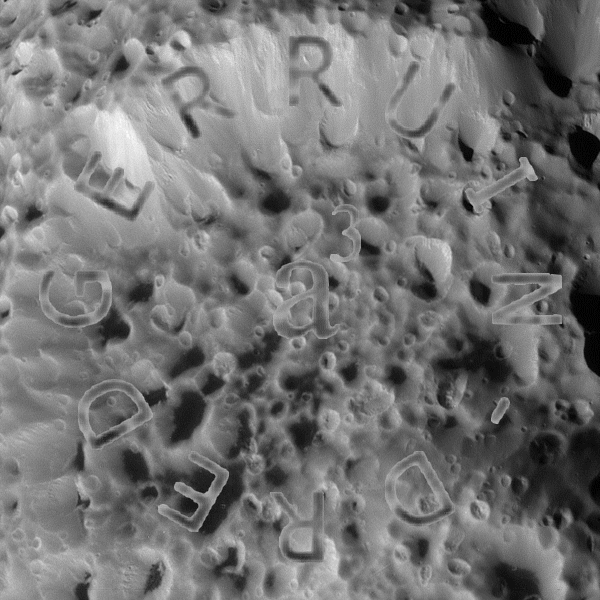
Cover of Triple-A by Ruin-Dredger (2000)

But you could see the whole of a Ruin-Dredger gig as asking the same searching thing. The band specialize in unusual frequencies that hunt out – and hum out – the resonances of the human body: the lungs, the bones, the blood. And their music sets up strange resonances in the mind. It’s both mindless and masterful, at once tearful and tyrannous. Sometimes it sounds like mathematics trying to come to life, and sometimes like mathematics trying to commit suicide. There’s a lot of science in their music, and a lot of silence too. “Star-clusters having tantrums,” is how one early review ran. “With occasional episodes of narcolepsy.” That mixture of sound and silence is mutually reinforcing: the sounds are sterner, the silence is sharper. They began their career with the albums Xoli-Hein (1992) and Pyramidion (1996), where they forged a series of griffs, or “gruff riffs”, that were often Ohrwürmer, or “ear-worms”, as German calls tunes that stick in your head. Even if you don’t want them to. But I’m not sure “tune” has ever been the right word for the music Ruin-Dredger create. It’s part industrial noise, part wolf-howl, part bat-twitter, but mostly “folded, fused, fissured, fractured, fidgety phonaesthesia.” And if you want to sample it, this album from the turn of the century is a good place to start.

What to call the album is one of the first puzzles it will set you. The band’s website usually calls it “a3” or “a3”; in interviews, the band themselves refer to it as “Triple-A” or “that A-fucker”. The second name comes from a plagiarism suit by the astro-music veterans Kargokkult that put Ruin-Dredger’s career on hold for nearly a year, 2002-3, and allegedly threatened to bankrupt their record-company. In the end the case was thrown out of court and even today some conspiracy-minded Dredge-heads claim it was cooked up for publicity between the ’Dredgers and the Kargonauts. The case might never have got as far as it did without that lunar cover for Triple-A, where the corroded letters of the band’s name and the album’s name hang above a lifeless moon-scape. Only it isn’t our moon. And it isn’t necessarily lifeless. Ruin-Dredger have a bee in their bonnet about the pre-biotic – the conditions necessary for the appearance of life. That’s what the first track on Triple-A, “Invention of the Cross”, is about: the chemicals that gave rise to life. And it literally has bees on it: the band sampled bees and bumblebees in flight and gathering nectar. They then altered the pitch and speed of the buzzing and made it sound both unearthly and unsettling. I’ve known people demand the track be turned off or skipped when it’s played to them.

But skipping track one of Triple-A is a bit like jumping from the frying-pan into the fire, because track two, “Seventh Sword”, is even more unearthly and even more unsettling. Bat-twitters hurtle through the speakers, falling from the ultra-sonic to the infra-sonic, rising in reverse, twisting, turning inside-out, mating, mutating and miscegenating. Then, as though the band have taken mercy on your ears and your mind, everything slows and soothes for track three, “Titanomachia”, which is often preceded in concert by the aforementioned carnal question: “And what doth it mean to be flesh?” This track is one of the last outings for the griffs of their early career: a slow, synth-based triple chord underlain by a sample of waves washing on an unknown shore. Track four, “Breathing Vacuum”, has also been known to provoke a “Turn it off!”, because the mumbling beneath the music is both sinister and sorrowful. You feel as though you should understand the words or, worse, that you will in your dreams. The chimes in the track are sinister too: they sound like a deep-sea, or deep-space, monster tapping on its fangs before putting them to famished use.

Which sets things up nicely, or nastily, for track five, “Scylla / Charybdis”. This is named after a pair of sea-monsters faced by Odysseus on his journey home from Troy and has been described by the ’Dredgers as a “battle-song”. The waves on “Titanomachia” are back, but bigger, badder and in a mood to fight. Daziel’s electronically treated voice wolf-howls a series of unintelligible questions, answered by patches of silence and gong-like drum-rolls. Track six, “Nyctogigas”, starts softly, builds back to the volume and violence of “Scyl/Char”, then breaks apart to allow the bats and bees of “Whilom” to steer your imagination out and up into the freezing star-light on the outer fringes of the solar system, where comets, shorn by the cold and dark, wait to swing sun-ward and regain their blazing locks. I like to listen to “Whilom” in the dark, wearing a blindfold, but then that’s the best way to listen to all of Ruin-Dredger’s music. Listening like that conjures visions and commands the viscera. Not an easy album, nor an unrewarding one, Triple-A isn’t their finest hour, if fan-polls and sales are any guide, but it’s an excellent guide to where they had come from and where they were about to go. If it’s the alpha-and-omega of their career, perhaps that explains the title: the “a” is the alpha (α) and the “3” an omega (ω) tipped on its side. I see it, or hear it, as a bridge between the ’nineties and the ’noughties: they’d give up the griffs and big up the bats, from then on, but they’ve never stopped asking that simple, sinister/sorrowful question of themselves and their listeners: “And What Doth It Mean To Be Flesh?”


a3 / a3 / Triple-A (S.R.K., 2000)

1. Invention of the Cross (5:26)
2. Seventh Sword (3:33)
3. Titanomachia (7:18)
4. Breathing Vacuum (9:03)
5. Scylla / Charybdis (6:11)
6. Nyctogigas (4:20)
7. Whilom (13:37)

Vigor Mortis

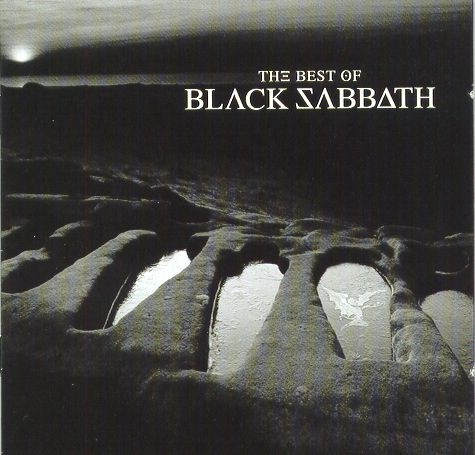
Front cover of The Best of Black Sabbath
In the Christian religion, the resurrection follows the virgin birth. In the rock-graves at Heysham, the virgin birth follows the resurrection. Or rather: the virgin-births follow the resurrections. There are many of both. The rock-graves at Heysham* are carved in solid rock near the remains of St Patrick’s chapel, an ancient ruin overlooking Morecambe Bay on the coast of Lancashire in England. You may have seen them before, because they appear on the cover of a compilation album by the heavy-metal band Black Sabbath, where they’re filled with ice and look suitably dark and sinister. But the graves are sometimes full of life and activity. In spring, as the rainwater filling them begins to warm, there are resurrections – dozens of them. Tiny crustaceans (a group of animals that includes crabs, shrimps and woodlice) hatch from eggs that have over-wintered in the sediment on the floors of the graves. Some of the crustaceans are called water-fleas, others are called seed-shrimps. Water-fleas, whose scientific name is Daphnia, hop through the water with jerks of their antennae, sieving it for fresh-water plankton. Seed-shrimps, or ostracods, are enclosed in tiny double-sided shells through which their legs protrude. They trundle over the stone sides of the graves, scraping off algae and catching even smaller and simpler animals like rotifers and protozoa.

The rock graves at Heysham (c. 11th century A.D.)

Rock graves at Heysham, Lancs. (c. 1000s)

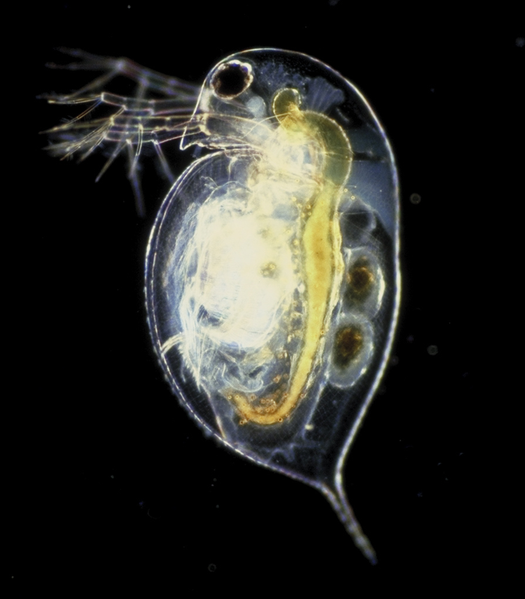
Water-fleas are famous for parthenogenesis, or their ability to produce offspring without sex. Those that hatch first in spring are female and give birth without mating with any males. A single water-flea in a jar of stagnant water soon becomes a swarm. It’s only later in the year that males are born and the water-fleas mate to produce winter eggs, which sink to the floor of the graves and lie there through the cold weather. The eggs of water-fleas and ostracods can also survive desiccation, or drying-up, and can be blown on the wind to new sites. That is probably how these crustaceans arrived in the rock-graves, which they must have occupied for centuries, through the coldest winters and the hottest summers, dying and being reborn again and again. When a human being or large animal dies, chemical changes in the body make the muscles rigid and wood-like. The scientific term for this is rigor mortis, or the “stiffness of death”. Rigor mortis wears off in time and the body begins to rot. The rock-graves at Heysham are an example of vigor mortis, or the “vigour of death”. Medieval human beings created the graves to bury their dead, but the bodies that were once there have been lost to history. The water-fleas and the seed-shrimps remain, tiny, overlooked and fascinating.

A seed-shrimp or ostracod

A seed-shrimp

A water-flea, Daphnia pulex

A water-flea


*Heysham is pronounced HEE-shum and is an old coastal village near the city of Lancaster, after which Lancashire is named.

Mental Marine Music

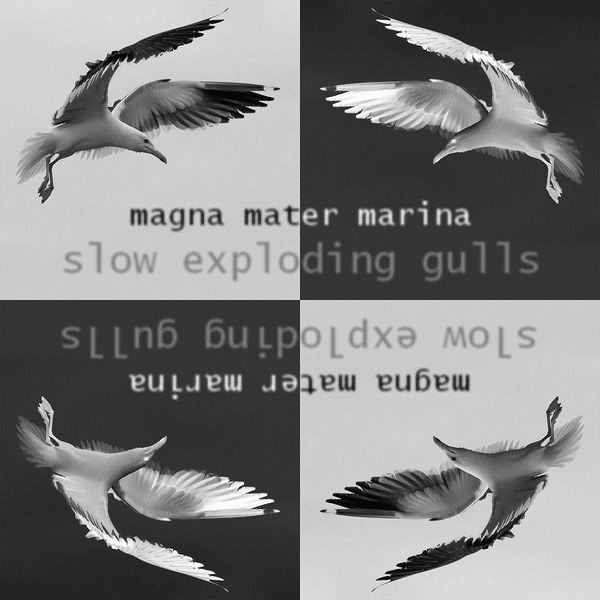
Cover of Magna Mater Marina by Slow Exploding Gulls (CD re-issue)

“Thalassa! Thalassa!” The chant that began the first song on the first side of the first S.E.G. album is still inspiring the group twenty-six years and eighteen albums later. Few fans will need reminding that it is ancient Greek for “The Sea! The Sea!”, as shouted in ecstasy by a mercenary army after a long and dangerous retreat across Asia Minor in 401 BC. Ecstasy is not so much an inspiration to the group as an aspiration. They try to use melody, rhythm and “drowned sound” to take their listeners out of the everyday and into the otherwhere, to sink them “full fathom five” in music as rich and mysterious as the sea. The S.E.G. story begins in 1987, when Joseph Corvin, the ever-present Kapitän und Kappellmeister, as he jokingly calls himself, was living in an old house in the ancient Celto-Roman town of Exeter on the southern English coast. When the sea-wind blew, his living quarters became lowing quarters: “an eerie wailing used to sound from the roof and there were all sorts of weird sound effects in the bathroom, because of air moving in the overflow pipe and the walls. I liked what I heard and I thought I could do something with it, musically speaking.”

Corvin recorded some of the wind-sounds, mixed them with gull-cries and underwater engine-noise, added vocals and electronically treated flute and drums, and put out the results on a cassette-only album called Magna Mater Marina (Latin for Great Marine Mother), under the odd but memorable moniker of Slow Exploding Gulls. The name was inspired by Corvin’s love of the surrealists Salvador Dalí and Max Ernst, but it would dog him and his cohorts for years to come, partly because it pigeon-holed the group as “Kraut-rock” and partly because it suggested cruelty to animals, which was not appreciated by some of his potential audience. Both assumptions were completely wrong: Corvin says, first, that, as a fan, he was then much more into The Cure, The Smiths and Siouxsie and the Banshees than anything electronic or experimental, and, second, that far from advocating cruelty to gulls, he was celebrating them:

Not for one moment was I suggesting any harm to anything with wings or feathers. Gulls are my favourite birds, highly potent symbols of freedom, grace and the life-force. The title was meant to be metaphorical, not literal, and it was partly a reference to the explosion of joy that sudden sight of a flying gull can waken in your heart. There’s something very Nietzschean about them and yeah, I will admit to a Friedrich-fixation in the 1980s, though the Kraut-rock label was an albatross around our necks, no pun intended, for most of the ’90s. It came mainly from a review in the N.M.E. [New Musical Express, one of Britain’s big “pop-papers”] claiming to detect similarities between us and Einstürzende Neubaten, which means “Collapsing New Buildings”. Well, I can’t say there wasn’t a subliminal influence, name-wise, but I’d heard very little by any of the German groups at the time and when I did hear more, I didn’t detect many similarities between their music and ours. We were and always will be inspired by sea-sounds, everything you can hear under and over the water of the British coast. The next label they tried to stick on us was “goth”, on the ground that we made gloomy music and always dressed in black. We didn’t: it was dark blue, it wasn’t all the time and there’s nothing gloomy about our music, if it’s listened to right. (Interview on the fan-site GullSegg, November, 2003)

Corvin’s protests were to no avail: S.E.G.’s next album, A Grey Mist (1989), was reviewed under titles like “Submarine Electro-Goths” and “Solipsistic Entrail-Gazing”. Again he says the press had got hold of the wrong end of the stick: “The title of the album comes from ‘Sea-Fever’, a very beautiful poem by John Masefield, and far from attempting to be gloomy or depressing, it was all about the joy of the sea, the cold in the early morning and the bite of the wind, ‘the white clouds flying’ and mist as a symbol of mystery and possibility, not as anything glum and gothic.” Happily, S.E.G. would outlive that early hostility and journalists’ insistence on labelling, rather than listening to, the music they created, but a lasting effect of both has been the playful name-switching they’ve indulged in since their early days. They’ve released albums under at least eight different names and performed gigs under all those and more, but every name has been based on the acronym S.E.G. and had a maritime theme. 1994’s Mew Upsilon Sigma, for example, came out under the name Swim with Elegant Gods, and 2003’s re-mixed Yr Wylan Ddu (Welsh for The Black Gull) under the name Seaside Excursion Guide. They’ve also recorded songs with titles like “Sunken Etruscan Gold”, “Sailing to Ecstatic Gnosis”, “Submersed in the Eternal Gulf” and “She’s an Exeter Girl” (a reference to Cathleen Orne, Joseph’s then girlfriend, now wife, who is indeed an Exeter girl).

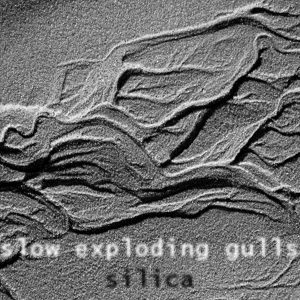
Cover of Silica by Slow Exploding Gulls

This S.E.G. motif means that hardcore fans, of whom they’ve garnered and retained a flighty fair few down the decades, are generally referred to as SEGheads, while their biggest – and best – fan-site is GullSegg, where you can find the earliest and most accurate news on the group’s activities, plus detailed and reasonably objective reviews of every piece of music they’ve ever recorded. So can S.E.G. be described as Shadowy Exeter Goths? No, Soaring Elemental Gods is much closer the mark and I join many mental-marine-music fans in wishing them well in their ambition of recording music in every major sea-side town of the British Isles. Wexford on the eastern coast of Ireland is next, according to GullSegg, and Wassernyxe, album #19 (and German/Greek for “Mermaid-Night”), should be released before the end of the year. It’s unlikely it will sail new seas, or sound new depths, but after twenty-six years of mer-music-making who could expect it to? Yes, never mind the rowlocks! S.E.G.’s Saline Esoterica Gangs on – and gongs on – every time someone plays a classic album like Mew or Thalas/Socratic, their 1996 split-EP with their own whale-song side-project Schatten über Exeter Gruppe (German for “Shadow over Exeter Group”).


Elsewhere other-posted:

• More Musings on Music

Previously pre-posted (please peruse):

Stoch’! (In the Name of Dove)

Proviously post-posted (please peruse):

The Sound of Silex

Get Your Locks Off

Led Zeppelin, Ray Tedman (Titan Books, 2011)

Front cover of Led Zeppelin by Ray Tedman

The most important thing in this big book of photographs is, of course, Robert Plant’s hair, which often looks remarkably like mine in both its colour and its curliness. There’s also little to choose between me and Robert Plant in the sex-god stakes, so I’ve often wondered precisely whose gigs my mother was attending in her youth (related rumours circulate, muso mutato et mama mutata, about at least one other keyly committed core component of the counter-cultural community). These aren’t unusual thoughts for me when I look at a book about Led Zeppelin: their hair interests me more than their harmonics. I usually get bored well before songs like “Whole Lotta Love” and “Stairway to Heaven” are over and I would much rather listen to the Beatles or Black Sabbath, even at their worst, than to Led Zeppelin, even at their best.

But, at their best, before their locks were shorn as the 1970s ended, Led Zeppelin did look much more like rock-gods than either the Beatles or Black Sabbath. One thing all three bands have in common is their classic quadrivalency: there are four men in each filling the four standard rock roles. I’ve outlined my humorous theory of the classic guitar-bass-drums-vocals line-up elsewhere, so all I’ll say here is that Led Zeppelin fit the theory well. Each member has a distinct personality as he plays a distinct instrument. Each is also distinct in appearance: Jimmy Page is rake-thin, Robert Plant well-built, John Paul Jones average, and Bonzo stocky. Bonzo always had facial hair too, which must say something about his psychology. The colour of his hair certainly says something about his psychology. Like skin-colour and eye-colour, hair-colour is a chemical phenomenon: different colours signal different chemicals or different levels of chemical in the body, and so in the brain. Lighter hair, like lighter skin and eyes, tends to go with a more introverted, less aggressive personality and it may be significant that Robert Plant and John Paul Jones, with lighter hair, are said to have been the two best-behaved members of Led Zeppelin. Black-haired Bonzo was notoriously bestial and also the heaviest drinker. Jimmy Page wasn’t violent, despite having black hair, but his somatype, or body-shape, doesn’t predict violence.

His face may predict high intelligence and high artistic achievement, however: he has always been a good-looking man. Good looks are related to symmetry, and symmetry is related to intelligence and coordination. Again, this isn’t an absolute rule: good-looking people can be stupid and bad at music, just as ugly people can be intelligent and good at music, and strange things can sometimes happen at the extremes of the bell-curve. But biology is about averages and tendencies, not absolutes, and biology is central to understanding human beings and their behaviour. That’s one of the things I find interesting about looking through this book, but there’s much more than individual biology at work here. Led Zeppelin followed fashions as well as setting them and faithfully reflected the look of the three decades in which they existed: the ’60s, the ’70s, and the ’80s.

Or first year of the ’80s, anyway: Bonzo died on 25th September 1980 and the band broke up. The book then follows Plant and Page into their solo careers and their occasional re-unions with Jones, but nobody looks as good as he did in the band’s mid-’70s prime, when their locks were longest and their testosterone levels highest. Endocrinology, or the science of hormones, is another essential part of understanding human behaviour and rock music at its loudest may influence hormones with more than its rhythms and melodies. High volume affects the entire body, not just the ears, and Led Zep were loud and proud, a band who shook the glands of their fans in more ways than one. As I’ve said, I’m not a big fan of Led Zeppelin myself, but if you are I can recommend this book. The photos range from the casual to the candid, the rampant to the risible, the phallocratic to the fan-worshipped, and there are regular biographical pages to guide you through the Led Zeppelin story. Oh, and there’s an index too, which books like this often lack.


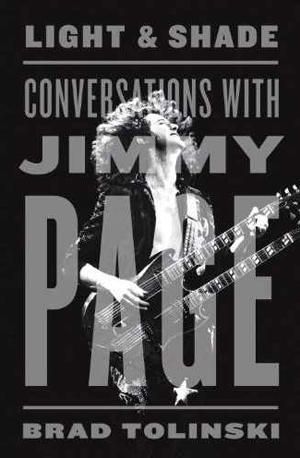
Light and Shade: Conversations with Jimmy Page, Brad Tolkinski (Virgin Books, 2012)
Front cover of Light and Shade Conversations with Jimmy Page by Brad Tolinski
I’ve seen too many bad bios about big beasts of the rock jungle to expect much when I pick up a new one, but I was pleasantly surprised by Light and Shade. It does descend into rock-journalese from time to time – Cream and Jimi Hendrix adopted “a new, heavily riff-driven mode of expression” in 1967, apparently – but the conversations with Page are interesting, intelligent, and even impish, as when Page reveals he can mock himself:

On your 1973 tour you started using your own private plane, the Starship. Was that a good thing, or did it just guarantee that the party could continue and you’d never have a moment of rest?

No, it was a good thing. It was a place where you could bring your music and books and create some semblance of continuity as you travelled from city to city. However, [our former tour manager] Richard Cole ran into one of the air hostesses on the Starship recently and she told him, “You know we made a lot of money off you guys,” and Cole asked her how. “Well,” she explained, “when people on the plane used to sniff cocaine, they’d roll up hundred-dollar bills to use as straws. Then after they were high or passed out, they’d forget about the money. So we would go around and grab all the money that was laying around.” That might’ve been true, but I’ll tell you one thing: They never got any of my money! [laughs]

(Ch. 7, “The tours were exercises in pure hedonism…”, pg. 172)

And now you know, if you didn’t already, why Page has the nickname “Led Wallet”: he has always been canny with his cash. But don’t be misled by the coke reference or the chapter-title: this isn’t Hammer of the Gods, the most notorious of the Zeppographies, so the sex’n’drugs side of Page’s rock’n’roll story doesn’t get anywhere near as much attention as his music, his metaphysics, and his mutating fashions. There aren’t many photos, but they’re all well-chosen and you can trace the evolution of Page’s looks, locks, and collaborations right from the 1960s to the present day. There are also contributions from John Paul Jones, Jack White of the White Stripes, publicists, guitar experts and fashionistas, so you do get a well-rounded portrait of an interesting and highly influential musician. I’m not a big Led Zeppelin fan and I still liked this book. And regretted the absence of an index. So it’s a shade light there. Otherwise, it should provide many pages of pleasure for Page-o-philes.

Guitardämmerung

Cover of Nation of Ashes by Man Will Destroy HimselfMan Will Destroy Himself, Nation of Ashes (2007)

I’ve enjoyed this album a lot. It’s short, sharp and psycho-sonically stimulating. It could be called sonic-ironic too. Hardcore, in the guitar sense, is an accelerated and intensified form of punk that first appeared in the late 1980s. It was then an extreme, bleeding-edge – and bleeding-ear – form of music. But now it has three decades of tradition behind it. One of the men who first championed it, the BBC D.J. John Peel (1939-2004), would be seventy-four if he were still alive today. This is from Peel’s auto/biography, Margrave of the Marshes (2004), which was begun by him but completed by his wife Sheila after he died of a heart-attack in Peru:

William [one of Peel’s sons] and I [his wife writes] went regularly with John to gigs that Extreme Noise Terror and Napalm Death played together at the Caribbean Centre in Ipswich. They were grimy, chaotic affairs attended largely by crusties wearing layers of shredded denim and dreadlocks thick as rope. The moshpit was like an initiation ritual – if you could make it out of there in one piece, you knew you could survive anything life had to throw at you. People would stagger out with nosebleeds, clutching their heads, complaining of double vision, drenched in sweat. And yet a good-natured atmosphere prevailed somehow. William, who was around thirteen at the time, took one look at these crusties, who mostly shunned bathing or showering, and decided that this was the musical sub-genre to which he wanted to pledge undying allegiance. His karate teacher attended the reggae nights upstairs at the Caribbean Centre, and would say to William on the way out, “What are you doing listening to that?” (Op. cit., pg. 387-8)

That extract sums up the music well: hardcore is adolescent and part of its early appeal was its ability to shock your parents and conventional society. Okay, the adolescent William Peel was attending Extreme Noise Terror gigs actually with his parents, but then John Peel was a permanent adolescent and the music didn’t appeal to the karate teacher. Before long, William Peel probably did something his father never did, namely begin to grow up. He would then have lost interest in hardcore. Or grindcore, as Sheila Peel calls it. I don’t think E.N.T. were grindcore (and neither do they, apparently) and I don’t think Napalm Death belong with E.N.T. or with Man Will Destroy Himself. For one thing, Napalm Death are crap. For another, they are, or became, much more metal and lost the grimy authenticity of E.N.T. and M.W.D.H.

Grime is authentic, after all: you’re closer to reality when you’re dirty and smelly and living in a squat, far from the nine-to-five conformity of deluded mainstream society. Or are you? In fact, the crusties – named from the crustiness of their unwashed skin and hair – could not have existed without the generous benefit-systems of Western Europe. Crusties sneered at straights – and lived off the taxes of straights. They bemoaned the brutal military-industrial complex – and were kept safe by it from a communist system that would not have tolerated their rebellion for a second. And, of course, they were using electricity to create and record their music. Not to mention benefitting from the transport network for food, the sewage network for hygiene, and the generally law-abiding, relatively uncorrupt societies that surrounded them and without which their “lifestyle” would have been impossible or unsustainable. If crusty political ideas had been realized – or are realized, because they’re alive and well in the Occupy movement – even crusties might begin to see that Western society was rather more complex and benign than they recognized.

But recognizing the complexity and benignity would get in the way of the self-righteousness that is another and essential part of hardcore’s adolescent appeal. You have to strip down your music to get the exciting speed and you have to strip down your ideas to get the exciting sneer. The first track on this album, “Subdivide”, begins with a sample from the end of the film Planet of the Apes (1968), when Charlton Heston learns, in a particularly dramatic and memorable way, where he has been all the time and what man has done with his super-sized brain. “Goddamn you all to Hell!” he cries – and the music swells up and screams off in that exciting, but by now very familiar, hardcore way. It’s an effective opening, but it reminds me of the term used of art by Aldous Huxley in Brave New World (1931): “emotional engineering”. The sample relies for its power on listeners’ previous knowledge of the film. Man has indeed destroyed himself – but in a science-fiction universe. The sample is effective, but insincere. Heston is acting and so, I feel, are M.W.D.H. The theme of nuclear armageddon was very well-trodden well before the ’noughties, when this album was released: Planet of the Apes appeared in 1968 and is based on a book published in 1963. Extreme Noise Terror were railing against the arms-trade from the beginning and E.N.T. have been assaulting ears, offending noses, and straining their throats for a long time now. Which is sonic-ironic: M.W.D.H. could never shock E.N.T. with their music, even though E.N.T. are probably old enough to be their dads.

Global warming, the apocalyptic theme now occupying the progressive community, isn’t so much fun to scream about: it’s slower and less obviously an act of malevolent free-will. But what about the much bigger threats posed not by man but by Mother Nature, with things like asteroid-strikes and mega-volcanoes? Well, hardcore bands have never worked themselves into self-righteous frenzies about those. How can you be self-righteous about billions of people dying if no human agency is involved? If we’re wiped out by an asteroid or a mega-volcano, it will be, at worst, a sin of omission. We could have spent more money researching the threat and inventing ways to prevent or avoid it. We’ve not been wiped out like that yet, but the threats remain and I think we should spend more money watching the skies, for example. But it’s difficult to get emotional about it: there are no self-righteous thrills to be found in nearby asteroids. Nuclear arsenals are different: men made those and men may use them. So you can get emotional about the threat. The strong sensations of hardcore aren’t supplied by just the speed and volume: the self-righteousness and sanctimony are important too. That’s why M.W.D.H. use that sample from Planet of the Apes and put nuclear missiles on the front cover of this album.

I don’t know whether they scream about global warming too, because I can’t understand the lyrics and haven’t found them on the web yet. The final track, “M.O.A.B.”, is presumably about the mega-munition called the “Mother Of All Bombs” by the U.S. military. Whether or not that bomb is the subject, it’s surprising how quickly you reach “M.O.A.B.”: this album whirls by and can seem even shorter than its actual running-time of twenty minutes. Hardcore is headlong, like sheets and shards of metal being blown along by a hurricane. And metal is a word that comes to mind a lot as you listen to this album. The sounds are metallic in an almost literal sense: strong but flexible, meaty but malleable. Nation of Ashes sounds like a sonic factory taking the raw ore of volume and hammering, twisting, and rolling it into shape. That’s appropriate for a form of music that depends on an advanced technological civilization, though it’s sonic-ironic because the music is being used to criticize that civilization. But Nation of Ashes also sounds metallic in a more strictly musical sense. As I’ve said, M.W.D.H. and E.N.T. aren’t metal bands like Napalm Death, but heavy metal does influence the sound of hardcore. There are throbbing, thundering passages between the headlong charges on this album, but that variety increases the power of the music. And has been doing so on hundreds of albums for thousands of days. So, as M.W.D.H.’s music pounds, listeners can ponder things like authenticity and originality.

I’ve certainly pondered my own originality while writing this review. I’m pleased with the title of the review – “Guitardämmerung” – but I’ve found from a web-search that it’s been used before. Other minds have worked like mine, noting the similarity between “guitar” and Götter. The point of a pun is to distort language and create a new sensation from something familiar. That’s also what punk did to rock music, and what hardcore did to punk: they were distortions for new sensations. Sometimes musical distortion is inadvertent: new forms of music, like new forms of life, can arise when there’s a mistake in copying. Or when the technology of the art does undesigned and originally unwanted things, like causing feedback. An accidental thing like that can then become something pursued and valued in its own right. Hardcore is about distortion in lots of ways: it uses distorted guitars and voices to protest about the distortion of society and justice. But this album isn’t distorted in one way: it adheres faithfully to the hardcore recipe first laid down in the late 1980s. So that’s sonic-ironic again.

“Guitardämmerung” also blends ideas in the way that hardcore blends punk and heavy metal. Götterdämmerung means “Twilight of the Gods” and refers to the cataclysmic end of the world in Norse mythology. Man Will Destroy Himself use electric guitars to create music about cataclysm and apocalypse, but are we now in the final stages of guitar-based music? Will hardcore, heavy metal, and other forms of rock exist much longer? I don’t think they will. There are cataclysms of various kinds ahead: political, social, scientific, and technological. The political and social cataclysms probably won’t be those foreseen by the self-righteous and sanctimonious crusty community (crummunity?). And that community may realize that it’s been working for political and social cataclysm in a lot of ways, rather than against it. The scientific and technological cataclysms will be more powerful and long-lasting in their effects – assuming science and technology survive what is ahead in politics and sociology. I don’t think the Deus Ex Machina, the electronically enhanced superhuman now in preparation, will be interested in loud guitars. But I’m not superhuman, or properly grown-up, and I am still interested in loud guitars. Although the music is quite different, this album makes me nostalgic – or prostalgic – in a similar way to the mediaeval ballads on Music of the Crusades. That music was traditional, and so, sonic-ironically, is hardcore, three decades after it first appeared. Hardcore expresses ugly emotions in an ugly way, but it’s still human. And Man is indeed about to be Destroyed.

Nation of Ashes is available for free at Last.fm


Elsewhere other-engageable:

Musings on Music