This Mortal Doyle

Challenger chopped and changed. That is to say, in one important respect, Arthur Conan Doyle’s character Professor Challenger lacked continuity. His philosophical views weren’t consistent. At one time he espoused materialism, at another he opposed it. He espoused it in “The Land of Mist” (1927):

“Don’t tell me, Daddy, that you with all your complex brain and wonderful self are a thing with no more life hereafter than a broken clock!”

“Four buckets of water and a bagful of salts,” said Challenger as he smilingly detached his daughter’s grip. “That’s your daddy, my lass, and you may as well reconcile your mind to it.”

But earlier, in “The Poison Belt” (1913), he had opposed it:

“No, Summerlee, I will have none of your materialism, for I, at least, am too great a thing to end in mere physical constituents, a packet of salts and three bucketfuls of water. Here ― here” ― and he beat his great head with his huge, hairy fist ― “there is something which uses matter, but is not of it ― something which might destroy death, but which death can never destroy.”

That story was published just over a century ago, but Challenger’s boast has not been vindicated in the meantime. So far as science can see, matter rules mind, not vice versa. Conan Doyle thought the same as the earlier Challenger, but Conan Doyle’s rich and teeming brain seems to have ended in “mere physical constituents”. To all appearances, when the organization of his brain broke down, so did his consciousness. And that concluded the cycle described by A.E. Housman in “Poem XXXII” of A Shropshire Lad (1896):

From far, from eve and morning
  And yon twelve-winded sky,
The stuff of life to knit me
  Blew hither: here am I.

Now – for a breath I tarry
  Nor yet disperse apart –
Take my hand quick and tell me,
  What have you in your heart.

Speak now, and I will answer;
  How shall I help you, say;
Ere to the wind’s twelve quarters
  I take my endless way. (ASL, XXXII)

Continue reading This Mortal Doyle

Slug is a Drug

Collins Complete Guide to British Coastal Wildlife
Collins Complete Guide to British Coastal Wildlife, Paul Sterry and Andrew Cleave (HarperCollins 2012)

Living by a river is good, but living by the sea is better. This means that the ideal might be Innsmouth:

The harbour, long clogged with sand, was enclosed by an ancient stone breakwater; on which I could begin to discern the minute forms of a few seated fishermen, and at whose end were what looked like the foundations of a bygone lighthouse. A sandy tongue had formed inside this barrier and upon it I saw a few decrepit cabins, moored dories, and scattered lobster-pots. The only deep water seemed to be where the river poured out past the belfried structure and turned southward to join the ocean at the breakwater’s end. (“The Shadow Over Innsmouth”, 1936)

Lovecraft would certainly have liked Collins Complete Guide to British Coastal Wildlife, a solid photographic guide to the flora and fauna of the British coast. There are some very Lovecraftian species here, both floral and faunal. Among the plants there’s sea-holly, Eryngium maritimum, a blue-grey shingle-dweller with gothically spiky and veined leaves. It has its own specialized parasite, Orobanche minor ssp. maritima, “an exclusively coastal sub-species” of common broomrape (pg. 94). Among the Lovecraftian animals there are the cephalopods (octopuses and squids), echinoderms (sea-urchins and starfish) and cnidarians (jellyfish and sea-anemones), but also the greater and lesser weever, Trachinus draco and Echiichthys vipera, which are “notorious fish, capable of inflicting a painful sting to a bather’s foot” (pg. 278).

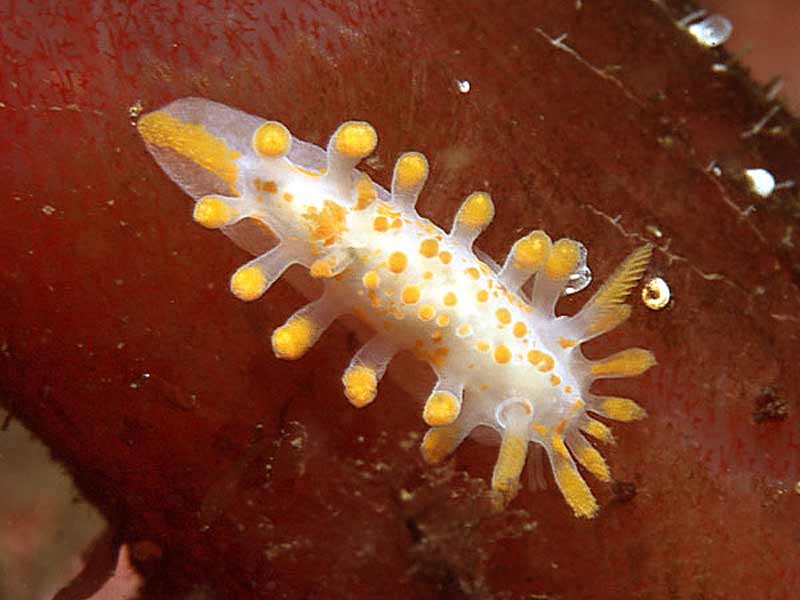
Limacia clavigera

Orange-clubbed sea-slug, Limacia clavigera


But the strangest and most wonderful creatures in the book might be the sea-slugs and sea-hares, which are brightly coloured or enigmatically mottled, with surreal knobs, furs and “rhinophores”, or head tentacles. If LSD took organic form, it might look like a sea-slug. Greilada elegans, “orange with blue spots”, Flabellina pedata, “purple body and pinkish-red cerata”, Catriona gymnata, “swollen, orange and white-tipped”, resemble the larvae of some eldritch interstellar race, destined to grow great and eat worlds (pp. 218-222 – “cerata” are “dorsal projections”). As it is, they stay tiny: the orange-clubbed sea-slug, Limacia clavigera, gets to 15mm on a diet of bryozoans, the miniature coral-like animals that are Lovecraftian in a different way. That “Limacia”, from the Latin limax, meaning “slug”, is a reminder that sea-slugs have an accurate common name, unlike Montagu’s sea snail, Liparis montagui, and the sea scorpion, Taurulus bubalis, which are both fish, and sea ivory, Ramalina siliquosa, which is a lichen. This book includes a land slug too, the great black, Arion ater, but it has none of the charm or beauty of its marine relatives.

Arion ater is included here because it’s “particularly common on coastal cliffs, paths and dunes” (pg. 239). The land snails that accompany it have charm, like the looping snail, Truncatella subcylindrica, and the wrinkled snail, Candidula intersecta, but they don’t have the beauty and variety of marine shell-dwellers, from the limpets, scallops and cockles to the wentletraps, cowries and whelks. And the violet snail, Jacintha jacintha, which rides the open ocean on a “‘float’ of mucus-trapped bubbles” as it feeds on the by-the-wind sailor, Velella velella. Layfolk would say that Velella and its relative Physalia physalis, the Portuguese man-o’-war, are jellyfish, but they’re actually “pelagic hydroids”. And Physalia is a colony of animals, not a single animal.
Sample page #1

Sample page #1


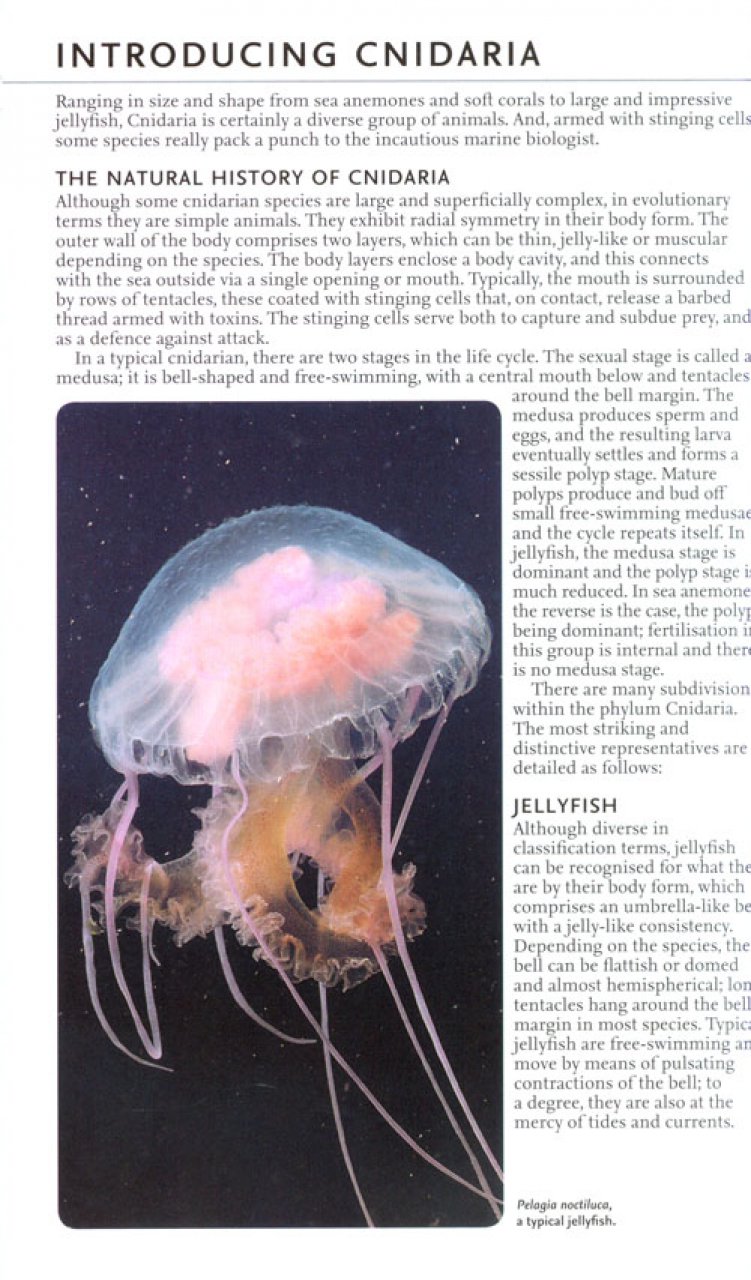
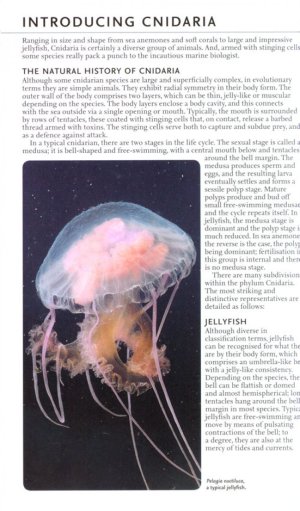
Both jellyfish and hydroids are related to sea-anemones and corals: they’re all classified as cnidaria, from the Greek κνιδη, knidē, meaning “nettle”. In short: they all sting. Some swim and sway too: the colours, patterns and sinuosity of the cnidaria are seductively strange. There are strawberry, snakelocks, gem, jewel, fountain and plumose anemones, for example: Actinia fragacea, Anemonia viridis, Aulactinia verrucosa, Corynactis viridis, Sargartiogeton laceratus and Metridium senile. The tentacles of the last-named look like a glossy head of white hair and the snakelocks anemone sometimes has green tentacles with purple tips.

After the cnidaria come the annelids, or segmented worms, which can be beautiful or repulsive, mundane or surreal, free-living or sessile. For example, the scaleworms are “unusual-looking polychaete worms whose dorsal surface is mostly or entirely covered with overlapping scales” (pg. 129). They’re reminiscent of the sea-slugs, though less strange and more subdued. But segmented worms gave rise to the wild variety of the crustaceans, including crabs, sea-slaters, lobsters and even barnacles, one species of which is a parasite: Sacculina carcini forms a “branching network” (pg. 178) within the body of a crab, particularly the green shore crab, Carcinus maenas. You would never guess that it was a barnacle and you might not guess that an infected crab was infected, because the yellow “reproductive structure” of the barnacle looks as though it belongs to the crab itself.
Sample page

Sample page #2


And there’s a photograph here to prove it. In fact, there are two: one in the barnacle’s own entry, the other in the entry for the green shore crab. I like the way the guide gives extra information like that. In the entries for sea-lavender, Limonium vulgare, and thrift, Armeria maritima, there are small photographs of insects that feed “only” or “almost exclusively” on these plants: the plume moth Agditis bennetii, with very narrow wings, and the more conventional moth Polymixis xanthomista (pg. 90), respectively. Those insects, with Fisher’s estuarine moth, Gortyna borelii, and the Sand Dart, Agrotis ripae, are stranded in the wild-flower section, as though they’ve been deposited there by a stray current. The fiery clearwing moth, Pyropteron chrysidiformis, is stranded in another way: in Britain, it’s “entirely restricted to stretches of grassy undercliff on the south coast of Kent”. It looks like a wasp wearing make-up. The scaly cricket, Pseudomogoplistes vincentae, isn’t attractive but is romantic in a similar way: it’s “confined to a handful of coastal shingle beaches in Britain and the Channel Islands” (pg. 17).

Also confined is the bracket fungus Phellinus hippophaeicola, which is “found only” on the trunks of sea buckthorn, Hippophae rhamnoides (pg. 54). Its photograph appears with its host, but the full fungus section is only one page anyway. It includes the “unmistakable” dune stinkhorn, Phallus hadriani, whose scientific name means “Hadrian’s dick”. It’s “restricted to dunes and associated with Marram” grass (pg. 50). But fungi flourish best away from the coast. Not that “flourish” is the right word, because fungi don’t flower. Nor do seaweeds, the giant algae that have to survive both battering by the waves and exposure to sun and wind. They cope by being tough: leathery or horny or chalky or coralline. And though their colours are limited mostly to green, brown and red, their geometry is very varied: leafy, membranous, thong-like, ribbon-like, whip-like, fan-like, feather-like, even globular: punctured ball weed, Leathesia difformis, and oyster thief, Colpomenia peregrina, for example. The book doesn’t explain why “oyster thief” is called that. Landlady’s wig, Desmarestia aculeata, red rags, Dilsea carnosa, and bladder wrack, Fucus vesiculous, are self-explanatory.

And there’s a bluntness to names like wrack, kelp and the various weeds – bean-weed, bead-weed, wire-weed – that go well with the rough, tough life these plants lead. That’s why rainbow wrack, Cystoseria tamariscifolia, sounds so odd. But it lives up to its name: it’s “bushy and iridescent blue-green underwater” (pg. 36).

Seaweeds are at the beginning of the book; birds, fish and mammals are at the end. After the strangeness, surreality and beauty of some of the plants and invertebrates, the higher animals can seem almost mundane. Evolution hasn’t found as many spinal solutions as non-spinal, because the invertebrates have been around much longer. Among the vertebrates, it’s been working longest on the fish, so the variety of shapes is greatest there: rays and flounders, lampreys and eels, sea-horses and pipe-fish, the giant sun-fish and the largest animal native to Britain, the basking shark, Cetorhinus maximus. Some of the names seem ancient and long-evolved too: saithe, pogge, goldsinny, weever, dab, goby, blenny, shanny and brill. The last-named, Scophthalmus rhombus, is a flatfish with a typically ugly head. As the book notes: “In their early stages, they resemble conventional species. But during their development the head shape distorts so that, although they lie and swim on their sides, both eyes are on top” (pg. 257).

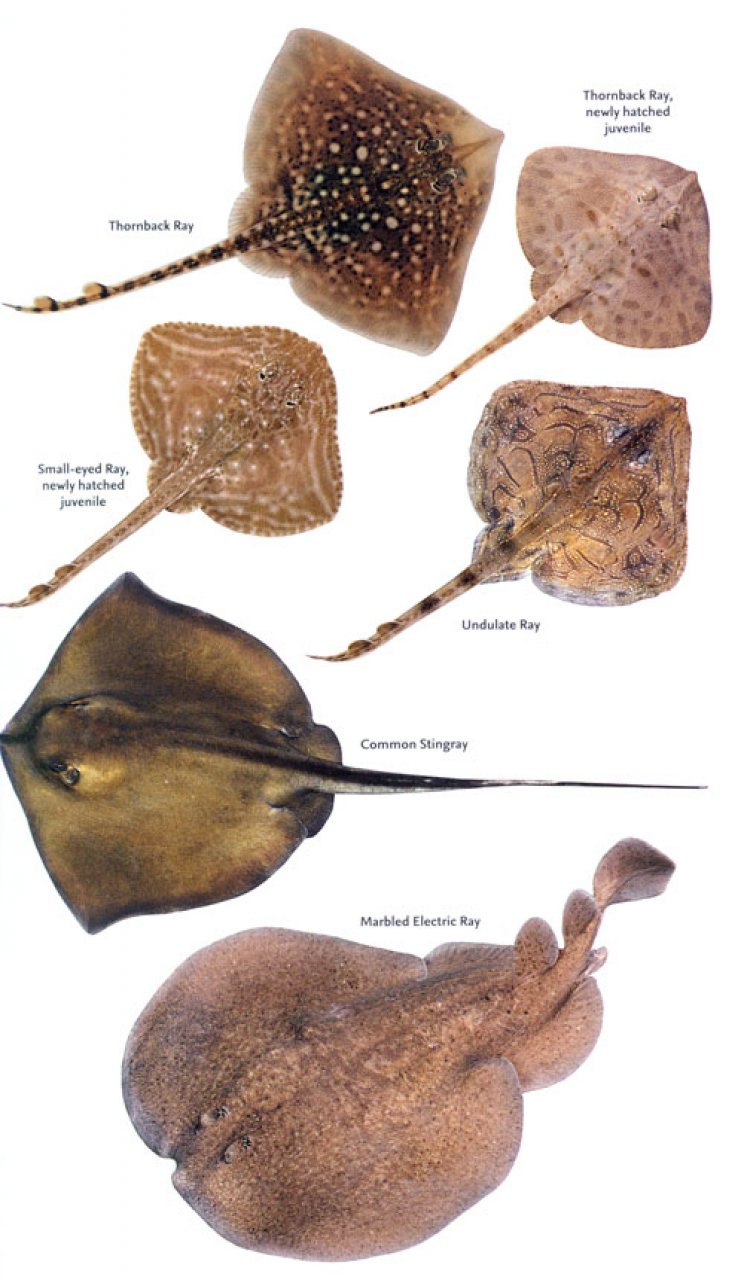
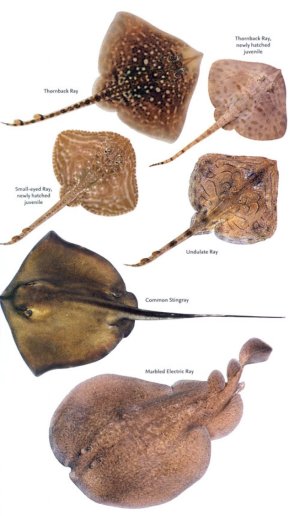
The rays aren’t distorted like that: they lie on their bellies, not on their sides, so their eyes don’t look distorted. Evolution has taken two different routes to the same ecological niche, the sea-floor. Camouflage is useful there, so both rays and flatfish have beautiful patterns: specklings, mottlings and spots. Other fish are colourful, but British fish can’t match the rainbow variety of fish in the tropics. Nor can British birds. The kingfisher, Alcedo atthis, is a rare exception and it “favours fresh waters”, except in winter (pg. 328). Truly coastal birds can be hard to tell apart: the knot, Calidris canutus, and the Sanderling, Calidris alba, are not as distinctive as their common names. Nor are the whimbrel, Numenius phaeopus, and the curlew, Numenius arquata. Both have long down-curved beaks and streaked, “grey-brown plumage” (pg. 342). But the whimbrel is smaller and rarer.

The gulls and terns can also be hard to tell apart, as can the skuas that prey on and parasitize them. “Skua”, which comes from Old Norse skúfr, is a good name for a gangster-like bird. I prefer “gull” in what is probably its original form, the Welsh gŵylan. The French mouette, for small gulls, and goéland, for large ones, are also good, and some French bird-names are used in English: avocet, plover and guillemot, for example. “Plover” is from Latin pluvia, “rain”, but the reference is “unexplained”, according to the Oxford English Dictionary. The reference of “ruff” might seem to be obvious: the male ruff, Philomachus pugnax, has a ruff of feathers in the breeding season, like a kind of gladiatorial costume: its scientific name literally means “the pugnacious lover-of-fighting”. But the female of this species is called a reeve, so perhaps ruffs have nothing to do with ruffs: the feminine form, “apparently made … by a vowel change (cf. fox vixen) suggests that [ruff] is an older word and separate” (OED).

This book uses “ruff” for both sexes: it doesn’t have space to chase etymology and give more than brief details of the hundreds of species it covers. The final species are the mammals and the final mammals are the ones that have returned to the sea: whales, dolphins and seals. After them comes a brief section on “The Strandline”:

A beach marks the zone where land meets sea. It is also where detached and floating matter is washed up and deposited by the tides, typically in well-defined lines. During periods of spring tides, debris is pushed to the top of the shore. But with approaching neap tides, tide extremes diminish and the high-tide mark drops; the result is a series of different strandlines on the shore. The strandline is a great place for the marine naturalist to explore and find unexpected delights washed up from the depths. But it is also home to a range of specialised animals that exploit the rich supply of organic matter created by decomposing seaweeds and marine creatures. (pg. 368)

Those specialised animals – sand-hoppers, kelp-flies and so on – have been covered earlier in the book, so this section covers things like skeletons, skulls, fossils and egg-cases – the “sea wash balls” laid by whelks and the “mermaid’s purses” laid by rays. Then there are “sea-beans”, tree-seeds that may have “drifted across the Atlantic from the Caribbean or Central America”. At first glance, seaweeds also seem to make a come-back in this section. Not so: a bryozoan branches like a plant but is “actually a colonial animal that lives just offshore attached to shells and stones”. Bryzoans are often washed ashore after storms. One of the commonest is hornwrack, Flustra foliacea, of which “fresh specimens smell like lemon” (pg. 254). When I first noticed that for myself, I thought I was having an olfactory hallucination. That’s the sea for you: always changing, always surprising. This book captures its complexity in 384 well-designed pages full of eye- and brain-candy.

No Plaice Like Olm

European Reptile and Amphibian Guide by Axel KwetEuropean Reptile and Amphibian Guide, Axel Kwet (New Holland 2009)

An attractive book about animals that are mostly attractive, sometimes strange, always interesting. It devotes photographs and descriptive text to all the reptiles and amphibians found in Europe, from tree-frogs to terrapins, from skinks to slow-worms. Some of the salamanders look like heraldic mascots, some of the lizards like enamel jewellery, and some of the toads like sumo wrestlers with exotic skin-diseases. When you leaf through the book, you’ve moving through several kinds of space: geographic and evolutionary, aesthetic and psychological. Europe is a big place and has a lot of reptilian and amphibian variety, including one species of turtle, the loggerhead, Caretta caretta, and one species of chameleon, the Mediterranean, Chamaeleo chamaeleon.

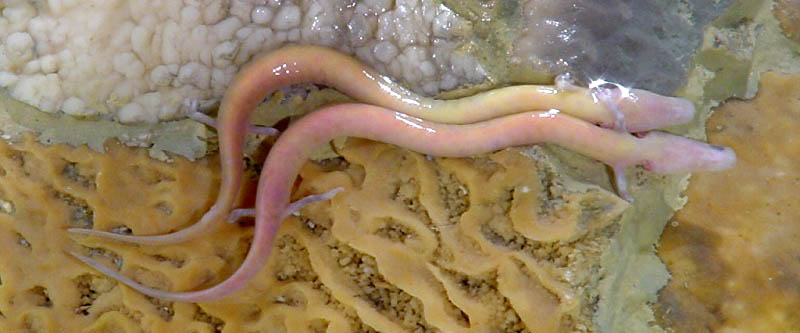
But every species, no matter how dissimilar in size and appearance, has a common ancestor: the tiny crested newt (Triturus cristatus) to the far north-west in Scotland and the two-and-a-half metre whip snake (Dolichophis caspius) to the far south-east in Greece; the sun-loving Hermann’s tortoise (Testudo hermanni), with its sturdy shell, and the pallid and worm-like olm (Proteus anguinus), which lives in “underground streams in limestone karst country along the coast from north-east Italy to Montenegro” (pg. 55). Long-limbed or limbless, sun-loving or sun-shunning, soft-skinned or scaly – they’re all variations on a common theme.

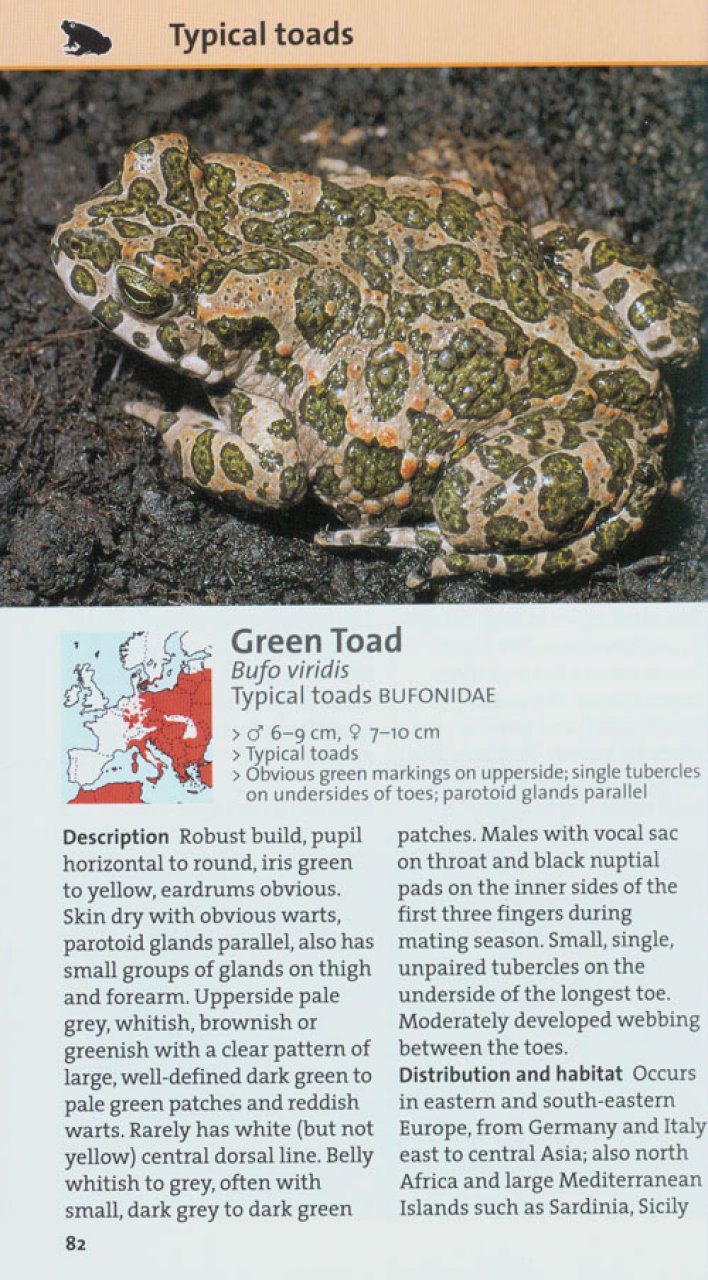
Sample page

Sample page from European Reptile and Amphibian Guide


And that’s where aesthetic and psychological space comes in, because different species and families evoke different impressions and emotions. Why do snakes look sinister and skinks look charming? But snakes are sinuous too and in a way it’s a shame that a photograph can capture their endlessly varying loops and curves as easily as it can capture the ridigity of a tortoise. At one time a book like this would have had paintings or drawings. Nowadays, it has photographs. The images are more realistic but less enchanted: the images are no longer mediated by the hand, eye and brain of an artist. But some enchantment remains: the glass lizard, Pseudopus apodus, peering from a holly bush on page 199 reminds me of Robert E. Howard’s “The God in the Bowl”, because there’s an alien intelligence in its gaze. Glass lizards are like snakes but can blink and retain “tiny, barely visible vestiges of the hind legs” (pg. 198).

Other snake-like reptiles retain vestiges of the fore-limbs too, like the Italian three-toed skink (Chalcides chalcides). The slow-worm, Anguis fragilis, has lost its limbs entirely, but doesn’t look sinister like a snake and can still blink. Elsewhere, some salamanders have lost not limbs but lungs: the Italian cave salamander, Speleomantes italicus, breathes through its skin and the lining of its mouth. So does Gené’s cave salamander, Speleomantes genei, which is found only on the island of Sardinia. It “emits an aromatic scent when touched” (pg. 54). Toads can emit toxins and snakes can inject venoms: movement in evolutionary space means movement in chemical space, because every alteration in an animal’s appearance and anatomy involves an alteration in the chemicals created by its body. But chemical space is two-fold: genotypic and phenotypic. The genes change and so the products of the genes change. The external appearance of every species is like a bookmark sticking out of the Book of Life, fixing its position in gene-space. You have to open that book to see the full recipe for the animal’s anatomy, physiology and behaviour, though not everything is specified by the genes.

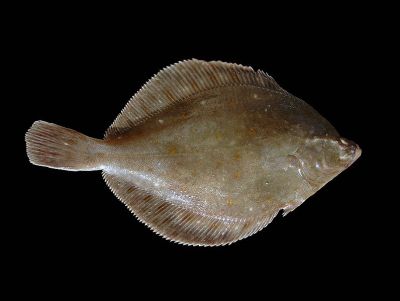
Pleuronectes platessa on the sea-floor

Pleuronectes platessa on the sea-floor


The force of gravity is one ingredient in an animal’s development, for example. So is sunlight or its absence. Or water, sand, warmth, cold. The descendants of that common ancestor occupy many ecological niches. And in fact one of those descendants wrote this book: humans and all other mammals share an ancestor with frogs, skinks and vipers. Before that, we were fish. So a plaice is a distant cousin of an olm, despite the huge difference in their appearance and habitat. One is flat, one is tubular. One lives in the sea, one lives in caves. But step by step, moving through genomic and topological space, you can turn a plaice into an olm. Or into anything else in this book. Just step back through time to the common ancestor, then take another evolutionary turning. One ancestor, many descendants. That ancestor was itself one descendant among many of something even earlier.
Olm in a Slovenian cave

Olm in a Slovenian cave


But there’s another important point: once variety appeared, it began to interact with itself. Evolutionary environment includes much more than the inanimate and inorganic. We mammals share more than an ancestor with reptiles and amphibians: we’ve also shared the earth. So we’re written into their genes and some of them are probably written into ours. Mammalian predators have influenced the evolution of skin-colour and psychology, making some animals camouflaged and cautious, others obtrusive and aggressive. But it works both ways: perhaps snakes seem sinister because we’re born with snake-sensitive instincts. If it’s got no limbs and it doesn’t blink, it might have a dangerous bite. That’s why the snake section of this book seems so different to the salamander section or the frog section. But all are interesting and all are important. This is a small book with some big themes.

Ghosts in the Cathedral

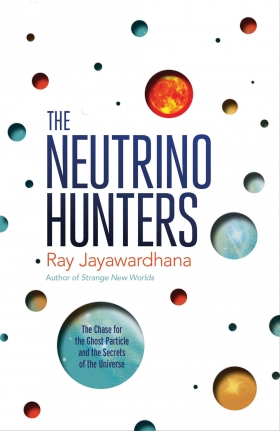
Front cover of The Neutrino Hunters by Ray JayawardhanaThe Neutrino Hunters: The Chase for the Ghost Particle and the Secrets of the Universe, Ray Jayawardhana (Oneworld 2013)

An easy read on a difficult topic: Ray Jayawardhana takes some complicated ideas and makes them a pleasure to absorb. Humans have only recently discovered neutrinos, but neutrinos have always known us from the inside:

…about a hundred trillion neutrinos produced in the nuclear furnace at the Sun’s core pass through your body every second of the day and night, yet they do no harm and leave no trace. During your entire lifetime, perhaps one neutrino will interact with an atom in your body. Neutrinos travel right through the Earth unhindered, like bullets cutting through a fog. (ch. 1, “The Hunt Heats Up”, pg. 9)

In a way, “ghost particle” is a misnomer: to neutrinos, we are the ghosts, because they pass through all solid matter almost as though it’s not there:

Neutrinos are elementary particles, just like electrons that buzz around atomic nuclei or quarks that combine to make protons and neutrons. They are fundamental building blocks of matter, but they don’t remain trapped inside atoms. Also unlike their subatomic cousins, neutrinos carry no electric charge, have a tiny mass and hardly ever interact with other particles. A typical neutrino can travel through a light-year’s worth of lead without interacting with any atoms. (ch. 1, pg. 7)

That’s a lot of lead, but a little of neutrino. With a different ratio – a lot less matter and a lot more neutrino – it’s possible to detect them on earth. Because so many are passing through the earth at any moment, a large piece of matter watched for long enough will eventually catch a ghost. So neutrino-hunters sink optical sensors into the transparent ice of the Antarctic and fill huge tanks with carbon tetrachloride or water. Then they wait:

Every once in a while, a solar neutrino would collide with an electron in the water and propel it forward, like a billiard ball that’s hit head-on. The fast-moving electron would create an electromagnetic “wake”, or cone of light, along its path. The resulting pale blue radiation is called “Cherenkov radiation”, after the Russian physicist Pavel Cherenkov, who investigated the phenomenon. Phototubes lining the inside walls of the tank would register each light flash and reveal an electron’s interaction with a neutrino. The Kamiokande provided two extra bits of information to researchers: from the direction of the light cone scientists would infer the direction of the incoming neutrino and from its intensity they could determine the neutrino’s energy. (ch. 4, “Sun Underground”, pg. 95)

That’s a description of a neutrino-hunt in “3,000 tons of pure water” in a mine “150 miles west of Tokyo”: big brains around the world are obsessed with the “little neutral one”. That’s what “neutrino” means in Italian, because the particle was named by the physicist Enrico Fermi (1901-54) after the original proposal, “neutron”, was taken over by another, and much bigger, particle with no electric charge. Fermi was one of the greatest physicists of all time and oversaw the first “controlled nuclear chain reaction” at the University of Chicago in 1942. That is, he helped build the first nuclear reactor. Like the sun, reactors are rich sources of neutrinos and because neutrinos pass easily through any form of shielding, a reactor can’t be hidden from a neutrino-detector. Nor can a supernova: one of the most interesting sections of the book discusses the way exploding stars flood the universe with a lot of light and a lot more neutrinos:

Alex Friedland of the Los Alamos National Laboratory explained that a supernova is in essence a “neutrino bomb”, since the explosion releases a truly staggering number – some 10^58, or ten billion trillion trillion trillion trillion – of these particles. … In fact, the energy emitted in the form of neutrinos within a few seconds is several hundred times what the Sun emits in the form of photons over its entire lifetime of nearly 10 billion years. What’s more, during the supernova explosion, 99 percent of the precursor star’s gravitational binding energy goes into the neutrinos of all flavors, while barely half a percent appears as visible light. (ch. 6, “Exploding Star”, pg. 125)

That light is remarkably bright, but it can be blocked by interstellar dust. The neutrinos can’t, so they’re a way to detect supernovae that are otherwise invisible. However, Supernova 1987A was highly visible: a lot of photons were captured by a lot of telescopes when it flared in the Large Magellanic Cloud. Nearly four hours before that, a few neutrino-detectors had captured far fewer neutrinos:

Detecting a grand total of two dozen particles may not sound like much to crow about. But the significance of these two dozen neutrino events is underlined by the fact that they have been the subject of hundreds of scientific papers over the years. Supernova 1987A was the first time that we had observed neutrinos coming from an astronomical source other than the Sun. (ch. 6, pg. 124)

The timing of the two dozen was very important: it came before the visible explosion and “meant that astrophysicists like Bahcall and his colleagues were right about what happened during a supernova explosion” (pg. 123). That’s John Bahcall (1931-2005), an American who wanted to be a rabbi but ended up a physicist after taking a science course during his philosophy degree at Berkeley. He had predicted how many solar neutrinos his colleague Raymond Davis (1914-2006) should detect interacting with atoms in a giant tank of “dry-cleaning fluid”, as carbon tetrachloride is also known. But Davis found “only a third as many as Bahcall’s model calculation predicted” (ch. 4, pg. 90). Was Davis missing some? Was Bahcall’s model wrong? The answer would take decades to arrive, as Davis refined his apparatus and Bahcall re-checked his calculations. This book is about several kinds of interaction: between neutrinos and atoms, between theory and experiment, between mathematics and matter. Neutrinos were predicted with maths before they were detected in matter. The Austrian physicist Wolfgang Pauli (1900-58) produced the prediction; Davis and others did the detecting.

The Super-Kamiokande neutrino-cathedral

The Super-Kamiokande neutrino-cathedral (click for larger image)

Pauli was famously witty; another big brain in the book, the Englishman Paul Dirac (1902-84), was famously taciturn. Big brains are often strange ones too. That’s part of why they’re attracted to the very strange world of atomic physics. Jayawardhana also discusses the Italian physicist Ettore Majorana (1906-?1938), who disappeared at the age of thirty-two, and his colleague Bruno Pontecorvo (1913-93), who defected to the Soviet Union. Neutrinos are fascinating and so are the humans who have hunted for them. So is the history that surrounded them. Quantum physics was convulsing science at the same time as communism and Nazism were convulsing Europe. As the Danish physicist Niels Bohr (1885-1962) said: “Anyone who is not shocked by quantum theory has not understood it.” Modern physicists have been called a new priesthood, devoted to lofty and remote ideas incomprehensible and irrelevant to ordinary people. But ordinary people fund the devices the priests build to pursue their ideas with. And some of the neutrino-detectors pictured here are as huge and awe-inspiring as cathedrals. Some might say they’re as futile as cathedrals too. But if understanding the universe isn’t enough in itself, there may be practical uses for neutrinos on the way. At present, we have to communicate over the earth’s surface; a beam of neutrinos can travel right through the earth.

The universe is also a dangerous place: some scientists theorized that the neutrino deficit in Ray Davis’s experiments meant the sun was about to go nova. It wasn’t, but neutrinos may help the human race spot other dangers and exploit new opportunities. We still know only a fraction of what’s out there and the ghost particle is a messenger from the heart not only of supernovae and the sun, but also of the earth itself. There’s radioactivity deep in the earth, so there are neutrinos streaming upward. As methods of detecting them get better, we’ll understand the interior of the earth better. But Jayawardhana doesn’t discuss another possibility: that we might even discover advanced life down there, living under huge pressures at very high temperatures, as Arthur C. Clarke suggested in his short-story “The Fires Within” (1949).

Clarke also suggested that life could exist inside the sun. There’s presently no way of testing his ideas, but neutrinos may carry even more secrets than standard science has guessed. Either way, I think Clarke would have enjoyed this book and perhaps Jayawardhana, who’s of Sri Lankan origin, was influenced by him. Jayawardhana’s writing certainly reminds me of Clarke’s writing. It’s clear, enthusiastic and a pleasure to read, wearing its learning lightly and carrying you easily over vast stretches of space and time. The Neutrino Hunters is an excellent introduction to the hunters, the hunted and the history, with a good glossary and index too.


Previously pre-posted (please peruse):

Think Ink – Review of 50 Quantum Physics Ideas You Really Need to Know

Guns’n’Gladioli

Front cover of A Light That Never Goes Out by Tony FletcherA Light That Never Goes Out: The Enduring Saga of the Smiths, Tony Fletcher (Windmill Books 2013)

Coke, booze, earsplitting volume. Not a combination you associate with the Smiths. But it was there, as you’ll learn from this book. Towards the end, they were almost turning into Guns’n’Gladioli. Morrissey, of course, was the odd one out: he wasn’t battering his brain-cells with drink and drugs on their final American tour. But back home his Lichtmusik was also lout-music: the Smiths didn’t just appeal to bedsit miserabilists in rain-hammered humdrum towns. No, they appealed to some football hooligans too, including a Chelsea fan who didn’t mind being asked, “You still wanking off over that miserable northern poof?” as he travelled north by train to do battle with Manchester United and Manchester City, who also supplied hoolifans to the Smiths (pp. 509-10). So did football clubs in Glasgow and Edinburgh. The Smiths are easy to caricature, but the caricatures don’t capture their complexity.

Tony Fletcher does capture it: the band, their music, their fans, friends, producers, studio-engineers and record-labels. He’s definitely a Guardianista, but his prose is plodding rather than painful and he does a good job of putting the poof and his partners into context. The 1980s is one important part of that context. So are Irish Catholicism and Manchester. When you look at pictures of the Smiths, you can see two clear divisions. One of them separates the singer, guitarist and drummer from the bassist: the dark-haired, bushy-browed, strong-faced Morrissey, Johnny Marr and Andy Rourke clearly belong to one race and the light-haired, lesser-browed, milder-faced Mike Joyce to another. They’re Irish and he’s English: the British Isles are rich in language and rich in biology too. But Morrissey’s height and handsomeness also separate him from Marr, Rourke and Joyce, like his polysyllabic name. Both must be related to his intelligence, his creativity and his ability to turn himself into the Pope of Mope and become much more famous than any of the other three. Fletcher doesn’t talk about this biology – as I said, he’s a Guardianista – but it’s implicit in his descriptions of Irish settlement in Manchester and of Morrissey’s genius.

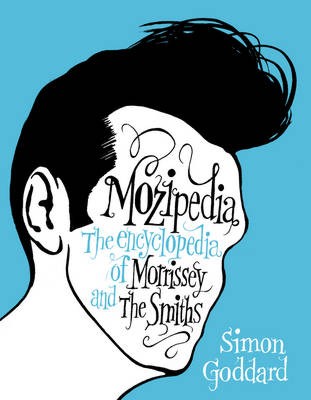
Is that too strong a word? Maybe. Morrissey is certainly the interesting and original one in this book and it ends with his story only just beginning. You can feel the tug of his later career throughout the book: it’s not discussed, but you know it’s there. But Fletcher isn’t concentrating on Morrissey and doesn’t seem very interested in Carry On and Brit-film in the 1960s, so he’s less good on what might be called the Smythos: the world created by Morrissey in his lyrics and interviews. Morrissey’s influences are better explained in Simon Goddard’s Mozipedia (2009), which isn’t just about the New York Dolls, the Cockney Rejects and vegetarianism. It has also entries for everyone from Hawtrey and Housman to Williams and Wilde by way of Sandy Shaw, Shelagh Delaney and Jobriath. No-one will ever devote an encyclopaedia to Marr like that: music doesn’t have as much meaning and metaphor in it. It has emotion and beauty instead and Fletcher is good at describing how Marr created a lot of both on albums like Meat Is Murder and Strangeways Here We Come.

Front cover of Mozipedia by Simon Goddard

Front cover of Mozipedia by Simon Goddard

I’ve never liked him much, though. I like what he did with the guitar and in the studio, but I don’t like what he did to his body and mind. Or what he put on his body: he didn’t have Mozza’s way with weeds either. In the photos, you can clearly see Morrissey’s narcissism and Marr’s weediness. It’s no surprise that Marr smoked a lot of marijuana, preferred working at night and didn’t eat properly. But he’s weedy in more ways than the physical: there’s also a photo of him with Billy Bragg, the committed socialist behind Red Wedge. This was a collective of musicians and bands who wanted to make the world a better place by fighting Fatcher, fascism and free speech with their fantastic music. Morrissey had his lefty opinions too, but he didn’t like collectives and he didn’t scorn just Margaret Thatcher and the Queen: Bob Geldof and Live Aid got the sharp side of his tongue too. Which is good. Mozza is worshipped by Guardianistas, but he’s not a Guardianista himself.

Or not wholly. The hive-mind hasn’t been able to hum him fully into line, unlike Marr and Bragg. As for Rourke and Joyce: their politics don’t matter and the most interesting thing one of them does in this book is get stung by a sting-ray (pp. 539-40). They were competent musicians, but they weren’t essential to the Smiths. Joyce is most important for causing trouble, not for strumming his bass: first there was the heroin addiction, then the 21st-century court-case in which he sued for more money and earnt Morrissey’s undying enmity. Fletcher barely mentions the court-case and ends the book in the 1980s, with the Smiths exhausted, antagonistic and unfulfilled. They never achieved their full potential and though few bands do, few bands have had more to offer than the Smiths. The Beatles were one and managed to offer it from the nearby northern city of Liverpool. They were Irish Catholic too. But, like the Smiths, they achieved success in England, not Ireland. That’s important and the younger band captured it in their name. “Smiths” is an Anglo-Saxon word with ancient roots and difficult phonetics. It seems simple, but it isn’t. Rather like light.

Think Ink

Front cover of 50 Quantum Physics Ideas You Really Need to Know by Joanne Baker50 Quantum Physics Ideas You Really Need to Know, Joanne Baker (Quercus 2013)

A very good introduction to a very difficult subject. A very superficial introduction too, because it doesn’t use proper mathematics. If it did, I’d be lost: like most people’s, my maths is far too weak for me to understand quantum physics. Here’s one of the side-quotes that help make this book such an interesting read: “We must be clear that when it comes to atoms, language can be used only as in poetry.”

That’s by the Jewish-Danish physicist Niels Bohr (1885-1962). It applies to quantum physics in general. Without the full maths, you’re peering through a frost-covered window into a sweetshop, you’re not inside sampling the wares. But even without the full maths, the concepts and ideas in this book are still difficult and challenging, from the early puzzles thrown up by the ultra-violet catastrophe to the ingenious experiments that have proved particle-wave duality and action at a distance.

But there’s a paradox here.

Continue reading: Think Ink

Brit Bot Book

Front cover of Reader's Digest Field Guide to the Wild Flowers of Britain
Reader’s Digest Field Guide to the Wild Flowers of Britain, J.R. Press et al, illustrated Leonora Box et al (1981)

This is probably the best introduction to British wild flowers that I’ve seen: drawings, photographs and text complement each other perfectly over more than four hundred pages. Despite being compact, it’s a little heavy to be a good field guide, but it would be useful in every British field, wasteland and marsh. From Indian balsam (Impatiens glandulifera) to flowering-rush (Butomus umbellatus) by way of green alkanet (Pentaglottis sempervirens), it’s got a lot, if not the lot (no Mycelis muralis, or wall lettuce, for example). The drawings are skilful, detailed, and often show the plant growing with different species in its habitat, which prepares the eye for identifying it in situ. The drawings also often have the adventitious additions that make David N. Pegler’s Pocket Guide to Mushrooms and Toadstools more enjoyable too, like the half-brick with Canadian fleabane (Conyza canadensis), the chewing-gum wrapper with sea mayweed (Matricaria maritima) and the frog with water violet (Hottonia palustris).

The drawings dominate the page devoted to each plant, but there’s a small photograph of a living specimen too, though “small” doesn’t always mean undramatic. Sea thrift (Armeria maritima) is shown growing quietly on a cliff-top with swirling sea and towering rocks beyond and below it. The photo sums up the book: wild flowers are often delicate and unobtrusive, but they illustrate some grand themes of evolution and biology, from ecological webs to mimicry, parasitism and toxicology: dead-nettles (Lamium spp.) mimick nettles, broomrape (Orobanche spp.) parasitizes broom, clover and more, and lots of British plants can kill you, sicken you or drive you insane, from hemlock (Conium maculatum) to henbane (Hyoscyamus niger). The book explores some grand themes of culture too: the text mixes serious botany with folklore, cuisine, herbalism, and literature. Pignuts (Conopodium majus) appear in The Tempest, for example, and in Ireland “were thought to be the food of leprachauns”. The etymologies aren’t always trustworthy — the “-ard” of “mustard” doesn’t mean ardente, “burning” — but that makes the book itself part of folklore and adds to the plants’ appeal. Highly recommended in this first edition.

Magna Mater Marina

Front cover of The Illustrated World Encyclopedia of Marine Fish and Sea CreaturesThe Illustrated World Encyclopedia of Marine Fish and Sea Creatures, Amy-Jane Beer and Derek Hall (Lorenz Books, 2007)

Books about marine life need to be big, like this one, because the sea is a big place and has been occupied for far longer than the land. You’ll learn here that some land creatures have even returned to it, like the ancestors of cetaceans (whales et al), sirenians (dugongs and manatees), and sea-snakes. The saltiness of human blood means that we each carry around a miniature ocean of our own, symbol of our own marine ancestry. The Illustrated World Encyclopedia of Marine Fish and Sea Creatures is an excellent guide to the remainers and the returners of our ancient home. It isn’t a proper scientific encyclopedia, but you can get a good sense of the richness and variety of marine life here, from jellyfish to electric rays by way of the deep-water sea-cucumber, Irpa abyssicola, and the very strange tripod fish, Bathypterois grallator.

Bathypterois grallator

The tripod fish, Bathypterois grallator

That scientific name literally means “the deep-wing stilt-walker”, because the tripod fish lives very deep, up to 3·5km down, and props itself up on extended fin-rays to save energy on swimming. Its tiny prey float towards to it on the current: it isn’t an active hunter. It’s also hermaphroditic, so that each fish can fertilize its own eggs if, thanks to depth and darkness, it doesn’t find a mate. Unlike many other deep-sea fish, however, it isn’t particularly ugly or grotesque and wouldn’t easily find place in an H.P. Lovecraft story. Vampyroteuthis infernalis, or “the vampire squid from hell”, definitely would. It looks rather like an animated umbrella, with dark webs between its tentacles and huge, light-thirsty eyes.

Sea anemones by Ernst Haeckel

Sea anemones by Ernst Haeckel

Elsewhere there’s proof that the sea contains not just abysmal ugliness but sublime beauty too, from cone shells (Conus spp.) and jewel “anemones” (Corynactis viridis) (really a form of coral, the book notes) to gorgeous fish like the copperband butterflyfish (Chelmon rostratus) and the Moorish idol (Zanclus cornutus). And the greater blue-ringed octopus (Hapalochlaena lunulata) is beautiful too, despite the “toxin in its saliva estimated to be 10,000 times more deadly than cyanide”. There isn’t enough here about plankton, which can be strange, ugly, and beautiful, but plankton could fill several encyclopedias, and this one does incorporate some more recent scientific discoveries, including the marine life that doesn’t depend ultimately on sunlight, however deep down dark it lives. The giant beardworm, Riftia pachyptila, lives in symbiosis with sulphide-digesting bacteria at hydrothermal vents on the ocean floor. It’s not part of the sun-chain and might have homologues beneath the ice-cap of Jupiter’s moon Europa. Life needs liquid, so far as we can see, and certainly on earth it had to get its start there. This book is an excellent introduction to the great biological cradle that is the sea and would be an ideal gift for a budding marine biologist or scientifically inclined sailer or fisherman.


Elsewhere other-posted:

Guise and Molls — review of Octopus: The Ocean’s Intelligent Invertebrate (2010)
Mental Marine Music — the band who supplied the title of this review