Factory Records

The factors of n are those numbers that divide n without remainder. So the factors of 6 are 1, 2, 3 and 6. If the function s(n) is defined as “the sum of the factors of n, excluding n, then s(6) = 1 + 2 + 3 = 6. This makes 6 a perfect number: its factors re-create it. 28 is another perfect number. The factors of 28 are 1, 2, 4, 7, 14 and 28, so s(28) = 1 + 2 + 4 + 7 + 14 = 28. Other perfect numbers are 496 and 8128. And they’re perfect in any base.

Amicable numbers are amicable in any base too. The factors of an amicable number sum to a second number whose factors sum to the first number. So s(220) = 284, s(284) = 220. That pair may have been known to Pythagoras (c.570-c.495 BC), but s(1184) = 1210, s(1210) = 1184 was discovered by an Italian schoolboy called Nicolò Paganini in 1866. There are also sociable chains, in which s(n), s(s(n)), s(s(s(n))) create a chain of numbers that leads back to n, like this:

12496 → 14288 → 15472 → 14536 → 14264 → 12496 (c=5)

Or this:

14316 → 19116 → 31704 → 47616 → 83328 → 177792 → 295488 → 629072 → 589786 → 294896 → 358336 → 418904 → 366556 → 274924 → 275444 → 243760 → 376736 → 381028 → 285778 → 152990 → 122410 → 97946 → 48976 → 45946 → 22976 → 22744 → 19916 → 17716 → 14316 (c=28)

Those sociable chains were discovered (and christened) in 1918 by the Belgian mathematician Paul Poulet (1887-1946). Other factor-sum patterns are dependant on the base they’re expressed in. For example, s(333) = 161. So both n and s(n) are palindromes in base-10. Here are more examples — the numbers in brackets are the prime factors of n and s(n):

333 (3^2, 37) → 161 (7, 23)
646 (2, 17, 19) → 434 (2, 7, 31)
656 (2^4, 41) → 646 (2, 17, 19)
979 (11, 89) → 101 (prime)
1001 (7, 11, 13) → 343 (7^3)
3553 (11, 17, 19) → 767 (13, 59)
10801 (7, 1543) → 1551 (3, 11, 47)
11111 (41, 271) → 313 (prime)
18581 (17, 1093) → 1111 (11, 101)
31713 (3, 11, 31^2) → 15951 (3, 13, 409)
34943 (83, 421) → 505 (5, 101)
48484 (2^2, 17, 23, 31) → 48284 (2^2, 12071)
57375 (3^3, 5^3, 17) → 54945 (3^3, 5, 11, 37)
95259 (3, 113, 281) → 33333 (3, 41, 271)
99099 (3^2, 7, 11^2, 13) → 94549 (7, 13, 1039)
158851 (7, 11, 2063) → 39293 (prime)
262262 (2, 7, 11, 13, 131) → 269962 (2, 7, 11, 1753)
569965 (5, 11, 43, 241) → 196691 (11, 17881)
1173711 (3, 7, 11, 5081) → 777777 (3, 7^2, 11, 13, 37)

Note how s(656) = 646 and s(646) = 434. There’s an even longer sequence in base-495:

33 → 55 → 77 → 99 → [17][17] → [19][19] → [21][21] → [43][43] → [45][45] → [111][111] → [193][193] → [195][195] → [477][477] (b=495) (c=13)
1488 (2^4, 3, 31) → 2480 (2^4, 5, 31) → 3472 (2^4, 7, 31) → 4464 (2^4, 3^2, 31) → 8432 (2^4, 17, 31) → 9424 (2^4, 19, 31) → 10416 (2^4, 3, 7, 31) → 21328 (2^4, 31, 43) → 22320 (2^4, 3^2, 5, 31) → 55056 (2^4, 3, 31, 37) → 95728 (2^4, 31, 193) → 96720 (2^4, 3, 5, 13, 31) → 236592 (2^4, 3^2, 31, 53)

I also tried looking for n whose s(n) mirrors n. But they’re hard to find in base-10. The first example is this:

498906 (2, 3^3, 9239) → 609894 (2, 3^2, 31, 1093)

498906 mirrors 609894, because the digits of each run in reverse to the digits of the other. Base-9 does better for mirror-sums, clocking up four in the same range of integers:

42 → 24 (base=9)
38 (2, 19) → 22 (2, 11)
402 → 204 (base=9)
326 (2, 163) → 166 (2, 83)
4002 → 2004 (base=9)
2918 (2, 1459) → 1462 (2, 17, 43)
5544 → 4455 (base=9)
4090 (2, 5, 409) → 3290 (2, 5, 7, 47)

Base-11 does better still, clocking up eight in the same range:

42 → 24 (base=11)
46 (2, 23) → 26 (2, 13)
2927 → 7292 (base=11)
3780 (2^2, 3^3, 5, 7) → 9660 (2^2, 3, 5, 7, 23)
4002 → 2004 (base=11)
5326 (2, 2663) → 2666 (2, 31, 43)
13772 → 27731 (base=11)
19560 (2^3, 3, 5, 163) → 39480 (2^3, 3, 5, 7, 47)
4[10]7[10]9 → 9[10]7[10]4 (base=11)
72840 (2^3, 3, 5, 607) → 146040 (2^3, 3, 5, 1217)
6929[10] → [10]9296 (base=11)
100176 (2^4, 3, 2087) → 158736 (2^4, 3, 3307)
171623 → 326171 (base=11)
265620 (2^2, 3, 5, 19, 233) → 520620 (2^2, 3, 5, 8677)
263702 → 207362 (base=11)
414790 (2, 5, 41479) → 331850 (2, 5^2, 6637)

Note that 42 mirrors its factor-sum in both base-9 and base-11. But s(42) = 24 in infinitely many bases, because when 42 = 2 x prime, s(42) = 1 + 2 + prime. So (prime-1) / 2 will give the base in which 24 = s(42). For example, 2 x 11 = 22 and 22 = 42 in base (11-1) / 2 or base-5. So s(42) = 1 + 2 + 11 = 14 = 2 x 5 + 4 = 24[b=5]. There are infinitely many primes, so infinitely many bases in which s(42) = 24.

Base-10 does better for mirror-sums when s(n) is re-defined to include n itself. So s(69) = 1 + 3 + 23 + 69 = 96. Here are the first examples of all-factor mirror-sums in base-10:

69 (3, 23) → 96 (2^5, 3)
276 (2^2, 3, 23) → 672 (2^5, 3, 7)
639 (3^2, 71) → 936 (2^3, 3^2, 13)
2556 (2^2, 3^2, 71) → 6552 (2^3, 3^2, 7, 13)

In the same range, base-9 now produces one mirror-sum, 13 → 31 = 12 (2^2, 3) → 28 (2^2, 7). Base-11 produces no mirror-sums in the same range. Base behaviour is eccentric, but that’s what makes it interesting.

Playing on the Nerves

Front cover of In a Glass Darkly by Sheridan Le FanuIn A Glass Darkly, Sheridan Le Fanu

Far less known than his great admirer M.R. James, the Dubliner Sheridan Le Fanu (1814-73) may be an even better and more haunting writer. And yet he doesn’t rely much on the supernatural. Some of his stories seem to be more about neurological disease than about ghostly visitation. That kind of disease was much more common in his Georgian and Victorian day, when the toxicity of many chemicals wasn’t understood properly and people could be poisoned by arsenic in their wallpaper. But the horrors conjured by a diseased brain can be both stronger and more mysterious than a ghost or demon, because they’re more intimate and less easy to escape.

Le Fanu is intimate in another way: he has Robert Aickman’s ability to start currents swirling in your subconscious. You can feel yourself being drawn down into the abysses that wait there, dark and mysterious with sex, death and primal instinct. “Carmilla”, his classic tale of adolescent lesbian vampirism, is a good example. It also reveals his wider sympathy with humanity. M.R. James would not have written about women or about that kind of sex. Homosexuality and necrophilia seem to inform James’ stories; Le Fanu’s have the richness and bittersweetness of a man with wider sexual interests. Like Frankenstein or Sherlock Holmes, “Carmilla” may be more famous than its author is. It still appears in horror anthologies, partly because of its theme, partly because it’s probably his best work.

It’s also written more simply than, say, “The Familiar”. You often have to pay attention when you read Le Fanu’s prose:

The mind thus turned in upon itself, and constantly occupied with a haunting anxiety which it dared not reveal, or confide to any human breast, became daily more excited, and, of course, more vividly impressible, by a system of attack which operated through the nervous system; and in this state he was destined to sustain, with increasing frequency, the stealthy visitations of that apparition, which from the first had seemed to possess so unearthly and terrible a hold upon his imagination. (“The Watcher”)

If you don’t concentrate as Le Fanu throws you the words, you drop them and can’t juggle the whirl of metaphor and concept he wants you to experience. The effort required to read his stories is no doubt part of why he isn’t as well-known as he should be. But what you invest is repaid with interest and this collection, in Oxford’s World Classics series, is well represented by the painting on the cover: a detail from the great John Atkinson Grimshaw’s Dulce Domum (1885), with a melancholy-dreaming young woman sitting in a house rich with detail, from peacock feathers to Chinese vases.

More Multi-Magic

The answer, I’m glad to say, is yes. The question is: Can a prime magic-square nest inside a second prime magic-square that nests inside a third prime magic-square? I asked this in Multi-Magic, where I described how a magic square is a square of numbers where all rows, all columns and both diagonals add to the same number, or magic total. This magic square consists entirely of prime numbers, or numbers divisible only by themselves and 1:

43 | 01 | 67
61 | 37 | 13
07 | 73 | 31

Base = 10, magic total = 111

It nests inside this prime magic-square, whose digit-sums in base-97 re-create it:

0619  =  [06][37] | 0097  =  [01][00] | 1123  =  [11][56]
1117  =  [11][50] | 0613  =  [06][31] | 0109  =  [01][12]
0103  =  [01][06] | 1129  =  [11][62] | 0607  =  [06][25]

Base = 97, magic total = 1839

And that prime magic-square nests inside this one:

2803  =  [1][0618] | 2281  =  [1][0096] | 3307  =  [1][1122]
3301  =  [1][1116] | 2797  =  [1][0612] | 2293  =  [1][0108]
2287  =  [1][0102] | 3313  =  [1][1128] | 2791  =  [1][0606]

Base = 2185, magic total = 8391

I don’t know whether that prime magic-square nests inside a fourth square, but a 3-nest is good for 3×3 magic squares. On the other hand, this famous 3×3 magic square is easy to nest inside an infinite series of other magic squares:

6 | 1 | 8
7 | 5 | 3
2 | 9 | 4

Base = 10, magic total = 15

It’s created by the digit-sums of this square in base-9 (“14 = 15” means that the number 14 is represented as “15” in base-9):

14 = 15 → 6 | 09 = 10 → 1 | 16 = 17 → 8
15 = 16 → 7 | 13 = 14 → 5 | 11 = 12 → 3
10 = 11 → 2 | 17 = 18 → 9 | 12 = 13 → 4

Base = 9, magic total = 39


And that square in base-9 is created by the digit-sums of this square in base-17:

30 = 1[13] → 14 | 25 = 00018 → 09 | 32 = 1[15] → 16
31 = 1[14] → 15 | 29 = 1[12] → 13 | 27 = 1[10] → 11
26 = 00019 → 10 | 33 = 1[16] → 17 | 28 = 1[11] → 12

Base = 17, magic total = 87

And so on:

62 = 1[29] → 30 | 57 = 1[24] → 25 | 64 = 1[31] → 32
63 = 1[30] → 31 | 61 = 1[28] → 29 | 59 = 1[26] → 27
58 = 1[25] → 26 | 65 = 1[32] → 33 | 60 = 1[27] → 28

Base = 33, magic total = 183

126 = 1[61] → 62 | 121 = 1[56] → 57 | 128 = 1[63] → 64
127 = 1[62] → 63 | 125 = 1[60] → 61 | 123 = 1[58] → 59
122 = 1[57] → 58 | 129 = 1[64] → 65 | 124 = 1[59] → 60

Base = 65, magic total = 375

Previously Pre-Posted (please peruse):

Multi-Magic

The Whisper from the Sea

─But what is that whisper?

─Ah. Then ye hear it?

─Aye. ’Tis thin and eerie, mingling with the waves, and seemeth to come from great distance. I know not the language thereof, but I hear great rage therein.

─As well ye might. We stand near the spot at which the wizard Zigan-Uvalen bested a demon sent against him by an enemy. ’Tis the demon’s whisper ye hear.

─Tell me the tale.

─It is after this wise…

Zigan-Uvalen woke to a stench of brimstone, a crackle of flame, and found himself staring up at a fearsome ebon face, lapped in blood-red fire, horned with curling jet, fanged in razor-sharp obsidian.

“Wake, Wizard!” the apparition boomed. “And make thy peace with thy gods, for I am come to devour thee!”

Zigan-Uvalen sat up and pinched himself thrice.

“Without introduction?” he asked, having verified that he was truly awake.

“Introduction?”

“Well, ’tis customary, in the better magickal circles.”

“Aye? Then know this: I am the Demon Ormaguz, summoned from the hottest corner of the deepest pit of Hell by your most puissant and malicious enemy, the wizard Muran-Egah. I have been dispatched by him over many leagues of plain and ocean to wreak his long-meditated, slow-readied, at-last-matured vengeance on thee.”

“Very well. And what are your qualifications?”

“Qualifications?”

“Aye. Are ye worthy of him who sent you, O Demon Ormaguz?”

“Aye, that I am! And will now dev–”

“Nay, nay!” The wizard raised a supplicatory hand. “Take not offence, O Ormaguz. I ask merely out of form. ’Tis customary, in the better magickal circles.”

“Truly?”

“Truly.”

“Then know this… Well, of formal qualifications, diplomas, and the like, I have none, ’tis true. But I am a demon, thou puny mortal. I have supernatural powers of body and mind, far beyond thy ken.”

“I doubt them not. At least, I doubt not your powers of body, in that ye have travelled so very far and very fast this very night. Or so ye say. But powers of mind? Of what do they consist?”

“Of aught thou carest to name, O Wizard.”

“Then ye have, for instance, much mathematical skill?”

“Far beyond thy ken.”

“How far?”

“Infinitely far, wizard!”

“Infinitely? Then could ye, for instance, choose a number at hazard from the whole and endless series of the integers?”

“Aye, that I could!”

“Entirely at hazard, as though ye rolled a die of infinite sides?”

“Aye! In less than the blink of an eye!”

“Well, so ye say.”

“So I say? Aye, so I say, and say sooth!”

“Take not offence, O Demon, but appearances are against you.”

“Against me?”

“Ye are a demon, after all, unbound by man’s pusillanimous morality.”

“I speak sooth, I tell thee! I could, in an instant, choose a number, entirely at hazard, from the whole and endless series of the integers.”

“And speak it to me?”

“Ha! So that is thy game, wizard! Thou seekest to occupy me with some prodigious number whilst thou makest thy escape.”

“Nay, nay, ye misjudge me, O Demon. Let me suggest this. If ye can, as ye say, choose such a number, then do so and recite its digits to me after the following wise: in the first second, name a single digit – nay, nay, O Demon, hear me out, I pray! Aye, in the first second, name a single digit thereof; in the second second, name four digits, which is to say, two raised to the second power; in the third second, name a number of digits I, as a mere mortal, cannot describe to you, for ’tis equal to three raised to the third power of three.”

“That would be 7,625,597,484,987 digits named in the third second, O Wizard.”

“Ah, most impressive! And your tongue would not falter to enunciate them?”

“Nay, not at all! Did I not tell thee my powers are supernatural?”

“That ye did, O Demon. And in the fourth second, of course, ye would name a number of digits equal to four raised to four to the fourth power of four. And so proceed till the number is exhausted. Does this seem well to you?”

“Aye, very well. Thou wilt have the satisfaction of knowing that ’tis an honest demon who devoureth thee.”

“That I will. Then, O Ormaguz, prove your honesty. Choose your number and recite it to me, after the wise I described to you. Then devour me at your leisure.”

─Then the Demon chose a number at hazard from the whole and endless series of the integers and began to recite it after the wise Zigan-Uvalen had described. That was eighteen centuries ago. The demon reciteth the number yet. That is the whisper ye hear from the sea, which rose long ago above the tomb of Zigan-Uvalen.

Multi-Magic

A magic square is a square of numbers in which all rows, all columns and both diagonals add to the same number, or magic total. The simplest magic square using distinct numbers is this:

6 1 8
7 5 3
2 9 4

It’s easy to prove that the magic total of a 3×3 magic square must be three times the central number. Accordingly, if the central number is 37, the magic total must be 111. There are lots of ways to create a magic square with 37 at its heart, but this is my favourite:

43 | 01 | 67
61 | 37 | 13
07 | 73 | 31

The square is special because all the numbers are prime, or divisible by only themselves and 1 (though 1 itself is not usually defined as prime in modern mathematics). I like the 37-square even more now that I’ve discovered it can be found inside another all-prime magic square:

0619 = 0006[37] | 0097 = 00000010 | 1123 = [11][56]
1117 = [11][50] | 0613 = 0006[31] | 0109 = 0001[12]
0103 = 00000016 | 1129 = [11][62] | 0607 = 0006[25]

Magic total = 1839

The square is shown in both base-10 and base-97. If the digit-sums of the base-97 square are calculated, this is the result (e.g., the digit-sum of 6[37][b=97] = 6 + 37 = 43):

43 | 01 | 67
61 | 37 | 13
07 | 73 | 31

This makes me wonder whether the 613-square might nest in another all-prime square, and so on, perhaps ad infinitum [Update: yes, the 613-square is a nestling]. There are certainly many nested all-prime squares. Here is square-631 in base-187:

661 = 003[100] | 379 = 00000025 | 853 = 004[105]
823 = 004[075] | 631 = 003[070] | 439 = 002[065]
409 = 002[035] | 883 = 004[135] | 601 = 003[040]

Magic total = 1893

Digit-sums:

103 | 007 | 109
079 | 073 | 067
037 | 139 | 043

Magic total = 219

There are also all-prime magic squares that have two kinds of nestlings inside them: digit-sum magic squares and digit-product magic squares. The digit-product of a number is calculated by multiplying its digits (except 0): digit-product(37) = 3 x 7 = 21, digit-product(103) = 1 x 3 = 3, and so on. In base-331, this all-prime magic square yields both a digit-sum square and a digit-product square:

503 = 1[172] | 359 = 1[028] | 521 = 1[190]
479 = 1[148] | 461 = 1[130] | 443 = 1[112]
401 = 1[070] | 563 = 1[232] | 419 = 1[088]

Magic total = 1383

Digit-sums:

173 | 029 | 191
149 | 131 | 113
071 | 233 | 089

Magic total = 393

Digit-products:

172 | 028 | 190
148 | 130 | 112
070 | 232 | 088

Magic total = 390

Here are two more twin-bearing all-prime magic squares:

Square-719 in base-451:

761 = 1[310] | 557 = 1[106] | 839 = 1[388]
797 = 1[346] | 719 = 1[268] | 641 = 1[190]
599 = 1[148] | 881 = 1[430] | 677 = 1[226]

Magic total = 2157

Digit-sums:

311 | 107 | 389
347 | 269 | 191
149 | 431 | 227

Magic total = 807

Digit-products:

310 | 106 | 388
346 | 268 | 190
148 | 430 | 226

Magic total = 804

Square-853 in base-344:

883 = 2[195] | 709 = 2[021] | 967 = 2[279]
937 = 2[249] | 853 = 2[165] | 769 = 2[081]
739 = 2[051] | 997 = 2[309] | 823 = 2[135]

Magic total = 2559

Digit-sums:

197 | 023 | 281
251 | 167 | 083
053 | 311 | 137

Magic total = 501

Digit-products:

390 | 042 | 558
498 | 330 | 162
102 | 618 | 270

Magic total = 990

Proviously Post-Posted (please peruse):

More Multi-Magic

Prummer-Time Views

East, west, home’s best. And for human beings, base-10 is a kind of home. We have ten fingers and we use ten digits. Base-10 comes naturally to us: it feels like home. So it’s disappointing that there is no number in base-10 that is equal to the sum of the squares of its digits (apart from the trivial 0^2 = 0 and 1^2 = 1). Base-9 and base-11 do better:

41 = 45[b=9] = 4^2 + 5^2 = 16 + 25 = 41
50 = 55[b=9] = 5^2 + 5^2 = 25 + 25 = 50

61 = 56[b=11] = 5^2 + 6^2 = 25 + 36 = 61
72 = 66[b=11] = 6^2 + 6^2 = 36 + 36 = 72

Base-47 does better still, with fourteen 2-sumbers. And base-10 does have 3-sumbers, or numbers equal to the sum of the cubes of their digits:

153 = 1^3 + 5^3 + 3^3 = 1 + 125 + 27 = 153
370 = 3^3 + 7^3 + 0^3 = 27 + 343 + 0 = 370
371 = 3^3 + 7^3 + 1^3 = 27 + 343 + 1 = 371
407 = 4^3 + 0^3 + 7^3 = 64 + 0 + 343 = 407

But base-10 disappoints again when it comes to prumbers, or prime sumbers, or numbers that are equal to the sum of the primes whose indices are equal to the digits of the number. The index of a prime number is its position in the list of primes. Here are the first nine primes and their indices (with 0 as a pseudo-prime at position 0):

prime(0) = 0
prime(1) = 2
prime(2) = 3
prime(3) = 5
prime(4) = 7
prime(5) = 11
prime(6) = 13
prime(7) = 17
prime(8) = 19
prime(9) = 23

So the prumber, or prime-sumber, of 1 = prime(1) = 2. The prumber of 104 = prime(1) + prime(0) + prime(4) = 2 + 0 + 7 = 9. The prumber of 186 = 2 + 19 + 13 = 34. But no number in base-10 is equal to its prime sumber. Base-2 and base-3 do better:

Base-2 has 1 prumber:

2 = 10[b=2] = 2 + 0 = 2

Base-3 has 2 prumbers:

4 = 11[b=3] = 2 + 2 = 4
5 = 12[b=3] = 2 + 3 = 5

But prumbers are rare. The next record is set by base-127, with 4 prumbers:

165 = 1[38][b=127] = 2 + 163 = 165
320 = 2[66][b=127] = 3 + 317 = 320
472 = 3[91][b=127] = 5 + 467 = 472
620 = 4[112][b=127] = 7 + 613 = 620

Base-479 has 4 prumbers:

1702 = 3[265] = 5 + 1697 = 1702
2250 = 4[334] = 7 + 2243 = 2250
2800 = 5[405] = 11 + 2789 = 2800
3344 = 6[470] = 13 + 3331 = 3344

Base-637 has 4 prumbers:

1514 = 2[240] = 3 + 1511 = 1514
2244 = 3[333] = 5 + 2239 = 2244
2976 = 4[428] = 7 + 2969 = 2976
4422 = 6[600] = 13 + 4409 = 4422

Base-831 has 4 prumbers:

999 = 1[168] = 2 + 997 = 999
2914 = 3[421] = 5 + 2909 = 2914
3858 = 4[534] = 7 + 3851 = 3858
4798 = 5[643] = 11 + 4787 = 4798

Base-876 has 4 prumbers:

1053 = 1[177] = 2 + 1051 = 1053
3066 = 3[438] = 5 + 3061 = 3066
4064 = 4[560] = 7 + 4057 = 4064
6042 = 6[786] = 13 + 6029 = 6042

Previously pre-posted (please peruse):

Sumbertime Views

Septics vs Dirties

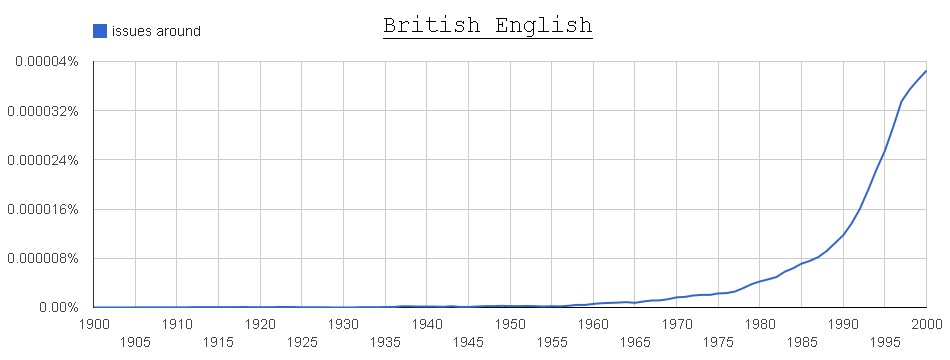
Some interesting patterns at Google’s Ngram Viewer (please follow the links to see the original images with further statistics):

in terms of (American + British English)

in terms of (American + British English)


in terms of (American English)

in terms of (American English)


in terms of (British English)

in terms of (British English)


issues around (American + British English)

issues around (American + British English)


issues around (American English)

issues around (American English)


issues around (British English)

issues around (British English)


Previously pre-posted (please peruse):

Titus Graun
Ex-term-in-ate!
Reds under the Thread