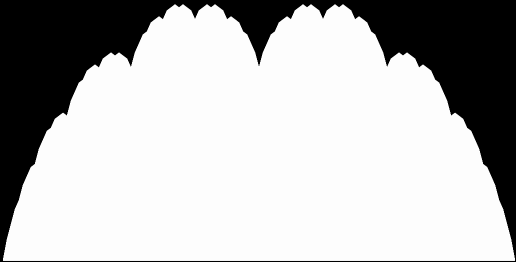
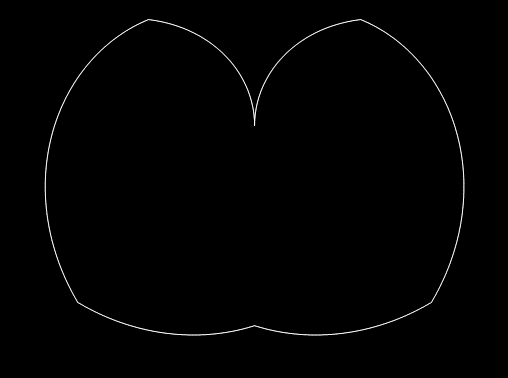
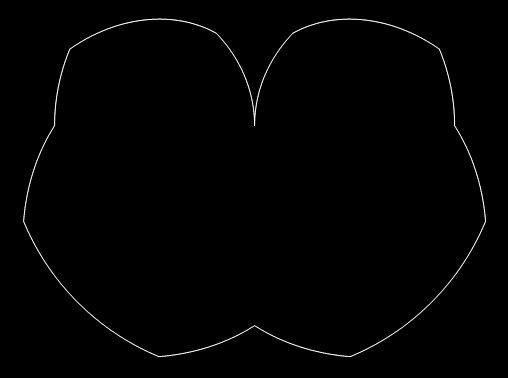
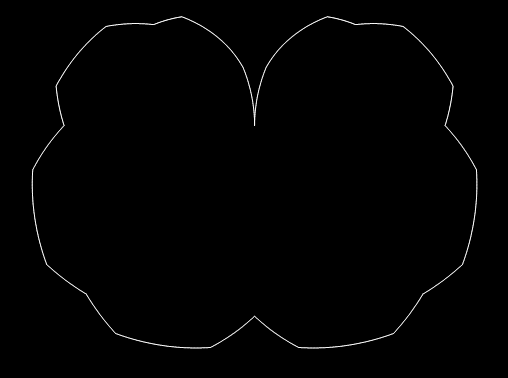
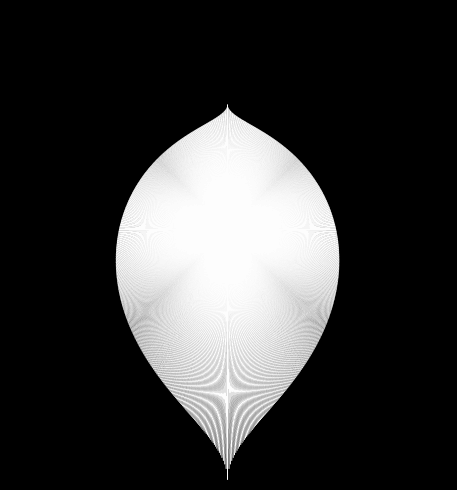
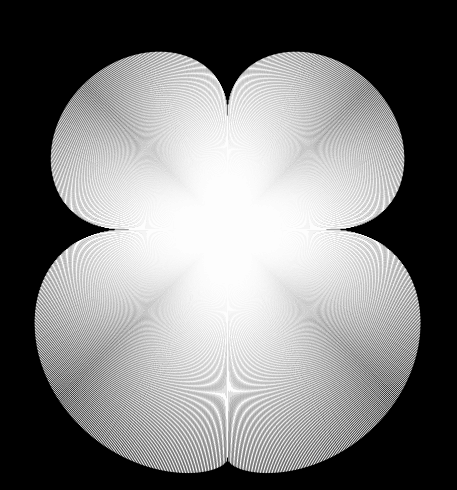
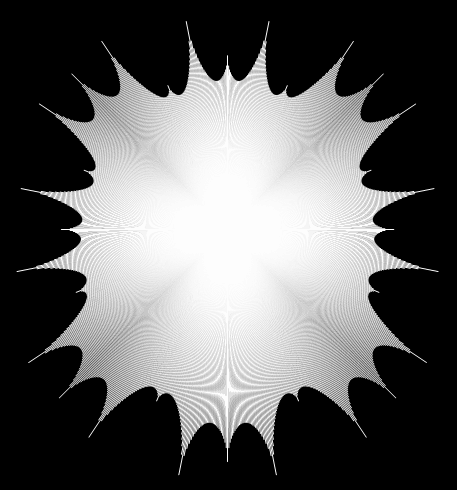
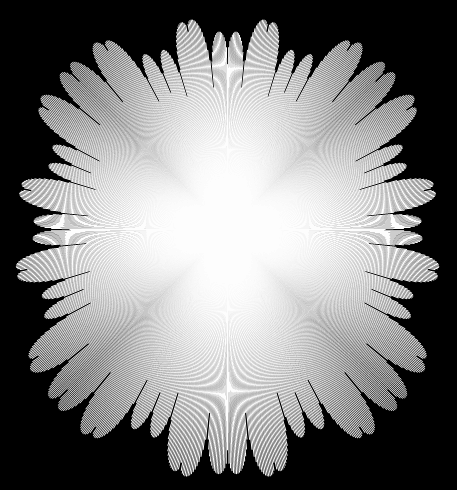
Floral Hex

I knew what the Sempervivum plant looked like:
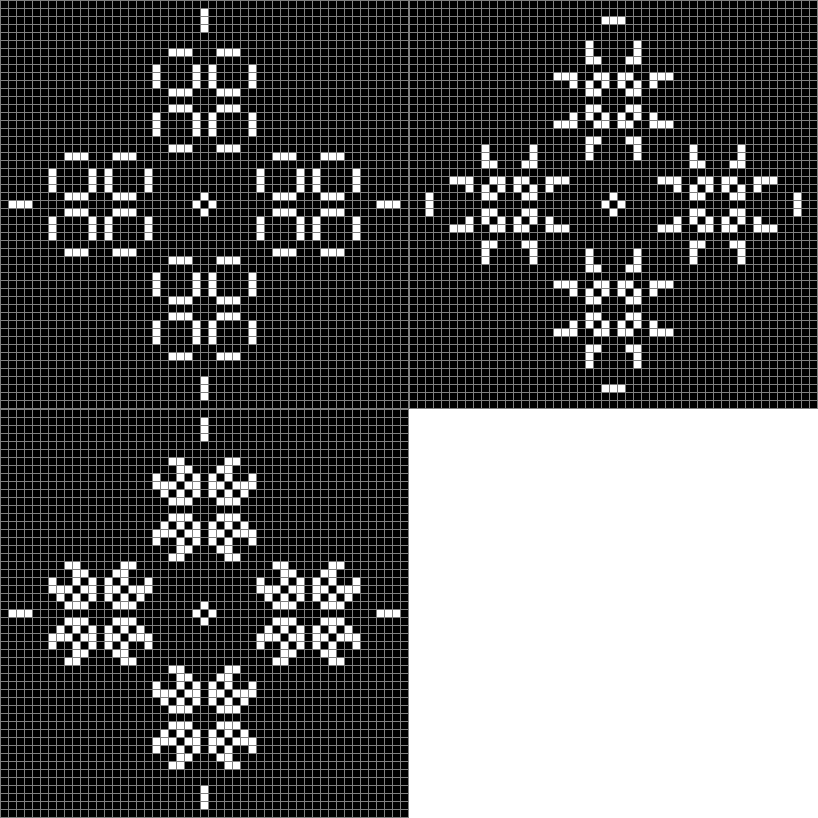
Sempervivum × giuseppii (from Wikipedia)


But I’d never seen the flowers until a few days ago:
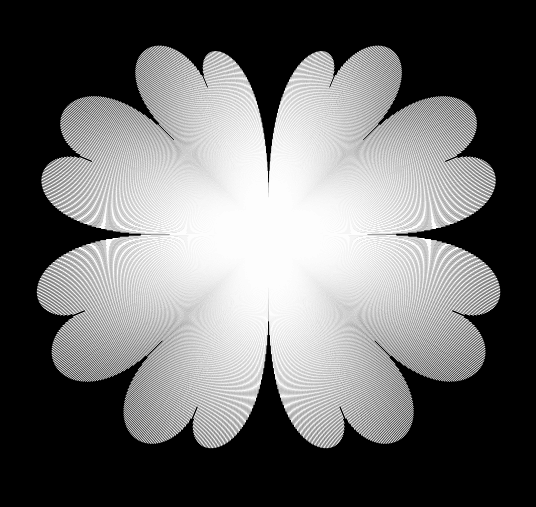
Sempervivum flowers (from Gardener’s Path)


They remind me of Clark Ashton Smith’s “The Demon of the Flower”:

Not as the plants and flowers of Earth, growing peacefully beneath a simple sun, were the blossoms of the planet Lophai. Coiling and uncoiling in double dawns; tossing tumultuously under vast suns of jade green and balas-ruby orange; swaying and weltering in rich twilights, in aurora-curtained nights, they resembled fields of rooted serpents that dance eternally to an other-worldly music. — “The Demon of the Flower”, Astounding Stories, Dec 1933

The Cruddiness of Cormac (continued)

Cormac McCarthy was a bad writer and an interesting phenomenon. Why did so many people say that he was a great writer, a genius, a giant of American letters? The puzzle isn’t as big as it appears. As with most over-rated artists, some of the people who said they liked him could see or glimpse the truth. They knew that he was pretentious and posturing, that he chose words clumsily and carelessly, had no sense of rhythm or the ridiculous, and wrote with all the natural grace and beauty of a chimpanzee riding a tricycle.

But most of those who saw the truth about Mccarthy didn’t dare to speak it. They stood beside the procession of praise and prizes and stayed shtum, when they should have shouted: “The emperor has no clothes!” A critic called B.R. Myers did dare to speak the truth. He shouted “The emperor has no clothes!” at the Atlantic in 2001:

McCarthy relies more on barrages of hit-and-miss verbiage than on careful use of just the right words. […] No novelist with a sense of the ridiculous would write such nonsense. Although his characters sometimes rib one another, McCarthy is among the most humorless writers in American history. […] It is a rare passage that can make you look up, wherever you may be, and wonder if you are being subjected to a diabolically thorough Candid Camera prank. I can just go along with the idea that horses might mistake human retching for the call of wild animals. But “wild animals” isn’t epic enough: McCarthy must blow smoke about some rude provisional species, as if your average quadruped had impeccable table manners and a pension plan. […] All the Pretty Horses received the National Book Award in 1992. “Not until now,” the judges wrote in their fatuous citation, “has the unhuman world been given its own holy canon.” What a difference a pseudo-biblical style makes; this so-called canon has little more to offer than the conventional belief that horses, like dogs, serve us well enough to merit exemption from an otherwise sweeping disregard for animal life. (No one ever sees a cow’s soul.) – “A Reader’s Manifesto”, The Atlantic (July 2001)

Myers is also right on the money when he says that McCarthy “thinks it more important to sound literary than to make sense.” He lets the gas out of McCarthy’s bloated reputation like a bad simile firing a bazooka into a dead whale. If you can’t see the cruddiness of Cormac, I recommend that you read Myers’ essay. It covers more bad writers than McCarthy, though, so if you’re pressed for time, just search for “Cormac” and have your eyes opened. Or not, as the case may be.

As for me, I’d like to re-quote a passage from McCarthy’s Pulitzer-prize-winning The Road (2006). I’ve already looked at it in “King Cormac”, but I have more to say:

When he woke in the woods in the dark and the cold of the night he’d reach out to touch the child sleeping beside him. Nights dark beyond darkness and the days more gray each one than what had gone before. Like the onset of some cold glaucoma dimming away the world. His hand rose and fell softly with each precious breath. He pushed away the plastic tarpaulin and raised himself in the stinking robes and blankets and looked toward the east for any light but there was none. In the dream from which he’d wakened he had wandered in a cave where the child led him by the hand. Their light playing over the wet flowstone walls. Like pilgrims in a fable swallowed up and lost among the inward parts of some granitic beast.

Is that good writing? No, it’s cruddy writing. Please consider these two sentences:

Like the onset of some cold glaucoma dimming away the world. His hand rose and fell softly with each precious breath.

You’ve got the pretentious and portentous “some cold glaucoma” followed by the hackneyed, Oprah-esque “precious breath”. The noun didn’t need any adjective. This is far stronger:

His hand rose and fell softly with each breath.

With “precious breath”, McCarthy was telling his readers what to think about the feelings of a father for his son. With just “breath”, he would have let his readers think it for themselves. Now look at this sentence:

He pushed away the plastic tarpaulin and raised himself in the stinking robes and blankets and looked toward the east for any light but there was none.

Is that good writing? No, again it’s cruddy writing. The sentence has no grace or rhythm and ends as McCarthy’s sentences so often do: with a bathetic thud. As Myers says of another of Cormac’s cruds: it can’t be “read aloud in a natural fashion.” This re-write of the sentence is stronger:

He pushed away the tarpaulin and raised himself in the stinking blankets and looked toward the east for light. But there was none.

And the re-write can be “read aloud in a natural fashion”. The Road is full of sentences that cry out in vain for a re-write. So are McCarthy’s other books. Not that I’ve read those other books, but I can see it from Myers’ essay and from quotes like this:

You can appreciate the language in McCarthy’s fiction for its lexical richness, gothic rhythms, and descriptive precision. In Suttree, you positively live on the grimy shore of the Tennessee River, where the “water was warm to the touch and had a granular lubricity like graphite.” Same for Blood Meridian. The Southwest desert is your home, or prison. You look up at the night sky. “All night sheetlightning quaked sourceless to the west beyond the midnight thunderheads, making a bluish day of the distant desert, the mountains on the sudden skyline stark and black and livid like a land of some other order out there whose true geology was not stone but fear.” – “a href=”https://www.theparisreview.org/blog/2023/06/16/on-cormac-mccarthy/”>On Cormac McCarthy”, The Paris Review (June 2023)

No, McCarthy’s language did not have “descriptive precision”. As B.R. Myers repeatedly demonstrates, it had the opposite: descriptive imprecision. That bit about the “true geology” being “fear” is, like so much of McCarthy’s writing, unintentionally funny. It suffers from the same fault as A.E. Housman identified in some of Swinburne’s more careless moments:

[M]uch worse can be said of another kind of simile, which grows common in his later writings. When a poet says that hatred is hot as fire or chastity white as snow, we can only object that we have often heard this before and that, considered as ornament, it is rather trite and cheap. But when he inverts his comparison and says that fire is hot as hatred and snow white as chastity, he is a fool for his pains. The heat of fire and the whiteness of snow are so much more sharply perceived than those qualities of hatred and chastity which have heat and whiteness for courtesy titles, that these similes actually blur the image and dilute the force of what is said. – “Swinburne” by A.E. Housman (1910)

A geology of stone is “much more sharply perceived” than a geology of fear. Whatever that is anyway. The cruddiness of Cormac also inspired cruddy writing by others. And still does:

McCarthy wrote figures, like Judge Holden, who were the genocidal tycoons of that brutal machine [of American history] and greased its wheels. Others, like Billy Parham, became its more indirect, melancholic grist. – “On Cormac McCarthy”, The Paris Review (June 2023)

Tycoons don’t grease wheels. That’s a job for underlings, not tycoons. And grist is what’s ground in a mill, not what fuels a brutal machine with wheels. “Indirect grist” doesn’t make sense. What do you do with indirect grist? Pretend to put it in a mill? As for “melancholic grist”: that’s both clumsy and funny. Cormac’s cruddiness continues. Le Roi Est Mort, Vive Le Roi!


Previously Pre-Posted (please peruse)

King Cormac — a look at the malign influence of McCarthy on the far better writer Stephen King

King Cormac

I had only one problem with Cormac McCarthy. He was crap.

More later.

Okay?

For now, let’s consider another famous writer. Millions of people have been writing English for hundreds of years. So the competition is intense for “Worst Simile Ever Written in English”. I still think this must be a leading contender:

Billy Nolan was at the pink fuzz-covered wheel [of the car]. Jackie Talbot, Henry Blake, Steve Deighan, and the Garson brothers, Kenny and Lou, were also squeezed in. Three joints were going, passing through the inner dark like the lambent eyes of some rotating Cerberus.

That’s from Stephen King’s Carrie (1974), describing some ill-intentioned teenagers smoking joints in a car. The paragraph starts gently and unpretentiously, lulling you into a false sense of security. Then wham! It hits you with “like the lambent eyes of some rotating Cerberus”. And where do I begin to dissect the wrongness of that simile? It’s simultaneously pretentious and illogical and ill-judged and anachronistic and clankingly clumsy and just plain stoopid. So where do I begin? Okay, I’ll begin with this observation: Cerberus had six eyes, not three (he had three heads, remember). So how did his six “lambent eyes” look like three glowing joints? Were his eyes very close-set? Did he keep three of them closed? Was he in fact part-dog, part-Cyclops, so that he only had three eyes after all? Yes, by “rotating” King means that now the three right eyes, now the three left eyes of Cerberus are visible, but there would be times when all six eyes were visible. And why is Cerberus rotating anyway?

I don’t know. And those questions by no means exhaust the idiotic possibilities raised by the simile. Let’s now ask how King’s lambent-eyed Cerberus was “rotating”. If his whole body was rotating on a vertical axis through his shoulders, say, then his three heads and six eyes would have been following too big an arc to fit the scene. So one has to assume that it was only his three heads and six eyes rotating on his one neck. Round and round and round. Which is a ridiculous image, not an eerie or ominous one.

No, we gotta face facts: King aimed for the Underworld and shot himself in the arse. And for the icing on the cake, we’ve got that poetic “some”. It wasn’t “a rotating Cerberus”, which would have been quite bad enough. It was “some rotating Cerberus”, as though King was setting his simile gently and carefully down on a bed of black velvet or plinth of polished obsidian, awestruck by the depth of his own erudition and the breadth of his own imagination. Fair enough: he’s human, he erred, I can forgive him. But how did the simile get past his editor and publisher and wife? Why did someone not say to him: “Steve, I like the book, in fact I love the book, but that appalling simile in part one has just gotta go?” Or why didn’t an editor suggest a re-write? I’d suggest this:

• Three joints were going, shifting in the inner dark like the glowing eyes of a watchful Cerberus.

Now the simile kinda works. The teenagers are up to something evil, but they don’t know that they’re going to unleash hell and harm themselves too. There’s authorial irony in the simile now: the hell-hound Cerberus is with them in spirit, conjured by the passing of the joints, but they, as characters in the story, don’t know it. They don’t know that Cerberus is patiently watching them, waiting to feast on their souls. I think the re-write removes the pretentiousness of linking ’70s American teenagers in a car with a monster from Greek mythology. The teenagers are evil but petty. It’s appropriate that they’re ignorant of grander and grotesquer things, like the three-headed hell-hound Cerberus and the telekinetic powers of the girl they’re planning to humiliate.

Alas, King or one of his editors didn’t re-write the simile. The original stayed put and turned the sentence into one of the worst I’ve ever read. And it was definitely the worst I’ve ever read in a book by Stephen King. That simile was bad by King’s own standards, because he’s not usually a pretentious or preening writer. So why did he write so badly there? I suspect the malign influence of another and much more critically acclaimed writer: the recently deceased Cormac McCarthy, who is easily the most pretentious and over-rated writer I’ve ever come across. I couldn’t finish Blood Meridian (1985) and although I did manage to finish The Road (2006), it didn’t change my opinion of the author. Cormac is crap. But Stephen King takes him seriously and, I suspect, was paying some kind of misguided homage to him when he came up with that appallingly bad “like the lambent eyes of some rotating Cerberus.”

If I’d read more of Cormac McCarthy’s books, I might be able to provide stronger evidence of my theory about his malign influence on that particular sentence in Carrie. But why would I want to read more of Cormac McCarthy’s books? I’m not a masochist and I don’t like reading bad English and pretentious prose. All the same, here’s a bit from The Road that suggests to me that King was imitating Cormac:

When he woke in the woods in the dark and the cold of the night he’d reach out to touch the child sleeping beside him. Nights dark beyond darkness and the days more gray each one than what had gone before. Like the onset of some cold glaucoma dimming away the world. His hand rose and fell softly with each precious breath. He pushed away the plastic tarpaulin and raised himself in the stinking robes and blankets and looked toward the east for any light but there was none. In the dream from which he’d wakened he had wandered in a cave where the child led him by the hand. Their light playing over the wet flowstone walls. Like pilgrims in a fable swallowed up and lost among the inward parts of some granitic beast.

There’s a lot of bad writing there, but I want to look at the two similes. They both use bad and pretentious imagery and they both have a would-be poetic “some”. Take the first simile. What on earth is a “cold glaucoma”? That doesn’t make sense. It isn’t the glaucoma that’s cold: it’s the way the glaucoma makes the world appear. “Cold glaucoma” is certainly an interesting medical concept, but it’s crap writing in a novel. Now take the second simile. What on earth is a “granitic beast”? If a beast is made of granite, how does it swallow people, let alone digest them? Granite is very solid and very rigid. The simile doesn’t work. And why did McCarthy say “inward parts” rather than the stronger “bowels”? Because he was doing what he did so often: writing badly and carelessly and pretentiously. “Granitic beast” is a stoopid image and the pretentious “granitic” makes it even worse.

Okay, neither simile is as bad as King’s “lambent-eyes-of-Cerberus” atrocity, but I detect a family resemblance and I think that King was trying to imitate some earlier writing by McCarthy. He shouldn’t have done. The ironic thing is that King himself is a better writer than McCarthy. I am too. But then who isn’t? It’s much easier to think of writers who are better than Cormac McCarthy than of writers who are worse. Let’s see: Will Self is worse. But who else? I’m glad to say that I can’t come up with anyone else. If I could come up with someone else, I would’ve suffered by reading another very bad writer.

Anyway, here’s my re-write of that extract from The Road:

When he woke in the woods in the dark and cold he’d reach out and touch the child sleeping beside him. Nights dark beyond darkness and each day grayer than the day before, as though he viewed the world through dying eyes. His hand rose and fell softly with each breath. He pushed away the tarpaulin and raised himself in the stinking blankets and looked toward the east for light. In the dream from which he’d wakened he had wandered in a cave where the child led him by the hand. Light played over the wet flowstone walls. They seemed like travelers in a story, swallowed and lost in the bowels of a petrified giant.

That’s still not very good, but it’s a definite improvement. If you don’t agree, you have a cloth ear for prose. And here’s my review of the whole book from 2013:

Highway to Hell

Cormac McCarthy won the Pulitzer Prize for The Road in 2007. The book is set in the aftermath of a world-wide cataclysm.

So is Stephen King’s The Stand (1978).

But The Road is much shorter than The Stand.

It makes up for this by being

much more pre

tentious

too.

Okay?

It is also much

less enter

taining.

Which is not to say that

The Road doesn’t have its

entertain

ing

bits.

For example

(spoiler alert)

the bit where the

unnamedfatherandsonprotagonists

go

into a wood and find

a fire where

some folks (far from

unferal)

have been preparing to

roast

and

eat a

b

a

b

y

.

.

.

For me

this was a

laugh-

out-loud mo

ment.

The “catamites” were pretty

funny

,

also

.

If you take Cormac McCarthy

seriously

my brother (or

sister)

I think that

you need to

grow up.

Okay?

But you

probably

nev

er

w

i

l

l

.

.

.


Elsewhere Other-Accessible…

A Reader’s Manifesto — B.R. Myers agrees with me about McCarthy, inter alios (et alias)

The Yartz of Yarz

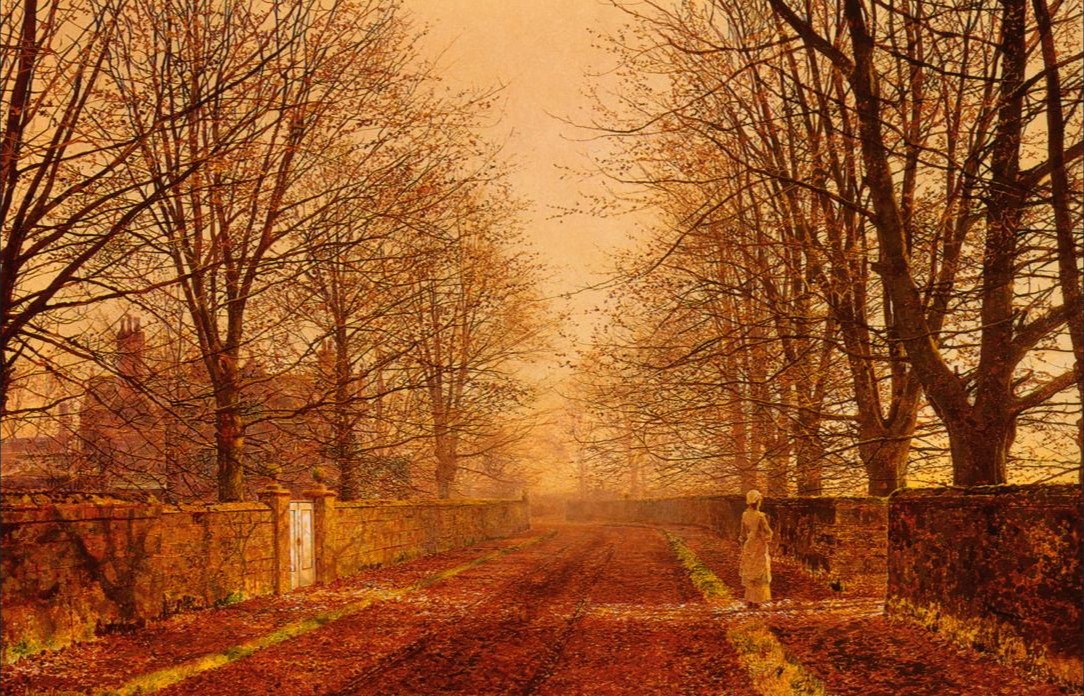
Les Pyrénees, a tapestry by Edmond Yarz (1845-1920)

(click for larger)


Post-Performative Post-Scriptum

The title of this incendiary intervention corely references the quondam Australian cultural attaché Sir Colin Lesley Patterson, who once boasted that “I chair the Cheese Board, I front the Yartz / You could term me a man of many parts.” For further details, please see:

• “In Terms of My Natural Life” — a pome by Les Patterson

A Walk on the Wide Side

How wide is a number? The obvious answer is to count digits and say that 1 and 9 are one digit wide, 11 and 99 are two digits wide, 111 and 999 are three digits wide, and so on. But that isn’t a very good answer. 111 and 999 are both three digits wide, but 999 is nine larger times than 111. And although 111 and 999 are both one digit wider than 11 and 99, 111 is much closer to 99 than 999 is to 111.

So there’s got to be a better answer to the question. I came across it indirectly, when I started looking at carries in powers. I wanted to know how fast a number grew in digit-width as it was multiplied repeatedly by, say, 2. For example, 2^3 = 8 and 2^4 = 16, so there’s been a carry at the far left and 2^4 = 16 has increased in digit-width by 1 over 2^3 = 8. After that, 2^6 = 64 and 2^7 = 128, so there’s another carry and another increase in digit-width. I wrote a program to sum the carries and divide them by the power. If I were better at math, I would’ve known what the value of carries / power was going to be. Here’s the program beginning to find it (it begins with a carry of 1, to mark 2^0 = 1 as creating a digit ex nihilo, as it were):


8 = 2^3
16 = 2^4 → 2 / 4 = 0.5
64 = 2^6
128 = 2^7 → 3 / 7 = 0.4285714285714285714285714286
512 = 2^9
1024 = 2^10 → 4 / 10 = 0.4
8192 = 2^13
16384 = 2^14 → 5 / 14 = 0.3571428571428571428571428571
65536 = 2^16
131072 = 2^17 → 6 / 17 = 0.3529411764705882352941176471
524288 = 2^19
1048576 = 2^20 → 7 / 20 = 0.35
8388608 = 2^23
16777216 = 2^24 → 8 / 24 = 0.3...
67108864 = 2^26
134217728 = 2^27 → 9 / 27 = 0.3...
536870912 = 2^29
1073741824 = 2^30 → 10 / 30 = 0.3...
8589934592 = 2^33
17179869184 = 2^34 → 11 / 34 = 0.3235294117647058823529411765
68719476736 = 2^36
137438953472 = 2^37 → 12 / 37 = 0.3243243243243243243243243243
549755813888 = 2^39
1099511627776 = 2^40 → 13 / 40 = 0.325
8796093022208 = 2^43
17592186044416 = 2^44 → 14 / 44 = 0.318...
70368744177664 = 2^46
140737488355328 = 2^47 → 15 / 47 = 0.3191489361702127659574468085
562949953421312 = 2^49
1125899906842624 = 2^50 → 16 / 50 = 0.32
9007199254740992 = 2^53
18014398509481984 = 2^54 → 17 / 54 = 0.3148...
72057594037927936 = 2^56
144115188075855872 = 2^57 → 18 / 57 = 0.3157894736842105263157894737
576460752303423488 = 2^59
1152921504606846976 = 2^60 → 19 / 60 = 0.316...
9223372036854775808 = 2^63
18446744073709551616 = 2^64 → 20 / 64 = 0.3125
73786976294838206464 = 2^66
147573952589676412928 = 2^67 → 21 / 67 = 0.3134328358208955223880597015
590295810358705651712 = 2^69
1180591620717411303424 = 2^70 → 22 / 70 = 0.3142857...
9444732965739290427392 = 2^73
18889465931478580854784 = 2^74 → 23 / 74 = 0.3108...
75557863725914323419136 = 2^76
151115727451828646838272 = 2^77 → 24 / 77 = 0.3116883...
604462909807314587353088 = 2^79
1208925819614629174706176 = 2^80 → 25 / 80 = 0.3125
9671406556917033397649408 = 2^83
19342813113834066795298816 = 2^84 → 26 / 84 = 0.3095238095238095238095238095
77371252455336267181195264 = 2^86
154742504910672534362390528 = 2^87 → 27 / 87 = 0.3103448275862068965517241379
618970019642690137449562112 = 2^89
1237940039285380274899124224 = 2^90 → 28 / 90 = 0.31...
9903520314283042199192993792 = 2^93
19807040628566084398385987584 = 2^94 → 29 / 94 = 0.3085106382978723404255319149
79228162514264337593543950336 = 2^96
158456325028528675187087900672 = 2^97 → 30 / 97 = 0.3092783505154639175257731959
633825300114114700748351602688 = 2^99
1267650600228229401496703205376 = 2^100 → 31 / 100 = 0.31

After calculating 2^p higher and higher (I discarded trailing digits of 2^p), I realized that the answer — carries / power — was converging on a value of slightly less than 0.30103. In the end (doh!), I realized that what I was calculating was the logarithm of 2 in base 10:


log(2) = 0.3010299956639811952137388947...
10^0.301029995663981... = 2

You can use then same carries-and-powers method to approximate the values of other logarithms:


log(1) = 0
log(2) = 0.3010299956639811952137388947...
log(3) = 0.4771212547196624372950279033...
log(4) = 0.6020599913279623904274777894...
log(5) = 0.6989700043360188047862611053...
log(6) = 0.7781512503836436325087667980...
log(7) = 0.8450980400142568307122162586...
log(8) = 0.9030899869919435856412166842...
log(9) = 0.9542425094393248745900558065...

I also realized logarithms are a good answer to the question I raised above: How wide is a number? The logs of the powers of 2 are multiples of log(2):


    log(2^1) = log(2) = 0.301029995663981195213738894
    log(2^2) = log(4) = 0.602059991327962390427477789 = 2 * log(2)
    log(2^3) = log(8) = 0.903089986991943585641216684 = 3 * log(2)
   log(2^4) = log(16) = 1.204119982655924780854955579 = 4 * log(2)
   log(2^5) = log(32) = 1.505149978319905976068694474 = 5 * log(2)
   log(2^6) = log(64) = 1.806179973983887171282433368 = 6 * log(2)
  log(2^7) = log(128) = 2.107209969647868366496172263 = 7 * log(2)
  log(2^8) = log(256) = 2.408239965311849561709911158 = 8 * log(2)
  log(2^9) = log(512) = 2.709269960975830756923650053 = 9 * log(2)
log(2^10) = log(1024) = 3.010299956639811952137388947 = 10 * log(2)

4 is 2 times larger than 2 and, in a sense, the width of 4 is 0.301029995663981… greater than the width of 2. As you can see, when the integer part of the log-sum increases by 1, so does the digit-width of the power:


 log(2^3) = log(8) = 0.903089986991943585641216684 = 3 * log(2)
log(2^4) = log(16) = 1.204119982655924780854955579 = 4 * log(2)

[...]

 log(2^6) = log(64) = 1.806179973983887171282433368 = 6 * log(2)
log(2^7) = log(128) = 2.107209969647868366496172263 = 7 * log(2)

[...]

  log(2^9) = log(512) = 2.709269960975830756923650053 = 9 * log(2)
log(2^10) = log(1024) = 3.01029995663981195213738894 = 10 * log(2)

In other words, powers of 2 are increasing in width by 0.301029995663981… units. When the increase flips the integer part of the log-sum up by 1, the digit-width or digit-count also increases by 1. To find the digit-count of a number, n, in a particular base, you simply take the integer part of log(n,b) and add 1. In base 10, the log of 123456789 is 8.091514… The integer part is 8 and 8+1 = 9. But it also makes perfect sense that log(1) = 0. No matter how many times you multiply a number by 1, the number never changes. That is, its width stays the same. So you can say that 1 has a width of 0, while 2 has a width of 0.301029995663981…

Logarithms also answer a question pre-previously raised on Overlord of the Über-Feral: Why are the Fibonacci numbers so productive in base 11 for digsum(fib(k)) = k? In base 10, such numbers are quickly exhausted:


digsum(fib(1)) = 1 = digsum(1)
digsum(fib(5)) = 5 = digsum(5)
digsum(fib(10)) = 10 = digsum(55)
digsum(fib(31)) = 31 = digsum(1346269)
digsum(fib(35)) = 35 = digsum(9227465)
digsum(fib(62)) = 62 = digsum(4052739537881)
digsum(fib(72)) = 72 = digsum(498454011879264)
digsum(fib(175)) = 175 = digsum(1672445759041379840132227567949787325)
digsum(fib(180)) = 180 = digsum(18547707689471986212190138521399707760)
digsum(fib(216)) = 216 = digsum(619220451666590135228675387863297874269396512)
digsum(fib(251)) = 251 = digsum(12776523572924732586037033894655031898659556447352249)
digsum(fib(252)) = 252 = digsum(20672849399056463095319772838289364792345825123228624)
digsum(fib(360)) = 360
digsum(fib(494)) = 494
digsum(fib(540)) = 540
digsum(fib(946)) = 946
digsum(fib(1188)) = 1188
digsum(fib(2222)) = 2222

In base 11, such numbers go on and on:


digsum(fib(1),b=11) = 1 = digsum(1) (k=1)
digsum(fib(5),b=11) = 5 = digsum(5) (k=5)
digsum(fib(12),b=11) = 12 = digsum(1A2) (k=13)
digsum(fib(38),b=11) = 38 = digsum(855138A1) (k=41)
digsum(fib(49)) = 49 = digsum(2067A724762) (k=53) (c=5)
digsum(fib(50)) = 50 = digsum(542194A6905) (k=55)
digsum(fib(55)) = 55 = digsum(54756364A280) (k=60)
digsum(fib(56)) = 56 = digsum(886283256841) (k=61)
digsum(fib(82)) = 82 = digsum(57751318A9814A6410) (k=90)
digsum(fib(89)) = 89 = digsum(140492673676A06482A2) (k=97)
digsum(fib(144)) = 144 = digsum(401631365A48A784A09392136653457871) (k=169) (c=10)
digsum(fib(159)) = 159 = digsum(67217257641069185100889658A1AA72A0805) (k=185)
digsum(fib(166)) = 166 = digsum(26466A3A88237918577363A2390343388205432) (k=193)
digsum(fib(186)) = 186 = digsum(6A963147A9599623A20A05390315140A21992A96005) (k=215)
digsum(fib(221)) = 221 (k=265) (c=15)
digsum(fib(225)) = 225 (k=269)
digsum(fib(2A1)) = 2A1 (k=353)
digsum(fib(2A3)) = 2A3 (k=355)

[...]

digsum(fib(39409)) = 39409 (k=56395)
digsum(fib(3958A)) = 3958A (k=56605) (c=295)
digsum(fib(3965A)) = 3965A (k=56693)
digsum(fib(3A106)) = 3A106 (k=57360)
digsum(fib(3AA46)) = 3AA46 (k=58493)
digsum(fib(40140)) = 40140 (k=58729)
digsum(fib(4222A)) = 4222A (k=61500) (c=300)
digsum(fib(42609)) = 42609 (k=61961)
digsum(fib(42775)) = 42775 (k=62155)
digsum(fib(4287A)) = 4287A (k=62281)
digsum(fib(430A2)) = 430A2 (k=62669)
digsum(fib(43499)) = 43499 (k=63149) (c=305)
digsum(fib(435A9)) = 435A9 (k=63281)

[...]

digsum(fib(157476)) = 157476 (k=244140) (c=525)
digsum(fib(158470)) = 158470 (k=245465)
digsum(fib(159037)) = 159037 (k=246275)
digsum(fib(159285)) = 159285 (k=246570)
digsum(fib(159978)) = 159978 (k=247409)
digsum(fib(162993)) = 162993 (k=252750) (c=530)
digsum(fib(163A32)) = 163A32 (k=254135)
digsum(fib(164918)) = 164918 (k=255329)
digsum(fib(166985)) = 166985 (k=258065)
digsum(fib(167234)) = 167234 (k=258493)
digsum(fib(167371)) = 167371 (k=258655) (c=535)
digsum(fib(1676A5)) = 1676A5 (k=259055)
digsum(fib(16992A)) = 16992A (k=261997)

[...]

When do these numbers run out in base 11? I don’t know, but I do know why there are so many of them. The answer involves the logarithm of a special number. The most famous aspect of Fibonacci numbers is that the ratio, fib(k) / fib(k-1), of successive numbers converges on an irrational constant known as Φ. Here are the first Fibonacci numbers, where fib(k) = fib(k-2) + fib(k-1) (in other words, 1+1 = 2, 1+2 = 3, 2+3 = 5, and so on):


1, 1, 2, 3, 5, 8, 13, 21, 34, 55, 89, 144, 233, 377, 610, 987, 1597, 2584, 4181, 6765, ...

And here are the first ratios:


1 / 1 = 1
2 / 1 = 2
3 / 2 = 1.5
5 / 3 = 1.6...
8 / 5 = 1.6
13 / 8 = 1.625
21 / 13 = 1.6153846...
34 / 21 = 1.619047...
55 / 34 = 1.617647058823529411764705882
89 / 55 = 1.618...
144 / 89 = 1.617977528089887640449438202
233 / 144 = 1.61805...
377 / 233 = 1.618025751072961373390557940
610 / 377 = 1.618037135278514588859416446
987 / 610 = 1.618032786885245901639344262
1597 / 987 = 1.618034447821681864235055724
2584 / 1597 = 1.618033813400125234815278648
4181 / 2584 = 1.618034055727554179566563468
6765 / 4181 = 1.618033963166706529538387946
[...]

The ratios get closer and closer to Φ = 1.618033988749894848204586834… = (√5 + 1) / 2. In other words, fib(k) ≈ fib(k-1) * Φ = fib(k-1) * 1.618… in base 10. This means that the digit-length of fib(k) ≈ integer(k * log(&Phi)) + 1. In base b, the average value of a digit in a Fibonacci number is (b^2-b) / 2b. Therefore in base 10, the average value of a digit is (10^2-10) / 20 = 90 / 20 = 4.5. The average value of digsum(fib(k)) ≈ 4.5 * log(&Phi) * k = 4.5 * 0.20898764… * k = 0.940444… * k. It isn’t surprising that as fib(k) gets larger, digsum(fib(k)) tends to get smaller than k.

In base 10, anyway. But what about base 11? In base 11, log(Φ) = 0.20068091818623… and the average value of a base-11 digit in fib(k) is 5 = 110 / 22 = (11^2 – 11) / 22. Therefore the average value of digsum(fib(k)) in base 11 is 5 * log(&Phi) * k = 5 * 0.20068091818623… * k = 1.00340459… * k. The average value of digsum(fib(k)) is much closer to k and it’s not surprising that for so many fib(k) in base 11, digsum(fib(k)) = k. In base 11, log(Φ) ≈ 1/5 and because the average digval is 5, digsum(fib(k)) ≈ 5 * 1/5 * k = 1 * k = k. As we’ve seen, that isn’t true in base 10. Nor is it true in base 12, where log(Φ) = 0.1936538843826… and average digval is 5.5 = (12^2 – 12) / 24 = 132 / 24. Therefore the average value in base 12 of digsum(fib(k)) = 1.0650963641… * k. The function digsum(fib(k)) = k rapidly dries up in base 12, just as it does in base 10:


digsum(fib(1),b=12) = 1 = digsum(1) (k=1)
digsum(fib(5),b=12) = 5 = digsum(5) (k=5)
digsum(fib(11) = 11 = digsum(175) (k=13)
digsum(fib(12) = 12 = digsum(275) (k=14)
digsum(fib(75) = 75 = digsum(976446538A0863811) (k=89) (c=5)
digsum(fib(80) = 80 = digsum(1B3643B50939808B400) (k=96)
digsum(fib(A3) = A3 = digsum(35147A566682BB9529034402) (k=123)
digsum(fib(165) = 165 (k=221)
digsum(fib(283) = 283 (k=387)
digsum(fib(2AB) = 2AB (k=419) (c=10)
digsum(fib(39A) = 39A (k=550)
digsum(fib(460) = 460 (k=648)
digsum(fib(525) = 525 (k=749)
digsum(fib(602) = 602 (k=866)
digsum(fib(624) = 624 (k=892) (c=15)
digsum(fib(781) = 781 (k=1105)
digsum(fib(1219) = 1219 (k=2037)


Previously Pre-Posted…

Mötley Vüe — more on digsum(fib(k)) = k

Two be Continued…

Here’s a useless fact that nobody interested in mathematics would ever forget: digsum(fib(2222)) = 2222. That is, if you add the digits of the 2222nd Fibonacci number, you get 2222:


fib(2222) = 104,966,721,620,282,584,734,867,037,988,863,914,269,721,309,244,628,258,918,225,835,217,264,239,539,186,480,867,849,267,122,885,365,019,934,494,625,410,255,045,832,359,715,759,649,385,824,745,506,982,513,773,397,742,803,445,080,995,617,047,976,796,168,678,756,479,470,761,439,513,575,962,955,568,645,505,845,492,393,360,201,582,183,610,207,447,528,637,825,187,188,815,786,270,477,935,419,631,184,553,635,981,047,057,037,341,800,837,414,913,595,584,426,355,208,257,232,868,908,837,817,478,483,039,310,790,967,631,454,123,105,472,742,221,897,397,857,677,674,619,381,961,429,837,434,434,636,098,678,708,225,493,682,469,561

2222 = 1 + 0 + 4 + 9 + 6 + 6 + 7 + 2 + 1 + 6 + 2 + 0 + 2 + 8 + 2 + 5 + 8 + 4 + 7 + 3 + 4 + 8 + 6 + 7 + 0 + 3 + 7 + 9 + 8 + 8 + 8 + 6 + 3 + 9 + 1 + 4 + 2 + 6 + 9 + 7 + 2 + 1 + 3 + 0 + 9 + 2 + 4 + 4 + 6 + 2 + 8 + 2 + 5 + 8 + 9 + 1 + 8 + 2 + 2 + 5 + 8 + 3 + 5 + 2 + 1 + 7 + 2 + 6 + 4 + 2 + 3 + 9 + 5 + 3 + 9 + 1 + 8 + 6 + 4 + 8 + 0 + 8 + 6 + 7 + 8 + 4 + 9 + 2 + 6 + 7 + 1 + 2 + 2 + 8 + 8 + 5 + 3 + 6 + 5 + 0 + 1 + 9 + 9 + 3 + 4 + 4 + 9 + 4 + 6 + 2 + 5 + 4 + 1 + 0 + 2 + 5 + 5 + 0 + 4 + 5 + 8 + 3 + 2 + 3 + 5 + 9 + 7 + 1 + 5 + 7 + 5 + 9 + 6 + 4 + 9 + 3 + 8 + 5 + 8 + 2 + 4 + 7 + 4 + 5 + 5 + 0 + 6 + 9 + 8 + 2 + 5 + 1 + 3 + 7 + 7 + 3 + 3 + 9 + 7 + 7 + 4 + 2 + 8 + 0 + 3 + 4 + 4 + 5 + 0 + 8 + 0 + 9 + 9 + 5 + 6 + 1 + 7 + 0 + 4 + 7 + 9 + 7 + 6 + 7 + 9 + 6 + 1 + 6 + 8 + 6 + 7 + 8 + 7 + 5 + 6 + 4 + 7 + 9 + 4 + 7 + 0 + 7 + 6 + 1 + 4 + 3 + 9 + 5 + 1 + 3 + 5 + 7 + 5 + 9 + 6 + 2 + 9 + 5 + 5 + 5 + 6 + 8 + 6 + 4 + 5 + 5 + 0 + 5 + 8 + 4 + 5 + 4 + 9 + 2 + 3 + 9 + 3 + 3 + 6 + 0 + 2 + 0 + 1 + 5 + 8 + 2 + 1 + 8 + 3 + 6 + 1 + 0 + 2 + 0 + 7 + 4 + 4 + 7 + 5 + 2 + 8 + 6 + 3 + 7 + 8 + 2 + 5 + 1 + 8 + 7 + 1 + 8 + 8 + 8 + 1 + 5 + 7 + 8 + 6 + 2 + 7 + 0 + 4 + 7 + 7 + 9 + 3 + 5 + 4 + 1 + 9 + 6 + 3 + 1 + 1 + 8 + 4 + 5 + 5 + 3 + 6 + 3 + 5 + 9 + 8 + 1 + 0 + 4 + 7 + 0 + 5 + 7 + 0 + 3 + 7 + 3 + 4 + 1 + 8 + 0 + 0 + 8 + 3 + 7 + 4 + 1 + 4 + 9 + 1 + 3 + 5 + 9 + 5 + 5 + 8 + 4 + 4 + 2 + 6 + 3 + 5 + 5 + 2 + 0 + 8 + 2 + 5 + 7 + 2 + 3 + 2 + 8 + 6 + 8 + 9 + 0 + 8 + 8 + 3 + 7 + 8 + 1 + 7 + 4 + 7 + 8 + 4 + 8 + 3 + 0 + 3 + 9 + 3 + 1 + 0 + 7 + 9 + 0 + 9 + 6 + 7 + 6 + 3 + 1 + 4 + 5 + 4 + 1 + 2 + 3 + 1 + 0 + 5 + 4 + 7 + 2 + 7 + 4 + 2 + 2 + 2 + 1 + 8 + 9 + 7 + 3 + 9 + 7 + 8 + 5 + 7 + 6 + 7 + 7 + 6 + 7 + 4 + 6 + 1 + 9 + 3 + 8 + 1 + 9 + 6 + 1 + 4 + 2 + 9 + 8 + 3 + 7 + 4 + 3 + 4 + 4 + 3 + 4 + 6 + 3 + 6 + 0 + 9 + 8 + 6 + 7 + 8 + 7 + 0 + 8 + 2 + 2 + 5 + 4 + 9 + 3 + 6 + 8 + 2 + 4 + 6 + 9 + 5 + 6 + 1

Numbers like this, where k = digsum(fib(k)), are rare. And 2222 is almost certainly the last of them. These are the relevant listings at the Online Encyclopedia of Integer Sequences:


0, 1, 5, 10, 31, 35, 62, 72, 175, 180, 216, 251, 252, 360, 494, 504, 540, 946, 1188, 2222 — A020995, Numbers k such that the sum of the digits of Fibonacci(k) is k.

0, 1, 5, 55, 1346269, 9227465, 4052739537881, 498454011879264, 1672445759041379840132227567949787325, 18547707689471986212190138521399707760, 619220451666590135228675387863297874269396512... — A067515, Fibonacci numbers with index = digit sum.

At least, they’re rare in base 10. What about other bases? Well, they’re rare in all other bases except one: base 11. When I looked there, I quickly found more than 450 numbers where digsum(fib(k),b=11) = k. So here’s an interesting little problem: Why is base 11 so productive? Or maybe I should say: Φ is base 11 so productive?

Astronomy Dominie

• ἐπαινῶ: παντὶ γάρ μοι δοκεῖ δῆλον ὅτι αὕτη γε ἀναγκάζει ψυχὴν εἰς τὸ ἄνω ὁρᾶν καὶ ἀπὸ τῶν ἐνθένδε ἐκεῖσε ἄγει. — Πολιτεία τοῦ Πλᾰ́τωνος

• • For every one, as I think, must see that astronomy compels the soul to look upwards and leads us from this world to another. — Plato’s Republic (c. 375 BC), Book 7, line 529a

Hour Power

How do you get an hourglass from this shape?

Rep-4 L-tromino


In fact, it’s easy. You simply divide the shape into four identical copies of itself, discard one copy, and repeat the process with each of the sub-copies:

l-triomino_124

Constructing an hourglass (animated)

l-triomino_124_upright_static1

Hourglass (static)


Here are some more posts about what I call the hourglass fractal:

The Hourglass Fractal at Overlord of the Über-feral