The Cruddiness of Cormac (continued)

Cormac McCarthy was a bad writer and an interesting phenomenon. Why did so many people say that he was a great writer, a genius, a giant of American letters? The puzzle isn’t as big as it appears. As with most over-rated artists, some of the people who said they liked him could see or glimpse the truth. They knew that he was pretentious and posturing, that he chose words clumsily and carelessly, had no sense of rhythm or the ridiculous, and wrote with all the natural grace and beauty of a chimpanzee riding a tricycle.

But most of those who saw the truth about Mccarthy didn’t dare to speak it. They stood beside the procession of praise and prizes and stayed shtum, when they should have shouted: “The emperor has no clothes!” A critic called B.R. Myers did dare to speak the truth. He shouted “The emperor has no clothes!” at the Atlantic in 2001:

McCarthy relies more on barrages of hit-and-miss verbiage than on careful use of just the right words. […] No novelist with a sense of the ridiculous would write such nonsense. Although his characters sometimes rib one another, McCarthy is among the most humorless writers in American history. […] It is a rare passage that can make you look up, wherever you may be, and wonder if you are being subjected to a diabolically thorough Candid Camera prank. I can just go along with the idea that horses might mistake human retching for the call of wild animals. But “wild animals” isn’t epic enough: McCarthy must blow smoke about some rude provisional species, as if your average quadruped had impeccable table manners and a pension plan. […] All the Pretty Horses received the National Book Award in 1992. “Not until now,” the judges wrote in their fatuous citation, “has the unhuman world been given its own holy canon.” What a difference a pseudo-biblical style makes; this so-called canon has little more to offer than the conventional belief that horses, like dogs, serve us well enough to merit exemption from an otherwise sweeping disregard for animal life. (No one ever sees a cow’s soul.) – “A Reader’s Manifesto”, The Atlantic (July 2001)

Myers is also right on the money when he says that McCarthy “thinks it more important to sound literary than to make sense.” He lets the gas out of McCarthy’s bloated reputation like a bad simile firing a bazooka into a dead whale. If you can’t see the cruddiness of Cormac, I recommend that you read Myers’ essay. It covers more bad writers than McCarthy, though, so if you’re pressed for time, just search for “Cormac” and have your eyes opened. Or not, as the case may be.

As for me, I’d like to re-quote a passage from McCarthy’s Pulitzer-prize-winning The Road (2006). I’ve already looked at it in “King Cormac”, but I have more to say:

When he woke in the woods in the dark and the cold of the night he’d reach out to touch the child sleeping beside him. Nights dark beyond darkness and the days more gray each one than what had gone before. Like the onset of some cold glaucoma dimming away the world. His hand rose and fell softly with each precious breath. He pushed away the plastic tarpaulin and raised himself in the stinking robes and blankets and looked toward the east for any light but there was none. In the dream from which he’d wakened he had wandered in a cave where the child led him by the hand. Their light playing over the wet flowstone walls. Like pilgrims in a fable swallowed up and lost among the inward parts of some granitic beast.

Is that good writing? No, it’s cruddy writing. Please consider these two sentences:

Like the onset of some cold glaucoma dimming away the world. His hand rose and fell softly with each precious breath.

You’ve got the pretentious and portentous “some cold glaucoma” followed by the hackneyed, Oprah-esque “precious breath”. The noun didn’t need any adjective. This is far stronger:

His hand rose and fell softly with each breath.

With “precious breath”, McCarthy was telling his readers what to think about the feelings of a father for his son. With just “breath”, he would have let his readers think it for themselves. Now look at this sentence:

He pushed away the plastic tarpaulin and raised himself in the stinking robes and blankets and looked toward the east for any light but there was none.

Is that good writing? No, again it’s cruddy writing. The sentence has no grace or rhythm and ends as McCarthy’s sentences so often do: with a bathetic thud. As Myers says of another of Cormac’s cruds: it can’t be “read aloud in a natural fashion.” This re-write of the sentence is stronger:

He pushed away the tarpaulin and raised himself in the stinking blankets and looked toward the east for light. But there was none.

And the re-write can be “read aloud in a natural fashion”. The Road is full of sentences that cry out in vain for a re-write. So are McCarthy’s other books. Not that I’ve read those other books, but I can see it from Myers’ essay and from quotes like this:

You can appreciate the language in McCarthy’s fiction for its lexical richness, gothic rhythms, and descriptive precision. In Suttree, you positively live on the grimy shore of the Tennessee River, where the “water was warm to the touch and had a granular lubricity like graphite.” Same for Blood Meridian. The Southwest desert is your home, or prison. You look up at the night sky. “All night sheetlightning quaked sourceless to the west beyond the midnight thunderheads, making a bluish day of the distant desert, the mountains on the sudden skyline stark and black and livid like a land of some other order out there whose true geology was not stone but fear.” – “a href=”https://www.theparisreview.org/blog/2023/06/16/on-cormac-mccarthy/”>On Cormac McCarthy”, The Paris Review (June 2023)

No, McCarthy’s language did not have “descriptive precision”. As B.R. Myers repeatedly demonstrates, it had the opposite: descriptive imprecision. That bit about the “true geology” being “fear” is, like so much of McCarthy’s writing, unintentionally funny. It suffers from the same fault as A.E. Housman identified in some of Swinburne’s more careless moments:

[M]uch worse can be said of another kind of simile, which grows common in his later writings. When a poet says that hatred is hot as fire or chastity white as snow, we can only object that we have often heard this before and that, considered as ornament, it is rather trite and cheap. But when he inverts his comparison and says that fire is hot as hatred and snow white as chastity, he is a fool for his pains. The heat of fire and the whiteness of snow are so much more sharply perceived than those qualities of hatred and chastity which have heat and whiteness for courtesy titles, that these similes actually blur the image and dilute the force of what is said. – “Swinburne” by A.E. Housman (1910)

A geology of stone is “much more sharply perceived” than a geology of fear. Whatever that is anyway. The cruddiness of Cormac also inspired cruddy writing by others. And still does:

McCarthy wrote figures, like Judge Holden, who were the genocidal tycoons of that brutal machine [of American history] and greased its wheels. Others, like Billy Parham, became its more indirect, melancholic grist. – “On Cormac McCarthy”, The Paris Review (June 2023)

Tycoons don’t grease wheels. That’s a job for underlings, not tycoons. And grist is what’s ground in a mill, not what fuels a brutal machine with wheels. “Indirect grist” doesn’t make sense. What do you do with indirect grist? Pretend to put it in a mill? As for “melancholic grist”: that’s both clumsy and funny. Cormac’s cruddiness continues. Le Roi Est Mort, Vive Le Roi!


Previously Pre-Posted (please peruse)

King Cormac — a look at the malign influence of McCarthy on the far better writer Stephen King
Lux Legibilis

I wake from dreams and turning
     My vision on the height
I scan the beacons burning
     About the fields of night.

Each in its steadfast station
     Inflaming heaven they flare;
They sign with conflagration
     The empty moors of air.

The signal-fires of warning
     They blaze, but none regard;
And on through night to morning
     The world runs ruinward. — A.E. Housman in More Poems (1936)


There was a young fellow named Bright
Who travelled much faster than light.
     He set off one day,
     In a relative way
And came back the previous night. — Anonymous

FractAlphic Frolix

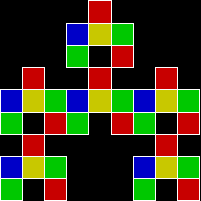
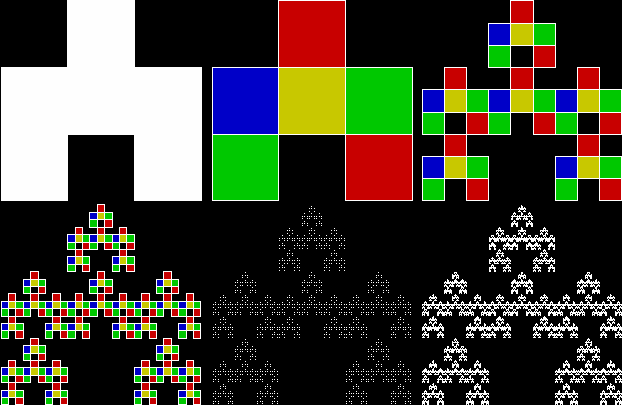
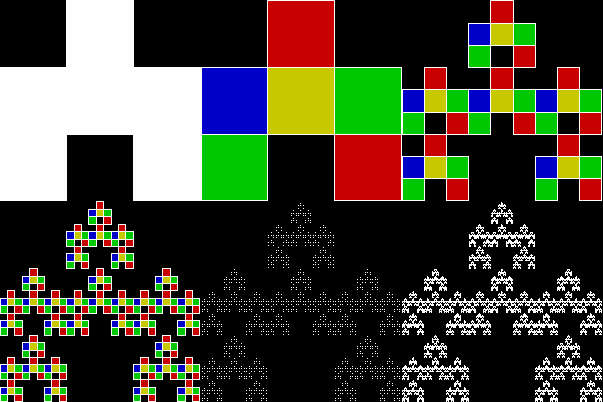
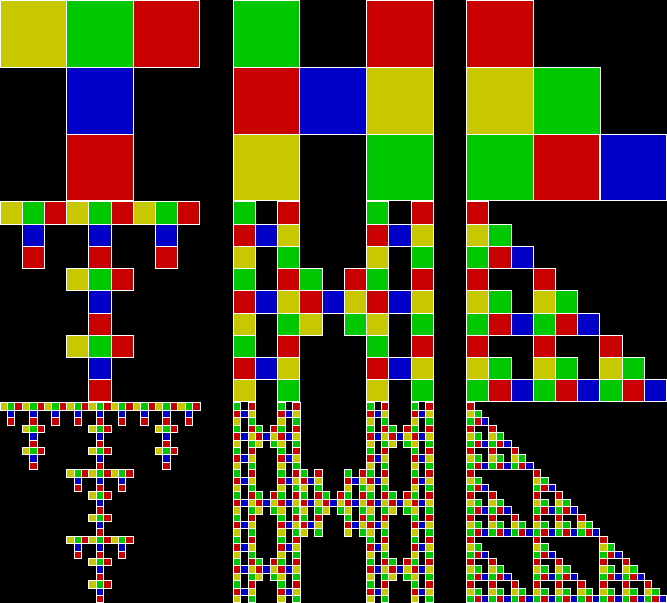
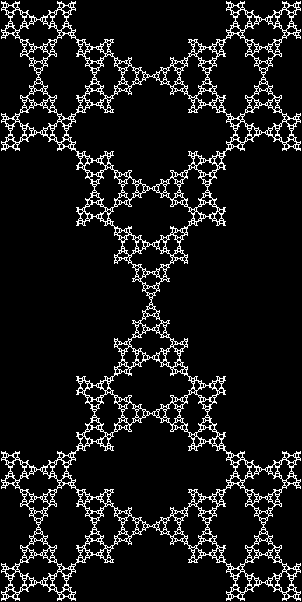
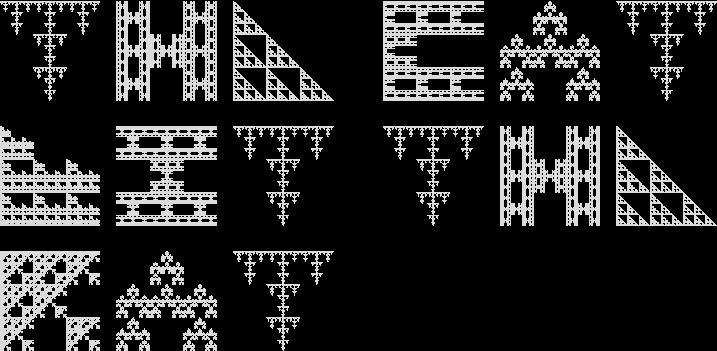
A fractal is a shape that contains smaller (and smaller) versions of itself, like this:

The hourglass fractal


Fractals also occur in nature. For example, part of a tree looks like the tree as whole. Part of a cloud or a lung looks like the cloud or lung as a whole. So trees, clouds and lungs are fractals. The letters of an alphabet don’t usually look like that, but I decided to create a fractal alphabet — or fractalphabet — that does.

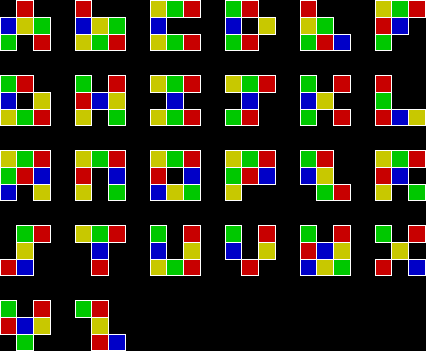
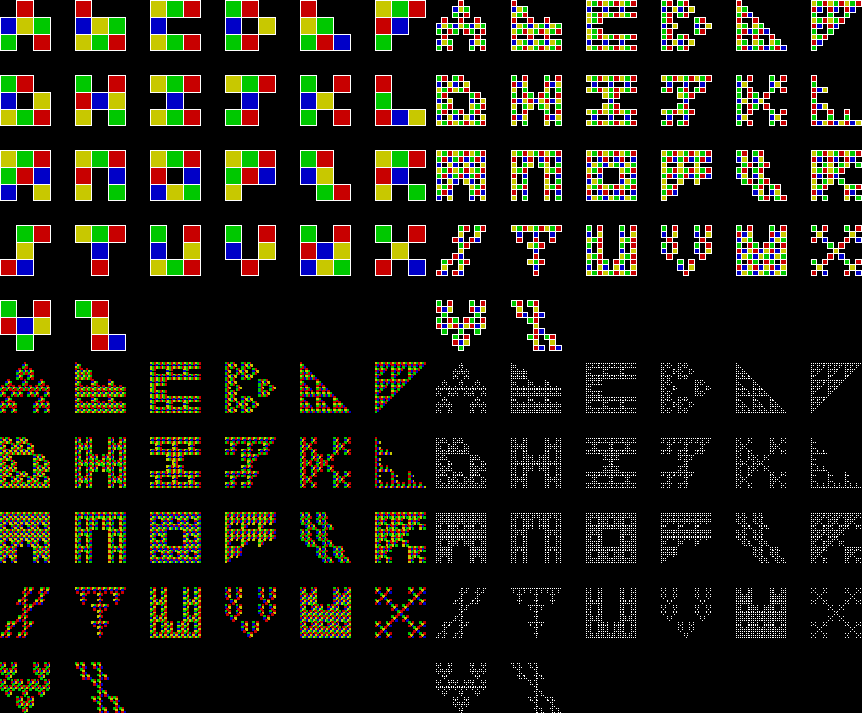
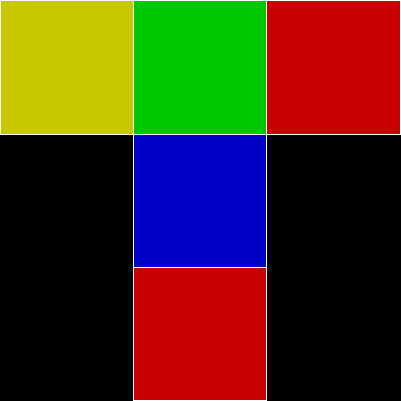
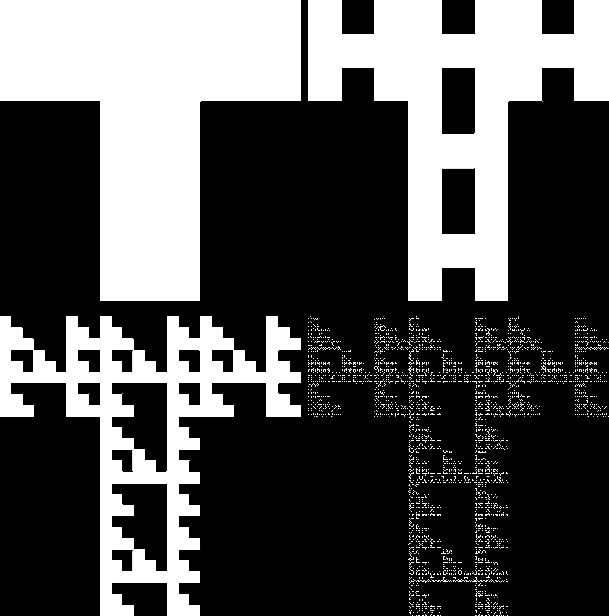
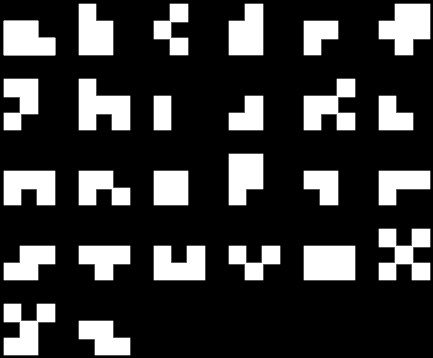
The fractalphabet starts with this minimal standard Roman alphabet in upper case, where each letter is created by filling selected squares in a 3×3 grid:


The above is stage 1 of the fractalphabet, when it isn’t actually a fractal alphabet at all. But if each filled square of the letter “A”, say, is replaced by the letter itself, the “A” turns into a fractal, like this:


Fractal A (animated)


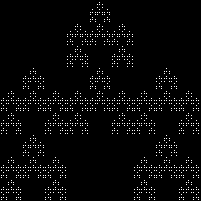
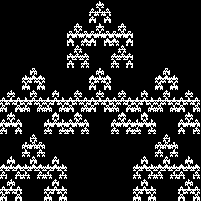
Here’s the whole alphabet being turned into fractals:

Full fractalphabet (black-and-white)


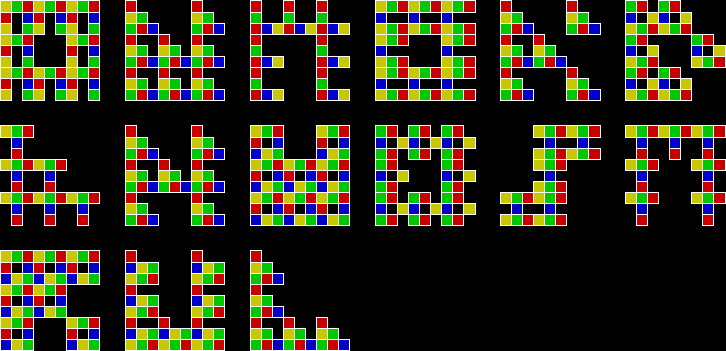
Full fractalphabet (color)


Full fractalphabet (b&w animated)


Full fractalphabet (color animated)


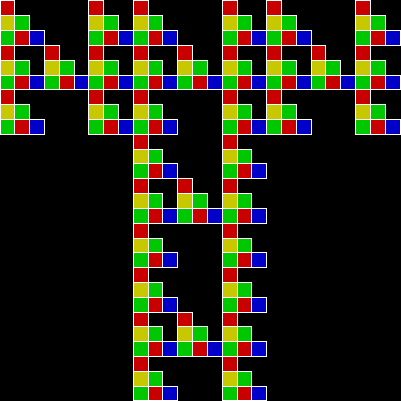
Now take a full word like “THE”:


You can turn each letter into a fractal using smaller copies of itself:


Fractal THE (b&w animated)


Fractal THE (color animated)


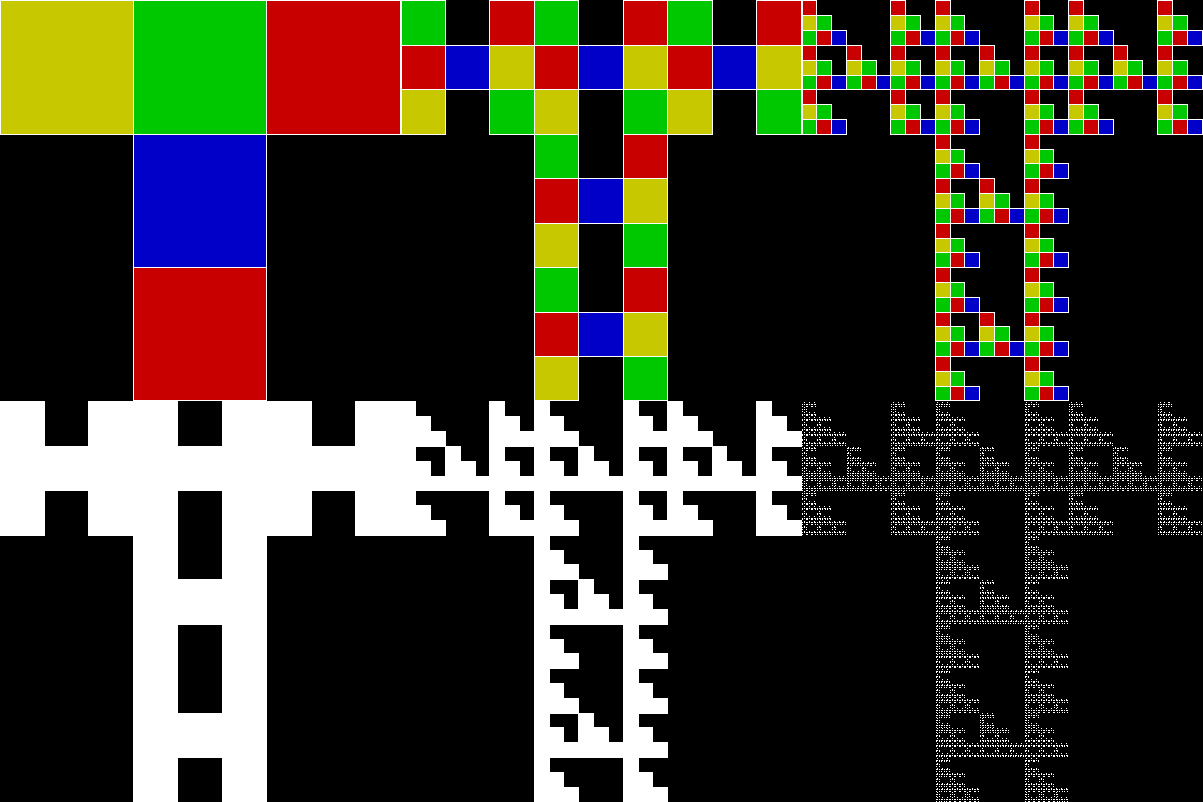
But you can also create a fractal from “THE” by compressing the “H” into the “T”, then the “E” into the “H”, like this:


Compressed THE (animated)


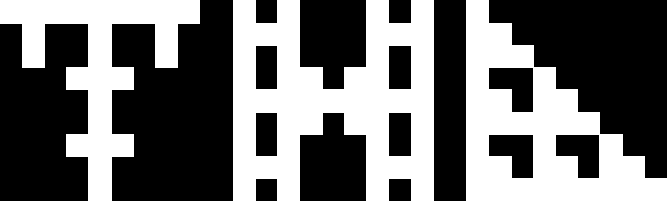
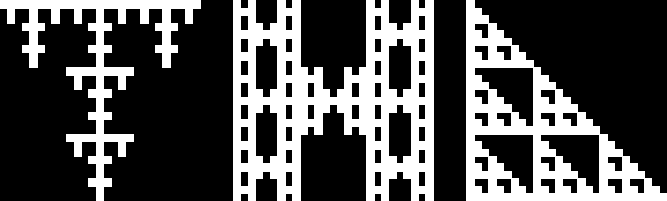
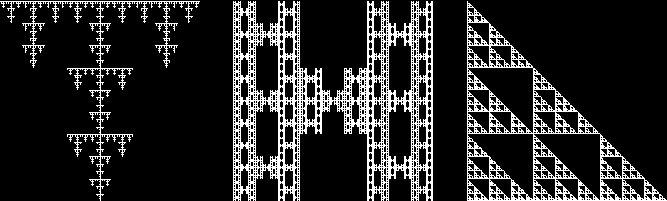
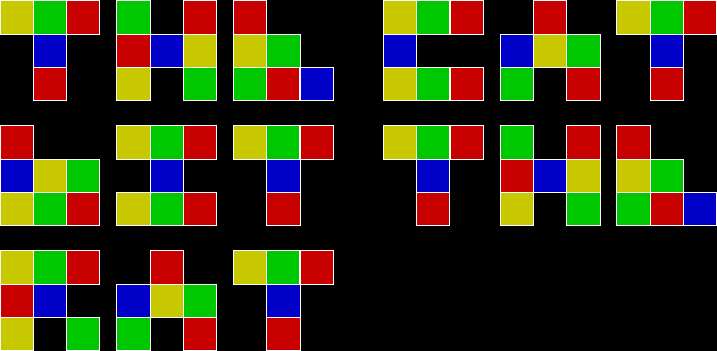
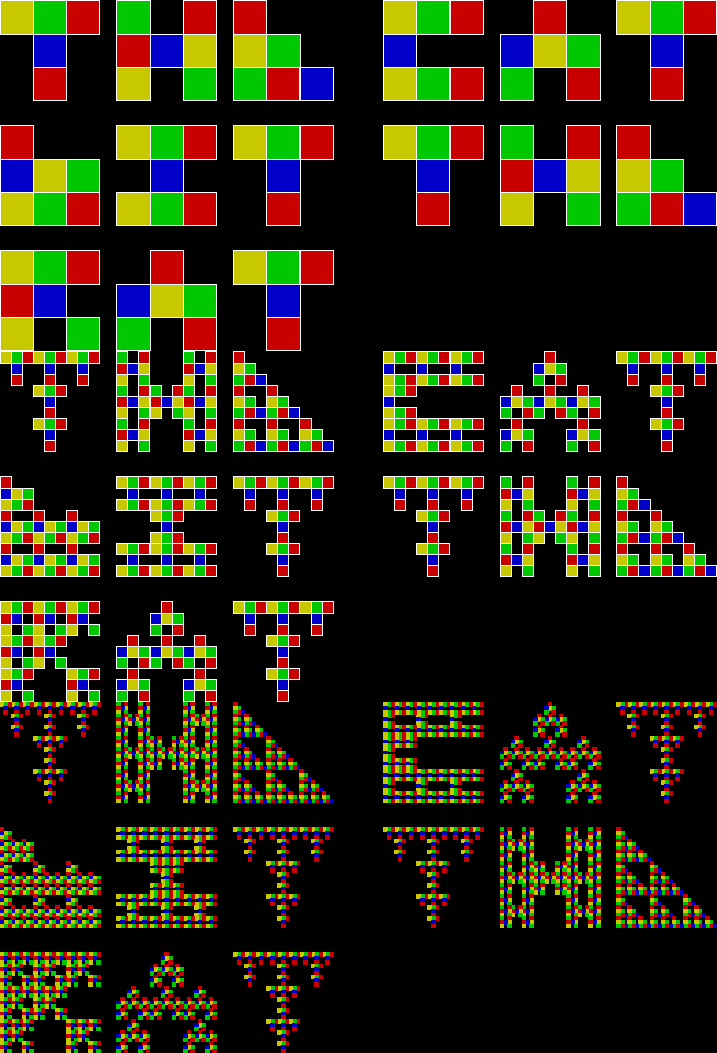
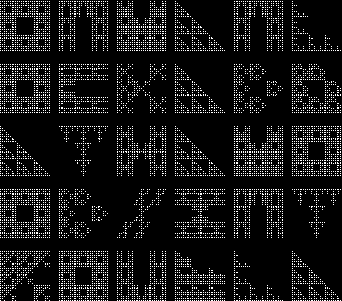
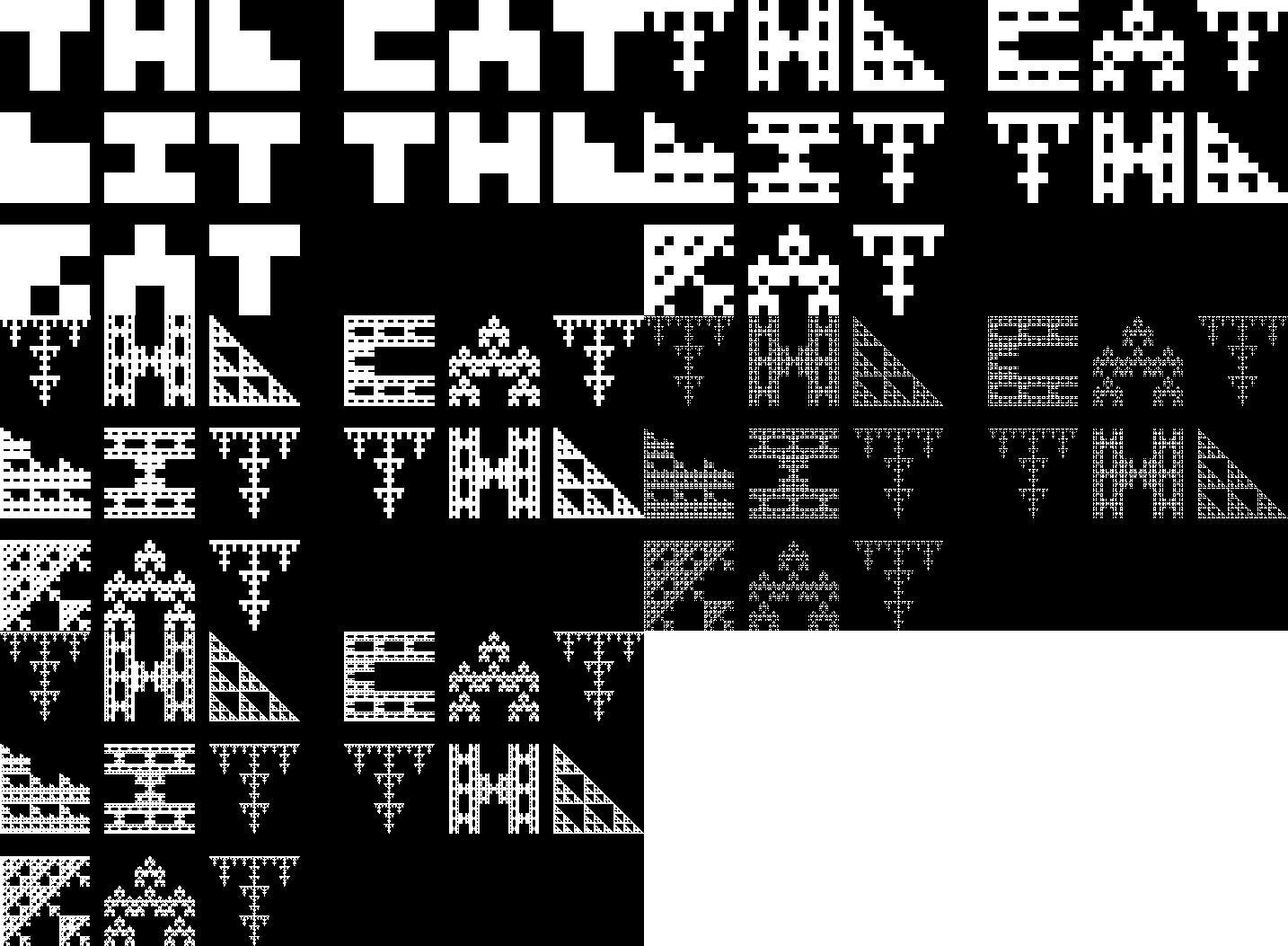
The compressed “THE” has a unique appearance and is both a letter and a word. Now try a complete sentence, “THE CAT BIT THE RAT”. This is the sentence in stage 1 of the fractalphabet:


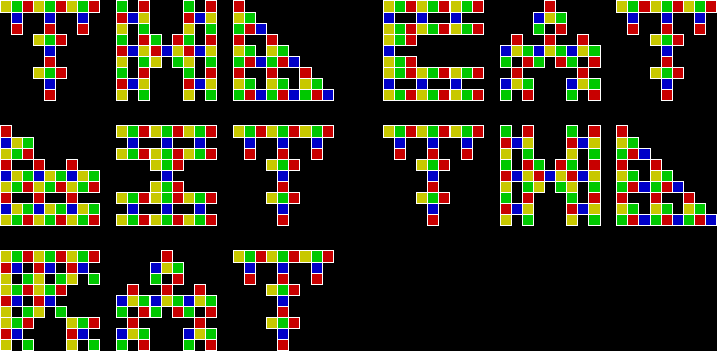
And stage 2:


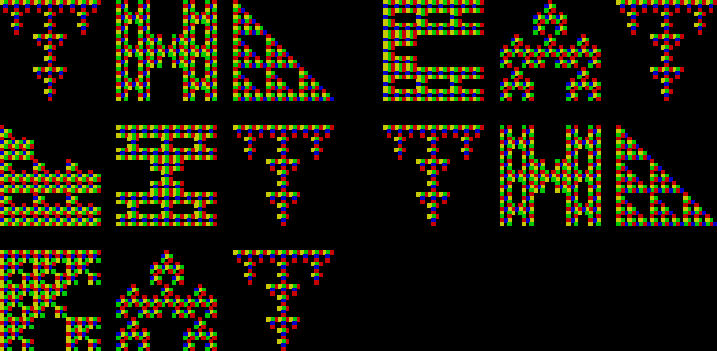
And further stages:


Fractal CAT (b&w animated)


Fractal CAT (color animated)


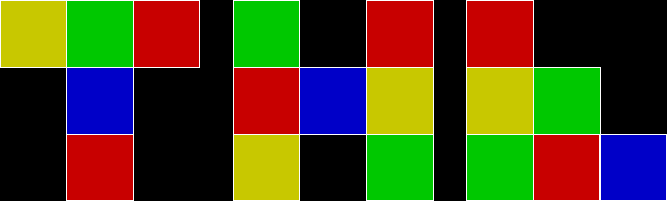
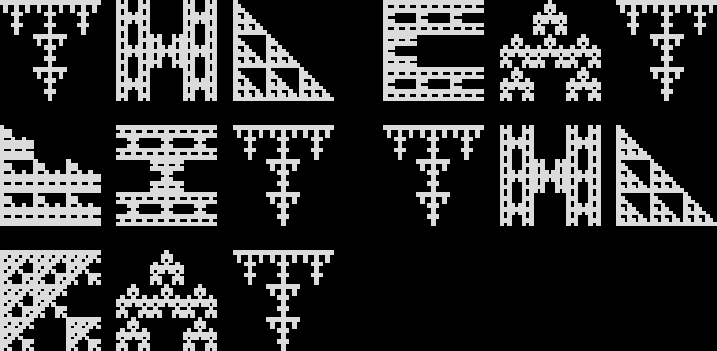
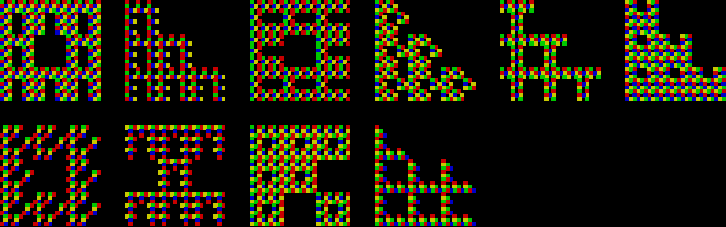
But, as we saw with “THE” above, that’s not the only fractal you can create from “THE CAT BIT THE RAT”. Here’s what I call a 2-compression of the sentence, where every second letter has been compressed into the letter that precedes it:


THE CAT BIT THE RAT (2-comp color)


THE CAT BIT THE RAT (2-comp b&w)


And here’s a 3-compression of the sentence, where every third letter has been compressed into every second letter, and every second-and-third letter has been compressed into the preceding letter:

THE CAT BIT THE RAT (3-comp color)


THE CAT BIT THE RAT (3-comp b&w)


As you can see above, each word of the original sentence is now a unique single letter of the fractalphabet. Theoretically, there’s no limit to the compression: you could fit every word of a book in the standard Roman alphabet into a single letter of the fractalphabet. Or you could fit an entire book into a single letter of the fractalphabet (with additional symbols for punctuation, which I haven’t bothered with here).

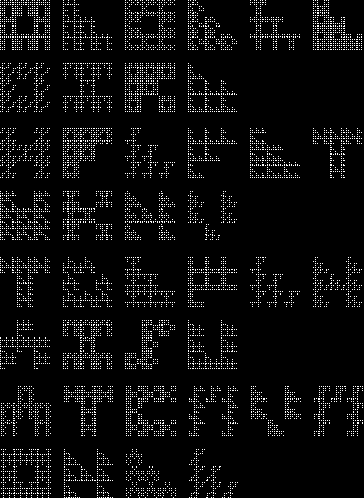
To see what the fractalphabeting of a longer text in the standard Roman alphabet might look like, take the first verse of a poem by A.E. Housman:

On Wenlock Edge the wood’s in trouble;
His forest fleece the Wrekin heaves;
The gale it plies the saplings double,
And thick on Severn snow the leaves. (“Poem XXXI” of A Shropshire Lad, 1896)

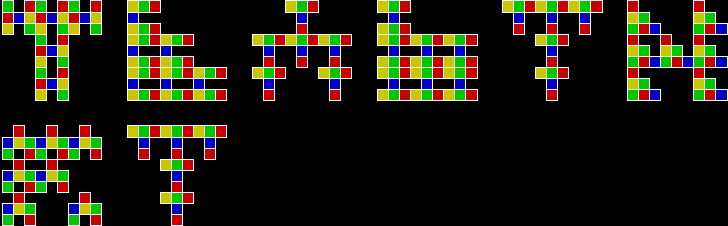
The first line looks like this in stage 1 of the fractalphabet:


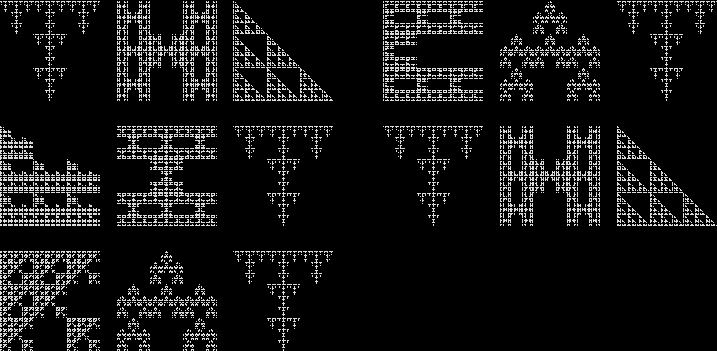
Here’s stage 2 of the standard fractalphabet, where each letter is divided into smaller copies of itself:


And here’s stage 3 of the standard fractalphabet:


Now examine a colour version of the first line in stage 1 of the fractalphabet:


As with “THE” above, let’s try compressing each second letter into the letter that precedes it:


And here’s a 3-comp of the first line:


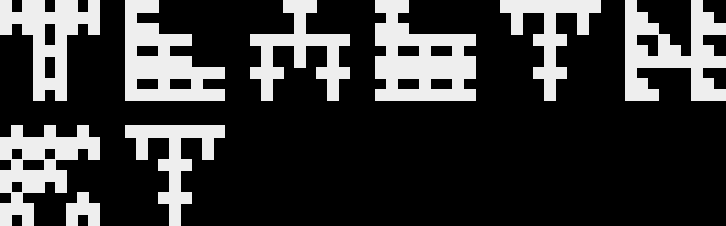
Finally, here’s the full first verse of Housman’s poem in 2-comp and 3-comp forms:

On Wenlock Edge the wood’s in trouble;
His forest fleece the Wrekin heaves;
The gale it plies the saplings double,
And thick on Severn snow the leaves. (“Poem XXXI of A Shropshire Lad, 1896)

“On Wenlock Edge” (2-comp)


“On Wenlock Edge” (3-comp)


Appendix

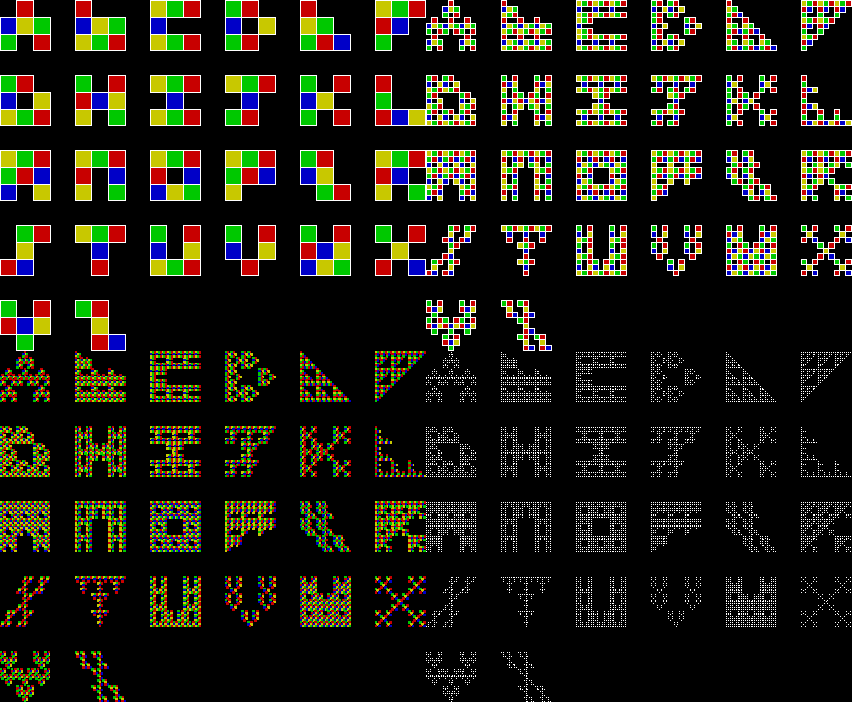
This is a possible lower-case version of the fractalphabet:

Whet Work

What, still alive at twenty-two,
A clean, upstanding chap like you?
Sure, if your throat ’tis hard to slit,
Slit your girl’s, and swing for it.

Like enough, you won’t be glad,
When they come to hang you, lad:
But bacon’s not the only thing
That’s cured by hanging from a string.

So, when the spilt ink of the night
Spreads o’er the blotting-pad of light,
Lads whose job is still to do
Shall whet their knives, and think of you.

Hugh Kingsmill’s famous parody of A.E. Housman

Performativizing Papyrocentricity #31

Papyrocentric Performativity Presents:

Nor Severn ShoreThe Poems of A.E. Housman, edited by Archie Burnett (Clarendon Press 1997) (posted @ Overlord of the Über-Feral)

Knight and ClayThe Riddle of the Labyrinth: The Quest to Crack an Ancient Code and the Uncovering of a Lost Civilisation, Margalit Fox (Profile Books 2013)

Goal God GuideThe Secret Footballer’s Guide to the Modern Game: Tips and Tactics from the Ultimate Insider, The Secret Footballer (Guardian Books 2014)


Or Read a Review at Random: RaRaR

Moto-Motto

Poem XLIII of Housman’s More Poems (1936) runs like this:

I wake from dreams and turning
My vision on the height
I scan the beacons burning
About the fields of night.

Each in its steadfast station
Inflaming heaven they flare;
They sign with conflagration
The empty moors of air.

The signal-fires of warning
They blaze, but none regard;
And on through night to morning
The world runs ruinward. (MP, XLIII)

In his commentary on the poem, the Housman scholar Archie Burnett traces a parallel with these lines from Lucretius: …multosque per annos | sustenata ruet moles et machina mundi – “…and the mass and fabric of the world, upheld through many years, shall crash into ruins” (De Rerum Natura, V 95-6).

I like the phrase moles et machina mundi, “mass and fabric of the world”, but I didn’t understand the translation fully. I investigated and discovered that the Latin word machina, though taken from Doric Greek μαχανα, makhana, “mechanical device”,* developed an additional meaning of “frame” or “body”. So Latin has deus ex machina, “god from the machine”, with one meaning, and machina mundi, “fabric of the world”, with another.

This seems to make machina a good word to expand the motto of this bijou bloguette. At the moment, the motto is this:

• Mathematica (v) • Magistra (iij) • Mundi (ij) •

That means “Mathematics is Mistress of the World”. Now try this:

• Mathematica (v) • Machina (iij) • Mundi (ij) •

The syllabification doesn’t change, but now I assume that the central word is pleasingly ambiguous and the motto means variously “Mathematics is Mechanism of the World”, the “Fabric of the World”, the “Engine of the World”, the “Body of the World”, and so on.

In addition, all the letters of Machina are found in Mathematica and Mundi, so the words on left and right almost act as a matrix, generating what appears between them.

There are further possibilities, blending magistra and machina:

• Mathematica (v) • Machistra (iij) • Mundi (ij) •

• Mathematica (v) • Magina (iij) • Mundi (ij) •


*In Attic Greek, it’s μηχανη, mēkhanē, whence “mechanical”, etc.

This Mortal Doyle

Challenger chopped and changed. That is to say, in one important respect, Arthur Conan Doyle’s character Professor Challenger lacked continuity. His philosophical views weren’t consistent. At one time he espoused materialism, at another he opposed it. He espoused it in “The Land of Mist” (1927):

“Don’t tell me, Daddy, that you with all your complex brain and wonderful self are a thing with no more life hereafter than a broken clock!”

“Four buckets of water and a bagful of salts,” said Challenger as he smilingly detached his daughter’s grip. “That’s your daddy, my lass, and you may as well reconcile your mind to it.”

But earlier, in “The Poison Belt” (1913), he had opposed it:

“No, Summerlee, I will have none of your materialism, for I, at least, am too great a thing to end in mere physical constituents, a packet of salts and three bucketfuls of water. Here ― here” ― and he beat his great head with his huge, hairy fist ― “there is something which uses matter, but is not of it ― something which might destroy death, but which death can never destroy.”

That story was published just over a century ago, but Challenger’s boast has not been vindicated in the meantime. So far as science can see, matter rules mind, not vice versa. Conan Doyle thought the same as the earlier Challenger, but Conan Doyle’s rich and teeming brain seems to have ended in “mere physical constituents”. To all appearances, when the organization of his brain broke down, so did his consciousness. And that concluded the cycle described by A.E. Housman in “Poem XXXII” of A Shropshire Lad (1896):

From far, from eve and morning
  And yon twelve-winded sky,
The stuff of life to knit me
  Blew hither: here am I.

Now – for a breath I tarry
  Nor yet disperse apart –
Take my hand quick and tell me,
  What have you in your heart.

Speak now, and I will answer;
  How shall I help you, say;
Ere to the wind’s twelve quarters
  I take my endless way. (ASL, XXXII)

Continue reading This Mortal Doyle

Words at War

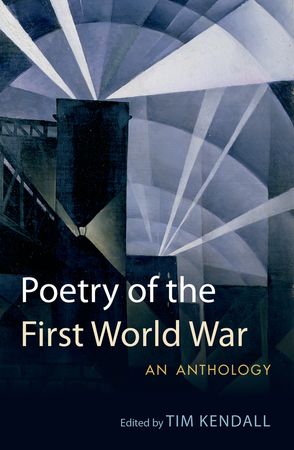
Front cover of Poetry of the First World War edited by Tim KendallPoetry of the First World War: An Anthology, ed. Tim Kendall (Oxford University Press 2013)

J.R.R. Tolkien and C.S. Lewis are famous names today, but both might have died young in the First World War. If so, they would now be long forgotten. Generally speaking, novelists, essayists and scholars take time to mature and need time to create. Poets are different: they can create something of permanent value in a few minutes. This helps explain why nearly half the men chosen for this book did not reach their thirties:

• Rupert Brooke (1887-1915)
• Julian Grenfell (1888-1915)
• Charles Sorley (1895-1915)
• Patrick Shaw Stewart (1888-1917)
• Arthur Graeme West (1891-1917)
• Isaac Rosenberg (1890-1918)
• Wilfred Owen (1893-1918)

And none of them left substantial bodies of work. Indeed, “except for some schoolboy verse”, Patrick Shaw Stewart is known for only one poem, which “was found written on the back flyleaf of his copy of A.E. Housman’s A Shropshire Lad after his death” (pg. 116). It begins like this:

I saw a man this morning
  Who did not wish to die:
I ask and cannot answer,
  If otherwise wish I.

(From I saw a man this morning)

Housman is here too, with Epitaph on an Army of Mercenaries, which Kipling, also here, is said to have called “the finest poem of the First World War” (pg. 14). I don’t agree and I would prefer less Kipling and no Thomas Hardy. That would have left space for something I wish had been included: translations from French and German. The First World War was fought by speakers of Europe’s three major languages and this book makes me realize that I know nothing about war poetry in French and German.

It would be interesting to compare it with the poetry in English. Were traditional forms mingling with modernism in the same way? I assume so. Wilfred Owen looked back to Keats and the assonance of Anglo-Saxon verse:

Our brains ache, in the merciless iced winds that knive us…
Wearied we keep awake because the night is silent…
Low, drooping flares confuse our memory of the salient…
Worried by silence, sentries whisper, curious, nervous,
  But nothing happens. (Exposure)

David Jones (1895-1974) looked forward:

   You can hear the silence of it:
You can hear the rat of no-man’s-land
rut-out intricacies,
weasel-out his patient workings,
scrut, scrut, sscrut,
harrow-out earthly, trowel his cunning paw;
redeem the time of our uncharity, to sap his own amphibi-
ous paradise.
   You can hear his carrying-parties rustle our corruptions
through the night-weeds – contest the choicest morsels in his
tiny conduits, bead-eyed feast on us; by a rule of his nature,
at night-feast on the broken of us. (In Parenthesis)

But is there Gerard Manley Hopkins in that? And in fact In Parenthesis was begun “in 1927 or 1928” and published in 1937. T.S. Eliot called it “a work of genius” (pg. 200). I’d prefer to disagree, but I can’t: you can feel the power in the extract given here. Isaac Rosenberg had a briefer life and left briefer work, but was someone else who could work magic with words:

A worm fed on the heart of Corinth,
Babylon and Rome.
Not Paris raped tall Helen,
But this incestuous worm
Who lured her vivid beauty
To his amorphous sleep.
England! famous as Helen
Is thy betrothal sung.
To him the shadowless,
More amorous than Solomon.

A beautiful poem about an ugly thing: death. A mysterious poem too. And a sardonic one. Rosenberg says much with little and I think he was a much better poet than the more famous Siegfried Sassoon and Robert Graves. They survived the war and wrote more during it, which helps explain their greater fame. But the flawed poetry of Graves was sometimes appropriate to its ugly theme:

To-day I found in Mametz Wood
A certain cure for lust of blood:

Where, propped against a shattered trunk,
  In a great mess of things unclean,
Sat a dead Boche; he scowled and stunk
  With clothes and face a sodden green,
Big-bellied, spectacled, crop-haired,
Dribbling black blood from nose and beard.

A poem like that is a cure for romanticism, but that’s part of what makes Wilfred Owen a better and more interesting poet than Graves. Owen’s romanticism wasn’t cured: there’s conflict in his poems about conflict:

I saw his round mouth’s crimson deepen as it fell,
  Like a sun, in his last deep hour;
Watched the magnificent recession of farewell,
  Clouding, half gleam, half glower,
And a last splendour burn the heavens of his cheek.
  And in his eyes
The cold stars lighting, very old and bleak,
  In different skies.

But how good is Owen’s work? He was a Kurt Cobain of his day: good-looking, tormented and dying young. You can’t escape the knowledge of early death when you read the poetry of one or listen to the music of other. That interferes with objective appraisal. But the flaws in Owen’s poetry add to its power, increasing the sense of someone writing against time and struggling for greatness in a bad place. The First World War destroyed a lot of poets and perhaps helped destroy poetry too, raising questions about tradition that some answered with nihilism. As Owen asks in Futility:

Was it for this the clay grew tall?
—O what made fatuous sun-beams toil
To break earth’s sleep at all?

Some of the poets here were happy to go to war, but it wasn’t the Homeric adventure anticipated by Patrick Shaw Stewart. He learnt that high explosive is impersonal, bullets kill at great distance and machines don’t need rest. Poetry of the First World War is about a confrontation: between flesh and metal, brains and machinery. It’s an interesting anthology that deserves much more time than I have devoted to it. The notes aren’t intrusive, the biographies are brief but illuminating, and although Tim Kendall is a Professor of English Literature he has let his profession down by writing clear prose and eschewing jargon. He’s also included some “Music-Hall and Trench Songs” and they speak for the ordinary and sometimes illiterate soldier. The First World War may be the most important war in European history and this is a good introduction to some of the words it inspired.

Lute to Kill

A little-known Housman poem that should be better-known:


Breathe, my lute, beneath my fingers
    One regretful breath,
One lament for life that lingers
    Round the doors of death.
For the frost has killed the rose,
And our summer dies in snows,
    And our morning once for all
    Gathers to the evenfall.

Hush, my lute, return to sleeping,
    Sing no songs again.
For the reaper stays his reaping
    On the darkened plain;
And the day has drained its cup,
And the twilight cometh up;
    Song and sorrow all that are
    Slumber at the even-star.

A.E. Housman (1859-1936) — see also Breathe, my lute at Wikilivres.

The Brain in Pain

You can stop reading now, if you want. Or can you? Are your decisions really your own, or are you and all other human beings merely spectators in the mind-arena, observing but neither influencing nor initiating what goes on there? Are all your apparent choices in your brain, but out of your hands, made by mechanisms beyond, or below, your conscious control?

In short, do you have free will? This is a big topic – one of the biggest. For me, the three most interesting things in the world are the Problem of Consciousness, the Problem of Existence and the Question of Free Will. I call consciousness and existence problems because I think they’re real. They’re actually there to be investigated and explained. I call free will a question because I don’t think it’s real. I don’t believe that human beings can choose freely or that any possible being, natural or supernatural, can do so. And I don’t believe we truly want free will: it’s an excuse for other things and something we gladly reject in certain circumstances.


Continue reading The Brain in Pain