Phil’ Kill Kult

Lucretius (1869)

by Alfred Tennyson

Lucilla, wedded to Lucretius, found
Her master cold; for when the morning flush
Of passion and the first embrace had died
Between them, tho’ he loved her none the less,
Yet often when the woman heard his foot
Return from pacings in the field, and ran
To greet him with a kiss, the master took
Small notice, or austerely, for his mind
Half buried in some weightier argument,
Or fancy-borne perhaps upon the rise
And long roll of the hexameter — he past
To turn and ponder those three hundred scrolls
Left by the Teacher, whom he held divine.
She brook’d it not, but wrathful, petulant
Dreaming some rival, sought and found a witch
Who brew’d the philtre which had power, they said
To lead an errant passion home again.
And this, at times, she mingled with his drink,
And this destroy’d him; for the wicked broth
Confused the chemic labor of the blood,
And tickling the brute brain within the man’s
Made havoc among those tender cells, and check’d
His power to shape. He loathed himself, and once
After a tempest woke upon a morn
That mock’d him with returning calm, and cried:

“Storm in the night! for thrice I heard the rain
Rushing; and once the flash of a thunderbolt —
Methought I never saw so fierce a fork —
Struck out the streaming mountain-side, and show’d
A riotous confluence of watercourses
Blanching and billowing in a hollow of it,
Where all but yester-eve was dusty-dry.

“Storm, and what dreams, ye holy Gods, what dreams!
For thrice I waken’d after dreams. Perchance
We do but recollect the dreams that come
Just ere the waking. Terrible: for it seem’d
A void was made in Nature, all her bonds
Crack’d; and I saw the flaring atom-streams
And torrents of her myriad universe,
Ruining along the illimitable inane,
Fly on to clash together again, and make
Another and another frame of things
For ever. That was mine, my dream, I knew it —
Of and belonging to me, as the dog
With inward yelp and restless forefoot plies
His function of the woodland; but the next!
I thought that all the blood by Sylla shed
Came driving rainlike down again on earth,
And where it dash’d the reddening meadow, sprang
No dragon warriors from Cadmean teeth,
For these I thought my dream would show to me,
But girls, Hetairai, curious in their art,
Hired animalisms, vile as those that made
The mulberry-faced Dictator’s orgies worse
Than aught they fable of the quiet Gods.
And hands they mixt, and yell’d and round me drove
In narrowing circles till I yell’d again
Half-suffocated, and sprang up, and saw —
Was it the first beam of my latest day?

“Then, then, from utter gloom stood out the
The breasts of Helen, and hoveringly a sword
Now over and now under, now direct,
Pointed itself to pierce, but sank down shamed
At all that beauty; and as I stared, a fire,
The fire that left a roofless Ilion,
Shot out of them, and scorch’d me that I woke.

“Is this thy vengeance, holy Venus, thine,
Because I would not one of thine own doves,
Not even a rose, were offered to thee? thine,
Forgetful how my rich proemion makes
Thy glory fly along the Italian field,
In lays that will outlast thy deity?

“Deity? nay, thy worshippers. My tongue
Trips, or I speak profanely. Which of these
Angers thee most, or angers thee at all?
Not if thou be’st of those who, far aloof
From envy, hate and pity, and spite and scorn,
Live the great life which all our greatest fain
Would follow, centred in eternal calm.

“Nay, if thou canst,
Goddess, like ourselves
Touch, and be touch’d, then would I cry to thee
To kiss thy Mavors, roll thy tender arms
Round him, and keep him from the lust of blood
That makes a steaming slaughter-house of Rome.

“Ay, but I meant not thee; I meant riot her
Whom all the pines of Ida shook to see
Slide from that quiet heaven of hers, and tempt
The Trojan, while his neatherds were abroad
Nor her that o’er her wounded hunter wept
Her deity false in human-amorous tears;
Nor whom her beardless apple-arbiter
Decided fairest. Rather, O ye Gods,
Poet-like, as the great Sicilian called
Calliope to grace his golden verse —
Ay, and this Kypris also — did I take
That popular name of thine to shadow forth
The all-generating powers and genial heat
Of Nature, when she strikes thro’ the thick blood
Of cattle, and light is large, and lambs are glad
Nosing the mother’s udder, and the bird
Makes his heart voice amid the blaze of flowers;
Which things appear the work of mighty Gods.

“The Gods! and if I go my work is left
Unfinish’d — if I go. The Gods, who haunt
The lucid interspace of world and world,
Where never creeps a cloud, or moves a wind,
Nor ever falls the least white star of snow
Nor ever lowest roll of thunder moans,
Nor sound of human sorrow mounts to mar
Their sacred everlasting calm! and such,
Not all so fine, nor so divine a calm
Not such, nor all unlike it, man may gain
Letting his own life go. The Gods, the Godsl
If all be atoms, how then should the Gods
Being atomic not be dissoluble,
Not follow the great law? My master held
That Gods there are, for all men so believe.
I prest my footsteps into his, and meant
Surely to lead my Memmius in a train
Of fiowery clauses onward to the proof
That Gods there are, and deathless. Meant? I meant?
I have forgotten what I meant, my mind
Stumbles, and all my faculties are lamed.

“Look where another of our Gods, the Sun
Apollo, Delius, or of older use
All-seeing Hyperion — what you will —
Has mounted yonder; since he never sware,
Except his wrath were wreak’d on wretched man,
That he would only shine among the dead
Hereafter — tales! for never yet on earth
Could dead flesh creep, or bits of roasting ox
Moan round the spit — nor knows he what he sees;
King of the East altho’ he seem, and girt
With song and flame and fragrance, slowly lifts
His golden feet on those empurpled stairs
That climb into the windy halls of heaven
And here he glances on an eye new-born,
And gets for greeting but a wail of pain;
And here he stays upon a freezing orb
That fain would gaze upon him to the last;
And here upon a yellow eyelid fallen
And closed by those who mourn a friend in vain,
Not thankful that his troubles are no more.
And me, altho’ his fire is on my face
Blinding, he sees not, nor at all can tell
Whether I mean this day to end myself.
Or lend an ear to Plato where he says,
That men like soldiers may not quit the post
Allotted by the Gods. But he that holds
The Gods are careless, wherefore need he care
Greatly for them, nor rather plunge at once,
Being troubled, wholly out of sight, and sink
Past earthquake — ay, and gout and stone, that break
Body toward death, and palsy, death-in-life,
And wretched age — and worst disease of all,
These prodigies of myriad nakednesses,
And twisted shapes of lust, unspeakable,
Abominable, strangers at my hearth
Not welcome, harpies miring every dish,
The phantom husks of something foully done,
And fleeting thro’ the boundless universe,
And blasting the long quiet of my breast
With animal heat and dire insanity?

“How should the mind, except it loved them, clasp
These idols to herself? or do they fly
Now thinner, and now thicker, like the flakes
In a fall of snow, and so press in, perforce
Of multitude, as crowds that in an hour
Of civic tumult jam the doors, and bear
The keepers down, and throng, their rags and the
The basest, far into that council-hall
Where sit the best and stateliest of the land?

“Can I not fling this horror off me again,
Seeing with how great ease Nature can smile
Balmier and nobler from her bath of storm,
At random ravage? and how easily
The mountain there has cast his cloudy slough,
Now towering o’er him in serenest air,
A mountain o’er a mountain, — ay, and within
All hollow as the hopes and fears of men?

“But who was he that in the garden snared
Picus and Faunus, rustic Gods? a tale
To laugh at — more to laugh at in myself —
For look! what is it? there? yon arbutus
Totters; a noiseless riot underneath
Strikes through the wood, sets all the tops quivering —;
The mountain quickens into Nymph and Faun,
And here an Oread — how the sun delights
To glance and shift about her slippery sides,
And rosy knees and supple roundedness,
And budded bosom-peaks — who this way runs
Before the rest! — a satyr, a satyr, see,
Follows; but him I proved impossible
Two-natured is no nature. Yet he draws
Nearer and nearer, and I scan him now
Beastlier than any phantom of his kind
That ever butted his rough brother-brute
For lust or lusty blood or provender.
I hate, abhor, spit, sicken at him; and she
Loathes him as well; such a precipitate heel,
Fledged as it were with Mercury’s ankle-wing,
Whirls her to me —; but will she fling herself
Shameless upon me? Catch her, goatfoot! nay,
Hide, hide them, million-myrtled wilderness,

And cavern-shadowing laurels, hide! do I wish —
What? —; that the bush were leafless? or to whelm
All of them in one massacre? O ye Gods
I know you careless, yet, behold, to you
From childly wont and ancient use I call —
I thought I lived securely as yourselves —
No lewdness, narrowing envy, monkey-spite,
No madness of ambition, avarice, none;
No larger feast than under plane or pine
With neighbors laid along the grass, to take
Only such cups as left us friendly-warm,
Affirming each his own philosophy
Nothing to mar the sober majesties
Of settled, sweet, Epicurean life.
But now it seems some unseen monster lays
His vast and filthy hands upon my will,
Wrenching it backward into his, and spoils
My bliss in being; and it was not great,
For save when shutting reasons up in rhythm,
Or Heliconian honey in living words,
To make a truth less harsh, I often grew
Tired of so much within our little life
Or of so little in our little life —
Poor little life that toddles half an hour
Crown’d with a flower or two, and there an end —
And since the nobler pleasure seems to fade,
Why should I, beastlike as I find myself,
Not manlike end myself? — our privilege —;
What beast has heart to do it? And what man
What Roman would be dragg’d in triumph thus?
Not I; not he, who bears one name with her
Whose death-blow struck the dateless doom of kings,
When, brooking not the Tarquin in her veins,
She made her blood in sight of Collatine
And all his peers, flushing the guiltless air,
Spout from the maiden fountain in her heart.
And from it sprang the Commonwealth, which breaks
As I am breaking now!

“And therefore now
Let her, that is the womb and tomb of all
Great Nature, take, and forcing far apart
Those blind beginnings that have made me man,
Dash them anew together at her will
Thro’ all her cycles — into man once more,
Or beast or bird or fish, or opulent flower.
But till this cosmic order everywhere
Shatter’d into one earthquake in one day
Cracks all to pieces, — and that hour perhaps
Is not so far when momentary man
Shall seem no more a something to himself,
But he, his hopes and hates, his homes and fanes
And even his bones long laid within the grave,
The very sides of the grave itself shall pass,
Vanishing, atom and void, atom and void,
Into the unseen for ever, — till that hour,
My golden work in which I told a truth
That stays the rolling Ixionian wheel,
And numbs the Fury’s ringlet-snake, and plucks
The mortal soul from out immortal hell
Shall stand. Ay, surely; then it fails at last
And perishes as I must, for O Thou
Passionless bride, divine Tranquillity,
Yearn’d after by the wisest of the wise
Who fail to find thee, being as thou art
Without one pleasure and without one pain,
Howbeit I know thou surely must be mine
Or soon or late, yet out of season, thus
I woo thee roughly, for thou carest not
How roughly men may woo thee so they win —;
Thus — thus — the soul flies out and dies in the air.”

With that he drove the knife into his side.
She heard him raging, heard him fall, ran in,
Beat breast, tore hair, cried out upon herself
As having fail’d in duty to him, shriek’d
That she but meant to win him back, fell on him
Clasp’d, kiss’d him, wail’d. He answer’d, “Care not thou!
Thy duty? What is duty? Fare thee well!”

Moto-Motto

Poem XLIII of Housman’s More Poems (1936) runs like this:

I wake from dreams and turning
My vision on the height
I scan the beacons burning
About the fields of night.

Each in its steadfast station
Inflaming heaven they flare;
They sign with conflagration
The empty moors of air.

The signal-fires of warning
They blaze, but none regard;
And on through night to morning
The world runs ruinward. (MP, XLIII)

In his commentary on the poem, the Housman scholar Archie Burnett traces a parallel with these lines from Lucretius: …multosque per annos | sustenata ruet moles et machina mundi – “…and the mass and fabric of the world, upheld through many years, shall crash into ruins” (De Rerum Natura, V 95-6).

I like the phrase moles et machina mundi, “mass and fabric of the world”, but I didn’t understand the translation fully. I investigated and discovered that the Latin word machina, though taken from Doric Greek μαχανα, makhana, “mechanical device”,* developed an additional meaning of “frame” or “body”. So Latin has deus ex machina, “god from the machine”, with one meaning, and machina mundi, “fabric of the world”, with another.

This seems to make machina a good word to expand the motto of this bijou bloguette. At the moment, the motto is this:

• Mathematica (v) • Magistra (iij) • Mundi (ij) •

That means “Mathematics is Mistress of the World”. Now try this:

• Mathematica (v) • Machina (iij) • Mundi (ij) •

The syllabification doesn’t change, but now I assume that the central word is pleasingly ambiguous and the motto means variously “Mathematics is Mechanism of the World”, the “Fabric of the World”, the “Engine of the World”, the “Body of the World”, and so on.

In addition, all the letters of Machina are found in Mathematica and Mundi, so the words on left and right almost act as a matrix, generating what appears between them.

There are further possibilities, blending magistra and machina:

• Mathematica (v) • Machistra (iij) • Mundi (ij) •

• Mathematica (v) • Magina (iij) • Mundi (ij) •


*In Attic Greek, it’s μηχανη, mēkhanē, whence “mechanical”, etc.

Nor Severn Shore

The Poems of A.E. Housman, edited by Archie Burnett (Clarendon Press 1997)

“I hate posterity — it’s so fond of having the last word.” So said Saki’s hero Reginald in “Reginald on the Academy” (1904). In The Poems of A.E. Housman, the academy is trying to have the last word on A.E. Housman (1859-1936). But Housman wouldn’t have minded. Horace boasted that his verse would prove monumentum aere perennius – “a monument more lasting than bronze” (Odes, III 30). Housman had humbler ambitions for his:

They say my verse is sad: No wonder;
Its narrow measure spans
Rue for eternity, and sorrow:
Not mine, but man’s.

This is for all ill-treated fellows
Unborn and unbegot,
For them to read
When they’re in trouble
And I am not.

In the commentary, Archie Burnett quotes a letter of “AEH to Witter Bynner, 3 June 1903: ‘My chief object in publishing my verses was to give pleasure to a few young men here and there’” (pg. 417). And Housman wasn’t in trouble when those lines were published, because he was dead. They open the posthumous More Poems (1936), which was edited by his brother Laurence.

In this case, I think there is more pleasure in the variant phrase “Tears of eternity”, included in the scholarly apparatus beneath the poem (pg. 113). Posterity seems to agree, because “Tears of eternity” appears in The Collected Poems of A.E. Housman, published as a popular edition in 1994 by Wordsworth. And it echoes Virgil’s lacrimae rerum, “the tears of things” (Aeneid, i. 462). Classical influences are not obvious in Housman, but they are there beneath the surface. The simplicity of his verse is deceptive:

Passages are adduced for consideration with no indication of their status or significance: that is a matter for literary criticism, and I have endeavoured only to provide a foundation for such criticism. I hope, however, to have rectified the anomaly whereby a wide range of intertextual reference is expected in, say, Milton or T.S. Eliot, but not in Housman; and to have promoted regard for Housman as one of the true scholar-poets. (“Introduction”, pg. lx)

Burnett’s hopes are realized. The best of Housman’s poems are like butterflies: small, delicate, enchanting. And Burnett sometimes seems to be breaking butterflies on the wheel. The commentary for a poem can be much longer than the poem itself. First it’s fixed by a long pin: “1st draft, Dec. 1895 – 24 Feb. 1900; 2nd draft 30 Mar. – 10 Apr. 1922” transfixes the lines given above, for example. Then there’s a description of the manuscripts: “ink, with corrections and uncancelled variants in pencil”. Then Burnett commences what Aldous Huxley called “the learned foolery of research into what, for scholars, is the all-important question: Who influenced whom to say what when?” (The Doors of Perception, 1954).

But the learned foolery is interesting and enlightening. You’ll understand and appreciate Housman better by reading this book. All readers will know that the lad of A Shropshire Lad (1896) is imaginary. But so, in part, is the Shropshire:

The vane on Hughley steeple
Veers bright, a far-known sign,
And there lie Hughley people
And there lie friends of mine.

Tall in their midst the tower
Divides the shade and sun,
And the clock strikes the hour
And tells the time to none. (ASL, LXI)

Burnett notes that there is “no steeple as such” on the church of St John Baptist at Hughley (pg. 365). Housman was “Worcestershire by birth” and Shropshire was his “horizon”, not his home (pg. 317). He wrote about the village of Hughley before he had even seen it:

I ascertained by looking down from Wenlock Edge that Hughley Church could not have much of a steeple. But as I had already composed the poem and could not invent another name that sounded so nice, I could only deplore that the church at Hughley should follow the bad example of the church at Brou, which persists in standing on a plain after Matthew Arnold has said it stands among mountains. I thought of putting a note to say that Hughley was only a name, but then I thought that would merely disturb the reader. I did not apprehend that the faithful would be making pilgrimages to these holy places. (Letter to Laurence Housman, 5th October 1896)

But what more appropriate for the faithful than to travel in hope and arrive in vain? A non-existent steeple is far more Housmanesque than an actual. His Shropshire is part of myth, not of mundanity. It’s a horizon, not a home, and no-one can ever go there. But if horizons are Housmanesque, so is humour. It’s not obvious from A Shropshire Lad that the author was one of the greatest classical scholars who ever lived. Nor is it obvious that the author could see the lighter side of life.

But he could. His letters prove that and so does some of his verse:

I knew a gentleman of culture
Whose aunt was eaten by a vulture.
He said “Though carrion may be scanty,
That bird should not have eaten auntie.” (?1917)

When I was born to a world of sin,
God be praised, it was raining gin,
Gin on the houses, gin on the walls,
Gin on the bunworks and copybook-stalls. (?1911)

He also joked about the Academy:

First Don O cuckoo, shall I call thee bird,
Or but a wandering voice?
Second Don State the alternative preferred,
With reasons for your choice. (date unknown)

Fragment of a Greek tragedy

Alcmaeon. Chorus.

Cho. O suitably-attired-in-leather-boots
Head of a traveller, wherefore seeking whom
Whence by what way purposed art thou come
To this well-nightingaled vicinity? (Fragment…, 1883)

The lines above are from the section called “Light Verse and Juvenilia”. Some of Housman’s nonsense verse is excellent. Some of it is also eerie: “Aunts and Nieces, or, Time and Space” (?1929) reminded me of M.R. James or Saki, with its “astoundingly absurd/Yet dangerous cockyoly-bird”:

In the middle of next week
There will be heard a piercing shriek,
And looking pale and weak and thin
Eliza will come flying in. (“Aunts and Nieces”)

Who would guess that the same man wrote A Shropshire Lad? But that also applies to “Iona”, Housman’s attempt to win the Newdigate Prize for English Verse at Oxford in 1879. As Burnett notes, the “subject and the metre (English heroic verse) were not of his choosing” (pg. 529). Unsurprisingly, the poem didn’t win the prize. It would make a good challenge for a literary scholar today. If you didn’t know who had written it, would you be able to guess?

And far in all the wide world’s peopled ways
Became a marvel and a wild amaze.
Became a wonder and a world’s desire
And fill’d high heaven and all men’s eyes with fire,
And wheresoever it smote, such power it had,
The reaper stay’d his reaping and was glad,
The ploughman left his plough and follow’d far,
The shepherd reck’d no more of folding-star,
The fisher thither turned his toiling oar
Harrowing the peopled main with nets no more.
The deep-sea diver left the watery whirl
And sought no more the shark-beleaguer’d pearl,
And far away the light on all men’s eyes
Struck blind the magian wisdom of the wise:
Then each man deemed his riches last and least
And came and worshipp’d out of west and east
At faith’s far altar raining gems like tears
And all the garner’d usury of years;
Brought jewell’d gold and treasure passing price
And ransack’d cities piled for sacrifice
And incense strange in marvellous woofs unfurl’d
For these had seen her star in all the world.
Had seen her star, and clothed in gladness trod
And walked on earth with a many a present god, […]

(“Iona”, ll. 85-108 – a “folding-star” is a star seen at nightfall, when sheep are gathered into the fold)

I think most literary scholars would conclude that those lines had been written by a forgotten Victorian poetaster influenced by Swinburne. But Burnett notes one link to Housman at his laconic best, for a reaper also appears in this poem:

Breathe, my lute, beneath my fingers
One regretful breath,
One lament for life that lingers
Round the doors of death.

For the frost has killed the rose,
And our summer dies in snows,
And our morning once for all
Gathers to the evenfall.

Hush, my lute, return to sleeping,
Sing no songs again.
For the reaper stays his reaping
On the darkened plain;

And the day has drained its cup,
And the twilight cometh up;
Song and sorrow all that are
Slumber at the even-star.

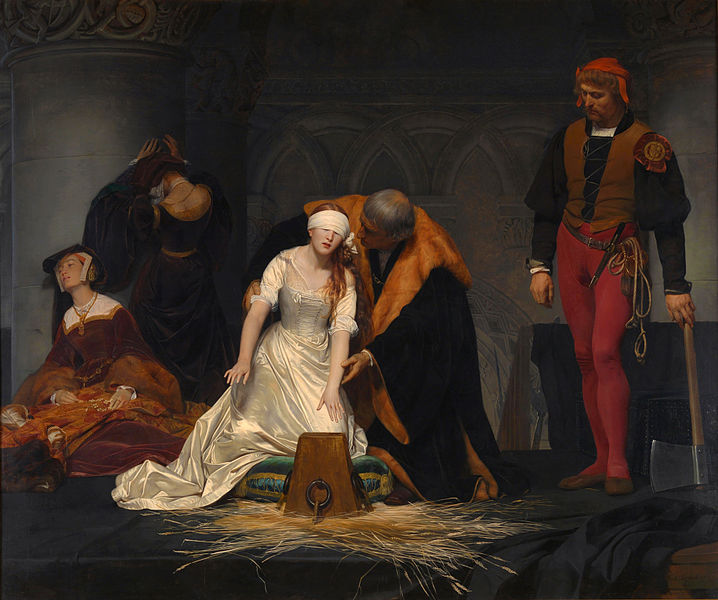
When I first came across that on the internet, I thought it was a late poem. It actually pre-dates “Iona” and was written in 1877 as a “song for Lady Jane Grey awaiting death in captivity”, part of a play, The Tragedy of Lady Jane Grey, that would have been published in a “Family Magazine”. But Housman left home to attend Oxford before he finished editing and transcribing the magazine.

Le Supplice de Jane Grey, Paul Delaroche (1833)

Le Supplice de Jane Grey, Paul Delaroche (1833)

Only a “fragment” of it was left and that is how the poem survived. What else has been lost? Nothing better than that, I would guess – and hope. But in a way this book retrieves lost poems. In the commentary to Poem XXV of Last Poems (1922), Burnett parallels Housman’s “sea-wet rock” with Philip Bourke Marston’s “sea-wet shining sand”. Marston was a blind poet whose collection Song-Tide (1888) was a “volume in Housman’s library”. He deserves to be better-remembered.

The German poet Heine, on the other hand, has the modern fame he deserves: a lot. His influence on Housman was considerable and he often appears in the commentary. Take Poem LVII in A Shropshire Lad:

You smile upon your friend to-day,
To-day his ills are over;
You hearken to the lover’s say,
And happy is the lover.

’Tis late to hearken, late to smile,
But better late than never;
I shall have lived a little while
Before I die for ever. (ASL, LVII)

The commentary notes a parallel with these verses by Heine:

Es kommt zu spät, was du mir lächelst,
Was du mir seufzest, kommt zu spät!
Längst sind gestorben die Gefühle,
Die du so grausam einst verschmäht.

Zu spät kommt deine Gegenliebe!
Es fallen aus mein Herz herab
All deine heissen Liebesblicke
Wie Sonnenstrahlen auf ein Grab.

Then it quotes the stilted Victorian translation Housman was familiar with: “It comes too late, thy present smiling, | It comes too late, thy present sigh! | The feelings all long since have perish’d | That thou didst spurn so cruelly. || Too late has come thy love responsive, | My heart thou vainly seek’st to stir | With burning looks of love, all falling | Like sunbeams on a sepulchre.” That’s by Edgar Alfred Bowring. Housman captures the simplicity and spirit of Heine much better in A Shropshire Lad.

But “Breathe, my lute” proves that Housman was Housmanesque before Heine, whose influence is “later than 1889” (“Introduction”, lx). Shakespeare and the Bible influenced him from the beginning, as the commentary proves again and again. He was also influenced by English and French folk-ballads, by Tennyson, Christina Rosetti, Swinburne and Stevenson, and by classical authors like Horace, Lucretius, Juvenal and Propertius. Burnett quotes the original languages, noting the Greek πολυφαρμακος behind “many-venomed” in Poem LXII of A Shropshire Lad and expanding Poem XLIII of More Poems with a resounding phrase from Lucretius: moles et machina mundi, “the mass and fabric of the world” (pg. 455).

And Propertius might have been writing Housman’s epitaph here:

Qui nunc iacet horrida pulvis,
Unius hic quoniam servus amoris erat. (Elegies II. XiiiA. 35-6)

Those lines were noted as a parallel to Poem XI of A Shropshire Lad by the Japanese scholar Tatsuzo Hijakata in the Housman Society Journal (9, 1983). Again the translation given here is stilted: “He that now lies naught but unlovely dust, once served one love and one love only”. Housman captured the spirit and simplicity of Propertius far better:

On your midnight pallet lying,
Listen, and undo the door:
Lads that waste the light in sighing
In the dark should sigh no more;
Night should ease a lover’s sorrow;
Therefore, since I go to-morrow,
Pity me before. (ASL, XI)

The classical influence could be more indirect: “the bluebells of the listless plain” in XXVIII of More Poems are explained by the parallel between the flower’s scientific name, Campanula, “little bell”, and campania, “level plain” (pg. 444). And so the spirit of Housman, “amateur botanist and professional Latinist” (ibid.), lingers amid the “learned foolery”, which cannot explain why his poetry is so good, but can illuminate his sources and allow people who knew him to reveal some of his contradictions and complexities:

One morning in May, 1914, when the trees in Cambridge were covered with blossom, he reached in his lecture… “Diffugere nives, redeunt iam gramina campis.” This ode [Horace, IV 7] he dissected with the usual display of brilliance, wit and sarcasm. Then for the first time in two years he looked up at us, and said in quite a different voice: “I should like to spend the last few minutes considering this ode simply as poetry.” Our previous experience of Professor Housman would have made us sure that he would regard such a proceeding as beneath contempt. He read the ode aloud with deep emotion, first in Latin and then in an English translation of his own. “That,” he said hurriedly, almost like a man betraying a secret, “I regard as the most beautiful poem in ancient literature,” and walked quickly out of the room. A scholar of Trinity (since killed in the War), who walked with me to our next lecture, expressed in undergraduate style our feeling that we had seen something not really meant for us. “I felt quite uncomfortable,” he said. “I was afraid the old fellow was going to cry.” (Commentary on More Poems, Poem V, pg. 427, quoting Mrs T.W. Pym in The Times, 5th May 1936, 5, from Grant Richards, Housman 1897-1936 (revised edition 1942), pg. 289)

But one of those who knew Housman was Housman himself. In More Poems XLIV, he writes of “Venice under sea”. And here, in a letter to his sister Katharine in 1926, is his last word on his love for the city:

I was surprised to find what pleasure it gave me to be in Venice again. It was like coming home, when sounds and smells which one had forgotten stole upon one’s senses; and certainly there is no place like it in the world: everything there is better in reality than in memory. I first saw it on a romantic evening after sunset inn 1900, and I left it on a sunshiny morning, and I shall not go there again. (Commentary to MP, XLIV, pp. 456-7)

Housman’s life, like his verse, combined contradictions: the bitter with the sweet. Sometimes he felt that everything had been futile:

When the bells justle in the tower
The hollow night amid,
Then on my tongue the taste is sour
Of all I ever did. (Additional Poems (1939), IX)

But that is actually “A Fragment preserved by oral tradition and said to have been composed by A.E. Housman in a dream” (pg. 469). Housman himself said that he did “not know” it or had “forgotten” it. So he forgot what he dreamt. He remembered what he had lived and could mingle the sweetness of memory with the bitterness of loss:

’Tis time, I think, by Wenlock town
The golden broom should blow;
The hawthorn sprinkled up and down
Should charge the land with snow.

Spring will not wait the loiterer’s time
Who keeps so long away;
So others wear the broom and climb
The hedgerows heaped with may.

Oh tarnish late on Wenlock Edge,
Gold that I never see;
Lie long, high snowdrifts in the hedge
That will not shower on me. (ASL, XXXIX)


Previously pre-posted (please peruse):

Poetry and Putridity — A.E.H. vs C.A.S.