Vibe Alibe

“The recent election of Syriza in Greece offers a vibrant glimmer of hope for the future of social and economic democracy in Europe.” — from a letter to The Guardian by Judith Butler, Slavoj Žižek, Jacqueline Rose, et al.

Mi Is Mirror

I hope that nobody thinks I’m being racially prejudiced when I say that, much though I am fascinated by her, I do not find the Anglo-American academic Mikita Brottman physically attractive. It is her mind that has raised my longstanding interest, nothing more.

Honest.

This is because, for me, Ms B is like a mirror that reverses not left and right, but male and female.

Obviously, we’re different in a lot of ways: I don’t smoke and I don’t have any tattoos, for example.

But there are big similarities too.

We were born in the same year (1956) and we were both keyly core contributors to seminal early issues of the transgressive journal Headpress Journal.

And we have various other things in common, like our mutually shared passion for corpse’n’cannibal cinema, our Glaswegian accents and (at different times) our season tickets for Hull Kingston Rovers.

So it is that, looking at Ms B, I have the uncanny experience of seeing myself as I might have been, had I been born female.

But it’s not just uncanny.

It’s horrifying at times too.

Okay, I’m comfortable with the idea that, born female, I would have been less intelligent and more conformist. So I don’t mind that Ms B is a Guardianista. Not particularly. I can face the fact that I would quite likely have been one of them too, as a female.

But there are worse things than being a Guardianista, believe it or not.

Ms B has a PhD in EngLit.

A PhD!

In EngLit.

It’s not at all easy for me to face the fact that I might have had one too, as a female. It really isn’t. But how can I deny it? I might have. That despicable, deplorable, thoroughly disreputable subject might have attracted me. In fact, it would probably have attracted me.

<retch>

But it gets worse still.

Ms B is a psychoanalyst.

A psychoanalyst.

Ach du lieber Gott!

See what I mean by “horrifying”?

I mean, even if I’d been born female I wouldn’t have sunk to such depths, would I? Would I? No, I have to face facts: I might. But I don’t think so. I have a feeling that there’s more to Brotty’s interest in Freud than her gender statusicity and her key commitment to core componency of the counter-cultural community.

But I’d better say no more. Verb sap.

Who Guards the Guardianistas?

“…We’re not so much a reaction against what’s going on – it’s more down to the music that we’re into – but in terms of guitar music there hasn’t been much in terms of louder groups.” – Bored of cookie-cutter conformity in music?, The Guardian, 6/iii/ 2014.


Elsewhere other-posted:

Ex-term-in-ate!

World Wide Watchmen

I prefer to self-issue books in a library. It’s quicker and more convenient. And you feel okay about borrowing books suggestive of sordid and socially unacceptable tastes. For example, who would want to hand a copy of Watch You Bleed to a live librarian?

Well, I wouldn’t mind. I find it amusing to be mistaken for a Guns’n’Roses fan, just as I find it amusing to be mistaken for a Guardian-reader. But there are limits, so I’m grateful for self-issue when I borrow, say, a biography of Martin Amis or that book about The Simpsons. The trouble is, nowadays we have to be more dubious about self-issue than we used to be. It’s all on computer and it isn’t just librarians who might be scanning the record of books you borrow. No, you also have to ask yourself: What will the NSA, GCHQ and MOSSAD think?

With this in mind, I’d like to put it clearly on record: I got that book out last year for research purposes only. Nothing more. I am not – repeat not – a fan of Iron Maiden. The same applies to that other book this year. I got it out for research purposes only, I swear. Inter alia, I had a hypothesis to confirm. I am not – repeat not – a fan of his.

Front cover of Iron Maiden: On Board Flight 666

And was the hypothesis confirmed? Yes, thanks for asking, it was.


As for Big Numbers, Moore asserted: “It is the most advanced comic work I’ve ever done in terms of the storytelling.” — Magic Words: The Extraordinary Life of Alan Moore, Lance Parkin, pg. 266 (Aurum 2013)


Elsewhere other-posted:

Ex-term-in-ate!

Guns’n’Gladioli

Front cover of A Light That Never Goes Out by Tony FletcherA Light That Never Goes Out: The Enduring Saga of the Smiths, Tony Fletcher (Windmill Books 2013)

Coke, booze, earsplitting volume. Not a combination you associate with the Smiths. But it was there, as you’ll learn from this book. Towards the end, they were almost turning into Guns’n’Gladioli. Morrissey, of course, was the odd one out: he wasn’t battering his brain-cells with drink and drugs on their final American tour. But back home his Lichtmusik was also lout-music: the Smiths didn’t just appeal to bedsit miserabilists in rain-hammered humdrum towns. No, they appealed to some football hooligans too, including a Chelsea fan who didn’t mind being asked, “You still wanking off over that miserable northern poof?” as he travelled north by train to do battle with Manchester United and Manchester City, who also supplied hoolifans to the Smiths (pp. 509-10). So did football clubs in Glasgow and Edinburgh. The Smiths are easy to caricature, but the caricatures don’t capture their complexity.

Tony Fletcher does capture it: the band, their music, their fans, friends, producers, studio-engineers and record-labels. He’s definitely a Guardianista, but his prose is plodding rather than painful and he does a good job of putting the poof and his partners into context. The 1980s is one important part of that context. So are Irish Catholicism and Manchester. When you look at pictures of the Smiths, you can see two clear divisions. One of them separates the singer, guitarist and drummer from the bassist: the dark-haired, bushy-browed, strong-faced Morrissey, Johnny Marr and Andy Rourke clearly belong to one race and the light-haired, lesser-browed, milder-faced Mike Joyce to another. They’re Irish and he’s English: the British Isles are rich in language and rich in biology too. But Morrissey’s height and handsomeness also separate him from Marr, Rourke and Joyce, like his polysyllabic name. Both must be related to his intelligence, his creativity and his ability to turn himself into the Pope of Mope and become much more famous than any of the other three. Fletcher doesn’t talk about this biology – as I said, he’s a Guardianista – but it’s implicit in his descriptions of Irish settlement in Manchester and of Morrissey’s genius.

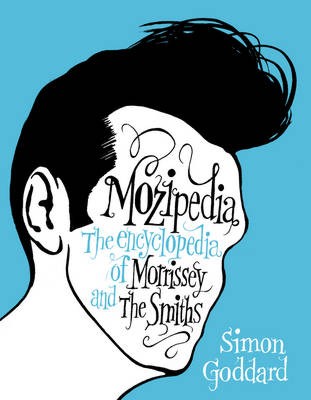
Is that too strong a word? Maybe. Morrissey is certainly the interesting and original one in this book and it ends with his story only just beginning. You can feel the tug of his later career throughout the book: it’s not discussed, but you know it’s there. But Fletcher isn’t concentrating on Morrissey and doesn’t seem very interested in Carry On and Brit-film in the 1960s, so he’s less good on what might be called the Smythos: the world created by Morrissey in his lyrics and interviews. Morrissey’s influences are better explained in Simon Goddard’s Mozipedia (2009), which isn’t just about the New York Dolls, the Cockney Rejects and vegetarianism. It has also entries for everyone from Hawtrey and Housman to Williams and Wilde by way of Sandy Shaw, Shelagh Delaney and Jobriath. No-one will ever devote an encyclopaedia to Marr like that: music doesn’t have as much meaning and metaphor in it. It has emotion and beauty instead and Fletcher is good at describing how Marr created a lot of both on albums like Meat Is Murder and Strangeways Here We Come.

Front cover of Mozipedia by Simon Goddard

Front cover of Mozipedia by Simon Goddard

I’ve never liked him much, though. I like what he did with the guitar and in the studio, but I don’t like what he did to his body and mind. Or what he put on his body: he didn’t have Mozza’s way with weeds either. In the photos, you can clearly see Morrissey’s narcissism and Marr’s weediness. It’s no surprise that Marr smoked a lot of marijuana, preferred working at night and didn’t eat properly. But he’s weedy in more ways than the physical: there’s also a photo of him with Billy Bragg, the committed socialist behind Red Wedge. This was a collective of musicians and bands who wanted to make the world a better place by fighting Fatcher, fascism and free speech with their fantastic music. Morrissey had his lefty opinions too, but he didn’t like collectives and he didn’t scorn just Margaret Thatcher and the Queen: Bob Geldof and Live Aid got the sharp side of his tongue too. Which is good. Mozza is worshipped by Guardianistas, but he’s not a Guardianista himself.

Or not wholly. The hive-mind hasn’t been able to hum him fully into line, unlike Marr and Bragg. As for Rourke and Joyce: their politics don’t matter and the most interesting thing one of them does in this book is get stung by a sting-ray (pp. 539-40). They were competent musicians, but they weren’t essential to the Smiths. Joyce is most important for causing trouble, not for strumming his bass: first there was the heroin addiction, then the 21st-century court-case in which he sued for more money and earnt Morrissey’s undying enmity. Fletcher barely mentions the court-case and ends the book in the 1980s, with the Smiths exhausted, antagonistic and unfulfilled. They never achieved their full potential and though few bands do, few bands have had more to offer than the Smiths. The Beatles were one and managed to offer it from the nearby northern city of Liverpool. They were Irish Catholic too. But, like the Smiths, they achieved success in England, not Ireland. That’s important and the younger band captured it in their name. “Smiths” is an Anglo-Saxon word with ancient roots and difficult phonetics. It seems simple, but it isn’t. Rather like light.

Mix to the Marx

“And in the global climate of the early 90s, it’s perhaps not surprising that the ANC bent to the neoliberal flood tide, putting its Freedom Charter calls for public ownership and redistribution of land on the back burner.” — Mandela has been sanitised by hypocrites and apologists, Seamus Milne, The Guardian, 12/xii/2013.


Previously pre-posted (please peruse):

Reds under the Thread

Ass You Like It

This is a guest post by Norman Foreman, B.A.


Mediaeval Catholic philosophers wrote about both praying and braying. The braying came from Buridan’s ass, a thought-experiment about choice and free will. Imagine a hungry ass set between two piles of hay that are identical in every way: size, shape, colour, tastiness and so on. Some philosophers argued that, if it had no reason to prefer one pile of hay to the other, the ass would be unable to choose and would therefore starve to death.

I don’t agree: inter alia, nervous systems don’t work symmetrically and we don’t experience objects as fully identical when they’re in different parts of our visual field. However, in a literary sense, I understand what it feels like to be Buridan’s ass. To assify myself, I start by imagining this:

• I’m offered £1000 to read a book by the transgressive author Will Self.

Would I accept? Yes. It would be distasteful, but I’d do it for £1000. Self’s writing is so bad that I might give the money back rather than finish the book, but I’d have a go. Now change the situation:

• I’m offered £1000 to read a book by the transgressive author Stewart Home.

Would I still accept? Yes. Again, it would be distasteful, but I’d do it for the money. Or I’d try, at least. The next step turns me into Buridan’s ass. I imagine this:

• I’m offered £1000 to read a book by either Will Self or Stewart Home (not both). And I have to make the choice for myself.

Now I’m on the horns of a dilemma. I would want the £1000, but I can’t decide which transgressive author I’d rather NOT read. Home is a downmarket version of Self, Self is an upmarket version of Home. It’s Self-as-chav vs Home-as-Oxbridge-grad. And/or vice versâ. They’re both keyly committed core components of the Guardianista community, with all that that implies in terms of issues around bad English, mixed metaphors and “in terms of”. I’m happy to say I’ve never read a book by either of them. So if I were offered £1000 to do so and had to choose either Self or Home, I couldn’t do it. Not unassisted. I’d have to toss a coin. Best of three. Or best of five dot dot dot


Previously pre-posted (please peruse):

Titus Graun
Ex-term-in-ate!
Reds under the Thread

Septics vs Dirties

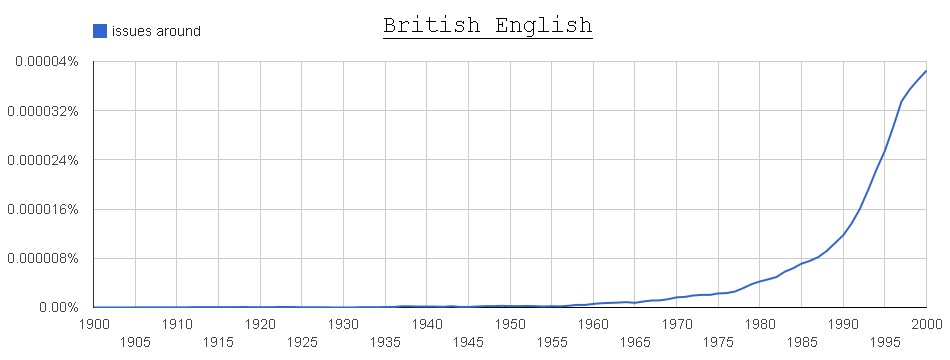
Some interesting patterns at Google’s Ngram Viewer (please follow the links to see the original images with further statistics):

in terms of (American + British English)

in terms of (American + British English)


in terms of (American English)

in terms of (American English)


in terms of (British English)

in terms of (British English)


issues around (American + British English)

issues around (American + British English)


issues around (American English)

issues around (American English)


issues around (British English)

issues around (British English)


Previously pre-posted (please peruse):

Titus Graun
Ex-term-in-ate!
Reds under the Thread

The Term Turns dot dot dot

In Titus Graun, I interrogated issues around the Grauniness, or Guardianisticity, of two keyly committed core components of the counter-cultural community: the semiotician Stewart Home and the æsthetician John Coulthart. Seeking to utilizate their usage-metrics for the core/epicentral Guardianista phrase “in terms of” (i.t.o.), I interrogated their personal websites like this in terms of January 2013:

site:http://www.johncoulthart.com “in terms of”
About 2,180 results

site:http://www.johncoulthart.com “the”
About 8,860 results

site:http://www.johncoulthart.com “and”
About 8,150 results


site:http://www.stewarthomesociety.org “in terms of”
About 123 results

site:http://www.stewarthomesociety.org “the”
About 602 results

site:http://www.stewarthomesociety.org “and”
About 599 results

Noting that Coulthart’s site used “the/and” approximately 14 times more often than Home’s, I adjusted Home’s raw i.t.o.-score accordingly: 123 x 14 = 1722. I concluded that Coulthart, with an i.t.o.-score of 2180, was approximately 26·59% Graunier than Home – exactly as one might have hoped, given that Coulthart is not merely a Guardianista (good), but a gay Guardianista (doubleplusgood). But that was in terms of January. When I re-interrogated their websites in terms of June 2013, I discovered that the semiotic situation had transitioned in a most disturbing and disquieting way:

site:http://www.johncoulthart.com “in terms of”
About 1,080 results

site:http://www.johncoulthart.com “the”
About 8,680 results

site:http://www.johncoulthart.com “and”
About 8,010 results


site:http://www.stewarthomesociety.org “in terms of”
About 119 results

site:http://www.stewarthomesociety.org “the”
About 541 results

site:http://www.stewarthomesociety.org “and”
About 536 results

I was aghast (literally) to see that Coulthart’s i.t.o.-metrics have spiked (in reverse). Other lexicostatistical metrics have transitioned relatively little: his site now seems to use “the/and” approximately 15·5 times more often than Home’s. Home’s raw i.t.o.-score is 119 and 119 x 15·5 = 1844·5. So it is now Home who is approximately 70·78% Graunier than Coulthart.

This can only be described as highly suspicious. What has Coulthart been up to? Has he been spraying his site with verbicide? Has he donned a black Savoy nihilinja-suit™, crept out under cover of darkness and clubbed innocent i.t.o.’s as they lay basking in the feral radiance of Manchester’s Most Maverick Messiahs? If so, this is “‘Pushing the Transgressive Envelope Too Far’ Too Far” too far. Even M.M.M.M. must look askance at behaviour like that. Surely.


Previously pre-posted (please peruse):

Titus Graun
Ex-term-in-ate!
Reds under the Thread

Chicks, Dicks and H.B.D.

Britain has recently been entertained by a cat-fight conducted at Twitter, The Observer and other loci of liberalism. Or perhaps “cat-and-castrated-tom-fight” is a better way of putting it. In the cat corner: a pair of self-righteous feminist egomaniacs called Julie Burchill and Suzanne Moore. In the castrato corner: lots of self-righteous transsexual egomaniacs and their supporters. It’s been one of those fights you wish both sides could lose, but it’s also been interesting from a hateful, bestial and demonic point of view. That is, from an HBD POV. HBD stands for human bio-diversity and is about looking at how human biology influences social, cultural and political patterns. Transsexuality is obviously a biological phenomenon, but I think feminism and female writers are too. Read on, if you’re man enough, and I’ll explain how.

The fight started when Suzanne Moore wrote an essay about “female anger” for an anthology published by the booksellers Waterstones. I don’t know or care what the anthology was about, but Moore’s essay included these lines:

The cliché is that female anger is always turned inwards rather than outwards into despair. We are angry with ourselves for not being happier, not being loved properly and not having the ideal body shape – that of a Brazilian transsexual. (Moore article)

Moore was then politely challenged on Twitter by a transphilic woman who detected a hint of transphobia in her remark. Moore refused to retract it and was even sarcastic about the notion of “intersectionality”, i.e., the multiple oppressions suffered by, say, black homosexuals with bad legs, who will suffer not just from racism, homophobia or disabledism, but from all three. Finally, pushed too far, Moore announced that:

People can just fuck off really. Cut their dicks off and be more feminist than me. Good for them. (Transphobic tweeting)

Moore then left Twitter because of the “bullying” she was experiencing. Her friend Julie Burchill came to her defence in The Observer (i.e. The Guardian-on-Sunday) in an article that began like this:

Hey trannies, cut it out

Where do dicks in terrible wigs get off lecturing us natural-born women about not being quite feministic enough? (Burchill article)

Burchill went on to excoriate “dicks in chick’s clothing” and “bed-wetters in bad wigs” who have had their “nuts taken off”. Further uproar ensued, the “transsexual community” complained long and loudly, and The Observer withdrew the article and apologized for the offence it had caused. All this has been entertaining but also, I think, an example of the poisoning of politics described by Britain’s Chief Rabbi, Jonathan Sacks:

Sacks: Multiculturalism threatens democracy

Multiculturalism promotes segregation, stifles free speech and threatens liberal democracy, Britain’s top Jewish official warned in extracts from his book The Home We Build Together: Recreating Society… [Jonathan] Sacks said Britain’s politics had been poisoned by the rise of identity politics, as minorities and aggrieved groups jockeyed first for rights, then for special treatment. The process, he said, began with Jews, before being taken up by blacks, women and gays. He said the effect had been “inexorably divisive. A culture of victimhood sets group against group, each claiming that its pain, injury, oppression, humiliation is greater than that of others.” (Multiculturalism threatens democracy, The Jerusalem Post)

By claiming “pain, injury, oppression” and so on, transsexuals want to make themselves immune from criticism. Saints could be trusted to behave well when immune from criticism, but saints wouldn’t demand to be so. Transsexuals are, I think it’s safe to say, no more saintly than Jews, blacks, women or gays. All the same, I also think Moore and Burchill have shown bigotry – in the proper, rather than politically correct, sense – towards transsexuals. This transphobic twosome obviously don’t like their feminist franchise being challenged by transsexuals, i.e., people who were born in men’s bodies, but think they’re really women and have had surgery to prove it. From my own bigoted, biocentric point of view, I am happy to accept that bodies do not always match brains and that someone with a female mind can be born in a male body. Or vice versa. It’s an interesting phenomenon, scientifically speaking, but it must also sometimes be a distressing phenomenon, psycho-socially speaking. Burchill’s sneers about “phantom limbs” and “bed-wetters in bad wigs” don’t show much female solidarity, let alone imaginative sympathy. But then she doesn’t seem to accept that a real woman can be born in a male body:

Shims, shemales, whatever you’re calling yourselves these days – don’t threaten or bully we [sic] lowly natural-born women, I warn you. We may not have as many lovely big swinging PhDs as you, but we’ve experienced a lifetime of PMT and sexual harassment, and many of us are now staring HRT and the menopause straight in the face – and still not flinching. Trust me, you ain’t seen nothing yet. You really won’t like us when we’re angry.

That is echt essentialism – indeed, physio-fascism. Burchill seems to believe that you can’t be a real woman unless you’re born in a female body. The bit about “lovely big swinging PhDs” is a sneer too, but a funny one: Burchill is an entertaining writer who combines masculine vigour with feminine illogic. Look at her reasoning here, for example:

…their lot [i.e., transsexuals] describe born women as “cis” – sounds like syph, cyst, cistern; all nasty stuff…

If “cis” is nasty because it sounds a bit like “cistern”, presumably “sister” would be even worse. Like Burchill, Suzanne Moore has no time for the nasty male invention of logic; unlike Burchill, she isn’t an entertaining or amusing writer. I’d never read anything by her before this cat-fight and I don’t intend to read anything again. The fight itself seems a good example of narcisso-sisters playing tyranny-trumps and poisoning politics, as the Chief Rabbi warned. Burchill and Moore themselves seem good examples of testotero-sisters: they’re masculinized in both psychology and physiognomy. It’s not just their aggression and coarseness: take a look at their faces:

Suzanne Moore and Julie Burchill

Suzanne Moore and Julie Burchill

I suggest that Moore and Burchill, despite their female bodies, are less psychologically female than some transsexuals who were born in male bodies. Both of them are left-wing and opponents of biological determinism, but they are cruder in their bio-determinism than the supposedly right-wing psychologist Hans Eysenck (1916–97), who was writing about HBD before HBD existed under its present name. In his book Sex, Violence and the Media (1978), Eysenck discussed that idea that “there is a strong biological determinant which predisposes individuals in the direction of greater or lesser ‘maleness’”:

Some of the strongest evidence for this point of view comes from the work of Dr Wilhart Schlegel, a Hamburg physician who made an exhaustive study of the shape of the pelvis in men and women. In men, typically, the pelvis is shaped like a funnel, tapering down to a narrow outlet; in women, the pelvis is shaped more like a tube, with a broad outlet. There is much variety within each sex; thus there are men with tube-shaped pelvis outlet structures, and women with funnel-shaped ones. What made Schlegel interested in the pelvic outlet is that its shape is apparently determined at the foetal stage by precisely the kind of hormonal burst [determining masculinity or femininity] already described; if such androgenic material is supplied, the pelvic shape will be masculine; if not, feminine. This led Schlegel to study in detail the social and sexual behaviour of men and women having typical and atypical pelvic shapes, using over a thousand men and women in his researches. (Op. cit., H.J. Eysenck and D.K.B. Nias, Maurice Temple Smith, London, 1978, pg. 230-1)

Schlegel discovered a strong correlation between pelvic shape and behaviour:

A masculine-type pelvis correlated with leadership, an active sexual role, dominance and a preference for a younger sexual partner, in men and women alike. A feminine-type pelvis correlated with empathy, suggestibility, and compliance. In other words, behaviour in both sexes seemed to be determined by the same hormonal factors which originally produced skeletal features of the pelvis, namely androgen secretion at the foetal stage.

Faces, like pelvises, are shaped by hormonal factors and I suggest that Moore and Burchill have masculinized faces. I also suggest that, as female writers, they are not unique in this. Another example of a masculinized female writer seems to be Hilary Mantel, winner of last year’s Man-Booker Prize for her novel Bring Out the Bodies. Mantel has been placed under scientific analysis by Eysenck’s protegé Chris Brand at his g-Factor blog:

Hilary Mantel

Hilary Mantel

Incomprehensible bug-eyed leftist old bag authoress Hilary Mantel was welcomed by the London Review of Books to put in her two pennorth slagging off the gracious, cheerful and pregnant Duchess of Cornwall… Broad-beamed Mantelpiece was a leftie born and bred – a matter which her publishers had contrived to conceal for several years. Of Irish parentage, she was raised a Catholic by parents who separated (she never saw her father after age eleven). She gave up Christianity at twelve and progressed to full-blown socialism, as was readily compatible with her studies at the London School of Economics and the University of Sheffield. Her own lack of husband and family was perhaps traceable to gynaecological problems so serious that she had been treated by doctors for psychosis during her twenties. (IQ & PC – By Chris Brand, Monday, February 25, 2013)

Mantel’s unusually broad features seem to occur elsewhere among female writers:

L-R: Jane Austen, Harriet Beecher Stowe, Pearl S. Buck, Iris Murdoch

L-R: Jane Austen, Harriet Beecher Stowe, Pearl S. Buck, Iris Murdoch

L-R: Joyce Carol Oates, Maya Angelou, Alice Walker, Arundhati Roy

L-R: Joyce Carol Oates, Maya Angelou, Alice Walker, Arundhati Roy

I suggest that the particular genre in which a writer works would also be reflected in her – or his – biology, but female writers are a small, self-selected group and don’t seem typical of women in general. This also appears to be true of female politicians. I first began to notice their unusual features in the 1990s among women like Hillary Clinton and Madeleine Albright:

Hillary Clinton and Madelaine Albright

Hillary Clinton and Madelaine Albright

Like Moore and Burchill, Clinton and Albright are left-wing and opponents of biological determinism. But the reality may be that a rejection of biological determinism is itself, in part, biologically determined. The subjective self-confidence and aggression of a masculinized woman may lead her to deny any influence of biology on politics, even though there is more and more evidence that such influence exists:

The GOP has a feminine face, UCLA study finds

At least when it comes to female politicians, perhaps you can judge a book by its cover, suggest two UCLA researchers who looked at facial features and political stances in the U.S. House of Representatives. “Female politicians with stereotypically feminine facial features are more likely to be Republican than Democrat, and the correlation increases the more conservative the lawmaker’s voting record,” said lead author Colleen M. Carpinella, a UCLA graduate student in psychology.

The researchers also found the opposite to be true: Female politicians with less stereotypically feminine facial features were more likely to be Democrats, and the more liberal their voting record, the greater the distance the politician’s appearance strayed from stereotypical gender norms. In fact, the relationship is so strong that politically uninformed undergraduates were able to determine the political affiliation of the representatives with an overall accuracy rate that exceeded chance, and the accuracy of those predications increased in direct relation to the lawmaker’s proximity to feminine norms. (“The GOP has a feminine face, UCLA study finds”, Meg Sullivan, September 27, 2012)

Faces and pelvises are indirect guides to brains and it would be very interesting to have more direct data about the brains of female politicians, whether left- or right-wing. It would also be interesting to know how many children they have and the sex-ratio of those children, because that is also influenced by hormonal factors. Like Burchill and Moore, Hilary Mantel and Hillary Clinton would no doubt dismiss HBD as hateful, but all of them are biological entities and none of them can escape HBD. Neither can I or you or any other human being, but the more we know about ourselves the better we may be able to understand politics and culture. And the more we know about human biology, the more we may also understand that some forms of politics are far less caring and compassionate than they claim to be.