Neuclid on the Block

How many blows does it take to demolish a wall with a hammer? It depends on the wall and the hammer, of course. If the wall is reality and the hammer is mathematics, you can do it in three blows, like this:

α’. Σημεῖόν ἐστιν, οὗ μέρος οὐθέν.
β’. Γραμμὴ δὲ μῆκος ἀπλατές.
γ’. Γραμμῆς δὲ πέρατα σημεῖα.

1. A point is that of which there is no part.
2. A line is a length without breadth.
3. The extremities of a line are points.

That is the astonishing, world-shattering opening in one of the strangest – and sanest – books ever written. It’s twenty-three centuries old, was written by an Alexandrian mathematician called Euclid (fl. 300 B.C.), and has been pored over by everyone from Abraham Lincoln to Bertrand Russell by way of Edna St. Vincent Millay. Its title is highly appropriate: Στοιχεῖα, or Elements. Physical reality is composed of chemical elements; mathematical reality is composed of logical elements. The second reality is much bigger – infinitely bigger, in fact. In his Elements, Euclid slipped the bonds of time, space and matter by demolishing the walls of reality with a mathematical hammer and escaping into a world of pure abstraction.

• Continue reading Neuclid on the Block

Spiral Archipelago

Incomplete map of Earthsea

Incomplete map of Earthsea

Ursula K. Le Guin, creatrix of Earthsea, is a much better writer than J.R.R. Tolkien, creator of Middle-earth: much more subtle, skilful and sophisticated. But for me Middle-earth has one big advantage over Earthsea: I can imagine Middle-earth really existing. I can’t say that for Earthsea, an archipelago-world of fishermen, goatherds and wizards. There’s something dead and disconnected about Earthsea. I’m not sure what it is, but it may have something to do with Le Guin’s dedicated political correctness.

For example, despite the northern European climate and culture on Earthsea, a sea-faring world with lots of rain, mist, snow and mountains, most of the people are supposed to have dark skins. The ones that don’t – the white-skinned, blond-haired Kargs – are the bloodthirsty baddies of A Wizard of Earthsea (1968), the first book in the series. Balls to biology, in other words: there’s propaganda to propagate. So it’s not surprising that Le Guin’s father was a famous and respected figure in the mostly disreputable discipline of anthropology. Earthsea is fantasy for Guardian-readers, in short.

But I still like the idea of an archipelago-world: sea and islands, islands and sea. As Le Guin herself says: “We all have archipelagos in our minds.” That’s one of the reasons I like the Ulam spiral: it reminds me of Earthsea. Unlike Earthsea, however, the sea and islands go on for ever. In the Ulam spiral, the islands are the prime numbers and the sea is the composite numbers. It’s based on a counter-clockwise spiral of integers, like this:

145←144←143←142←141←140139←138←137←136←135←134←133
 ↓                                               ↑
146 101←100←099←098←097←096←095←094←093←092←091 132
 ↓   ↓                                       ↑   ↑
147 102 065←064←063←062←061←060←059←058←057 090 131
 ↓   ↓   ↓                                  ↑   ↑
148 103 066 037←036←035←034←033←032←031 056 089 130
 ↓   ↓   ↓   ↓                       ↑   ↑   ↑   ↑
149 104 067 038 017←016←015←014←013 030 055 088 129
 ↓   ↓   ↓   ↓   ↓               ↑      ↑   ↑   ↑
150 105 068 039 018 005←004←003 012 029 054 087 128
 ↓   ↓   ↓   ↓   ↓   ↓       ↑   ↑   ↑   ↑   ↑   ↑
151 106 069 040 019 006 001002 011 028 053 086 127
 ↓   ↓   ↓   ↓   ↓   ↓           ↑      ↑   ↑   
152 107 070 041 020 007→008→009→010 027 052 085 126
 ↓   ↓   ↓   ↓   ↓                   ↑   ↑   ↑   ↑
153 108 071 042 021→022→023→024→025→026 051 084 125
 ↓   ↓   ↓   ↓                           ↑   ↑   ↑
154 109 072 043→044→045→046→047→048→049→050 083 124
 ↓   ↓   ↓                                   ↑   ↑
155 110 073→074→075→076→077→078→079→080→081→082 123
 ↓   ↓                                           ↑
156 111→112→113→114→115→116→117→118→119→120→121→122
 ↓                                                   ↑
157→158→159→160→161→162→163→164→165→166→167→168→169→170

The spiral is named after Stanislaw Ulam (1909-84), a Polish mathematician who invented it while doodling during a boring meeting. When numbers are represented as pixels and 1 is green, the spiral looks like this – note the unique “knee” formed by 2, 3 (directly above 2) and 11 (to the right of 2):

Ulam spiral

Ulam spiral (animated)

(If the image above does not animate, please try opening it in a new window.)

Some prime-pixels are isolated, like eyots or aits (small islands) in the number-sea, but some touch corner-to-corner and form larger units, larger islands. There are also prime-diamonds, like islands with lakes on them. The largest island, with 19 primes, may come very near the centre of the spiral:

island1

Island 1 = (5, 7, 17, 19, 23, 37, 41, 43, 47, 67, 71, 73, 79, 103, 107, 109, 113, 149, 151) (i=19) (x=-3, y=3, n=37) (n=1 at x=0, y=0)

Here are some more prime-islands – prIslands or priminsulas – in the Ulam-sea that I find interesting or attractive for one reason or other:

island2

Island 2 = (281, 283, 353, 431, 433, 521, 523, 617, 619, 719, 827, 829, 947) (i=13) (x=6, y=-12, n=619)


island3

Island 3 = (20347, 20921, 21499, 21503, 22091, 22093, 22691, 23293, 23297, 23909, 23911, 24533, 25163, 25801, 26449, 27103, 27767, 28439) (i=18) (x=-39, y=-81, n=26449)


island4

Island 4 = (537347, 540283, 543227, 546179, 549139, 552107, 555083, 558067, 561059, 561061, 564059, 564061, 567067, 570083, 573107, 573109) (i=16) (x=375, y=-315, n=561061)


island5

Island 5 = (1259047, 1263539, 1263541, 1268039, 1272547, 1277063, 1281587, 1286119, 1290659, 1295207, 1299763) (i=11) (x=-561, y=399, n=1259047)


island6

Island 6 = (1341841, 1346479, 1351123, 1355777, 1360439, 1360441, 1365107, 1365109, 1369783, 1369787, 1369789, 1374473, 1379167) (i=13) (x=-585, y=-297, n=1369783)


island7

Island 7 = (2419799, 2419801, 2426027, 2426033, 2432263, 2432267, 2438507, 2438509, 2444759, 2451017, 2457283, 2463557) (i=12) (x=558, y=780, n=2432263)


island8

Island 8 = (3189833, 3196979, 3196981, 3204137, 3204139, 3211301, 3211303, 3218471, 3218473, 3218477, 3225653) (i=11) (x=-894, y=858, n=3196981)

Tri Again

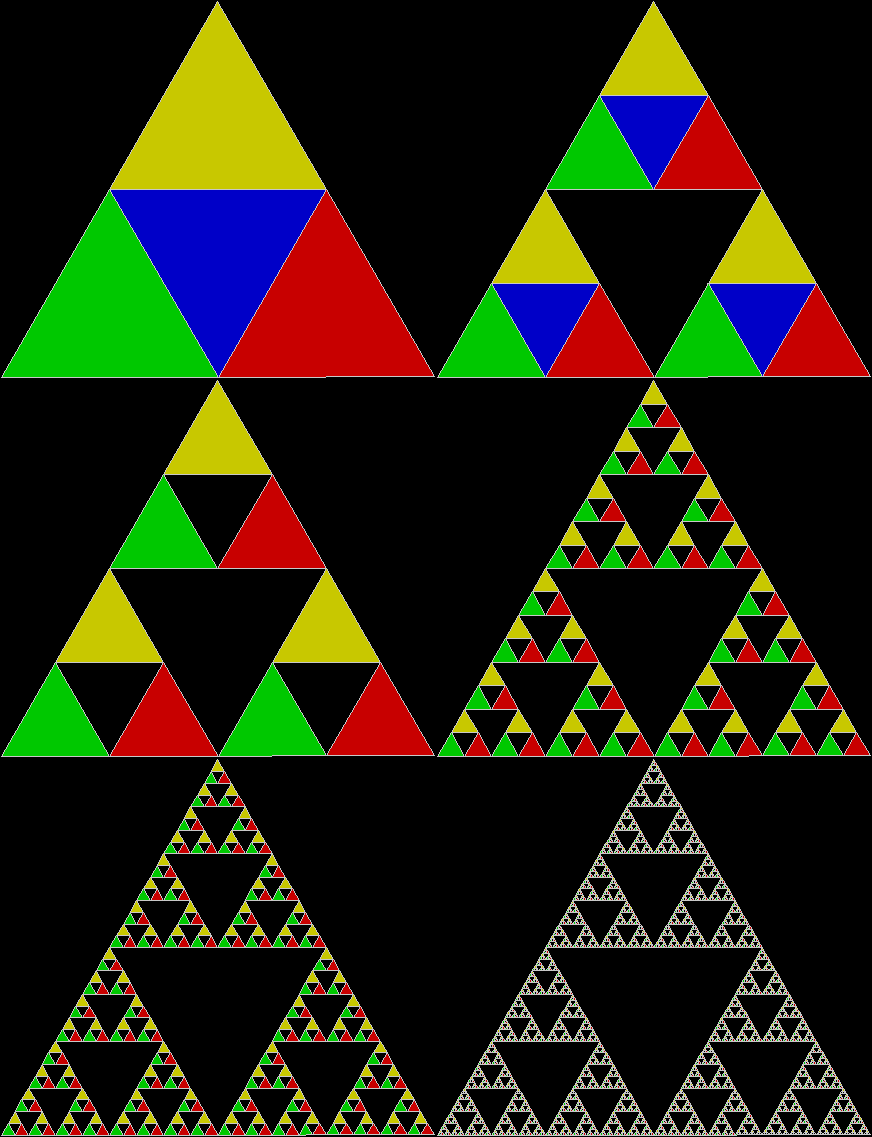
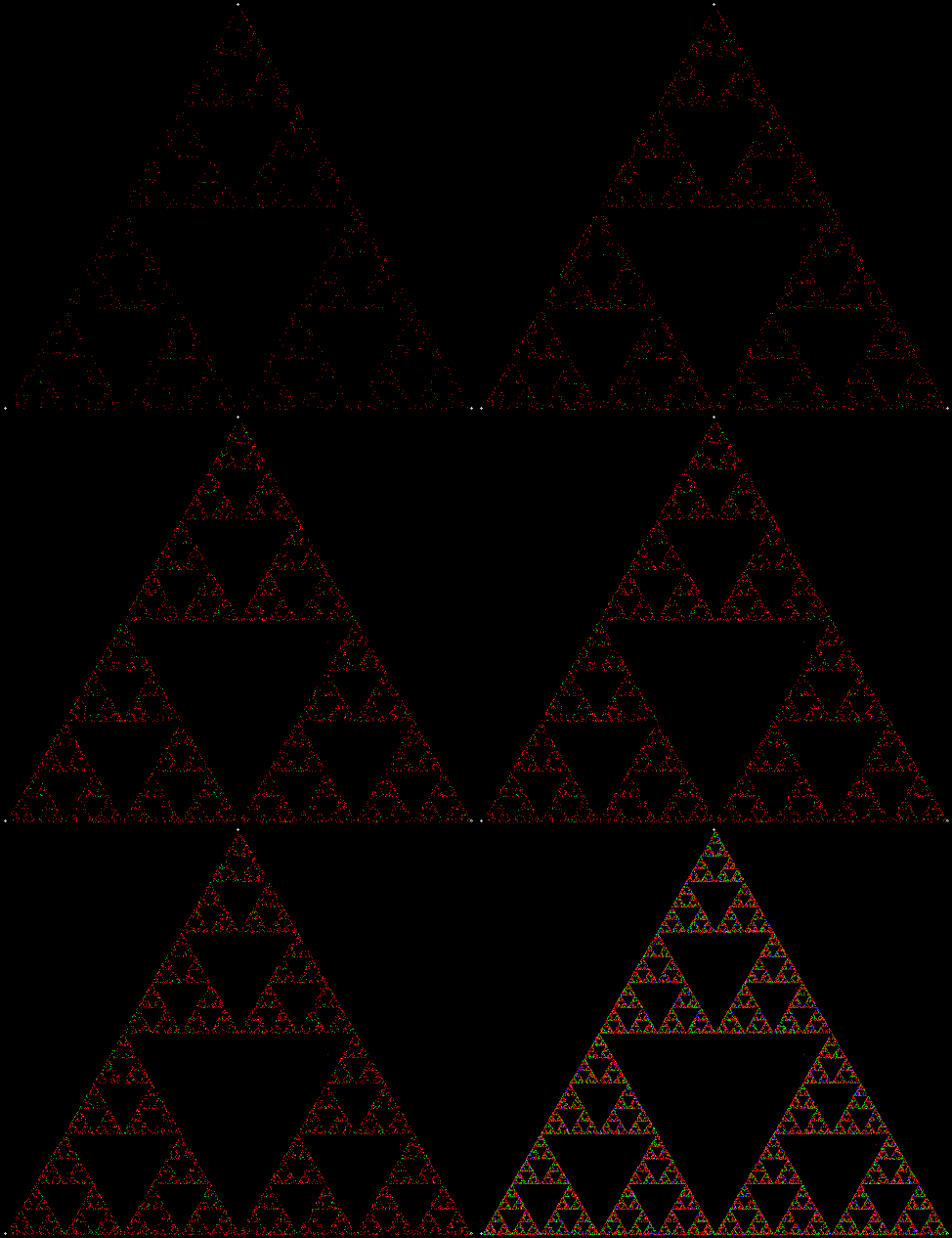
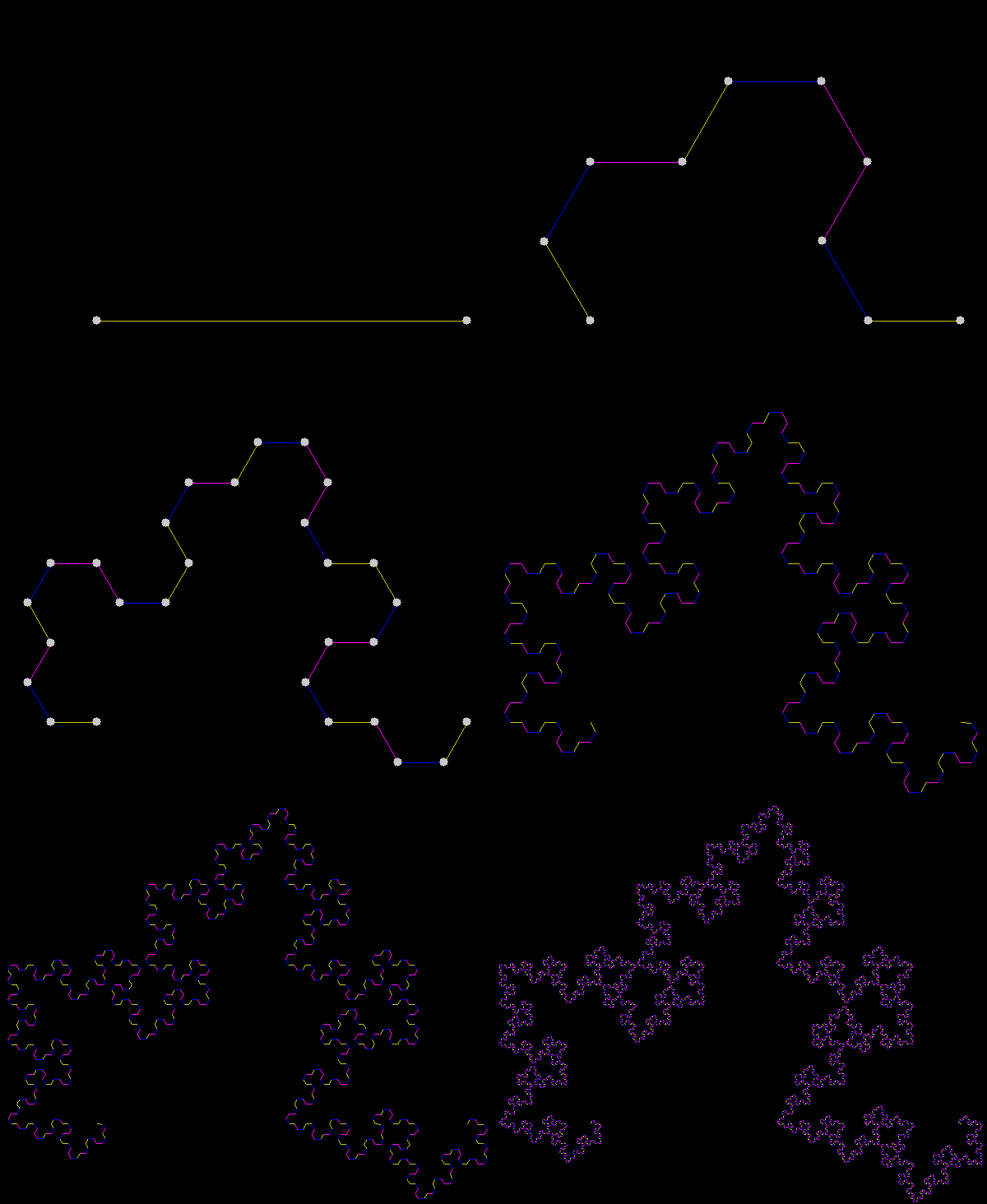
All roads lead to Rome, so the old saying goes. But you may get your feet wet, so try the Sierpiński triangle instead. This fractal is named after the Polish mathematician Wacław Sierpiński (1882-1969) and quite a few roads lead there too. You can create it by deleting, jumping or bending, inter alia. Here is method #1:

Sierpinski middle delete

Divide an equilateral triangle into four, remove the central triangle, do the same to the new triangles.

Here is method #2:

Sierpinski random jump

Pick a corner at random, jump half-way towards it, mark the spot, repeat.

And here is method #3:

Sierpinski arrowhead

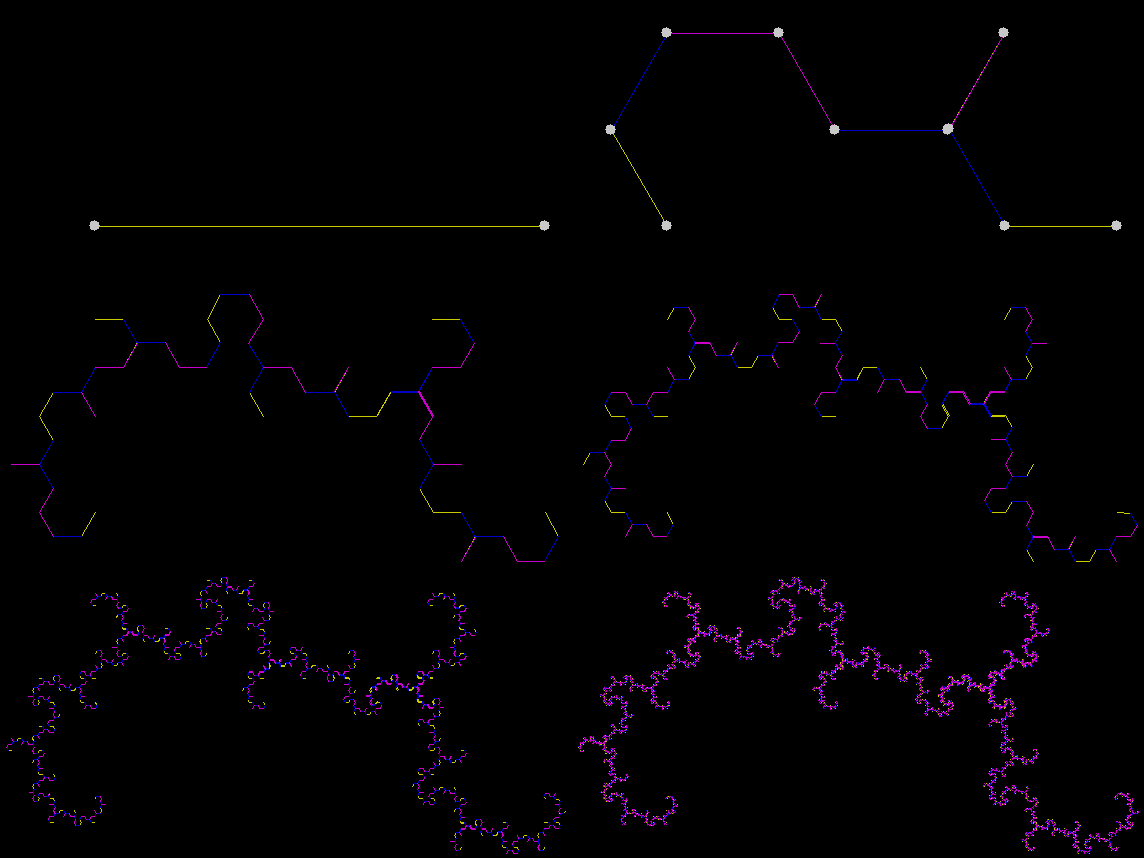
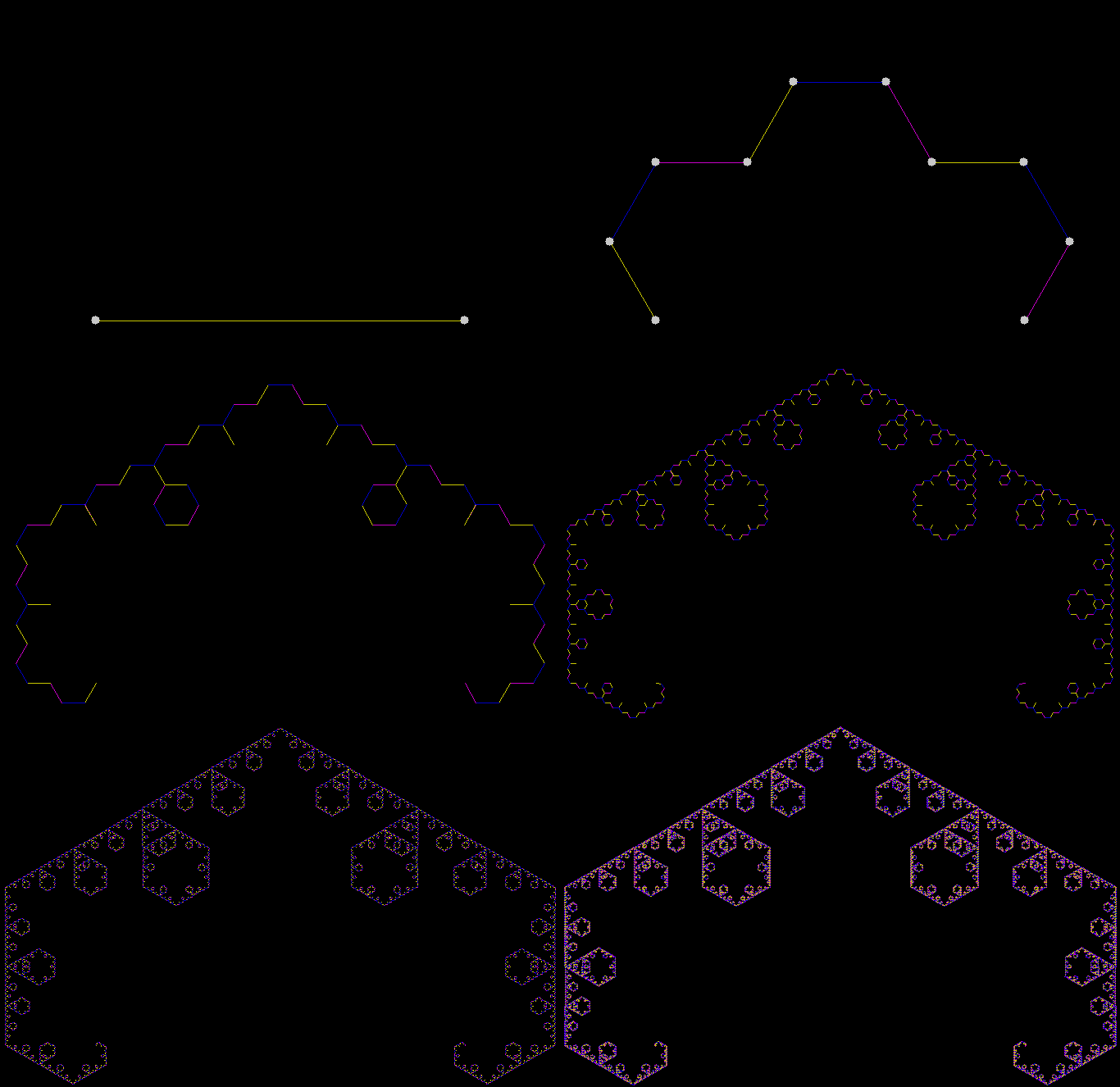
Bend a straight line into a hump consisting of three straight lines, then repeat with each new line.

Each method can be varied to create new fractals. Method #3, which is also known as the arrowhead fractal, depends on the orientation of the additional humps, as you can see from the animated gif above. There are eight, or 2 x 2 x 2, ways of varying these three orientations, so eight fractals can be produced if the same combination of orientations is kept at each stage, like this (some are mirror images — if an animated gif doesn’t work, please open it in a new window):

arrowhead1

arrowhead2

arrowhead3

arrowhead4

arrowhead5

If different combinations are allowed at different stages, the number of different fractals gets much bigger:

• Continuing viewing Tri Again.

V for Vertex

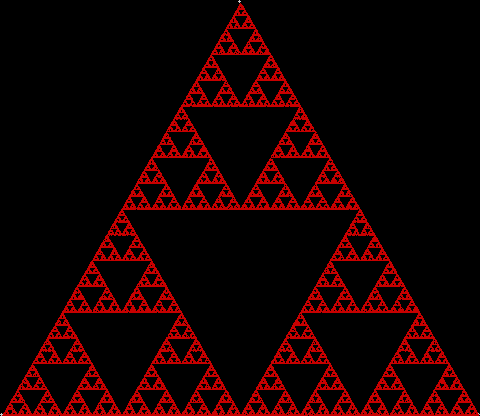
To create a simple fractal, take an equilateral triangle and divide it into four more equilateral triangles. Remove the middle triangle. Repeat the process with each new triangle and go on repeating it. You’ll end up with a shape like this, which is known as the Sierpiński triangle, after the Polish mathematician Wacław Sierpiński (1882-1969):

Sierpinski triangle

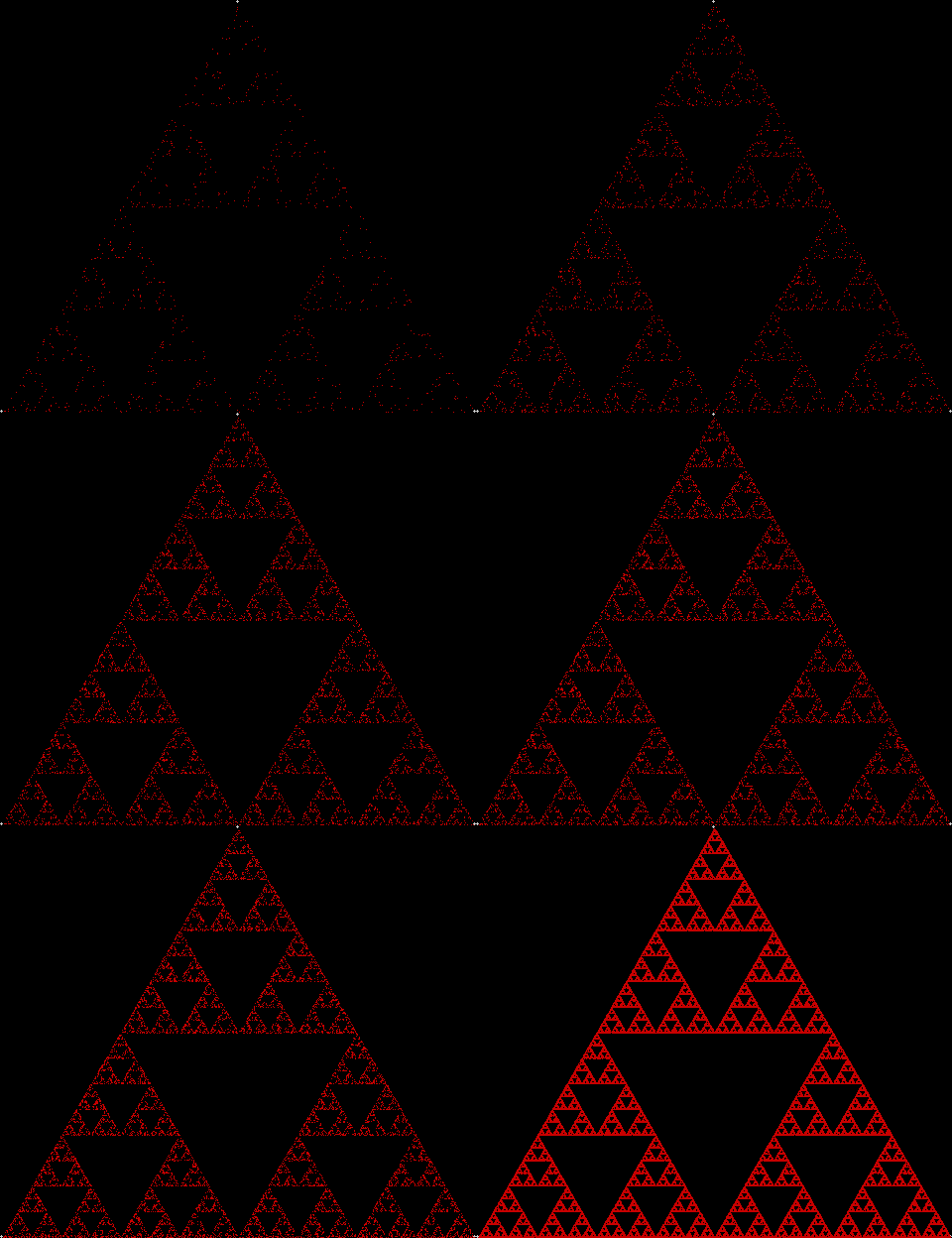
But you can also create the Sierpiński triangle one pixel at a time. Choose any point inside an equilateral triangle. Pick a corner of the triangle at random and move half-way towards it. Mark this spot. Then pick a corner at random again and move half-way towards the corner. And repeat. The result looks like this:

triangle

A simple program to create the fractal looks like this:

initial()
repeat
  fractal()
  altervariables()
until false

function initial()
  v = 3 [v for vertex]
  r = 500
  lm = 0.5
endfunc

function fractal()
  th = 2 * pi / v
[the following loop creates the corners of the triangle]
  for l = 1 to v
    x[l]=xcenter + sin(l*th) * r
    y[l]=ycenter + cos(l*th) * r
  next l
  fx = xcenter
  fy = ycenter
  repeat
    rv = random(v)
    fx = fx + (x[rv]-fx) * lm
    fy = fy + (y[rv]-fy) * lm
    plot(fx,fy)
  until keypressed
endfunc

function altervariables()
[change v, lm, r etc]
endfunc

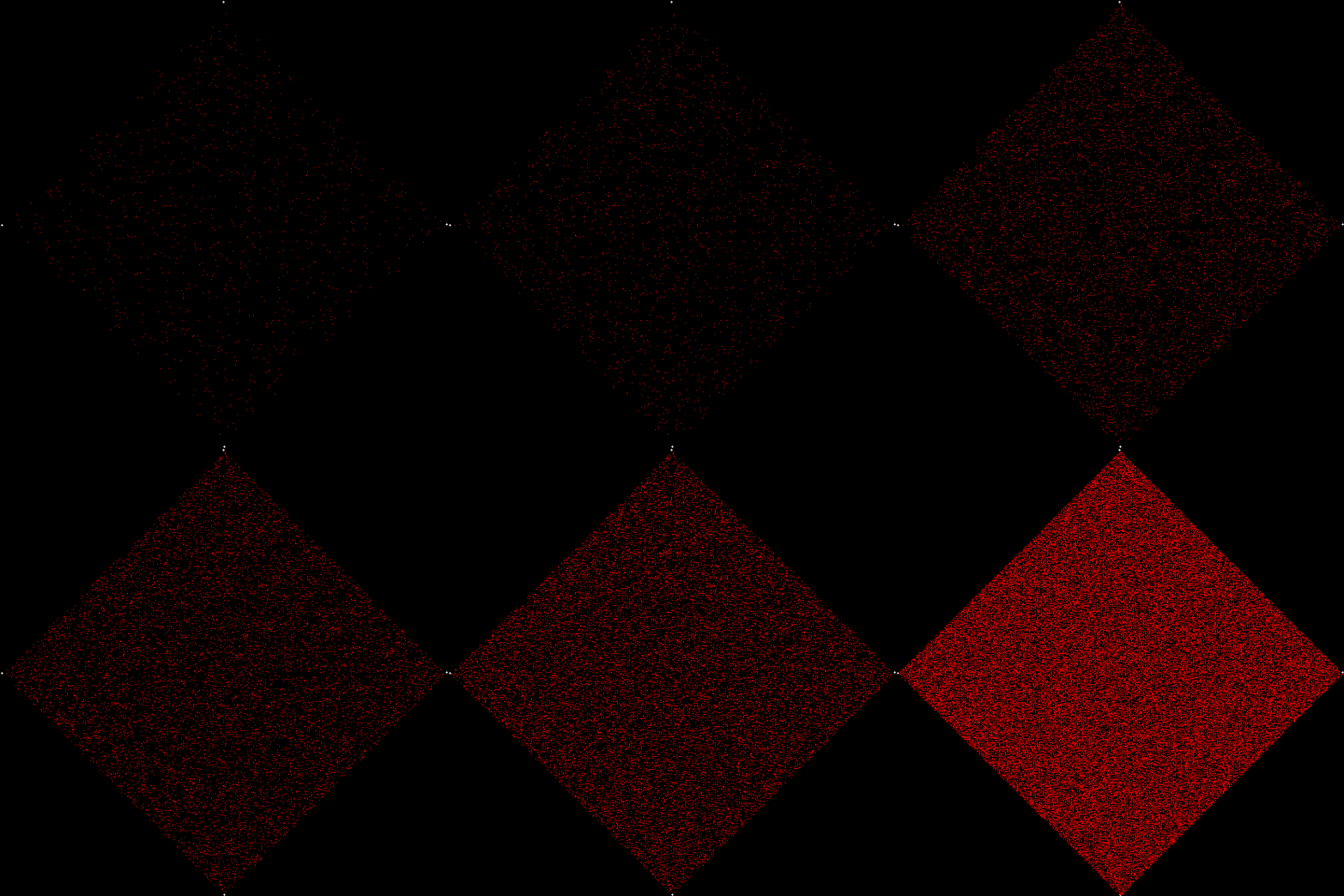
In this case, more is less. When v = 4 and the shape is a square, there is no fractal and plot(fx,fy) covers the entire square.

square

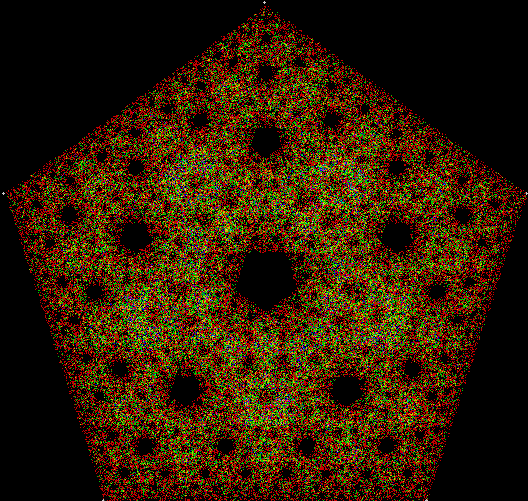
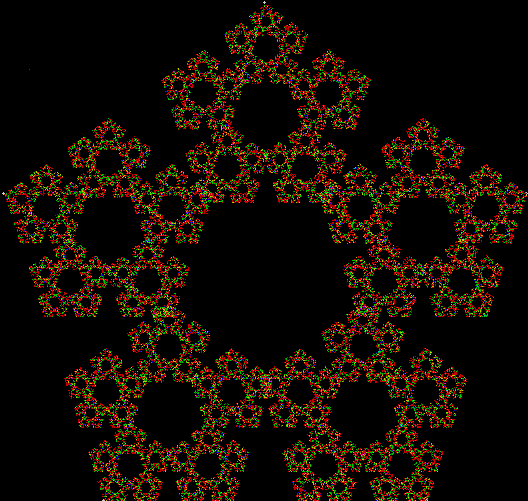
When v = 5 and the shape is a pentagon, this fractal appears:

pentagon

But v = 4 produces a fractal if a simple change is made in the program. This time, a corner cannot be chosen twice in a row:

square_used1

function initial()
  v = 4
  r = 500
  lm = 0.5
  ci = 1 [i.e, number of iterations since corner previously chosen]
endfunc

function fractal()
  th = 2 * pi / v
  for l = 1 to v
    x[l]=xcenter + sin(l*th) * r
    y[l]=ycenter + cos(l*th) * r
    chosen[l]=0
  next l
  fx = xcenter
  fy = ycenter
  repeat
    repeat
      rv = random(v)
    until chosen[rv]=0
    for l = 1 to v
      if chosen[l]>0 then chosen[l] = chosen[l]-1
    next l
    chosen[rv] = ci
    fx = fx + (x[rv]-fx) * lm
    fy = fy + (y[rv]-fy) * lm
    plot(fx,fy)
  until keypressed
endfunc

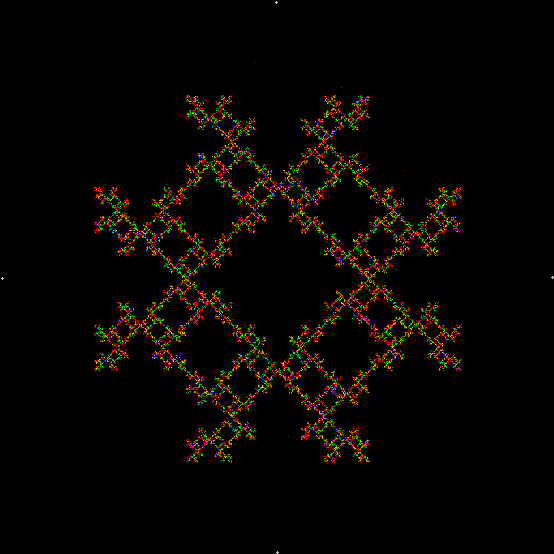
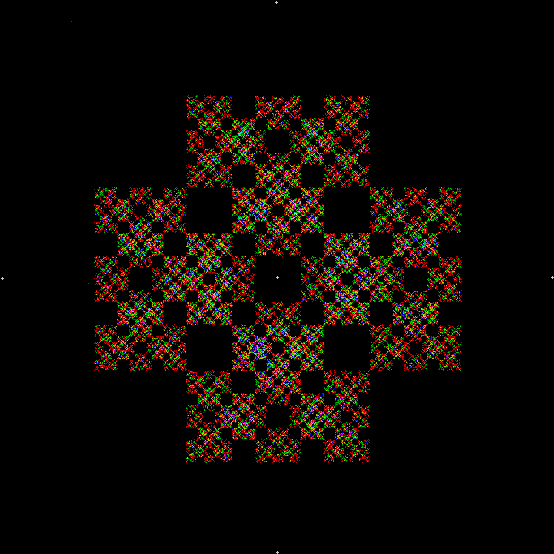
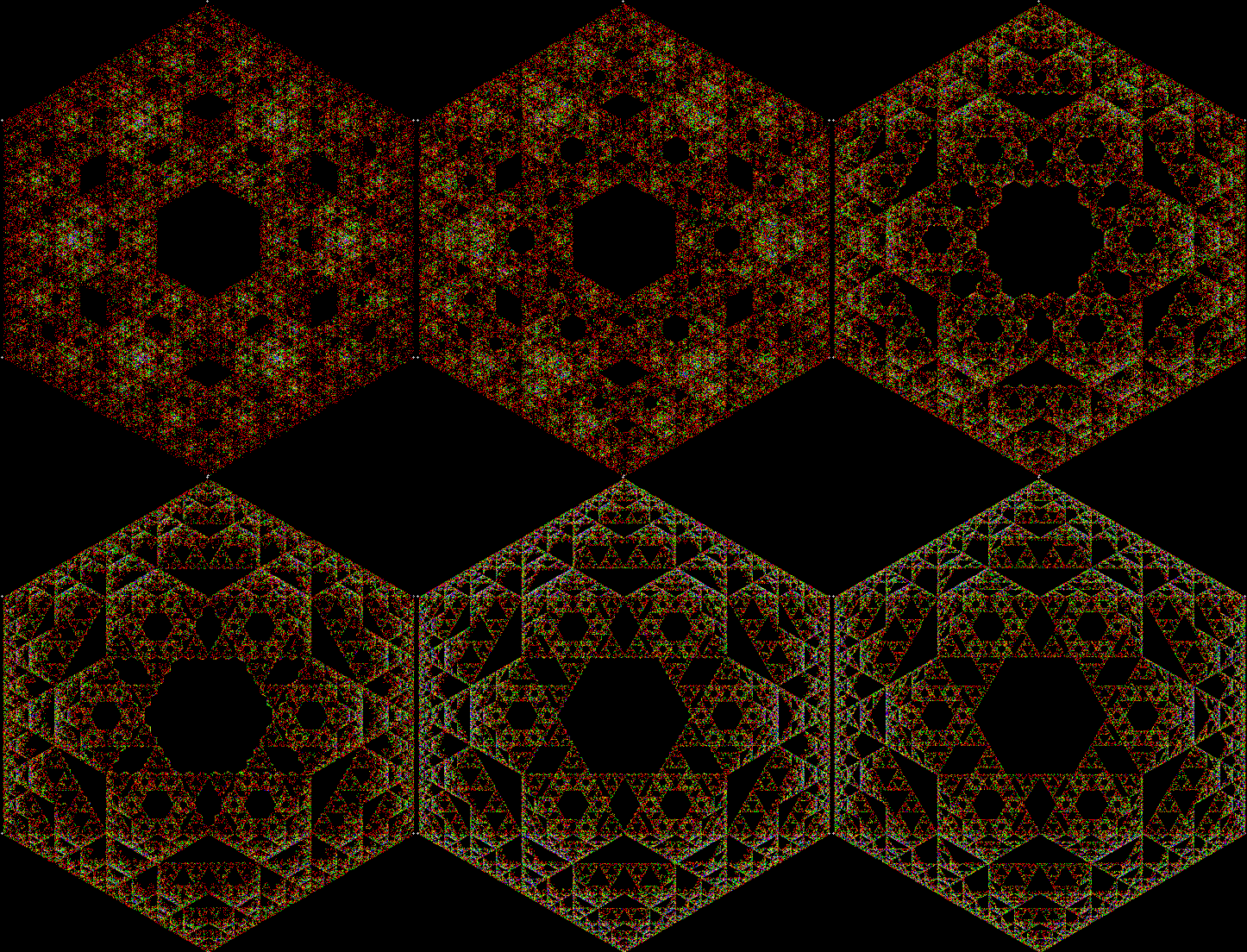
One can also disallow a corner if the corner next to it has been chosen previously, adjust the size of the movement towards the chosen corner, add a central point to the polygon, and so on. Here are more fractals created with such variations:

square_used1_center

square_used1_vi1

square_used1_vi2

square_used2

pentagon_lm0.6

pentagon_used1_5_vi1

hexagon_used1_6_vi3

Clock around the Rock

If you like minimalism, you should like binary. There is unsurpassable simplicity and elegance in the idea that any number can be reduced to a series of 1’s and 0’s. It’s unsurpassable because you can’t get any simpler: unless you use finger-counting, two symbols are the minimum possible. But with those two – a stark 1 and 0, true and false, yin and yang, sun and moon, black and white – you can conquer any number you please. 2 = 10[2]. 5 = 101. 100 = 1100100. 666 = 1010011010. 2013 = 11111011101. 9^9 = 387420489 = 10111000101111001000101001001. You can also perform any mathematics you please, from counting sheep to modelling the evolution of the universe.
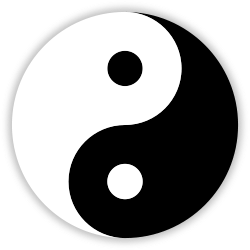
Yin and Yang symbol

1 + 0 = ∞

But one disadvantage of binary, from the human point of view, is that numbers get long quickly: every doubling in size adds an extra digit. You can overcome that disadvantage using octal or hexadecimal, which compress blocks of binary into single digits, but those number systems need more symbols: eight and sixteen, as their names suggest. There’s an elegance there too, but binary goes masked, hiding its minimalist appeal beneath apparent complexity. It doesn’t need to wear a mask for computers, but human beings can appreciate bare binary too, even with our weak memories and easily tiring nervous systems. I especially like minimalist binary when it’s put to work on those most maximalist of numbers: the primes. You can compare integers, or whole numbers, to minerals. Some are like mica or shale, breaking readily into smaller parts, but primes are like granite or some other ultra-hard, resistant rock. In other words, some integers are easy to divide by other integers and some, like the primes, are not. Compare 256 with 257. 256 = 2^8, so it’s divisible by 128, 64, 32, 16, 8, 4, 2 and 1. 257 is a prime, so it’s divisible by nothing but itself and 1. Powers of two are easy to calculate and, in binary, very easy to represent:

2^0 = 1 = 1
2^1 = 2 = 10[2]
2^2 = 4 = 100
2^3 = 8 = 1000
2^4 = 16 = 10000
2^5 = 32 = 100000
2^6 = 64 = 1000000
2^7 = 128 = 10000000
2^8 = 256 = 100000000

Primes are the opposite: hard to calculate and usually hard to represent, whatever the base:

02 = 000010[2]
03 = 000011
05 = 000101
07 = 000111
11 = 001011
13 = 001101
17 = 010001
19 = 010011
23 = 010111
29 = 011101
31 = 011111
37 = 100101
41 = 101001
43 = 101011

Maximalist numbers, minimalist base: it’s a potent combination. But “brimes”, or binary primes, nearly all have one thing in common. Apart from 2, a special case, each brime must begin and end with 1. For the digits in-between, the God of Mathematics seems to be tossing a coin, putting 1 for heads, 0 for tails. But sometimes the coin will come up all heads or all tails: 127 = 1111111[2] and 257 = 100000001, for example. Brimes like that have a stark simplicity amid the jumble of 83 = 1010011[2], 113 = 1110001, 239 = 11101111, 251 = 11111011, 277 = 100010101, and so on. Brimes like 127 and 257 are also palindromes, or the same reading in both directions. But less simple brimes can be palindromes too:

73 = 1001001
107 = 1101011
313 = 100111001
443 = 110111011
1193 = 10010101001
1453 = 10110101101
1571 = 11000100011
1619 = 11001010011
1787 = 11011111011
1831 = 11100100111
1879 = 11101010111

But, whether they’re palindromes or not, all brimes except 2 begin and end with 1, so they can be represented as rings, like this:
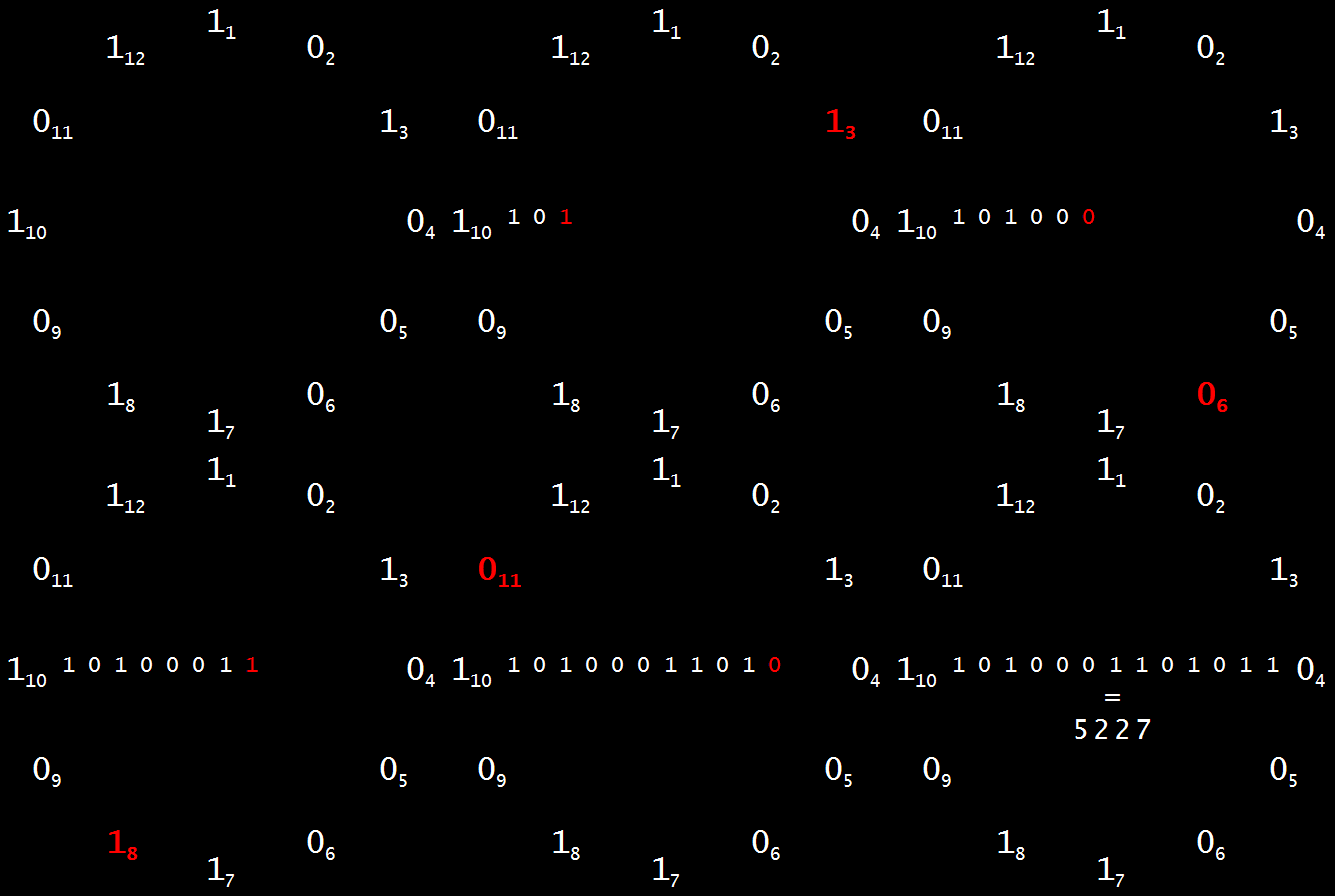
Ouroboros5227

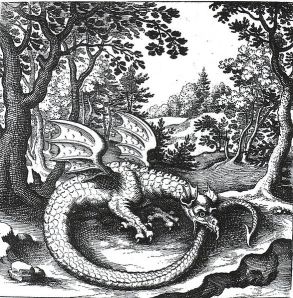
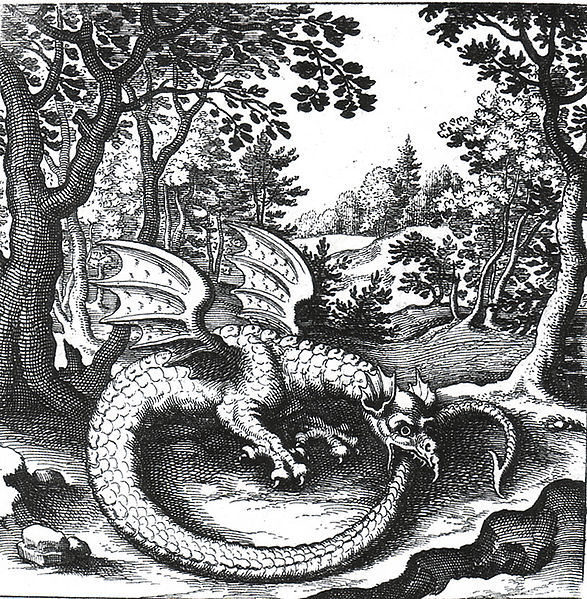
Those twelve bits, or binary digits, actually represent the thirteen bits of 5227 = 1,010,001,101,011. Start at twelve o’clock (digit 1 of the prime) and count clockwise, adding 1’s and 0’s till you reach 12 o’clock again and add the final 1. Then you’ve clocked around the rock and created the granite of 5227, which can’t be divided by any integers but itself and 1. Another way to see the brime-ring is as an Ouroboros (pronounced “or-ROB-or-us”), a serpent or dragon biting its own tail, like this:
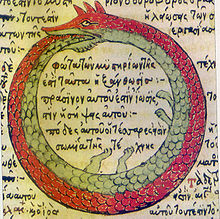
Alchemical Ouroboros

Alchemical Ouroboros (1478)

Dragon Ouroboros

Another alchemical Ouroboros (1599)

But you don’t have to start clocking around the rock at midday or midnight. Take the Ouroboprime of 5227 and start at eleven o’clock (digit 12 of the prime), adding 1’s and 0’s as you move clockwise. When you’ve clocked around the rock, you’ll have created the granite of 6709, another prime:
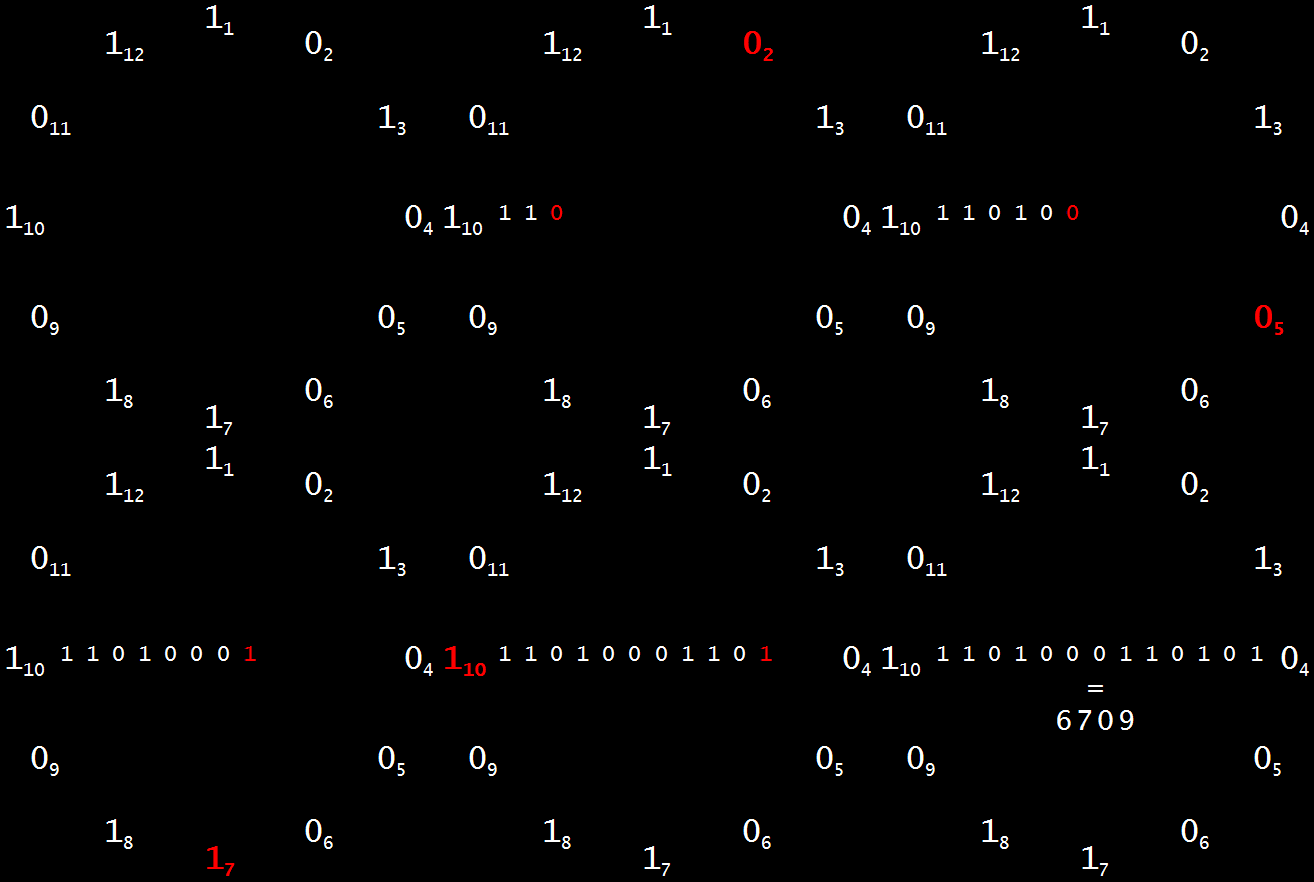
Ouroboros6709

Other Ouroboprimes produce brimes both clockwise and anti-clockwise, like 47 = 101,111.

Clockwise

101,111 = 47
111,011 = 59
111,101 = 61

Anti-Clockwise

111,101 = 61
111,011 = 59
101,111 = 47

If you demand the clock-rocked brime produce distinct primes, you sometimes get more in one direction than the other. Here is 151 = 10,010,111:

Clockwise

10,010,111 = 151
11,100,101 = 229

Anti-Clockwise

11,101,001 = 233
11,010,011 = 211
10,100,111 = 167
10,011,101 = 157

The most productive brime I’ve discovered so far is 2,326,439 = 1,000,110,111,111,110,100,111[2], which produces fifteen distinct primes:

Clockwise (7 brimes)

1,000,110,111,111,110,100,111 = 2326439
1,100,011,011,111,111,010,011 = 3260371
1,110,100,111,000,110,111,111 = 3830207
1,111,101,001,110,001,101,111 = 4103279
1,111,110,100,111,000,110,111 = 4148791
1,111,111,010,011,100,011,011 = 4171547
1,101,111,111,101,001,110,001 = 3668593

Anti-Clockwise (8 brimes)

1,110,010,111,111,110,110,001 = 3768241
1,100,101,111,111,101,100,011 = 3342179
1,111,111,011,000,111,001,011 = 4174283
1,111,110,110,001,110,010,111 = 4154263
1,111,101,100,011,100,101,111 = 4114223
1,111,011,000,111,001,011,111 = 4034143
1,110,110,001,110,010,111,111 = 3873983
1,000,111,001,011,111,111,011 = 2332667


Appendix: Deciminimalist Primes

Some primes in base ten use only the two most basic symbols too. That is, primes like 11[10], 101[10], 10111[10] and 1011001[10] are composed of only 1’s and 0’s. Furthermore, when these numbers are read as binary instead, they are still prime: 11[2] = 3, 101[2] = 5, 10111[2] = 23 and 1011001[2] = 89. Here is an incomplete list of these deciminimalist primes:

11[10] = 1,011[2]; 11[2] = 3[10] is also prime.

101[10] = 1,100,101[2]; 101[2] = 5[10] is also prime.

10,111[10] = 10,011,101,111,111[2]; 10,111[2] = 23[10] is also prime.

101,111[10] = 11,000,101,011,110,111[2]; 101,111[2] = 47[10] is also prime.

1,011,001[10] = 11,110,110,110,100,111,001[2]; 1,011,001[2] = 89[10] is also prime.

1,100,101[10] = 100,001,100,100,101,000,101[2]; 1,100,101[2] = 101[10] is also prime.

10,010,101[10] = 100,110,001,011,110,111,110,101[2]; 10,010,101[2] = 149[10] is also prime.

10,011,101[10] = 100,110,001,100,000,111,011,101[2]; 10,011,101[2] = 157[10] is also prime.

10,100,011[10] = 100,110,100,001,110,100,101,011[2]; 10,100,011[2] = 163[10] is also prime.

10,101,101[10] = 100,110,100,010,000,101,101,101[2]; 10,101,101[2] = 173[10] is also prime.

10,110,011[10] = 100,110,100,100,010,000,111,011[2]; 10,110,011[2] = 179[10] is also prime.

10,111,001[10] = 100,110,100,100,100,000,011,001[2].

11,000,111[10] = 101,001,111,101,100,100,101,111[2]; 11,000,111[2] = 199[10] is also prime.

11,100,101[10] = 101,010,010,101,111,111,000,101[2]; 11,100,101[2] = 229[10] is also prime.

11,110,111[10] = 101,010,011,000,011,011,011,111[2].

11,111,101[10] = 101,010,011,000,101,010,111,101[2].

100,011,001[10] = 101,111,101,100,000,101,111,111,001[2]; 100,011,001[2] = 281[10] is also prime.

100,100,111[10] = 101,111,101,110,110,100,000,001,111[2].

100,111,001[10] = 101,111,101,111,001,001,010,011,001[2]; 100,111,001[2] = 313[10] is also prime.

101,001,001[10] = 110,000,001,010,010,011,100,101,001[2].

101,001,011[10] = 110,000,001,010,010,011,100,110,011[2]; 101,001,011[2] = 331[10] is also prime.

101,001,101[10] = 110,000,001,010,010,011,110,001,101[2].

101,100,011[10] = 110,000,001,101,010,100,111,101,011[2].

101,101,001[10] = 110,000,001,101,010,110,111,001,001[2].

101,101,111[10] = 110,000,001,101,010,111,000,110,111[2]; 101,101,111[2] = 367[10] is also prime.

101,110,111[10] = 110,000,001,101,101,000,101,011,111[2].

101,111,011[10] = 110,000,001,101,101,010,011,100,011[2]; 101,111,011[2] = 379[10] is also prime.

101,111,111[10] = 110,000,001,101,101,010,101,000,111[2]; 101,111,111[2] = 383[10] is also prime.

110,010,101[10] = 110,100,011,101,001,111,011,110,101[2].

110,100,101[10] = 110,100,011,111,111,111,010,000,101[2]; 110,100,101[2] = 421[10] is also prime.

110,101,001[10] = 110,100,100,000,000,001,000,001,001[2].

110,110,001[10] = 110,100,100,000,010,010,100,110,001[2]; 110,110,001[2] = 433[10] is also prime.

110,111,011[10] = 110,100,100,000,010,100,100,100,011[2]; 110,111,011[2] = 443[10] is also prime.

Flesh and Binary

It’s odd that probability theory is so counter-intuitive to human beings and so late-flowering in mathematics. Men have been gambling for thousands of years, but didn’t develop a good understanding of what happens when dice are rolled or coins are tossed until a few centuries ago. And an intuitive grasp of probability would have been useful long before gambling was invented. Our genes automatically equip us to speak, to walk and to throw, but they don’t equip us to understand by instinct why five-tails-in-a-row makes heads no more likely on the sixth coin-toss than it was on the first.

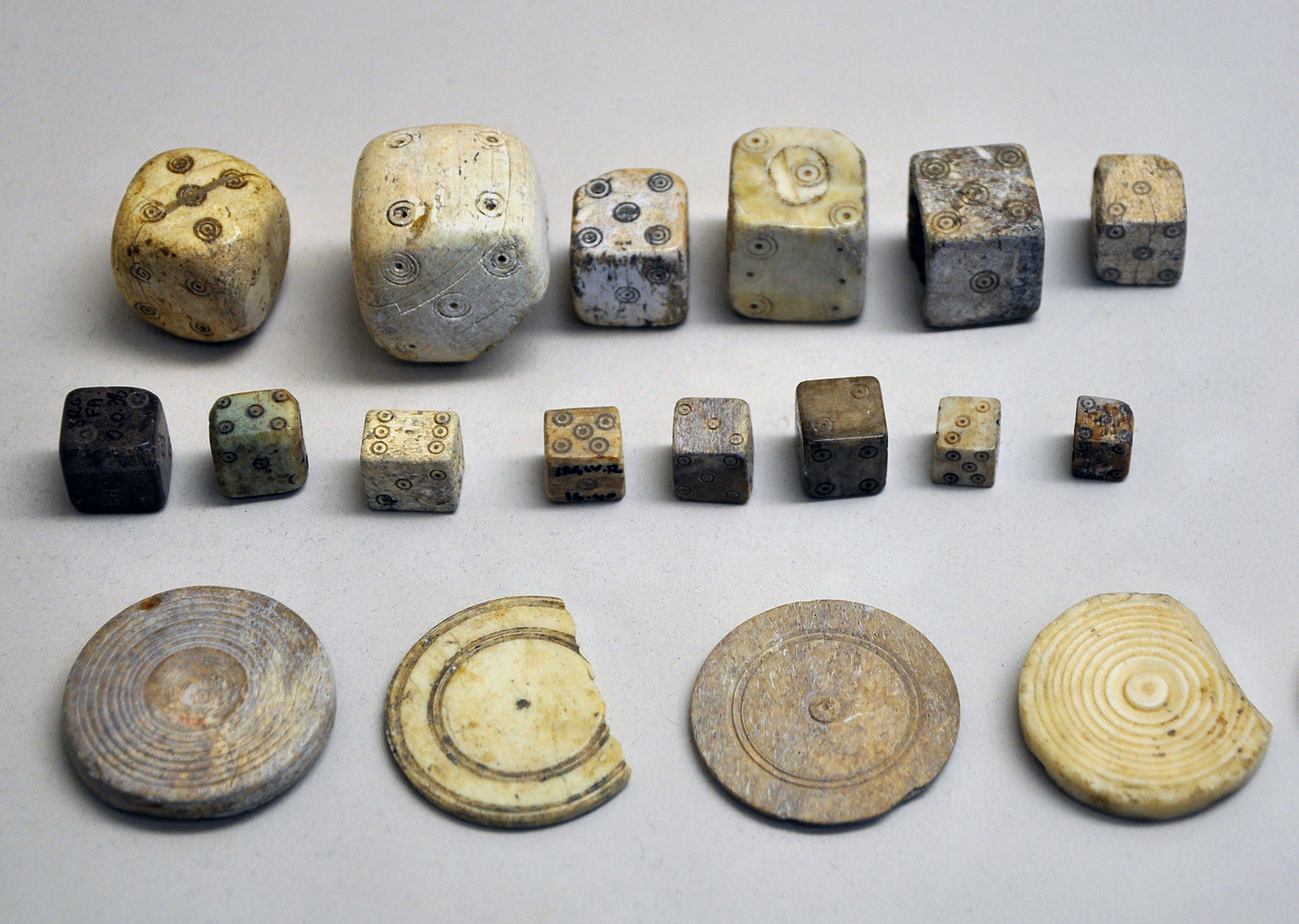
Dice from ancient Rome

Dice and gambling tokens from ancient Rome

Or to understand why five-boys-in-a-row makes the birth of a girl next time no more likely than it was during the first pregnancy (at least in theory). Boy/girl, like heads/tails, is a binary choice, so binary numbers are useful for understanding the probabilities of birth or coin-tossing. Questions like these are often asked to test knowledge of elementary probability:

1. Suppose a family have two children and the elder is a boy. What is the probability that both are boys?

2. Suppose a family have two children and at least one is a boy. What is the probability that both are boys?

People sometimes assume that the two questions are equivalent, but binary makes it clear that they’re not. If 1 represents a boy, 0 represents a girl and digit-order represents birth-order, the first question covers these possibilities: 10, 11. So the chance of both children being boys is 1/2 or 50%. The second question covers these possibilities: 10, 01, 11. So the chance of both children being boys is 1/3 = 33·3%. But now examine this question:

3. Suppose a family have two children and only one is called John. What is the probability that both children are boys?

That might seem the equivalent of question 2, but it isn’t. The name “John” doesn’t just identify the child as a boy, it identifies him as a unique boy, distinct from any brother he happens to have. Binary isn’t sufficient any more. So, while boy = 1, John = 2. The possibilities are: 20, 21, 02, 12. The chance of both children being boys is then 1/2 = 50%.

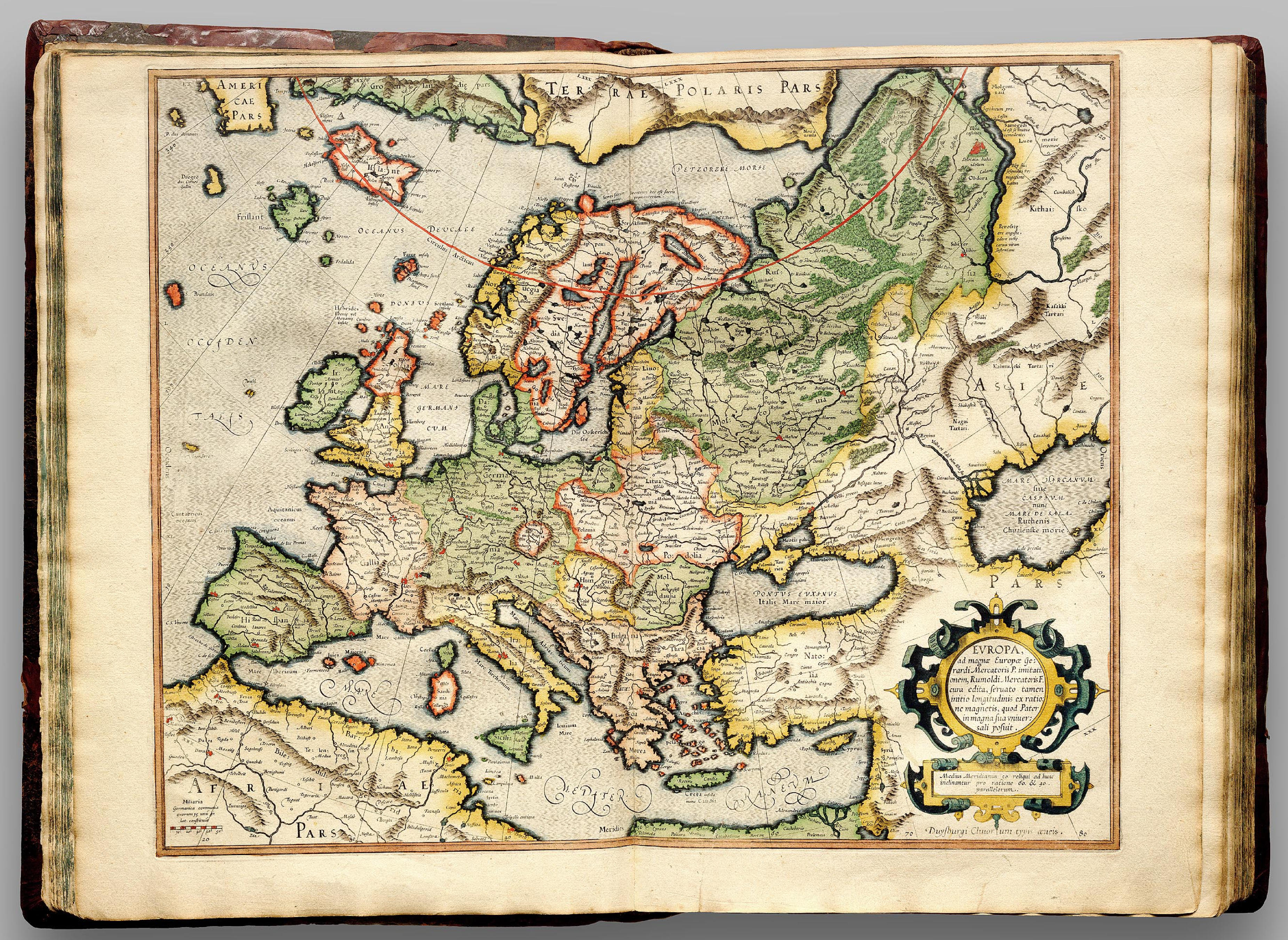
The three questions above are very simple, but I don’t think Archimedes or Euclid ever addressed the mathematics behind them. Perhaps they would have made mistakes if they had. I hope I haven’t, more than two millennia later. Perhaps the difficulty of understanding probability relates to the fact that it involves movement and change. The Greeks developed a highly sophisticated mathematics of static geometry, but did not understand projectiles or falling objects. When mathematicians began understood those in Renaissance Italy, they also began to understand the behaviour of dice, coins and cards. Ideas were on the move then and this new mathematics was obviously related to the rise of science: Galileo (1564-1642) is an important figure in both fields. But the maths and science can be linked with apparently distinct phenomena like Protestantism and classical music. All of these things began to develop in a “band of genius” identified by the American researcher Charles Murray. It runs roughly from Italy through France and Germany to Scotland: from Galileo through Beethoven and Descartes to David Hume.
Map of Europe from Mercator's Atlas Cosmographicae (1596)

Map of Europe from Mercator’s Atlas Cosmographicae (1596)

But how far is geography also biology? Having children is a form of gambling: the dice of DNA, shaken in testicle- and ovary-cups, are rolled in a casino run by Mother Nature. Or rather, in a series of casinos where different rules apply: the genetic bets placed in Africa or Europe or Asia haven’t paid off in the same way. In other words, what wins in one place may lose in another. Different environments have favoured different sets of genes with different effects on both bodies and brains. All human beings have many things in common, but saying that we all belong to the same race, the human race, is like saying that we all speak the same language, the human language. It’s a ludicrous and anti-scientific idea, however widely it may be accepted (and enforced) in the modern West.
Languages have fuzzy boundaries. So do races. Languages have dialects and accents, and so, in a sense, do races. The genius that unites Galileo, Beethoven and Hume may have been a particular genetic dialect spoken, as it were, in a particular area of Europe. Or perhaps it’s better to see European genius as a series of overlapping dialects. Testing that idea will involve mathematics and probability theory, and the computers that crunch the data about flesh will run on binary. Apparently disparate things are united by mathematics, but maths unites everything partly because it is everything. Understanding the behaviour of dice in the sixteenth century leads to understanding the behaviour of DNA in the twenty-first.

The next step will be to control the DNA-dice as they roll. China has already begun trying to do that using science first developed in the West. But the West itself is still in the thrall of crypto-religious ideas about equality and environment. These differences have biological causes: the way different races think about genetics, or persuade other races to think about genetics, is related to their genetics. You can’t escape genes any more than you can escape maths. But the latter is a ladder that allows us to see over the old genetic wall and glimpse the possibilities beyond it. The Chinese are trying to climb over the wall using super-computers; the West is still insisting that there’s nothing on the other side. Interesting times are ahead for both flesh and binary.

Appendix

1. Suppose a family have three children and the eldest is a girl. What is the probability that all three are girls?

2. Suppose a family have three children and at least one is a girl. What is the probability that all three are girls?

3. Suppose a family have three children and only one is called Joan. What is the probability that all three are girls?

The possibilities in the first case are: 000, 001, 010, 011. So the chance of three girls is 1/4 = 25%.

The possibilities in the second case are: 000, 001, 010, 011, 100, 101, 110. So the chance of three girls is 1/7 = 14·28%.

The possibilities in the third case are: 200, 201, 210, 211, 020, 021, 120, 121, 002, 012, 102, 112. So the chance of three girls is 3/12 = 1/4 = 25%.

Sumbertime Views

Like 666 (see Revelation 13:18), 153 (see John 21:11) appears in the Bible. And perhaps for the same reason: because it is the sum of successive integers. 153 = 1+2+3+…+17 = Σ(17), just as 666 = Σ(36). So both numbers are sum-numbers or sumbers. But 153 has other interesting properties, including one that can’t have been known in Biblical times, because numbers weren’t represented in the right way. It’s also the sum of the cubes of its digits: 153 = 1^3 + 5^3 + 3^3 = 1 + 125 + 27. So 153 is a cube-sumber or 3-sumber. The other 3-sumbers are 370, 371 and 407. There are 4-sumbers too, like 1,634 = 1^4 + 6^4 + 3^4 + 4^4, and 5-sumbers, like 194,979 = 1^5 + 9^5 + 4^5 + 9^5 + 7^5 + 9^5, and 6-sumbers, like 548,834 = 5^6 + 4^6 + 8^6 + 8^6 + 3^6 + 4^6.

But there are no 2-sumbers, or numbers that are the sum of the squares of their digits. It doesn’t take long to confirm this, because numbers above a certain size can’t be 2-sumbers. 9^2 + 9^2 = 162, but 9^2 + 9^2 + 9^2 = 243. So 2-sumbers can’t exist above 99 and if you search that high you’ll find that they don’t exist at all. At least not in this house, but they do exist in the houses next door. Base 10 yields nothing, so what about base 9?

4^2 + 5^2 = 45[9] = 41[10]
5^2 + 5^2 = 55[9] = 50

And base 11?

5^2 + 6^2 = 56[11] = 61[10]
6^2 + 6^2 = 66[11] = 72

This happens because odd bases always yield a pair of 2-sumbers whose second digit is one more than half the base and whose first digit is the same or one less. See above (and the appendix). Such a pair is found among the 14 sumbers of base 47, which is the best total till base 157 and its 22 sumbers. Here are the 2-sumbers for base 47:

2^2 + 10^2 = 104
3^2 + 12^2 = 153
5^2 + 15^2 = 250
9^2 + 19^2 = 442
12^2 + 21^2 = 585
14^2 + 22^2 = 680
23^2 + 24^2 = 1,105
24^2 + 24^2 = 1,152
33^2 + 22^2 = 1,573
35^2 + 21^2 = 1,666
38^2 + 19^2 = 1,805
42^2 + 15^2 = 1,989
44^2 + 12^2 = 2,080
45^2 + 10^2 = 2,125

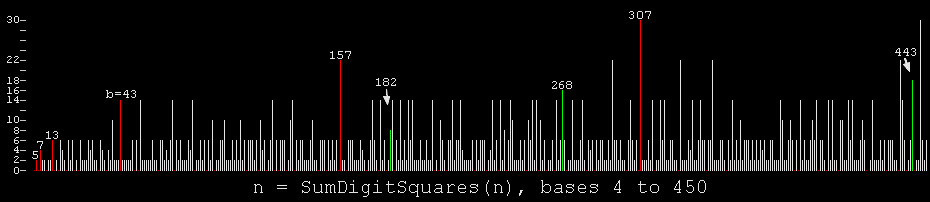
As the progressive records for 2-sumber-totals are set, subsequent bases seem to either match or surpass them, except in three cases below base 450:

2 in base 5
4 in base 7
6 in base 13
10 in base 43
14 in base 47
22 in base 157
8 in base 182*
16 in base 268*
30 in base 307
18 in base 443*

Totals for sums of squares in bases 4 to 450

Totals for sums-of–squares in bases 4 to 450 (click for larger image)

Appendix: Odd Bases and 2-sumbers

Take an even number and half of that even number: say 12 and 6. 12 x 6 = 11 x 6 + 6. Further, 12 x 6 = 2 x 6 x 6 = 2 x 6^2 = 6^2 + 6^2. Accordingly, 66[11] = 6 x 11 + 6 = 12 x 6 = 6^2 + 6^2. So 66 in base 11 is a 2-sumber. Similar reasoning applies to every other odd base except base-3 [update: wrong!]. Now, take 12 x 5 = 2 x 6 x 5 = 2 x (5×5 + 5) = 5^2+5 + 5^5+5 = 5^5 + 5^5+2×5. Further, 5^5+2×5 = (5+1)(5+1) – 1 = 6^2 – 1. Accordingly, 56[11] = 11×5 + 6 = 12×5 + 1 = 5^2 + 6^2. Again, similar reasoning applies to every other odd base except base-3 [update: no — 1^2 + 2^2 = 12[3] = 5; 2^2 + 2^2 = 22[3] = 8]. This means that every odd base b, except base-3, will supply a pair of 2-sumbers with digits [d-1][d] and [d][d], where d = (b + 1) / 2.

Live and Let Dice

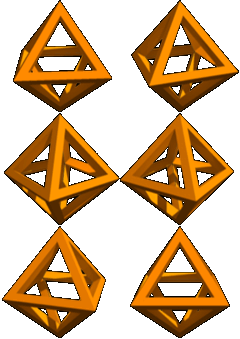
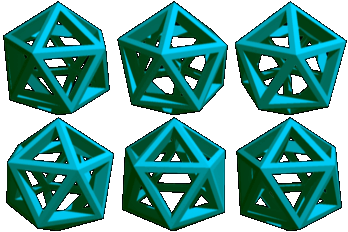
How many ways are there to die? The answer is actually five, if by “die” you mean “roll a die” and by “rolled die” you mean “Platonic polyhedron”. The Platonic polyhedra are the solid shapes in which each polygonal face and each vertex (meeting-point of the edges) are the same. There are surprisingly few. Search as long and as far as you like: you’ll find only five of them in this or any other universe. The standard cubic die is the most familiar: each of its six faces is square and each of its eight vertices is the meeting-point of three edges. The other four Platonic polyhedra are the tetrahedron, with four triangular faces and four vertices; the octahedron, with eight triangular faces and six vertices; the dodecahedron, with twelve pentagonal faces and twenty vertices; and the icosahedron, with twenty triangular faces and twelve vertices. Note the symmetries of face- and vertex-number: the dodecahedron can be created inside the icosahedron, and vice versa. Similarly, the cube, or hexahedron, can be created inside the octahedron, and vice versa. The tetrahedron is self-spawning and pairs itself. Plato wrote about these shapes in his Timaeus (c. 360 B.C.) and based a mathemystical cosmology on them, which is why they are called the Platonic polyhedra.

An animated gif of a tetrahedron

Tetrahedron


An animated gif of a hexahedron

Hexahedron

An animated gif of an octahedron

Octahedron


An animated gif of a dodecahedron

Dodecahedron

An animated gif of an icosahedron

Icosahedron

They make good dice because they have no preferred way to fall: each face has the same relationship with the other faces and the centre of gravity, so no face is likelier to land uppermost. Or downmost, in the case of the tetrahedron, which is why it is the basis of the caltrop. This is a spiked weapon, used for many centuries, that always lands with a sharp point pointing upwards, ready to wound the feet of men and horses or damage tyres and tracks. The other four Platonic polyhedra don’t have a particular role in warfare, as far as I know, but all five might have a role in jurisprudence and might raise an interesting question about probability. Suppose, in some strange Tycholatric, or fortune-worshipping, nation, that one face of each Platonic die represents death. A criminal convicted of a serious offence has to choose one of the five dice. The die is then rolled f times, or as many times as it has faces. If the death-face is rolled, the criminal is executed; if not, he is imprisoned for life.

The question is: Which die should he choose to minimize, or maximize, his chance of getting the death-face? Or doesn’t it matter? After all, for each die, the odds of rolling the death-face are 1/f and the die is rolled f times. Each face of the tetrahedron has a 1/4 chance of being chosen, but the tetrahedron is rolled only four times. For the icosahedron, it’s a much smaller 1/20 chance, but the die is rolled twenty times. Well, it does matter which die is chosen. To see which offers the best odds, you have to raise the odds of not getting the death-face to the power of f, like this:

3/4 x 3/4 x 3/4 x 3/4 = 3/4 ^4 = 27/256 = 0·316…

5/6 ^6 = 15,625 / 46,656 = 0·335…

7/8 ^8 = 5,764,801 / 16,777,216 = 0·344…

11/12 ^12 = 3,138,428,376,721 / 8,916,100,448,256 = 0·352…

19/20 ^20 = 37,589,973,457,545,958,193,355,601 / 104,857,600,000,000,000,000,000,000 = 0·358…

Those represent the odds of avoiding the death-face. Criminals who want to avoid execution should choose the icosahedron. For the odds of rolling the death-face, simply subtract the avoidance-odds from 1, like this:

1 – 3/4 ^4 = 0·684…

1 – 5/6 ^6 = 0·665…

1 – 7/8 ^8 = 0·656…

1 – 11/12 ^12 = 0·648…

1 – 19/20 ^20 = 0·642…

So criminals who prefer execution to life-imprisonment should choose the tetrahedron. If the Tycholatric nation offers freedom to every criminal who rolls the same face of the die f times, then the tetrahedron is also clearly best. The odds of rolling a single specified face f times are 1/f ^f:

1/4 x 1/4 x 1/4 x 1/4 = 1/4^4 = 1 / 256

1/6^6 = 1 / 46,656

1/8^8 = 1 / 16,777,216

1/12^12 = 1 / 8,916,100,448,256

1/20^20 = 1 / 104,857,600,000,000,000,000,000,000

But there are f faces on each polyhedron, so the odds of rolling any face f times are 1/f ^(f-1). On average, of every sixty-four (256/4) criminals who choose to roll the tetrahedron, one will roll the same face four times and be reprieved. If a hundred criminals face the death-penalty each year and all choose to roll the tetrahedron, one criminal will be reprieved roughly every eight months. But if all criminals choose to roll the icosahedron and they have been rolling since the Big Bang, just under fourteen billion years ago, it is very, very, very unlikely that any have yet been reprieved.

Rep-Tile Reflections

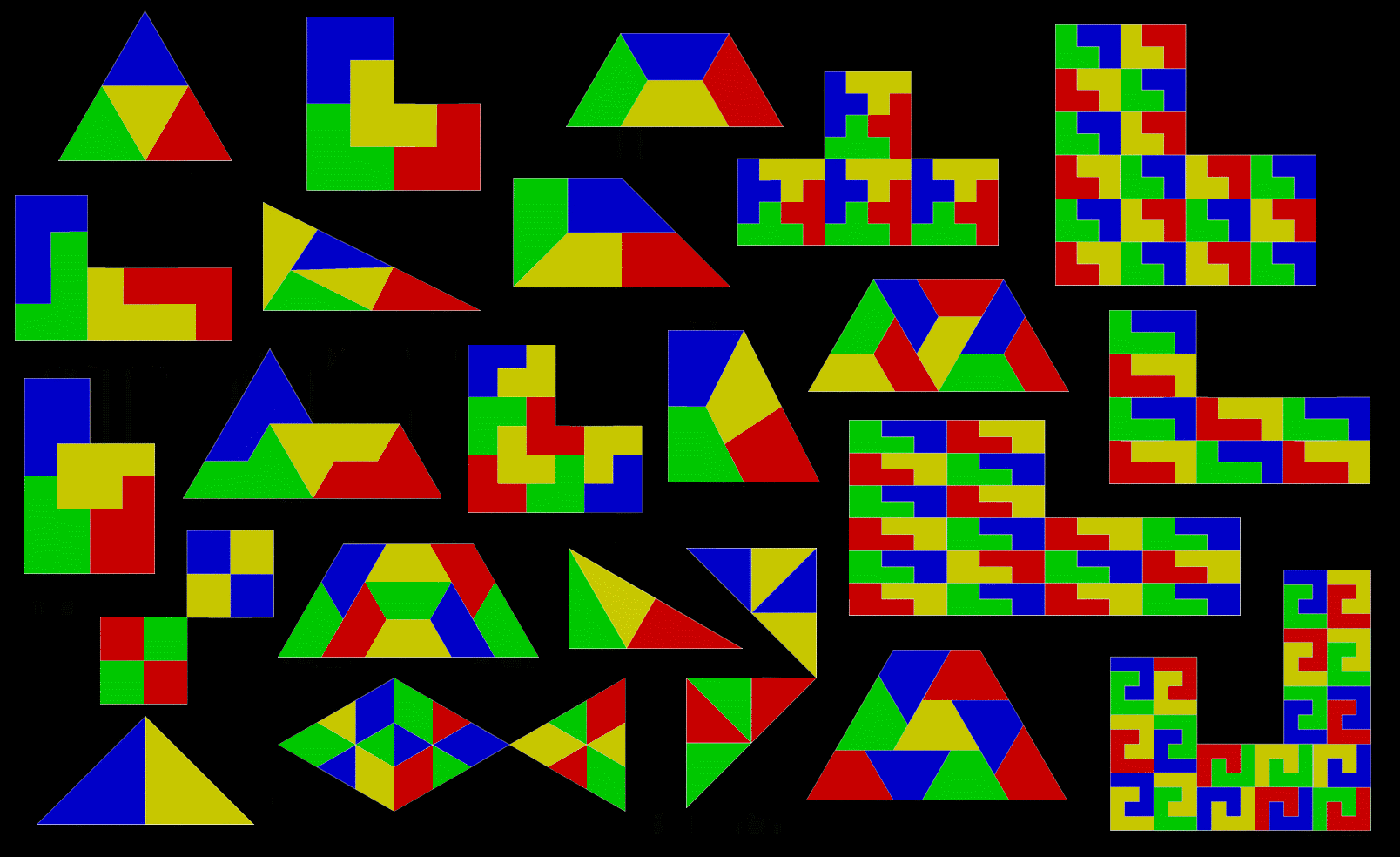
A rep-tile, or repeat-tile, is a two-dimensional shape that can be divided completely into copies of itself. A square, for example, can be divided into smaller squares: four or nine or sixteen, and so on. Rectangles are the same. Triangles can be divided into two copies or three or more, depending on their precise shape. Here are some rep-tiles, including various rep-triangles:

Various rep-tiles

Various rep-tiles — click for larger image

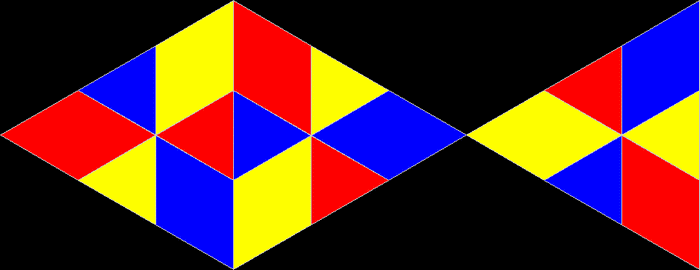
Some are simple, some are complex. Some have special names: the sphinx and the fish are easy to spot. I like both of those, particularly the fish. It would make a good symbol for a religion: richly evocative of life, eternally sub-divisible of self: 1, 9, 81, 729, 6561, 59049, 531441… I also like the double-square, the double-triangle and the T-tile in the top row. But perhaps the most potent, to my mind, is the half-square in the bottom left-hand corner. A single stroke sub-divides it, yet its hypotenuse, or longer side, represents the mysterious and mind-expanding √2, a number that exists nowhere in the physical universe. But the half-square itself is mind-expanding. All rep-tiles are. If intelligent life exists elsewhere in the universe, perhaps other minds are contemplating the fish or the sphinx or the half-square and musing thus: “If intelligent life exists elsewhere in the universe, perhaps…”

Mathematics unites human minds across barriers of language, culture and politics. But perhaps it unites minds across barriers of biology too. Imagine a form of life based on silicon or gas, on unguessable combinations of matter and energy in unreachable, unobservable parts of the universe. If it’s intelligent life and has discovered mathematics, it may also have discovered rep-tiles. And it may be contemplating the possibility of other minds doing the same. And why confine these speculations to this universe and this reality? In parallel universes, in alternative realities, minds may be contemplating rep-tiles and speculating in the same way. If our universe ends in a Big Crunch and then explodes again in a Big Bang, intelligent life may rise again and discover rep-tiles again and speculate again on their implications. The wildest speculation of all would be to hypothesize a psycho-math-space, a mental realm beyond time and matter where, in mathemystic communion, suitably attuned and aware minds can sense each other’s presence and even communicate.

The rep-tile known as the fish

Credo in Piscem…

So meditate on the fish or the sphinx or the half-square. Do you feel the tendrils of an alien mind brush your own? Are you in communion with a stone-being from the far past, a fire-being from the far future, a hive-being from a parallel universe? Well, probably not. And even if you do feel those mental tendrils, how would you know they’re really there? No, I doubt that the psycho-math-space exists. But it might and science might prove its existence one day. Another possibility is that there is no other intelligent life, never has been, and never will be. We may be the only ones who will ever muse on rep-tiles and other aspects of mathematics. Somehow, though, rep-tiles themselves seem to say that this isn’t so. Particularly the fish. It mimics life and can spawn itself eternally. As I said, it would make a good symbol for a religion: a mathemysticism of trans-biological communion. Credo in Piscem, Unum et Infinitum et Æternum. “I believe in the Fish, One, Unending, Everlasting.” That might be the motto of the religion. If you want to join it, simply wish upon the fish and muse on other minds, around other stars, who may be doing the same.