Maven of Mixcegenation

The obfuscating and intentional doublespeak swirling around the emotive cauldron ingredients of “immigration”, “illegal immigration” and “small boats” has been intentionally leveraged into mainstream political and media jargon by Reform UK, big tech algorithms, and thence into the baying mob. […] We are daily enriched by, and should feel deeply indebted to, the many people of colour in this and other sectors of our society. — “This capitulation to racist rhetoric will not end well for Labour or Britain”, letter by Quentin Cowen of Laxfield, Suffolk in The Guardian, 18xi25


Post-Performative Post-Scriptum

“The obfuscating and intentional doublespeak swirling around the emotive cauldron of…” woulda bin even betterer. If the ingredients aren’t bubbling away in the emotive cauldron, why would doublespeak bother to swirl around them? It certainly wouldn’t swirl around them as much, one would’ve thought. And does “emotive cauldron ingredients” mean “emotive-cauldron ingredients” or “emotive cauldron-ingredients”? Maybe it’s both. I’m also struck by the implications of “intentionally leveraged”. Is it possible to “unintentionally leverage” something? Not in this context, one would have thought. And if doublespeak is swirling, that is, if it’s fluid, it’s hard to see how one could exert leverage on it.

Etc, etc. Like all the best Guardianese, this passage is passionately pregnant with interrogation-inducing imagery in a way that is very difficult to achieve by conscious effort. Perhaps Quentin has been smoking some wacky baccy or other psychoactive stimulant supplied by one of the many Persons of Colour enriching his life and fighting da power in da extensive hoodz of Laxfield, Suffolk.

Penny’s Petrified Parade

“Without political agitation, sex can always be co-opted, calcifying gender revolution into another weary parade of saleable binary stereotypes.” — Laurie Penny, Meat Market: Female Flesh Under Capitalism (2011)

Give It Some Pivot

Hydrology, geology, acoustics and more combine in one magnificently muddled mixed metaphor:

When [Emily] Pankhurst ordered her followers to stop bombing the British state and start helping to arm it for the war effort [after 1914], it left some of the most radicalized to fall into “a feminist-fascist estuary formed in the crater generated by Mrs Pankhurst’s pivot from law-breaking insurgency to conformist cheerleading”. — ‘It’s a scary time’: Sophie Lewis on the ‘enemy feminisms’ that enable the far right, The Guardian, 21ii25

Among the baffling questions raised by the metaphor is this: Why “estuary”? It would make sense to say “[fall into] a stagnant and stinking feminist-fascist pool formed in the crater…” But estuaries aren’t stagnant and craters don’t create estuaries anyway. Rivers do when they flow into a sea or lake. What would the river and sea represent?

I’ve no idea. And I would find it very difficult to match that mixed metaphor without making it seemed contrived or confected. Mixed metaphors are a zen thing: for best effect, they’ve got to flow from the fingertips or float off the tongue without effort, welling up from a bottomless crater of bollocks like a meth-smoking bull in a china-shop riding a feral tsunami of unhinged imagery and clashing comparativization.

Miximal Metaphors

“Each of Robyn’s three Honey-era Later performances featured a moment. Towards the end of ‘Missing U’, she finally stared down the camera, having avoided eye contact for fear of emotional collapse, while during ‘Honey’ she did away with the mic stand to make room for supple dance moves. With ‘Every Heartbeat’, meanwhile, peaked when she punctured the highwire emotional blood-letting with a cheeky wink.” — “The 100 greatest BBC music performances – ranked!”, The Guardian, 6×22


Post-Performative Post-Scriptum…

If you think it’s easy to mix so many metaphors in so few words, all I can say is: Try it for yourself!

Oh My Guardian #8

“When it comes to Harry Potter, JK Rowling just can’t leave it alone. This is not necessarily a bad thing – fans have got to see Harry and friends all grown-up in the Cursed Child plays – but she’s also managed to muddy the waters by her constant rejigging of the original narrative furniture.” — Fantastic Beasts isn’t racist, but JK Rowling should stop tweaking the source material, Hannah Flint, The Guardian, 28ix2018.


Oh My Guardian #7 — the previous entry in this award-winning series
Reds under the Thread more on mixed metaphors… in terms of The Guardian
All posts interrogating issues around the Guardian-reading community and its affiliates

Oh My Guardian #6

[…] the whole vintage package – which started as essentially a rediscovery of simple skills, tying generations together and serving as a visual cake-based bulwark against modern turbulence – has been used to sugar-coat a free-market nationalism that isn’t sweet at all. — Zoë Williams, Let’s ditch the nostalgia that’s invaded our TV and seeped into our politics, The Guardian, 30iv2018.


Elsewhere other-engageable:

Oh My Guardian #5
Zo with the Flow
Reds under the Thread (more on mixed metaphory)

Maxed Messages

Terminal Trio – Robert Burchill on “in terms of”
Mixed Messages – the Joy of Guardian prose
Paradigms Loused

Oh My Guardian #2

“Instead, Mr Comey has rocket-fuelled a venomous contest just when Mr Trump was desperate for a lifeline…” — The Guardian view on the FBI’s Clinton probe: exactly the wrong thing to do


Previously pre-posted…

Oh My Guardian #1
Reds under the Thread

Bestia Bestialissima

Auberon Waugh called himself a “practitioner of the vituperative arts”. Perhaps it was a Catholic thing. And unless you know Latin, you won’t understand. Or you won’t understand as much as you might. I don’t know Latin well, but I can appreciate some of the wonderful vituperation in a book of Latin exorcisms I’ve found scanned at Google Books. The title alone is good: Flagellum Daemonum: Exorcismos Terribiles, Potentissimos et Efficaces, which means (I think) The Flail of Demons: Exorcisms Terrible, Most Potent and Effective. Or is the title Fustis Daemonum: Adiurationes Formidabiles, Potentissimas et Efficaces, meaning The Cudgel of Demons: Adjurations Formidable, Most Potent and Effective?
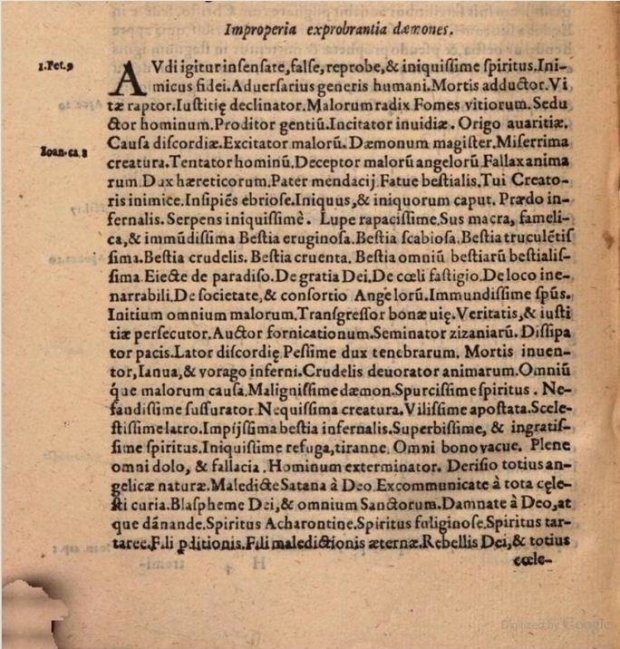
Vituperation from the Flagellum Daemonum (1644)

Vituperation from the Flagellum Daemonum (1644)


Either way, one of the exorcisms contains a good list of curses directed at the Devil. He’s called Bestia Omnium Bestiarum Bestialissima, meaning “Beast of All Beasts the Most Beastly”. Beside that, there are Dux Hæreticorum and Lupus Rapacissimus, “Duke of Heretics” and “Most Rapacious Wolf”. There’s an odd Sus Macra, Famelica, et Immundissima, which means something like “Scrawny, Famished and Most Filthy Hog”. Lovecraft would have liked Nefandissimus Susurrator, “Most Unspeakable Whisperer”, and Draco Iniquissimus, “Most Iniquitous Dragon”.

Pessimus Dux Tenebrarum is “Most Evil Duke of Darkness” and Janua et Vorago Inferni is “Door and Abyss of Hell”. Seminator Zizaniarum, meaning “Sower of Tares”, refers to Matthew xiii, 25: “But while men slept, his enemy came and sowed tares among the wheat, and went his way.” And those are only a few of the curses poured on the Devil’s head. I’ve turned the full list into plain text. As it says in the book that originally led me to the Flagellum Daemonum, “The following is a specimen of one of these vituperative addresses”:

Audi igitur insensate, false, reprobe, et iniquissime Spiritus. Inimice fidei. Adversarie generis humani. Mortis adductor. Vitæ raptor. Justitiæ declinator. Malorum radix. Fomes vitiorum. Seductor hominum. Proditor gentium. Incitator invidiæ. Origo aravitiæ. Causa discordiæ. Excitator malorum. Dæmonum magister. Miserrima Creature. Tentator Homininum. Deceptor malorum Angelorum. Fallax animarum. Dux Hæreticorum. Pater Mendacii. Fatue Bestialis. Tui creatoris Inimicus. Insipiens ebriose. Inique et iniquorum caput. Prædo infernalis. Serpens iniquissime. Lupe rapacissime. Sus macra, famelica, et immundissima. Bestia eruginosa. Bestia scabiosa. Bestia truculentissima. Bestia crudelis. Bestia cruenta. Bestia omnium Bestiarum Bestialissima. Ejecte de Paradise. De gratiâ Dei. De Cœli fastigio. De loco inerrabili. De Societate et consortia Angelorum. Immundissime Spiritus Initium omnium malorum. Trangressor bonæ vitæ. Veritatis et Justitiæ persecutor. Auctor fornicationum. Seminator zizaniarum. Dissipator pacis. Latro discordiæ. Pessime dux tenebrarum. Mortis inventor. Janua et vorago Inferni. Crudelis devorator animarum omniumque malorum causa. Malignissime Dæmon. Spurcissime Spiritus. Nefandissime susurrator. Nequissima Creatura. Vilissime apostata. Scelestissima latro. Impiissima bestia infernalis. Superbissime et ingratissime Spiritus. Iniquissime refuga. Tyranne, Omni bono vacue. Plene omni dolo et fallaciâ. Hominum exterminator. Derisio totius Angelicæ Naturæ. Maledicte Satana a Deo. Excommunicate a totâ cœlesti curiâ. Blaspheme Dei et omnium Sanctorum. Damnate a Deo atque Damnande. Spiritus Acherontine. Spiritus Tartaree. Fili Perditionis. Fili maledictionis æternæ. Rebellis Dei et totius cœlestis curiæ. Serpens crudelissime. Draco iniquissime. Creatura damnata, reprobata et maledicta a Deo in æternum ob superbiam nequitiam tuam.

The first line, Audi igitur insensate, false, reprobe, et iniquissime Spiritus means something like “Hear, then, Senseless, False, Reprobate and Most Iniquitous Spirit”. Then the Devil is called Inimicus Fidei, “Enemy of the Faith”, Adversarius Generis Humani, “Adversary of the Human Race”, Mortis Adductor, “Dragger to Death”, and Vitæ Raptor, “Snatcher of Life”. Then the vituperation really begins.

Go Fig, Carr

“What they will find is a clear look into the molten core of a certain mind-set, a place where conspiracies are legion, victims are portrayed as perpetrators and so-called news is a fig leaf on a far darker art.” — “Sowing Mayhem, One Click at a Time”, David Carr, The New York Times, 15/xii/2014, viâ Steve Sailer.