He Say, He Sigh, He Sow #46

“… for comic effect he also drew on neglected Arabic words, including buldah, or ‘freedom from hair of the space between the eyebrows’, and bahsala, to ‘remove one’s clothes and gamble with them’.” — Christopher de Bellaigue, The Islamic Enlightenment: The Modern Struggle between Faith and Reason (2017), writing of the Lebanese Christian Maronite novelist Ahmad Faris al-Shidyaq (1805-87) (ch. 5, Vortex, pg. 167)

The Conqueror Term

True story. I saw a copy of Rub Out the Words (2012) on a library shelf. It’s a collection of letters by core counter-cultural colossus William S. Burroughs. I pulled the book off the shelf, opened it, and began to search for a hit of heresiarchal heroin. Exactly 23 seconds later, my eyes fell on this phantasmagoric phraseology:

I do not think a writer should be called upon to defend his work in terms of a legal system that dates back to the middle ages.

I was stunned. Exactly 23 seconds. Well, I didn’t actually time it, but it would have been exactly 23 seconds if you choose the right base. And it was round-about 23 seconds in base 10. So I think reality was trying to tell me something: that Burroughs was part of the Hive Mind. He used a toxic term that good writers shouldn’t use – never, nunca, nohow, nowhere.

And it wasn’t the sole example in the book, I have since learnt. Here, then, are my suggestions for how Burroughs should have rubbed out the offending words and replaced them with something shorter and less vague (the final two examples are by the book’s editor and by someone Burroughs is quoting):

• I do not think a writer should be called upon to defend his work in terms of a legal system that dates back to the middle ages. → in a legal system
• All this is quite possible in terms of existing techniques. → with / by existing techniques
• I am not talking in terms of a thousand years. I am talking in NOW terms. → not talking of a thousand years. I am talking NOW.
• I am thinking in terms of the no-paying far-out magazines like Yugen and Kulchur. → thinking of / about no-paying far-out magazines
• When two or more letters covered the same ground, I selected the best in terms of quality of writing and completeness of thought. → in quality of writing
• Mr Burroughs writes enthusiastically about apomorphine treatment but I do not feel his enthusiasm is justified in terms of published results. → by published results

Okay, there are a lot of letters in the collection and Burroughs himself used “in terms of” only four (or five) times, which isn’t too bad. However, each use is an echt Guardianism, so Burroughs was undoubtedly a victim of the Conqueror Term, like millions of others, then and now. But it isn’t only English-speakers who can be victims of the Conqueror Term: it has infected usage in French too. This is from a speech by the new French president Emmanuel Macron:

… c’est ensuite les routes des trafics multiples qui nécessitent des réponses aussi en termes de sécurité et de coordination régionale … – Emmanuel Macron empêtré dans une folle polémique, Mediaguinee, 10/vii/2017.

… it is then the roads of multiple trafficking which also require answers in terms of security and regional coordination … – French President Emmanuel Macron is in the middle of a social media firestorm, Vox, 10/vii/2017.

The French and English can be shortened in the same way:

• des réponses aussi en termes de sécurité → des réponses aussi en sécurité
• answers in terms of security → in security

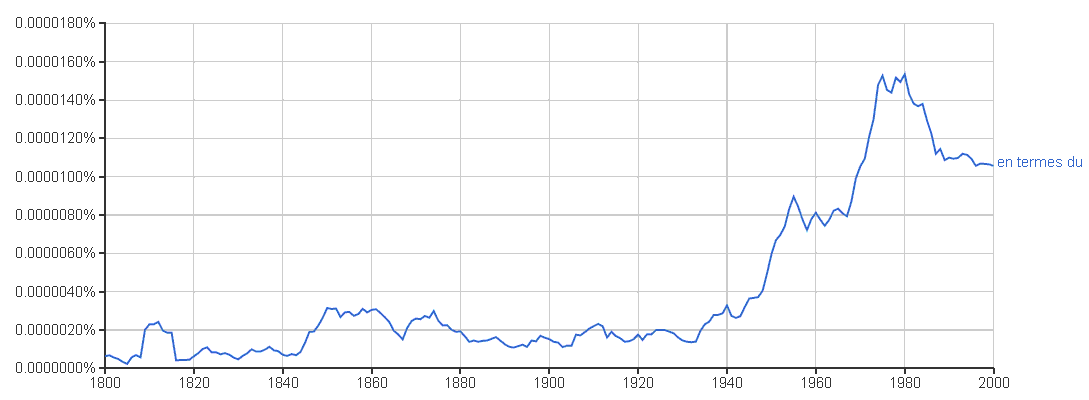
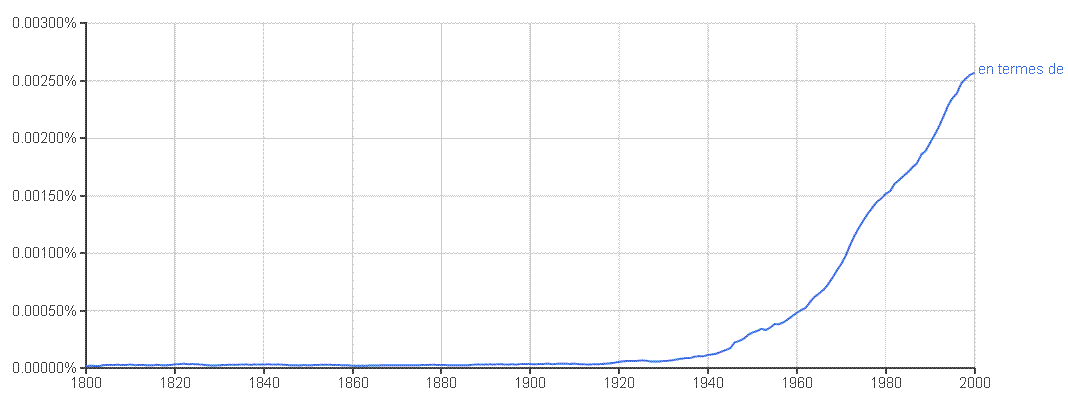
Macron, as you’d expect, is part of the Hive Mind too. He and many other Francophones have succumbed to the Conqueror Term, as you can see from these graphs at Google nGrams (“en termes du” behaves in an interesting way):

En termes de

En termes du

But there are termicides in French too:

Attention, on confond souvent la signification de “en termes de”. Cette expression signifie « dans le vocabulaire de », « dans le langage de » et ne veut pas dire « en ce qui concerne », « en matière de », « sur le plan de ». Cette confusion est sûrement due à l’expression anglaise “in terms of” qui elle a le sens de “en matière de”. Faut-il écrire “en termes de” ou “en terme de” ?, La Langue Française, Nicolas Le Roux, août 31, 2015.

Take care: people often confuse the meaning of “en termes de”. This expression means “in the vocabulary of”, “in the language of”, and does not mean “in what concerns”, “in the matter of”, “after the form of”. This confusion is surely due to the English expression “in terms of”, which has the sense of “in the matter of”. (My translation, so not reliable)

Things were worse than I thought. Pero… ¡La lucha continúa!


Elsewhere other-posted:

The Conqueror Worm — the title of the incendiary intervention above is of course a reference to the famous poem by Edgar Allan In Terms Of Poe
Paradigms Loused

He Say, He Sigh, He Sow #45

…ψάμμος ἀριθμὸν περιπέφευγεν… — Πίνδαρου Ολυμπιόνικος ΙΙ, 98

   “…the sand escapes all numbering…” — Pindar, Second Olympian Ode, line 98

Sphere Hear

οὐσίαν θεοῦ σφαιροειδῆ, μηδὲν ὅμοιον ἔχουσαν ἀνθρώπωι· ὅλον δὲ ὁρᾶν καὶ ὅλον ἀκούειν, μὴ μέντοι ἀναπνεῖν· σύμπαντά τε εἶναι νοῦν καὶ φρόνησιν καὶ ἀίδιον. — Διογένης Λαέρτιος, Βίοι καὶ γνῶμαι τῶν ἐν φιλοσοφίᾳ εὐδοκιμησάντων

    “The substance of God is spherical, in no way resembling man. He is all eye and all ear, but does not breathe; he is the totality of mind and thought, and is eternal.” — Xenophanes’ concept of God in Diogenes Laërtius’ Lives of Eminent Philosophers (c. 280-320 AD), Book IX, chapter 2 (translated by R.D. Hicks, 1925)

He Say, He Sigh, He Sow #42

« Il n’y avait plus dans la rue que les boutiquiers et les chats. » — Albert Camus, L’Étranger (1942).

    “There was no longer anything in the street but shopkeepers and cats.” — Camus, The Outsider.

He Say, He Sigh, He Sow #41

κατ’ ἐπακολούθημα δὲ καὶ περὶ τῆς ἐγκυκλίου καλουμένης παιδείας, εἰς ὅσα εὔχρηστος, περί τε ἀστρολογικῆς καὶ μαθηματικῆς καὶ μαγικῆς γοητείας τε ἐπιδραμητέον. αὐχοῦσι γὰρ δὴ καὶ ἐπὶ ταῖσδε οἱ Πανέλληνες ὡς μεγίσταις ἐπιστήμαις. — Κλήμης ὁ Ἀλεξανδρεύς, Στρώματα.

   “By consequence, also we must treat of what is called the curriculum of study — how far it is serviceable; and of astrology, and mathematics, and magic, and sorcery. For all the Greeks boast of these as the highest sciences.” — Clement of Alexandria, The Stromata, Book II.

He Say, He Sigh, He Sow #39

— Croyez-vous aux idées dangereuses ?
— Qu’entendez-vous par là ?
— Croyez-vous que certaines idées soient aussi dangereuses pour certains esprits que le poison pour le corps ?
— Mais, oui, peut-être.

  Guy de Maupassant, « Divorce » (1888)


“Do you believe in dangerous ideas?”
“What do you mean by that?”
“Do you believe that certain ideas are as dangerous for some minds as poison is for the body?”
“Well, yes, perhaps.”

Bestia Bestialissima

Auberon Waugh called himself a “practitioner of the vituperative arts”. Perhaps it was a Catholic thing. And unless you know Latin, you won’t understand. Or you won’t understand as much as you might. I don’t know Latin well, but I can appreciate some of the wonderful vituperation in a book of Latin exorcisms I’ve found scanned at Google Books. The title alone is good: Flagellum Daemonum: Exorcismos Terribiles, Potentissimos et Efficaces, which means (I think) The Flail of Demons: Exorcisms Terrible, Most Potent and Effective. Or is the title Fustis Daemonum: Adiurationes Formidabiles, Potentissimas et Efficaces, meaning The Cudgel of Demons: Adjurations Formidable, Most Potent and Effective?
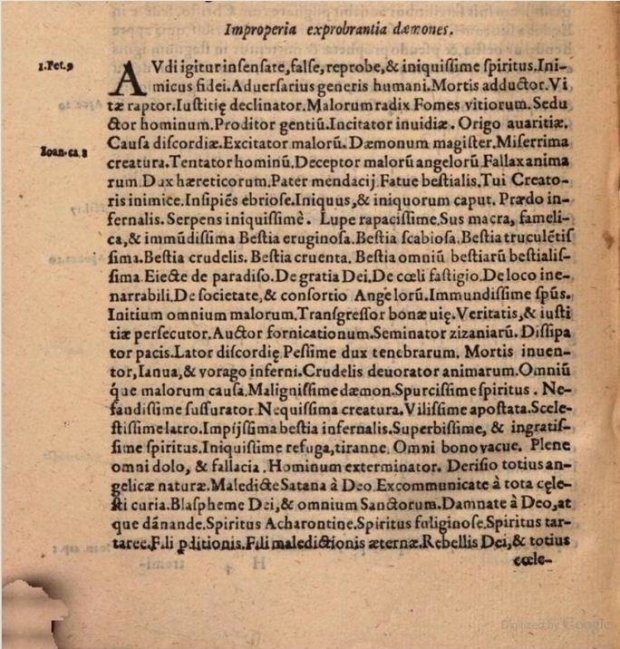
Vituperation from the Flagellum Daemonum (1644)

Vituperation from the Flagellum Daemonum (1644)


Either way, one of the exorcisms contains a good list of curses directed at the Devil. He’s called Bestia Omnium Bestiarum Bestialissima, meaning “Beast of All Beasts the Most Beastly”. Beside that, there are Dux Hæreticorum and Lupus Rapacissimus, “Duke of Heretics” and “Most Rapacious Wolf”. There’s an odd Sus Macra, Famelica, et Immundissima, which means something like “Scrawny, Famished and Most Filthy Hog”. Lovecraft would have liked Nefandissimus Susurrator, “Most Unspeakable Whisperer”, and Draco Iniquissimus, “Most Iniquitous Dragon”.

Pessimus Dux Tenebrarum is “Most Evil Duke of Darkness” and Janua et Vorago Inferni is “Door and Abyss of Hell”. Seminator Zizaniarum, meaning “Sower of Tares”, refers to Matthew xiii, 25: “But while men slept, his enemy came and sowed tares among the wheat, and went his way.” And those are only a few of the curses poured on the Devil’s head. I’ve turned the full list into plain text. As it says in the book that originally led me to the Flagellum Daemonum, “The following is a specimen of one of these vituperative addresses”:

Audi igitur insensate, false, reprobe, et iniquissime Spiritus. Inimice fidei. Adversarie generis humani. Mortis adductor. Vitæ raptor. Justitiæ declinator. Malorum radix. Fomes vitiorum. Seductor hominum. Proditor gentium. Incitator invidiæ. Origo aravitiæ. Causa discordiæ. Excitator malorum. Dæmonum magister. Miserrima Creature. Tentator Homininum. Deceptor malorum Angelorum. Fallax animarum. Dux Hæreticorum. Pater Mendacii. Fatue Bestialis. Tui creatoris Inimicus. Insipiens ebriose. Inique et iniquorum caput. Prædo infernalis. Serpens iniquissime. Lupe rapacissime. Sus macra, famelica, et immundissima. Bestia eruginosa. Bestia scabiosa. Bestia truculentissima. Bestia crudelis. Bestia cruenta. Bestia omnium Bestiarum Bestialissima. Ejecte de Paradise. De gratiâ Dei. De Cœli fastigio. De loco inerrabili. De Societate et consortia Angelorum. Immundissime Spiritus Initium omnium malorum. Trangressor bonæ vitæ. Veritatis et Justitiæ persecutor. Auctor fornicationum. Seminator zizaniarum. Dissipator pacis. Latro discordiæ. Pessime dux tenebrarum. Mortis inventor. Janua et vorago Inferni. Crudelis devorator animarum omniumque malorum causa. Malignissime Dæmon. Spurcissime Spiritus. Nefandissime susurrator. Nequissima Creatura. Vilissime apostata. Scelestissima latro. Impiissima bestia infernalis. Superbissime et ingratissime Spiritus. Iniquissime refuga. Tyranne, Omni bono vacue. Plene omni dolo et fallaciâ. Hominum exterminator. Derisio totius Angelicæ Naturæ. Maledicte Satana a Deo. Excommunicate a totâ cœlesti curiâ. Blaspheme Dei et omnium Sanctorum. Damnate a Deo atque Damnande. Spiritus Acherontine. Spiritus Tartaree. Fili Perditionis. Fili maledictionis æternæ. Rebellis Dei et totius cœlestis curiæ. Serpens crudelissime. Draco iniquissime. Creatura damnata, reprobata et maledicta a Deo in æternum ob superbiam nequitiam tuam.

The first line, Audi igitur insensate, false, reprobe, et iniquissime Spiritus means something like “Hear, then, Senseless, False, Reprobate and Most Iniquitous Spirit”. Then the Devil is called Inimicus Fidei, “Enemy of the Faith”, Adversarius Generis Humani, “Adversary of the Human Race”, Mortis Adductor, “Dragger to Death”, and Vitæ Raptor, “Snatcher of Life”. Then the vituperation really begins.

I Have a Threem

And now I have another. My first “threem”, or “three-M”, for this bijou bloguette was the alliterative three-word Latin phrase Mathematica Magistra Mundi, meaning “Mathematics Mistress of the World”. I also use it in the form Mathematica Machina Mundi, which has a variety of translations. In both Latin phrases, the words have five, three and two syllables, respectively. That’s the first three prime numbers in reverse and also part of the Fibonacci sequence in reverse.

You can find the same alliteration in languages derived from Latin, like the French La Mathématique, Maîtresse du Monde, but you don’t get the same syllable-count. So how likely was it that everything – the same alliteration and the same syllable-count – would appear in a language unrelated to Latin? But it does. Here’s a Georgian translation of the threem:

მათემატიკა მსოფლიოს მეფე

Matemat’ik’a Msoplios Mepe

“Mathematics the World’s King”

Msoplios isn’t a typo: Georgian is famous for its exotic consonant clusters and მს- / ms- isn’t a particularly unusual example. But it’s one I particularly like.

He Say, He Sigh, He Show #33

Apud me omnia fiunt Mathematicè in NaturaRené Descartes (1596-1650).
  • For me, all things in nature occur mathematically. — Correspondence with Martin Mersenne (1640).