Ass You Like It

This is a guest post by Norman Foreman, B.A.


Mediaeval Catholic philosophers wrote about both praying and braying. The braying came from Buridan’s ass, a thought-experiment about choice and free will. Imagine a hungry ass set between two piles of hay that are identical in every way: size, shape, colour, tastiness and so on. Some philosophers argued that, if it had no reason to prefer one pile of hay to the other, the ass would be unable to choose and would therefore starve to death.

I don’t agree: inter alia, nervous systems don’t work symmetrically and we don’t experience objects as fully identical when they’re in different parts of our visual field. However, in a literary sense, I understand what it feels like to be Buridan’s ass. To assify myself, I start by imagining this:

• I’m offered £1000 to read a book by the transgressive author Will Self.

Would I accept? Yes. It would be distasteful, but I’d do it for £1000. Self’s writing is so bad that I might give the money back rather than finish the book, but I’d have a go. Now change the situation:

• I’m offered £1000 to read a book by the transgressive author Stewart Home.

Would I still accept? Yes. Again, it would be distasteful, but I’d do it for the money. Or I’d try, at least. The next step turns me into Buridan’s ass. I imagine this:

• I’m offered £1000 to read a book by either Will Self or Stewart Home (not both). And I have to make the choice for myself.

Now I’m on the horns of a dilemma. I would want the £1000, but I can’t decide which transgressive author I’d rather NOT read. Home is a downmarket version of Self, Self is an upmarket version of Home. It’s Self-as-chav vs Home-as-Oxbridge-grad. And/or vice versâ. They’re both keyly committed core components of the Guardianista community, with all that that implies in terms of issues around bad English, mixed metaphors and “in terms of”. I’m happy to say I’ve never read a book by either of them. So if I were offered £1000 to do so and had to choose either Self or Home, I couldn’t do it. Not unassisted. I’d have to toss a coin. Best of three. Or best of five dot dot dot


Previously pre-posted (please peruse):

Titus Graun
Ex-term-in-ate!
Reds under the Thread

Bri’ on the Sky

Front cover of Wonders of the Solar System by Brian Cox and Andrew Cohen

Bri’ Eyes the Sky

Wonders of the Solar System, Professor Brian Cox and Andrew Cohen (Collins 2010)

One of the most powerful images in this book is also one of the most understated. It’s an artist’s impression of a dim star seen over the curve of a dwarf-planet called Sedna. The star is a G-type called Sol. We on Earth know it better as the sun. Sedna is a satellite of the sun too, but it’s much, much further out than we are. It takes 12,000 years to complete a single orbit and its surface is a biophobic -240°C. It’s so distant that sunrise is star-rise and it wasn’t discovered until 2003. But the sun’s gravity still keeps it in place: one of the weakest forces in nature is one of the most influential. That’s one important message in an understated, crypto-Lovecraftian image.

Sedna has been there, creeping around its dim mother-star, since long before man evolved. It will still be there long after man disappears, voluntarily or otherwise. This frozen dwarf is a good symbol of the vastness of the universe and its apparent indifference to life. We don’t seem to interest the universe at all, but the universe certainly interests us. Wonders of the Solar System is a good introduction to our tiny corner of it, describing some fundamentals of astronomy with the help of spectacular photographs and well-designed illustrations. You can learn how fusion powers the sun, how Mars lost its atmosphere and how there might be life beneath the frozen surface of Jupiter’s satellite Europa. The text is simple, but not simplistic, though I think the big name on the cover did little of the writing: this book is probably much more Cohen than Cox. Either way, I enjoyed reading the words and not just looking at the pictures, all the way from star-dim Sedna (pp. 26-7) to “Scars on Mars” (pp. 220-1) by way of “The most violent place in the solar system” (pp. 198-9), a.k.a. Jupiter’s gravity-flexed, volcano-pocked satellite Io.

Pockmarked moon -- the Galilean satellite Io

Pockmarked moon — the Galilean satellite Io

Everything described out there is linked to something down here, because that’s how it was done in the television series. Linking the sky with the earth allowed the BBC to film the genial and photogenic physicist Brian Cox in various exotic settings: Hawaii, India, East Africa, Iceland and so on. I’ve not seen any of Cox’s TV-work, but he seems an effective popularizer of science. And the pretty-boy shots here add anthropology to the astronomy. What is the scientific point of Cox striding away in an artistic blur over the Sahara desert (pg. 103), staring soulfully into the distance near the Iguaçu Falls on the Brazilian-Argentine border (pg. 37) or gazing down into the Grand Canyon, hips slung, hands in pockets (pg. 163)? There isn’t a scientific point: the photos are there for his fans, particularly his female ones. He’s a sci-celeb, a geek with chic, and we’re supposed to see the sky through Bri’s eyes.

But he’s also a liberal working for the Bolshevik Broadcasting Corporation, so he’ll be happy with the prominent photo early on: Brian holding protective glasses over the eyes of a dusky-skinned child during a solar eclipse in India. The same simul-scribes’ Wonders of Life (Collins 2013), another book-of-the-BBC-series, opens with a similarly allophilic allophoto: a dusky-skinned Mexican crowned in monarch butterflies. This is narcissistic and patronizing, but the readiness of whites to “Embrace the Other” helps explain science, because science involves looking away from the self, the tribe and the quotidian quest for status and survival. Of course, Cox and Cohen would gasp with horror at the idea of racial differences explaining big things like science and politics. Cox would be sincere in his horror. I’m not so sure about Cohen.

But there are wonders within us as well as without us and though you won’t hear about them on the BBC, the tsunami of HBD, or research into human bio-diversity, is now rolling ashore. It will sweep away almost all of Cox’s and Cohen’s politics, but leave most of their science intact. It isn’t a coincidence that the rings of Saturn were discovered by the Italian Galileo and explained by the Dutchman Huygens and the Italian Cassini, or that the photos of Saturn here were taken by a space-probe launched by white Americans. But the United States has much less money now for space exploration. That’s explained by race too: as the US looks less like its founders, it looks less like a First World nation too. It’s fun to see the world through Bri’s eyes, but he’s careful not to look at everything that’s out there.

Septics vs Dirties

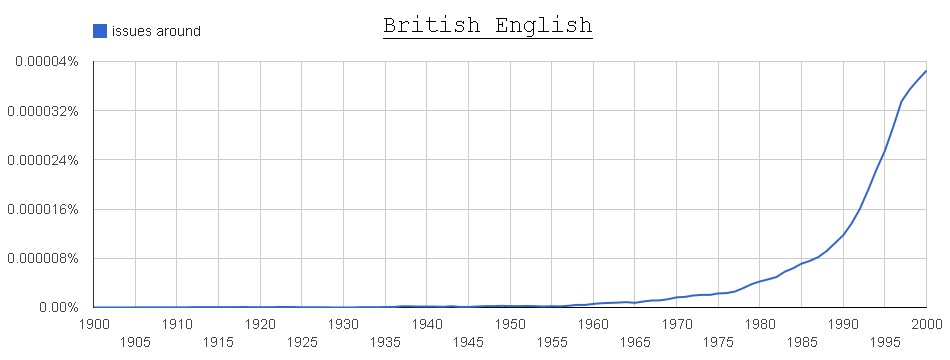
Some interesting patterns at Google’s Ngram Viewer (please follow the links to see the original images with further statistics):

in terms of (American + British English)

in terms of (American + British English)


in terms of (American English)

in terms of (American English)


in terms of (British English)

in terms of (British English)


issues around (American + British English)

issues around (American + British English)


issues around (American English)

issues around (American English)


issues around (British English)

issues around (British English)


Previously pre-posted (please peruse):

Titus Graun
Ex-term-in-ate!
Reds under the Thread

The Term Turns dot dot dot

In Titus Graun, I interrogated issues around the Grauniness, or Guardianisticity, of two keyly committed core components of the counter-cultural community: the semiotician Stewart Home and the æsthetician John Coulthart. Seeking to utilizate their usage-metrics for the core/epicentral Guardianista phrase “in terms of” (i.t.o.), I interrogated their personal websites like this in terms of January 2013:

site:http://www.johncoulthart.com “in terms of”
About 2,180 results

site:http://www.johncoulthart.com “the”
About 8,860 results

site:http://www.johncoulthart.com “and”
About 8,150 results


site:http://www.stewarthomesociety.org “in terms of”
About 123 results

site:http://www.stewarthomesociety.org “the”
About 602 results

site:http://www.stewarthomesociety.org “and”
About 599 results

Noting that Coulthart’s site used “the/and” approximately 14 times more often than Home’s, I adjusted Home’s raw i.t.o.-score accordingly: 123 x 14 = 1722. I concluded that Coulthart, with an i.t.o.-score of 2180, was approximately 26·59% Graunier than Home – exactly as one might have hoped, given that Coulthart is not merely a Guardianista (good), but a gay Guardianista (doubleplusgood). But that was in terms of January. When I re-interrogated their websites in terms of June 2013, I discovered that the semiotic situation had transitioned in a most disturbing and disquieting way:

site:http://www.johncoulthart.com “in terms of”
About 1,080 results

site:http://www.johncoulthart.com “the”
About 8,680 results

site:http://www.johncoulthart.com “and”
About 8,010 results


site:http://www.stewarthomesociety.org “in terms of”
About 119 results

site:http://www.stewarthomesociety.org “the”
About 541 results

site:http://www.stewarthomesociety.org “and”
About 536 results

I was aghast (literally) to see that Coulthart’s i.t.o.-metrics have spiked (in reverse). Other lexicostatistical metrics have transitioned relatively little: his site now seems to use “the/and” approximately 15·5 times more often than Home’s. Home’s raw i.t.o.-score is 119 and 119 x 15·5 = 1844·5. So it is now Home who is approximately 70·78% Graunier than Coulthart.

This can only be described as highly suspicious. What has Coulthart been up to? Has he been spraying his site with verbicide? Has he donned a black Savoy nihilinja-suit™, crept out under cover of darkness and clubbed innocent i.t.o.’s as they lay basking in the feral radiance of Manchester’s Most Maverick Messiahs? If so, this is “‘Pushing the Transgressive Envelope Too Far’ Too Far” too far. Even M.M.M.M. must look askance at behaviour like that. Surely.


Previously pre-posted (please peruse):

Titus Graun
Ex-term-in-ate!
Reds under the Thread

He Say, He Sigh, He Sow #13

“In the early thirties Trotsky also spoke of ‘Bonapartism’ in the Stalinist regime. In 1935, however, he observed that in the French Revolution Thermidor had come first and Napoleon afterwards; the order should be the same in Russia, and, as there was already a Bonaparte, Thermidor must have come and gone.” — Leszek Kołakowski in Main Currents of Marxism: Vol. III, The Breakdown (1978).

Paradigm Lost

Genius schmenius — genetics is sooooo 1950s:

But Paul Martin, a sociologist at the University of Sheffield, UK, is surprised that geneticists are still pursuing this line of research. “I think most people would say that’s the wrong paradigm, when most educational research suggests that social factors are incredibly important,” he says. “Strategically, this seems like something of a throwback.”

Chinese project probes the genetics of genius

See? Sense and decency. That’s because sociology is a proper science. Nearly as proper as psychoanalysis or astrology, in fact.

He Say, He Sigh, He Sow #9 and #10

“One of mighty union-smashing Maggie’s few big mistakes – along with increasing comprehensive education, letting third-world immigration and enforced multiculturalism rip, leaving the NHS and BBC ‘safe in our hands’, smashing the fisheries, selling out the Northern Irish Protestants, increasing welfarism, ending academic freedom and trying to push through the Poll Tax – was to be unfriendly to German reunification.” — Chris Brand, gFactor.


“Homosexual men are nature’s Petri dishes.” — Greg Cochran, West Hunter.

Flesh and Binary

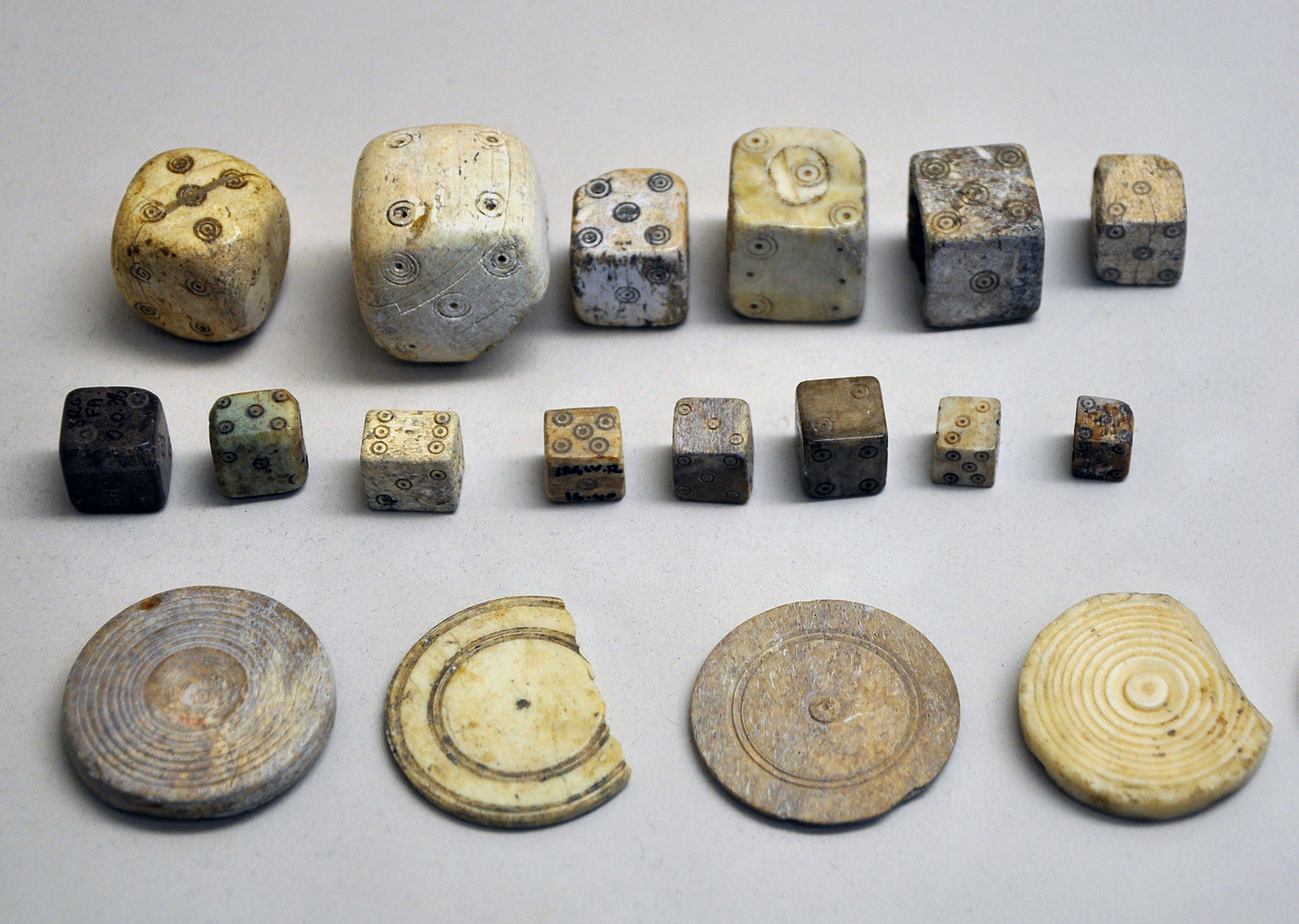
It’s odd that probability theory is so counter-intuitive to human beings and so late-flowering in mathematics. Men have been gambling for thousands of years, but didn’t develop a good understanding of what happens when dice are rolled or coins are tossed until a few centuries ago. And an intuitive grasp of probability would have been useful long before gambling was invented. Our genes automatically equip us to speak, to walk and to throw, but they don’t equip us to understand by instinct why five-tails-in-a-row makes heads no more likely on the sixth coin-toss than it was on the first.
Dice from ancient Rome

Dice and gambling tokens from ancient Rome

Or to understand why five-boys-in-a-row makes the birth of a girl next time no more likely than it was during the first pregnancy (at least in theory). Boy/girl, like heads/tails, is a binary choice, so binary numbers are useful for understanding the probabilities of birth or coin-tossing. Questions like these are often asked to test knowledge of elementary probability:

1. Suppose a family have two children and the elder is a boy. What is the probability that both are boys?

2. Suppose a family have two children and at least one is a boy. What is the probability that both are boys?

People sometimes assume that the two questions are equivalent, but binary makes it clear that they’re not. If 1 represents a boy, 0 represents a girl and digit-order represents birth-order, the first question covers these possibilities: 10, 11. So the chance of both children being boys is 1/2 or 50%. The second question covers these possibilities: 10, 01, 11. So the chance of both children being boys is 1/3 = 33·3%. But now examine this question:

3. Suppose a family have two children and only one is called John. What is the probability that both children are boys?

That might seem the equivalent of question 2, but it isn’t. The name “John” doesn’t just identify the child as a boy, it identifies him as a unique boy, distinct from any brother he happens to have. Binary isn’t sufficient any more. So, while boy = 1, John = 2. The possibilities are: 20, 21, 02, 12. The chance of both children being boys is then 1/2 = 50%.

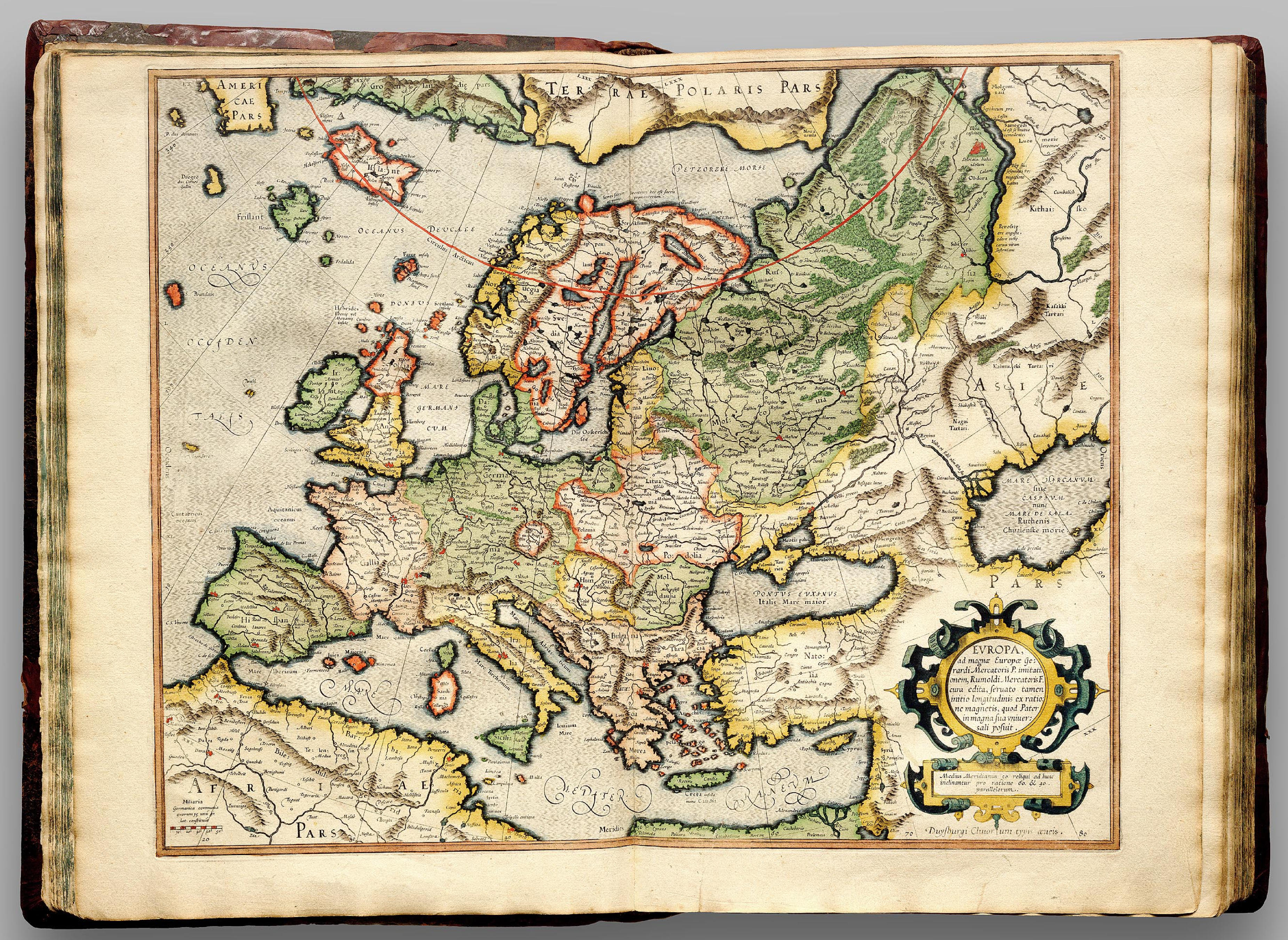
The three questions above are very simple, but I don’t think Archimedes or Euclid ever addressed the mathematics behind them. Perhaps they would have made mistakes if they had. I hope I haven’t, more than two millennia later. Perhaps the difficulty of understanding probability relates to the fact that it involves movement and change. The Greeks developed a highly sophisticated mathematics of static geometry, but did not understand projectiles or falling objects. When mathematicians began understood those in Renaissance Italy, they also began to understand the behaviour of dice, coins and cards. Ideas were on the move then and this new mathematics was obviously related to the rise of science: Galileo (1564-1642) is an important figure in both fields. But the maths and science can be linked with apparently distinct phenomena like Protestantism and classical music. All of these things began to develop in a “band of genius” identified by the American researcher Charles Murray. It runs roughly from Italy through France and Germany to Scotland: from Galileo through Beethoven and Descartes to David Hume.
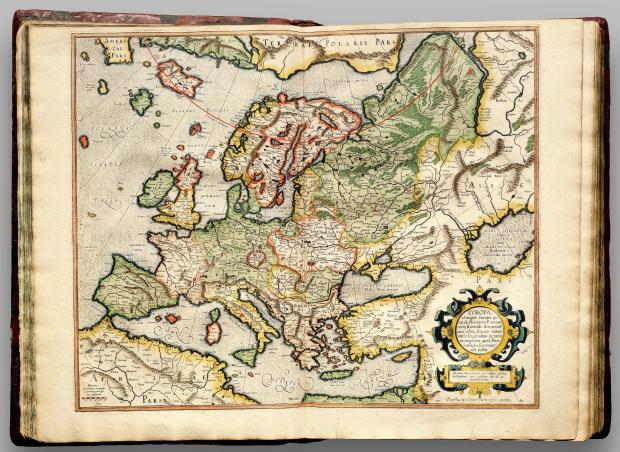
Map of Europe from Mercator's Atlas Cosmographicae (1596)

Map of Europe from Mercator’s Atlas Cosmographicae (1596)

But how far is geography also biology? Having children is a form of gambling: the dice of DNA, shaken in testicle- and ovary-cups, are rolled in a casino run by Mother Nature. Or rather, in a series of casinos where different rules apply: the genetic bets placed in Africa or Europe or Asia haven’t paid off in the same way. In other words, what wins in one place may lose in another. Different environments have favoured different sets of genes with different effects on both bodies and brains. All human beings have many things in common, but saying that we all belong to the same race, the human race, is like saying that we all speak the same language, the human language. It’s a ludicrous and anti-scientific idea, however widely it may be accepted (and enforced) in the modern West.

Languages have fuzzy boundaries. So do races. Languages have dialects and accents, and so, in a sense, do races. The genius that unites Galileo, Beethoven and Hume may have been a particular genetic dialect spoken, as it were, in a particular area of Europe. Or perhaps it’s better to see European genius as a series of overlapping dialects. Testing that idea will involve mathematics and probability theory, and the computers that crunch the data about flesh will run on binary. Apparently disparate things are united by mathematics, but maths unites everything partly because it is everything. Understanding the behaviour of dice in the sixteenth century leads to understanding the behaviour of DNA in the twenty-first.

The next step will be to control the DNA-dice as they roll. China has already begun trying to do that using science first developed in the West. But the West itself is still in the thrall of crypto-religious ideas about equality and environment. These differences have biological causes: the way different races think about genetics, or persuade other races to think about genetics, is related to their genetics. You can’t escape genes any more than you can escape maths. But the latter is a ladder that allows us to see over the old genetic wall and glimpse the possibilities beyond it. The Chinese are trying to climb over the wall using super-computers; the West is still insisting that there’s nothing on the other side. Interesting times are ahead for both flesh and binary.

Appendix

1. Suppose a family have three children and the eldest is a girl. What is the probability that all three are girls?

2. Suppose a family have three children and at least one is a girl. What is the probability that all three are girls?

3. Suppose a family have three children and only one is called Joan. What is the probability that all three are girls?

The possibilities in the first case are: 000, 001, 010, 011. So the chance of three girls is 1/4 = 25%.

The possibilities in the second case are: 000, 001, 010, 011, 100, 101, 110. So the chance of three girls is 1/7 = 14·28%.

The possibilities in the third case are: 200, 201, 210, 211, 020, 021, 120, 121, 002, 012, 102, 112. So the chance of three girls is 3/12 = 1/4 = 25%.


Vibrancy and Vileness

Every so often you come across a news-story that isn’t just horrifying in itself but offers a sickening glimpse into the wilful neglect and toxicity of a so-called “civilized” state and its so-called “justice” system. Here’s a story like that from Scandinavia:

Rapist is sentenced to six-and-a-half years in prison

The Iraqi man (35) arrived in Norway in 2003. Now he has been convicted of sexual assault twice. The 35-year-old Iraqi has now been sentenced to six-and-a-half years in prison and ordered to pay NoK 300,000 [$52,000/£34,000] in damages after he was arrested for participating in a gang rape in Slottsparken [the park surrounding the Royal Palace in Oslo] in October 2011. The 35-year-old also committed a particularly degrading rape at Rådhusplassen [the town square] in November 2005. On that occasion he raped a 27-year-old woman behind some pallets with granite slabs. When the victim resisted, the man put his hand over her mouth and nose and told her that he would kill her.

The woman who was raped in Slottsparken told police that she was raped by several men and that she feared that she would be killed. She is unsure of how many men who raped her, but she knows that none of the rapists used condoms. As a result she was given HIV-prevention drugs and pregnancy-termination drugs. The relationship with her fiancé came to an end and she attempted to commit suicide after the ordeal. Today she is afraid to meet men who look foreign.

(Translation of Aftenpost story, “Seks og et halvt års fengsel for voldtektsmann”, 2nd April, 2013)

But “horrifying” is perhaps understating it. I’m left shaking my head in disgust and asking one urgent question: Why, in the name of decency and justice, was this obnoxious woman not prosecuted and punished severely for her blatant auto-incitement to racial hatred and xenophobia / allophobia? Her wilfully selfish attitude reeks of toxic white privilege and obdurate refusal to sensitively engage issues around the Other. Shame on you, Norway, for creating a society in which such corrosive and egocentric individuals can exist. To flush their hateful ideology from your so-called “nation”, I suggest that you immediately double immigration from Iraq – and go on doubling it for as long as it takes. And double immigration from Somalia, Haïti and the Congo too. Until you do that, you can count yourself a thoroughly failed state.


A Slap on the Wrist — original translation, which is adapted slightly above

Chicks, Dicks and H.B.D.

Britain has recently been entertained by a cat-fight conducted at Twitter, The Observer and other loci of liberalism. Or perhaps “cat-and-castrated-tom-fight” is a better way of putting it. In the cat corner: a pair of self-righteous feminist egomaniacs called Julie Burchill and Suzanne Moore. In the castrato corner: lots of self-righteous transsexual egomaniacs and their supporters. It’s been one of those fights you wish both sides could lose, but it’s also been interesting from a hateful, bestial and demonic point of view. That is, from an HBD POV. HBD stands for human bio-diversity and is about looking at how human biology influences social, cultural and political patterns. Transsexuality is obviously a biological phenomenon, but I think feminism and female writers are too. Read on, if you’re man enough, and I’ll explain how.

The fight started when Suzanne Moore wrote an essay about “female anger” for an anthology published by the booksellers Waterstones. I don’t know or care what the anthology was about, but Moore’s essay included these lines:

The cliché is that female anger is always turned inwards rather than outwards into despair. We are angry with ourselves for not being happier, not being loved properly and not having the ideal body shape – that of a Brazilian transsexual. (Moore article)

Moore was then politely challenged on Twitter by a transphilic woman who detected a hint of transphobia in her remark. Moore refused to retract it and was even sarcastic about the notion of “intersectionality”, i.e., the multiple oppressions suffered by, say, black homosexuals with bad legs, who will suffer not just from racism, homophobia or disabledism, but from all three. Finally, pushed too far, Moore announced that:

People can just fuck off really. Cut their dicks off and be more feminist than me. Good for them. (Transphobic tweeting)

Moore then left Twitter because of the “bullying” she was experiencing. Her friend Julie Burchill came to her defence in The Observer (i.e. The Guardian-on-Sunday) in an article that began like this:

Hey trannies, cut it out

Where do dicks in terrible wigs get off lecturing us natural-born women about not being quite feministic enough? (Burchill article)

Burchill went on to excoriate “dicks in chick’s clothing” and “bed-wetters in bad wigs” who have had their “nuts taken off”. Further uproar ensued, the “transsexual community” complained long and loudly, and The Observer withdrew the article and apologized for the offence it had caused. All this has been entertaining but also, I think, an example of the poisoning of politics described by Britain’s Chief Rabbi, Jonathan Sacks:

Sacks: Multiculturalism threatens democracy

Multiculturalism promotes segregation, stifles free speech and threatens liberal democracy, Britain’s top Jewish official warned in extracts from his book The Home We Build Together: Recreating Society… [Jonathan] Sacks said Britain’s politics had been poisoned by the rise of identity politics, as minorities and aggrieved groups jockeyed first for rights, then for special treatment. The process, he said, began with Jews, before being taken up by blacks, women and gays. He said the effect had been “inexorably divisive. A culture of victimhood sets group against group, each claiming that its pain, injury, oppression, humiliation is greater than that of others.” (Multiculturalism threatens democracy, The Jerusalem Post)

By claiming “pain, injury, oppression” and so on, transsexuals want to make themselves immune from criticism. Saints could be trusted to behave well when immune from criticism, but saints wouldn’t demand to be so. Transsexuals are, I think it’s safe to say, no more saintly than Jews, blacks, women or gays. All the same, I also think Moore and Burchill have shown bigotry – in the proper, rather than politically correct, sense – towards transsexuals. This transphobic twosome obviously don’t like their feminist franchise being challenged by transsexuals, i.e., people who were born in men’s bodies, but think they’re really women and have had surgery to prove it. From my own bigoted, biocentric point of view, I am happy to accept that bodies do not always match brains and that someone with a female mind can be born in a male body. Or vice versa. It’s an interesting phenomenon, scientifically speaking, but it must also sometimes be a distressing phenomenon, psycho-socially speaking. Burchill’s sneers about “phantom limbs” and “bed-wetters in bad wigs” don’t show much female solidarity, let alone imaginative sympathy. But then she doesn’t seem to accept that a real woman can be born in a male body:

Shims, shemales, whatever you’re calling yourselves these days – don’t threaten or bully we [sic] lowly natural-born women, I warn you. We may not have as many lovely big swinging PhDs as you, but we’ve experienced a lifetime of PMT and sexual harassment, and many of us are now staring HRT and the menopause straight in the face – and still not flinching. Trust me, you ain’t seen nothing yet. You really won’t like us when we’re angry.

That is echt essentialism – indeed, physio-fascism. Burchill seems to believe that you can’t be a real woman unless you’re born in a female body. The bit about “lovely big swinging PhDs” is a sneer too, but a funny one: Burchill is an entertaining writer who combines masculine vigour with feminine illogic. Look at her reasoning here, for example:

…their lot [i.e., transsexuals] describe born women as “cis” – sounds like syph, cyst, cistern; all nasty stuff…

If “cis” is nasty because it sounds a bit like “cistern”, presumably “sister” would be even worse. Like Burchill, Suzanne Moore has no time for the nasty male invention of logic; unlike Burchill, she isn’t an entertaining or amusing writer. I’d never read anything by her before this cat-fight and I don’t intend to read anything again. The fight itself seems a good example of narcisso-sisters playing tyranny-trumps and poisoning politics, as the Chief Rabbi warned. Burchill and Moore themselves seem good examples of testotero-sisters: they’re masculinized in both psychology and physiognomy. It’s not just their aggression and coarseness: take a look at their faces:

Suzanne Moore and Julie Burchill

Suzanne Moore and Julie Burchill

I suggest that Moore and Burchill, despite their female bodies, are less psychologically female than some transsexuals who were born in male bodies. Both of them are left-wing and opponents of biological determinism, but they are cruder in their bio-determinism than the supposedly right-wing psychologist Hans Eysenck (1916–97), who was writing about HBD before HBD existed under its present name. In his book Sex, Violence and the Media (1978), Eysenck discussed that idea that “there is a strong biological determinant which predisposes individuals in the direction of greater or lesser ‘maleness’”:

Some of the strongest evidence for this point of view comes from the work of Dr Wilhart Schlegel, a Hamburg physician who made an exhaustive study of the shape of the pelvis in men and women. In men, typically, the pelvis is shaped like a funnel, tapering down to a narrow outlet; in women, the pelvis is shaped more like a tube, with a broad outlet. There is much variety within each sex; thus there are men with tube-shaped pelvis outlet structures, and women with funnel-shaped ones. What made Schlegel interested in the pelvic outlet is that its shape is apparently determined at the foetal stage by precisely the kind of hormonal burst [determining masculinity or femininity] already described; if such androgenic material is supplied, the pelvic shape will be masculine; if not, feminine. This led Schlegel to study in detail the social and sexual behaviour of men and women having typical and atypical pelvic shapes, using over a thousand men and women in his researches. (Op. cit., H.J. Eysenck and D.K.B. Nias, Maurice Temple Smith, London, 1978, pg. 230-1)

Schlegel discovered a strong correlation between pelvic shape and behaviour:

A masculine-type pelvis correlated with leadership, an active sexual role, dominance and a preference for a younger sexual partner, in men and women alike. A feminine-type pelvis correlated with empathy, suggestibility, and compliance. In other words, behaviour in both sexes seemed to be determined by the same hormonal factors which originally produced skeletal features of the pelvis, namely androgen secretion at the foetal stage.

Faces, like pelvises, are shaped by hormonal factors and I suggest that Moore and Burchill have masculinized faces. I also suggest that, as female writers, they are not unique in this. Another example of a masculinized female writer seems to be Hilary Mantel, winner of last year’s Man-Booker Prize for her novel Bring Out the Bodies. Mantel has been placed under scientific analysis by Eysenck’s protegé Chris Brand at his g-Factor blog:

Hilary Mantel

Hilary Mantel

Incomprehensible bug-eyed leftist old bag authoress Hilary Mantel was welcomed by the London Review of Books to put in her two pennorth slagging off the gracious, cheerful and pregnant Duchess of Cornwall… Broad-beamed Mantelpiece was a leftie born and bred – a matter which her publishers had contrived to conceal for several years. Of Irish parentage, she was raised a Catholic by parents who separated (she never saw her father after age eleven). She gave up Christianity at twelve and progressed to full-blown socialism, as was readily compatible with her studies at the London School of Economics and the University of Sheffield. Her own lack of husband and family was perhaps traceable to gynaecological problems so serious that she had been treated by doctors for psychosis during her twenties. (IQ & PC – By Chris Brand, Monday, February 25, 2013)

Mantel’s unusually broad features seem to occur elsewhere among female writers:

L-R: Jane Austen, Harriet Beecher Stowe, Pearl S. Buck, Iris Murdoch

L-R: Jane Austen, Harriet Beecher Stowe, Pearl S. Buck, Iris Murdoch

L-R: Joyce Carol Oates, Maya Angelou, Alice Walker, Arundhati Roy

L-R: Joyce Carol Oates, Maya Angelou, Alice Walker, Arundhati Roy

I suggest that the particular genre in which a writer works would also be reflected in her – or his – biology, but female writers are a small, self-selected group and don’t seem typical of women in general. This also appears to be true of female politicians. I first began to notice their unusual features in the 1990s among women like Hillary Clinton and Madeleine Albright:

Hillary Clinton and Madelaine Albright

Hillary Clinton and Madelaine Albright

Like Moore and Burchill, Clinton and Albright are left-wing and opponents of biological determinism. But the reality may be that a rejection of biological determinism is itself, in part, biologically determined. The subjective self-confidence and aggression of a masculinized woman may lead her to deny any influence of biology on politics, even though there is more and more evidence that such influence exists:

The GOP has a feminine face, UCLA study finds

At least when it comes to female politicians, perhaps you can judge a book by its cover, suggest two UCLA researchers who looked at facial features and political stances in the U.S. House of Representatives. “Female politicians with stereotypically feminine facial features are more likely to be Republican than Democrat, and the correlation increases the more conservative the lawmaker’s voting record,” said lead author Colleen M. Carpinella, a UCLA graduate student in psychology.

The researchers also found the opposite to be true: Female politicians with less stereotypically feminine facial features were more likely to be Democrats, and the more liberal their voting record, the greater the distance the politician’s appearance strayed from stereotypical gender norms. In fact, the relationship is so strong that politically uninformed undergraduates were able to determine the political affiliation of the representatives with an overall accuracy rate that exceeded chance, and the accuracy of those predications increased in direct relation to the lawmaker’s proximity to feminine norms. (“The GOP has a feminine face, UCLA study finds”, Meg Sullivan, September 27, 2012)

Faces and pelvises are indirect guides to brains and it would be very interesting to have more direct data about the brains of female politicians, whether left- or right-wing. It would also be interesting to know how many children they have and the sex-ratio of those children, because that is also influenced by hormonal factors. Like Burchill and Moore, Hilary Mantel and Hillary Clinton would no doubt dismiss HBD as hateful, but all of them are biological entities and none of them can escape HBD. Neither can I or you or any other human being, but the more we know about ourselves the better we may be able to understand politics and culture. And the more we know about human biology, the more we may also understand that some forms of politics are far less caring and compassionate than they claim to be.