Mavericks in a Metropolis of Millions…

Trump has won again.

I can’t believe I’ve just written those words.

I don’t wanna believe I’ve just written those words.

But I hafta.

’Coz they’re true.

Toxically, traumatizingly, tear-tappingly true.

So how’m I gonna respond to the toxic truth of tyrannical Trump’s triumph?

Welp… how better than by publishing some fiercely unbowed words of anti-fascist resistance from one of the core counter-cultural components at one of the world’s leading anti-racist publishing houses?

Yes indeedy, this Papyrocentric Performativizer is positively pulsating with pride and passion to present an exclusive antifa extract from arguably the best interview in Titans of Transgression: Incendiary Interviews with Eleven Ultra-Icons of Über-Extremity (TransVisceral Books 2024), which has just seen its third edition.

Please raise your revolutionary fists for Jay Guinness, Artistic Director and Ipsissimic Aesthetician at Manchester-locused Savoy Books, long hailed as England’s most transgressive publishing company…

Readers’ Advisory: Interview extract contains strong language and uncompromising counter-cultural contrarianism. Proceed at your own risk.

[…]

Miriam Stimbers: Manchester was in the headlines for all the wrong reasons in 2017 [editor’s note: Miriam is referring to the murder of twenty-two people by the homophobic and misogynist Islamist suicide-bomber Salman Abedi at the Manchester Arena].

Jay Guinness: It was, yes. Sadly it was.

Miriam Stimbers: How did you react at Savoy?

Jay Guinness: We in the Savoy community were badly affected. Clearly, we’ve engaged fictionally, artistically, aesthetically with issues around fascism, hatred, intolerance throughout our professional lives, but to have those issues strike on your own doorstep, as it were, strike for real, well, it’s something you could never be prepared for.

Miriam Stimbers: So you think what he did was fascism?

Jay Guinness: I think it was echt fascism, fascism pur sang. Pun not intended. Let’s not beat about the bush. It was fascism.

Miriam Stimbers: Much has been made of the fact that the terrorist––

Jay Guinness: I don’t think “terrorist” is the mot juste. Not at all. For me, he’s just a criminal with a diseased mind. And I don’t mean that as a compliment!
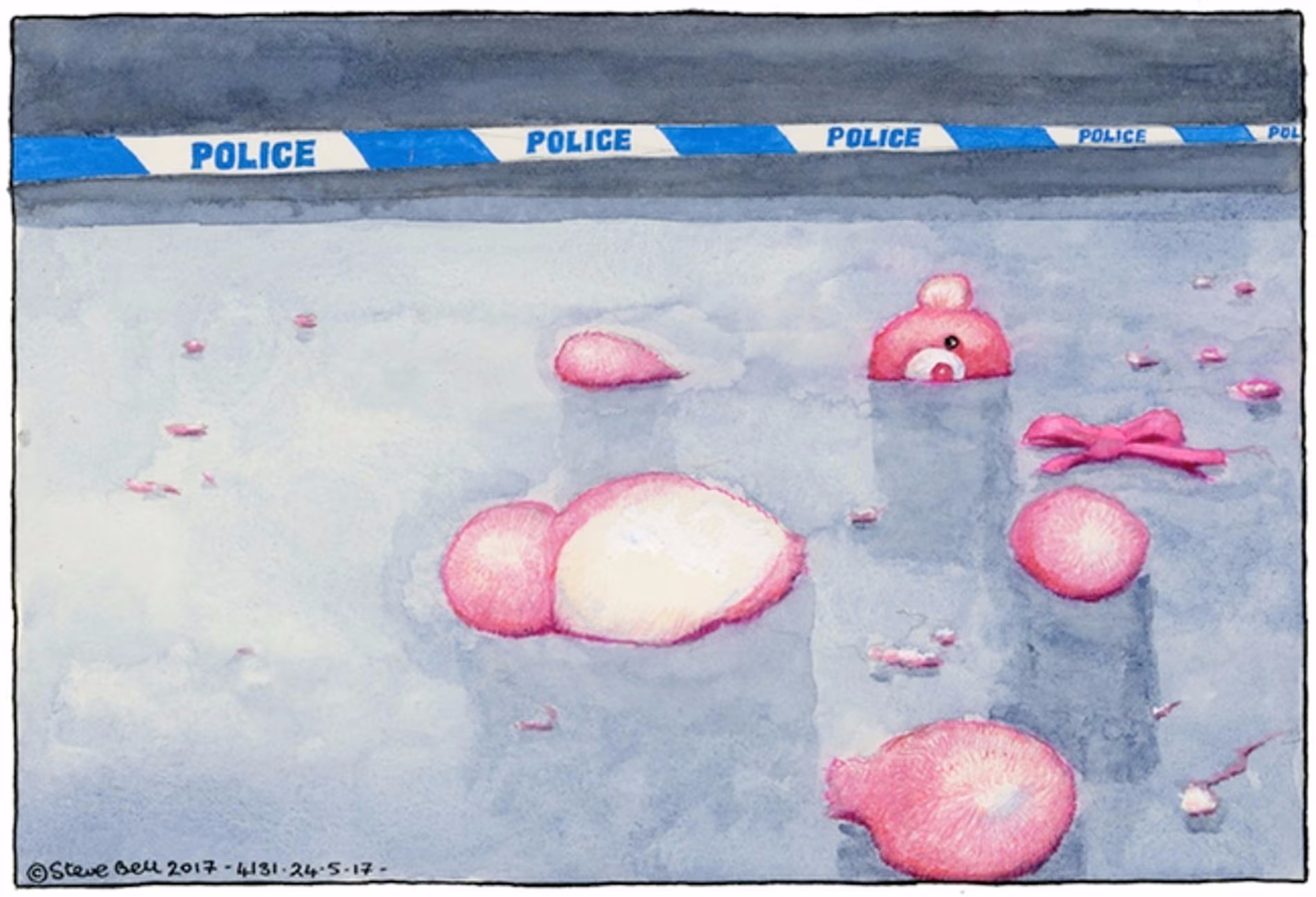
Steve Bell of The Guardian excoriates the Manchester Arena Bomber

Miriam Stimbers: Okay. Much has been made of the fact that the criminal was born and brought up in Manchester. Have you any thoughts on that?

Jay Guinness: You’re right, much has been made of it. But for me and my colleagues at Savoy what he did merely underlined the fact that Manchester is a state of mind far more than it is a physical and temporal Sitz im Leben. It’s about a locus of values, not about geography. I mean, I was born in Huddersfield myself, but I felt that I was Mancunian from the moment I first hung my hat here, because I subscribe to Mancunian values. People who were born here but don’t subscribe to those values aren’t part of the city. Not for me, not for the Savoy community, not ever. I think Dave [Britton] put it best when we were processing the news of what he’d done. Dave’s words have stayed with me: “He’s not a fucking Manc, he’s a fucking cunt. The fucker should be fucking strung up.”

Miriam Stimbers: Metaphorically speaking?

Jay Guinness: No, not metaphorically. Literally. We in the Savoy community are a pretty progressive bunch. We’re not instinctive supporters of the death penalty, to put it mildly. But if you took a vote at Savoy in terms of whether people who do things like that should be hanged, it would be a unanimous yes. No dissenters.

Miriam Stimbers: I’m taken aback. It seems a little extreme. A lot extreme, to be honest.

Jay Guinness: The Savoy community might be progressive, but we’re not bleeding-heart liberals. As Dave said, the fucker should be fucking strung up.

Miriam Stimbers: But what could you hope to achieve by it?

Jay Guinness: Well, for one thing it would be a deterrent to others. Just as importantly, it would ensure he doesn’t do it again.

Miriam Stimbers: But he won’t be doing it again. How could he?

Jay Guinness: Very easily. And he will do it again. We in the Savoy community are confident of that. Leopards don’t change their spots.

Miriam Stimbers: But how could he do it again? He’s dead.

Jay Guinness: I’m sorry, you’ve lost me. Who’s dead?

Miriam Stimbers: Salman Abedi, of course. The suicide-bomber at the Manchester Arena. Who else?
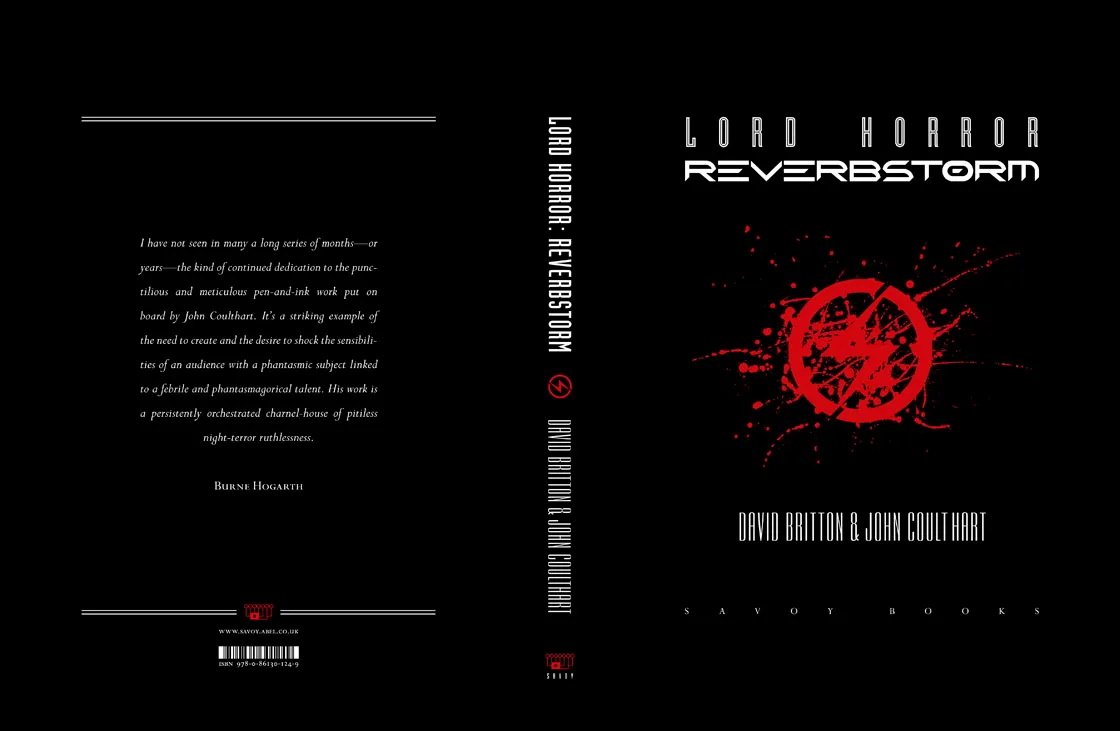
Much More Mucking Maverick Than You, Monkeyfunker!

Jay Guinness: Oh no, no, no, you’ve got entirely the wrong end of the stick. I wasn’t talking about that poor British-Muslim boy. He was quite possibly the biggest victim in that unfortunate business at the Arena.

Miriam Stimbers: Then who were you talking about?

Jay Guinness: That despicable creature Morrissey, of course. Those comments of his about immigration and Salman’s background were utterly unforgivable. Utterly. But no more than one would expect. As Dave went on to say: “That fucking crypto-fascist cunt’s just a fucking attention-seeker, always fucking has been, always fucking will be. String the fucker up!”

Miriam Stimbers: And you really think there’d be a majority at Savoy in favour of executing Morrissey?

Jay Guinness: I don’t think it, I know it. But it wouldn’t just be a majority, it would a unanimous vote, nem. con. What has Morrissey ever done but bring Manchester into disrepute with his dire music, his shitty fashion sense and his toxic racist agenda? As Michael Moorcock once said: “Fascism never sleeps and nor must the anti-fascist community.” In terms of saying it all, it does. Definitively.

[…]

Interview extract © Jay Guinness, Dr Miriam Stimbers, TransVisceral Books 2024


Jay Guinness is a Huddersfield-born artist and aesthetician, and the subject of Dr Joan Jay Jefferson’s incisive and exhaustive biography Art-Bandit: Interrogating the Outlaw Aesthetics of Über-Maverick Gay Atelierista Jay Guinness (University of Salford Press 2012). See reviews of Art-Bandit at: Pink News, The Guardian, London Review of Books, Quietus, and Huffington Post. Visit Jay’s website for news of his latest projects.

Miriam Stimbers is a Glasgow-born psychoanalyst, literary scholar and cultural commentatrix whose most recent book is the updated edition of Morbidly Miriam: The Mephitic Memoirs of Miriam B. Stimbers (TransVisceral Books 2023). See a review of Morbidly Miriam at Papyrocentric Performativity. Visit Miriam’s website for news of her latest projects.


Previously pre-posted on Papyrocentric Performativity…

Il Nano e il Necrofilo… – an earlier exclusive extract from Titans of Transgression

The Hurt Shocker – an even earlier exclusive extract from Titans of Transgression

I Say, I Sigh, I Sow #14

“In a very real sense, the Holocaust, as the ultimate moral and aesthetic obscenity, was also the ultimate drum-solo.” — Simon Whitechapel, 31i18

Terminal Breach

It’s said that, if you hear “in terms of” 23 times in 23 hours on the 23rd of the month, the ghost of William Burroughs will appear and offer you a heroin enema.

I don’t know whether this is true.


Elsewhere other-engageable:

William S. Burroughs
Alan Moore, C.B.E.
Michael Moorcock
Will Self
Stewart Home
Cormac McCarthy
Dr Joan Jay Jefferson
Serpent’s Tail
Titans of Trangression

Sime Time

I came across the writings of Simon Whitechapel a year ago after picking up the first twenty or so issues of Headpress, a 1990s ’zine that dealt with the relentlessly grim, the esoteric and prurient. His style was fascinating, coming across as intelligent and well-read and — at least from first reading — subtly ironic.

In fact he must have impressed some other people during this time too as Headpress’ Critical Vision imprint spun his collected articles together for publication under the title Intense Device: A Journey Through Lust, Murder and the Fires of Hell — they have all the typical interests that run through Whitechapel’s work — there is an obsession with numerology, with Whitehouse-style distortion music, with Hitler and de Sade. There are also articles on farting, on Jack Chick and novelisations of TV shows. They are fascinating, written in a scholarly way with footnotes aplenty but never difficult to understand. He also wrote two non-fiction works during the late 1990s and early 2000s that centred around sadism and the murder of women in South America. They are dark.

There are also the works of fiction. To say that Whitechapel is transgressive is an understatement. His writing bleeds. The ‘official’ work The Slaughter King is filled with the detailed descriptions of sadistic murder, beginning with a serial killer murdering a gay prostitute whilst listening to distortion-atrocity music. The plot is schlocky but serviceable, jumping around inconsistently but the images it creates are terrifying. A bourgeois dinner party straight out of Buñuel and Pasolini’s nightmares where guests are served poisons as if they were the finest consommés: they eat bees until their faces swell, dropping dead at the table, finishing with a trifle “made from the berries of the several varieties of belladonna, of cuckoo-pint, and of the flowers of monkshood”. It’s a sinister book, but nothing compared to his second work.

Whitechapel wrote The Eyes. This is clear just from a simple comparison between his texts, the fascination with language, with sadism, with de Sade. The thing is, The Eyes is supposedly written by some guy called Aldapuerta, Spanish apparently. ‘Aldapuerta’ can be written Alda Puerta — ‘at the gate’, a telling description of these short stories, which go past this point many, many times. The tale of ‘Aldapuerta’ himself is too exact to be believed: a young boy with an interest in de Sade, corrupted by the local pornographer, medical-school training that honed his knowledge, then a mysterious death (echoing shades of Pasolini’s own) and finishing with the “and he might be baaaack” closer. But this point isn’t really an issue and it’s understandable that Whitechapel would want to keep his name away from this work. It is also surrealistically brilliant at times: amongst the brutality, the images it creates are unforgettable.

Of course, Whitechapel is a fake name, redolent of Jack the Ripper, and even Simon was taken from elsewhere — a colleague perhaps? He disappeared during the 2000s, no longer writing for Headpress, a few self-published chapbooks pastiching Clark Ashton Smith… where did he go? There are the rumours of prison time — they are convincing to my mind, as they too revolve around different identities, around extremity and anonymity. I wonder though, if true, just how much this individual actually believed in them. His most recent writings, at his tricksy blog, hint at this, as well as make his ‘relationship’ with Aldapuerta clearer but it’s not in my ability to directly connect the personas.

If you want to be fascinated and repulsed, then the non-author Simon Whitechapel is for you.

Lancashire


Elsewhere other-posted:

It’s The Gweel Thing…Gweel & Other Alterities, Simon Whitechapel (Ideophasis Books, 2011)

Bill Self

I would be disturbed and dismayed if Will Self ever wrote an essay on Evelyn Waugh or Clark Ashton Smith. In fact, I hope he has never even heard of CAS. But I’m happy to see Self writing in the Guardian on William Burroughs. It’s a perfect setting for a perfect pairing. And Self, like Christopher Hitchens, raises a very interesting question. What is his mother-tongue? Quechua? Tagalog? Sumerian? Whatever it is, it’s not even remotely related to English.


William Burroughs — the original Junkie — Will Self, The Guardian, 1/ii/2014.

Entitled Junkie: Confessions of an Unredeemed Drug Addict and authored pseudonymously by “William Lee” (Burroughs’ mother’s maiden name – he didn’t look too far for a nom de plume) …

[Self missed his chance there: nom de guerre would have been much better.]

The two-books-in-one format was not uncommon in 1950s America …

Despite its subhead, Wyn did think the book had a redemptive capability …

Both Junkie and Narcotic Agent have covers of beautiful garishness, featuring 1950s damsels in distress. On the cover of Junkie a craggy-browed man is grabbing a blond lovely from behind; one of his arms is around her neck, while the other grasps her hand, within which is a paper package. The table beside them has been knocked in the fray, propelling a spoon, a hypodermic, and even a gas ring, into inner space.

This cover illustration is, in fact, just that: an illustration of a scene described by Burroughs in the book. “When my wife saw I was getting the habit again, she did something she had never done before. I was cooking up a shot two days after I’d connected with Old Ike. My wife grabbed the spoon and threw the junk on the floor. I slapped her twice across the face and she threw herself on the bed, sobbing …” That this uncredited and now forgotten hack artist should have chosen one of the few episodes featuring the protagonist’s wife to use for the cover illustration represents one of those nastily serendipitous ironies that Burroughs himself almost always chose to view as evidence of the magical universe. …

… if you turn to his glossary of junk lingo and jive talk – you will see how many arcane drug terms have metastasised into the vigorous language. …

Burroughs viewed the postwar era as a Götterdämmerung and a convulsive re-evaluation of values. …

An open homosexual and a drug addict, his quintessentially Midwestern libertarianism led him to eschew any command economy of ethics …

For Burroughs, the re-evaluation was both discount and markup …

… and perhaps it was this that made him such a great avatar of the emergent counterculture. …

Janus-faced, and like some terminally cadaverous butler, Burroughs ushers in the new society of kicks for insight as well as kicks’ sake. …

Let’s return to that cover illustration with its portrayal of “William Lee” as Rock Hudson and his common-law wife, Joan Vollmer, as Kim Novak.

When I say Burroughs himself must have regarded the illustration – if he thought of it at all – as evidence of the magical universe he conceived of as underpinning and interpenetrating our own …

Much has been written and even more conjectured about the killing. Burroughs himself described it as “the accidental shooting death”; and although he jumped bail, he was only convicted – in absentia by the Mexican court – of homicide. …

When Burroughs was off heroin he was a bad, blackout drunk (for evidence you need look no further than his own confirmation in Junky). …

By the time Burroughs was living in Tangier in the late 1950s, his sense of being little more than a cipher, or a fictional construct, had become so plangent …

Burroughs was the perfect incarnation of late 20th-century western angst precisely because he was an addict. Self-deluding, vain, narcissistic, self-obsessed, and yet curiously perceptive about the sickness of the world if not his own malaise, Burroughs both offered up and was compelled to provide his psyche as a form of Petri dish, within which were cultured the obsessive and compulsive viruses of modernity. …

In a thin-as-a-rake’s progress …

… a deceptively thin, Pandora’s portfolio of an idea …

It is Burroughs’ own denial of the nature of his addiction that makes this book capable of being read as a fiendish parable of modern alienation. …

For, in describing addiction as “a way of life”, Burroughs makes of the hypodermic a microscope, through which he can examine the soul of man under late 20th-century capitalism.

William Burroughs – the original Junkie, The Guardian, 1/ii/2014.


The big disappointment is that he didn’t use in terms of.

Performativizing Papyrocentricity #15

Papyrocentric Performativity Presents:

Brought to BookA Book of English Essays, selected by W.E. Williams (Pelican 1942)

GlamourdämmerungTreasures of Nirvana, Gillian G. Gaar (Carlton 2011)

Highway to Hell – The Road, Cormac McCarthy (2006)

Solids and ShadowsAn Adventure in Multidimensional Space: The Art and Geometry of Polygons, Polyhedra, and Polytopes, Koji Miyazaki (Wiley-Interscience 1987) (posted @ Overlord of the Über-Feral)

Magna Mater MarinaThe Illustrated World Encyclopedia of Marine Fish and Sea Creatures, Amy-Jane Beer and Derek Hall (Lorenz Books 2007) (@ O.o.t.Ü.-F.)


Or Read a Review at Random: RaRaR

Performativizing Papyrocentricity #14

Papyrocentric Performativity Presents:

Scheming DemonThe Screwtape Letters, C.S. Lewis (1942)

Ai Wei to HellHow to Read Contemporary Art, Michael Wilson (Thames & Hudson, 2013)

Toxic TwosomeDoll, Peter Sotos and James Havoc (TransVisceral Books, 2013)

Know Your LimaçonsThe Penguin Dictionary of Curious and Interesting Geometry, David Wells (1991) (posted @ Overlord of the Über-Feral)

Pestilent, Pustulent and Pox-Pocked – various books by Dr Miriam B. Stimbers (@ O.o.t.Ü.-F.)


Or Read a Review at Random: RaRaR

Ass You Like It

This is a guest post by Norman Foreman, B.A.


Mediaeval Catholic philosophers wrote about both praying and braying. The braying came from Buridan’s ass, a thought-experiment about choice and free will. Imagine a hungry ass set between two piles of hay that are identical in every way: size, shape, colour, tastiness and so on. Some philosophers argued that, if it had no reason to prefer one pile of hay to the other, the ass would be unable to choose and would therefore starve to death.

I don’t agree: inter alia, nervous systems don’t work symmetrically and we don’t experience objects as fully identical when they’re in different parts of our visual field. However, in a literary sense, I understand what it feels like to be Buridan’s ass. To assify myself, I start by imagining this:

• I’m offered £1000 to read a book by the transgressive author Will Self.

Would I accept? Yes. It would be distasteful, but I’d do it for £1000. Self’s writing is so bad that I might give the money back rather than finish the book, but I’d have a go. Now change the situation:

• I’m offered £1000 to read a book by the transgressive author Stewart Home.

Would I still accept? Yes. Again, it would be distasteful, but I’d do it for the money. Or I’d try, at least. The next step turns me into Buridan’s ass. I imagine this:

• I’m offered £1000 to read a book by either Will Self or Stewart Home (not both). And I have to make the choice for myself.

Now I’m on the horns of a dilemma. I would want the £1000, but I can’t decide which transgressive author I’d rather NOT read. Home is a downmarket version of Self, Self is an upmarket version of Home. It’s Self-as-chav vs Home-as-Oxbridge-grad. And/or vice versâ. They’re both keyly committed core components of the Guardianista community, with all that that implies in terms of issues around bad English, mixed metaphors and “in terms of”. I’m happy to say I’ve never read a book by either of them. So if I were offered £1000 to do so and had to choose either Self or Home, I couldn’t do it. Not unassisted. I’d have to toss a coin. Best of three. Or best of five dot dot dot


Previously pre-posted (please peruse):

Titus Graun
Ex-term-in-ate!
Reds under the Thread

Keeping It Gweel

Gweel & Other Alterities, Simon Whitechapel (Ideophasis Press, 2011)

This review is a useless waste of time. I can tell you very little about Gweel. It’s a book, if that helps. It’s made of paper. It has pages. Lots of little words on the pages.

What I can’t do is classify Gweel into a genre, not because none of them fit, but because the concept of a genre doesn’t seem to apply to Gweel. It stands alone, without classification. Calling Gweel “experimental” or “avant garde” would be like stamping a barcode on a moon rock.

It may have been written for an audience of one: author Simon Whitechapel. If we make the very reasonable assumption that he owns a copy of his own book, he may have attained 100% market saturation. However, there could be a valuable peripheral market: people who want to read a book that is very different from anything they’ve read before.

It is a collection of short pieces of writing, similar in tone but not in form, exploring “dread, death, and doom.” “Kopfwurmkundalini” and “Beating the Meat” resemble horror stories, and manage to be frightening yet strangely fantastic. The first one is about a man – paralysed in a motorbike accident, able to communicate only by eye-blinks – and his induction into a strange new reality. It contains a rather thrilling story-within-a-story called “MS Found in a Steel Bottle”, about two men journeying to the bottom of the ocean in a bathysphere. “Kopfwurmkundalini”’s final pages are written in a made-up language, but the author has encluded a glossary so that you can finish the story.

Those two/three stories make up about half of Gweel’s length. The remainder mostly consists of shorter work that seems to be more about creating an atmosphere or evoking an emotion. “Night Shift” is about a prison for planets (Venus, we learn, is serving a 10^3.2 year sentence for sex-trafficking), and a theme of prisons and planets runs through a fair few of the other stories here, although usually in a less surreal context. “Acariasis” is a vignette about a convict who sees a dust-mite crawling on his cell wall, and imagines it’s a grain of sand from Mars. The image is vivid and the piece has a powerful effect. “Primessence” is The Shawshank Redemption on peyote (and math). A prisoner believes that because his cell is a prime number, he will soon be snatched from it by some mathematical daemon (the story ends with the prisoner’s fate unknown). “The Whisper” is a ghost story of sorts, short and achingly sad.

No doubt my impression of Gweel differs from the one the author intended. But maybe his intention was that I have that different impression than him. Maybe Gweel reveals different secrets to each reader.

I can’t analyse it much, but Gweel struck me as an experience like Fellini’s Amarcord… lots of little story-threads, none of them terribly meaningful on their own. Experienced together, however, those threads will weave themselves into a tapestry in the hall of your mind, a tapestry that’s entirely unique… and your own.

Original review


Jesús say: I… S….. R… U… B… B… I… S…. H…. B… O… O… K…. | W… H… A…. N… K… C…. H… A… P… L…. E…. I… S…. H… I… J… O…. D… E…. P… U…. T… A…..

Previously pre-posted:

It’s The Gweel Thing…

Ear Will An Thee

(This is a guest-review by Norman Foreman, B.A.)

Yr Wylan Ddu, Simon Whitechapel (Papyrocentric Press, ?)

If, like me, you froth at the mouth and roll on the floor biting the carpet when you hear the phrase “Pre-order now”, then relief is at hand. You might have thought that “pre-ordering now” was as logical as “ordering pre-now”. You were wrong. Here is a book that really can be pre-ordered now, because it doesn’t exist yet. If it ever does exist, it will cease to be pre-orderable now. In the meantime, you’re pre-ordering it whether you know it or not. In fact, the less you know, the more you’re pre-ordering it. All life-forms in the Universe, actual and otherwise, are pre-ordering it at this very moment, from the humblest virus to the mightiest hive-mind.

Front cover of yr wylan ddu by slow exploding gulls

Yr Wylan Ddu (2003) by Slow Exploding Gulls

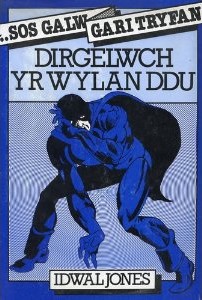
There’s no escape, in other words. And no more review, you might think, given that the book doesn’t exist yet. True, but I can review the title. It’s Welsh, it means “The Black Gull”, and it’s pronounced something like “Ear Will An Thee”. It was also originally the title of an album in 2003 by the Exeter electronistas Slow Exploding Gulls. Whether S.E.G. will object to the appropriation remains to be seen. If they do, it can be pointed out that Dirgelwch Yr Wylan Ddu, or Secret of the Black Gull, was the title of a children’s book by Idwal Jones (1890-1964) published in 1978.

Front cover of Dirgelwch Yr Wylan Ddu by Idwal Jones

Idwal Jones’ Secret of the Black Gull (1978)

There is nothing corresponding to “of” in the original title of that book, but then Welsh grammar doesn’t work like that. Yr Wylan Ddu contains some good examples of how it does work. It’s an active, almost clockwork or organic, phrase compared to its static English equivalent. In isolation, the Welsh words for “the”, “black” and “gull” would be y, du, and gwylan, pronounced something like “ee”, “dee” and “goo-ill-an” in southern Welsh. But put them together and they mutate in more ways than one: Yr Wylan Ddu (adjectives generally follow the noun in Welsh). The similarity between gwylan and “gull” isn’t a coincidence: the English word is borrowed from Celtic.

However, it is unlikely that Yr Wylan Ddu will actually be written in Welsh or any other Celtic language. First, Whitechapel doubtless feels that this would reduce his already small audience. Second, he doesn’t speak Welsh. Or write it. So the book will probably follow past trends and be written in English. It’s also safe to predict that it will refer to at least one black gull. So: pre-order now. And please carry on doing so until further notice.