The Brain in Pain

You can stop reading now, if you want. Or can you? Are your decisions really your own, or are you and all other human beings merely spectators in the mind-arena, observing but neither influencing nor initiating what goes on there? Are all your apparent choices in your brain, but out of your hands, made by mechanisms beyond, or below, your conscious control?

In short, do you have free will? This is a big topic – one of the biggest. For me, the three most interesting things in the world are the Problem of Consciousness, the Problem of Existence and the Question of Free Will. I call consciousness and existence problems because I think they’re real. They’re actually there to be investigated and explained. I call free will a question because I don’t think it’s real. I don’t believe that human beings can choose freely or that any possible being, natural or supernatural, can do so. And I don’t believe we truly want free will: it’s an excuse for other things and something we gladly reject in certain circumstances.


Continue reading The Brain in Pain

Tattoo Your Ears

“The most merciful thing in the world,” said H.P. Lovecraft, “is the inability of the human mind to correlate all its contents.” Nowadays we can’t correlate all the contents of our hard-drives either. But occasionally bits come together. I’ve had two MP3s sitting on my hard-drive for months: “Drink or Die” by Erotic Support and “Hunter Gatherer” by Swords of Mars. I liked them both a lot, but until recently I didn’t realize that they were by two incarnations of the same Finnish band.

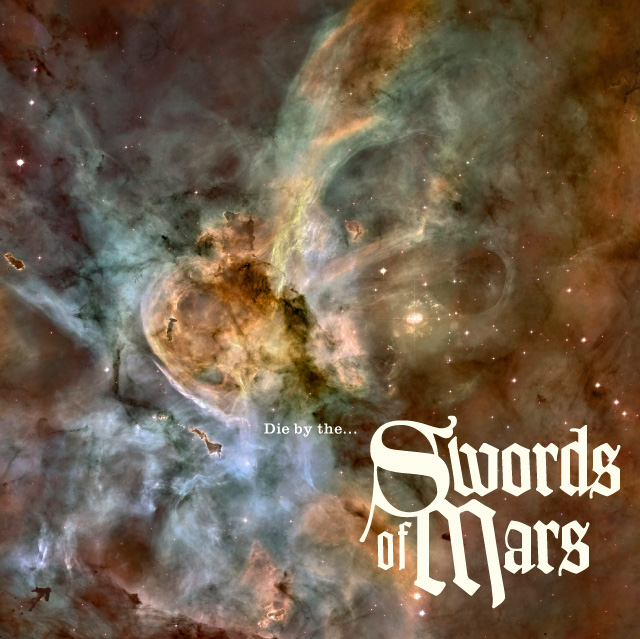
Cover of "Die by the..." Swords of Mars
They don’t sound very much alike, after all. But now that I’ve correlated them, they’ve inspired some thoughts on music and mutilation. “Drink or Die” is a dense, fuzzy, leather-lunged rumble-rocker that, like a good Mötley Crüe song, your ears can snort like cocaine. But, unlike Mötley Crüe, the auditory rush lasts the whole song, not just the first half. “Hunter Gatherer” is much more sombre. Erotic Support were “Helsinki beercore”; Swords of Mars are darker, doomier and dirgier. They’ve also got a better name – “Erotic Support” seems to have lost something in translation. Finnish is a long way from English: it’s in a different and unrelated language family, the Finno-Ugric, not the Indo-European. So it lines up with Hungarian and Estonian, not English, German and French. But Erotic Support’s lyrics are good English and “Drink or Die” is a clever title. They’d have been a more interesting band if they’d sung entirely in Finnish, but also less successful, because less accessible to the rest of the world.

Es war einmal eine Königstochter, die ging hinaus in den Wald und setzte sich an einen kühlen Brunnen. Sie hatte eine goldene Kugel, die war ihr liebstes Spielwerk, die warf sie in die Höhe und fing sie wieder in der Luft und hatte ihre Lust daran. Einmal war die Kugel gar hoch geflogen, sie hatte die Hand schon ausgestreckt und die Finger gekrümmt, um sie wieder zufangen, da schlug sie neben vorbei auf die Erde, rollte und rollte und geradezu in das Wasser hinein.

Some Indo-European


Mieleni minun tekevi, aivoni ajattelevi
lähteäni laulamahan, saa’ani sanelemahan,
sukuvirttä suoltamahan, lajivirttä laulamahan.
Sanat suussani sulavat, puhe’et putoelevat,
kielelleni kerkiävät, hampahilleni hajoovat.

Veli kulta, veikkoseni, kaunis kasvinkumppalini!
Lähe nyt kanssa laulamahan, saa kera sanelemahan
yhtehen yhyttyämme, kahta’alta käytyämme!
Harvoin yhtehen yhymme, saamme toinen toisihimme
näillä raukoilla rajoilla, poloisilla Pohjan mailla.

Some Finno-Ugric


All the same, being inaccessible sometimes helps a band’s appeal to the rest of the world: the mystique of black metal is much stronger in bands that use only Norwegian or one of the other Scandinavian languages. Erotic Support haven’t joined that rebellion against Coca-Colonization and tried to create an indigenous genre. They’re happy to reproduce more or less American music using the more or less American invention known as the electric guitar. But amplified music would have appeared in Europe even if North America had been colonized by the Chinese, so I wonder what rock would sound like if it had evolved in Europe instead. It wouldn’t be called rock, of course, but what other differences would it have? Would it be more sophisticated, for example? I think it would. The success of American exports depends in part on their strong and simple flavours. “Drink or Die” has those flavours: it’s about volume, rhythm and power. It’s full of a certain “drug-addled, crab-infested, tinnitus-nagged spirit” — the “urge to submerge in the raw bedrock viscerality of rock”, as some metaphor-mixing, über-emphasizing idiot once put it (I think it was me).

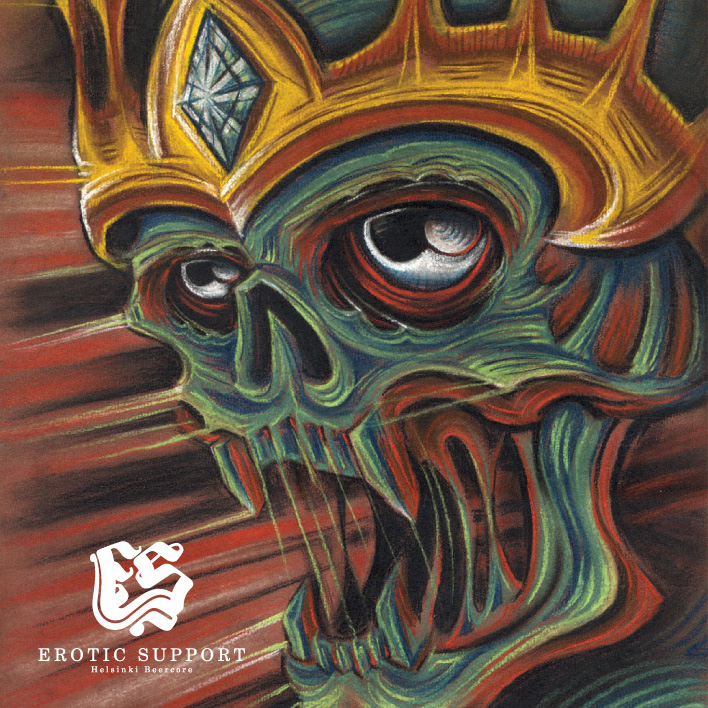
Cover of "II" by Erotic Support

Erotic Support are “beercore”, remember. Beer marks the brain with hangovers, just as tattoos mark the skin with ink. And just as loud music marks the ears with tinnitus. There are various kinds of self-mutilation in rock and that self-mutilation can have unhealthy motives. It can be an expression of boredom, angst, anomie and self-hatred. Unsurprisingly, Finland has the nineteenth highest suicide rate in the world. Beer, tattoos and tinnitus are part of the louder, dirtier and loutier end of rock: unlike Radiohead or Coldplay, Erotic Support sound like a band with tattoos who are used to hangovers. “Drink or Die” is a joke about exactly that. But what if rock had evolved in a wine-drinking culture? Would it be less of a sado-masochistic ritual, more a refined rite? Maybe not: the god of wine is Dionysos and he was Ho Bromios, the Thunderer. His brother Pan induces panic with loud noises. But black metal looks towards northern paganism: it’s music for pine forests, cold seas and beer-drinkers, not olive groves, warm seas and oenopotes.

Erotic Support don’t create soundscapes for Finland the way black metal creates soundscapes for Norway, but they do create beer-drinkers’ music, so they do express Finnishness to that extent. Swords of Mars, being darker, doomier and dirgier, are moving nearer an indigenous Finnish rock, or an indigenous Scandinavian rock, at least. This may be related to the fact that genes express themselves more strongly as an individual ages: for example, the correlation between the intelligence of parents and their children is strongest when the children are adults. Erotic Support create faster, more aggressive music than Swords of Mars, so it isn’t surprising that they’re the younger version of the same band. In biology, the genotype creates the phenotype: DNA codes for bodies and behaviour. Music is part of what Richard Dawkins calls the “extended phenotype”, like the nest of a bird or the termite-fishing-rods of a chimpanzee. A bird’s wings are created directly by its genes; a bird’s nest is created indirectly by its genes, viâ the brain. So a bird’s wings are part of the phenotype and a bird’s nest part of the extended phenotype.

Both are under the influence of the genes and both are expressions of biology. Music (like bird-song) is an expression of biology too, as is the difference between the music of Erotic Support and Swords of Mars. As brains age, the behaviour they create changes. Swords of Mars are older and not attracted to reckless self-mutilation as Erotic Support were: it’s not music to precede hangovers and induce tinnitus any more. Sword of Mars aren’t trying to tattoo your ears but to educate your mind.

Poulet’s Propeller

The Penguin Dictionary of Curious and Interesting Numbers (1986) is one of my favourite books. It’s a fascinating mixture of math, mathecdote and math-joke:

2·618 0333…

The square of φ, the golden ratio, and the only positive number such that √n = n-1. (pg. 45)


6

Kepler discussed the 6-fold symmetry of snowflakes, and attempted to explain it by considering the close packing of spheres in a hexagonal array. (pg. 69)


39

This appears to be the first uninteresting number, which of course makes it an especially interesting number, because it is the smallest number to have the property of being uninteresting.

It is therefore also the first number to be simultaneously interesting and uninteresting. (pg. 120)

David Wells, who wrote the Dictionary, “had the rare distinction of being a Cambridge scholar in mathematics and failing his degree”. He must be the mathematical equivalent of the astronomer Patrick Moore: a popularizer responsible for opening many minds and inspiring many careers. He’s also written books on geometry and mathematical puzzles. But not everyone appreciates his efforts. This is a sideswipe in a review of William Hartston’s The Book of Numbers:

Thankfully, this book is more concerned with facts than mathematics. Anyone wanting to learn more about [π] or the Fibonacci sequence should turn to the Penguin Dictionary of Curious and Interesting Numbers, a volume which none but propeller-heads will find either curious or interesting. (Review in The Independent, 18th December 1997)


Continue reading: Poulet’s Propeller

Leaf Brief

Front cover of What A Plant Knows by Daniel ChamovitzWhat a Plant Knows: A Field Guide to the Senses of Your Garden – and Beyond, Daniel Chamovitz (Oneworld 2012)

This is a brief but burgeoning book, covering a lot of science and a lot of scientific history. Plants stay in one place and don’t seem to suffer pain or discomfort, so they’re good experimental subjects, particularly for introverts. That’s why Charles Darwin devoted even more time to plants than he did to worms and barnacles. Chamovitz describes Darwin’s ingenious experiments and the even more ingenious experiments of the researchers that followed him. Over millions of years the world has set problems of survival for plants; in solving these problems, plants have set puzzles for scientists. How do plants know when to flower and prepare for winter? How do they resist attacks by insects? Or prey on insects? Or invite visits from pollinators? And how do they communicate with each other? The answers aren’t just chemical: they’re electrical too, as research on the world’s most famous carnivorous plant has proved:

Alexander Volkov and his colleagues at Oakwood University in Alabama first demonstrated that it is indeed electricity that causes the Venus flytrap to close. To test the model, they rigged up very fine electrodes and applied an electrical current to the open lobes of the trap. This made the trap close without any direct touch to its trigger hairs … (ch. 6, “What A Plant Remembers”, pp. 147-8)

Acoustics is also at work in the plant kingdom:

In a process known as buzz pollination, bumblebees stimulate a flower to release its pollen by rapidly vibrating their wing muscles without actually flapping their wings, leading to a high-frequency vibration. … In a similar vein, Roman Zweifel and Fabienne Zeugin from the University of Bern in Switzerland have reported ultrasonic vibrations emanating from pine and oak trees during a drought. These vibrations result from changes in the water content of the water-transporting xylem vessels. While these sounds are passive results of physical forces (in the same way that a rock crashing off a cliff makes a noise), perhaps these ultrasonic vibrations are used as a signal by other trees to prepare for dry conditions. (ch. 4, “What A Plant Hears”, pg. 107-8)

All of this is mathematical: a plant is a mechanism that processes not just sun, water and carbon-dioxide, but information from its environment too. But then sun, water and CO2 are all part of that information: sunlight signals plants as well as sustaining them. Its strength and duration are cues for the seasons and time of the day. So is its colour:

By the time John F. Kennedy was elected president, Warren L. Butler and his colleagues had demonstrated that a single photoreceptor in plants was responsible for both the red and far-red effects. They called this receptor “phytochrome”, meaning “plant colour”. In its simplest model, phytochrome is a light-activated switch. Red light activates phytochrome, turning it into a form primed to receive far-red light. Far-red light inactivates phytochrome, turning it into a form primed to receive red light. Ecologically, this makes a lot of sense. In nature, the last light a plant sees at the end of the day is far-red, and this signifies to the plant that it should “turn-off”. In the morning it sees red light and it wakes up. In this way a plant measures how long ago it last saw red light and adjusts its growth accordingly. (ch. 1, “What A Plant Sees”, pg. 21-2)

There’s an obvious analogy with a computer automatically turning itself off and on, which would make phytochrome and its associated chemicals a kind of hardware created by the software of the genes. Plants share some of that software with human beings: in one fascinating section, Chamovitz discusses the links between healthy plants and sick people:

The arabidopsis [A. thaliana, mustard plant] genome contains BRCA, CFTR, and several hundred other genes associated with human disease or impairment because they are essential for basic cellular biology. These important genes had already evolved 1.5 billion years ago in the single-celled organism that was the common evolutionary ancestor to both plants and animals. (ch. 4, “What A Plant Hears”, pg. 105)

What a Plant Knows stimulates human minds as it discusses plant senses. It’s one of the best briefest, or briefest best, books on science I’ve ever read, packing a lot of history and scientific information into six chapters. Plants don’t move much, but they’re a very lively topic and botany is a good way to understand and appreciate biology and scientific research better.

Electrify Your Eyes

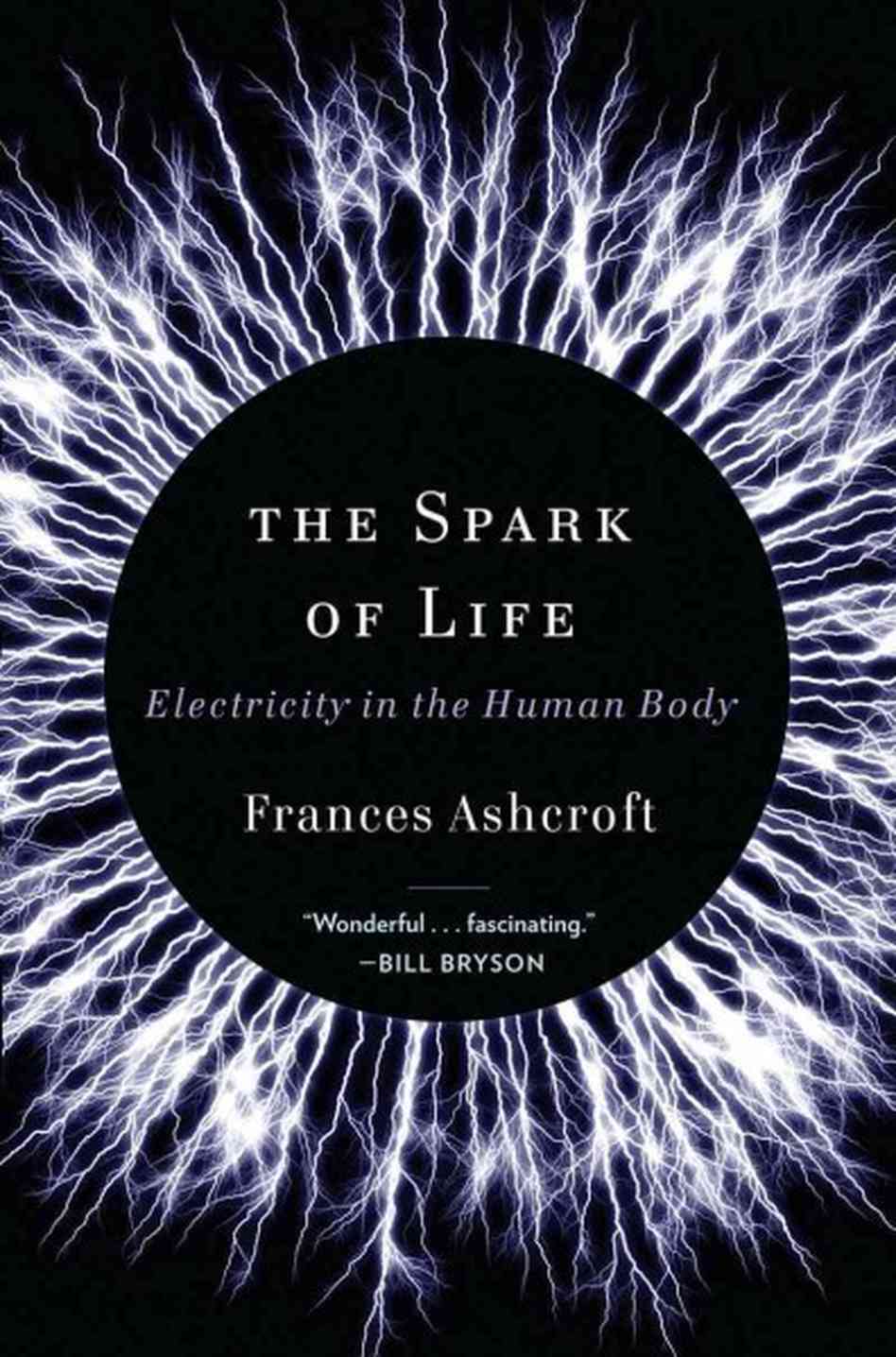
Front cover of The Spark of Life by Frances AshcroftThe Spark of Life: Electricity in the Human Body, Frances Ashcroft (Penguin 2013)

“Electricity in the Human Body” is the subtitle of this book. Make that the goat, frog, eel, shark, torpedo-ray, snake, platypus, spiny anteater, sooty shearwater and fruit-fly body too. And if Venus flytraps, maize and algae have bodies, throw them in next. Frances Ashcroft gives you a bargeload of buzz for your buck, a shedload of shock for your shekel: The Spark of Life describes the use of electricity by many different forms of life. But it discusses death a lot too, from lightning-strikes and electric chairs to heart-attacks and toxicology. Poisons can be a cheap and highly effective way of interfering with the electro-chemistry of the body:

The importance of sodium and potassium channels in generating the nerve impulse is demonstrated by the fact that a vast array of poisons from spiders, shellfish, sea anemones, frogs, snakes, scorpions and many other exotic creatures interact with these channels and thereby modify the function of nerve and muscle. … The tetrodotoxin contained in the liver and other tissues of this fish [the fugu or puffer-fish, Takifugu spp., Lagocephalus spp., etc] is a potent blocker of the sodium channels found in your nerves and skeletal muscles. It causes numbness and tingling of the lips and mouth within as little as thirty minutes … This sensation of “pins and needles” spreads rapidly to the face and neck, moves onto the fingers and toes, and is then followed by gradual paralysis of the skeletal muscles … Ultimately the respiratory muscles are paralysed, which can be fatal. The heart is not affected, as it has a different kind of sodium channel that is far less sensitive to tetrodotoxin. The toxin is also unable to cross the blood-brain barrier so that, rather horrifyingly, although unable to move and near death, the patient remains conscious. (ch. 3, “Acting on Impulse”, pp. 69-70)

In short, fugu-poisoning is the opposite of electrocution: it’s the absence rather than the excess of electricity that kills its victims. Those “channels” are a reminder that electro-chemistry could also be called electro-mechanics: unlike an electricity-filled computer, an electricity-filled body has moving parts – and in more ways than one. Our muscles move because ions move in and out of our cells. This means that a body has to be wet inside, not dry like a computer, but it’s easy to imagine a human brain controlling a robotic body. But would a brain still be conscious if it became metal-and-plastic too? Perhaps a brain has to be both soggy and sparky to be conscious.

The electrical nature of the brain certainly seems important, though that may be a superstitious conclusion. Electricity is a mysterious phenomenon and so is consciousness, so they seem to go together well. Ashcroft writes a lot about the sense-organs and the data they supply to the brain, but like all scientists she cannot explain how those data are turned into conscious experience as the maths-engine of the brain applies its neuro-functions and neuro-algorithms. However, she does suggest ways in which our consciousness might be expanded in future. Humans have colour vision, based on the three types of cone-cells in our eyes:

Most mammals, such as cats and dogs, have only two types of cone photopigment and so see only a limited range of colour … Other animals live in a world entirely without colour. But humans should not be too complacent, for we are far from having the best colour vision in the animal world and lag far behind the mantis shrimp, which enjoys ten or more different visual pigments. Even tropical fish possess four or five types of cones. (ch. 9, “The Doors of Perception”, pg. 199)

Bio-engineering may one day sharpen and extend all our senses, from sight and hearing to touch, taste and smell. It may also give us new senses, like the ability to form sound-pictures like bats and detect infra-red like pit-vipers. And why not X-rays and radio-waves too? It’s an exciting prospect, but in a sense it won’t be anything new: our new senses, like our old ones, will depend on nerve-impulses and the way they’re mashed and mathed in that handful of “electrified clay” known as the brain.

“Electrified clay” is Shelley’s phrase: like his wife Mary, he was fascinated by the early electric experiments of the Italian scientists Luigi Galvani and Alessandro Volta. Mary turned her fascination into a book called Frankenstein (1818) and her invention is part of the scientific history in this book. The story of bio-electricity is still going strong: there are electric mysteries in all kinds of bodies waiting to be solved. Maybe consciousness is one of them. And if science proves unable to crack consciousness, it’s certainly able to expand it. Reading this book is one way to experience the mind-expanding powers of science, but seeing like a mantis shrimp would be good too.

Bri’ on the Sky

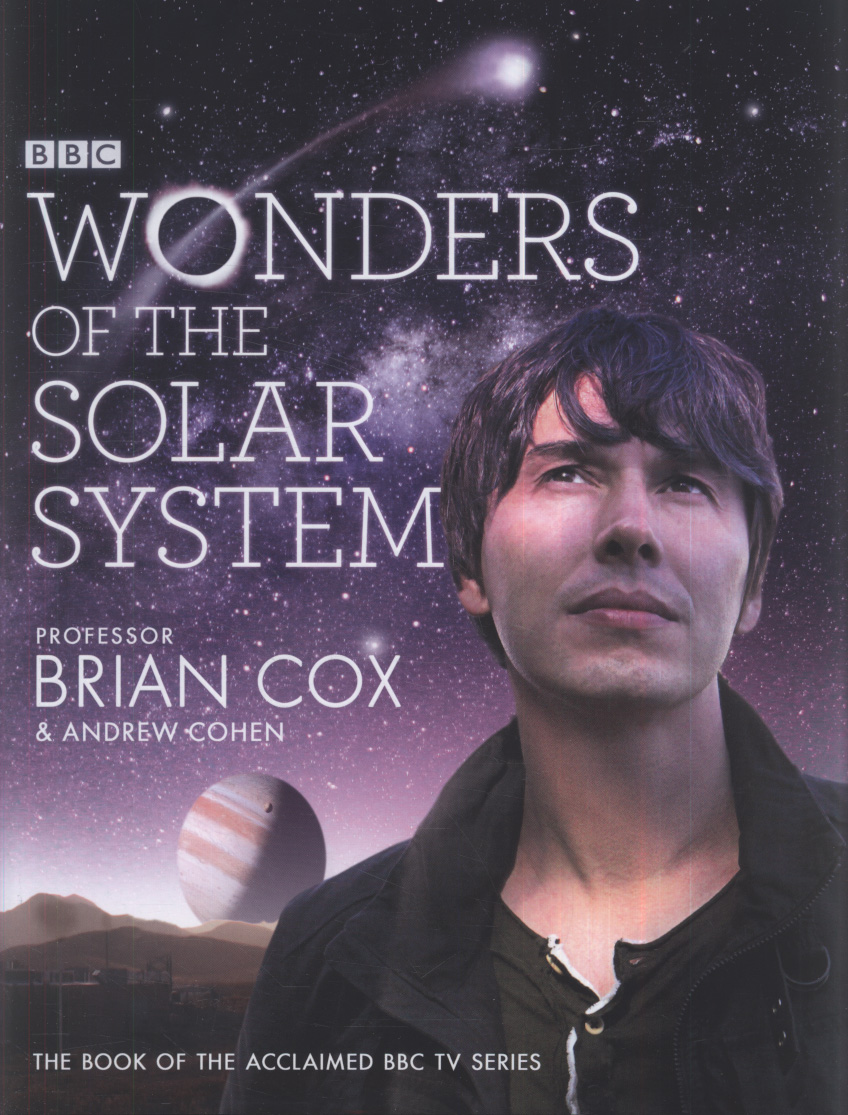
Front cover of Wonders of the Solar System by Brian Cox and Andrew Cohen

Bri’ Eyes the Sky

Wonders of the Solar System, Professor Brian Cox and Andrew Cohen (Collins 2010)

One of the most powerful images in this book is also one of the most understated. It’s an artist’s impression of a dim star seen over the curve of a dwarf-planet called Sedna. The star is a G-type called Sol. We on Earth know it better as the sun. Sedna is a satellite of the sun too, but it’s much, much further out than we are. It takes 12,000 years to complete a single orbit and its surface is a biophobic -240°C. It’s so distant that sunrise is star-rise and it wasn’t discovered until 2003. But the sun’s gravity still keeps it in place: one of the weakest forces in nature is one of the most influential. That’s one important message in an understated, crypto-Lovecraftian image.

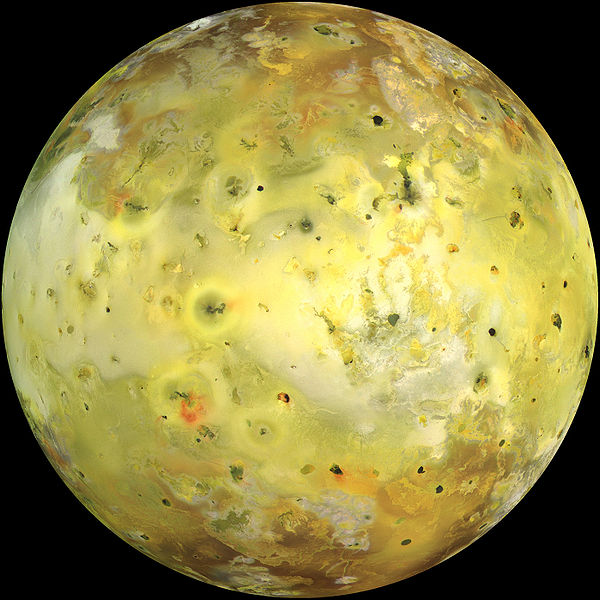
Sedna has been there, creeping around its dim mother-star, since long before man evolved. It will still be there long after man disappears, voluntarily or otherwise. This frozen dwarf is a good symbol of the vastness of the universe and its apparent indifference to life. We don’t seem to interest the universe at all, but the universe certainly interests us. Wonders of the Solar System is a good introduction to our tiny corner of it, describing some fundamentals of astronomy with the help of spectacular photographs and well-designed illustrations. You can learn how fusion powers the sun, how Mars lost its atmosphere and how there might be life beneath the frozen surface of Jupiter’s satellite Europa. The text is simple, but not simplistic, though I think the big name on the cover did little of the writing: this book is probably much more Cohen than Cox. Either way, I enjoyed reading the words and not just looking at the pictures, all the way from star-dim Sedna (pp. 26-7) to “Scars on Mars” (pp. 220-1) by way of “The most violent place in the solar system” (pp. 198-9), a.k.a. Jupiter’s gravity-flexed, volcano-pocked satellite Io.

Pockmarked moon -- the Galilean satellite Io

Pockmarked moon — the Galilean satellite Io

Everything described out there is linked to something down here, because that’s how it was done in the television series. Linking the sky with the earth allowed the BBC to film the genial and photogenic physicist Brian Cox in various exotic settings: Hawaii, India, East Africa, Iceland and so on. I’ve not seen any of Cox’s TV-work, but he seems an effective popularizer of science. And the pretty-boy shots here add anthropology to the astronomy. What is the scientific point of Cox striding away in an artistic blur over the Sahara desert (pg. 103), staring soulfully into the distance near the Iguaçu Falls on the Brazilian-Argentine border (pg. 37) or gazing down into the Grand Canyon, hips slung, hands in pockets (pg. 163)? There isn’t a scientific point: the photos are there for his fans, particularly his female ones. He’s a sci-celeb, a geek with chic, and we’re supposed to see the sky through Bri’s eyes.

But he’s also a liberal working for the Bolshevik Broadcasting Corporation, so he’ll be happy with the prominent photo early on: Brian holding protective glasses over the eyes of a dusky-skinned child during a solar eclipse in India. The same simul-scribes’ Wonders of Life (Collins 2013), another book-of-the-BBC-series, opens with a similarly allophilic allophoto: a dusky-skinned Mexican crowned in monarch butterflies. This is narcissistic and patronizing, but the readiness of whites to “Embrace the Other” helps explain science, because science involves looking away from the self, the tribe and the quotidian quest for status and survival. Of course, Cox and Cohen would gasp with horror at the idea of racial differences explaining big things like science and politics. Cox would be sincere in his horror. I’m not so sure about Cohen.

But there are wonders within us as well as without us and though you won’t hear about them on the BBC, the tsunami of HBD, or research into human bio-diversity, is now rolling ashore. It will sweep away almost all of Cox’s and Cohen’s politics, but leave most of their science intact. It isn’t a coincidence that the rings of Saturn were discovered by the Italian Galileo and explained by the Dutchman Huygens and the Italian Cassini, or that the photos of Saturn here were taken by a space-probe launched by white Americans. But the United States has much less money now for space exploration. That’s explained by race too: as the US looks less like its founders, it looks less like a First World nation too. It’s fun to see the world through Bri’s eyes, but he’s careful not to look at everything that’s out there.

Playing on the Nerves

Front cover of In a Glass Darkly by Sheridan Le FanuIn A Glass Darkly, Sheridan Le Fanu

Far less known than his great admirer M.R. James, the Dubliner Sheridan Le Fanu (1814-73) may be an even better and more haunting writer. And yet he doesn’t rely much on the supernatural. Some of his stories seem to be more about neurological disease than about ghostly visitation. That kind of disease was much more common in his Georgian and Victorian day, when the toxicity of many chemicals wasn’t understood properly and people could be poisoned by arsenic in their wallpaper. But the horrors conjured by a diseased brain can be both stronger and more mysterious than a ghost or demon, because they’re more intimate and less easy to escape.

Le Fanu is intimate in another way: he has Robert Aickman’s ability to start currents swirling in your subconscious. You can feel yourself being drawn down into the abysses that wait there, dark and mysterious with sex, death and primal instinct. “Carmilla”, his classic tale of adolescent lesbian vampirism, is a good example. It also reveals his wider sympathy with humanity. M.R. James would not have written about women or about that kind of sex. Homosexuality and necrophilia seem to inform James’ stories; Le Fanu’s have the richness and bittersweetness of a man with wider sexual interests. Like Frankenstein or Sherlock Holmes, “Carmilla” may be more famous than its author is. It still appears in horror anthologies, partly because of its theme, partly because it’s probably his best work.

It’s also written more simply than, say, “The Familiar”. You often have to pay attention when you read Le Fanu’s prose:

The mind thus turned in upon itself, and constantly occupied with a haunting anxiety which it dared not reveal, or confide to any human breast, became daily more excited, and, of course, more vividly impressible, by a system of attack which operated through the nervous system; and in this state he was destined to sustain, with increasing frequency, the stealthy visitations of that apparition, which from the first had seemed to possess so unearthly and terrible a hold upon his imagination. (“The Watcher”)

If you don’t concentrate as Le Fanu throws you the words, you drop them and can’t juggle the whirl of metaphor and concept he wants you to experience. The effort required to read his stories is no doubt part of why he isn’t as well-known as he should be. But what you invest is repaid with interest and this collection, in Oxford’s World Classics series, is well represented by the painting on the cover: a detail from the great John Atkinson Grimshaw’s Dulce Domum (1885), with a melancholy-dreaming young woman sitting in a house rich with detail, from peacock feathers to Chinese vases.

Performativizing Papyrocentricity #11

Papyrocentric Performativity Presents:

StellissimusThe Cosmic Gallery: The Most Beautiful Images of the Universe, Giles Sparrow (Quercus 2013)

Eyck’s EyesVan Eyck, Simone Ferrari (Prestel 2013)

Dealing Death at a DistanceSniper: Sniping Skills from the World’s Elite Forces, Martin J. Dougherty (Amber Books 2012)

Serious StimbulationCleaner, Kinder, Caringer: Women’s Wisdom for a Wounded World, edited by Dr Miriam B. Stimbers (University of Nebraska Press 2013)


Keeping It GweelGweel and Other Alterities, Simon Whitechapel (Ideophasis Press 2011) (posted @ Overlord of the Über-Feral)

Ave Aves!Collins Bird Guide: The Most Complete Guide to the Birds of Britain and Europe (second edition), text and maps by Lars Svensson, illustrations and captions by Killian Mullarney and Dan Zetterström (HarperCollins, 2009) (@ O.o.t.Ü.-F.)

Flesh and FearUnderstanding Owls: Biology, Management, Breeding, Training, Jemima Parry-Jones (David & Charles, 1998) (@ O.o.t.Ü.-F.)

Hit and SmithSongs that Saved Your Life: The Art of The Smiths 1982-87, Simon Goddard (Titan Books 2013) (@ O.o.t.Ü.-F.)


Or Read a Review at Random: RaRaR

Stories and Stars

A story is stranger than a star. Stronger too. What do I mean? I mean that the story has more secrets than a star and holds its secrets more tightly. A full scientific description of a star is easier than a full scientific description of a story. Stars are much more primitive, much closer to the fundamentals of the universe. They’re huge and impressive, but they’re relatively simple things: giant spheres of flaming gas. Mathematically speaking, they’re more compressible: you have to put fewer numbers into fewer formulae to model their behaviour. A universe with just stars in it isn’t very complex, as you would expect from the evolution of our own universe. There were stars in it long before there were stories.

A universe with stories in it, by contrast, is definitely complex. This is because stories depend on language and language is the scientific mother-lode, the most difficult and important problem of all. Or rather, the human brain is. The human brain understands a lot about stars, despite their distance, but relatively little about itself, despite brains being right on the spot. Consciousness is a tough nut to crack, for example. Perhaps it’s uncrackable. Language looks easier, but linguistics is still more like stamp-collecting than science. We can describe the structure of language in detail – use labels like “pluperfect subjunctive”, “synecdoche”, “bilabial fricative” and so on – but we don’t know how that structure is instantiated in the brain or where language came from. How did it evolve? How is it coded in the human genome? How does meaning get into and out of sounds and shapes, into and out of speech and writing? These are big, important and very interesting questions, but we’ve barely begun to answer them.

Distribution of dental fricatives and the O blood-group in Europe (from David Crystal's )

Distribution of dental fricatives and the O blood-group in Europe (from David Crystal’s Cambridge Encyclopedia of Language)

But certain things seem clear already. Language-genes must differ in important ways between different groups, influencing their linguistic skills and their preferences in phonetics and grammar. For example, there are some interesting correlations between blood-groups and use of dental fricatives in Europe. The invention of writing has exerted evolutionary pressures in Europe and Asia in ways it hasn’t in Africa, Australasia and the Americas. Glossogenetics, or the study of language and genes, will find important differences between races and within them, running parallel with differences in psychology and physiology. Language is a human universal, but that doesn’t mean one set of identical genes underlies the linguistic behaviour of all human groups. Skin, bones and blood are human universals too, but they differ between groups for genetic reasons.

Understanding the evolution and effects of these genetic differences is ultimately a mathematical exercise, and understanding language will be too. So will understanding the brain. For one thing, the brain must, at bottom, be a maths-engine or math-engine: a mechanism receiving, processing and sending information according to rules. But that’s a bit like saying fish are wet. Fish can’t escape water and human beings can’t escape mathematics. Nothing can: to exist is to stand in relation to other entities, to influence and be influenced by them, and mathematics is about that inter-play of entities. Or rather, that inter-play is Mathematics, with a big “M”, and nothing escapes it. Human beings have invented a way of modelling that fundamental micro- and macroscopic inter-play, which is mathematics with a small “m”. When they use this model, human beings can make mistakes. But when they do go wrong, they can do so in ways detectable to other human beings using the same model:

In 1853 William Shanks published his calculations of π to 707 decimal places. He used the same formula as [John] Machin and calculated in the process several logarithms to 137 decimal places, and the exact value of 2^721. A Victorian commentator asserted: “These tremendous stretches of calculation… prove more than the capacity of this or that computer for labor and accuracy; they show that there is in the community an increase in skill and courage…”

Augustus de Morgan thought he saw something else in Shanks’s labours. The digit 7 appeared suspiciously less often than the other digits, only 44 times against an average expected frequency of 61 for each digit. De Morgan calculated that the odds against such a low frequency were 45 to 1. De Morgan, or rather William Shanks, was wrong. In 1945, using a desk calculator, Ferguson found that Shanks had made an error; his calculation was wrong from place 528 onwards. Shanks, fortunately, was long dead. (The Penguin Dictionary of Curious and Interesting Numbers, 1986, David Wells, entry for π, pg. 51)

Unlike theology or politics, mathematics is not merely self-correcting, but multiply so: there are different routes to the same truths and different ways of testing a result. Science too is self-correcting and can test its results by different means, partly because science is a mathematical activity and partly because it is studying a mathematical artifact: the gigantic structure of space, matter and energy known as the Universe. Some scientists and philosophers have puzzled over what the physicist Eugene Wigner (1902-95) called “The Unreasonable Effectiveness of Mathematics in the Natural Sciences”. In his essay on the topic, Wigner tried to make two points:

The first point is that the enormous usefulness of mathematics in the natural sciences is something bordering on the mysterious and that there is no rational explanation for it. Second, it is just this uncanny usefulness of mathematical concepts that raises the question of the uniqueness of our physical theories. (Op. cit., in Communications in Pure and Applied Mathematics, vol. 13, No. I, February 1960)

I disagree with Wigner: it is not mysterious or uncanny and there is a rational explanation for it. The “effectiveness” of small-m maths for scientists is just as reasonable as the effectiveness of fins for fish or of wings for birds. The sea is water and the sky is air. The universe contains both sea and sky: and the universe is maths. Fins and wings are mechanisms that allow fish and birds to operate effectively in their water- and air-filled environments. Maths is a mechanism that allows scientists to operate effectively in their maths-filled environment. Scientists have, in a sense, evolved towards using maths just as fish and birds have evolved towards using fins and wings. Men have always used language to model the universe, but language is not “unreasonably effective” for understanding the universe. It isn’t effective at all.

It is effective, however, in manipulating and controlling other human beings, which explains its importance in politics and theology. In politics, language is used to manipulate; in science, language is used to explain. That is why mathematics is so important in science and so carefully avoided in politics. And in certain academic disciplines. But the paradox is that physics is much more intellectually demanding than, say, literary theory because the raw stuff of physics is actually much simpler than literature. To understand the paradox, imagine that two kinds of boulder are strewn on a plain. One kind is huge and made of black granite. The other kind is relatively small and made of chalk. Two tribes of academic live on the plain, one devoted to studying the black granite boulders, the other devoted to studying the chalk boulders.

The granite academics, being unable to lift or cut into their boulders, will have no need of physical strength or tool-making ability. Instead, they will justify their existence by sitting on their boulders and telling stories about them or describing their bumps and contours in minute detail. The chalk academics, by contrast, will be lifting and cutting into their boulders and will know far more about them. So the chalk academics will need physical strength and tool-making ability. In other words, physics, being inherently simpler than literature, is within the grasp of a sufficiently powerful human intellect in a way literature is not. Appreciating literature depends on intuition rather than intellect. And so strong intellects are able to lift and cut into the problems of physics as they aren’t able to lift and cut into the problems of literature, because the problems of literature depend on consciousness and on the hugely complex mechanisms of language, society and psychology.

Intuition is extremely powerful, but isn’t under conscious control like intellect and isn’t transparent to consciousness in the same way. In the fullest sense, it includes the senses, but who can control his own vision and hearing or understand how they turn the raw stuff of the sense-organs into the magic tapestry of conscious experience? Flickering nerve impulses create a world of sight, sound, scent, taste and touch and human beings are able to turn that world into the symbols of language, then extract it again from the symbols. This linguifaction is a far more complex process than the ignifaction that drives a star. At present it’s beyond the grasp of our intellects, so the people who study it don’t need and don’t build intellectual muscle in the way that physicists do.

Or one could say that literature is at a higher level of physics. In theory, it is ultimately and entirely reducible to physics, but the mathematics governing its emergence from physics are complex and not well-understood. It’s like the difference between a caterpillar and a butterfly. They are two aspects of one creature, but it’s difficult to understand how one becomes the other, as a caterpillar dissolves into chemical soup inside a chrysalis and turns into something entirely different in appearance and behaviour. Modelling the behaviour of a caterpillar is simpler than modelling the behaviour of a butterfly. A caterpillar’s brain has less to cope with than a butterfly’s. Caterpillars crawl and butterflies fly. Caterpillars eat and butterflies mate. And so on.

Stars can be compared to caterpillars, stories to butterflies. It’s easier to explain stars than to explain stories. And one of the things we don’t understand about stories is how we understand stories.

2:1 Now when Jesus was born in Bethlehem of Judaea in the days of Herod the king, behold, there came wise men from the east to Jerusalem, 2:2 Saying, Where is he that is born King of the Jews? for we have seen his star in the east, and are come to worship him. 2:3 When Herod the king had heard these things, he was troubled, and all Jerusalem with him. 2:4 And when he had gathered all the chief priests and scribes of the people together, he demanded of them where Christ should be born. 2:5 And they said unto him, In Bethlehem of Judaea: for thus it is written by the prophet, 2:6 And thou Bethlehem, in the land of Juda, art not the least among the princes of Juda: for out of thee shall come a Governor, that shall rule my people Israel. 2:7 Then Herod, when he had privily called the wise men, enquired of them diligently what time the star appeared. 2:8 And he sent them to Bethlehem, and said, Go and search diligently for the young child; and when ye have found him, bring me word again, that I may come and worship him also. 2:9 When they had heard the king, they departed; and, lo, the star, which they saw in the east, went before them, till it came and stood over where the young child was. 2:10 When they saw the star, they rejoiced with exceeding great joy. 2:11 And when they were come into the house, they saw the young child with Mary his mother, and fell down, and worshipped him: and when they had opened their treasures, they presented unto him gifts; gold, and frankincense and myrrh. – From The Gospel According to Saint Matthew.